
If you run a charging product business for the UK market, or often buy chargers and charging cables via UK cross-border shopping, you have most likely come across the terms UK RoHS, UK WEEE and UK REACH. Many people think they are all “environmental certifications” and that passing one means full compliance, even confusing them with the UKCA and CE marks. In fact, although all three regulations are related to the environmental and health impacts of electrical and electronic equipment, they cover completely different stages, targets and responsibilities. Getting them wrong may result in product detention at best, and fines at worst.
In this article, we will start from the actual scenarios of charging products, and clearly explain the differences, scope of application, compliance requirements and common misconceptions of the three regulations in one go, so that you can go from beginner to being able to judge compliance by yourself, and apply what you learn right after reading.
First Things First: Application Boundaries and Core Positioning
Before talking about specific rules, let’s first clarify the most easily confused geographical and product application scopes to avoid going off track from the start.
Geographical Application: Rules for GB and Northern Ireland Are Different
After Brexit, the environmental regulation systems in different parts of the UK are not fully unified:
- England, Scotland and Wales (collectively referred to as GB) apply the series of UK-prefixed environmental regulations, supervised by UK domestic authorities;
- Northern Ireland (NI), due to its special status, still aligns with EU rules, and applies EU RoHS, EU REACH and local NI WEEE rules.
The core objectives of the three are the same: to reduce the risks of electrical and electronic equipment to the environment and human health. However, they have different divisions of labor in terms of controlled links and scopes, and cannot replace each other.
Correspondence Between Sales Regions and Compliance Marks
Compliance marking requirements vary by market, so do not affix marks arbitrarily:
- GB market: The UK series of regulations apply. Whether to use the UKCA or CE mark on products shall be subject to the current announcement of the UK government, and policies may be adjusted over time;
- NI market: Corresponding EU environmental regulations apply. The CE mark is generally used, and the UK(NI) mark is used for specific products that require third-party assessment;
- Products sold across both GB and NI only need to meet the requirements of the respective target markets. It is not necessary to prepare two completely independent sets of documents, and the specific determination shall follow the rules of the corresponding regulations.
In addition, special attention should be paid: for electrical and electronic equipment placed on the Northern Ireland market, it is also necessary to verify the notification obligation under the EU REACH SCIP database (i.e. the requirement for articles containing substances of very high concern to be submitted to the database), depending on whether the product meets the conditions.
Does Your Charging Product Need to Comply? First Pass the Determination Check
What many people struggle with most is “Is the charging cable I sell considered electrical and electronic equipment? Does it need RoHS compliance?”. The core prerequisite for determination is to first confirm whether the product belongs to EEE (Electrical and Electronic Equipment) — that is, equipment that relies on electric current or electromagnetic fields to function, and whose rated voltage is within the specified range.
First, clarify several types of charging products that definitely belong to EEE: mobile phone chargers, power adapters, adapters with conversion circuits, and fast charging cables with fast charging chips/conversion circuits.
If it is an ordinary passive charging cable (no chip, no circuit), RoHS and WEEE need to be determined separately:
- For RoHS, is the cable within the scope of the regulation? The scope of application of UK RoHS explicitly includes cables and related spare parts for repair and reuse. Even if a passive charging cable is sold independently and does not itself constitute EEE that relies on electric current or electromagnetic fields to function, RoHS application cannot be excluded solely for this reason. It shall be verified according to the cable scope in the regulation and the specific product use;
- How is RoHS verified? Regardless of whether the cable is sold as part of a set with a charger, RoHS is assessed according to the general limits for homogeneous materials. There are no special limit rules that only apply to cables sold in sets;
- For WEEE, does it belong to EEE? Whether WEEE applies to independently sold passive cables shall be separately determined according to the EEE definition, actual product function and placement method, and cannot be directly derived from the RoHS conclusion;
- Is it a spare part dedicated to repair/upgrade? If it is a spare part specifically used to replace parts of old equipment, it shall also be separately determined according to the spare part scope and specific use of the corresponding regulation.
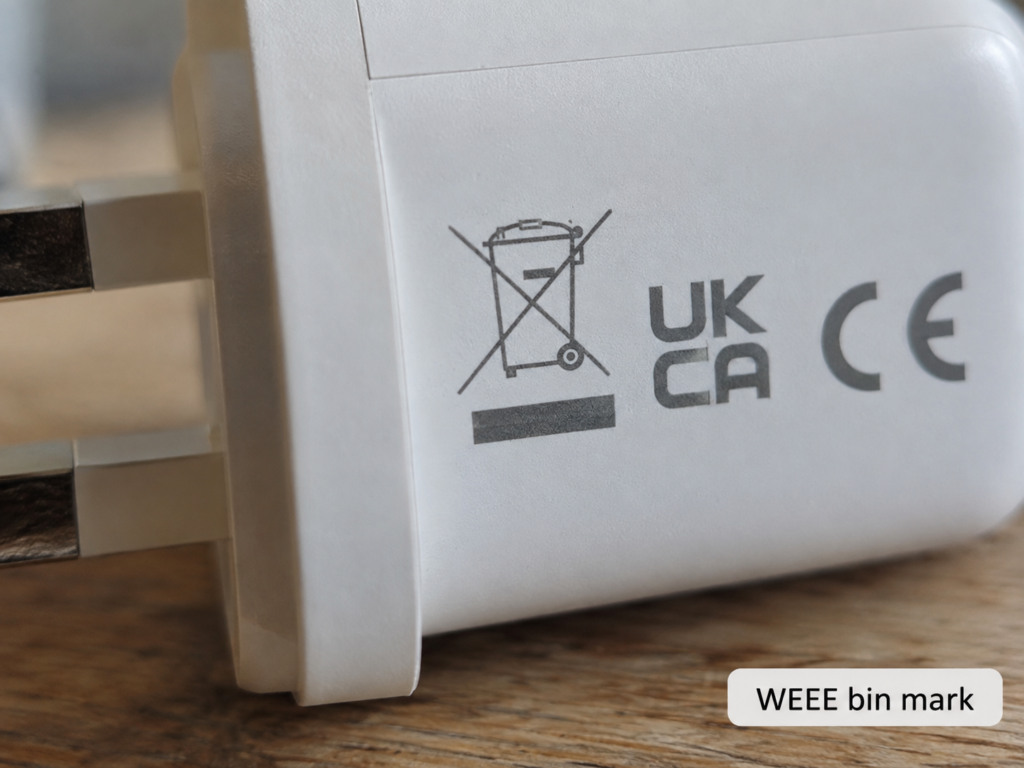
The final basis for determination shall still be the official EEE definition, actual product function and placement method. Situations that may involve exclusion include large fixed installations, large stationary industrial tools and specific national defense uses that meet the statutory definitions, etc. Determination must be made item by item according to the definitions, product uses and exclusion clauses of each regulation; industrial use or fixed installation itself does not automatically constitute exclusion. Charging products for medical use also need to be determined item by item, and are not automatically exempt.
Core Division of Labor of the Three Regulations, Remember in One Sentence
You don’t need to memorize complex legal definitions. First remember the core positioning of the three regulations, and the subsequent rules will be easy to understand:
- UK RoHS: Controls whether there are toxic substances in products — it restricts specific hazardous substances in electrical and electronic equipment, and controls the composition of homogeneous materials;
- UK WEEE: Controls how to dispose of products after use — it regulates the recycling and treatment of e-waste, and implements the producer’s responsibility for recycling costs;
- UK REACH: Controls the risks of chemical substances in manufacturing, placing on the market and use — it controls chemical risks in all categories of chemical substances and articles; waste itself is not within the scope of UK REACH, and waste management is mainly regulated by other waste regulations.
For consumer-grade EEE charging products in the GB market, the obligations under the three regulations are independent and need to be verified separately; they cannot cover each other.
UK WEEE: E-Waste Recycling Responsibility Rules
WEEE arranges the collection, treatment, recycling and reporting obligations of electrical and electronic products through the producer responsibility system. Whether a party is a statutory producer and what obligations it shall bear shall be determined according to whether the sales region is GB or NI, brand arrangement, import arrangement, sales target and distance selling model, based on the corresponding WEEE regulations; it cannot be generalized solely by “first placing on the UK market”. It mainly governs the recycling and treatment responsibility of waste electrical and electronic equipment, and does not control whether the product materials are toxic.
Applicable Product Scope
The applicable product scope of WEEE is basically consistent with the EEE scope of RoHS, but the WEEE applicability of passive charging cables shall be separately determined according to the EEE definition, function and placement method, and cannot be determined solely based on the RoHS conclusion.
Registration Subjects and Channels
The “producer” in WEEE does not only refer to factories. It includes four types of subjects: manufacturers with their own brands, importers, private label parties (i.e. brand owners), and overseas sellers that conduct distance sales to the UK (such as cross-border e-commerce sellers that ship directly from China to UK consumers).
- Producers in the GB market may register with the corresponding environmental regulatory authority according to their place of establishment (for example, enterprises in England contact the Environment Agency (EA) of England), and do not need to register repeatedly in the three regions of GB;
- If selling to Northern Ireland, it is necessary to separately verify the local WEEE registration rules of NI; GB registration cannot be used directly;
- E-commerce platforms may require sellers to provide a WEEE registration number, but the legal liability of the platform shall be determined on a case-by-case basis according to the sales model, and there is no general joint and several liability.
Core Compliance Requirements
First is the mandatory marking: the common crossed-out wheeled bin symbol. Producers should usually give priority to affixing this mark on the body of EEE products; for EEE placed on the market after August 13, 2005, it shall also be distinguished by a horizontal line or date mark as required by regulations. Only when it is impossible to mark on the product body due to the size or function of the equipment can the mark be placed on the packaging, user manual or warranty document.
Special attention should be paid here: marking is not equal to registration — the bin symbol only tells consumers that this product cannot be thrown into household waste and needs to be recycled separately; it is a recycling reminder. WEEE registration requires producers to register, pay recycling fees, and declare annual placement volume, which is a legal obligation. The two cannot replace each other at all.
Other core requirements include: completing producer registration, and declaring product placement volume and category on an annual basis; for those that join a Producer Responsibility Scheme (PCS, a third-party organization that helps enterprises handle recycling declarations, fee payments and other matters), they shall fulfill obligations such as recycling treatment fee declaration and compliance data submission according to the service scope of the selected PCS. Whether the registration number needs to be published on product pages or business information depends on the sales channel and local rules, and there is no unified requirement.
In terms of product classification, products shall be classified into the corresponding WEEE category according to their actual functions. Small chargers are usually classified as “small equipment”, and the specific classification shall be subject to the latest official classification.
Retail End Recycling Rules
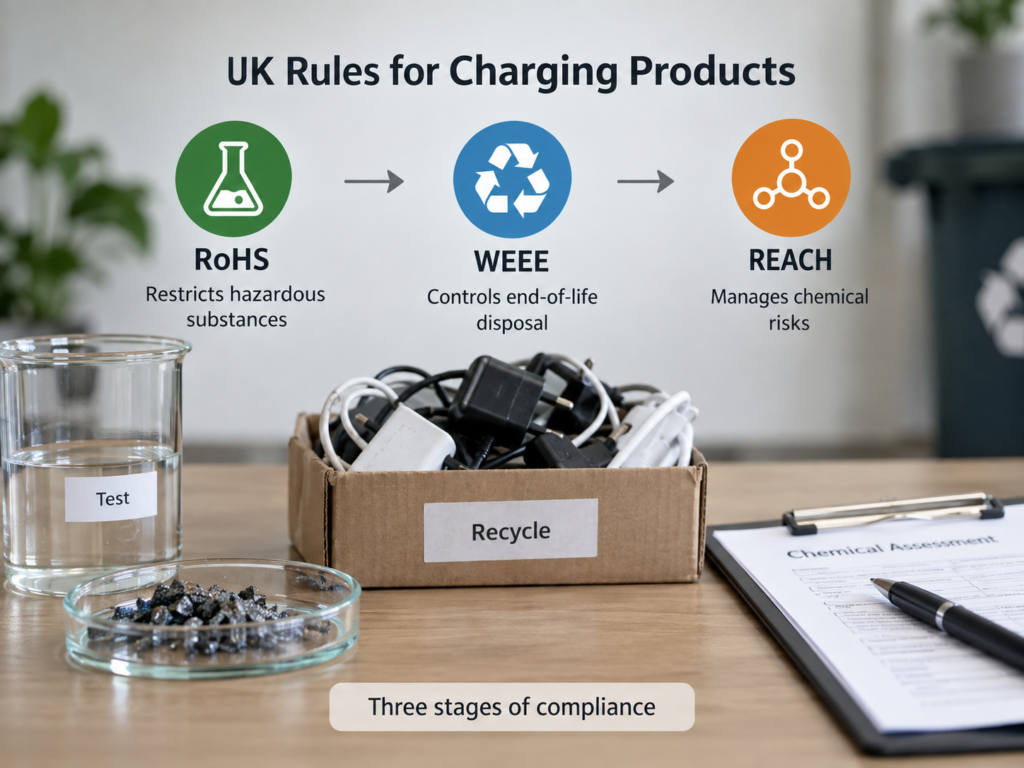
The core meaning of the bin symbol is that products cannot be mixed into household waste and need to be recycled separately. The recycling obligations of retailers are not uniform, and shall be specifically determined according to conditions such as store area, product categories sold, and whether they participate in the Distributor Take-back Scheme (DTS).
Horizontal Comparison of Core Dimensions (GB · Consumer-Grade Charging Products)
After explaining the requirements of each regulation separately, it may still be a bit confusing. We will make a horizontal comparison from several dimensions that everyone is most concerned about to help you quickly distinguish the differences.
| Comparison Dimension | UK RoHS | UK WEEE | UK REACH |
|---|---|---|---|
| Applicable product scope | Charging products that meet the EEE definition, as well as cables and related spare parts for repair and reuse within the scope of the regulation; passive charging cables cannot be excluded from RoHS solely because they do not themselves constitute EEE | Basically consistent with the EEE scope of RoHS, but shall be separately determined according to the EEE definition, product function and placement method | All charging products containing chemical materials (including purely passive cables and packaging) |
| Core responsible subjects | Manufacturers, importers and brand owners that place EEE on the GB market | Statutory producers (including cross-border distance selling sellers), platform obligations determined on a case-by-case basis | Entire supply chain (raw material suppliers → factories → sellers) |
| Required compliance documents | Technical documentation, RoHS Declaration of Conformity (DoC); BOM, supplier declarations, test reports, applicable risk/conformity assessment records, etc. shall be included in the technical documentation according to product risk and certification needs | Producer registration certificate, PCS agreement, annual placement volume declaration records | Material declarations, SVHC information communication records, restriction substance conformity certificates |
| Mandatory marking requirements | No separate marking, reflected through UKCA/CE (according to applicable conditions) and DoC | Crossed-out wheeled bin symbol, usually shall be marked on the product body; EEE placed on the market after August 13, 2005 shall also be marked with a horizontal line or date as required, and can only be placed on packaging, manuals or warranty documents when it is impossible to mark on the body due to size or function | No mandatory product marking, SVHC information shall be provided upon consumer request |
| Triggers for obligation updates | Exemption list updates, product material changes, supplier changes | Annual placement volume changes, product classification adjustments, regulatory rule updates | SVHC candidate list/restriction list updates, product formula/material changes |
Below are a few more key conclusions from the comparison, all of which are problems frequently encountered in actual operation:
- Control objectives: RoHS controls material composition in the production stage to reduce the use of toxic materials; WEEE controls recycling and treatment in the waste stage to reduce the amount of e-waste sent to landfill; REACH controls the chemical risks of substances, mixtures and articles in manufacturing, placing on the market and use. Waste itself is not within the scope of UK REACH. For non-EEE charging products, WEEE does not necessarily apply; but for RoHS, it is also necessary to check whether the product is a cable or related spare part within the scope of the regulation, and REACH still needs to be verified as well.
- Second-hand product rules: The WEEE producer responsibility for second-hand EEE products will not be automatically transferred, and shall be determined on a case-by-case basis according to the first placing subject and resale model. Private resale of idle items generally does not trigger the obligation, but commercial second-hand sales may require bearing responsibility.
- Personal use rules: Non-commercial personal cross-border purchases for own use do not need to fulfill producer obligations; but overseas sellers that conduct commercial direct distance sales to UK consumers need to bear responsibility as statutory producers.
- Factors affecting compliance costs: Common cost variables for the three regulations include number of SKUs, number of homogeneous material splits, BOM completeness, annual sales tonnage, and whether sales are across GB/NI/EU. In addition, RoHS costs are also related to testing depth, whether third-party reports are required, and material complexity; WEEE costs are related to producer type, PCS rates, and declared placement volume brackets; REACH costs are related to SVHC list updates, whether restricted/authorized substances are involved, and whether registration obligations are triggered.
- Consequences of non-compliance: General non-compliance consequences for the three regulations include product detention/removal from shelves, rectification, confiscation of illegal gains, and administrative fines. Serious cases may involve criminal liability. The difference lies in different law enforcement agencies and penalty discretion standards for different regulations, and the specific situation shall be subject to the facts of the violation and case-by-case determination. Common violation triggering scenarios include e-commerce platform spot checks, customs clearance verification, routine regulatory inspections, and consumer complaints.
Practical Judgment and Common Misconceptions
In actual operation, many people fall into various pitfalls. We have compiled methods for quickly judging compliance, key points for different roles, and the most common misconceptions to help you avoid detours.
3-Step Method to Quickly Judge Basic Compliance of Charging Products
You don’t need to understand complex regulations, ordinary people can quickly make a fairly accurate judgment:
- Check the marks: Check whether there are compliance marks for the target market on the product or packaging (such as UKCA/CE for the GB market), and whether there is the WEEE crossed-out bin symbol;
- Check documents: Check whether the RoHS DoC, WEEE registration certificate, and REACH SVHC declaration can be provided;
- Core pitfall avoidance: EU CE, EU RoHS and REACH documents cannot be directly equated with compliance documents for the UK GB market, and need to be verified separately.
Compliance Priorities for Different Roles
You don’t need to learn everything, just find the priorities corresponding to your role:
- Ordinary consumers: Purchase from formal channels, confirm that the product has the compliance mark and bin symbol for the corresponding market, and there is no need to conduct testing by yourself;
- Cross-border e-commerce sellers: Prioritize completing WEEE registration and preparing RoHS DoC, and focus on fulfilling the SVHC information communication obligation for REACH;
- Supply chain factories: Focus on controlling the RoHS limits of homogeneous materials in raw materials, and do a good job in traceability and declaration of REACH substance compositions.
High-Risk Scenarios for Statutory Exclusion/Exemption
Many people like to “grant themselves exemption”. It should be emphasized here that all exclusions or exemptions must be checked item by item against the application scope, use restrictions and validity period in the original text of the regulation, and corresponding product evidence must be provided. You cannot claim exemption just by yourself.
Medical devices, chargers for medical devices and products for national defense use cannot be deemed exempt solely by name. Medical-related products need to check the relationship between main equipment and accessories and the corresponding RoHS/WEEE exclusion or exemption clauses; for national defense-related UK REACH exemptions, it is necessary to confirm whether there is an applicable exemption made under Article 2(3). Any RoHS substance exemption must also be checked item by item against the use conditions and validity period in the annex.
Quick Check of High-Frequency Misconceptions
We have compiled the 6 most common misconceptions, see if you have ever fallen for them:
- Misconception: Passing one regulation covers all — Correction: The control directions of the three regulations are completely different. EEE products need to be verified separately and cannot replace each other;
- Misconception: Purely passive charging cables are definitely not controlled by RoHS/WEEE — Correction: For RoHS, the scope of application of the regulation explicitly includes cables and related spare parts for repair and reuse. Passive charging cables cannot be excluded solely because they do not themselves belong to EEE; RoHS is verified according to the general limits for homogeneous materials. Whether WEEE applies shall be separately determined according to the EEE definition, product function and placement method;
- Misconception: Having the UKCA/CE mark equals full compliance — Correction: The UKCA/CE mark only indicates that the manufacturer declares the product complies with applicable marking regulations; for products subject to RoHS, RoHS may be one of the scopes of this declaration of conformity. However, the mark itself cannot prove that non-marking obligations such as WEEE producer registration, recycling responsibility, REACH SVHC information communication or notification have been fulfilled;
- Misconception: The WEEE bin symbol equals RoHS compliance — Correction: The bin symbol is the recycling mark of WEEE and has nothing to do with hazardous substance limits;
- Misconception: UK regulations and EU versions are fully interchangeable — Correction: After Brexit, there may be differences in substance lists and regulatory procedures between the UK and the EU, and they cannot be used interchangeably directly;
- Misconception: REACH registration is required if the total imported weight of products exceeds 1 ton — Correction: REACH registration targets the substance itself. Ordinary finished products do not need registration as long as the substance is not released and does not reach the notification threshold.
Official Inquiry Channels and Verification Precautions
Compliance information on the internet is mixed. The most reliable way is to check official channels. We have compiled the official inquiry portals for various UK regulations, as well as verification precautions.
Original Regulations and General Guidelines
- UK official regulation database: legislation.gov.uk, where you can find the original text of all officially effective regulations;
- UK government product safety guide: includes the latest policies and applicable conditions for UKCA marking and RoHS compliance.
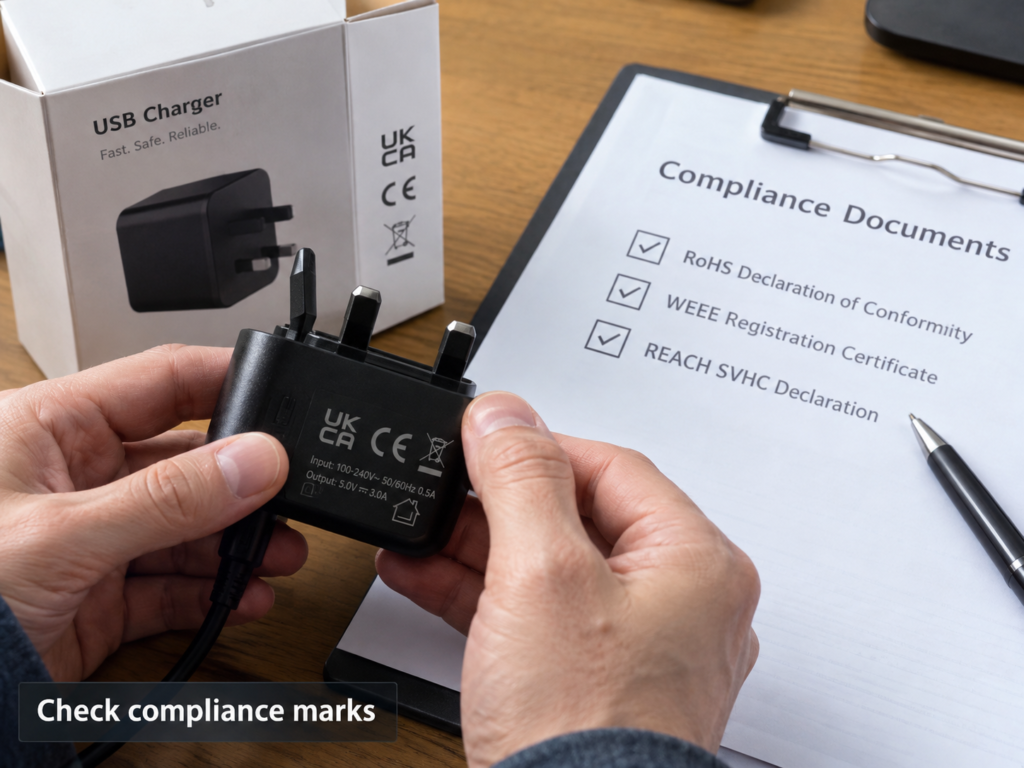
Verification tip: All rules are subject to the latest official version. Pay attention to distinguishing between the UK version and the EU version, and do not confuse them.
UK RoHS (Applicable to GB) Regulatory Portal
The policy authority for UK RoHS is the Department for Business and Trade (DBT) of the UK, which is responsible for rule-making and exemption list updates; market enforcement is carried out by the Office for Product Safety and Standards (OPSS) and local statutory enforcement agencies according to their division of labor. You can find the RoHS exemption list, compliance guides, frequently asked questions and other content on official channels.
WEEE Regulatory and Registration Portals (GB + NI)
WEEE in the GB market is under the responsibility of the respective environmental regulatory authorities of England, Scotland and Wales (such as the Environment Agency (EA) in England). The official websites provide access to producer registration channels, PCS institution lists, retailer recycling rules, product classification guides and other content.
If selling to Northern Ireland, you need to check the WEEE registration rules of the NI environmental regulatory authority; the GB registration channel does not apply.
REACH Regulatory and Inquiry Portals (GB + NI)
REACH in the GB market is regulated by the Health and Safety Executive (HSE) of the UK. The official website provides UK REACH guides, SVHC candidate list, restriction list, notification requirements and other content.
If placing products on the Northern Ireland market, EU REACH applies, and you need to check the list in the EU ECHA database; the UK version of the list cannot be used directly.
Verification Precautions
- Be sure to check the valid version of the rules for the corresponding region to avoid confusing the UK version and the EU version;
- After regulation updates, product compliance shall be re-evaluated. It is recommended to verify the core lists and policies every six months;
- The compliance documents or guides consulted shall be marked with the verification date to avoid using outdated information.
Final Summary
Overall, these three UK environmental regulations have their own divisions of labor, and there is no such thing as one covering the other — RoHS controls toxic and hazardous substances in materials, WEEE controls recycling responsibility after product disposal, and REACH controls the risks of chemical substances, mixtures and articles in manufacturing, placing on the market and use.
After reading this article, you should be able to distinguish the core positioning of the three regulations, understand that the RoHS and WEEE applicability of passive charging cables need to be determined separately, quickly judge basic compliance by checking marks and documents, and find the corresponding compliance priorities according to your role (consumer, seller, factory). At the same time, you can also distinguish the regulatory differences between the GB and NI markets, avoid 6 common compliance misconceptions, and know where to check the latest official information to verify accuracy.
For charging product practitioners, first do a good job in product classification and determination, then prepare documents and complete registration according to the requirements of different markets, and follow up on regulation updates regularly, so as to basically avoid environmental compliance risks. For ordinary consumers, choosing formal channels and checking applicable marks can be used as a preliminary screening signal, but the WEEE mark and UKCA/CE mark cannot alone prove actual RoHS/REACH conformity, fulfillment of WEEE registration, or that the product is relatively more environmentally friendly; if in doubt, you should request manufacturer, conformity and recycling information from the seller.