
If you are a consumer living in South Korea who frequently shops for power banks online, or a cross-border e-commerce novice looking to sell power bank products to the South Korean market, you have most likely heard of the term “KC certification”. Some call it the “entry ticket” to the South Korean market, some regard it as a quality guarantee, and others are confused about whether their products actually need it.
This article starts with the most basic definition, covering scope of application, application process, authenticity verification, and key points to avoid pitfalls. Whether you are an ordinary user choosing products or a novice merchant handling compliance, you can find corresponding practical information here.
Basic Knowledge: First, Understand What KC Certification Really Is
Put simply, KC certification is a mandatory safety access certificate required by the South Korean government for specific electronic products. Its competent authority is the Korean Agency for Technology and Standards (abbreviated as KATS, equivalent to South Korea’s official agency responsible for product safety standards and market supervision). Its core purpose is very clear: to keep products with safety hazards such as fire, liquid leakage, and electric shock out of the market, and protect consumers’ safety during use.
For different people, the actual role of KC certification also varies. Ordinary consumers no longer have to guess whether a product is safe by “feeling the shell and looking at the price”; as long as they see a formal KC mark, it means the product meets South Korea’s basic safety requirements and can be purchased with confidence. For novice cross-border merchants, KC certification is an important compliance threshold for entering the South Korean market — products without certification or that fail to meet other applicable requirements may, at best, be detained by customs or removed from e-commerce platforms, and at worst, be fined or even subject to recall, resulting in very large losses.
Here we must first clarify several most common misconceptions to avoid everyone reading on with wrong understandings:
First, KC certification is not a “highest quality rating”; it is only the minimum threshold for safety compliance — just like the passing line for an exam, passing does not mean getting a full score of 100, it only means that the most basic safety requirements have been met.
Second, KC certificates are not a “universal pass”. For products with different functions and different configurations, certification requirements and certificates are independent; you cannot use the certificate for Model A for Model B.
Third, having a KC mark does not mean “absolutely safe in all scenarios”. If used improperly (such as throwing it into a fire, or charging with a damaged charger), problems may still occur. Certification only guarantees safety under normal use.
Scope of Application Judgment: Does Your Power Bank Need KC Certification?
After understanding what KC is, the core question arises: exactly which power banks must have KC certification? Which are prone to misjudgment? Which really don’t need it? Let’s go through them one by one.
Ordinary lithium-ion power banks usually need to be processed in accordance with the KC safety management requirements applicable to their built-in lithium secondary batteries. Among basic models, the most common ordinary power banks with USB-A and USB-C ports, as well as models with built-in cables and magnetic charging, usually need to be included in the scope of judgment. Products with additional functions such as solar panels and LED lighting cannot ignore their battery safety requirements just because they have more functions.
However, not all portable power supply products can be directly treated as the same type of “ordinary power bank”. For example, portable energy storage products with built-in AC input, AC output, and inverter functions may also fall under other electrical appliance safety management categories; products with functions such as wireless charging, Bluetooth, and Wi-Fi may also involve additional radio, EMC, or other requirements. Which systems are applicable should be confirmed based on the actual structure, rated conditions, and functions, and conclusions cannot be drawn only by looking at the product name, appearance, or just because it can charge a mobile phone.
A special reminder here: white-label and OEM products also need to meet corresponding compliance requirements based on the actual applicant entity, model, and product information; they cannot directly use certificates from other brands, even if they are produced by the same factory.
There are several types of products that are easily mistaken as not needing KC certification, but in fact they still require careful confirmation:
The first type is small-capacity mini models. Many people think “with such a small capacity, there’s no way it’s dangerous”, but the South Korean government does not have a rule of direct exemption based on capacity size. Whether certification is required depends on the official product catalog; small capacity does not automatically mean no certification is needed.
The second type is multi-functional models, such as power banks with flashlights or makeup mirrors. As long as the core attribute is a power bank, additional functions will not automatically change its positioning as a battery product.
The third type is modified products. If your product already has a KC record, but later the battery cell, protection board, shell, or other declared key items are changed, you should confirm with the certification body before the change whether it belongs to change of certification, derivative model processing, or requires supplementary testing. Without completing the required change procedures, you may not continue to sell under the original certification information.
Of course, not all portable power supply products with batteries are processed under the ordinary power bank category. The built-in batteries of devices such as mobile phones and laptop computers should usually be judged in combination with the applicable requirements of the whole machine and its components; car emergency jump starters, industrial/medical special portable power supplies, as well as disposable, non-rechargeable portable power supply products may also be subject to whole-machine, component, medical device, or other regulatory systems respectively. They may not be processed according to ordinary power bank rules, but cannot be simply summarized as “no KC required”.
If you are still unsure, you can remember two core judgment principles:
First, it is subject to the final sales form, actual structure, and intended use, not the appearance or promotional name — for example, a product promoted as a “multi-functional camping light” but whose main function is to charge mobile phones may still essentially belong to power bank-related products, requiring further confirmation of applicable requirements.
Second, you cannot only look at the documents of the battery cell or battery pack; whether the whole machine is compliant also needs to be judged in combination with the actual product’s protection circuit, shell, ports, as well as possible additional wireless, electrical safety, or other requirements.
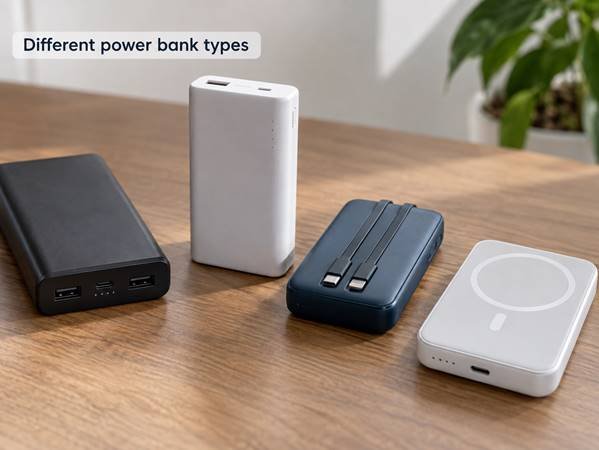
| Category | Typical Product Examples |
| Usually need to be confirmed in accordance with KC safety management requirements for lithium secondary batteries | Ordinary USB-C power banks, power banks with built-in cables, magnetic power banks |
| Require further confirmation of additional requirements | Power banks with wireless charging, products with Bluetooth or Wi-Fi functions, portable energy storage products with built-in AC input or AC output |
| Not necessarily processed under the ordinary power bank category | Built-in mobile phone batteries, car emergency jump starters, disposable non-rechargeable hand warmers |
Core Certification Requirements: What Hurdles Does KC Certification Involve?
Many people think KC certification is just “testing whether the battery will explode”, but in fact the requirements are much more detailed than that. Let’s explain the core types of requirements in plain language.
The most basic is the safety performance of the battery and the product. The product needs to complete corresponding abuse and structural safety tests in accordance with the South Korean battery safety standards applicable at the time of application. Whether items such as overcharge, overdischarge, short circuit, impact, vibration, crush, and drop are applicable, and how each test is judged, depends on the specific product category and standard version; the pass conditions for different tests are not exactly the same, and cannot be simply understood as a certain phenomenon must never occur under any circumstances.
Second is protection measures. The product should be equipped with and verify corresponding protection measures in accordance with applicable safety standards, such as restriction or protection functions against abnormal conditions such as overcharge, overcurrent, over-temperature, and short circuit. The protection method, action threshold, and whether to cut off input or output shall be subject to applicable standards and product design; not all products and all abnormalities must adopt the same “whole machine automatic power-off” method.
Third is shell and port safety, such as electric shock protection design, port firmness, shell material, and overall structure, all of which must meet applicable requirements. These requirements correspond to South Korea’s current portable lithium battery safety standards, and specific clauses will be implemented according to the latest version at the time of certification application. You don’t need to memorize them by rote; formal testing institutions will test according to the standards.
If your power bank has special functions, there may be additional requirements. Whether it is necessary to conduct electromagnetic compatibility (EMC) conformity assessment shall be judged based on whether the product is included in the objects listed in South Korea’s , as well as the actual circuit and functions; fast charging or multi-port output alone cannot be used as a basis for conclusion. Products with Bluetooth or Wi-Fi usually need to confirm wireless equipment conformity assessment respectively; products with wireless charging function should also separately confirm RRA conformity assessment requirements in accordance with relevant regulations on radio application equipment, regardless of whether they have “communication functions”.
In addition, the external charger included with the product, commonly known as the charging head, should be separately verified for whether it is subject to South Korea’s electrical safety, standby power consumption, and energy efficiency management catalogs, as well as relevant rated conditions and exemption regulations; you cannot directly conclude that standby power consumption requirements must apply just because it is a standard accessory.
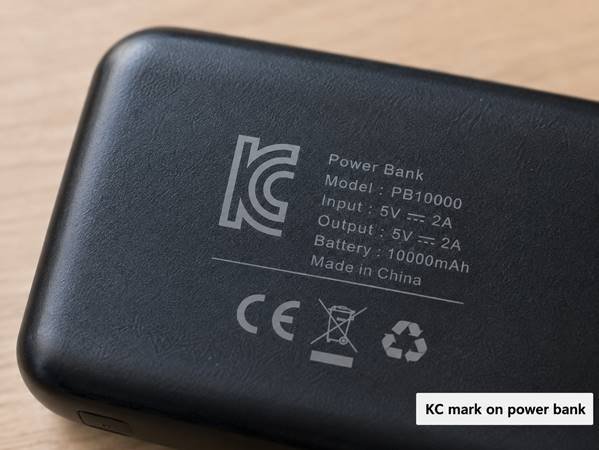
In addition to the product itself passing the requirements, there are also clear requirements for labeling and instructions. Products subject to safety certification or safety confirmation shall bear the KC mark and required information on the product or packaging in accordance with applicable rules. General information includes the certification or safety confirmation number, model, manufacturer or importer, date of manufacture, contact information within South Korea that can actually provide after-sales service, as well as content separately required by individual safety standards; whether it should be marked on the product or packaging shall be subject to applicable rules. The instruction manual usually should also provide Korean safety warnings, usage precautions, and applicable waste disposal instructions.
Here is an advanced knowledge point that novice merchants need to understand: South Korea’s electrical product safety management is generally divided into three systems: safety certification, safety confirmation, and supplier conformity confirmation, but they are not three processing paths that applicants can freely choose based on power, cycle, or cost. Which system applies to a certain product is determined by the current statutory categories and scope. For power banks, it is also necessary to distinguish between KC safety management for lithium secondary batteries, and independent safety, energy efficiency, and RRA conformity assessment requirements that may arise from the product’s wireless charging, Bluetooth, Wi-Fi, AC power, or other functions.
Full Application Process: How to Go From Preparation to Obtaining the Certificate?
If you are a novice cross-border merchant planning to apply for KC certification for your power bank, you don’t need to search randomly for guides; just follow the steps below and you won’t go wrong.
Before the formal application, you need to prepare three things first:
First is documentation, including a complete product specification (which must clearly state the model, capacity, ports, functions), specification documents for the battery cell and protection board, as well as qualification documents of the applicant.
Second is samples. They must be complete finished products close to mass production, and must be completely consistent with the configuration of subsequent bulk goods — you cannot specially make a “perfect sample” for testing while cutting corners on bulk goods; if found later, the certificate will be directly revoked.
Third is the requirement for the applicant entity. KC certification usually requires an entity that can bear relevant responsibilities within South Korea, such as an importer or authorized seller; if it is an overseas brand without a local South Korean entity, it can entrust a formal agency to assist with the application.
After preparation, you can proceed according to the following steps:
Step 1: Conduct product classification judgment first, confirm the safety management requirements applicable to lithium secondary batteries, and whether additional RRA radio, EMC, or other assessments are needed. Clarify the requirements in advance to avoid detours.
Step 2: Select an officially recognized testing or certification body. Be sure to verify the other party’s qualifications first, and don’t believe claims like “fast certification in 3 days” or “guaranteed pass without testing” — formal certification requires following procedures, and those that are too fast are most likely fake certificates.
Step 3: Submit documentation and send samples for testing. If the test fails, you must rectify according to requirements, and retest after rectification until passing.
Step 4: Factory consistency check. Note that this is not required for all systems; factory inspections of production conditions and product consistency will only be conducted in cases where corresponding requirements apply.
The final step is certificate issuance or completion of registration and official filing, after which the KC mark and other applicable labels shall be affixed as required.
Regarding the cycle and cost that everyone is most concerned about, there is actually no unified standard answer, only a conventional reference can be given:
In terms of cycle: if the product has no problems and does not require rectification, it is generally 4-8 weeks. The specific time will be affected by laboratory scheduling, number of rectifications, and certification path — if the product fails several times after modifications, a delay of several months is also possible.
In terms of cost: for an ordinary 10000mAh USB-C power bank, the cost is roughly several thousand to over ten thousand RMB. But the specific price depends on the product’s functions, configuration, and certification path; there is no unified fixed price. It is recommended to find 2-3 formal institutions to compare quotations, and don’t be greedy for cheapness to find unqualified small agencies.
Obtaining the certificate is not a once-and-for-all matter. Do not understand KC as having a unified 5-year validity period: the methods for continuous validity, change, and subsequent management of safety certification and safety confirmation are different. Safety certification has regular post-management; safety confirmation usually does not involve factory inspections and regular reviews. Before changing the product or key declared items, you should confirm with the certification body whether it is necessary to handle certification change, derivative model processing, or supplementary assessment, and continuously pay attention to the certificate or registration status, applicable standards, and notices from the competent authority or certification body. Failure to handle major product changes as required, or non-conformity found in market supervision, may affect the qualification to continue selling.
Authenticity Query and Verification: How to Judge Whether a KC Certification Is Real?
Whether consumers are buying products or merchants are sourcing from suppliers, it is inevitable to verify the authenticity of KC certification. In fact, the method is very simple, divided into several steps from fastest to slowest:
First is a preliminary judgment that can be completed in 10 seconds, by directly looking at the labeling on the product or packaging:
First, look at the KC pattern. The focus is not on the color, but on whether the pattern is obviously deformed, blurry, or misused. The color of the KC pattern cannot be used as a standard for authenticity judgment.
Second, check whether legal information such as the certification or safety confirmation number and product model can correspond to official records. If the product label is poorly printed, has no verifiable number or model, and even basic Korean safety information is obviously missing, you should be vigilant.
As for whether other information such as rated capacity and input/output parameters must be marked, it should be confirmed according to the safety standards applicable to the product, and cannot be regarded as a fixed requirement that is completely consistent for all products.
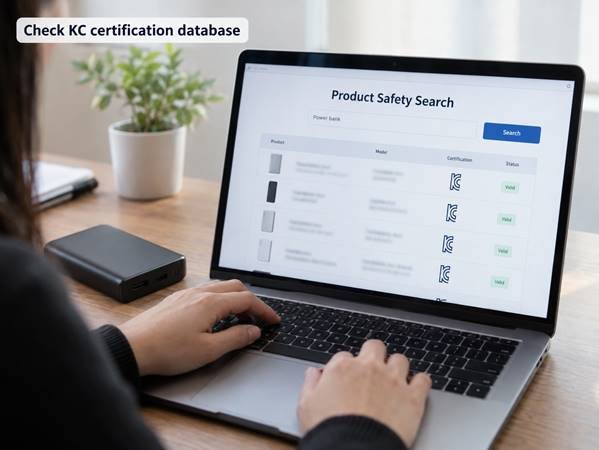
If the preliminary judgment is fine, you can also check the official database, which is the most accurate. However, you need to query separately by certification category: electrical safety certification or safety confirmation information should be verified in official product safety systems such as Safety Korea; if the product involves wireless, wireless charging, or EMC conformity assessment, you should also query the corresponding records in the RRA conformity assessment database. When querying, you can usually use information such as certification or registration number, product model, applicant, and manufacturer to search; you don’t have to have the number to query.
A small detail to note here: when querying, carefully check the model suffix, English or Korean spelling, and whether there are spaces. Many times the reason you can’t find it is not because the certificate is fake, but because you entered the wrong information.
After finding the record, don’t just stop at “there is a record”; you also need to check three dimensions:
First, check the certificate or registration status: whether it is still valid, and whether there are suspension, revocation, or other abnormal records — some records were real before, but were later revoked due to non-conformity, so they are still useless.
Second, check the product information: whether the model, capacity, and manufacturer on the record are completely consistent with the product you have. A difference of even one letter may mean it is not the same product.
Third, check the coverage scope: many merchants will say “our entire series has KC”, but in fact, products with the same appearance but different capacities and functions do not necessarily share the same certificate or registration record; it must correspond to the specific model.
Finally, let’s summarize several common fraud tactics; if you encounter them, just avoid them directly:
The first is “passing off another’s certificate as one’s own”: using the KC certificate of the battery cell or battery pack to pass off as the whole machine compliance document, or using certifications from other regions and for other purposes such as CE, UL, UN38.3 to fool people, saying “we have certification”, but it is not the applicable document required by South Korea at all.
The second is abnormal labeling and numbering, such as incorrect number format, not found in the official database, and parameters on the product not matching the registration information. These are typical characteristics of fake certificates.
The third is the seller not cooperating with verification, such as refusing to give the complete certification number, refusing to provide information of the applicant entity, only saying “we definitely have a certificate” but unable to produce verifiable materials. This kind of situation is basically problematic.
Common Misconceptions and Pitfall Avoidance: 90% of People Have Fallen for These Pitfalls
After talking about how to check authenticity, let’s sort out several of the easiest pitfalls to fall into, which are useful for both consumers and merchants.
First are several groups of the most easily confused concepts, which must be clearly distinguished:
1. Battery cell/battery pack KC ≠ Whole machine compliance: Qualified battery cells are only the foundation. Whether the circuit, shell, ports, and additional functions of the assembled whole machine meet the requirements still need to be confirmed separately; you cannot use the battery cell certificate as the whole machine certificate.
2. KC safety certification ≠ KC voluntary mark: There are different categories of KC marks. Whether safety products are subject to mandatory access requirements must be confirmed according to statutory categories; some merchants use voluntary KC marks to fool people, saying they have KC, but in fact it is not the applicable mandatory requirement.
3. KC certification ≠ quality/capacity certification: To emphasize again, KC is only a safety threshold; it does not evaluate the quality of the product, nor does it verify whether the capacity is falsely labeled — don’t think that products with KC must have real labeled capacity, these are two different things.
4. KC certification ≠ CE/UL/FCC/UN38.3: These certifications have different applicable regions and assessment purposes. CE is for the EU, UL is for the US, FCC is for US electromagnetic compatibility, and UN38.3 is for transportation safety. None of them can replace the applicable compliance documents required by South Korea.
For novice merchants, when applying for KC, they should especially avoid these pitfalls:
The first is finding an unqualified agency. The fake certificate they issue cannot be found in the official database at all, and when it is discovered during customs clearance, the loss will be huge.
The second is inconsistent product conformity. Either the samples sent for testing have different configurations from the bulk goods, or the product is modified without confirming whether it is necessary to handle certification change, derivative model processing, or supplementary assessment. If found in subsequent random inspections, it may affect the certificate or registration status, and may also face penalties.
The third is confusing access documents. For example, only having the UN38.3 transport report and thinking it can be used as KC — UN38.3 only ensures safety during transportation, which is completely different from KC for market access, and cannot replace it at all.
When ordinary consumers buy power banks, remembering these three points can avoid most pitfalls:
First, don’t buy products without a KC mark and whose price is far lower than the market price — power bank battery cells and protection boards have costs, and those that are too cheap are most likely inferior products, even if they have a KC printed on it, it’s fake.
Second, don’t just look at the certification pictures on the e-commerce product detail page. Be sure to scroll through the product details to see the labeling on the product or packaging, or check the product model and number after receiving the goods. Pictures on the detail page can be edited, and physical product information is more worth verifying.
Third, don’t equate KC with “high quality”. It is only a basic safety threshold. If you want better quality and more real capacity, you still need to look at the brand and reviews, not just whether there is KC.
Applicable Boundaries and Special Rules: These Special Situations Require Attention
In addition to conventional power banks, there are some special situations and rules that you can understand according to your own needs.
First, products with different functions have different compliance requirements:
Power banks with wireless charging function, such as those with magnetic wireless charging, in addition to conventional battery safety, should also additionally confirm the safety and RRA conformity assessment requirements of the wireless charging part; this cannot be ignored just because it does not have Bluetooth or Wi-Fi. Products with Bluetooth and Wi-Fi also need to confirm the corresponding wireless equipment requirements respectively.
Products with built-in AC input, AC output, inverter function, or high-power PD output should confirm whether they involve additional electrical safety, EMC, or other audit items based on the actual structure, rated conditions, and the category they belong to, and cannot be directly judged only by “higher power”.
Many people ask whether high-capacity power banks above 20000mAh have higher requirements? South Korea’s KC does not use 20000mAh as a unified test boundary. High-capacity products should confirm applicable standards and additional assessments based on the actual battery type, rated energy or energy density, structure, and additional functions; it cannot be assumed in advance that the test items are exactly the same as those of small-capacity products.
For cross-border sales, there are several special rules to note:
Personal carrying or cross-border direct mail does not automatically exempt from KC requirements; it should be confirmed on a case-by-case basis according to the import method, purpose, quantity, product category, and whether purchase agency or statutory exemption procedures apply.
If it is bulk import, or publicly sold on South Korean e-commerce platforms, the applicable mandatory compliance requirements must be met first, otherwise customs clearance may be blocked, and the platform may also remove the product.
If the product is stored and sold in local South Korean warehouses, it may also be subject to random inspections by local regulatory authorities, and entities such as manufacturers, importers, and sellers may bear corresponding responsibilities.
Even if the product has already been launched and sold, it must still comply with post-marketing supervision rules. Products may face measures such as safety investigations, random inspections, correction orders, sales restrictions, certification revocation, or recall, but the frequency, responsible entities, and disposal methods shall be subject to specific legal procedures, product risks, and decisions of the competent authority. It cannot be simply understood as each product being subject to 1-2 fixed random inspections per year, nor can it be generalized as automatic full-category recall or permanent entry ban. When overseas brands look for South Korean partners, they should also clarify the responsibilities of each party for product consistency, document preservation, and after-sales handling.
Final Summary
After talking so much, let’s finally extract the core content for everyone to quickly remember.
If you are an ordinary consumer, after reading this article you should be able to do three things:
First, you can quickly judge whether a power bank meets the basic safety requirements of the South Korean market, without guessing blindly.
Second, you can verify records in the corresponding South Korean official databases based on the safety, wireless charging, wireless, or EMC requirements involved in the product, and will not be fooled by fake labels.
Third, you can avoid purchasing pitfalls such as “KC = high quality” and “snatching a bargain on unlabeled low-price products”, and buy with more confidence.
If you are a novice cross-border merchant, you can also gain three practical abilities:
First, you can accurately judge which South Korean compliance requirements your power bank products need to confirm, so you won’t waste money or miss any requirements.
Second, you can sort out the basic application process, cycle, and cost-influencing factors, plan time and budget in advance, and won’t miss the launch time.
Third, you can identify common pitfalls such as fake certificates, inconsistent samples, and modified products not handled as required, avoid compliance risks, and prevent goods detention and fines.
Finally, let’s reiterate the core positioning of KC certification: it is an important safety access requirement for related battery products in the South Korean market, but not the highest quality rating; South Korean compliance for power banks should also distinguish between KC safety management for lithium secondary batteries, and independent safety, energy efficiency, and RRA conformity assessment requirements that may arise from the product’s wireless charging, Bluetooth, Wi-Fi, AC power, or other functions. It only covers the declared models and configurations; as long as the product is modified, compliance needs to be re-evaluated. Whether buying or selling products, understanding the essence of KC certification can help you avoid many unnecessary pitfalls.