
Whether you are an ordinary consumer shopping for power banks overseas, or a brand seller running a cross-border business, you have most likely seen the marking “IEC 62133”. Some call it a “pass” for battery safety, some say it is just a marketing gimmick, and others confuse it with transport certification or complete product certification. This article starts with basic concepts, and thoroughly explains the scope of application, test requirements, certificate verification, differences from other certifications, as well as pitfalls to avoid when purchasing or applying for IEC 62133. After reading it, you will be able to verify authenticity by yourself and make reasonable safety decisions.
First, Get the Basics Right: Core Common Knowledge of IEC 62133
Standards and Certifications Are Not the Same Thing
When many people first encounter IEC 62133, they think it is a type of “certification”, but that is not the case at all. Simply put, IEC 62133 is a series of safety standards for portable sealed secondary cells and batteries formulated by the International Electrotechnical Commission (IEC), equivalent to a unified “safety examination paper” that specifies the safety requirements that relevant cells and batteries must meet. Among them, IEC 62133-2 applies to lithium-based cells and batteries, and IEC 62133-1 applies to nickel-based cells and batteries. Certification, on the other hand, is a “certificate of conformity” issued for submitted samples after a third-party laboratory or certification body completes testing and assessment in accordance with applicable standards.
A most common misconception must be specially emphasized here: IEC is only responsible for formulating and updating standards, and does not issue any certification certificates itself. Therefore, there is no such thing as “IEC official certification” at all. Anyone who promotes it this way either does not understand the rules or is deliberately misleading consumers.
Which Version Should Be Used? Confirm According to the Target Market
IEC 62133 has now been split into two parts, corresponding to different battery types:
• IEC 62133-1 is for nickel-based batteries such as nickel-cadmium and nickel-metal hydride batteries. Consumer-grade power banks almost all use lithium batteries, so this version is basically not involved;
• IEC 62133-2:2017 is a version specifically for lithium-based cells and batteries, which power banks usually involve.
The earlier 2012 combined edition has been split and replaced. When actually applying for certification, selling cross-border, or undergoing platform review, the acceptable version should be confirmed in accordance with the target market’s regulations, certification schemes, and customer or platform rules. When verifying documents, it is also necessary to check whether the listed version and, if necessary, amendments meet relevant requirements, and IEC 62133-2:2017 cannot be regarded as the only valid designation in all situations.
Which Products Are Applicable? Which Are Not?
The scope of application of IEC 62133-2 has clear boundaries; not all battery-powered power supplies fall under it:
• Applicable products: Lithium-containing cells and batteries for portable applications, including common consumer-grade power banks with built-in lithium batteries. IEC 62133-2 itself does not specify an applicable range of 10Wh to 100Wh;
• Products that are not applicable or require separate judgment: Primary batteries and lead-acid batteries are not applicable to IEC 62133-2; nickel-cadmium and nickel-metal hydride secondary batteries should consider IEC 62133-1. Whether vehicle jump starters, energy storage products, etc. are applicable to IEC 62133-2 must be judged based on their battery design, portable application attributes, and specific regulations and product standards of the target market;
• In addition, for complete products with built-in batteries, both the complete product standard and the battery standard may apply simultaneously. Whether IEC 62133-2 testing or equivalent assessment is required should be determined according to the specific requirements of the target market’s regulations, certification schemes, and complete product standards, and cannot be automatically excluded just because the battery is non-removable.
Several Basic Terms You Must Understand
To understand the following content, first master the three most basic battery-related terms:
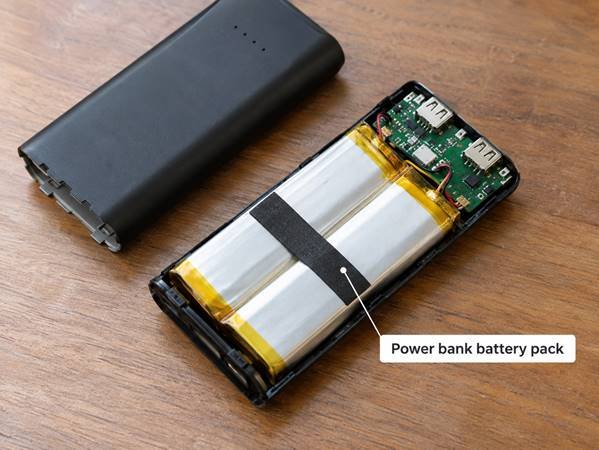
• Cell: The smallest unit of energy storage. The cylindrical batteries and pouch-type square batteries you see when you take apart a power bank are all cells. A single cell usually cannot be used directly as the output of a USB power bank; to provide controlled and compatible USB output for mobile phones, protection, power conversion, and protocol control circuits are usually also required.
• Battery pack: A whole unit that can stably supply power to the outside, formed by combining multiple cells in series/parallel, plus a protection board and packaging. The battery part in a power bank is essentially a battery pack.
• Energy (Wh): The core indicator for measuring power storage, with the calculation formula of [nominal voltage × nominal capacity (Ah)]. Many people are used to looking at mAh, but mAh is only a unit of capacity. For batteries with different voltages, the actual power storage of the same mAh varies greatly. Therefore, Wh is a more accurate indicator of stored energy, and is also an important parameter in certification.
What It Covers and What It Does Not: Value and Boundaries of Certification
Value for Ordinary Consumers
When shopping for power banks overseas, IEC 62133 is one of the most core safety references. Products that pass this set of tests have at least passed relevant safety scenario verification at the sample submission stage, which can reduce the risks of fire, leakage, and explosion. In addition, you can also use certification to check merchants’ claims: if a merchant claims to use high-quality cells but cannot provide verifiable IEC 62133-related test or certification materials, the credibility of the claim is questionable.
Significance for Merchants and Brand Owners
IEC 62133-2 test reports or CB documents may be one of the battery safety materials required by some markets, customers, or platforms. Whether products can be sold, listed, or cleared through customs also depends on the mandatory regulations of the sales location, platform rules, complete product compliance, and transport documents. Well-prepared battery safety materials also help reduce recalls, user compensation, and brand reputation losses caused by battery safety issues.
Certification Limitations You Must Know
Many people think that “with certification, it is absolutely safe”, but this is not the case. It has clear capability boundaries:
First, certification only proves that the submitted samples meet the standard, and does not mean that all mass-produced products are up to standard. If manufacturers secretly replace cells or reduce the configuration of protection boards, mass-produced products may still have problems;
Second, testing covers normal use and specific abnormal test conditions specified in the standard, but cannot be regarded as exhaustive verification of all actual use situations or all foreseeable misuse. In case of extreme abuse, such as throwing into fire or hitting with heavy objects, even the most qualified batteries carry risks;
Third, it only tests safety performance, and does not cover user experience indicators such as charging speed, capacity conversion rate, and fast charging compatibility. That is to say, a power bank that has passed IEC 62133 may charge very slowly, or may not be compatible with your mobile phone’s fast charging; these are not within the scope of certification.
What Exactly Do Safety Tests Cover: Dual Checks from Cells to Battery Packs
The core of IEC 62133 testing is divided into two parts: single cell testing and battery pack testing. Each test item shall be judged in accordance with the corresponding test conditions and acceptance criteria specified in IEC 62133-2; no fire and no explosion are multiple key safety requirements, but leakage, appearance, and other results must be evaluated according to the specific limits and judgment conditions of the corresponding items.
Safety Testing of Single Cells
The cell is the core of the battery, and must first pass single-cell testing. Each item corresponds to abnormal or mechanical stress scenarios that may be encountered:
• Overcharge/forced discharge test: Tested in accordance with the abnormal charging and discharging conditions specified in the standard, requiring the cell to meet the corresponding safety acceptance criteria;
• External short circuit test: Simulates the situation where the positive and negative electrodes of the cell accidentally form an external short circuit, judged according to the test conditions and acceptance criteria specified in the standard, and does not require the cell to quickly cut off power by itself;
• Thermal abuse test: Evaluates the safety performance of cells under abnormal high temperature conditions. Aviation low pressure simulation is a UN 38.3 transport test and is not an IEC 62133-2 item;
• Vibration/free fall/crush test: Used to evaluate safety after mechanical stress, and the results shall be judged according to the fire, explosion, leakage, and other acceptance criteria specified for each item.
Safety Testing of Battery Packs (Including Protection Boards)
Qualified cells alone are not enough; after forming a battery pack, further testing is required, because the risks will change after multiple cells are connected in series and parallel:
• Relevant safety function verification: Battery packs need to verify abnormal charging, short circuit, and other relevant safety requirements in accordance with the applicable clauses of IEC 62133-2; whether a protection board is used, the specific type of protection functions, and action parameters shall be evaluated based on the battery design and corresponding clauses of the standard;
• Combined safety verification: After multiple cells are connected in series and parallel, the whole still needs to meet the safety requirements of applicable items, and new risks cannot be caused by cell matching problems.
Many low-cost power banks use qualified cells, but cut corners on the protection board or overall design, and may still fail the battery pack test. This is why you cannot only look at cell certification.
How to Check If a Certificate Is Fake: Complete Guide to Verification Methods
Nowadays, many merchants post certification icons on product detail pages, but icons can be edited. If you really want to verify, you need to learn to distinguish documents and conduct official checks.
First, Distinguish Which Documents Are Useful and Which Are Invalid
There are four types of common relevant documents, with different functions and applicable scenarios:
1. Test report: An official document issued by the laboratory for samples, test standards, test items, and results, which is an important technical certification document;
2. Certification certificate: A certificate of conformity issued by a third-party body. The association between the certificate and the test report and the way they are provided depend on the specific certification scheme. The authenticity and scope of application cannot be judged solely by a picture of the certificate;
3. CB certificate: A certificate of the IECEE international mutual recognition system. After obtaining a CB certificate, it can be used as basic material for applying for local certification in many countries. Whether supplementary assessment or testing is required still depends on the requirements of the target market;
4. Supplier declarations and icon screenshots: Supplier declarations cannot replace documents requiring third-party certification or testing, but may be legal documents in regulations that adopt the manufacturer’s declaration of conformity system. Screenshots of certification icons without numbers, product scope, or traceable sources are not sufficiently persuasive.
5 Key Pieces of Information to Check for Beginners
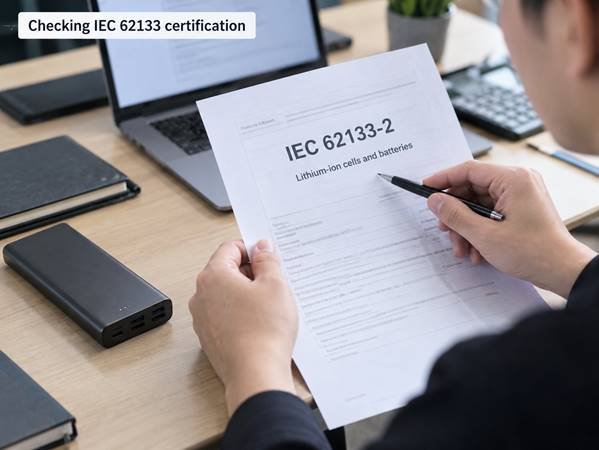
When you get a certificate, you don’t need to stare at the dense professional content. First check these 5 items, and you can eliminate many fake and inapplicable certificates:
| Check Item | Specific Requirements |
| Standard version | Confirm whether the IEC 62133-2 version listed in the document and, if necessary, amendments meet the requirements of the target market, customer, or platform; be cautious if only IEC 62133 is written without specifying the specific part and scope of application |
| Test object | Clearly see whether the test is for cells, battery packs, or the battery part of a complete product; do not use cell certification as the certification of the entire power bank |
| Product parameters | The brand, model, Wh value, cell model, etc. on the certificate should be consistent with the actual product and the coverage scope of the certificate |
| Issuing body | If verifying a CB certificate, check whether the issuing body is an IECEE-recognized NCB and whether the relevant laboratory is a CBTL; for other reports, check the laboratory’s accreditation qualifications for the corresponding standard and scope |
| Valid status | The valid status, validity period, and change rules of the certificate shall be subject to the issuing body and the system of the target market, and shall not be preset as 3 to 5 years |
3 Steps to Officially Check Authenticity
Looking at documents alone is not enough. It is best to prioritize verification using the official inquiry channels of the issuing body or the applicable certification system:
Step 1: Find the official website of the issuing body or the inquiry channel provided by the applicable certification system;
Step 2: Enter the certificate number, report number, or other queryable information in the manner allowed by the channel;
Step 3: Check whether the query results match the certificate holder, model, parameters, and coverage scope of the actual product.
Not all bodies publicly provide databases for querying by product model or certificate number. If there is no public query record, you should directly verify the number, certificate holder, product scope, and certificate status with the issuing body. You cannot conclude that the document is fake or invalid just because it cannot be found on public web pages.
Judgment Logic for Series Model Coverage
It is normal for the same certificate to cover multiple series models, but there is a prerequisite: the core safety structure of these models must be consistent. Changes in cells, protection circuits, series/parallel connection methods, capacity, and structure may all affect the scope of certification. Before changes, a difference assessment shall be conducted by the issuing body or a laboratory with corresponding qualifications, and based on the results, it shall be decided whether to update documents, conduct supplementary tests, or re-certify.
Also note: if only a high-power USB-C output function is added, it may not affect the certification scope of the battery itself, but the safety of the complete product needs to be assessed separately, and the complete product certification of the old model cannot be directly applied.
Don’t Confuse Them: Differences from Other Common Certifications
Many people confuse IEC 62133 with concepts such as UN 38.3, CE, and UL, but their division of responsibilities is completely different.
Differences from Transport Safety Standards (UN 38.3)
UN 38.3 is a lithium battery transport safety standard formulated by the United Nations. It governs whether lithium batteries are dangerous during air, sea, and land transport, such as whether they will leak or explode on airplanes. It does not govern safety in daily use.
IEC 62133, on the other hand, governs daily use safety and cannot replace transport certification. When transporting lithium batteries or devices containing lithium batteries, the requirements of UN 38.3 and applicable transport rules shall be met; whether IEC 62133-2 test reports, CB documents, or local certification are also required depends on the destination market, customer, and platform requirements.
Differences from Complete Product Safety Standards (IEC 62368-1)
IEC 62368-1 is a complete product safety standard for information technology and audio-visual equipment. It governs the entire circuit, interfaces, and insulation parts of power banks, such as whether the USB-C port will leak electricity, whether the circuit board will catch fire, and whether the casing will cause electric shock.
IEC 62133 only governs the internal battery part of the power bank, and is a component of complete product safety. Even if the complete product has an applicable UL certification mark or has completed the EU CE conformity assessment, it cannot be concluded solely based on this that the built-in battery has been tested in accordance with IEC 62133-2; applicable regulations, complete product standards, and battery-related evidence shall be checked.
Relationship with National Market Access Certifications
Market access requirements vary from country to country, and their relationship with IEC 62133 is also different:
• Each market shall separately check applicable regulations and designated standards. IEC 62133-2 or CB test materials can sometimes be used as technical evidence and reduce duplicate work, but whether they are accepted by the target market and whether there are national differences or supplementary tests must be confirmed by local regulations and certification bodies;
• For North America, whether NRTL certification and applicable standards are required shall be determined according to the sales region, product use, local electrical regulations, and retailer and customer requirements. For example, UL standards or Canadian standards may be involved. IEC 62133-2 documents usually cannot automatically replace these requirements.
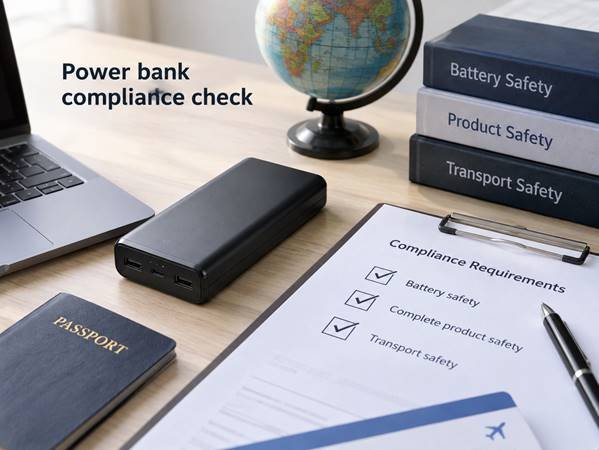
The general judgment logic is: first confirm the target sales country, then separately check the three types of compliance requirements: battery safety, complete product safety, and transport safety, and prepare corresponding documents according to local rules, to be truly compliant.
Need to Apply for Certification? Core Process and Key Pitfall Avoidance Points
If you are a brand owner or merchant who needs to apply for IEC 62133 certification for your power banks, this part of the content can help you avoid detours and control costs.
Core Application Steps
The application process is not complicated, with four core steps:
1. First clarify the test object (cells, battery packs, or the battery part of a complete product) and the specific requirements of the target market — different markets may have different requirements for standard versions and additional items;
2. Prepare a full set of product materials: including product specifications, cell parameters, protection board materials, product labels, and user manuals;
3. Choose a qualified laboratory; if there is a need for the CB system, you can choose a relevant IECEE CBTL to participate in testing, and apply for a CB certificate through an IECEE-recognized NCB, which makes it more convenient to convert to multi-country certification later;
4. Submit samples for testing. If they fail, you need to adjust the product according to rectification suggestions and retest. After all items are passed, you can obtain the corresponding test report or certification document.
Certificate Maintenance and Change Rules
Certificates are not once-and-for-all. There are several rules to note:
• Certificate status, validity period, and supervision requirements vary depending on the issuing body, certification scheme, and target market;
• If the product changes cell model, adjusts series/parallel connection method or capacity, replaces the protection board, or modifies the core safety structure, it may affect the scope of certification;
• Before changes, a difference assessment shall be conducted by the issuing body or a laboratory with corresponding qualifications, and based on the results, it shall be decided whether to update documents, conduct supplementary tests, or re-certify;
• Mass-produced products must be consistent with the submitted samples and the coverage scope of the certificate. If cut corners are found in market spot checks, relevant compliance documents may become invalid, and you may also face fines.
Factors Affecting Cycle and Cost
There is no fixed value for the certification cycle and cost, which are mainly affected by the following factors:
• Battery design, test object, number of samples, target certification scheme, and rectification situation all affect the cycle and cost;
• Whether existing cell test materials can be cited and what work can be reduced must be confirmed by the certification body according to model consistency and scheme rules;
• The type of certificate also affects cost. Applying for a CB certificate involves more processes and costs, but the overall cost may be lower when converting to multi-country certification later, which is suitable for merchants operating in the global market.
Common Causes of Test Failure
There are four most common reasons for failing IEC 62133 testing:
1. The protection circuit or relevant safety design does not match the applicable clauses, for example, the abnormal charging protection design is unreasonable;
2. Poor cell consistency, which easily causes problems in thermal tests and discharge tests after multiple cells are combined;
3. Defective structural design, where internal wires or solder joints become loose after vibration testing, leading to short circuits;
4. The submitted samples are “specially made” and different from mass-produced products, resulting in direct failure in subsequent market spot checks.
Paying attention to these points in advance when applying can greatly improve the pass rate.
Practical Checklist: Safety Guide from Purchase to Use
Avoiding Common Cognitive Misconceptions
First, correct several most common cognitive errors:
❌ Having IEC 62133 certification means you can sell globally: Incorrect. You also need to meet the complete product safety, labeling, transport, and other requirements of the target country;
❌ Certified cells = compliant entire power bank: Incorrect. You also need to check the assembly process, protection board matching, and whether the complete product structure is safe;
❌ After certification, you can upgrade capacity/power at will: Incorrect. As long as core components are changed, the scope of certification should be re-assessed;
❌ IEC 62133 is a transport certification: Incorrect. It is a daily use safety standard and cannot replace UN 38.3 transport certification.
Consumer Purchase Checklist
When buying a power bank, checking against these points can help you avoid products with unclear information or unknown sources:
| Check Dimension | Purchase Requirements |
| Product label | Check whether the label information required by the regulations of the sales location, as well as parameters such as rated capacity, rated energy, input and output, are clear and consistent |
| Certification materials | If you need to verify battery safety materials, you can request the test report, CB certificate, or local compliance documents (if applicable) corresponding to the specific model from the brand; do not judge compliance solely based on the “IEC 62133” text or icon on the packaging |
| Parameter consistency | The model and capacity parameters on the packaging, user manual, and product detail page should be consistent |
| Pitfall avoidance reminder | Wh information is particularly useful for comparing stored energy and air carry restrictions, but whether it is a mandatory labeling item shall be subject to local rules; be cautious about purchasing products that cannot provide verifiable product materials |
Daily Safe Use Checklist
Even if you buy a qualified product, you should pay attention to safety when using it:
1. Use qualified chargers and charging cables, and do not charge for a long time in flammable places such as pillows, quilts, and sofas;
2. If the power bank shows swelling, cracked casing, leakage, abnormal heating, or abnormal charging, stop using it immediately;
3. Do not throw discarded power banks into household waste; send them to special battery recycling points. Do not continue to use, disassemble, or throw swollen, damaged, or leaking power banks into household waste. You should contact local battery recycling agencies, sellers, or environmental and fire protection authorities, and conduct safe delivery and disposal in accordance with local regulations.
Final Remarks
After reading this article, you should have mastered these core abilities: you can distinguish that IEC 62133 is a standard rather than a certification, and clarify its coverage scope; you can judge whether a power bank is within the applicable scope; you can verify the authenticity and validity of certification through official channels; you can distinguish its differences from UN 38.3 and complete product safety certification, and will not be fooled by merchants; if you have application needs, you also know the core process, cost-influencing factors, and common pitfalls; you can also make basic safety decisions according to the purchase, use, and recycling checklists.
Battery safety is no trivial matter. Knowing a little more about certification can give you an extra layer of safety protection.