
Many power bank sellers entering the European market for the first time get confused by “CE certification”: some say you can list products by spending a few thousand yuan on a certificate, some say you must get a certificate issued by an official EU body, and others use the UN38.3 transport report for lithium batteries as CE compliance proof.
First, we need to correct a most core perception: the commonly called “CE certification” is just an industry colloquial term. It is essentially a manufacturer’s self-declaration of conformity, not a “qualification certificate” issued by the EU authorities — there is no unified “CE certificate” issuing body across the EU. The core of compliance is a set of traceable technical documents that can support the product’s compliance with requirements.
Basic Understanding of CE Compliance (Must-Read for Beginners)
What is the CE Mark
In plain terms, for products falling within the scope of applicable EU harmonized legislation, the CE mark indicates that the manufacturer has confirmed the product meets the applicable requirements of these regulations. Its full French name is Conformité Européenne, which literally translates to “European Conformity”.
These requirements may involve safety, health, electromagnetic compatibility, radio spectrum use, and restriction of hazardous substances, etc. The applicable requirements vary for different products. CE is not a general prerequisite for all products sold in the EU and European Economic Area (EU/EEA), but applies to products covered by specific EU harmonized legislation.
Many people regard CE as a “quality medal”, thinking that a power bank with the CE mark charges fast, has long battery life, and good quality — this is a complete misunderstanding. CE is not a mark of product performance or quality grade, and has no direct equivalent relationship with performance indicators such as charging speed, battery life, drop resistance and durability. Its core support is technical documents, and there is no official unified “certificate”.
Why CE Compliance is Mandatory
For power banks that fall within the scope of applicable EU harmonized legislation and are placed on the EU/EEA market, CE is a mandatory legal requirement. If the requirements are not met, you may face risks such as customs detention of goods, removal from e-commerce platforms, fines, and even product recalls. Of course, compliant products also give consumers more peace of mind, as it means the product has completed compliance assessment in accordance with applicable regulations.
5 Most Common Cognitive Misconceptions
Many people’s misunderstandings about CE essentially stem from treating it as a “third-party issued quality certificate”. Here we clarify the most common misconceptions at once:
1. Misconception 1: CE is quality certification → CE indicates that the product meets the relevant requirements of applicable EU harmonized legislation, which may involve safety, health, electromagnetic compatibility, radio spectrum use, and restriction of hazardous substances, etc., but does not mean the product has particularly good performance. Just like a driver’s license only proves that you can drive legally and safely, it does not mean you are a racing driver.
2. Misconception 2: All European countries recognize CE → After Brexit, the UK launched its own UKCA access mark, and CE cannot directly replace all UK market requirements; non-EU/EEA countries such as Switzerland also have their own access rules, which cannot be generalized.
3. Misconception 3: UN38.3 transport report equals CE → UN38.3 is a mandatory transport requirement for lithium batteries by air and sea, which only covers safety during transport, and is completely different from CE for market access.
4. Misconception 4: Low-capacity power banks do not need CE → Whether CE requirements apply does not depend on capacity, but on whether the product falls within the scope of applicable EU harmonized legislation. Finished consumer power banks placed on the EU market, whether 5000mAh or 20000mAh, should confirm applicable requirements according to their actual structure.
5. Misconception 5: Having a CE certificate = compliance → The EU has no statutory unified CE certificate. The core of compliance is the effectiveness of applicable conformity assessment, technical documents, and EU Declaration of Conformity (DoC). Third-party certificates can be auxiliary evidence, but a piece of paper printed with the CE mark itself cannot prove that the product is definitely compliant.
Differences Between CE and Other Market Access Marks
Many sellers confuse access requirements of different regions. In fact, they are independent systems and not mutually applicable. The core judgment principle is: first confirm the sales destination and product type, then match the corresponding access requirements.
| Access Mark | Applicable Region | Relationship with CE |
| CE | EU/European Economic Area (EU/EEA) | Applies to products covered by relevant EU harmonized legislation |
| UKCA | UK (Great Britain) | An independent access system launched after Brexit, CE cannot directly replace it in all scenarios |
| FCC/UL | United States | Electromagnetic compatibility/safety access requirements for the US market, completely independent of the EU system |
| PSE | Japan | Electrical safety requirements for the Japanese market, with different certification logic from the EU |
Applicable Boundaries of Regulations: What CE Requirements Apply to Your Power Bank
Many people think that “CE for power banks is a fixed set of tests”, but that’s not the case at all. CE is not a certification for a certain product name, but depends on which EU harmonized regulations your product falls under — ordinary USB models and models with Bluetooth or AC plugs have very different regulations to meet.
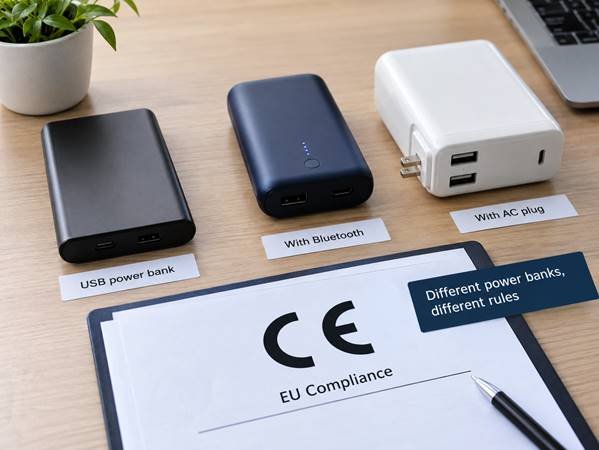
Quick Reference of Applicable Regulations for Different Types of Power Banks
Consumer power banks usually involve requirements such as EMC (Electromagnetic Compatibility) and RoHS (Restriction of Hazardous Substances), and those with special functions need to add corresponding regulations. At the same time, requirements such as the Battery Regulation, GPSR (General Product Safety Regulation), as well as WEEE and battery producer responsibility also need to be assessed separately.
It should be noted that although the EU Battery Regulation is not a traditional CE directive, the regulation itself includes conformity assessment, EU Declaration of Conformity and CE marking requirements for applicable batteries; GPSR applies to the extent not covered by the safety requirements of EU harmonized legislation.
Below is a reference of applicable regulations for common power bank types. Note that all products must be assessed item by item in combination with the actual structure, and there is no unified “power bank CE template”:
| Product Type | CE Harmonized Legislation or Related CE Requirements | Parallel Market Placement Obligations |
| Ordinary low-voltage USB model (USB-A/USB-C output, no other functions) | EMC Directive, RoHS Directive | EU Battery Regulation, GPSR |
| Smart model with Bluetooth/Wi-Fi/APP | RED Directive, RoHS Directive; RED includes basic EMC requirements, and conformity assessment is not carried out under the EMC Directive at the same time | EU Battery Regulation, GPSR |
| Wall charger model/mains output model with AC input/output | EMC Directive, RoHS Directive, LVD (Low Voltage) Directive | EU Battery Regulation, GPSR |
| Wireless charging model (no communication function) | EMC Directive, RoHS Directive | EU Battery Regulation, GPSR |
| Solar-assisted charging model | EMC Directive, RoHS Directive | EU Battery Regulation, GPSR |
| Composite model with magnetic attraction, built-in cable, digital display | EMC Directive, RoHS Directive (added according to actual functions) | EU Battery Regulation, GPSR |
Which Products Are Assessed Under the Finished Product CE Path
All finished portable energy storage products intended for consumers, mainly used to charge portable devices such as mobile phones, tablets, and laptops, are assessed under the finished product CE path for ordinary consumer power banks, including:
• Ordinary consumer power banks with USB-A/USB-C output
• High-power power banks supporting fast charging protocols such as PD/QC
• Composite power banks with magnetic attraction, built-in cable, and digital display
• Consumer power banks with wireless charging, solar-assisted charging, and built-in AC plug
• Smart power banks with Bluetooth positioning and APP control
Which Products Are Not Assessed Under the Ordinary Finished Product CE Path
Note: Not being assessed under the finished product CE path ≠ no EU compliance obligations, but other regulations apply according to the corresponding product category:
• Pure lithium battery cells/battery packs: Fulfill obligations such as safety, labeling, conformity assessment, and recycling in accordance with the corresponding clauses, product categories, and effective dates of the EU Battery Regulation, and are not assessed under the finished power bank CE path.
• Industrial backup energy storage power supplies, non-removable batteries built into equipment: Assessed under the path of industrial equipment or host accessories, and the complete machine manufacturer covers compliance requirements in the complete machine’s technical documents.
• Non-consumer power banks with special functions such as medical/explosion-proof: Subject to special regulations such as medical equipment and explosion-proof equipment, and the ordinary consumer path does not apply.
• Large-capacity outdoor energy storage power supplies (mains output): Need to separately assess requirements such as LVD, EMC, and battery regulations, and cannot be handled under the simplified path for ordinary power banks.
How to Determine If It Counts as “Placed on the EU Market”
Only when the following two conditions are met at the same time, it is necessary to do CE compliance as a finished power bank:
1. First provision in a commercial context: The first provision of products to end consumers or the distribution chain in the EU/EEA in commercial activities, including cross-border e-commerce sales, commercial gifts, and free samples.
2. Consumer portable energy storage finished product: The product is a portable energy storage device intended for consumers, whose main purpose is to charge portable electronic devices such as mobile phones, tablets, and laptops.
If it is a power bank carried into the country for personal use and for non-commercial purposes, it does not constitute “placing on the market” and does not require CE compliance.
In addition, there are several situations that do not require assessment under the finished product CE path:
• Only selling battery cells instead of finished power banks: Battery cells need to meet the corresponding requirements of the EU Battery Regulation.
• As a non-removable accessory of a compliant host: The complete machine manufacturer covers compliance requirements in the complete machine’s technical documents and risk assessment.
• Target market is non-EU/EEA countries: Only need to meet the access requirements of the target market, which has nothing to do with EU CE.
Core CE Compliance Requirements (Plain Language Version)
Many people count all requirements related to the EU market as “CE content”, but in fact they need to be viewed separately. The applicable logic and document requirements of regulations such as EMC, RED, RoHS, and LVD applicable to the complete machine are not exactly the same as those of the Battery Regulation, GPSR, WEEE, and producer responsibility systems.
Comparison Table of Three Types of Compliance Obligations
First, let’s clarify the boundaries of different obligations to avoid wasting money:
| Obligation Category | Included Regulations | Core Obligations | Typical Documents | Common Misjudgments |
| CE harmonized legislation applicable to complete machines | EMC Directive, RoHS Directive, RED Directive, LVD Low Voltage Directive | Products meet corresponding safety, electromagnetic compatibility, environmental protection, radio frequency and other requirements, supported by technical documents | Corresponding test reports, risk assessment reports, technical document packages | Thinking that all power banks are subject to LVD; thinking that RoHS only tests the complete machine |
| Battery and general product safety requirements | EU Battery Regulation, GPSR General Product Safety Regulation | Battery safety, labeling, conformity assessment and other obligations shall be implemented according to battery category and applicable dates; supply chain due diligence only applies when conditions such as economic operators, turnover thresholds and material scope specified in the regulation are met; GPSR covers risks not covered by the safety requirements of special legislation | Battery test report, battery label draft, GPSR risk assessment, EU Declaration of Conformity | Thinking that the Battery Regulation is not related to CE at all; thinking that GPSR can replace special safety tests |
| Recycling and producer responsibility | WEEE Directive, waste battery producer responsibility system | Producers usually must complete registration in each member state where they intend to first supply batteries before supplying batteries in the local market; subsequent ongoing obligations such as recycling, reporting and fee payment must also be fulfilled | WEEE registration certificate, battery producer registration certificate, recycling mark use materials | Thinking that WEEE is not needed after CE is done; thinking that recycling marks can be printed casually |
Below we break down the core requirements in detail:
Product Safety and Battery Safety
In plain terms: when used normally or accidentally misused, the power bank will not explode, catch fire, leak electricity, or have dangerous high temperatures.
Evidence Requirements for Battery Safety
The commonly used safety test standard for lithium-ion cells/battery packs is EN IEC 62133-2, which can be used as important technical evidence for battery safety.
When selecting standards, you can follow three steps: ① First identify the applicable regulations and risk points of the product; ② Check the currently valid list of harmonized standards and transition periods in the Official Journal of the European Union to avoid using inapplicable or expired standards for testing.
Assessment Logic for Complete Machine Safety
Many people think that all power banks need to do LVD (Low Voltage Directive), but that’s not the case:
• Ordinary power banks that only have low-voltage DC input and output with rated voltages all outside the LVD scope are usually not subject to the LVD Directive. When judging, you can’t just look at the USB output terminal, you must also check all rated input and output voltages of the device at the same time.
• Parts with rated input or output of AC 50–1000V or DC 75–1500V need to assess whether the LVD Directive applies, and verify safety items such as insulation and electric shock protection.
Here is a special reminder of a common misconception: qualified cells do not mean the complete machine is compliant. Even if you use cells that have passed EN IEC 62133-2 testing, they can only be used as part of the safety evidence and cannot replace the safety assessment of the complete machine — after all, the complete machine’s circuit design, heat dissipation, and protection strategy will all affect safety.
Electromagnetic Compatibility (EMC) Requirements
EMC sounds very professional. In plain terms, there are two requirements: first, when you use this power bank, it will not interfere with other electronic devices such as nearby mobile phones and routers; second, when there is slight electromagnetic interference from the outside, the power bank will not have safety failures, such as abnormal stop working or damaging charged devices.
There are two core verification items: compliant disturbance emission (not interfering with others) and qualified anti-interference ability (not having problems due to interference from others).
Testing should cover real usage scenarios: charging, discharging, charging while discharging, fast charging protocol switching and other states must be tested, not just standby.
It should be noted here that output ripple, temperature rise, fast charging protocol stability, etc., belong to the category of performance, reliability or safety risk assessment, and are not within the core assessment scope of EMC. Don’t confuse them with EMC testing.
EMC or RED test standards must be selected from the list of harmonized standards valid at the time of testing according to product functions, intended use and applicable regulations. EN 55032 and EN 55035 can only be used as candidate standards when the product falls within the scope of their multimedia equipment application, and should not be regarded as a fixed standard combination applicable to all power banks. Products with radio functions should also confirm applicable standards in accordance with the harmonized standard system corresponding to RED.
Environmental Protection (RoHS) Requirements
The core of RoHS is to restrict the content of toxic and hazardous substances in products. In plain terms: the 10 hazardous substances in the product must not exceed the limit, to avoid environmental pollution after disposal.
These 10 controlled substances are: lead (Pb), mercury (Hg), cadmium (Cd), hexavalent chromium (Cr(VI)), polybrominated biphenyls (PBB), polybrominated diphenyl ethers (PBDE), bis(2-ethylhexyl) phthalate (DEHP), dibutyl phthalate (DBP), benzyl butyl phthalate (BBP), diisobutyl phthalate (DIBP).
The limit rule is: except for cadmium, whose limit is 0.01% (100ppm), the limit of the other 9 substances in homogeneous materials is 0.1% (1000ppm). The “homogeneous material” here refers to the smallest unit of the same material that cannot be disassembled further. For example, the plastic sheath of a wire is one homogeneous material, and the copper wire inside is another. It is not calculated based on the average content of the entire product.
Key controlled components include: circuit boards, solder, batteries, housing plastics, wires, connectors.
The core requirement of RoHS is traceability of supply chain materials, exemption clauses must be checked for applicability item by item, and mass-produced products must be consistent with the tested samples.
A common misconception is: only looking at the RoHS report of the complete machine without looking at the homogeneous material data, or thinking that the limits of all components are the same.
Compliance Verification Requirements for Additional Functions
If your power bank has additional functions, you need to add corresponding compliance verification, and cannot directly apply the report of the ordinary model:
• Bluetooth/Wi-Fi/cellular communication function: Will trigger the RED (Radio Equipment) Directive, requiring verification of items such as radio frequency emission, spectrum utilization, and electromagnetic exposure. RED itself includes basic EMC requirements, and conformity assessment should not be repeated under the EMC Directive at the same time.
• Wireless charging function: There is a common misjudgment here — power banks with only wireless power supply function will not trigger the RED Directive. Only when they also have radio communication or measurement functions such as Bluetooth and NFC, RED assessment is required. The verification focus of wireless charging is EMC, product safety, temperature rise, foreign object detection, and metal foreign object heating risk, which should cover the full power state of wireless charging.
• AC input/output function: Will trigger the LVD (Low Voltage) Directive, requiring verification of items such as insulation, electric shock protection, plug structure, withstand voltage, and leakage current.
• Lighting function: According to the complete machine risk assessment, additional testing of corresponding lamp safety and EMC items is required.
• Solar-assisted charging function: Passive solar panels themselves are not sources of electromagnetic disturbance, so there is no need to separately test the EMC of solar panels. The verification focus is the complete machine with charging management circuit, and its safety and EMC performance under different modes such as solar input, USB input, discharging, and charging while discharging.
Three Layers of Distinction for Battery-Related Requirements
Many people count all battery-related requirements as traditional “CE certification”, but in fact they belong to different levels:
1. Transport layer: UN38.3 is a mandatory requirement for lithium battery air and sea transport, which only covers transport safety, and is not the same thing as complete machine CE market access.
2. Product compliance layer: The EU Battery Regulation is not a traditional CE directive, but the regulation itself stipulates conformity assessment, EU Declaration of Conformity and CE marking requirements for applicable batteries. Specific obligations shall be determined according to battery category and phased applicable dates, and shall be assessed separately from the EMC, RED, RoHS or LVD obligations applicable to the complete machine.
3. Recycling layer: Battery producer responsibility belongs to the producer responsibility system. Producers usually need to complete registration in each member state where they plan to first supply batteries, and then continue to fulfill obligations such as recycling, reporting and fee payment.
Full Process of CE Compliance Handling (With Pitfall Avoidance Checkpoints)
After figuring out the applicable regulations, you can go through the compliance process. From preparation to getting complete documents, it takes about 2-4 weeks for ordinary models, and the more functions, the longer the cycle. Let’s explain step by step:
Step 1: Preparatory Product and Data Preparation
First, fully finalize the final product model, parameters, functions, and structure to avoid mid-term changes — if you add a wireless charging function in the middle of testing, the previous tests may need to be re-evaluated.
Materials to be prepared in advance include: product specification sheet, circuit principle description, key component list (BOM), relevant materials of cells/batteries.
Samples should also be prepared in advance, the quantity is according to the test plan. The most important thing is: the samples must be able to represent the final mass-produced version, and engineering prototypes cannot be used as a substitute.
✅ Checkpoint: List all additional functions and input/output voltage ranges of the product, and check the corresponding regulations one by one to avoid missing assessments.
Step 2: Select a Compliant Testing Institution
When selecting an institution, the key depends on whether the laboratory has the capabilities, equipment and methods matching the product and test items. The laboratory’s accreditation scope, such as CNAS or ILAC mutual recognition accreditation scope, can be used as an important basis for verifying its capabilities, but it is not a statutory sufficient or necessary condition for CE compliance. The manufacturer is still responsible for the technical documents and conformity.
There are two common pitfalls to avoid:
1. Ordinary consumer power banks usually do not require certification by an EU Notified Body (NB). Many institutions will trick you into paying extra for an “NB certificate”, but for ordinary products applicable to the self-conformity assessment path, NB intervention is not required.
2. Be wary of promotions such as “get certificate in 3 days” and “guaranteed pass”. The cycle should be determined according to the test scope, sample status, existing valid evidence and rectification situation, and you cannot directly judge the authenticity of the report only by the number of days; but if the institution cannot explain the test items, test conditions and technical document requirements, you need to be vigilant.
In terms of cost and cycle, ordinary USB models usually cost several thousand to tens of thousands of yuan. The more functions such as Bluetooth, wireless charging, and AC plugs, the higher the cost and the longer the cycle. The specific situation shall be subject to the actual product.
Step 3: Product Testing and Rectification
Before formal testing, you can do pre-testing to check risks and fix problems in advance to avoid wasting time if formal testing fails.
If the formal test fails, the laboratory will usually give rectification directions. After modification, you cannot simply think that only the originally unqualified items need to be retested. Instead, you should first do a change impact analysis: if the modification affects other functions, structures, materials or circuits, all applicable items that may be affected must be retested.
✅ Checkpoint: The report obtained after the test is completed should include measured data, test conditions, sample photos and other information that can support the conclusion, not just a conclusion of “meets requirements”.
Step 4: Compile a Complete Technical Document Package
Many people think that a test report is enough, but that’s not the case. The technical document package is the core data supporting CE compliance, and also the core verification object of regulatory spot checks. In plain terms, it is “a collection of all technical data that can prove your product is compliant”.
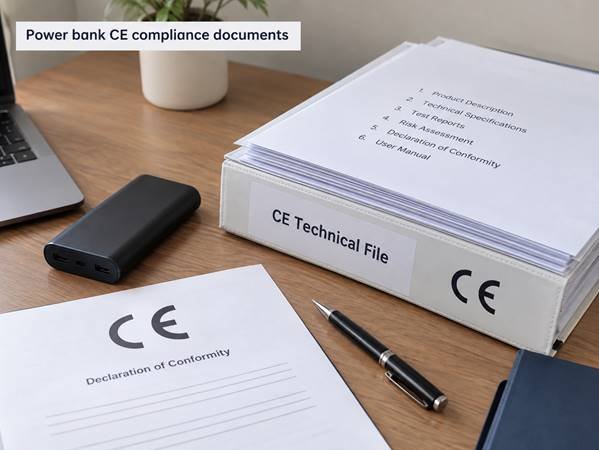
The necessary contents of the technical document package include: product description and model rules, appearance/internal photos, BOM and key component qualifications, circuit schematic/PCB description, test reports, risk assessment reports, etc.
Key point: having only test reports does not equal compliance. The entire set of documents must be complete and traceable.
Step 5: Sign the EU Declaration of Conformity (DoC)
The EU Declaration of Conformity (DoC) is a legal declaration issued by the manufacturer itself. In plain terms, it is “I, as the manufacturer, guarantee that this product complies with the corresponding EU regulations”, and you are legally responsible for this declaration.
The statutory necessary contents of the DoC include: manufacturer information, unique product identification (model/batch), applicable EU regulations, adopted standards/technical specifications, signatory information, etc. The test report number can be written in as internal traceability information, but it is not a statutory required item.
Note: A DoC without valid technical document support cannot prove product compliance. One DoC can integrate multiple applicable regulations, and there is no need to make a separate one for each regulation.
Step 6: Labeling, Instructions and CE Marking Affixation
After the tests and documents are completed, the compliance information must be correctly marked on the product, packaging and instructions:
Correct Way to Affix the CE Mark
The CE mark must in principle be at least 5mm in height, with standardized proportions, clear, visible, legible and durable, and should be affixed to the product body first. If the relevant requirements cannot be met due to the nature or size of the product, corresponding exceptions can be applied, or it can be marked on the packaging, parcel or accompanying documents according to applicable regulations.
It cannot be affixed to easily detachable parts, nor can it be mixed with other marks to make it indistinguishable.
The formal CE mark is usually printed on the back parameter area of the power bank, together with information such as model, input and output parameters, rated energy Wh, etc., for easy identification and traceability.
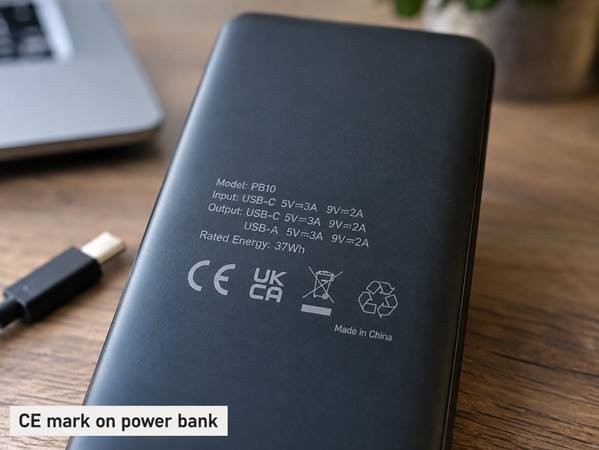
Product Traceability Information
Product identification information and manufacturer contact information shall be marked on the product according to applicable regulations; if it cannot be marked due to product size or nature, it can usually be marked on the packaging or accompanying documents according to regulations.
Input and output parameters shall be marked according to applicable product safety regulations, labeling regulations and product description needs, and should not be simply understood as a unified mandatory item for all products with CE marks. In actual operation, power banks usually still should clearly mark basic information such as model, input and output parameters, to facilitate correct use by consumers and regulatory traceability.
Battery Labels and Recycling Marks
According to the requirements of the EU Battery Regulation, relevant information such as capacity and energy shall be marked according to product category, effective schedule and labeling rules. Here we specifically mention Wh (rated energy), which is the core judgment parameter for air carry and transport links, and is also a common marked item on battery labels.
The recycling mark shall be affixed with a classified recycling mark according to the requirements of WEEE and battery regulations, and the size and position shall comply with the regulations of the target member state.
Instruction Manual Requirements
The instruction manual must be provided in the local official language version according to the regulations of the target member state, not just in English — for example, if sold to France, there must be a French instruction manual, and if sold to Germany, there must be a German instruction manual. The content should include necessary information such as safety warnings, instructions for use, and troubleshooting.
Step 7: Configure an EU-Based Economic Operator (Must-Read for Non-EU Manufacturers)
For products covered by the harmonized legislation listed in the Market Surveillance Regulation and whose manufacturer is not established in the EU, it is necessary to ensure that there is an economic operator established in the EU. The power banks discussed in this article usually may involve regulations such as EMC, RoHS, RED or LVD, so confirmation should be made in combination with the actual applicable regulations.
Many people are unclear about the responsibilities of different roles. Let’s clarify here:
• Manufacturer: Bears ultimate responsibility for product compliance.
• Importer: The entity that introduces products into the EU market, needs to verify compliance documents and keep records.
• Authorized Representative (EU Rep): Designated by the manufacturer to represent the manufacturer in liaising with EU regulators.
• Fulfillment service providers (such as overseas warehouses): Usually only provide warehousing and logistics services, and do not naturally assume the responsibility of the importer.
• Distributor: Need to ensure that products have compliant marks, and cannot sell obviously non-compliant products.
Non-EU manufacturers can choose importers, authorized representatives or eligible fulfillment service providers as economic operators. The core requirement is that there must be an entity established in the EU.
✅ Checkpoint: The name, registered trade name or trademark, and postal address of the EU economic operator shall be clearly displayed on the product, packaging, parcel or accompanying documents. Electronic contact information can be additionally provided, but it is not a required marking content under this provision.
Step 8: Post-Market Ongoing Compliance
Many people think that doing CE once is a once-and-for-all thing. In fact, CE has no fixed validity period. You need to establish a re-assessment mechanism triggered by changes and regulatory updates. As long as the following situations occur, you need to re-assess the compliance of the product:
• Product modification: Changing cells, modifying BMS/PCB, changing housing flame-retardant materials, adding or removing functions, replacing wireless modules, modifying firmware power strategies, etc.
• External changes: The end of the transition period of regulations or harmonized standards, updated regulatory requirements, emergence of new safety risk information, etc.
• Other changes: Changing production locations, modifying label parameters, etc.
In terms of record retention, technical documents and DoC usually need to be kept for 10 years; records of market complaints, accidents, recalls, non-conforming product handling and corrective measures shall be kept according to risk management requirements, applicable regulations and member state regulations. If you receive a regulatory spot check request, you must be able to provide complete technical documents in a timely manner.
How to Verify the Validity of CE Compliance Documents
CE documents on the market are mixed. Many sellers spend money but get reports that cannot support compliance. Here we teach you how to verify it yourself.
Differences Between Four Types of CE-Related Documents
First, figure out the role of different documents, don’t treat non-essential ones as essential:
| Document Type | Issuing Entity | Core Function | Is It Essential for CE Compliance |
| Test Report | Laboratory | Common important technical evidence, used to prove that the product meets the corresponding standards or requirements | Usually important, but whether it is needed and the specific form depends on applicable regulations, risk assessment and conformity assessment path |
| CE Certificate | Third-party institution | Can be used as third-party auxiliary evidence | Voluntary third-party certificates usually cannot replace the manufacturer’s DoC and technical documents; when notified body procedures apply, corresponding documents shall be obtained in accordance with statutory procedures |
| EU Declaration of Conformity (DoC) | Manufacturer | Legal declaration document, which is the core voucher of compliance | Yes |
| UN38.3 Transport Report | Laboratory | For lithium battery transport, has nothing to do with complete machine CE market access | No (only required for transport) |
Four Steps to Verify the Authenticity and Validity of Reports
You don’t need to find any “query platform”. Follow these four steps to check, which can greatly reduce the risk of getting inapplicable documents:
1. Check product information: The model, parameters, appearance, and functions on the report should clearly cover the actually sold product. Series reports are not necessarily invalid, but there must be sufficient series coverage description and variant technical demonstration to prove that key differences will not affect the test results.
2. Check test scope: The test items should cover all functions and applicable regulations. For example, if your product has wireless charging, the report should include relevant tests for wireless charging, not just tests for ordinary USB models.
3. Check laboratory capabilities: The laboratory should have the capabilities, equipment and methods matching the test items. Its accreditation scope can be used as an important basis for verifying capabilities, and can also be queried through the laboratory’s official website or mutual recognition system.
4. Check report content: The report should include measured data, test conditions, sample photos, issuance date and other information that can support the conclusion, not just a conclusion page.
Common Invalid Situations of CE Compliance
If there are the following situations, you need to be highly vigilant:
• Only test reports of cells, no assessment of applicable requirements for the complete machine and complete technical documents.
• The model on the report is inconsistent with the actually sold model, and there is no valid series coverage or variant technical demonstration.
• The CE mark is unclear, invisible, illegible or not durable; in principle, the size should meet the requirements, and only when the product nature or size really cannot meet the requirements can exceptions be applied or the mark be placed on packaging, parcels or accompanying documents.
• Fraudulently using CE marks or reports of other products.
• No valid DoC, or incomplete technical documents.
Common Questions About CE Document Query
Many people ask “Why can’t I find my CE certificate on the EU official website?”, here is a unified explanation:
The EU does not have a unified official database covering all CE compliance documents. The EU’s NANDO system can only query the qualification scope of Notified Bodies (NB). Even for NB institutions, they may not make every certificate public. Ordinary CE reports usually cannot be queried on official platforms, so “only certificates that can be queried are valid” is a complete misconception — the matching degree between documents and products, and whether technical documents can support compliance, are the core of judgment.
Compliance Differences Between Different Products and Sales Scenarios
Power banks with different functions have different error-prone points of compliance; different sales channels also have different requirements. Here we have sorted out common error-prone points and differences.
Compliance Error-Prone Points for Different Types of Power Banks
| Product Type | Easily Overlooked Compliance Items | Precautions |
| Ordinary USB power bank | Protection function verification under abnormal working conditions, housing plastic flame-retardant grade verification, RoHS homogeneous material data traceability | Common problems are insufficient protection functions and substandard materials |
| USB-C PD fast charging power bank | High-power output stability, safety protection after fast charging protocol negotiation failure, power distribution when multiple ports output at the same time, temperature rise test | Must mark the maximum single-port power and total output power |
| Magnetic/wireless charging power bank | Effectiveness of wireless charging foreign object detection, metal foreign object heating test, magnetic attraction fatigue test | No RED assessment is required when there is no communication function, don’t waste money |
| Built-in AC plug/wall charger model | Insulation withstand voltage of mains input side, plug mechanical strength, leakage current test | The safety of the DC part of the power bank and the AC power supply part shall be assessed separately |
| Power bank with Bluetooth/APP function | Firmware version consistency of wireless module, radio frequency exposure assessment, EMC test in low power mode | Must meet the requirements of the RED Directive |
| Solar power bank | Safety and EMC test at the maximum power point of solar input, temperature rise in charging while discharging (solar + discharge) mode | No need to separately test the EMC of passive solar panels |
Differences in Compliance Requirements for Different Sales Scenarios
• Cross-border e-commerce platforms (such as Amazon Europe): Platforms usually require CE test reports, DoC, and EU economic operator information. Some categories also require WEEE and battery producer registration certificates. The specific requirements are subject to the latest rules of the platform. If they are unqualified, products may be directly removed from the shelves.
• Offline wholesale/retail: Instruction manuals in the language of the target member state must be provided. Warranty materials are provided according to commercial arrangements, but warranty cards cannot replace statutory consumer rights. Market regulatory authorities will conduct random inspections, and if unqualified, it may trigger full-channel recalls.
• B2B supply: Complete compliance documents need to be provided to the purchaser. Whether the purchaser is an importer depends on whether it is an entity established in the EU and places third-country products on the EU market for the first time; if the product has been placed on the EU market by other entities, the purchaser usually assumes corresponding obligations as a distributor or user role.
Explanation of Easily Confused Energy Storage Parameters
Many sellers and consumers confuse mAh and Wh. Here we clarify it at once:
• mAh (milliampere-hour): Indicates the capacity of the battery, which is only meaningful when combined with the nominal voltage, and cannot directly represent the amount of energy storage.
• Wh (watt-hour, rated energy): The standard parameter for measuring energy storage. Air carry and battery labels are all based on Wh as the core basis.
• Conversion formula: Wh = nominal voltage × capacity (Ah) = nominal voltage × capacity (mAh) ÷ 1000.
However, the premise of this formula is that the capacity and the multiplied voltage belong to the same measurement benchmark. If a power bank is marked with 20000mAh, you must first confirm whether this value is calculated based on the nominal voltage of the cell, or measured at a certain output voltage.
For example, if 20000mAh refers to the nominal capacity on the 3.7V cell side, the rated energy is about 74Wh. The rated capacity at the 5V output terminal will be affected by the DC-DC conversion efficiency and test conditions. You cannot directly regard the capacity at the 5V output terminal as the same 20000mAh, let alone equate it with the 20000mAh on the cell side.
Therefore, when judging the real energy storage of a power bank, prioritize looking at Wh, and confirm the voltage benchmark corresponding to the capacity marking.
Practical Self-Check List and Capability Summary
Power Bank CE Compliance Self-Check List
You can check one by one against this list to ensure no omissions:
• ✅ Product and regulation matching: All applicable EU regulations corresponding to the product structure have been confirmed, including harmonized legislation applicable to the complete machine, Battery Regulation, parallel obligations and producer responsibility.
• ✅ Technical documents: There are technical evidence and test reports covering all functions; there is a complete technical document package; there is a signed compliant DoC; the data of key components is traceable.
• ✅ Labeling and packaging: There is a standardized CE mark on the product body or eligible packaging and accompanying documents; product identification and manufacturer information are marked according to applicable regulations; battery-related information is marked according to the requirements of the Battery Regulation; there is a recycling mark that meets the requirements.
• ✅ Market preparation: A compliant EU-based economic operator has been configured; instruction manuals in the local language have been prepared according to the requirements of the target member state; recycling responsibility requirements such as WEEE and battery producer registration have been completed.
Capabilities You Can Master After Learning
After reading this guide, you should be able to:
• Quickly judge whether a power bank needs EU CE compliance and which regulations apply.
• Explain the core requirements, complete handling process and necessary documents of CE compliance.
• Identify common scams and invalid situations of CE compliance, and independently verify the validity of reports.
• Adjust compliance plans according to product type and sales scenario.
• Distinguish the responsibilities of different EU economic operators to avoid compliance risks.
• Complete basic CE compliance self-checks by yourself.
Frequently Asked Questions (FAQ)
How much does CE certification for power banks cost?
There is no fixed quotation. The cost is determined by factors such as the number of product functions, whether it has a wireless/mains module, sample status, number of rectifications, and laboratory capabilities. Ordinary USB models usually cost several thousand to tens of thousands of yuan. The more functions, the higher the cost. It is recommended to choose a compliant testing institution with corresponding testing capabilities.
How long is the CE certification cycle for power banks?
Ordinary USB models usually take 2-4 weeks, and products with functions such as Bluetooth, wireless charging, and AC plugs will have a longer cycle. If rectification is required or the data is incomplete, the cycle will be extended accordingly. The specific situation shall be subject to the actual test scope, sample status and rectification situation.
What standards apply to CE certification of power banks?
Standards must be determined according to product functions, intended use, applicable regulations and the list of harmonized standards valid at the time of testing. EN 55032/55035 can only be used as candidate standards when the product falls within the scope of their multimedia equipment application; products with wireless functions should confirm applicable standards according to the RED corresponding standard system; products with AC input or output also need to assess LVD corresponding standards. Common technical evidence for battery safety includes EN IEC 62133-2, and the specific situation shall still be subject to the actual structure of the product.
What certification is required for power banks on Amazon Europe?
It is necessary to meet the applicable EU compliance requirements. Usually, technical test materials, EU DoC, and EU economic operator information may be required. Some categories also require WEEE and battery producer registration certificates. The specific requirements are subject to the latest rules of the platform.
How to check the authenticity of a power bank CE report?
The EU does not have a unified CE report query platform. The matching degree between the document and the product, whether the report covers the actually sold model, and whether the technical documents can support compliance are the core of judgment. You can verify it by yourself according to the four-step verification method mentioned earlier.
Does CE certification for power banks with wireless charging require RED?
Those with only wireless power supply function do not need to do RED; if they also have radio communication or measurement functions such as Bluetooth, Wi-Fi, NFC, etc., they need to meet the requirements of the RED Directive and complete radio frequency related tests.
How long is the validity period of CE certification for power banks?
CE has no fixed validity period. As long as the product has not been modified, the applicable regulations have not been updated, and the original technical documents can still support the product’s compliance with requirements, the compliance documents can remain valid. If the product is modified or regulations and standards are updated, compliance needs to be re-assessed.
Overall, CE compliance for power banks is not as simple as buying a “certificate”, but a complete system from product design, testing, document preparation to post-market management. Its core is not the piece of paper printed with CE, but traceable technical documents and responsibility for product compliance. As long as you figure out the applicable regulations, find a testing institution with the right capabilities, and do a good job of document retention, you can avoid most pitfalls and enter the EU market more steadily.