
If you have ever bought a PD fast charging charger, or done cross-border business with related products, you must have seen a bunch of various marks: 3C, UL, CE, FCC, USB-IF… Some are mandatory requirements, some are selling points promoted by merchants. Many people can’t tell them apart at all: does a USB-C port necessarily mean PD fast charging? Can a product with the CE mark be sold globally? How to judge whether a certification is real or fake? In this article, we will explain the global certification of PD fast charging chargers thoroughly from basic common knowledge to advanced decision-making. Whether you are an ordinary consumer or a cross-border merchant, you can find the information you need.
Beginner Basics: Core Common Knowledge of PD Chargers and Certifications
Which Products Count as PD Fast Charging Chargers
The PD fast charging chargers we refer to specifically mean wired chargers (also called power adapters) with a USB-C interface that support the USB PD fast charging protocol. This article mainly discusses USB-C PD wall chargers, desktop power adapters, and travel adapters connected to AC mains power; car chargers and power banks that support USB PD output also belong to PD power supply products, but their applicable regulations, test standards, and certification requirements need to be judged separately. Pure plug adapters do not have charging or PD power supply capabilities.
The common power of consumer-grade PD chargers ranges from 20W to 140W. 240W models supporting PD 3.1 require additional safety requirements due to higher output voltage. Here we need to clarify the most common misconception first: a USB-C port does not equal support for PD fast charging — the C port is only the physical interface shape, while PD is a set of fast charging protocols that require separate support from the internal chip of the charger. Many cheap C-port chargers only have a fixed 5V output and do not support PD fast charging at all.
What’s the Difference Between PD Fast Charging and Ordinary Chargers
Traditional basic USB chargers usually provide a fixed 5V output; but chargers that do not support USB PD may also adopt other fast charging protocols and provide outputs such as 9V and 12V. The feature of USB PD is that it negotiates power supply capacity between the source end and the powered end in accordance with the USB PD specification, just like the charger and the device communicate first, then decide what “water pressure” and “water flow” to use. Common PD voltage levels are 5V, 9V, 15V, 20V, and some also support PPS programmable voltage regulation, which can adapt to the private fast charging protocols of some mobile phones.
It should be noted that PD power supply requires the source end and the powered end to support and complete PD negotiation, and the cable must be suitable for the required USB-C current, voltage, and power level; when power supply exceeds 3A, 5A, or EPR power supply, cables with corresponding electronic markers and EPR capabilities must also be used.
What Is the Use of Charger Certifications
The essence of certification is that official or authorized institutions prove that the product meets local regulatory requirements such as safety, compatibility, and energy efficiency, rather than the merchant’s own claims. For ordinary users, there are three core values: first, safety guarantee, reducing the risk of electric shock and fire; second, compatibility reference, reducing the probability of buying the wrong product that cannot be used; third, the basis for after-sales rights protection, which provides evidence when problems arise.
But we must also be clear about the boundaries of certification: certification or conformity assessment proves that the submitted product and its controlled production conditions meet the requirements of applicable standards, and is not a consumer warranty or a safety guarantee for all usage scenarios. If the product is dropped, exposed to water, modified, or aged, it should be stopped from use or evaluated by professionals. There is also a very easy point to confuse: safety certification is not equal to fast charging compatibility — safety certifications such as UL and 3C only manage electrical safety, not whether you can fast charge; protocol certifications such as USB-IF only manage whether fast charging can match, not whether it will catch fire. The two have completely different management directions.
Core Classification of Global Certifications and Easily Confused Concepts
Many people get more confused the more they look at certifications, essentially because they have not figured out the classification logic. We can break down certifications from two dimensions, and it will be much clearer.
3 Categories by Mandatory Level
The first category is mandatory access category: it is required to sell in the target market, and if not, goods will be detained or removed from shelves, such as China’s 3C certification and Japan’s PSE compliance.
The second category is market-accepted category: it is not a legal mandatory requirement, but mainstream channels and consumers recognize it, which is equivalent to a de facto access threshold, such as UL/ETL safety listing in the United States and GS certification in Germany.
The third category is self-declaration category: enterprises themselves promise to meet the requirements, no third-party certification is required, but they bear full legal responsibility, such as CE in the European Union and FCC SDoC in the United States.
4 Categories by Control Function
The first category is safety category: the most core category, which manages personal and property risks such as electric shock prevention, fire, over-temperature, and short circuit.
The second category is electromagnetic compatibility (EMC) category: simply put, it ensures that the charger will not interfere with surrounding electronic equipment when working, for example, it will not cause WiFi lag or Bluetooth disconnection.
The third category is energy efficiency and environmental protection category: it limits standby power consumption, controls hazardous substances, and also bears recycling responsibilities.
The fourth category is protocol compatibility category: it verifies the compatibility and consistency of fast charging protocols, such as USB-IF certification, which is an exclusive category for PD fast charging.
The Relationship Between Certification, Plugs, and Voltage
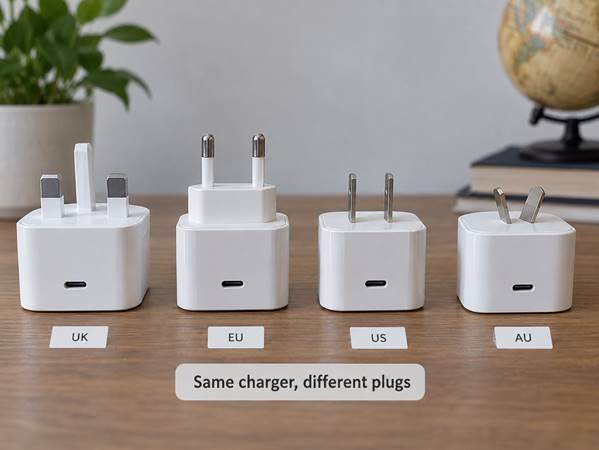
There are three common misconceptions here, which must be clarified in advance:
First, wide voltage (100-240V) only means it can adapt to different power grids around the world, it does not mean that it has passed global certification — certification is based on regional regulations, and has nothing to do with the voltage range.
Second, the correct plug shape does not mean compliance — for example, British standard pins must have a fuse inside, and European standard pins must have an insulating layer; these are safety requirements, not just that it can be plugged in.
Third, if the same product changes its plug or modifies its voltage range, it is likely to need to be re-certified, and the original certificate cannot be used directly.
Finally, remember a major principle: a country’s conformity mark or certificate usually cannot automatically meet the legal access requirements of other markets; however, different markets may adopt harmonized IEC/EN standards, and materials such as CB reports may also be used by target market certification bodies for difference assessment or certificate conversion, which still must be confirmed in accordance with local regulations.
Comparison Table of Easily Confused Terms
Many people can’t tell apart terms such as certification, test report, and self-declaration. We have compiled a comparison table for easy understanding:
| Term | Plain Explanation | Valid Evidence |
| Certification | Evaluated and certified by a third-party institution in accordance with a specific certification scheme; whether it includes factory inspection, follow-up supervision, sampling re-testing, or certificate maintenance depends on the specific certification system | Official certification certificate, official mark on the product |
| Test Report | Test results of a single submitted sample by a third party, only representing the status of the sample | Report document issued by a testing institution |
| Self-Declaration | The enterprise itself promises compliance, no third-party certification is required, and bears full legal responsibility | Declaration of Conformity (DoC), corresponding mark (such as CE) |
| Registration/Filing | The enterprise submits information to the regulatory authority for archiving and accepts follow-up spot checks | Registration number, public information in the official database |
| Market Access | The minimum compliance requirement for products to be sold in the target market | Complete compliance document package |
List of Access Certifications for PD Chargers in Major Global Markets
After understanding the classification, let’s look at the specific requirements of each major market. You don’t need to memorize them by rote, just know the core logic and identification points.
North America (United States, Canada)
United States
Many people’s biggest misunderstanding of US certification is that “FCC is a safety certification”, but it is not at all: FCC mainly controls radio frequency emission and harmful interference, and does not manage electrical safety at all. Most ordinary chargers, if subject to Part 15 unintentional radiator rules, usually adopt SDoC rather than FCC ID.
In terms of safety, there is no unified mandatory certification at the US federal level, but states and major retailers require products to have UL or ETL safety listing, which is equivalent to a de facto market access threshold. In terms of energy efficiency, DOE Level VI energy efficiency only applies to products that meet the definition of “External Power Supply (EPS)”, which depends on the product structure and output type, not all PD chargers need to do it.
Identification points: FCC ID only applies to specific equipment that requires Certification, and cannot replace the SDoC or other applicable compliance documents that the charger itself should have; for safety, look for marks from institutions such as UL/ETL. The US civil voltage is 120V, and Type A/B plugs are commonly used.
Canada
Canada’s logic is similar to that of the United States: EMC is under the jurisdiction of ISED (formerly IC), and energy efficiency must meet NRCan requirements. Safety is controlled at the provincial level, but commercial circulation basically requires safety marks with a “c” prefix such as CSA, cUL, cETL (c stands for Canadian recognition), without which it is difficult to enter mainstream channels.
Identification points: safety mark with c prefix, ISED compliance certificate. Canada’s civil voltage is 120V, and Type A/B plugs are commonly used.
European Union and European Economic Area (EEA)
The core access mark of the EU is CE, but many people think CE is an official certificate, but it is not: CE is a conformity mark, which is self-declared by the manufacturer to meet the requirements, no official unified certification is required, provided that there are supporting technical documents and EU DoC (EU Declaration of Conformity), and the enterprise is fully responsible for problems.
CE compliance must cover multiple directives: LVD (Low Voltage Directive, for safety), EMC (Electromagnetic Compatibility), RoHS (Restriction of Hazardous Substances), ErP (Energy-related Products), etc. There is also the WEEE directive that is easily confused with CE — the crossed-out trash can mark, which requires producers to complete recycling registration; this is not part of CE, but a separate mandatory requirement.
If you want to improve market competitiveness, you can do GS certification, which is a voluntary safety mark in Germany, usually including independent third-party testing and continuous supervision, and may have additional requirements under the Product Safety Act framework; its specific technical requirements should be compared according to applicable standards and certification schemes, and cannot be simply equated as necessarily stricter than LVD.
Identification points: CE mark, WEEE mark, EU DoC, RoHS declaration (RoHS has no unified official mark, generally declared by the enterprise itself). The EU civil voltage is 230V, and Type C/F plugs are commonly used, but the plug standards of each country are not uniform, for example, Ireland and Malta use British standard Type G.
United Kingdom
After Brexit, the UK’s certification system is slightly more complicated: the Great Britain region (England, Scotland, Wales) applies the UKCA mark, but the specific path and transition period need to be confirmed according to the current official policy and product category, and be sure to check the latest official guide before sales. The Northern Ireland region implements NI rules, applies CE or CE+UKNI marks, which need to be judged in combination with designated bodies and regulations.
The UK’s mandatory requirements cover safety, EMC, environmental protection, energy efficiency and other dimensions, and identification can be done by checking the corresponding marks and declarations of conformity. The UK civil voltage is 230V, using British standard Type G three-pin square plugs; this kind of plug must have a fuse inside, and compliance requirements are calculated separately, you cannot just change the pins and sell it as a British standard product.
Core Asia-Pacific Markets (China, Japan, South Korea, Australia and New Zealand)
China
China’s CCC (3C) certification is mandatory access, covering safety + EMC, and the responsible subject is the certified manufacturer or importer. The authenticity can be queried directly by entering the certificate number or model in the official database of the Certification and Accreditation Administration of China. Regular products will be affixed with the 3C mark. It should be noted that 3C certification must cover the power, port configuration, and plug specifications of the corresponding product, and certificate fraud is a common counterfeiting method.
China’s civil voltage is 220V, and Type I plugs are commonly used.
Japan
Japan’s PSE compliance is based on the DENAN Law, and the responsible subject must be an importer or manufacturer located in Japan. PSE is divided into two types: specified electrical products use the diamond-shaped PSE mark, and non-specified electrical products use the circular PSE mark. You cannot judge compliance only by the shape of the mark, you must combine the product classification.
The responsible subject in Japan must perform corresponding declaration, test record preservation and marking obligations in accordance with DENAN. When verifying, it should be combined with product classification, PSE mark, responsible subject information and applicable test/conformity documents; do not interpret METI filing as a unified product certification database that can be publicly queried by model.
Japan’s civil voltage is 100V, and Type A/B plugs are commonly used.
South Korea
South Korean electrical products need to confirm electrical safety and electromagnetic wave compliance requirements respectively according to product categories. In the safety field, safety certification, safety confirmation, or supplier conformity confirmation may apply; EMC applies the corresponding RRA conformity procedure. Whether overseas manufacturers can act as applicants, whether they must entrust a Korean agent, or whether the importer bears responsibility, should be confirmed according to the specific product and procedure.
Authenticity can be queried in the KC certification database, and products must be affixed with the KC mark.
South Korea’s civil voltage is 220V, and Type C/F plugs are commonly used.
Australia and New Zealand
Australia and New Zealand adopt the RCM compliance mark system, covering safety + EMC, and the responsible subject is the local supplier. RCM does not require registration for all products, but is determined according to the safety risk level. Some PD chargers only need self-declaration and affixing the RCM mark, and only high-risk categories require product registration. You can query in the EESS database to check supplier and product registration information.
The civil voltage in Australia and New Zealand is 230V, and Type I plugs are commonly used.
Emerging Markets (Representatives of Southeast Asia, Latin America, Middle East)
Certifications in these markets have several commonalities: most refer to IEC international standards, require a local responsible subject, and small batches for personal use may be exempted, but the specific ones shall be subject to local customs regulations. The core requirements of the three representative markets are as follows:
• India: BIS mandatory registration, referring to IEC safety standards, requires a designated local representative/importer, mandatory for commercial sales, small batches for personal use may be exempted.
• Brazil: INMETRO certification, the mandatory scope is confirmed according to product classification, requires testing and certification by local institutions, and must also meet local language requirements for labels and manuals.
• Saudi Arabia: SABER/SASO compliance system, requires product certificate + shipment conformity certificate, the applicable scope is confirmed according to current regulations, requires local importer/responsible subject.
Exclusive Certification for PD Fast Charging: USB-IF Protocol Certification
What we talked about earlier are the general access certifications of various countries. PD fast charging chargers also have an exclusive certification — USB-IF protocol certification, which many people have the most misunderstandings about.
Basic Definition and Boundaries
USB-IF certification is a voluntary PD protocol conformity certification launched by the USB Implementers Forum. Its core boundary is: it only verifies the conformity and interoperability of USB specifications, and does not replace the mandatory safety certifications of various countries. Simply put, safety certification manages whether you will have an accident, USB-IF manages whether your fast charging can match, the two are completely independent.
The scope of USB-IF conformity testing depends on the product category and its actually implemented USB-C/PD functions, which can include PD negotiation and declared power supply capacity; if the product implements optional functions such as PPS or EPR, it should also meet the corresponding requirements. Electronic markers are mainly capability declarations for USB-C cables such as 5A and EPR, and cables should be evaluated separately according to their applicable specifications. The covered protocol versions are PD 3.0 (SPR mode, up to 100W) and PD 3.1 (EPR mode, up to 240W).
Practical Value for Ordinary Users
USB-IF is not a mandatory requirement, but it has three practical functions: first, as a compatibility reference, reducing the probability of intermittent charging and incompatibility between PD devices; second, it can verify the PD support capability declared by the manufacturer to avoid false labeling; third, it is an important bonus item for purchasing PD products. Ordinary users can choose according to their needs, and cross-border merchants can decide whether to apply for it according to the target market and platform requirements.
Authenticity Judgment Method
There are three key points to judge the authenticity of USB-IF certification:
First, look at the product identification: look for the official “USB-IF Certified” mark. Only marking “PD fast charging” or “supports PD” does not mean passing the certification.
Second, check the official database: you can query on the USB-IF official website using the TID number, brand or model. The TID is not necessarily printed on the product, you can also ask the seller for it.
Third, pay special attention to multi-port models: for multi-port products, the specific model, port configuration and declared USB functions corresponding to the certification should be checked in the USB-IF TID or manufacturer’s materials. Do not use the promotion of a certain port or total power to replace the verification of the whole machine’s certification scope and the actual capabilities of each port.
Beginner Practice: 4 Steps to Quickly Identify the Authenticity of Certifications
After talking about so many certification types, the most practical thing is how to distinguish authenticity. Follow these four steps, and most counterfeits can be avoided.
Step 1: Check the Nameplate Marking (Product Body Priority)
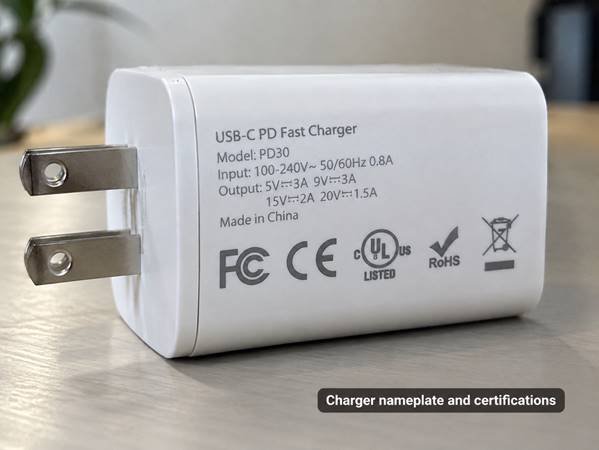
First, look at the nameplate on the charger body — the parameters and marks printed on the plastic shell. This is more reliable than the packaging and product detail page, because the cost of counterfeiting is higher. Three points must be checked:
1. It has the mandatory access mark of the region, with clear printing and correct proportion, not crooked or blurred into a mess;
2. It has complete brand, model, input and output parameters, responsible subject or certification number; those without even a model and manufacturer must have problems;
3. For multi-port models, the rated output of each port and multi-port usage restrictions should be clearly disclosed on the product body, packaging, or applicable marking position of the manual; whether all combinations must be marked on the body shall be subject to the applicable standards and regulations of the target market.
If you see blurred and crooked marks, no model/manufacturer information, or contradictory parameters, just pass. For a more advanced check, when verifying, it should be confirmed that the product has an applicable responsible subject and traceable information, and check whether the actual product’s brand, model and key configuration fall within the scope clearly defined in the certificate, DoC, test materials or their attachments. For self-declaration paths such as CE, UKCA, and FCC SDoC, the absence of a third-party certificate number should not be used as the sole basis for judging non-compliance.
Step 2: Cross-Verification with Official Databases and Documents
If the nameplate is okay, the next step is to verify through official channels. Common query channels are:
• China 3C: Official database of the Certification and Accreditation Administration of China (query by certificate number/model)
• North American Safety Listing: UL/ETL/CSA official website (query by certificate number/model)
• North American FCC: FCC database (only applicable to products with FCC ID)
• USB-IF PD: USB-IF official website (query by TID/brand/model)
• Australia and New Zealand RCM: EESS database (query supplier/product registration information)
The general verification requirement is to confirm whether the actual product’s brand, model and key configuration fall within the scope clearly defined in the certificate, DoC, test materials or their attachments, rather than just checking whether there is a same certificate number on the document.
If no public record can be found, first confirm whether the system originally has a public product database and the correct query fields; for paths such as CE and FCC SDoC, the responsible party should be required to provide applicable DoC, technical document summaries or other verifiable evidence. No result in the public database is a risk signal, but it should be comprehensively judged in combination with the certification path and document authenticity.
Here is a special reminder: third-party test reports are not equal to certification — test reports are only responsible for the single sample submitted, have no official mark, and no follow-up factory supervision. Many merchants will use test reports to pretend to be certification, so be sure to distinguish.
Step 3: Basic Safety Recheck After Receiving Goods
Even if there are no problems with the previous steps, do a simple check after receiving the goods:
First, look at the appearance: check whether the pins, shell, and interface are loose, cracked, or have burn marks; a brand new charger should not have these problems.
Then power on test: after plugging into the device, check whether there is abnormal noise, peculiar smell, or whether the shell is abnormally hot (normal charging will be a little warm, but it is definitely wrong if it is too hot to hold).
Multi-port models should also be tested: when multiple ports are used at the same time, whether the power distribution meets the product description.
If there is frequent intermittent charging, restart, or overheating, stop using it immediately and contact the seller for return or exchange.
Step 4: Avoid Common Counterfeiting Routines
Finally, remember the four most common counterfeiting routines and avoid them in advance:
1. Mark only: Only print the certification mark, no corresponding responsible subject or traceable materials, which cannot be verified at all;
2. Certificate fraud: Use the certification of low-power/single-port models of the same series to pretend to be high-power/multi-port models;
3. Concept swapping: Publicize “compliant with XX standard” as “passed XX certification”; reference standards and formal certification are completely different things;
4. Report impersonation: Use third-party test reports to pretend to be formal certification or self-declaration documents.
There are also two advanced pitfall avoidance points: first, don’t think that self-declaration certifications (such as CE, FCC SDoC) can be marked casually, these have legal effect, and counterfeiting will face penalties such as fines and removal from shelves; second, platform approval pass ≠ full compliance — the platform only does entry-level review, and the final responsibility is still borne by the manufacturer and seller.
Intermediate Advanced: Scenario-Based Decision-Making and Pitfall Avoidance
If you are a cross-border merchant, bulk purchaser, or want to match certification requirements more systematically, the following content will help you establish a set of decision-making logic, so you don’t have to mess around with the requirements of a bunch of countries.
General Certification Decision Process (Avoid Mechanical Superposition by Country)
Many people’s misunderstanding of certification is “I want to sell globally, so I will do all countries’ certifications”, but it is completely unnecessary and a waste of money. The correct process is four steps:
1. Clarify product attributes: Determine the SKU model, input voltage/plug, number/type of ports, rated power, and PD protocol version. These are the basics, and applicable regulations vary with different products;
2. Clarify sales attributes: Determine the target market, sales model (self-use/offline/e-commerce/cross-border), and responsible subject (who bears legal responsibility);
3. Match regulatory requirements: Corresponding to the mandatory access, market acceptance, and platform special requirements of the target market, choose as needed;
4. Verify compliance evidence: Check the consistency of certificates/documents and products, and retain a complete compliance document package for spot checks or rights protection.
Certification Selection Logic for Different Scenarios
The certifications required for different scenarios are completely different, don’t pursue “the more the better”:
• Personal self-use/local purchase: Prioritize local mandatory access certification, and you can add USB-IF if you have PD compatibility needs;
• Overseas shopping/cross-border self-use: In addition to confirming input voltage, frequency and plug compatibility, you should also confirm the product safety status, local restrictions on personal import and use, and whether the conversion plug is applicable. Personal self-use may have exemptions or enforcement differences, but it does not mean that the product automatically meets local safety requirements;
• Cross-border merchant sales: Must complete the mandatory access of the target market; it is recommended to add safety listing for North America, and add USB-IF for global models to improve competitiveness.
Key Verification Points for High-Power and Multi-Port PD Chargers
High-power (generally ≥65W, mostly used for laptops) and multi-port PD chargers are high-incidence areas of certification fraud, so extra attention should be paid during verification.
High-Power PD Chargers
First, confirm whether safety tests such as temperature rise and overload protection cover the highest power level. Some merchants only test the safety of low power, and do not meet the requirements at high power. Also note: GaN is a power device technology route, not a certification type — small-volume high-power GaN chargers must also meet the same safety standards as ordinary chargers. In addition, the actual output of high-power PD requires the device and cable to jointly support the corresponding PD level; it is not that the charger can output whatever power it is rated for.
Multi-Port PD Chargers
The core requirement is: certification must cover the output specifications of all ports, not just the total power. Be sure to check three types of parameters: maximum single-port power, multi-port combined power, and total rated power — all three must match. There is also a normal phenomenon to distinguish: short-term intermittent charging when plugging and unplugging devices is power reallocation, which is not certification invalidation or quality problem.
Certification Notes for Special Form Products
Two special forms of PD chargers require extra attention:
• Replaceable pins/travel models: Each replaceable pin must meet the plug safety requirements of the target market. For example, British standard pins must have a fuse, and European standard pins must have an insulating layer; you can’t just change the pins and use it;
• Travel adapters: They only solve physical plug adaptation, and do not change the certification status of the charger body — for example, if you take a charger with only US UL certification and plug it with a British standard adapter to use in the UK, the charger itself still does not meet the UK safety requirements.
Certification Boundary Between PD Chargers and Matching Cables
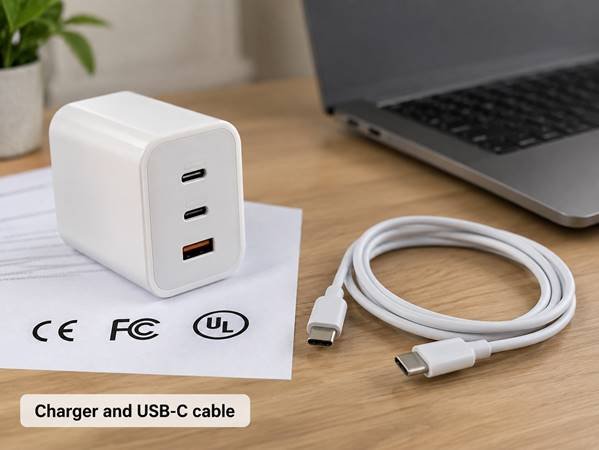
Many people buy cables along with chargers. Here is a core principle to clarify: charger certification does not automatically cover independently sold USB-C cables, and cables need to be judged for compliance separately.
The corresponding relationship between cable parameters and PD power is fixed:
• 3A cable: supports up to 60W PD (20V/3A), no E-Marker chip required;
• 5A cable with E-Marker: supports up to 100W (20V/5A) in PD 3.0 SPR mode;
• PD 3.1 EPR 240W: requires the charger, device, and cable to all support EPR (48V/5A), missing any one will not reach 240W.
The cable itself must also meet the material flame retardant and environmental protection (such as RoHS) requirements of the target market, and can also optionally do USB-IF certification to improve compatibility. A reminder for ordinary users: if your device only supports up to 100W PD, a 5A PD 3.0 cable with E-Marker is sufficient, no need to blindly buy 240W cables.
Compliance Document Package List for Enterprise/Bulk Procurement
If it is an enterprise bulk procurement or cross-border merchant stocking, be sure to organize a complete compliance document package, so that you won’t panic when encountering customs spot checks, platform audits, or consumer complaints. The document package is mainly divided into three categories:
1. Basic product documents: Product specification sheet, key component list, label draft, manual;
2. Test and certification documents: CB report and target market difference items, safety/EMC/energy efficiency test reports, certification certificates/registration certificates for each market;
3. Responsibility and environmental protection documents: Local importer/responsible subject authorization letter, WEEE/packaging recycling registration certificate.
Advanced Pitfall Avoidance: Misconceptions About Regulations and Product Changes
Finally, let’s talk about a few high-level misconceptions that are easy to step on, and even merchants who have been doing it for a long time may fall for them.
Regulatory Misconceptions
• Misconception 1: All PD chargers must have an FCC ID → Most ordinary PD chargers in the US market follow the FCC SDoC path and do not require a mandatory FCC ID;
• Misconception 2: RCM certification equals unified product registration in Australia and New Zealand → RCM is a compliance mark system, and whether registration is required is determined according to the safety risk level;
• Misconception 3: Certification rules in emerging markets are roughly the same → The processes, cycles, and costs of India’s BIS, Brazil’s INMETRO, and Saudi Arabia’s SABER are very different and cannot be generalized.
Protocol Misconceptions
• Misconception 1: With USB-IF certification, it will definitely run at the full rated power → Actual power is affected by multiple factors such as port allocation, cables, and device negotiation results;
• Misconception 2: All 5A cables with E-Marker support 240W → 5A electronic marker cables can be used for SPR power supply up to 100W, but the actual power still depends on the joint negotiation of the source end, the powered end, and the cable. To achieve a maximum of 240W, the cable must clearly support PD 3.1 EPR and the corresponding 50V/5A capability, and both the source end and the powered end must also support EPR; only marking 5A or E-Marker is not enough to prove support for 240W;
• Misconception 3: With PD certification, it is compatible with all fast charging → It only guarantees compliance with the PD protocol, and is not compatible with the private fast charging of mobile phone manufacturers.
Misconceptions About Product Changes and Validity Period
• Misconception 1: Certification is permanently valid after passing → Compliance status changes with certificate status, factory supervision, standard updates, and product configuration changes;
• Misconception 2: Products of the same series can share one certification → Only models/configurations within the certification coverage can be used, and changing power/ports/plugs requires re-evaluation;
• Misconception 3: Changing packaging allows cross-market sales → Different markets have different requirements for labels, manuals, and responsible subjects, which need to be met separately;
• Misconception 4: Personal self-use exemption equals commercial sales compliance → Small batches for personal self-use may be exempted, and commercial sales must complete all access requirements.
Summary
To understand the global certification of PD fast charging chargers, the core is to develop three abilities:
First, be able to quickly identify the mandatory/accepted certification requirements for PD chargers in major global markets, distinguish the legal differences between certification, test reports, and self-declarations, and not be confused by various terms;
Second, be able to use the four-step method of “check nameplate → verify evidence chain → recheck after receiving goods → avoid counterfeiting routines” to identify the authenticity of certification, and also independently judge the matching between cables and PD power, so as not to step on pitfalls when buying;
Third, be able to match the corresponding certification requirements according to the decision process based on usage scenarios, product attributes, and sales models, and sort out a complete compliance document package, so that you have a clear idea whether it is for your own use or for business.