
If you are a cross-border seller of charging products planning to enter the Chinese mainland market, you will most likely hear the terms “CCC” and “SRRC”. Many new sellers confuse the two, either thinking both are safety certifications, or not knowing which one their products need, and even have goods detained or fined for missing required certifications.
This article focuses specifically on the category of charging cables, chargers, power adapters, power banks, and smart charging products. It will clearly explain the core differences, determination methods, and key pitfall avoidance points of the two certifications, so that you can go from beginner to being able to independently make preliminary compliance judgments without searching for scattered information everywhere.
Basic Introduction: First Understand What the Two Certifications Are
First is CCC certification, commonly known as 3C certification, with the full name China Compulsory Certification. It is a statutory mandatory access requirement in the Chinese mainland, regulated by the Certification and Accreditation Administration of the People’s Republic of China (CNCA). Its core is to verify whether the electrical safety and electromagnetic compatibility (EMC, which simply means the product will not be easily interfered with by other devices, nor will it emit excessive electromagnetic waves to interfere with others) of products within the catalog are compliant. You can think of it as the “safety ID card” for products entering the market — without this certificate, products in the catalog cannot be legally produced, imported, or sold.
For charging products, CCC mainly covers chargers, power adapters, and power banks in the catalog. As for cables, only cables that meet the scope of wire and cable products in the CCC catalog and corresponding implementation rules may require CCC; the current or power marked on the charging cable itself is not a basis for judgment, and ordinary USB charging cables are usually not automatically included in CCC just because they support high power.
Next is SRRC certification, with the full name Radio Transmission Equipment Type Approval. It is a statutory administrative license for wireless devices in the Chinese mainland, regulated by the Radio Administration Bureau of the Ministry of Industry and Information Technology (MIIT). Its core is to verify whether the spectrum use of radio transmission equipment in the catalog is compliant, to prevent unauthorized occupation of public frequency bands and interference with normal communications. You can think of it as the “spectrum use pass” for wireless functions.
In principle, radio transmission equipment shall apply for type approval, except for equipment that meets the current Technical Requirements for Micro-power Short-range Radio Transmission Equipment and falls within the scope of exemption from type approval. For charging products, smart charging products with Bluetooth, WiFi, cellular network and other functions cannot be judged solely by “whether they transmit signals”, but must be evaluated in combination with the actual frequency band, power, wireless solution, and applicable technical conditions. Transmission equipment such as cellular, which usually does not fall within the scope of micro-power exemption, generally requires type approval; some Bluetooth, WiFi, and NFC devices may meet the exemption conditions.
Before the formal comparison, let’s first clarify the applicable boundaries of this article to avoid misusing the conclusions:
- Covered categories: Limited to charging cables, chargers, power adapters, wireless/smart charging products, and power banks;
- Rule version: Based on the current mandatory requirements in 2024, excluding voluntary certifications;
- Applicable region: Only for the Chinese mainland market; the compliance rules of Hong Kong, Macao, and Taiwan regions of China are independent;
- Applicable scenarios: Consumer-grade products for import, cross-border e-commerce, and domestic offline distribution;
- Scope of this article: Only compares the two mandatory requirements of CCC and SRRC, excluding other compliance requirements such as energy efficiency, RoHS, and network access license.
After clarifying the basic concepts, here is a fastest preliminary screening tool for you. It cannot replace checking the catalog and implementation rules, but it can help you quickly identify the parts that need key verification:
| Product Functional Features | Preliminary CCC Judgment | Preliminary SRRC Judgment |
|---|---|---|
| With mains AC to low voltage conversion function, no active wireless transmission | Usually needs to be determined according to the CCC catalog and implementation rules | Usually not required |
| With active wireless transmission function, no mains voltage conversion | Does not automatically exempt from CCC; still needs to separately check the CCC catalog and implementation rules | Need to check whether it meets the type approval exemption requirements; if not met or not within the exemption scope, SRRC is required |
| With both mains voltage conversion + active wireless transmission functions | Needs to be determined according to the CCC catalog and implementation rules | Need to check whether it meets the type approval exemption requirements; the two cannot replace each other |
| Neither mains voltage conversion nor active wireless transmission | Still need to check whether it is a CCC catalog product, such as power banks | Usually not required |
Of course, this conclusion is not static. If the function or structure of the product changes, or the official certification catalog is updated, re-judgment is required.
Comparison of Applicable Scope: How to Accurately Determine Whether Your Charging Product Needs Certification?
The four-grid table is only a beginner-level quick judgment. For each specific product, you need to carefully check it against the official catalog and determination logic, otherwise it is easy to misjudge.
Determination of Charging Products Subject to Mandatory CCC
To determine whether a charging product needs CCC, it is not just about whether it is “plug-in”, but follows the steps of “product use → power supply structure → matching CCC catalog → confirmation by corresponding implementation rules”.
Charging products that usually require CCC fall into the following categories:
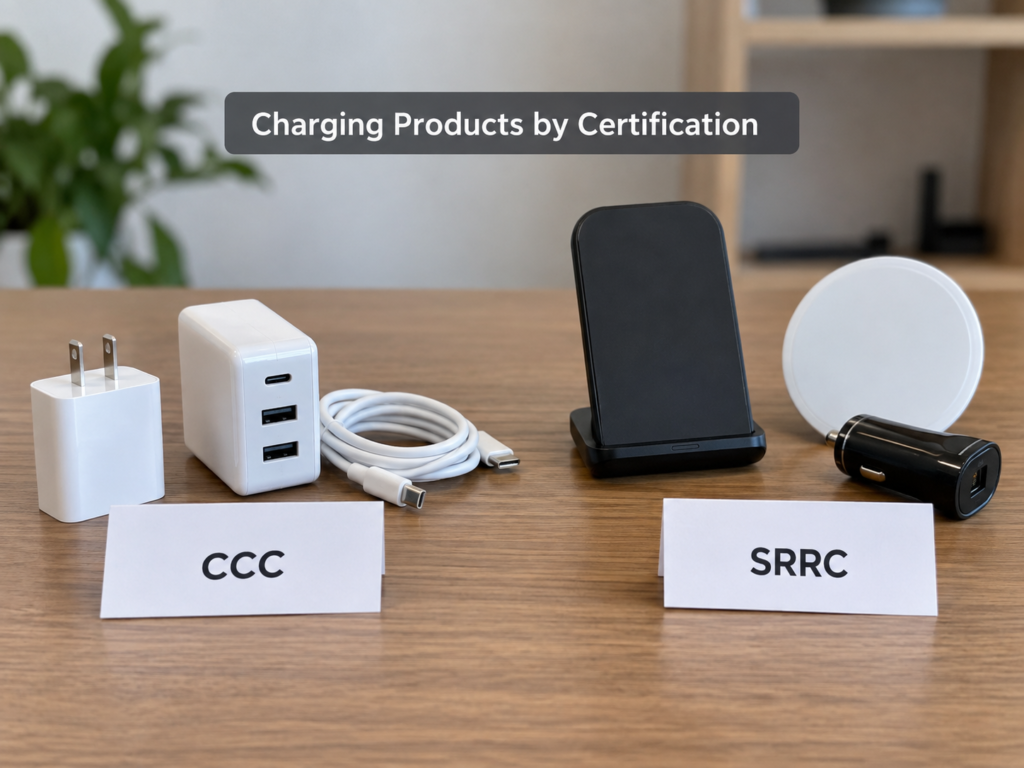
- Chargers and power adapters with mains input and voltage conversion functions, such as common mobile phone fast chargers and laptop power adapters;
- Independently sold wired charging bases, managed under the power adapter category;
- Lithium-ion battery power banks. Note that this category was officially and mandatorily included in the CCC catalog on August 1, 2024, and was voluntary before that;
- Cables that meet the scope of wire and cable products in the CCC catalog and corresponding implementation rules. Whether they are included depends on conditions such as product category, rated voltage, insulation or sheath structure, and applicable scope, not just whether it is a “high current” or “high power” charging cable.
Some categories need to be determined on a case-by-case basis and cannot be generalized: for example, data cables with E-Marker protocol chips, charging bases or cables sold as accessories with complete machines, need to be judged in combination with the latest catalog and implementation rules.
Categories that usually do not require CCC are also clear: purely passive low-voltage USB charging cables, that is, ordinary cables without chips, without voltage conversion functions, and only responsible for transmitting low-voltage electricity, are generally not in the CCC catalog. Even if the cable supports high USB charging power, it cannot be judged whether it falls within the scope of CCC wire and cable products solely based on the power label.
Determination of Charging Products Subject to Mandatory SRRC
The core of determining whether SRRC is needed is whether the product is a radio transmission equipment, and the final basis is the regulations on radio transmission equipment type approval and the exemption rules for micro-power short-range equipment.
Here we need to specifically explain “micro-power exemption”: it is not that low power means SRRC is definitely not required, nor can it be judged solely by fixed “four elements”. Whether to be exempted from type approval shall be verified item by item against all applicable technical conditions and use restrictions of the equipment category in the current Technical Requirements for Micro-power Short-range Radio Transmission Equipment. Frequency band, transmission power or field strength are only common conditions; different equipment categories may also involve requirements such as occupied bandwidth, spurious emission, modulation method, antenna, frequency tolerance, and use restrictions.
Smart chargers and shared charging devices with wireless communication functions such as Bluetooth, WiFi, and cellular networks need to first check whether they meet the micro-power equipment exemption requirements. Those that do not meet the conditions or are not within the exemption scope usually need to apply for SRRC.
Wireless charging bases with wireless control and positioning functions, such as wireless chargers whose power can be adjusted via APP, also need to be judged whether they fall within the exemption scope based on their actual wireless functions, rather than directly concluding that SRRC must be applied for just because they have Bluetooth or WiFi functions.
Categories that need to be determined on a case-by-case basis: extremely low-power wireless modules and charging products with NFC functions need to be checked one by one against the current official technical requirements and exemption scope.
Categories that usually do not require SRRC: purely wired charging products, data cables, and ordinary chargers without radio transmission functions do not need SRRC.
Core Relationship of Applicable Scope and Clarification of Common Confusions
First, the regulatory logics of the two are completely independent: CCC covers safety and electromagnetic compatibility, while SRRC covers wireless spectrum use, and neither can replace the other.
Second, the conditions for overlapping triggering need to be viewed separately: if a product falls within the scope of the CCC catalog and applicable implementation rules, and at the same time has wireless transmission functions that are not within the scope of type approval exemption, it may be necessary to apply for both CCC and SRRC.
Conversely, if the product is neither within the scope of the CCC catalog nor has wireless transmission functions requiring type approval, neither certificate is needed.
Here we also need to specifically clarify a common misconception: the EMC (electromagnetic compatibility) test in CCC is completely different from SRRC’s wireless spectrum approval. EMC is part of safety compliance, which tests whether the product will be interfered with or interfere with the normal operation of others; while SRRC tests whether the frequency band you use is legal and whether you occupy public communication resources without authorization. The regulatory objectives of the two are completely different.
Item-by-Item Comparison of Core Dimensions: Differences from Application to Supervision
If you have initially determined that you need one or both of the certifications, next we will break down the differences between the two certifications from several dimensions that everyone is most concerned about, to facilitate your planning of application pace and budget.
Regulatory Logic and Competent Authorities
CCC is a full-chain supervision, covering the entire process of production, import, and sales. Certification bodies designated by the CNCA are responsible for issuing certificates, which is equivalent to supervision from the factory to the shelf.
SRRC focuses more on model access, requiring equipment that should undergo type approval to complete the approval before going on the market. Certificates are directly issued by the Radio Administration Bureau of the MIIT, and its core supervision is “whether the wireless parameters of this product are compliant”.
The common point of the two is clear: both are statutory mandatory requirements. Products within the corresponding management scope cannot be legally sold in the Chinese mainland if they have not obtained certification or approval as required.
Core Test Content
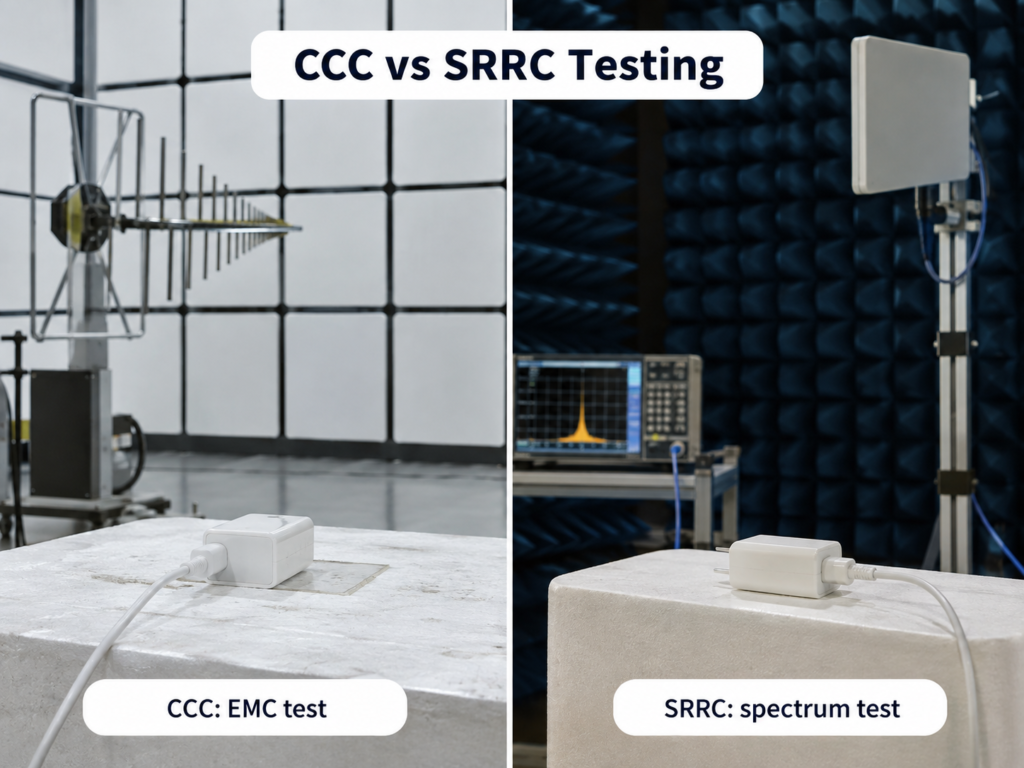
CCC’s testing direction revolves around “safety”: including electrical safety (such as insulation performance, leakage current level, withstand voltage capability), mechanical fire resistance, labeling specifications, and the EMC test mentioned earlier. Test results are affected by factors such as input voltage, ambient temperature, and load size.
SRRC’s testing direction revolves around “wireless parameters”: including whether the operating frequency is within the allowed frequency band, whether the transmission power exceeds the standard, whether the bandwidth meets the requirements, and interference control (such as whether spurious emissions and adjacent channel power will interfere with other frequency bands). Test results are affected by factors such as antenna type, software version, and operating mode.
Of course, the specific test items shall be determined according to the product category, current standards, and implementation rules, and test items will vary for different products.
Certification Process and Cycle
The cycles we mentioned are conventional estimates under the premise of qualified samples and complete materials, and there will be actual fluctuations.
The CCC process is longer: application → sample submission for testing → factory inspection → certificate issuance → post-certification supervision. Due to the factory inspection link, the overall cycle is about 6-10 weeks.
The SRRC process is relatively simple: application → sample submission for RF testing → data review → certificate issuance. There is no regular factory inspection link, so the cycle is shorter, about 4-8 weeks.
If your product needs to apply for both certificates, you can start them in parallel, which can shorten the total market entry time.
If the sample is unqualified and needs rectification, the factory inspection fails, or the materials need to be supplemented, the cycle will be extended accordingly. The specific cycle shall be subject to the official acceptance progress and product complexity. If you need expedited service, you should confirm with the certification body in advance.
Certificate Validity and Fees
CCC certificates do not have a fixed and unified validity period. They need to continuously meet the certification conditions and pass the post-certification supervision of the certification body to maintain validity. It is not a once-and-for-all matter after getting the certificate.
SRRC type approval certificates obtained in accordance with current measures are valid for a long term, and do not usually require renewal upon expiration. However, the certificate may be changed, revoked, or cancelled in accordance with the law, and when the product configuration changes, it may be necessary to re-evaluate whether the original approval information still applies.
In terms of fees, both are charged according to product complexity: the conventional cost of CCC ranges from thousands to tens of thousands of yuan, including testing fees, factory inspection fees, and post-certification supervision fees.
The cost of SRRC application mainly depends on services such as RF testing, rectification, agency, samples, and logistics. Type approval of radio transmission equipment is an administrative license, and should not be described as charging a “certificate fee”. Specific testing and service fees should be inquired from testing institutions or service agencies, and expedited services should be confirmed separately if needed.
Labeling and Traceability Requirements
CCC labeling requirements are clear: the CCC mark shall be affixed to certified products in accordance with the corresponding implementation rules. If it cannot be affixed to the product body due to reasons such as product size and material, allowed alternative labeling methods shall be adopted in accordance with the rules. The certificate number can be queried in the official system of the CNCA.
SRRC labeling requirement is to affix or display the CMIIT ID (that is, the radio transmission equipment type approval code, which is the unique identifier for each product approved by SRRC) as required. As for the position of the label, whether electronic labels can be used, and whether there are alternative methods, it shall be confirmed according to the product size, equipment conditions, and specific rules.
The two have a common requirement: the actually sold model, manufacturer, and product configuration shall fall within the coverage of the CCC certificate or type approval, and be consistent with the approval information. Packaging and online display shall not mislead about the model, certification status, or product configuration.
Follow-up Supervision and Consequences of Violation
CCC’s follow-up supervision is stricter: certification bodies will carry out post-certification supervision in accordance with implementation rules and annual plans, to verify whether mass-produced products are consistent with the originally certified samples, and whether key components and structures have been changed without authorization.
SRRC does not have regular annual factory inspections, and mainly relies on random inspections, which check whether the wireless parameters of the product are consistent with the approval information and whether the labeling is compliant.
In terms of violation consequences, both may lead to goods detention, fines, confiscation of illegal gains, and removal from shelves for recall. CCC non-compliance may also lead to the suspension, revocation, or cancellation of relevant product certificates, and may trigger administrative consequences such as ordering correction, confiscation, and fines. The specific disposal objects and penalties shall be subject to the illegal acts and the statutory authority of law enforcement agencies and certification bodies. This is only a conventional risk reference.
Model Coverage and Change Rules
Many sellers ask: I have several similar products, can I use one certificate? This depends on the model coverage rules.
CCC’s model boundary is: series models within the same certification unit must have the same structure, key components, and performance to share one certificate. If the manufacturer, key components, or circuit structure are changed, you must apply to the certification body for a change in advance, otherwise the certificate will become invalid.
SRRC’s model boundary is: products of the same approved model must have the same wireless solution, antenna, power, and firmware to share one approval ID. If the wireless module, antenna, frequency band, or operating mode is changed, it is necessary to re-evaluate whether to re-apply for approval.
No matter which certification it is, as long as the product configuration changes, you must confirm in advance whether you need to re-apply, don’t wait until you are inspected to find that the certificate is invalid.
Official Regulatory Basis and Query Portals
Whether you judge by yourself or find an agent to apply, the final basis shall be the official rules. Here we have sorted out the official regulatory sources and authenticity query channels for the two certifications for your self-verification.
The core regulatory basis related to CCC includes: the Catalog of Mandatory Product Certification, implementation rules for corresponding products, and relevant announcements issued by the State Administration for Market Regulation and the CNCA.
The official query portal is the mandatory product certification query system of the CNCA. You can enter the certificate number or product model to verify whether the certificate status, model, certificate holder, manufacturer, and key parameters are consistent.
The core regulatory basis related to SRRC includes: the Catalog of Radio Transmission Equipment Type Approval, the Technical Requirements for Micro-power Short-range Radio Transmission Equipment, and relevant announcements issued by the MIIT.
The official query portal is the radio type approval query system of the MIIT. You can enter the CMIIT ID or product model to verify whether the certificate status, ID, approved model, applicant, and wireless parameters are consistent with the actual product, and pay attention to whether there are applicable transitional provisions.
Finally, we would like to remind everyone that certification catalogs, implementation rules, and technical requirements will be dynamically updated with official announcements, and the final compliance requirements must be subject to the latest official documents.
Typical Charging Product Certification Determination Cases
To help you understand the determination logic more intuitively, we have sorted out the most common types of cases in charging products, which you can directly refer to against your own products.
Products That Only Need CCC
20W USB-C Wired Wall Charger
Configuration: With mains input, voltage conversion function, no wireless function at all.
CCC determination: Required, belongs to the power adapter category in the CCC catalog.
SRRC determination: Not required, no radio transmission function.
Key verification points: Confirm whether the product falls within the current CCC catalog, and the output parameters meet the corresponding standards.
Misjudgment reminder: Not all plug-in products need CCC; they must meet the catalog requirements.
Ordinary Wired Power Bank
Configuration: Lithium-ion battery energy storage, low-voltage output, no wireless function.
CCC determination: Required, officially included in the mandatory catalog of lithium-ion battery category since August 1, 2024.
SRRC determination: Not required, no radio transmission function.
Key verification points: Battery capacity and output parameters meet the CCC implementation rules for power banks.
Misjudgment reminder: Not all products with batteries are managed as power banks; they must be classified against the catalog.
Wired PD Charging Base Without Wireless Function
Configuration: With mains input, voltage conversion function, only wired output, no wireless function.
CCC determination: Those sold independently require CCC; those sold together with the complete machine shall be determined according to the implementation rules of the complete machine.
SRRC determination: Not required, no radio transmission function.
Key verification points: Confirm whether the product is sold independently and whether it is managed under the power adapter category.
Misjudgment reminder: Not all charging bases need CCC; it shall be judged in combination with the sales form and product classification.
Products That Need Both CCC and SRRC
Wireless Charger with Bluetooth APP Control
Configuration: With mains input, voltage conversion function, supports Bluetooth communication control, and has wireless power supply function.
CCC determination: Required, belongs to the power adapter/wireless charger category in the catalog.
SRRC determination: First check whether the Bluetooth function meets the exemption requirements for micro-power short-range radio transmission equipment; if not met or not within the exemption scope, SRRC is required.
Key verification points: Confirm whether the Bluetooth function meets all applicable technical conditions for micro-power equipment; whether the wireless power supply part requires separate approval.
Misjudgment reminder: Not all wireless chargers need SRRC; only active communication functions that are not within the exemption scope need to be processed, and inductive power transmission alone does not count.
Smart Fast Charging Station with WiFi Remote Monitoring
Configuration: With mains input, multi-channel voltage conversion, supports WiFi communication.
CCC determination: Required, belongs to the power adapter category in the catalog.
SRRC determination: First check whether the WiFi function meets the exemption requirements for micro-power short-range radio transmission equipment; if not met or not within the exemption scope, SRRC is required.
Key verification points: Confirm whether the WiFi frequency band, power, and other applicable technical conditions meet the exemption or approval requirements.
Misjudgment reminder: Low power does not mean SRRC is exempted; all applicable technical conditions and use restrictions of the product category shall be checked.
Shared Power Bank with Bluetooth Positioning Function
Configuration: Lithium-ion battery energy storage, built-in Bluetooth positioning module, supports shared communication function.
CCC determination: Required, belongs to the mandatory catalog of power bank category.
SRRC determination: First check whether the Bluetooth positioning module and the complete machine meet the exemption requirements for micro-power short-range radio transmission equipment; if not met or not within the exemption scope, SRRC is required.
Key verification points: Confirm whether the Bluetooth module parameters and antenna are consistent with the approval information, or whether they meet the applicable exemption technical conditions.
Misjudgment reminder: It is not that if the built-in Bluetooth module already has SRRC, the complete machine does not need to apply; module approval does not mean the complete machine is compliant.
Products That Do Not Require Either Mandatory Certification
Purely Passive USB-A to USB-C Charging Cable
Configuration: No chip, no voltage conversion function, only transmits low-voltage electricity/data.
CCC determination: Usually not required, not a product in the CCC catalog.
SRRC determination: Not required, no radio transmission function.
Key verification points: Confirm whether it has active chips such as E-Marker, and whether it is included in the wire and cable catalog.
Misjudgment reminder: Not all USB cables need CCC.
Purely Passive Charging Adapter Without Wireless Function
Configuration: No chip, no voltage conversion function, only physical interface conversion.
CCC determination: Usually not required, not a product in the CCC catalog.
SRRC determination: Not required, no radio transmission function.
Key verification points: Confirm whether it has active circuits and whether it has voltage conversion function.
Misjudgment reminder: Not all charging accessories require certification.
Special Products Prone to Misjudgment
Ordinary Qi Wireless Charger (Inductive Power Transmission Only)
Configuration: With mains input, voltage conversion function, only supports electromagnetic induction power transmission, no communication functions such as Bluetooth/WiFi.
CCC determination: Usually required, needs to be verified according to the catalog and product structure.
SRRC determination: Usually not required, wireless power supply is not an active communication transmission scenario that requires approval.
Key verification points: Confirm whether there is hidden wireless communication function, and whether the wireless power supply parameters meet the exemption requirements.
Misjudgment reminder: Not all products with the word “wireless” need SRRC.
USB-C Cable with E-Marker Chip
Configuration: With E-Marker protocol chip, low-voltage transmission, no wireless function.
CCC determination: Determined against the latest CCC catalog, not automatically mandatory.
SRRC determination: Not required, E-Marker is a wired identification chip, not a wireless transmission device.
Key verification points: Confirm whether it is included in the wire and cable/information technology equipment accessory catalog.
Misjudgment reminder: Not all cables with chips need CCC or SRRC.
Charging Cable Sold as Accessory with Charger
Configuration: Sold together with the complete machine, not sold separately.
CCC determination: If the cable itself falls within the CCC catalog, separate certification is required; otherwise, it shall be judged according to the rules of the complete machine.
SRRC determination: Not required if there is no wireless function.
Key verification points: Confirm whether it is manufactured/imported/sold separately, and whether it is a product in the CCC catalog.
Misjudgment reminder: It is not that all accessory cables do not need separate certification.
Advanced Pitfall Avoidance: Authenticity Verification and Common Misconceptions
After understanding the basic rules and determination methods, let’s talk about the pitfalls that new sellers are most likely to fall into, and how to verify the authenticity of certificates, to avoid spending money but still being non-compliant.
Methods for Verifying Certificate Authenticity and Validity
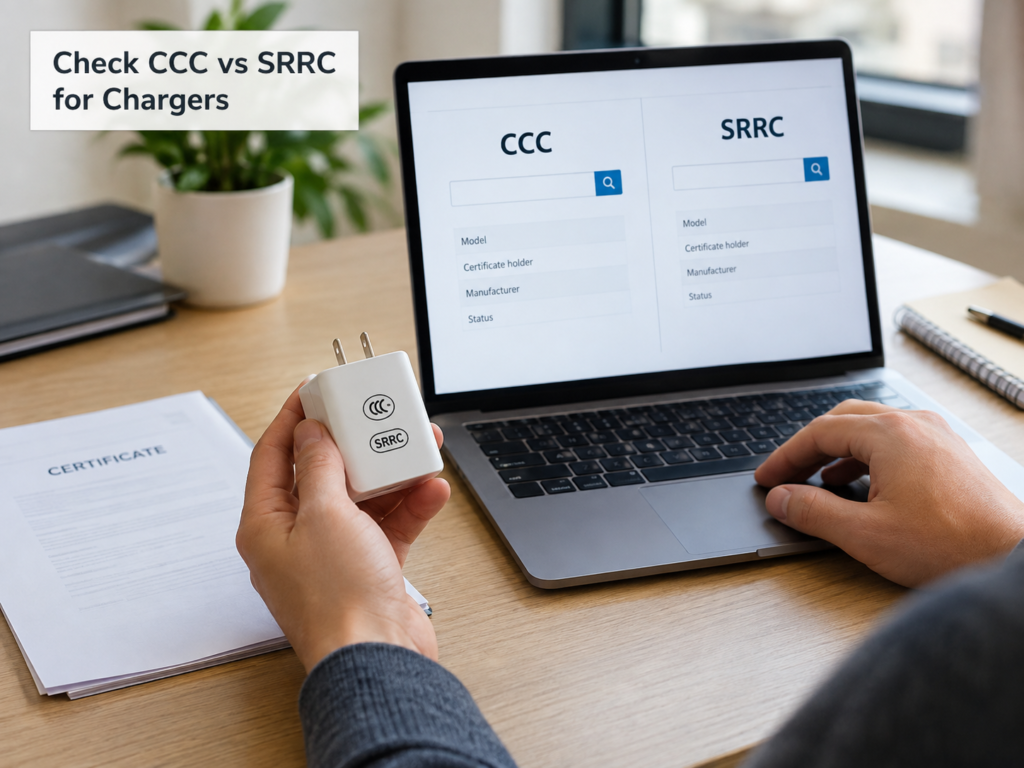
To check a CCC certificate, log in to the mandatory product certification query system of the CNCA, enter the certificate number or product model, and verify whether the information such as model, certificate holder, manufacturer, and certificate status are consistent.
To check an SRRC certificate, log in to the radio type approval query system of the MIIT, enter the CMIIT ID or product model, and verify whether the approved model, applicant, wireless parameters, and certificate status are consistent. The current type approval certificate is valid for a long term, but you still need to pay attention to whether the certificate has been changed, revoked, or cancelled in accordance with the law, and whether there are applicable transitional provisions.
Here is a core reminder: even if the certificate is real, it does not mean your product can use it. You must first verify whether the model on the certificate and the configuration of the product you actually sell fall within the coverage of the certificate. Many sellers are inspected because the model or configuration does not match.
Inventory of Common Cognitive Misconceptions
- With CCC, SRRC is not needed → Wrong. The two regulate completely different dimensions. If the product has wireless transmission functions that are not within the scope of type approval exemption, separate SRRC application may still be required.
- Low wireless power means SRRC is not needed → Wrong. All applicable technical conditions and use restrictions of the product category shall be checked, not just power.
- All USB cables need CCC → Wrong. Purely passive low-voltage cables usually do not need it, and shall be determined against the latest catalog. Supporting high-power charging does not mean it is automatically included in CCC.
- Overseas CE/FCC can replace Chinese certifications → Wrong. The testing standards and regulatory systems of the two are completely different, and Chinese certifications must be applied for separately.
- Wireless charging = SRRC required → Wrong. Wireless chargers that only do inductive power transmission do not need it; when they have wireless communication functions, it is also necessary to judge whether the function falls within the scope of type approval exemption.
- Test report equals certification/approval → Wrong. A test report is only one of the materials for applying for certification, and itself does not have the effect of market access.
- If the wireless module has SRRC, the complete machine does not need to apply → Wrong. Module approval does not mean the complete machine is compliant. As long as the configuration of the complete machine changes, re-evaluation is required.
Exclusive Pitfalls for Overseas Sellers
First, unqualified sample testing delays market launch. It is recommended to find a qualified laboratory for pre-testing before formally applying for certification, to find and rectify problems in advance, and avoid getting stuck in formal testing.
Second, CCC factory inspection fails. If your factory is overseas, you must choose a certification body with overseas factory inspection qualifications, otherwise the factory inspection cannot be carried out, and naturally you cannot get the certificate.
Third, the certificate model is inconsistent with the actually sold model. The actually sold product model, manufacturer, and configuration shall fall within the scope of certification or approval; the display on packaging and e-commerce detail pages shall not mislead about the model, certification status, or product configuration, otherwise it is easy to have goods detained during customs clearance.
Fourth, credulously trusting “guaranteed pass” agents leads to fines. You must choose formal certification bodies recognized by the authorities, do not seek cheap and find unregulated agents that promise “guaranteed pass”, in the end the certificate is fake, and you will be the one who suffers.
Quick Decision-Making Method and Market Entry Preparation
Finally, we have sorted out a set of directly implementable quick decision-making methods and market entry preparation checklist for you, to help you avoid detours.
Three-Step Method for Quick Determination of Charging Product Certification
Step 1: Disassemble functions. First disassemble your product functions, and look at two core points: Is it a CCC catalog product? Does it have radio transmission function?
Step 2: Check the basis. If the product may fall within the CCC catalog, check the catalog and corresponding implementation rules; if it has wireless transmission, check the type approval regulations, as well as the applicable technical requirements and exemption scope for micro-power short-range radio transmission equipment.
Step 3: Verify if unsure. If you are not sure, don’t guess blindly, directly consult the official window or a formal certification agency to avoid compliance risks caused by misjudgment.
Application Pace Planning for Products Requiring Dual Certificates
First, the two certifications can be applied for in parallel, without waiting for one to be completed before the other, which can shorten the total market entry time.
Second, prioritize locking variables: if the wireless solution is not finalized, do not start SRRC testing; if the power supply structure is not finalized, do not start CCC testing, otherwise you will have to retest every time you make a change, wasting money and time.
In addition, try to use mature wireless modules that have obtained SRRC, which can reduce the workload of repeated evaluation, but note that this does not exempt the complete machine from the type approval obligation, and the complete machine still needs to go through the process.
Finally, any changes must be evaluated in advance: for example, if the antenna, power, software, or circuit are changed, you must first confirm whether it will affect the certification status, don’t wait until the certificate becomes invalid to find out.
Pre-Market Entry Compliance Checklist
- Certificate verification: The CCC certificate is in normal status; if the product requires SRRC, confirm that the type approval certificate status, CMIIT ID, approved model, applicant, and wireless parameters are consistent with the actual product.
- Labeling verification: Affix the CCC mark on the certified product in accordance with the corresponding rules; the CMIIT ID shall be labeled in accordance with the type approval labeling regulations and equipment conditions, and confirm the allowed alternative labeling methods if necessary.
- Consistency verification: The key parameters of mass-produced products, such as circuit structure, wireless module, and antenna, are consistent with the originally submitted test samples.
- Import/listing verification: Prepare certificate documents in advance to meet the upload and verification requirements of customs and e-commerce platforms.
Suggestions for Cycle and Budget Reservation
In terms of time, it is recommended to reserve 2-4 weeks for rectification and supplementation. Do not apply right on the launch date. In case the sample is unqualified and needs rectification, it is easy to delay the launch.
In terms of budget, it is recommended to reserve an additional 10%-20% of the cost to cope with possible test rectification or expedited needs.
In terms of overall planning, for new categories, it is recommended to confirm the certification requirements 1-2 months in advance, and formally apply after the product is fully finalized, to avoid wasting costs due to mid-way design changes.
Core Summary
After reading this article, you should have mastered the following core capabilities:
First, you can clearly distinguish the core nature and regulatory logic of CCC and SRRC, and will no longer confuse the two;
Second, you can initially determine the certification needs of common charging products through the determination logic and three-step method;
Third, you can avoid the 7 most common compliance cognitive misconceptions and save a lot of detours;
Fourth, you can verify the authenticity of CCC certificates and SRRC CMIIT IDs, as well as model matching, through official channels;
Fifth, you can reasonably plan the application pace for products requiring dual certificates and complete basic compliance self-inspection before market entry.
Of course, specific compliance requirements will change with the update of official rules, and the final basis shall be the latest official documents. When you are unsure, consulting the authorities or formal institutions first is always the safest choice.