
Power adapter sellers new to the Canadian market, and even ordinary consumers, often hear the term “NRCan energy efficiency certification”, but many people misunderstand it from the start: some think it is a unified certificate issued by the Canadian government that you just stick on and you’re done; some think low-power chargers don’t need to comply; and others confuse it with safety certification. This article will explain all key points of NRCan energy efficiency compliance from basic knowledge to practical verification, so that whether you are an ordinary buyer, a cross-border seller, or a compliance professional just starting out, you can understand and apply it.
Must-Know Basics: Fundamental Understanding of NRCan Energy Efficiency Compliance
First, Grasp the Core Understanding
First, we need to correct a most common misunderstanding: the “NRCan energy efficiency certification” commonly known in the industry is essentially a statutory energy efficiency compliance obligation in Canada, not a stamped “compliance certificate” issued to you by Natural Resources Canada (NRCan for short). NRCan itself does not issue a unified compliance certificate. Applicable products must first have their energy efficiency verified as meeting standards by a qualified third-party certification body, then the responsible party submits an energy efficiency report to NRCan, and only after completing all statutory procedures is the product considered compliant.
Three Parties and Core Requirements
There are three core roles in the entire compliance system, with clearly divided powers and responsibilities:
• The regulatory body is NRCan, which is responsible for formulating rules and conducting random enforcement inspections, and does not directly participate in testing or certification issuance;
• The responsible party is legally referred to as a “dealer”. A dealer is the responsible subject defined in the Energy Efficiency Act and its regulations for the manufacture, import, sale, lease, or interprovincial transportation of regulated products; whether a party is a dealer shall be judged based on actual conduct and whether the purpose is sale or lease;
• The third party is a qualified certification body, responsible for verifying whether the product’s energy efficiency meets the standards, issuing verification marks, or confirming whether the product is eligible to use the international efficiency logo.
The core requirements of the entire compliance can be summarized in four points: the product meets the minimum energy efficiency standards, is verified by a qualified certification body, submits the energy efficiency report as required, and fulfills the obligations of labeling and document retention. If a regulated product is manufactured, imported, or transported interprovincially for the purpose of sale or lease but has not completed compliance, it cannot enter the Canadian market in that manner — of course, whether it is specifically regulated shall be judged in combination with the product category, specific conduct, and applicable exceptions.
Why Does NRCan Regulate the Energy Efficiency of Power Adapters?
Many people ask: It’s just a small charger, is it necessary to have special legislation to regulate its energy efficiency? In fact, the reasons behind it are very practical:
First, to reduce no-load standby waste across society. Think about it: how many chargers in your home are plugged into outlets all year round without being used? Although the power consumed by each charger when no-load is not much, when you add up millions or even tens of millions across Canada, the annual wasted electricity is an astronomical figure;
Second, to unify the minimum energy efficiency threshold of the market, keep out those shoddy products with cut corners and extremely high power consumption, and prevent bad money from driving out good money;
Third, to provide market entities with a clear basis for compliance judgment, so that sellers know what level to achieve and buyers also have a standard for judgment;
Finally, to reduce the long-term hidden electricity bill expenses of end users. The seemingly insignificant standby power consumption adds up to a considerable expense over the years.
Don’t Confuse Them: Boundaries Between NRCan Energy Efficiency and Other Certifications
Many people confuse NRCan energy efficiency with other certifications, but in fact they belong to completely different regulatory systems, and neither can replace the other:
| Certification/Label Type | Core Jurisdiction | Relationship with NRCan Energy Efficiency |
| NRCan Energy Efficiency | Energy consumption indicators such as no-load power consumption and operating efficiency of products | It is itself a statutory compliance requirement |
| Safety Certification (cUL/CSA, etc.) | Electrical safety risks such as electric shock and fire | Mutually independent; energy efficiency compliance does not mean safety qualification, and vice versa |
| EMC Certification (IC, etc.) | Electromagnetic interference, electromagnetic compatibility | Belong to different regulatory systems, completely unrelated |
| Overseas Energy Efficiency Rules (US DOE/EU ErP, etc.) | Energy efficiency requirements of the corresponding country/region | Each system is independent and cannot directly replace NRCan compliance |
| Performance Publicity (Fast Charging/GaN, etc.) | Charging speed and technical attributes advertised by manufacturers | Voluntary marketing content, unrelated to statutory energy efficiency compliance |
In short, NRCan energy efficiency is the statutory bottom line for the Canadian market, not an honorary evaluation of “high-quality products”, nor does it cover other dimensions such as safety and performance.
Step-by-Step Judgment: Does Your Power Adapter Need to Meet NRCan Requirements?
What many people find most troublesome is “Does my charger need NRCan compliance?” You don’t have to guess; just check step by step according to the logic below, and you can basically judge it by yourself.
The first thing to confirm is whether your conduct is directly related to the Canadian market. You should first confirm whether you are a dealer as defined by law, and whether the manufacture, import, or interprovincial transportation is for the purpose of sale or lease. Personal non-commercial use, import for export purposes, and specific exceptions stipulated in the regulations for import reports are subject to different terms and conditions respectively, and cannot be confused. You also cannot assume exemption just because the product is “in small quantities” or “is a sample”.
Next, you need to judge whether the product is an “external power supply” as defined by the regulations. To put it simply, it is an external power supply device independent of the electrical equipment, not a built-in part inside the equipment. Common AC-DC adapters such as USB chargers, laptop power supplies, desktop charging station modules, and external power supplies for routers or monitors may fall into this category; while power modules directly soldered inside the equipment are usually not considered external power supplies and do not need to comply with this category.
There is a super easy pitfall here that must be mentioned separately: NRCan’s regulation of external power supplies has no universal minimum power threshold. The circulating online claim that “you don’t need to worry about it if it’s less than 0.3W” is wrong. Whether a product is an external power supply shall be judged according to the complete definition and exclusions of the regulations, including statutory elements such as an independent physical enclosure, conversion of household alternating current to direct current or low-voltage alternating current, and the relationship with independent end products. Whether it is specifically regulated shall be comprehensively judged in combination with product type and statutory exclusions, not just based on power. In addition, all parameters shall be subject to the rated continuous parameters on the product nameplate; the peak power advertised by merchants and marketing nominal power do not count.
After confirming that it falls into the category of external power supplies, you need to further refine the product classification, because different categories have different energy efficiency requirements and test methods. There are three common classifications:
• Single-voltage external power supply: a product designed to provide one output voltage at a time. The “single voltage” here does not mean that the output current is fixed; the current on the product nameplate usually indicates the rated or maximum output capacity;
• Simultaneous multi-voltage external power supply: can output multiple channels of different AC/DC voltages at the same time. For example, some multi-port charging stations can output 5V to mobile phones and 20V to laptops at the same time;
• Adaptive external power supply: automatically adjusts the output voltage through a digital communication protocol (such as USB PD). It does not output multiple channels at the same time, but a single channel changes according to the device’s needs, such as the common PD fast charging chargers nowadays.
In addition, they can also be divided into direct operation type (ordinary consumer-grade products, most of which we come into contact with) and indirect operation type (for special purposes, with different rules, which need to be verified separately) according to operation mode. Note here: you cannot classify products only by their names. For example, USB-C PD chargers and multi-port chargers must be confirmed in combination with their simultaneous output capability, protocol logic, and circuit design; you cannot directly classify them as adaptive just because you see “PD”.
The next step is to exclude other separately regulated product categories. For example, “battery chargers” are a separately regulated category. When judging, the main function of the product, statutory definition, and applicable test procedures shall prevail, not just the product name. For example: some multi-port charging devices with battery management functions, whose main function is to charge batteries, may be evaluated according to the rules for battery chargers, not external power supplies.
Next, check the conditional exemption clauses. The conditions applicable to different exceptions are not the same, and shall be confirmed according to the corresponding regulatory provisions respectively; you cannot judge arbitrarily by yourself. Special reminder: adapters for medical, industrial, aerospace and other industrial uses are not automatically exempt. You must check whether the regulations clearly include this use in the exclusion or exemption scope; if it is not listed, even medical-use adapters must comply.
Then there are statutory explicit exclusions — if the product falls within this scope, it may not need to comply with the external power supply category, but it must be checked verbatim against the current definition of external power supply. For example, devices designed to power medical devices, solid-state lighting fixtures, DC motor ceiling fans, or battery chargers, as well as devices that meet the specified output voltage, current, and main motor load conditions, may not fall within the definition of external power supply.
Enterprises shall keep materials that can prove the product’s intended use and electrical parameters, but the regulations do not stipulate that a fixed “qualification certificate” or “circuit function description” must be submitted in all cases. To emphasize again: these are cases directly excluded from the statutory definition, not all products for industrial use are automatically exempt; do not expand the scope on your own.
The final step is to confirm the difference in obligations between import or sales scenarios; different scenarios have different requirements:
• Adapters imported separately and retailed separately: need to fulfill obligations such as testing, verification, report submission, and import information provision in accordance with applicable rules;
• Power modules truly built into the complete machine: usually do not belong to the external power supply project, and the complete machine or other applicable product categories shall be checked separately;
• External power supplies that are separated from the complete machine and only included with the packaging: may still be external power supplies, and their energy efficiency standards and import report obligations shall be judged according to the specific provisions of the regulations for the product and the corresponding import situation.
Core Requirements: Energy Efficiency Indicators and Testing Logic
After figuring out whether compliance is required, let’s take a look at what NRCan actually assesses, and the basic logic of testing and labeling.
Two Core Assessment Indicators
In fact, NRCan’s energy efficiency assessment for power adapters only has two easy-to-understand indicators:
The first is no-load power consumption: it is the power consumed by the adapter itself when it is plugged into the mains and no load is connected to the other end, in watts (W). The lower this value, the more power-saving it is in standby mode;
The second is average efficiency: it is the ratio of the electrical energy input from the grid to the available output electrical energy when the adapter is working normally, expressed as a percentage. The higher the value, the less electrical energy is wasted.
You don’t have to memorize the specific limit values by rote, because the requirements vary for different product types and different manufacturing dates; just check the corresponding regulations according to the rules.
How to Check Energy Efficiency Limits
The core logic of checking limits is: first classify the product, then find the corresponding standard in combination with the manufacturing date; there is no need to memorize the power segments circulated online by rote.
• For non-replacement direct-operation external power supplies manufactured on or after July 1, 2017, Table D.1 of the CSA C381.1-17 standard applies;
• For replacement direct-operation external power supplies manufactured on or after February 10, 2020, Table D.1 of the CSA C381.1-17 standard also applies;
• For indirect-operation external power supplies, check according to the corresponding standards specified in the regulations;
• For adaptive or simultaneous multi-voltage products, you need to first calculate the equivalent parameters according to the corresponding test procedures, then match the corresponding limits.
Various power segment tables circulated online are only illustrations of common situations. If you really want to comply, you must take the latest original regulations as the standard, and cannot directly copy them.
Basic Logic of Energy Efficiency Testing
Energy efficiency testing is not something you can do casually on your own; it must follow the official test procedures.
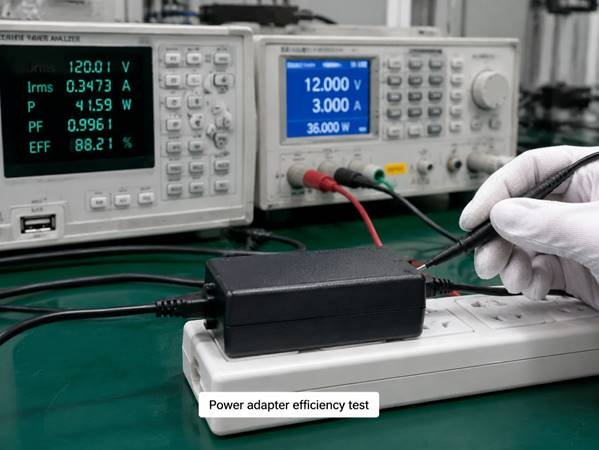
The test input voltage and frequency must be determined according to the applicable test procedures and the product’s rated input range. For external power supplies with a rated 100–120V AC input, the typical test conditions specified in CSA C381.1-17 are 115V and 60Hz; for products with other rated input ranges, the corresponding clauses of the standard shall be followed. When testing average efficiency, single-voltage products are generally tested at four rated load points: 25%, 50%, 75%, and 100%, then the average efficiency is calculated.
Testing must be completed by a laboratory with corresponding energy efficiency testing capabilities, and the measured data must also be verified by a qualified certification body. The final test report needs to include product information, test conditions, test process and results, and is the core technical document for subsequent verification, declaration, and retention.
Relationship Between Level VI Labeling and Compliance
Many people have seen the Roman numeral “VI” mark printed on chargers, which is commonly referred to as Level VI. What is its relationship with NRCan compliance?
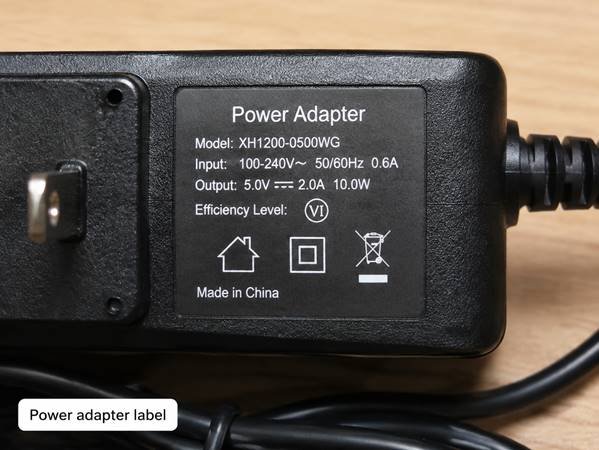
First, the mandatory compliance mark required by regulations is the verification mark, issued by a qualified certification body; while the internationally used efficiency Roman numeral mark (such as Level VI), if it meets the requirements, can directly replace the verification mark, and there is no need to additionally print the certification body’s mark.
But there is a very common misunderstanding here: printing the Level VI mark does not mean that NRCan compliance is passed. The Level VI mark itself is only a label of efficiency grade. It must first pass the verification of a certification body to prove that the product does reach the corresponding grade, and the energy efficiency report has been submitted, before this mark has compliance effect. In addition, Level VI is only an energy efficiency grade, and has nothing to do with whether it is fast charging or whether GaN technology is used; don’t be confused by marketing publicity.
Practical Implementation: Full Workflow of NRCan Energy Efficiency Compliance
Many people think that compliance is “applying for a certificate from NRCan”, but that’s not the case at all. The core of the entire process is third-party verification + self-declaration. NRCan does not issue a unified compliance certificate. Let’s look at how to do it step by step.
Pre-Compliance Preparation
Before officially starting the compliance process, doing three things first can save you a lot of detours:
First, confirm the responsible party (dealer), that is, judge who bears the corresponding compliance obligations based on the actual manufacture, import, sale, lease, or interprovincial transportation conduct;
Second, prepare basic materials, including product specifications, test samples, and design drafts of nameplates and packaging;
Third, according to the step-by-step judgment method mentioned earlier, pre-classify the product, and initially confirm the product category and applicable requirements to avoid going astray later.
Core Compliance Workflow
The entire compliance process can be divided into seven steps. Note that this is not a process of “applying for a certificate from NRCan”, but a statutory compliance obligation process:
Step 1: Product classification confirmation. Be sure to confirm the product’s subcategory clearly: whether it is single-voltage, adaptive, or simultaneous multi-voltage, and whether it is direct operation or indirect operation. If the classification is wrong, subsequent testing will be in vain;
Step 2: Determine the verification and labeling path. Choose in advance whether to use the certification body’s verification mark or a qualified international efficiency mark (such as Level VI). Only after confirming this should you make the nameplate to avoid rework later;
Step 3: Obtain energy efficiency data. Generally, a capable laboratory is entrusted to conduct testing; if permitted by regulations, calculation using a qualified mathematical model is also acceptable;
Step 4: Certification body verification. Submit product materials and energy efficiency data to a qualified certification body, which will verify whether the product classification is correct, whether the energy efficiency data meets the standards, and whether it is eligible for label use;
Step 5: Submit the energy efficiency report. Be sure to submit the report through NRCan’s official system before import or interprovincial transportation. This is a statutory mandatory obligation, and you cannot wait until the goods arrive at the port to make up for it;
Step 6: Import/interprovincial release verification. After confirming that the verification is completed, the report has been submitted, and all materials are complete, then arrange import or interprovincial transportation to avoid being detained;
Step 7: Archiving and change control. All compliance documents must be kept properly as required by regulations. If there are subsequent product changes, the impact on the compliance status shall be evaluated in a timely manner.
Supplementary note: NRCan does not have routine factory inspections, nor does it issue a unified “compliance certificate”, but the competent authority can conduct random enforcement inspections at any time and require all compliance records to be provided, so documents must be kept properly.
Technical Document Package and Change Control
Compliance is not a one-and-done thing; subsequent document management and change control are very important.
First is the core technical document package, each document has its corresponding purpose:
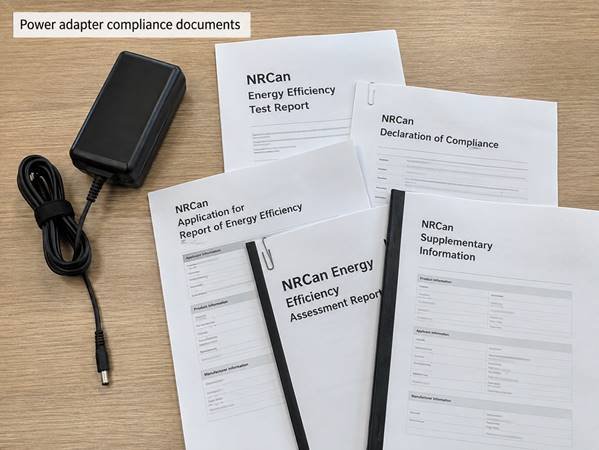
• Basic product materials (specifications, nameplates, BOM, circuit descriptions): used for product classification and parameter verification;
• Energy efficiency data documents (test reports, mathematical model calculation basis): used for energy efficiency verification and declaration support;
• Certification body verification documents: used to prove that energy efficiency information has been verified and label use is legal;
• Energy efficiency report submission voucher: used to prove that the statutory declaration obligation has been completed;
• Import/sales records: used for regulatory random inspection traceability.
Many sellers ask: Can multiple models share one test report? Only when these models are technically identical — for example, the circuit, power, and output configuration are the same, only the appearance, color, and silk screen are different — can they share it; otherwise, they cannot.
If there are subsequent changes to the product, all changes must be recorded to ensure traceability, and corresponding actions must be taken according to the content of the changes:
• Changes to appearance, color, silk screen, or model, etc.: shall also be submitted to the certification body or verification subject for confirmation first. Only when it is confirmed in writing that the change does not affect the identification of the verified product, mark authorization, and energy efficiency results may supplementary testing be unnecessary, and the confirmation record shall be kept;
• Changes to key components or circuits: submit to the certification body for evaluation, and conduct supplementary testing and re-verification if necessary;
• Changes to output gears, ports, or rated power: require reclassification, supplementary testing, re-verification, and update of declaration information;
• Brand or model change: update verification and declaration information, and confirm technical equivalence;
• Change in import or sales scenario: check the corresponding compliance obligation requirements.
Don’t Confuse Them: Different Labels Belong to Different Regulations
Various labels on products belong to different regulatory systems and cannot replace each other; they must be checked separately:
• The core product labeling requirement of NRCan energy efficiency regulations is the applicable verification mark; external power supplies may use the international efficiency mark when meeting regulatory conditions;
• Nameplate requirements for electrical rated parameters such as input and output shall be checked separately according to applicable safety standards, certification schemes, and other product regulations at the same time, and shall not be uniformly classified as NRCan energy efficiency labeling requirements;
• Safety certification marks: such as cUL, CSA, etc., are under the jurisdiction of safety regulatory authorities and have nothing to do with energy efficiency;
• Market voluntary labels: such as GaN, fast charging, etc., are manufacturer marketing content and have no regulatory effect;
• English-French bilingual/packaging requirements: fall within the scope of Canada’s Consumer Packaging Act and provincial consumer information laws, and need to be verified separately.
Compliance Verification: Five-Stage Evidence Chain Cross-Verification Method
Whether you are a seller purchasing products or a consumer who wants to confirm whether the product you bought is compliant, you must learn to verify correctly — you cannot draw a conclusion just by looking at a certain label or a certain document. You need to cross-verify with multiple materials to form a complete evidence chain.
Core Principles of Verification
First, remember three principles:
First, do not rely on a single evidence; multiple materials must be cross-verified to form a complete evidence chain before it counts;
Second, NRCan’s official public search is only an auxiliary means and cannot be used alone as a basis for judging compliance or non-compliance;
Third, the inability to find public information can only trigger a supplementary document requirement, and cannot directly presume compliance or non-compliance.
Five-Stage Evidence Chain Verification Sequence
When conducting specific verification, you can follow the order from easy to difficult, divided into five steps:
Stage 1: Physical verification. First look at the product itself, check whether the brand, model, and rated parameters are clear, whether the energy efficiency label is standardized, and whether the model corresponding to the label is consistent with the nameplate;
Stage 2: Verification of certification body verification materials. Check the verification documents issued by the certification body to confirm that the product model, energy efficiency parameters, and label use eligibility are consistent with the physical product;
Stage 3: Verification of energy efficiency report submission voucher. Confirm that the report has been submitted before import or interprovincial transportation, and the declaration information is consistent with the verification documents;
Stage 4: Verification of test/calculation basis. Check that the product information, test conditions, and results in the test report or calculation documents are consistent with the verification documents;
Stage 5: Verification of import documents. If it is an adapter imported separately, check whether the information on the customs declaration form and commercial invoice matches; if it is included with or built into the complete machine, check whether the declaration parameters of the complete machine correspond.
Common Reasons Why Information Cannot Be Found in the Public System
Many people are used to checking information in NRCan’s public system, and if they can’t find it, they think it’s non-compliant. In fact, there are many reasons why it can’t be found:
• The sales SKU and the declared model have different names; you need to ask the seller for the official declared model before checking;
• Newly submitted declaration information has not been made public yet; the specific public availability time limit shall be subject to NRCan’s official statement;
• The product belongs to an exempt or excluded category and does not need to be declared at all;
• The keyword is misspelled, for example, there are differences in the brand name or model suffix; just change the keyword and try again.
As the saying goes: not being able to find information does not mean it must be non-compliant; it must be comprehensively judged in combination with other materials.
Boundaries of Verification Results
Finally, it should be clear that verification results have boundaries and cannot prove everything.
A complete document chain can support confirming that a certain model has corresponding verification documents and has submitted an energy efficiency report, but this does not constitute NRCan approval, nor can it prove solely by documents that the actual sales batches continue to meet all applicable requirements. As for whether the physical product is consistent, whether the documents are authentic, and whether the actual energy efficiency meets the standards, certification body confirmation, sampling testing, or regulatory verification may still be required.
It also cannot prove that the product meets safety or EMC requirements, nor can it prove that the currently sold batches are completely consistent with the verification samples — these require other verification methods.
Pitfall Avoidance Guide: Common Misconceptions and Risk Warnings
Common Cognitive Misconceptions
We have organized the common misconceptions mentioned earlier into a table for your quick comparison:
| Common Misconception | Correct Statement | Corresponding Content Location |
| Low-power chargers definitely don’t need NRCan | There is no universal 0.3W power threshold; it needs to be comprehensively judged in combination with product type and statutory exclusions | Step-by-Step Judgment, Step 3 |
| Having a Level VI mark means NRCan is passed | The mark is only valid when certification body verification is completed and the energy efficiency report is submitted at the same time | Energy Efficiency Indicators and Testing Logic |
| NRCan energy efficiency does not require third-party participation at all | Applicable products need to have their energy efficiency verified by a qualified certification body | Basic Understanding |
| Energy efficiency certifications from other countries/regions can replace NRCan | Each system is independent; US DOE, EU ErP, etc. cannot directly replace it | Basic Understanding Boundaries |
| If the complete machine passes certification, the matching adapter is compliant | External power supplies separated from the complete machine still need to be judged separately according to applicable rules | Step-by-Step Judgment, Scenario Differences |
| NRCan has fixed annual renewal/validity period | There is no fixed annual renewal; compliance depends on regulatory changes and product changes | Practical Implementation, Change Control |
| Medical/industrial adapters are directly exempt | Only products that meet the statutory exclusion conditions in the definition may not apply; industrial use is not automatically exempt | Step-by-Step Judgment, Exclusions |
Pitfall Avoidance Points and Violation Risks for Each Scenario
The key points of pitfall avoidance are different for different scenarios; you can match them to your situation:
• Manufacturers/brands handling compliance: confirm product classification before testing, don’t test the wrong category; for core parameter changes, first find a certification body for evaluation, don’t wait until the change is completed to find out that re-testing is needed; confirm the labeling path before production to avoid rework due to wrong nameplate printing;
• Purchasing/e-commerce sellers: be wary of vague statements from suppliers such as “US-Canada universal” and “global certification”, and must separately verify NRCan compliance information;
• Importers: for adapters imported separately, prepare import information documents in advance; for adapters separated from the complete machine and included with the packaging, also confirm whether they have completed compliance according to applicable rules, don’t think that it’s fine as long as the complete machine passes.
Non-compliance may lead to consequences such as customs clearance detention, product removal, and fines. The specific penalty intensity shall be subject to the regulatory enforcement scale; never take chances.
Ready-to-Use: Compliance Checklist
We have compiled checklists for three different scenarios, which you can use directly.
Ordinary Consumer Purchase Checklist (Canadian Market)
1. Safety dimension: has a legal Canadian safety certification mark, and nameplate parameters are clearly marked;
2. Energy efficiency dimension: has a clear energy efficiency label, and the model corresponding to the label is consistent with the product nameplate;
3. Demand matching: nominal power, interfaces, and functions match actual needs;
If further verification is needed, you can ask the seller to provide verification documents and the official declared model, and check according to the five-stage evidence chain method.
Cross-Border Seller/Purchasing Pre-Listing Checklist
1. Confirm whether the product falls within the NRCan regulatory scope according to the step-by-step judgment method;
2. Product classification is correct, energy efficiency testing and certification body verification have been completed, and labels meet requirements;
3. The energy efficiency report has been submitted before import/interprovincial transportation, and the declaration information is consistent with the actual product;
4. For adapters imported separately, import information documents required for customs/commercial invoices have been prepared;
5. Product labels meet corresponding regulatory requirements (check energy efficiency, safety, language, etc. separately);
6. Information such as model, brand, and power declared to customs is consistent with the actual product.
Quick Troubleshooting Steps for Suspicious Products
1. Check whether the model, parameters, and energy efficiency labels on the physical product, packaging, and sales page are consistent;
2. Preliminarily judge the product classification and regulatory scope according to the step-by-step judgment method;
3. Require the supplier to provide certification body verification documents and report submission vouchers, and check the parameters;
4. For products imported separately, check whether the import document information matches;
5. If there is an official public search portal, use the official declared model to query for auxiliary verification;
6. If there are still doubts, do not purchase or list it as a compliant product.
Summary
After reading this article, you should have a from-beginner-to-practical-application understanding of NRCan energy efficiency compliance for power adapters. You can distinguish the core boundaries between NRCan energy efficiency and safety, EMC, and performance certifications, and know the respective roles of the regulator, responsible party, and third-party institutions; you can judge whether a power adapter needs to meet NRCan requirements following the step-by-step judgment method, and can also identify statutory exclusions; you can understand the meaning of no-load power consumption and average efficiency, and can locate the source of energy efficiency limits according to manufacturing date and product type; you can correctly understand the role of Level VI and verification marks, and will not directly equate a label with compliance; you can verify the compliance status of products through the five-stage evidence chain method, and also understand the boundaries of verification results; you can distinguish the different applicable scenarios of separately imported, complete-machine-included, and complete-machine-built-in power modules; you can avoid common misconceptions and risks in the scenarios of handling, purchasing, selling, and importing; and you can also conduct basic compliance checks for power adapters in the Canadian market.
NRCan energy efficiency compliance may seem to have many items, but in fact the core logic is very simple: classify according to rules, test according to standards, declare according to requirements, and retain according to regulations. Do every step solidly, and you can steadily avoid most risks.