
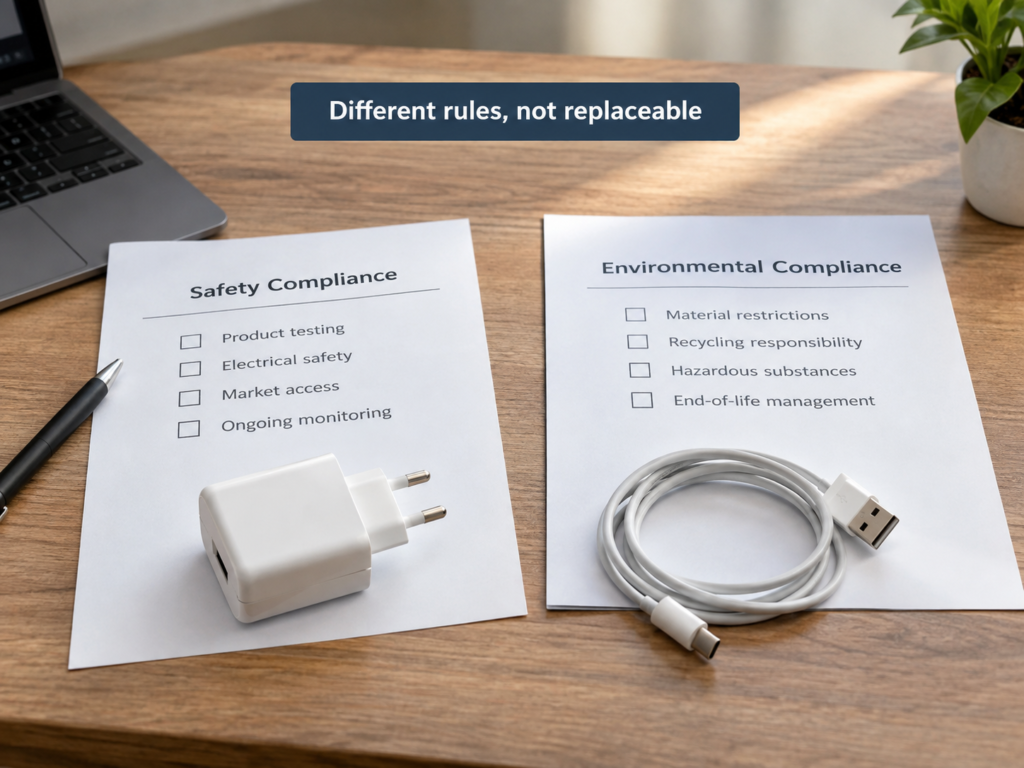
Sellers of charging products targeting the South Korean market have most likely been confused by the two environmental requirements K-RoHS and EPR: some say both are environmental compliance, so doing one is enough; some use EU RoHS reports directly to meet requirements, only to have their products removed from platforms; others hear that all charging cables will require EPR in 2026, rush to register in advance, and end up wasting money.
In fact, these two regulations are completely different, with different controlled links, required content, and responsible entities. Getting them wrong means wasting money at best, and being fined or banned from import at worst.
This article focuses on consumer-grade charging cables, chargers, power adapters and similar products, explaining K-RoHS and EPR thoroughly from basic positioning, applicability determination, compliance processes to illegal consequences. It will also answer the 5 most frequently asked questions by sellers, and finally provide you with quick determination methods and official inquiry channels. Whether you are a new cross-border seller, a charging product supplier, or an entry-level compliance staff, you will be able to quickly sort out your compliance obligations and avoid entry-level pitfalls after reading this.
Align Baselines Before Comparison: Avoid Talking Past Each Other
Before the formal comparison, we will first clarify the comparison benchmarks to avoid drawing wrong conclusions due to different product scopes and regulation versions.
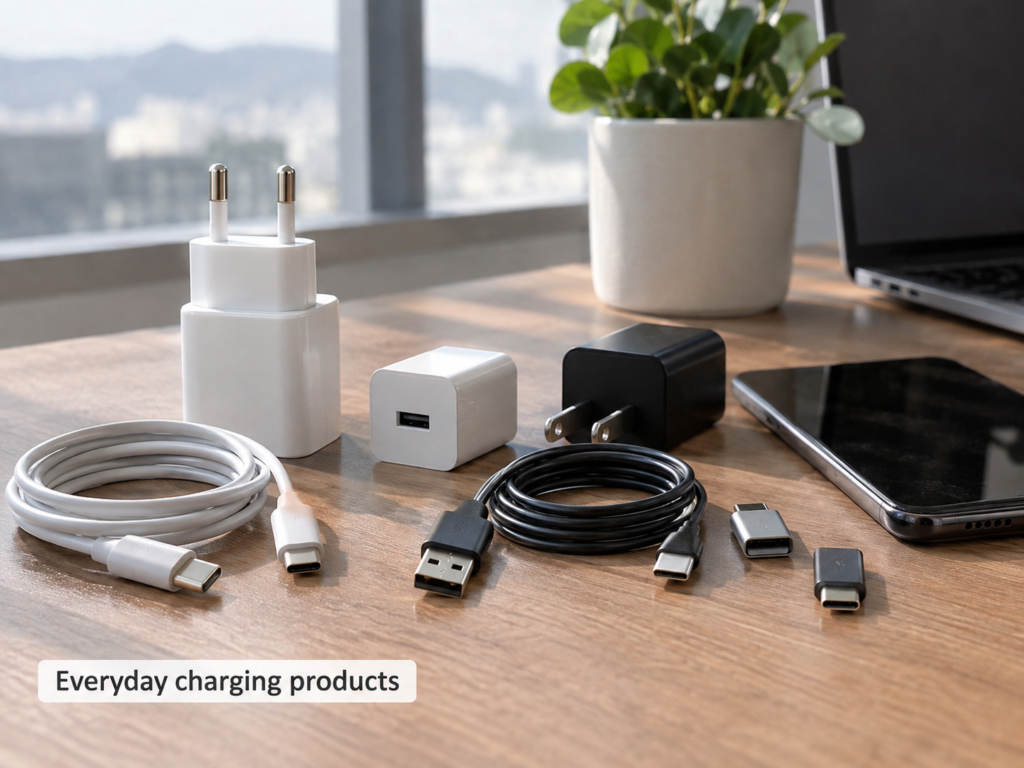
First, the unified product scope. The default comparison objects in this article are ordinary consumer-grade charging products, including commonly sold charging cables, USB/USB-C data cables, chargers, power adapters, and connectors with electronic functions. For boundary categories such as passive charging cables, USB-C cables with E-marker chips, charging sets, power banks, and wireless chargers, we will explain the determination rules separately; charging products for special purposes such as industrial grade, medical use, and military use are not within the scope of this article and require separate verification.
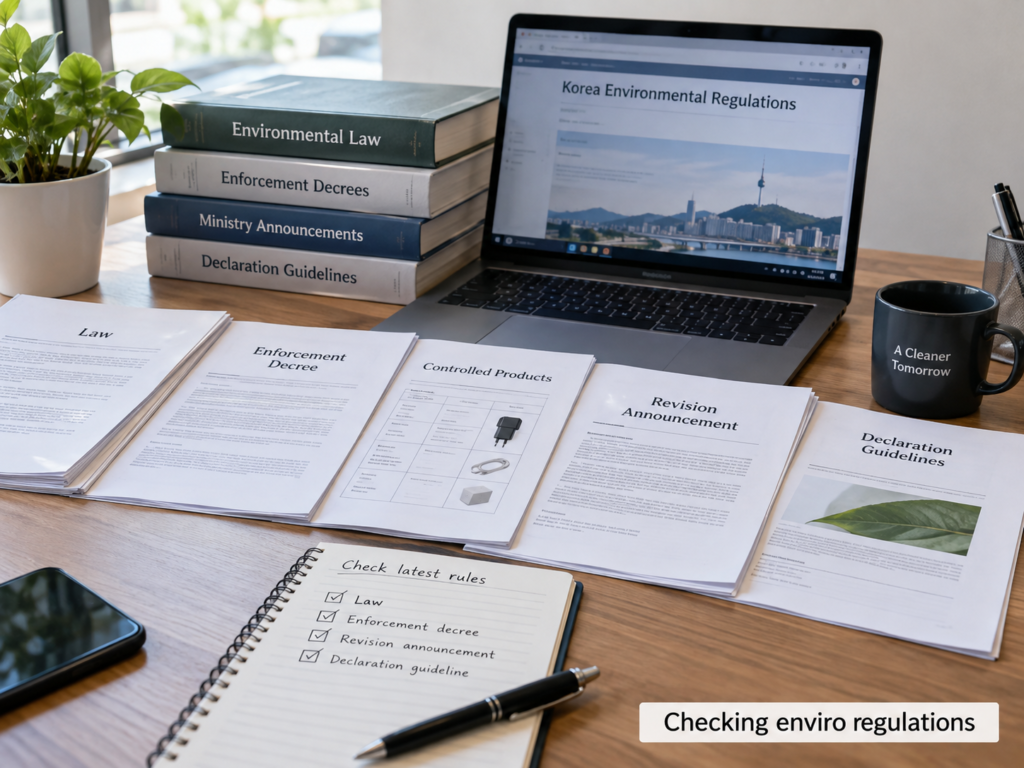
Second, the verification rules for regulation versions. All content in this article is based on the currently effective public regulations for consumer electronics in South Korea from 2024 to 2026, and does not involve historical versions or drafts still under public consultation. To verify the latest rules, you must check four types of official documents: the full text of the law, enforcement decrees and attached schedules (i.e., the list of controlled products), revision announcements from the Ministry of Environment, and annual declaration guidelines. It is particularly worth mentioning that regarding the 2026 scope adjustment of electrical and electronic EPR, there are many rumors online now, but the final result must be subject to the official schedule released by the authorities. There is no conclusion that “all charging accessories are automatically included”, so do not trust unofficial information easily.
Finally, the comparison dimensions and applicable prerequisites. We will compare item by item from 7 dimensions: regulatory objectives, applicability determination, core requirements, obligated entities, compliance processes, illegal consequences, and exemption rules. All conclusions default to ordinary consumer-grade charging products. For special categories or special transaction structures (such as OEM manufacturing, B2B bare packaging), separate verification is required.
Practice with Real Scenarios: 4 Common Charging Product Cases
After finishing the rules, let’s practice with several real scenarios that sellers most often encounter, to help you better understand how to make determinations.
Scenario 1: Independently Retailed 25W USB-C PD Charger
Facts: A Chinese cross-border seller sells 25W USB-C PD chargers on South Korean e-commerce platforms, with color box packaging and no built-in battery.
- K-RoHS determination: Usually included in control, needs to comply with material hazardous substance requirements;
- EPR determination: Need to check the item scope of electrical and electronic EPR, your entity identity, and scale threshold; for packaging EPR, need to check the packaging material category and threshold;
- Packaging obligations: Need to check the applicable requirements for packaging separate discharge labeling and material evaluation;
- Evidence to be retained: Product classification certificate, BOM, test report, EPR declaration receipt, packaging labeling certificate;
- Points still to be confirmed with the South Korean side: The current year’s declaration item classification, small-scale exemption threshold, and whether the platform has additional compliance requirements.
Scenario 2: Complimentary Bundled USB-C Charging Cable
Facts: Complete mobile phones of a South Korean brand are imported, with a complimentary USB-C charging cable in the packaging box, produced by a Chinese OEM factory.
- K-RoHS determination: Need to check the control schedule. Usually, charging cables need separate compliance and will not be automatically exempted just because they are complimentary with the main device;
- EPR determination: Whether it can be declared together with the main device is subject to the current year’s PRO rules and item classification, and the responsible entity is verified based on the brand owner and customs declaration entity;
- Packaging obligations: For those packaged with the main device, need to check the applicable requirements for packaging labeling;
- Evidence to be retained: Material compliance certificate of the charging cable, complete device declaration records, responsibility division documents;
- Points still to be confirmed: Whether accessories can be declared together with the complete device, and the attribution of the responsible entity.
Scenario 3: B2B Bare-Packaged Wholesale USB Connector Components
Facts: A Chinese supplier exports USB connector components in bare packaging to a South Korean factory, for the South Korean factory to assemble into finished products.
- K-RoHS determination: First confirm whether the components are within the control scope, and the seller needs to provide compliance certificates as required;
- EPR determination: The responsible party is confirmed based on the transaction structure, customs declaration entity, and scale threshold, and is not automatically borne by the South Korean factory;
- Packaging obligations: If there are indeed no packaging materials falling within the applicable scope, or if corresponding exemption conditions are met, relevant packaging obligations may not be triggered; however, judgment should be made item by item based on the actually used transportation, collection and protective packaging materials, as well as the applicable scope, obligated entities and exemption conditions, and cannot be directly excluded solely on the basis of “bare packaging”;
- Evidence to be retained: Product classification certificate, material compliance declaration, transaction contract;
- Points still to be confirmed: Whether the components are within the component exemption scope, and the attribution of the responsible entity.
Boundary Product Determination Reference
There are several other common boundary products, for your reference:
- USB-C cables with E-marker chips: Usually included in K-RoHS control; for EPR, need to check the electrical and electronic item scope;
- Power banks with built-in batteries: Need to check both electrical and electronic EPR and battery-related obligations at the same time;
- PCBs imported only as components: Determine whether they are included in the K-RoHS/EPR scope based on the end use.
Don’t Trust Online Information Blindly: Official Inquiry Channels and Archiving Requirements
Information online is mixed, much of it is outdated or inaccurate. To verify the latest rules, you must check official channels. We have compiled several of the most authoritative databases and archiving requirements for your own verification.
1. Korea National Legal Information Center
Purpose: Verify the full text of laws, enforcement decrees, attached schedules and revision history; it is the most authoritative source of laws and decrees.
Query fields: Decree name, revision number, effective date.
Archiving requirements: Download the official Korean original text, mark the query date, and save screenshots of core clauses.
2. Official Website of the Ministry of Environment (MOE) of Korea
Purpose: Verify regulation revision announcements, policy interpretations, and major adjustment notices. For example, the 2026 EPR scope adjustment will be announced here as soon as possible.
Query fields: K-RoHS, electrical and electronic EPR, packaging EPR, packaging labeling.
Archiving requirements: Save the original PDF of the announcement, and take screenshots of the release date and document number.
3. Official Websites of Korea Environment Corporation (KECO) and PROs
Purpose: Verify annual declaration guidelines, item classification, fee standards, and declaration system operation requirements. Declaration operations, annual notices and system materials can be inquired from the Korea Environment Corporation and applicable collective performance organizations; item scope, obligated entities, statutory standards and fee basis should be simultaneously checked against laws, enforcement decrees, Ministry of Environment notices and current notices issued by the Korea Environment Corporation.
Query fields: Annual declaration guidelines, item classification table, exemption threshold, declaration process.
Archiving requirements: Download the current declaration guidelines, and save consultation records and declaration receipts.
Enterprise Internal Archiving Requirements
In addition to official documents, internal enterprise archiving is also very important. Materials that need to be retained include: regulation query records (date, querist, core conclusions), compliance determination basis, evidence documents, responsible persons and review records.
Version management should also be done well: after regulations are updated, re-verify and update archived documents to avoid using outdated versions. Otherwise, when a random inspection occurs, it is useless to use old regulations as the basis.
14 Most Common Entry-Level Pitfalls
We have compiled the pitfalls that entry-level sellers most often fall into, see if you have encountered any of them.
5 Common Misconceptions About K-RoHS
- EU RoHS reports can be used directly as K-RoHS reports → Wrong. EU RoHS test reports do not automatically prove compliance with South Korean requirements. They should be checked against South Korea’s applicable items, limits and use exemptions, and conformity confirmation and confirmation result disclosure should be completed in accordance with South Korean rules; if customers, platforms or disclosure methods require Korean language materials, then prepare corresponding Korean documents;
- Testing only high-risk parts can prove compliance → Wrong. Except for applicable statutory use exemptions, restricted substances should meet the limits at the homogeneous material level, and enterprises should complete conformity confirmation in accordance with prescribed methods;
- K-RoHS is an official mandatory certification → Wrong. Its essence is conformity confirmation, test for inspection, and disclosure of confirmation results; there is no mandatory official certificate;
- Products with electronic functions must be subject to K-RoHS control → Wrong. It is subject to the list in the attached schedule of the enforcement decree, and judged in combination with use and structure;
- Small-batch samples/exhibition products do not need to comply with K-RoHS → Wrong. You need to first check statutory exceptions; those that do not meet the exceptions still need to comply.
6 Common Misconceptions About EPR
- After the 2026 EPR adjustment, all charging accessories must be registered separately → Wrong. The scope adjustment is subject to the official schedule, and there is no conclusion that all are automatically included;
- Having packaging triggers packaging EPR → Wrong. It needs to meet three conditions at the same time: packaging material category, obligated entity identity, and scale threshold;
- Charging products with batteries necessarily involve three types of EPR → Wrong. It is necessary to distinguish between overall product recycling and separate battery EPR obligations; they are not necessarily superimposed;
- EPR is a one-time certification, just pay once → Wrong. It requires annual declaration and fulfillment of corresponding obligations. If the reuse obligation is not fulfilled, a reuse contribution may be levied;
- EPR compliance can only be achieved by joining a PRO → Wrong. If eligible, you can choose statutory methods such as self-performance or PRO performance;
- Charging accessories in sets do not need to comply with EPR → Wrong. Whether combined declaration is allowed is subject to the current year’s item rules, and obligations cannot be exempted on one’s own.
3 General Pitfall Avoidance Reminders
- Do not skip verification of high-risk materials to save test fees. The fines for violations are far higher than compliance costs, which is not worth the loss;
- Compliance requirements need to be verified in combination with the actual product scenario and transaction structure. Do not assume that small batches/accessories are automatically exempt;
- Contracts can only allocate commercial costs, but cannot transfer statutory responsibilities. Be sure to verify the responsibility attribution clearly before the first shipment.
5 Most Frequently Asked Questions by Sellers
Finally, we will answer the 5 most frequently asked questions by sellers. We have actually covered them earlier, but here we provide concise answers in one place for your quick reference.
- Do chargers sold in South Korea need to comply with both K-RoHS and EPR?
Answer: If the product enters the South Korean market for circulation and meets the trigger conditions of both regulations at the same time, then both are required. The two regulate different links and cannot replace each other. The specific determination should be combined with the product scope, entity identity, and transaction structure. - Will charging cables also require South Korean EPR in 2026?
Answer: Currently there is no conclusion that “all charging cables will require EPR in 2026”. The specific scope adjustment is subject to the attached schedule of the formal enforcement decree issued by the South Korean Ministry of Environment. It is recommended to regularly verify official announcements and not trust unofficial rumors easily. - Can EU RoHS reports be used for South Korean K-RoHS?
Answer: They cannot be used directly. Most of the limits of the two are consistent, but requirements such as product classification and exemption lists are different. They should be checked against South Korea’s applicable items, limits and use exemptions, and conformity confirmation and confirmation result disclosure should be completed in accordance with South Korean rules; if customers, platforms or disclosure methods require Korean language materials, then prepare corresponding Korean documents. - Under what circumstances can South Korean packaging separate discharge labeling be exempted?
Answer: Small-area packaging and packaging of specific categories can be exempted. The specific rules are subject to the current rules of the Act on the Promotion of Resource Saving and Recycling and supporting decrees. Those who meet the conditions should retain the exemption basis properly. - How to check the latest official rules for compliance of charging products in South Korea?
Answer: You can inquire through three official channels: Korea National Legal Information Center (check the original text of laws and attached schedules), official website of the Ministry of Environment of Korea (check policy revision announcements), official websites of Korea Environment Corporation and PROs (check declaration details). Among them, statutory items, standards and fee basis should also be checked against laws, enforcement decrees, Ministry of Environment notices and current notices of the Korea Environment Corporation.
Summary
Finally, we use a table to quickly review the core differences between K-RoHS and EPR for your easy reference at any time:
| Comparison Dimension | K-RoHS | EPR (including all categories) |
|---|---|---|
| Core of Control | Restriction of hazardous and toxic substances in materials | Producer responsibility for recycling |
| Controlled Link | Material compliance before production/market entry | Recycling and treatment after product scrapping |
| Applicability Determination | Subject to the list in the attached schedule of the enforcement decree | Three-tier determination (product scope + entity threshold + transaction exception) |
| Nature of Compliance | Pre-market entry compliance, re-verification required for changes | Continuous annual declaration and fulfillment of corresponding obligations |
| Core Evidence | Conformity confirmation materials, test reports, public disclosure documents | Declaration receipts, payment vouchers, sales volume/weight ledgers |
| Illegal Consequences | For violations of hazardous substance use restriction regulations, the maximum penalty is up to 3 years of imprisonment or a fine of up to 30 million won | Penalties of current decrees apply according to different systems |
After reading this article, you should be able to independently complete the following tasks:
- Quickly make a preliminary judgment on whether charging cables and chargers trigger K-RoHS, and which type of EPR obligation they correspond to;
- Distinguish the compliance processes, core requirements and obligated entity determination logic of the two regulations;
- Verify the current regulation version through South Korean official databases and retain compliance evidence;
- Identify common entry-level compliance pitfalls and avoid them;
- Roughly estimate compliance costs and know the direction of optimizing compliance processes.
South Korea’s environmental regulations are updated relatively frequently. It is recommended that you develop the habit of regularly verifying official announcements and do not always use outdated rules. If you encounter boundary categories or special transaction structures, it is best to confirm with professional institutions or relevant South Korean departments to avoid violations due to wrong determination.