
Friends who make products such as charging cables, USB-C chargers, and power adapters have most likely heard of RoHS and REACH if they plan to enter the EU market. Many people’s first reaction is, “Aren’t they both environmental tests? Can’t I just do one?” In fact, the positioning, regulated scope, and triggered obligations of these two regulations are very different. Confusing them will at best waste testing fees, and at worst cause products to fail to meet market access or chemical regulatory requirements.
A reassurance for beginners: distinguish the core positioning in 3 seconds
Let’s first explain the two regulations in plain language for the charging industry:
• **RoHS**: A “hazardous substance limit gate” specifically for electronic and electrical equipment, mainly controlling 10 specified substances. As long as the content in any homogeneous material exceeds the limit and no exemption applies, the product cannot be placed on the EU market as a compliant product.
• **REACH**: An EU chemical regulation covering substances, mixtures, and articles, which regulates the full life cycle risks of chemicals from production, use to disposal. For finished products, common key points include the information transmission obligation for substances on the SVHC candidate list, as well as the restriction clauses in REACH Annex XVII; different situations correspond to different requirements such as notification, communication, SCIP submission, or restriction on placing on the market and use.
If you can’t remember the details, grasp the 3 core distinguishing points for quick judgment:
1. **Different regulatory scopes**: RoHS mainly regulates electronic and electrical equipment, while REACH also covers articles such as product packaging and non-electronic accessories.
2. **Different triggered consequences**: Exceeding RoHS limits may cause products to fail to meet access requirements; for REACH, it depends on specific rules, which may be information transmission, notification or SCIP obligations, or a certain restriction clause prohibiting placing on the market or use.
3. **Different numbers of substances**: RoHS currently controls 10 fixed substances; the REACH SVHC candidate list currently has 253 entries, which shall be subject to the real-time list of the European Chemicals Agency (ECHA). This list is updated irregularly, and there is no statutory fixed annual update frequency.
For friends who make charging products, the applicable boundaries are also very clear:
• As long as they are electronic and electrical products such as charging cables, USB/USB-C cables, chargers, power adapters, and connectors, entering the EU usually requires confirming the applicability of RoHS and completing the corresponding conformity assessment.
• Plastic, rubber, ink, and plated parts in products, as well as packaging and non-electronic accessories, also require assessment of REACH-related obligations.
• **Key reminder: RoHS and REACH cannot replace each other. There is no general situation where completing one test automatically satisfies the regulatory obligations of the other.**
Core requirements and common misunderstandings of the two types of regulations
Now that we understand the terms, let’s explain the core requirements of the two regulations respectively, as well as the most common misunderstandings people have.
Core rules of RoHS
The original intention of RoHS is to reduce toxic substances in e-waste and lower risks to the environment and human health, so it mainly targets electronic and electrical products.
• There are 10 controlled substances in total: 4 heavy metals (lead, mercury, cadmium, hexavalent chromium), 2 brominated flame retardants, and 4 phthalate plasticizers.
• The limits apply to **homogeneous materials**. Simply put, they are single material layers that cannot be further split by ordinary means, such as the PVC sheath of a charging cable, terminal plating, solder, housing plastic, or printing ink.
• Limit requirements: the limit for cadmium is 0.01%, and the remaining 9 substances are usually 0.1%. As long as any relevant homogeneous material exceeds the limit and no applicable exemption exists, the product does not meet RoHS requirements.
• **Common misunderstanding**: RoHS does not require “complete absence of hazardous substances”, but requires that these 10 specific substances do not exceed the corresponding limits.
It should be noted that the RoHS regulation requires manufacturers to complete conformity assessment, establish technical documentation, issue an EU declaration of conformity, and affix the CE mark. It does not stipulate that every product must be sent to a third-party laboratory for layer-by-layer testing. Testing is only one way to establish compliance evidence.
Core rules of REACH
The goal of REACH is to prevent and control environmental and health risks of chemicals throughout their life cycle. For finished articles such as charging cables, chargers, and power adapters, there are usually two most common areas of concern, but REACH itself also includes other mechanisms such as registration and authorization.
• The first category is **SVHC (Substances of Very High Concern)**. SVHC is the abbreviation for “Substances of Very High Concern”, which usually have carcinogenic, mutagenic, reproductive harm, persistence, or other high-risk characteristics.
• The second category is **REACH Annex XVII restrictions**. This part is not a unified “if it exceeds the standard, it is banned from sale” rule, but stipulates restriction conditions for different substances, uses, and products respectively.
• SVHC obligations are usually judged by whether the concentration of candidate list substances in each **article** exceeds 0.1% (w/w). An “article” here refers to an object whose shape, surface, or design determines its function more than its chemical composition.
• For complex products composed of multiple articles, the weight of the entire charger or the entire finished cable cannot be used as the denominator to dilute the SVHC concentration in an internal article. You should first identify which components are independent articles, and then judge them respectively.
• When SVHC in an article exceeds 0.1%, the supplier shall provide professional recipients with information sufficient for the safe use of the article; when a consumer makes a request, a reply shall be given free of charge within 45 days.
• Whether REACH Annex XVII restrictions apply depends on the restricted objects, concentration or migration limits, uses, exemption conditions, and effective dates specified in the corresponding clauses item by item. Only when the conditions for a certain restriction explicitly prohibiting placing on the market or use are met will it constitute a corresponding violation.
**Common misunderstanding**: REACH is not something that “one test can solve everything”. You must first clarify whether you want to verify SVHC candidate list obligations or specific Annex XVII restriction clauses; the items, judgment methods, and required evidence for the two may be completely different.
Practical operation for charging products: how to select the required test items
After talking about so many differences, what you care about most must be “which test should my product do?” Let’s clarify the key logic first: the regulation requires you to complete a compliance assessment, not that every product must purchase a report named “RoHS test” or “full REACH test”.
Scenarios where RoHS compliance assessment is the main focus
If the product is a standard electronic and electrical product such as a charging cable or charger, when entering the EU market, it is usually necessary to confirm the applicability of RoHS and complete the corresponding conformity assessment.
In the following situations, you can prioritize using existing material data and supply chain evidence instead of mechanically repeating testing:
• The product uses mature materials, and the supplier can provide traceable compliance data for materials or components;
• The product structure, materials, processes, and supply chain are stable, with no new materials or special coatings;
• The platform or customer only additionally requires RoHS compliance certification.
However, it should be noted that if the customer only requires RoHS, it does not mean that REACH obligations automatically disappear. Products, packaging, and accompanying articles still need to undergo REACH-related assessments.
Special scenarios where only REACH is assessed
Only a few special situations will have the case of “RoHS not applicable but REACH still needs to be assessed”, such as:
• Non-electronic accessories of charging products, such as paper packaging, storage bags, and cable ties exported separately, do not belong to the category of electronic and electrical equipment;
• The customer only requires verification of specific SVHC candidate list substances or a certain Annex XVII restriction;
• Products exported to non-EU countries need to be judged according to local regulations, rather than directly applying EU RoHS or REACH requirements.
When selling to non-EU countries, you should check local RoHS, chemical, and product access rules country by country. Do not take Norway or Iceland as examples of “no RoHS requirements”; both countries are part of the European Economic Area (EEA) and are subject to EEA rules related to RoHS.
Scenarios where both RoHS and REACH assessments are conducted
In the following situations, it is usually necessary to complete both RoHS and REACH compliance assessments, and decide whether to arrange testing based on data completeness and risk:
• Entering the EU market for the first time, with incomplete supply chain data, or insufficient certainty about the actual material situation of the product;
• The platform or customer explicitly requires provision of RoHS and REACH-related evidence;
• The product contains new coatings, modified plastics, recycled materials, or components with opaque compositions;
• The product body, packaging, or accessories contain more materials with higher chemical risks such as plastic, rubber, ink, and plating.
There is no rule that a full set of “RoHS + REACH tests” must be purchased for the first export to the EU; similarly, you cannot fail to assess statutory REACH obligations just because the customer does not require a REACH report.
Practical tips for cost optimization
Testing and data organization are both costs. Here are 3 practical tips for you:
1. **Products of the same series can share evidence, but representativeness must be proven**: For example, for charging cables that only differ in length, if the cable sheath, terminals, solder, housing, process, supplier, and applicable items are all the same, they can be covered by the same report or material evidence. But you cannot default to sharing just because “the models are similar” or “the material names are the same”.
2. **Arrange testing according to risk, but do not leave evidence gaps**: Cable sheaths, solder, plating, ink, etc. are indeed common areas of concern in charging products, but for untested components, material declarations, component specifications, or other compliance evidence should still be retained.
3. **Verify laboratory capabilities, do not blindly believe the claim of ‘EU-certified laboratories’**: There is no unified “EU-accredited RoHS/REACH testing qualification” for RoHS and REACH. If you need to commission testing, you should confirm whether the laboratory has ISO/IEC 17025 accreditation scope for the intended testing methods and items, and check whether the sample information, methods, and data in the report are traceable.
Avoiding common high-frequency misunderstandings (exclusive cases for charging products)
Finally, we have sorted out 6 of the most common misunderstandings in the charging industry, which many veteran sellers have fallen for. You can compare them to avoid pitfalls.
Misunderstanding 1: If you have done RoHS, you don’t need to do REACH
**Correction**: The regulatory scopes, substance lists, and obligations of the two are completely different. RoHS compliance does not mean REACH compliance.
**Charging product case**: The PVC sheath of a charging cable meets the limits of the 4 phthalate plasticizers in RoHS, but it may still contain other substances on the REACH candidate list, or involve an applicable Annex XVII restriction, so REACH assessment is still required.
Misunderstanding 2: REACH testing is SVHC testing
**Correction**: For suppliers of finished articles, SVHC candidate list obligations and Annex XVII restrictions are the two most common key points, but SVHC is only part of the REACH system.
**Risk warning**: Only doing SVHC screening does not mean that all potentially applicable REACH restrictions have been verified. Whether components such as plating, ink, plastic, and rubber involve restriction requirements should be judged in combination with specific Annex XVII entries, uses, and exemption conditions.
Misunderstanding 3: The two “0.1%” are the same standard
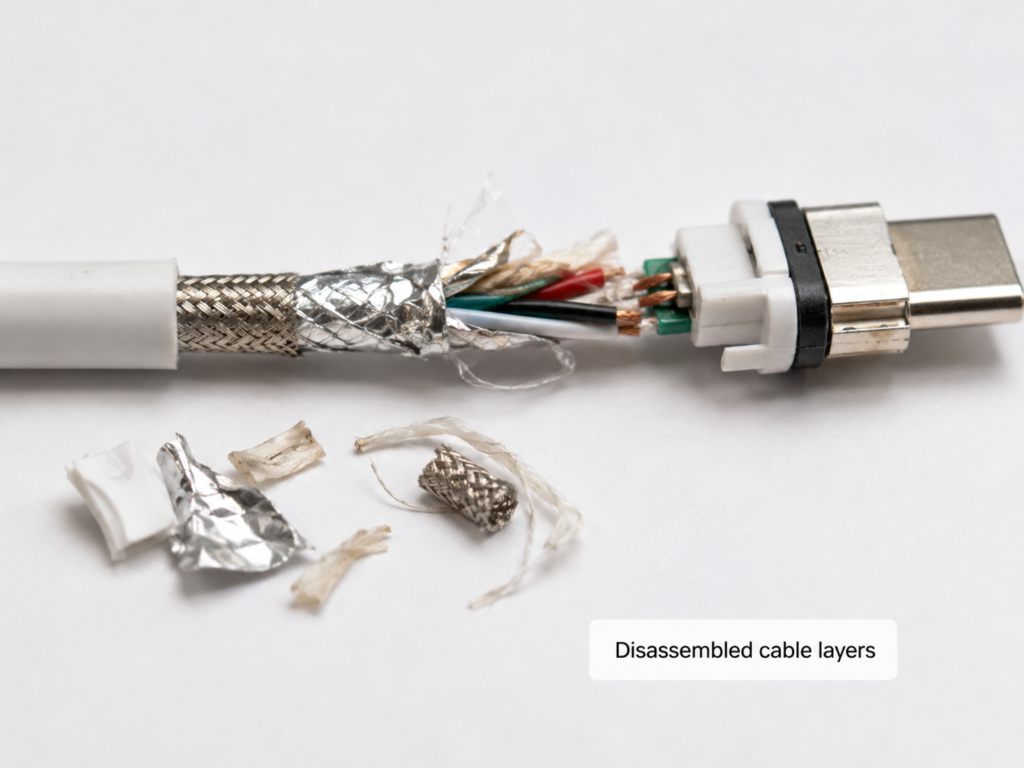
**Correction**: The 0.1% in RoHS is usually the content limit for **homogeneous materials**; the 0.1% in REACH SVHC is usually judged by the concentration in each **article**, and the calculation bases are completely different.
**Charging product case**: The solder on the charger circuit board is a common object in RoHS homogeneous material assessment, and the lead content in the solder needs to be judged according to RoHS limits. As for REACH SVHC obligations, you cannot draw a conclusion by converting the lead in the solder based on the weight of the entire charger; you should first identify whether the relevant components constitute an independent article, and then assess based on that article.
Misunderstanding 4: A passed test is permanently valid
**Correction**: Neither RoHS nor REACH test reports have a unified statutory validity period, but there is also no rule that they “automatically become invalid after one year”.
**Pitfall avoidance method**: Record the samples, materials, suppliers, processes, and regulation versions corresponding to the report. Whenever you change suppliers, materials, formulas, ink colors, or production processes, or when the SVHC candidate list, Annex XVII restrictions, or RoHS exemptions change, you should re-conduct a compliance assessment and decide whether to supplement testing based on risk.
Misunderstanding 5: Small-batch products do not need testing
**Correction**: RoHS has no general rule of automatic exemption due to small product quantity. Applicable electronic and electrical products entering the EU market, even in small quantities, need to meet RoHS requirements and establish corresponding technical documentation.
**Note**: The “1 ton/year” in REACH refers to a condition in the Article 7(2) notification judgment, not an exemption threshold for all REACH obligations. Small-batch placement on the market may still involve SVHC information transmission, SCIP obligations, or Annex XVII restrictions.
Misunderstanding 6: There is an official “REACH certification certificate”
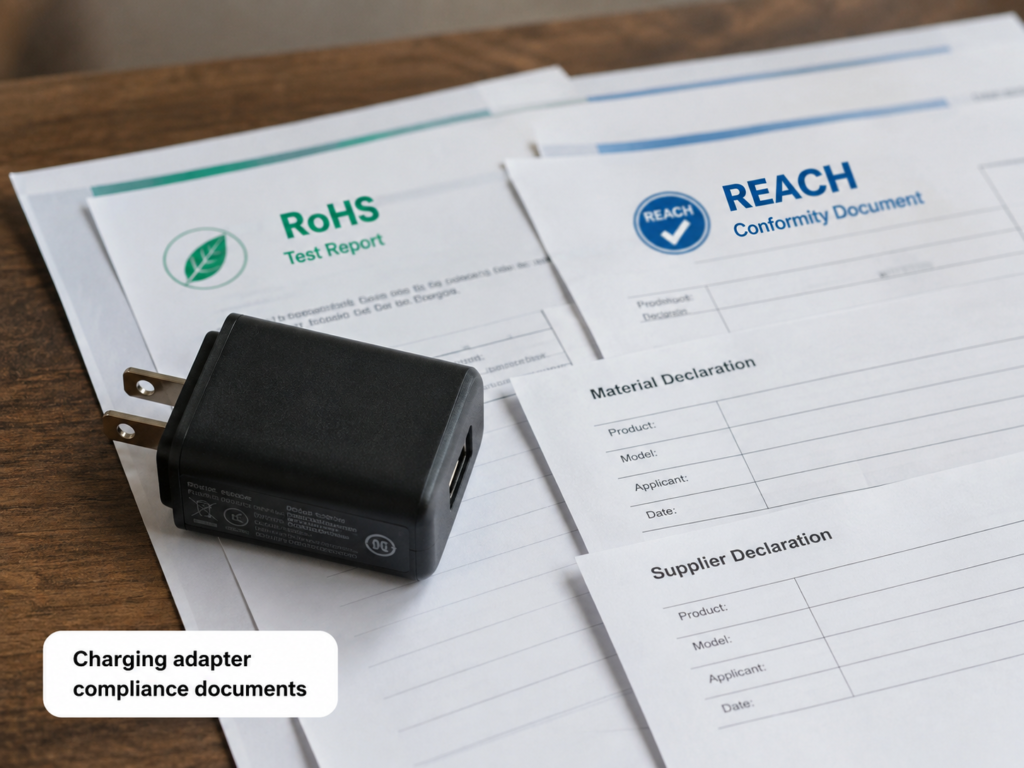
**Correction**: REACH does not have an official unified “REACH certification certificate”. Enterprises may provide test reports, material declarations, supplier declarations, or conformity documents, but the value of these materials depends on their specific coverage and traceability.
**Pitfall avoidance method**: If you encounter an organization promoting “REACH certification”, be sure to ask them to clarify whether the test is for SVHC or specific restriction clauses, which version of the list is used, which samples and materials are covered, and whether detailed test data is provided. A single general certificate is usually insufficient to prove actual compliance.
Quick decision-making and core summary
Finally, we have sorted out a 3-step quick judgment method for you to refer to at any time.
3 steps to quickly select tests (general for charging products)
1. **Look at the market**: For charging electronic and electrical products in the EU market, first confirm the applicability of RoHS and complete the corresponding conformity assessment; at the same time, assess the REACH obligations of the product, packaging, and accompanying articles. For non-EU European countries, judge according to local specific rules.
2. **Look at the product**: When the product contains new materials, complex components, special coatings, modified plastics, or recycled materials, you should prioritize supplementing material information and risk assessment; when data is insufficient, then consider SVHC screening or targeted restricted substance testing.
3. **Look at the requirements**: For items explicitly required by the platform or customer, evidence should be provided as required, but if the customer does not put forward a certain requirement, it does not mean that the statutory obligation does not exist. When exporting to the EU for the first time, the focus is to complete the applicability assessment of RoHS and REACH, rather than blindly purchasing so-called “full set of tests”.
Key takeaways
After reading this article, you should be able to do the following:
• Distinguish the positioning, regulatory scope, and judgment logic of RoHS and REACH, and no longer think “they are both environmental tests, just do one”;
• Be able to correspond to your own charging product scenarios, judge which compliance assessments need to be completed, and which situations require supplementary testing;
• Be able to understand test reports and identify whether the report truly covers actual products and current regulatory requirements;
• When encountering the question of “whether one test can replace another”, be able to judge right or wrong by yourself.
In general, RoHS and REACH are like two different security checks in the EU market: RoHS is a hazardous substance limit requirement exclusive to electronic and electrical equipment, focusing on the content of 10 substances in homogeneous materials; REACH is a broader chemical regulation system, which requires separate judgment in combination with the SVHC candidate list, Article information transmission obligations, SCIP requirements, and specific restriction clauses. When making charging products for the EU, don’t think that “one report works everywhere”. First clarify the product materials, supply chain, and regulatory obligations, then choose appropriate evidence and testing methods, so that you can avoid many detours.