
Friends who do cross-border business with lithium battery-powered products have almost all encountered the situation where freight forwarders ask, “Do you have a UN38.3 report? How long is its validity period?” Many people assume this report is like the shelf life of food—it expires on the due date and needs to be retested, and some even spend a lot of unnecessary money just to avoid delaying shipments.
In fact, the validity period of UN38.3 is far from as simple as “valid for 1 year”. Today we will explain this thoroughly, from basic concepts to judgment methods, and then to common pitfalls. After reading this, you will be able to judge whether the report you have can be used by yourself.
Before going into detailed explanations, here are three core conclusions to help you quickly build an understanding: First, the UN38.3 report has no globally unified mandatory validity period at all. The core criterion for judging whether it can be used is whether the battery you want to transport belongs to the same type as the battery that was originally tested, not the issuance date on the report. Second, before each shipment, whether this report can be used must be checked from four dimensions: whether the product type matches, whether the test documents are complete, whether they comply with the regulations of the corresponding transport route, and whether there are additional requirements from the carrier or sales platform. Third, the “Cargo Transport Condition Appraisal Certificate” that people often hear about is not a UN38.3 test summary, nor does it have a validity period uniformly stipulated by UN38.3; however, its issuance and scope of application may need to be verified in combination with UN38.3 test materials, cargo status, packaging, transport mode, and the requirements of the issuing authority, and must never be confused.
First, get it straight: What exactly is UN38.3, and which products need it?
First of all, we must clarify the basic concept of UN38.3 to avoid confusing document types from the start. UN38.3 is a lithium battery transport safety test standard formulated by the United Nations. It only verifies one thing: whether this lithium battery will have safety problems such as leakage, fire, and explosion during normal transport. It is an access requirement for transport safety, not a product quality certification, nor a performance certification.
For lithium battery cells and lithium batteries that are put into normal operation, their design models should in principle pass the applicable UN38.3 tests. Whether the battery is transported separately, placed in the same box as the equipment, or already installed in the equipment mainly affects the UN number, as well as the corresponding packaging, state of charge, labeling, and declaration requirements, rather than determining whether UN38.3 testing is required. For situations that have not yet passed the test, such as prototypes or small batches, they can only be transported after obtaining corresponding approval in accordance with applicable regulations.
For sellers of charging products, products with built-in lithium batteries all need to comply with UN38.3, such as power banks, charging cases for wireless earbuds, and wireless chargers with built-in batteries. Pure chargers, USB/USB-C charging cables, and power adapters without built-in batteries do not have energy-storage lithium batteries themselves, so they do not need UN38.3 testing—don’t be fooled by freight forwarders.
Many people cannot distinguish the three documents related to UN38.3 and often mix up the rules of different documents, which is also the main reason for the confusion about the validity period.
These three documents are the complete UN38.3 test report, the UN38.3 test summary, and the Cargo Transport Condition Appraisal Certificate. We use a table to help you quickly distinguish them:
| Document Type | Core Function | Common Scenarios | Validity Period Rules |
| Complete UN38.3 Test Report | Complete technical basis recording applicable tests and results | Test data retention, special regulatory verification, dispute evidence | No standard mandatory validity period, judged based on battery type and applicable rules |
| UN38.3 Test Summary | Simplified compliance documents required by regulations to be provided to or made available to the supply chain | Provided when carriers, regulatory authorities, or platforms require verification | Same as above, no unified mandatory validity period |
| Cargo Transport Condition Appraisal Certificate | Determines the transport modes and conditions suitable for the cargo | Declaration and verification required by some transport modes or channels | Separate rules, determined based on the issuing authority, transport mode, and carrier requirements |
The focus of the regulations is that the relevant battery models pass the applicable tests and provide a qualified test summary. Whether the complete test report must be issued by a third party or a laboratory with specific qualifications must be confirmed separately according to the rules of the carrier, platform, customer, or destination, and is not uniformly mandatory required by UN38.3 itself.
The uses and rules of these three documents are completely different, and they must never be confused. For example, you cannot apply the validity period of the transport appraisal certificate to the validity period of the UN38.3 report, which is completely wrong.
Some people may ask, it’s just a report, what happens if it’s not compliant? In actual transport, if UN38.3-related documents are not compliant, in mild cases, the carrier will directly reject the cargo, booking will be blocked, or supplementary materials will be required; in severe cases, the cargo will be returned, and may also be penalized according to destination regulations during customs clearance. Now many overseas buyers and cross-border e-commerce platforms also take UN38.3 as a basic requirement for product access, and without it, you can’t even list the product.
Why doesn’t UN38.3 have a fixed validity period?
Many people find it strange, how can a report have no validity period? In fact, this is related to the essence of UN38.3.
The core logic is very simple: UN38.3 tests the transport safety of “a certain type of lithium battery”, not the validity period of “a certain test”. As long as the battery you transport belongs to the same type as the battery that was originally tested, this report can be used all the time, and it has no direct relationship with whether the report was issued last year or three years ago.
The “same type” here does not mean that all details must be exactly the same. It has clear judgment thresholds. As long as the core safety-related parameters have not changed, it can be used continuously. Conversely, even if you just did a UN38.3 test for a battery last month, if you launch a completely different battery, this report still cannot be used.
Then what is the issuance date on the report for? It has only one function: to trace when the test was conducted and which version of the UN38.3 standard it corresponds to. It is not the “expiration date” stipulated by the UN38.3 standard, and you must never directly say whether the report can be used just by looking at the date.
Many people also worry that old reports will become useless when the standard is updated, but that’s not actually the case. The UN38.3 standard is revised regularly, and the current latest version is the 8th Revised Edition and Amendment No. 1 of 2025. The update of the standard version will not directly invalidate old reports. Whether supplementary testing or retesting is required depends on three aspects: first, whether the regulations corresponding to your transport route require the use of the new version; second, the regulatory rules of the place of origin and destination; third, whether the carrier has written requirements. Only when the new regulations clearly require the use of the new version of the test, and your existing test data cannot prove compliance with the new version’s requirements, do you need to evaluate supplementary testing or retesting.
In which cases can old reports no longer be used?
Although there is no fixed validity period, it does not mean that a report can be used for a lifetime. In the following situations, the report can no longer be used.
The most common reason is that the battery you want to transport does not belong to the same type as the one originally tested.
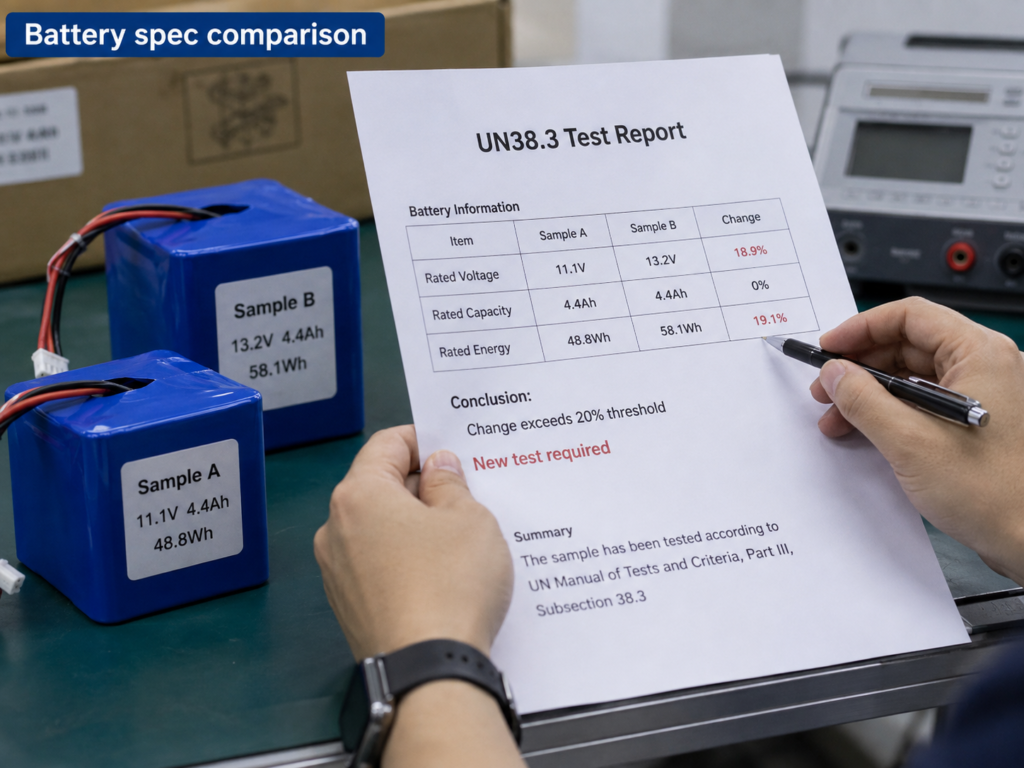
For rechargeable lithium battery cells and lithium batteries, the judgment criteria are very clear: if the change in rated watt-hours exceeds 20%, or the rated voltage increases by more than 20%, or the content of the change may substantially affect the results of any transport safety test, it shall be regarded as a new type, and the applicable specified tests shall be completed.
Which changes require special attention for evaluation? For example, if the cell supplier is changed, the battery management system (that is, the circuit that controls battery charging and discharging and provides safety protection, often abbreviated as BMS) is adjusted, the internal structure or assembly method of the battery is changed, or the fixing method of the battery or the short-circuit prevention design is changed, you need to find a laboratory to evaluate whether the report can be used continuously. Take a very common example: if two power banks have the same nominal voltage, the 10000mAh and 20000mAh power banks of the same series usually have a rated watt-hour difference of more than 20%, and should be regarded as new types. Ultimately, the judgment should be based on the rated watt-hours in the nameplate or technical documents, as well as the actual design changes, and cannot be concluded solely based on mAh. Of course, there are exceptions. If only the outer packaging of the product is changed or the label is modified, which does not affect the safety design of the battery itself, the original report can be used.
The second situation where it cannot be used is that the standard version on which the test is based is no longer recognized by the applicable rules. For example, if transport regulations, regulatory authorities, or sales platforms clearly require the use of the new version of UN38.3, and your existing tests do not cover the newly added mandatory requirements of the new version, so you cannot prove compliance, then it cannot be used at this time.
The third type is that the report itself has compliance defects. This is divided into two levels: one is the regulatory level, for example, the type of test does not meet the requirements of UN38.3, the information in the test summary is missing or cannot be traced, or the core parameters on the report do not match the actual product; the other is the commercial acceptance level, for example, the customer or carrier specifies requirements for laboratory qualifications, report language, seal, and issuance date, and if your report cannot meet them, it will also be rejected.
There are also some special restricted scenarios, for example, batteries that have been repaired, refurbished, disassembled and reassembled, or you have purchased cells from different suppliers and directly use the original report without evaluation; there are also damaged, defective, waste, or to-be-recycled batteries—these cannot be shipped as general cargo based on historical UN38.3 reports.
It should be particularly noted that batteries that are found to be defective or damaged due to battery safety reasons and may have dangerous heating, fire, or short circuit shall be handled in accordance with the prohibition or special approval rules of the applicable transport mode, and cannot be shipped under normal conditions solely based on historical UN38.3 materials. Recall or accident information itself should also be further judged in combination with specific reasons and the actual state of the battery, and cannot be generalized just by seeing “recall” or “had an accident”.
How to check the requirements of different transport channels?
Since UN38.3 itself does not have a unified validity period, where does the “report within 1 year” that freight forwarders usually talk about come from? In fact, these date requirements are all the risk control rules of carriers, freight forwarders, and cross-border platforms themselves, not mandatory stipulated by the UN38.3 standard. The same report can be used by Airline A but may be rejected by Airline B, which is very normal. The core principle is: everything shall be subject to the written requirements of the channel.
The requirements of different transport scenarios vary greatly. Let’s talk about the common situations respectively:
International air transport is the most common one people encounter. The UN38.3 test summary shall be provided or made available as required. Carriers, national regulatory authorities, or platforms may require submission at the time of acceptance, but not all air cargo must be accompanied by a paper test summary for each shipment. For air shipments, you cannot only look at the test summary, but also check the requirements such as waybill information, dangerous goods declaration, packaging, marking, labeling, and state of charge according to the specific UN number, transport status, and packaging instructions. There is also no unified standard for date requirements, and the requirements of different airlines and different freight forwarders may be different. The safest way is to ask the airline or freight forwarder for written confirmation in advance and keep a file for yourself to avoid being stuck when the shipment is about to go out.
For sea, land, and rail transport, documents shall be checked in accordance with the applicable dangerous goods rules, regulations of the place of origin and destination, and the requirements of the carrier respectively. The test summary shall be able to be provided as required; there is no global unified rule on whether the Cargo Transport Condition Appraisal Certificate is required, and it shall be subject to the clear requirements of the carrier or competent authority. The validity period requirements also vary greatly. Some may require reports within six months, and some may have no requirements. Be sure to confirm with the transport operator or freight forwarder in advance.
If you use the official logistics of cross-border e-commerce platforms or international express delivery, the requirements may be stricter. Some will require documents issued in the current year, or have other specific period requirements. In this case, you should check the latest announcement of the platform in advance, or directly consult the platform’s official logistics customer service.
Here we will talk separately about the verification of the Cargo Transport Condition Appraisal Certificate: it is not a UN38.3 test summary. Whether to provide it and how long its validity period is depends on the issuing authority, transport mode, carrier, and local rules. The issuance and scope of application of the appraisal certificate may also need to be judged in combination with UN38.3 test materials, cargo status, packaging, and transport mode. Before shipment, be sure to check the product scope, applicable transport mode, issuance date, and expiration clauses on the original document, and don’t take the wrong one or an expired one.
Step-by-step guide to judge whether the report can be used in 4 steps
After talking so much, some people may say, I have an old report in hand, how can I quickly judge whether it can be used for this shipment? Just follow these four steps, and you basically won’t go wrong.
Step 1: First check whether the product type matches the report type. You can take out the report and compare the battery model, cell parameters, structure description, and manufacturer information on it to judge whether they belong to the same test type. For charging products, when encountering models with different capacities or replaced cell sources, the original document should not be used directly; it should be evaluated whether it still belongs to the tested type based on design changes such as rated watt-hours, rated voltage, as well as cell material, structure, and protection devices. When the conditions for a new type are met, the applicable retesting shall be completed.
Step 2: Check the compliance of the report itself. First look at the regulatory level: whether the test type meets the requirements of UN38.3, whether the information in the test summary is complete and traceable, and whether the core parameters on the report are consistent with the actual product you want to transport. Then look at the commercial level: whether it meets the requirements of the channel for laboratory qualifications, language, seal, and format.
Step 3: Check the documents and conditions of the entire transport chain. First, check whether the UN number (the unified number identifying the type of cargo in dangerous goods transport), transport status (whether the battery is transported separately, in the same box as the equipment, or installed in the equipment), watt-hours or lithium content match; then check whether the model, manufacturer, and contact person on the test summary are consistent with the information you declared; also check whether the packaging, battery state of charge (that is, the battery power limit during transport), transport labels and markings, and declaration documents meet the requirements; finally, exclude situations that cannot be transported normally, such as damage, recall, and waste.
Step 4: Check the timeliness and special requirements of the channel. You can first make a preliminary judgment based on the issuance date of the report and the transport mode, and then be sure to consult the freight forwarder, carrier, or platform to obtain written confirmation, which is the safest way. If a transport appraisal certificate is involved, its validity period and scope of application should be checked separately, and should not be confused with the UN38.3 report.
If it is found that the requirements are not met after checking, there is no need to rush to retest. Different situations have different solutions: if only the channel’s timeliness requirement is not met, but the product itself has not changed and the report is compliant, you can ask the channel whether it can accept the original report plus a product conformity declaration; if the transport appraisal certificate has expired, you should confirm the renewal conditions with the original issuing authority or carrier. When the product model, UN38.3 applicable materials, packaging, transport mode, and applicable rules have not changed, the issuing authority may accept the original test materials for renewal; if there are changes or its rules require it, it may be necessary to supplement appraisal materials, re-appraise, or conduct corresponding tests.
If the product has minor changes that do not affect transport safety, you can consult the laboratory whether you need to make up a few test items instead of retesting the full set; if the product belongs to a new battery type, or the standard version is incompatible, the applicable test items specified in UN38.3 shall be completed according to the product category. The items required for battery cells, non-rechargeable batteries, rechargeable batteries, and battery assemblies are not exactly the same, and it cannot be generally understood that all products need to redo all eight tests.
If only the information in the report is wrong or pages are missing, it cannot be generally assumed that no retesting is required. If it is a clerical error, typesetting problem, or missing page that can be proven by the original test records, you can contact the original testing institution to correct it or issue a new one; but if what is missing is necessary tests, key models or parameters cannot be traced, or the actual product is inconsistent with the tested design, the compliance should be re-determined first, and applicable retesting shall be carried out if necessary.
6 most common pitfalls
Finally, we have sorted out 6 most common pitfalls that people easily fall into. Avoiding them in advance can save a lot of money and time.
The first misconception, and also the most common one: the validity period of the UN38.3 report is fixed at 1 year. The truth is that 1 year is only the risk control requirement of some air channels, not a mandatory provision of the UN38.3 standard. Moreover, even if the report is just issued, if you are transporting a new type of battery, it is still useless.
The second misconception: the validity period of the transport appraisal certificate is equal to the validity period of the UN38.3 report. The truth is that the transport appraisal certificate is a different document, and its validity period depends on the issuing authority, transport mode, etc. After the appraisal certificate expires, you need to confirm the renewal conditions with the issuing authority or carrier; if the product, packaging, transport mode, and applicable rules have not changed, you may be able to renew using the original UN38.3 test materials, but it does not mean that you can definitely renew as long as you have a UN38.3 report.
The third misconception: batteries with the same capacity and same appearance can share a report. The truth is that the same capacity and same appearance do not mean that the cell system, internal structure, and protection design are the same. They must be judged according to the “same type” standard, and cannot be judged only by appearance.
The fourth misconception: with a UN38.3 report, it can be used globally and transported directly. The truth is that UN38.3 is only a basic requirement for transport compliance. You also need to meet a series of regulations such as packaging, labeling, and declaration. The requirements of different channels and different countries vary, and having a report does not mean everything is fine.
The fifth misconception: the validity period marked on the report is the validity period required by the standard. The truth is that some laboratories will mark a validity period on the report themselves, which is the laboratory’s own rule and does not mean that the UN38.3 standard has this requirement. Ultimately, it depends on the battery type and applicable rules.
The sixth misconception: after the UN38.3 standard is updated, old reports are directly invalidated. The truth is that version updates will not automatically invalidate old reports. Only when the applicable rules clearly require the use of the new version, and your existing tests cannot meet the new version’s requirements, do you need supplementary testing or retesting.
Practical preparations before shipment
Finally, we have sorted out a few practical tips for you. Preparing according to them before shipment can save you a lot of detours.

First of all, there are several necessary materials before shipment, which you can sort out in advance: first, the UN38.3 test summary, which shall be provided or kept for inspection as required by the channel; if there are special requirements, then supplement the complete report; second, the product conformity declaration, which should be prepared in advance if the channel requires it; third, the Cargo Transport Condition Appraisal Certificate, which should be prepared if the transport mode or channel requires it; fourth, compliant packaging, transport labels, and declaration documents; as well as other supplementary materials required by the channel.
When confirming requirements with a freight forwarder or carrier, focus on clarifying five things, which can basically cover all needs: first, what UN38.3-related documents need to be provided for this transport; second, whether there are clear requirements for the issuance date of the documents; third, whether there are qualification or designated requirements for the laboratory that issued the report; fourth, what are the UN number, packaging requirements, labeling requirements, and battery state of charge limits for the corresponding transport mode respectively; fifth, whether there are other declarations or materials that need to be prepared in advance.
After reading this article, you should be able to master these practical abilities: you can distinguish the three types of easily confused documents, and know that UN38.3 itself does not have a standard mandatory unified validity period; you can check by yourself whether the report can be used for the current shipment through the four-step judgment method; you can avoid the six most common misconceptions, so you don’t have to waste money on retesting, nor will you delay transport due to document problems; when encountering a report that does not meet the requirements, you know how to deal with it accordingly; finally, you can sort out the materials needed for shipment by yourself, and take the initiative to confirm the core requirements with the freight forwarder.
In general, the issue of the validity period of UN38.3 is essentially not “checking whether the date has expired”, but “checking whether this report can prove that the batch of batteries you are currently going to transport meets the transport safety requirements”. Remember that the core is the consistency of the battery type, and then carefully check in combination with the written requirements of the transport channel, so that you can avoid most pitfalls and don’t have to spend money on unnecessary retesting for nothing.