
When buying car chargers, outdoor charging cables, or portable power stations, you’ve most likely seen markings like “IP67” or “IPX4” on the packaging or nameplates. Many people think this is a “waterproof score” — that the higher the number, the more durable the product, and even that a product marked IP67 can be submerged in water while powered on. These misunderstandings can, at best, make you waste money, and at worst, pose safety hazards like electric shock or fire.
In this article, we will thoroughly explain IP protection ratings specifically for common products like charging cables and chargers: from how to read them, how to tell if they’re genuine, to what rating to choose for different scenarios and what to note when using them. After reading, you’ll be able to judge for yourself and no longer be led by vague marketing claims from merchants.
First, Understand: What Exactly Is an IP Rating?
The full name of IP protection rating is Ingress Protection (enclosure protection against intrusion/entry, commonly called IP code). It is a unified coding system developed by the International Electrotechnical Commission (IEC) in accordance with the IEC 60529 standard, used to indicate the protection level of a product’s enclosure against access to hazardous parts, ingress of solid foreign objects, and harmful ingress of water.
Here’s a key point to highlight first: IP ratings **only apply to the protective capability of the enclosure**. They do not mean that the product’s electrical safety, electromagnetic interference resistance, energy efficiency, or other indicators meet standards, nor can they be directly equated to the durability of the entire product. In addition, IP ratings can be self-declared by manufacturers. Even if there is a third-party test report, it only means that the submitted sample met the standard under test conditions, and does not represent that all mass-produced products are exactly the same.
For charging products, there are three main reasons to pay attention to IP ratings:
First, in terms of safety, qualified protection can reduce the risk of fire and electric shock caused by accidental contact with hazardous parts or water ingress short circuits. Second, in terms of usage, different scenarios have different protection needs — choosing a matching rating is sufficient, no need to spend extra money. Third, in terms of avoiding pitfalls, many merchants use vague marketing terms without unified standards like “daily waterproof” or “super waterproof”. Understanding IP rules will keep you from being fooled.
Not all charging products must be marked with an IP rating: products such as chargers, power adapters, data cables, car chargers, and outdoor charging sockets can be marked according to their protective capability. Ordinary low-protection products for indoor use may not be marked, which does not mean they have no basic protection — for example, most common mobile phone chargers at home have basic finger-touch protection, but just have not undergone special IP testing for marking.
How to Read the IP Code? Don’t Reverse the Order
The standard IP code has a fixed structure: **IP + first digit (dustproof/access protection rating) + second digit (waterproof rating)**. The order of the two digits must never be swapped. For example, IP67 means dustproof level 6 + waterproof level 7. The reverse “IP76” is not a formal marking, and if you encounter it, you can directly judge it as non-standard marketing.
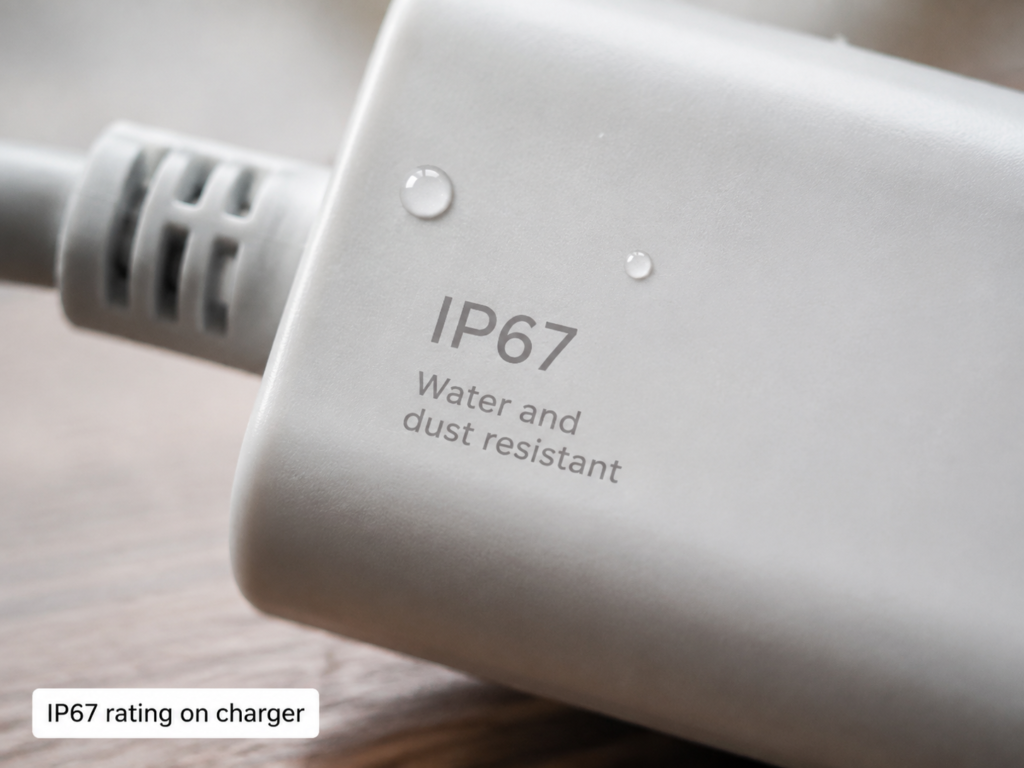
If an X appears in the code, such as IPX4 or IP6X, it means **the rating for that position is not declared**, not that it has level 0 protection. For example, IPX4 just means the manufacturer has not marked the dustproof rating, not that it is completely non-dustproof — it may have basic dustproof capability but just has not undergone the corresponding test. As for the additional letters A, B, C, D, etc. that follow some markings, they are rarely used for charging products. If you encounter them, just check the official manual, no need to overthink it.
To confirm the real IP rating of a product, don’t just look at the large-font marketing on the product detail page. Look for markings on the product body/nameplate, manual, packaging compliance marking area, and official technical specifications. And be sure to clearly check the **protection object**: is it the whole device, the interface, the cable assembly, or a specific part? For example, some waterproof data cables only mark “interface IP67”, not that the entire cable including the cable body can be submerged in water.
There’s another common misconception many people fall for: **don’t treat the two digits as a total score to compare**. The two digits correspond to completely different protection directions, and there is no such thing as “the higher the number, the better overall”. A higher rating in the same protection direction usually covers lower ratings (for example, IP6X definitely has stronger dustproof capability than IP5X), but waterproof ratings cannot be simply linearly substituted — for example, IPX7 (temporary immersion) does not necessarily cover IPX5/IPX6 (water jet protection), because the test pressure and force application methods of the two are completely different. When buying, be sure to check them separately according to your own scenario.
First Digit: Dustproof + Protection Against Access to Hazardous Parts, Don’t Just Look at “Dustproof”
The first digit assesses two requirements at the same time: first, preventing personnel from accessing internal hazardous parts, and second, preventing solid foreign objects from entering the enclosure. The larger the digit, the smaller the size of foreign objects allowed to enter, and the stricter the protection against access to hazardous parts.
Levels 0-2: Basic Contact Protection (Indoor Dry Scenarios)
• **IP0X**: Indicates that the IP code does not specify protection against access to hazardous parts and ingress of solid foreign objects; it cannot be presumed solely from this code that the internal live parts of a specific product are definitely directly accessible.
• **IP1X**: Prevents ingress of solid foreign objects with a diameter ≥ 50 mm; for example, when the back of a hand accidentally touches an enclosure opening, it is usually unable to access internal hazardous parts.
• **IP2X**: Prevents ingress of solid foreign objects with a diameter ≥ 12.5 mm, meaning an adult’s finger cannot reach inside. This is a common rated level for basic protection against access to hazardous parts, and most ordinary indoor chargers meet this level.
Levels 3-4: Protection Against Small Foreign Objects (Dusty/Mobile Scenarios)
• **IP3X**: Prevents ingress of solid foreign objects with a diameter ≥ 2.5 mm, such as thick screwdrivers or metal shavings. Suitable for scenarios where there are scattered small metal parts in the environment.
• **IP4X**: Prevents ingress of solid foreign objects with a diameter ≥ 1.0 mm, such as some small screws or larger particles. It does not mean dustproof; fine sand and dust may still enter.
Levels 5-6: Dustproof Ratings (Outdoor/High-Dust Scenarios)
• **IP5X**: Dust-protected level. Dust that is allowed to enter must not interfere with the normal operation of the equipment or pose safety risks.
• **IP6X**: Dust-tight level. No dust shall enter under specified dust test conditions. Note that this does not mean the product will remain absolutely dust-free permanently after wear, damage, or beyond test conditions.
The core difference between the two is the allowed amount of dust ingress and the degree of impact on function and safety.
Second Digit: Waterproof Rating, Higher Is Not More Versatile
The second characteristic digit of the current IEC 60529 ranges from 0 to 9, of which 0 to 8 are common levels, and 9 corresponds to high-temperature high-pressure water jets. Different levels correspond to different water contact methods; a higher number does not mean it is suitable for all water-related scenarios.
The IP code only covers the test medium, temperature, spray or immersion method and duration specified in the standard. For IPX1 to IPX8, clean water is usually used and subject to specified temperature difference conditions; IPX9 is high-temperature water jet. Seawater, beverages, detergents, steam, etc., are not automatically covered by the corresponding IP water tests.
Levels 0-4: Drip/Splash Proof (Daily Light Exposure)
• **IPX0**: No waterproof capability; even a small amount of water ingress may cause damage.
• **IPX1/IPX2**: Protection against vertically dripping water, dripping water at 15° tilt. Corresponding to daily scenarios like a water cup placed next to it, with a few drops of water falling vertically.
• **IPX3**: Protection against spraying water within a 60° range. Corresponding to light rain falling at an angle, such as a charger by the window getting a little wet from slanting light rain.
• **IPX4**: Protection against splashing water from any direction. Corresponding to scenarios like clean water spilled on it from a knocked-over cup on the desk, or getting caught in light rain while walking.
Levels 5-6: Water Jet Proof (Outdoor/Washable Scenarios)
• **IPX5**: Protection against low-pressure water jets. Corresponding to scenarios like moderate outdoor rain, or slowly rinsing the enclosure with a regular faucet.
• **IPX6**: Protection against high-pressure water jets. Corresponding to scenarios like heavy rain or strong rinsing.
A special reminder here: water jet proof does not equal submersible. Even IPX6 products are prohibited from being immersed in water for a long time.
Levels 7-8: Immersion Proof (Accidental Falling into Water Scenarios)
• **IPX7**: According to the conventional test conditions of IEC 60529, the test lasts 30 minutes. When the enclosure height does not exceed 850 mm, its lowest point is 1 m below the water surface; when the enclosure height exceeds 850 mm, its highest point is 150 mm below the water surface. The requirement after the test is that there shall be no harmful effects. Corresponding to short-term falling into water scenarios like accidentally dropping into a pool or shallow water area.
• **IPX8**: Continuous immersion protection. The specific immersion conditions shall be agreed between the manufacturer and the user, and the requirements are stricter than IPX7. Consumers should confirm the water depth, duration, assembly state and other restrictions in the manufacturer’s manual, technical specifications or after-sales materials; if the manufacturer does not provide this information, it is impossible to judge the actual applicable scenario solely by the IPX8 code.
⚠️ Key reminder: IPX7 and IPX5/IPX6 do not automatically include each other. That is to say, a product that can be immersed for 30 minutes may not withstand high-pressure water jets; a product that can withstand high-pressure water jets may not be submersible. Be sure to check the ratings separately.
Special Waterproof Ratings
• **IPX9**: Belongs to the IEC 60529 system, protection against high-temperature high-pressure water jets. Rarely marked on ordinary consumer-grade charging products, mostly used on industrial equipment.
• **IPX9K**: Belongs to the ISO 20653 road vehicle system, a special waterproof requirement for in-vehicle equipment, rarely seen on ordinary charging products.
Avoid Pitfalls: IP Rating Is Not a “Lifetime Warranty”, It Has Conditions for Validity
Many people buy a charger marked IP67, and when it breaks due to water ingress after half a year of use, they say the merchant is false advertising — in fact, most likely they didn’t understand the conditions for the IP rating to be valid. It is not effective forever, nor does it protect against all situations.
First, here are some common marking references (only for understanding, not representing industry standard configuration; for specifics, be sure to read the product manual):
• Ordinary indoor chargers: may be marked IP20 (basic electric shock protection, no waterproof or dustproof)
• Car chargers: may be marked IP40 or IP54
• Special waterproof data cables, outdoor portable chargers: may be marked IP54 or IP67
• Outdoor camping charging sockets: may be marked IP66 or IP67
When purchasing, be sure to refer to the declaration of **the same assembly state** on the product body, manual, and technical specifications of the specific model, and don’t just guess based on the product category.
Four Elements of a Protection Declaration (Missing Any Means You Can’t Confirm Actual Capability)
1. **Protection object**: It must be clear whether it covers the whole device, interface, cable assembly, or specific parts. In addition, IP ratings only test enclosure protection, and are not equivalent to other properties such as bending resistance, tensile resistance, wear resistance, oil resistance, UV resistance, or plug-in life. Don’t confuse them.
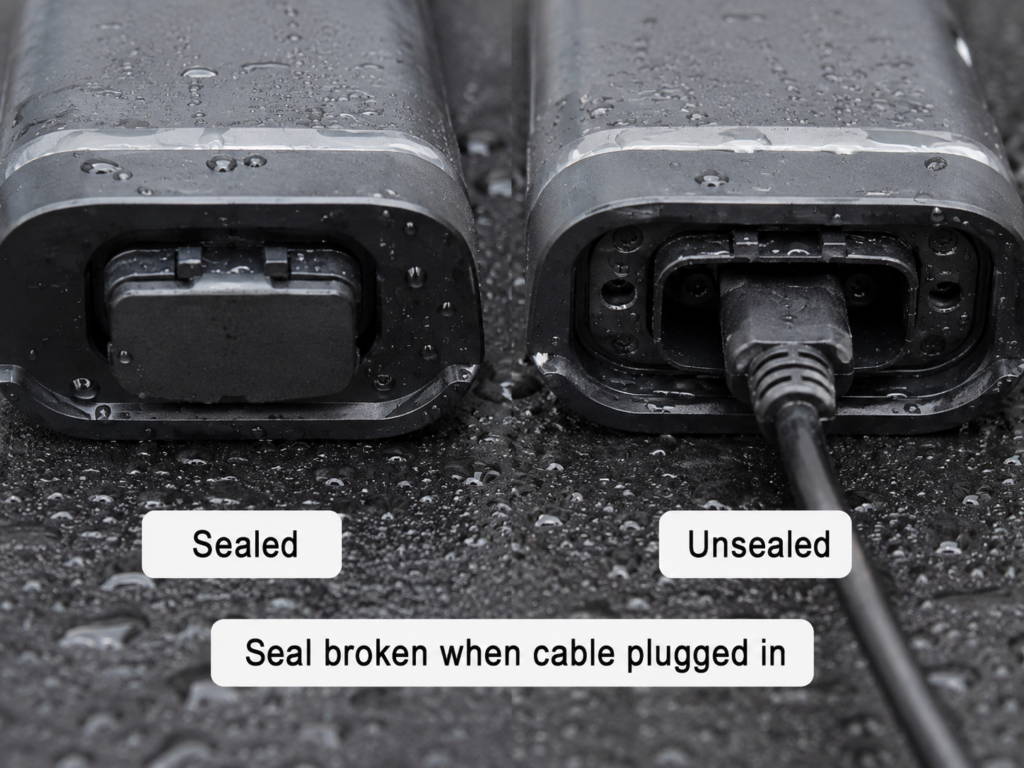
2. **Assembly state**: Confirm whether the dust plug is closed, whether the original sealed cable is plugged in, and whether the installation direction is compliant. For example, if a charger is marked IP67 but an ordinary charging cable is plugged in, the seal at the interface is broken, and the protection directly fails. Whether the cable and charger meet the standard after connection must be clearly declared by the manufacturer, and you cannot take it for granted.
3. **Environmental medium**: The IP code only covers the test medium, temperature, spray or immersion method and duration specified in the standard. For IPX1 to IPX8, clean water is usually used and subject to specified temperature difference conditions; IPX9 is high-temperature water jet. Seawater, beverages, detergents, steam, etc. are not automatically covered by the corresponding IP water tests — for example, if you take a charger to the beach, salt water will corrode the sealing rubber ring, and it will fail quickly; steam during bathing is gaseous and may also pass through the sealing structure and enter the interior.
4. **Exposure method/duration**: Only corresponds to the test spray/immersion conditions, and does not mean it can be exposed for a long time or used beyond test conditions. For example, IPX7 only covers the specified 30-minute test, and it cannot be inferred that the product can be immersed for a day; the risks and consequences of immersion beyond this condition are not guaranteed by the IPX7 code.
Common Causes of IP Protection Degradation
IP ratings are not effective for life. The following situations will reduce or even disable the protective capability:
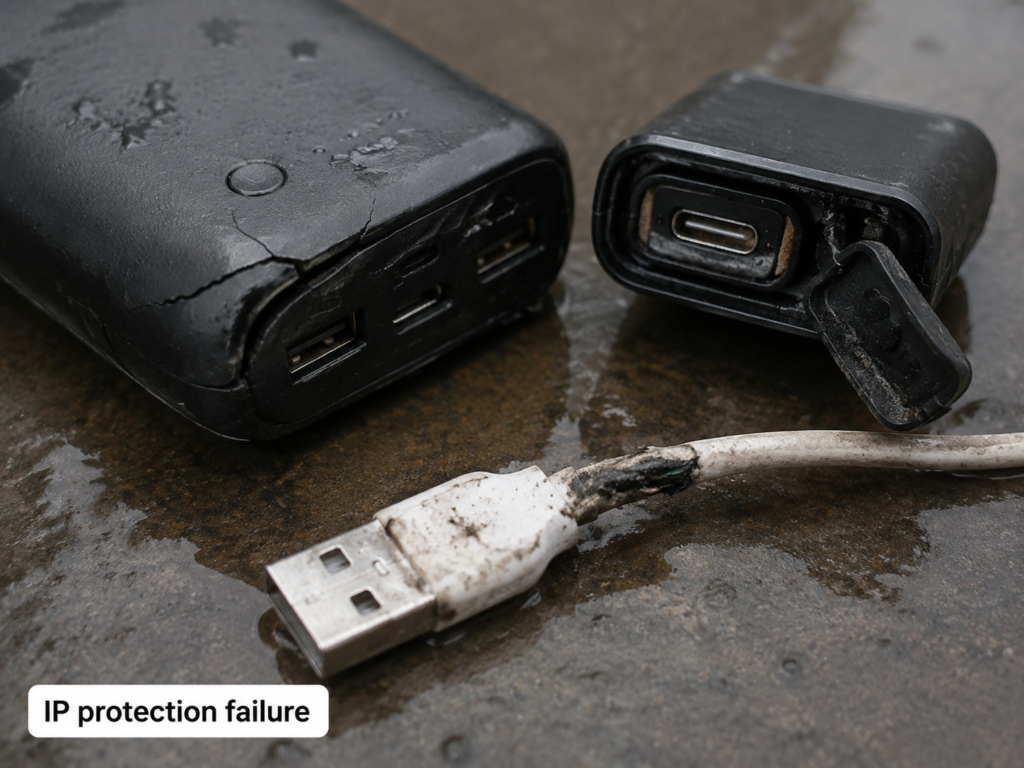
• **Physical damage**: Cracking of the enclosure caused by dropping, impact, or extrusion, which damages the sealing structure;
• **Normal wear**: Frequent plugging and unplugging of interfaces, opening and closing of dust plugs will wear the sealing rubber ring over time;
• **Environmental aging**: Long-term high-temperature exposure, ultraviolet radiation, or contact with corrosive liquids will age and brittle seals and plastic enclosures;
• **Non-compliant assembly**: Plugging in non-original cables, not covering the dust plug, or self-disassembly and repair will all damage the sealing structure.
Core Differences Between Laboratory Testing and Real-World Use
IP testing is completed under fixed ideal conditions, and only guarantees no failure under test conditions. Real-world environments have higher risks, so never actively challenge the rated limit.
More importantly: **The IP code only indicates the protection level of the enclosure under specified test conditions, and cannot alone prove that the product can be connected, operated, or charged in a powered, wet, or immersed state.** Unless the manufacturer explicitly permits this use state and it meets applicable safety requirements, the power should be turned off first and the product kept dry. In addition, scenarios involving non-room-temperature liquid clean water such as condensed water and hot steam are also not automatically covered by standard tests.
How to Choose and Use? From Pitfall Avoidance to Scenario Matching
3 Most Common Misconceptions
1. **Misconception 1: The higher the IP number, the more worth buying**
The two digits correspond to different protection directions and cannot be compared across dimensions. For example, you can’t say IP67 is definitely better than IP54; it depends on actual needs. In addition, a high IP rating does not necessarily mean poor heat dissipation. Temperature rise depends on various factors such as power, thermal design, materials, ambient temperature, and load. Many high-protection products ensure heat dissipation by optimizing thermal design. For daily indoor use, there is no need to blindly pursue high protection; meeting basic electric shock protection is sufficient.
2. **Misconception 2: With an IP waterproof rating, you can charge with water/use in the shower**
This cannot be judged solely by the IP waterproof rating. The IP code does not alone prove that the product can be connected, operated, or charged in a powered, wet, or immersed state; hot water and water vapor may penetrate the seal, chemical liquids will corrode the rubber ring, and touching water while powered still poses an electric shock risk. Unless the manufacturer explicitly permits this use state and it meets applicable safety requirements, the power should be turned off first and the product kept dry.
3. **Misconception 3: IP ratings are effective for life**
Protective capability will gradually decrease with wear, aging, disassembly/repair, and changes in assembly state. Buying a high-IP product does not mean it’s a once-and-for-all solution.
4 Quick Ways to Judge the Authenticity of IP Marketing Claims
When you encounter a product you’re unsure about, just check against these four points:
1. **Check marking standardization**: Whether there is a complete “IP + two digits/X” format, and whether the digit order is correct. For example, “IP76” is an obviously non-standard marking.
2. **Check declaration elements**: Whether the protection object, assembly state, and test conditions are clear. For example, for products marked IPX8, consumers should confirm the water depth, duration, assembly state, and use restrictions from the manufacturer’s manual, technical specifications, or after-sales materials; these boundaries cannot be judged solely by the IPX8 code.
3. **Check information consistency**: Whether the markings on the detail page, manual, and product body are consistent. Be wary of custom marketing without the IP prefix (for example, only saying “daily waterproof” or “level 7 waterproof”, which has no unified standard and low credibility).
4. **Check test basis**: If there is a third-party report, confirm that the test sample and assembly state are consistent with the sold product, to avoid the situation where merchants submit custom samples for testing but sell the regular version.
Selection Reference for Different Exposure Scenarios
| Usage Scenario | Priority Measures | Selection Requirements | Precautions |
| Indoor dry (bedroom/office) | Avoid liquid splashes, clean dust regularly | Choose compliant charging products that meet basic electric shock protection | No need to blindly pursue high protection ratings |
| Occasional clean water splashes (desk/kitchen edge) | Keep as far away from water sources as possible, wipe dry promptly after splashing | Models with dustproof and splash-proof ratings can be chosen | Need to confirm the manufacturer’s declaration that the corresponding assembly state withstands splashing; only applicable to corresponding test conditions |
| Rain + dusty (car/balcony/construction site perimeter) | Shield from rain and dust as much as possible, store promptly when not in use | Models with dustproof and water jet-proof ratings can be chosen | Need to confirm suitability for the corresponding installation/assembly state; clean interfaces promptly after dust exposure; do not rinse directly with high-pressure water |
| Temporary clean water immersion (outdoor camping/waterside work) | Keep as far away from water sources as possible, avoid falling into water | Models with short-term immersion ratings can be chosen | Need to confirm the manufacturer’s clear immersion conditions; after falling into water, must power off, dry and inspect before use; cannot charge directly; not resistant to seawater/salt water |
| High-pressure rinsing/coastal high corrosion | Avoid using ordinary consumer-grade charging products | Choose industrial-grade special protection products | Need to confirm the product is clearly marked to withstand the corresponding corrosion/high-pressure rinsing conditions |
IP Protection Checklist Before Purchase/Use
1. **Marking check**: Whether there is a standardized IP code, and whether the marked protection object is clear;
2. **Appearance check**: Whether the dust plug is intact, whether the interface seal is worn, whether the enclosure has cracks/ signs of disassembly and repair;
3. **Condition check**: For high waterproof ratings (such as IPX8), whether water depth, duration, and use state can be confirmed from the manufacturer’s materials;
4. **Document check**: Whether the manual has test instructions and use restrictions for the corresponding IP rating.
Correct Handling Steps After Charging Products Get Wet
1. If you can operate safely without touching standing water, wet plugs, or damaged equipment, first turn off the upstream power or disconnect the circuit breaker, then unplug the connecting cable; if safety cannot be confirmed, do not plug or unplug with bare hands, stay away from the scene and contact professionals or the power management party;
2. Wipe off surface moisture, place with the interface facing down in a ventilated and cool place to dry naturally. Do not use heating equipment such as high-temperature hair dryers or ovens, to avoid damaging seals and components;
3. Before confirming complete dryness, do not connect to a charger or any power source;
4. If the device is connected to mains power, has been obviously immersed, or has tripped/has strange odors/abnormal heating, stop using it immediately, contact after-sales or qualified maintenance personnel, and do not disassemble and handle it by yourself.
Quick Summary
By now, you should be able to independently judge these four things:
1. Can correctly interpret the two digits of the IP rating, distinguish the specific capabilities and test logic of dustproof/access protection and waterproof, and no longer treat the two digits as a total score for comparison;
2. Can identify formal IP markings and vague marketing, understand the four elements of IP rating validity and the boundaries of powered use, and will not take risks with safety;
3. Can choose suitable charging products according to the exposure type of their own usage scenarios, combined with product declarations, neither wasting money nor choosing products with insufficient protection;
4. Can judge which situations will cause IP protection to fail, know the correct handling method after water ingress, and can maximize product life and avoid risks.
Frequently Asked Questions
**Q1: What do the two digits of the IP protection rating represent respectively?**
A: The first digit is the rating for dustproof/protection against access to hazardous parts, with a total of 0-6 levels. The larger the digit, the stronger the ability to prevent foreign objects and access to hazardous parts. The second digit is the waterproof rating. The second characteristic digit of the current IEC 60529 ranges from 0 to 9, of which 0 to 8 are common levels, and 9 corresponds to high-temperature high-pressure water jets. IPX9K belongs to the ISO 20653 road vehicle system. The two digits are independent and cannot be confused.
**Q2: Can an IP67 charger be charged when wet?**
A: This cannot be judged solely by IP67. IP67 only means that the enclosure’s dustproof and short-term immersion tests meet the corresponding requirements. It cannot alone prove that the product can be connected, operated, or charged in a powered, wet, or immersed state. Unless the manufacturer explicitly permits this use state and it meets applicable safety requirements, the power should be turned off first and the product kept dry.
**Q3: Which has better waterproof performance, IPX4 or IP67?**
A: The two have different test directions and cannot be directly compared. IPX4 is splash-proof from any direction, suitable for daily water splashes and light rain scenarios; IPX7 is short-term immersion proof, suitable for accidental falling into water scenarios. For daily splash use, IPX4 is sufficient; if you are worried about falling into water, IPX7 is more appropriate. You can’t simply say which is better.
**Q4: Do ordinary data cables have IP protection ratings?**
A: Ordinary data cables are rarely marked with IP ratings separately, because daily indoor use usually does not require special protection. Any cable, connector, or cable assembly may be marked with an IP code if the manufacturer makes a declaration and clarifies the protection object and assembly state. Special waterproof cables especially need to check the declaration under the interface connection state.
**Q5: Will chargers with high IP ratings have poor heat dissipation?**
A: A high IP rating does not necessarily mean poor heat dissipation. The temperature rise of a charger depends on various factors such as power, thermal path design, materials, ambient temperature, and load. Many high-protection rating products ensure heat dissipation by optimizing thermal design, so it cannot be generalized.
**Q6: Is the IPX7 waterproof standard 1 meter for 30 minutes?**
A: IEC 60529 stipulates that the IPX7 test lasts 30 minutes, but 1 meter and 150 mm are not fixed conditions applicable to all samples at the same time: when the enclosure height does not exceed 850 mm, the lowest point of the sample is 1 m below the water surface; when the enclosure height exceeds 850 mm, the highest point of the sample is 150 mm below the water surface. The requirement after the test is that there shall be no harmful effects. For specific products, the manufacturer’s declaration shall still prevail.