
If you have bought products such as chargers or laptop power supplies in North America, you have most likely seen the UL logo printed on the product body label or packaging. Many people think it is a randomly printed quality mark, while others believe that as long as a product has this mark, it is globally applicable and covers everything — in fact, these are common misconceptions. For merchants running small cross-border businesses, or ordinary users who just want to choose a safe charger, understanding what UL certification is, how to identify it, and how to verify it can not only help check product compliance documents, but also reduce safety hazards in daily electricity use.
First, Understand: What Exactly is UL Certification?
Simply put, the UL safety listing or safety certification mentioned in this article is a product safety assessment conducted by third-party institutions such as UL Solutions in accordance with applicable safety standards. It mainly focuses on whether the product can prevent unacceptable hazards such as electric shock and fire under normal use and specified abnormal or fault conditions; it does not guarantee fast charging protocol compatibility, charging speed on a specific device, or energy efficiency performance. Other performance or energy efficiency claims depend on corresponding tests, regulatory compliance, or independent certification documents.
Moreover, the coverage of UL certification is subject to the product models, model series, construction, ratings, and applicable conditions specified in the certification file. Not all chargers of a certain brand have UL certification, nor can it be directly assumed that other models are covered just because one product in the same series has obtained certification.
For ordinary users and entry-level merchants, the practical value of UL certification mainly lies in three aspects: First, in American workplaces, some retail channels, platform product categories, or corporate procurement specifications, electrical products may need to meet applicable safety requirements and provide NRTL certification or other specified compliance documents; UL is one of the common options, but UL is not mandatory for all channels or products. Second, it helps reduce safety risks in daily use, as certified products need to undergo assessments in terms of electric shock protection, fire protection, temperature rise, abnormal conditions, etc. in accordance with applicable standards. Third, the UL mark and certification file can be used as one of the materials to verify whether the product has obtained the corresponding third-party safety certification when it leaves the factory, but they do not determine insurance claims, accident liability, or compensation results.
Regarding UL certification, there are three most commonly misunderstood basic concepts that need to be clarified first:
First, it is not a full-category certification mandated by U.S. law. Some products, sales channels, commercial scenarios, or insurance requirements may require compliance with specific safety requirements, but not all power supply sellers must have UL certification;
Second, it is not globally applicable. It is mainly highly recognized in the United States and Canada; for Europe and Australia, you still need to check local applicable requirements;
Third, UL safety certification cannot replace the CE conformity requirements for applicable regulations in the EU market, and the CE mark also cannot naturally replace the NRTL certification required by channels, regulatory agencies, or customers in the United States or Canada. The two may overlap in electrical safety objectives, but they differ in applicable markets, legal mechanisms, conformity assessment methods, and applicable standards.
Which Power Adapters Require UL Certification Check?
Many people think that all charging-related products need to be checked for UL certification, but that is not the case. Different products are evaluated according to their respective uses, structures, and applicable standards, and external power adapters are just one category.
Most external power adapters we come into contact with daily may involve safety certification for consumer power supplies: for example, wall-plug USB/USB-C chargers, including the popular compact GaN multi-port fast chargers; DC plug or USB-C PD power adapters for laptops; desktop adapters for routers and monitors (the style with wires on both ends and a square box in the middle); and travel adapters with voltage conversion function and replaceable plugs — note that these are ones with voltage transformation function, not those that only change the plug shape.
There are several types of products that seem related to charging, but actually do not belong to the category of external power adapters, so don’t confuse them:
• Power banks, wireless chargers, and car chargers may each apply their own separate UL standards, with rules different from those for external adapters;
• Pure plug adapters, that is, products that only change the plug shape without converting voltage, do not themselves belong to external adapters with voltage transformation function;
• Charging cables and detachable AC power cords are components or accessories that may have special certification requirements, which are not equivalent to the certification of finished adapters;
• Built-in power modules in devices, such as power boards inside TVs, usually need to be evaluated in combination with the final device and its applicable standards; some can be used as recognized components, while others may be certified as independent power supply categories, and cannot be uniformly regarded as only certified as internal components.
A special reminder here: the coverage of UL certification is subject to the product models, model series, construction, ratings, and applicable conditions specified in the certification file, and is not simply divided by brand or marketing series. For example, in the “fast charging series” of the same brand, the 20W single-port model being certified does not mean that the 65W dual-port model is necessarily covered — as long as the design, parameters, construction, or coverage in the certification file are different, the conclusion cannot be directly shared. Even for the same product, if the internal structure is modified or key components are replaced later, it also needs to be reviewed according to UL procedures. Therefore, when judging, be sure to check the complete product model or series, rated parameters, and relevant certification documents, and do not just rely on the merchant’s marketing claim of “full series UL certification”.
What Does UL Certification Cover? What Does It Not Cover?
Many people have no concept of the assessment scope of UL safety certification, and tend to attribute performance and energy efficiency to UL. In fact, the focus of safety certification is whether the product can avoid unacceptable safety hazards under the conditions specified by applicable standards; specific requirements vary by product category, structure, rating, and applicable standards.
| What UL Safety Certification Typically Covers | What UL Safety Certification Does Not Guarantee |
| Electric shock protection, insulation, and safety protection of accessible parts | Fast charging compatibility, charging speed on specific devices |
| Fire protection, temperature rise, and material-related safety requirements | Whether energy efficiency and no-load power consumption meet applicable regulations |
| Hazard protection under specified abnormal or fault conditions | Safety when used beyond rated parameters |
| Safety requirements for mechanical strength, structure, and connection parts | Special requirements for dedicated scenarios such as medical and industrial use |
We can break down these requirements into several easy-to-understand parts:
First is electric shock protection. Applicable safety standards will put forward requirements for the protection of live parts, insulation, electrical clearance, and accessible parts according to the product structure. Products can meet the requirements through insulation, isolation, enclosure protection, or other evaluated designs. Not all power adapters use exactly the same input-output isolation method, which depends on the product use and construction conditions in the certification file.
Second is fire protection and heat resistance. Standards usually put forward requirements for the temperature rise, fire risk, and related materials and components of products under rated use conditions. The enclosures, internal components, and fire protection designs of different products do not have to be exactly the same, but risks need to be controlled under the conditions specified by applicable standards. Even for today’s very compact GaN chargers, temperature rise and safety design cannot be ignored just because they are made smaller.
Third is abnormal operating condition protection. In daily use, situations such as short circuits and overloads are inevitable, for example, abnormalities caused by damaged charging cables, or problems with device loads. Applicable safety standards require that products do not produce unacceptable hazards under specified abnormal or single fault conditions. Different products can achieve compliance through current limiting, temperature limiting, fusing, shutdown, insulation, or other evaluated designs, and it is not necessarily “automatic output cut-off”. For multi-port chargers, the safety risk when multiple ports are used simultaneously should also be evaluated according to their structure, rating, and use conditions.
Last is mechanical structure reliability. Applicable standards will put forward corresponding requirements for enclosures, plugs, cable connections, etc. according to product category and structure, to avoid hazards caused by daily foreseeable use and mechanical stress. Whether tests such as drop, extrusion, and bending are involved, and how the test conditions are set, shall be subject to applicable standards and certification files, and a single scenario cannot be used to generalize all adapters.
As for the content not covered, let’s clarify again: performance indicators such as fast charging protocol compatibility, whether a certain mobile phone can trigger fast charging, and actual charging speed are not guaranteed by UL safety certification; UL safety certification is usually not equivalent to compliance with external power supply energy efficiency or no-load power consumption. Energy efficiency requirements should be separately verified in accordance with applicable DOE regulations, state-level regulations, or voluntary programs such as ENERGY STAR, and energy efficiency cannot be judged solely by the UL safety mark.
Also note that many external power adapters used for audio-visual, information and communication technology equipment can be evaluated according to UL 62368-1; other adapters may apply UL 1310, UL 1012 or other product-specific standards, which shall be subject to product use and certification files. Special adapters for medical and industrial use may also have their own applicable standards, and the certification conclusions of consumer products cannot be simply used as a substitute.
How to Identify a Genuine UL Mark
Just knowing that there is UL certification is not enough; you need to know how to read the mark — many fake UL marks get by through vague labeling. The specific style, position, and accompanying information of the UL mark vary by certification category, mark version, and product type, and conclusions cannot be drawn based on just one element.
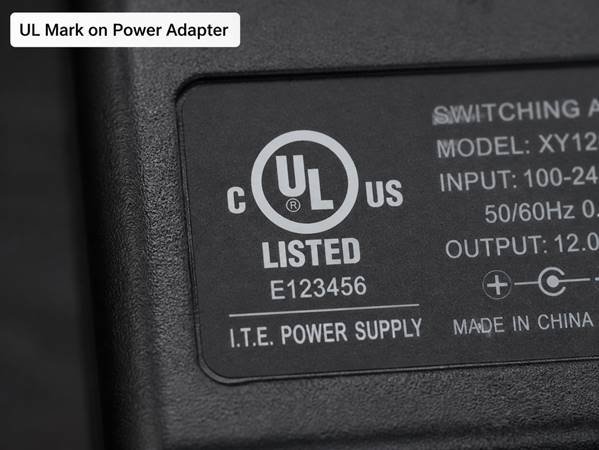
First, consumers can focus on checking several types of information: the UL mark on the product or the smallest unit packaging; the control number, unique identifier, or file number near the mark or in the certification documents; product identity information such as the listing company, product model or model series, and rated parameters. Which specific information must be printed on the product body and which can appear on the smallest packaging or in certification documents shall be subject to the requirements of the product category and certification file.
Many people are used to looking for UL file numbers starting with E. It can indeed be a useful query clue, but not all genuine UL marks must have a file number starting with E. Traditional UL Listed marks may use control numbers, while enhanced or smart marks usually come with a unique identifier or file number; the layouts of different certification categories, mark versions, and labeling schemes may also differ. Therefore, the absence of an E-starting file number itself does not prove that the mark is fake; it should be comprehensively verified in combination with the mark style, product category, listing company, model or series, and UL query results.
There are three main types of UL marks, which many people easily confuse, and their meanings are very different:
• Listing / Certified: Usually applies to end products or fully assembled products. When buying finished products such as chargers and power adapters, you should focus on confirming whether the product is within the corresponding listing or certification scope;
• Recognized: Usually applies to components, such as some internal elements of adapters. The fact that the part itself is recognized does not mean that the entire finished adapter has obtained the corresponding UL listing or certification — when a merchant says “uses UL-certified components”, you still need to confirm the complete machine documentation;
• Classified: Usually applies to specific performance, specific uses, or specific usage scenarios of products. It is relatively rare on consumer-grade power adapters.
Another easily overlooked point is regional coverage. A UL mark with Canadian identification elements may indicate that the product is applicable to both the U.S. and Canadian markets; but the specific coverage is still subject to the mark style, certification file, and product category. UL is not globally applicable. If you want to sell or use it in other countries and regions, you still need to check local certification and regulatory requirements.
3 Steps to Verify the Authenticity and Validity of UL Certification
Just looking at the mark is not enough, after all, marks can be faked. If you want to further confirm whether the UL certification documents match the product, you can search in UL’s official system, and then make a comprehensive judgment combined with product information.
Prepare Information Before Querying
Prioritize checking the marks provided on the product body and the smallest unit packaging in accordance with the law or certification category requirements, and verify them in combination with the manual, certification documents, and the UL database. The listing company can be identified by the company name, trademark, or UL file number; the model, rating, and mark position shall be subject to the requirements of the specific product category.
If there is a file number, control number, or unique identifier on the product or packaging, you can record it first; at the same time, write down the complete product model, brand, listing company, or manufacturer name clearly. Do not rely solely on the merchant’s promotional page, because the model, picture, or certification description on the promotional page may not correspond to the actual product you have.
Steps to Query on the Official Website
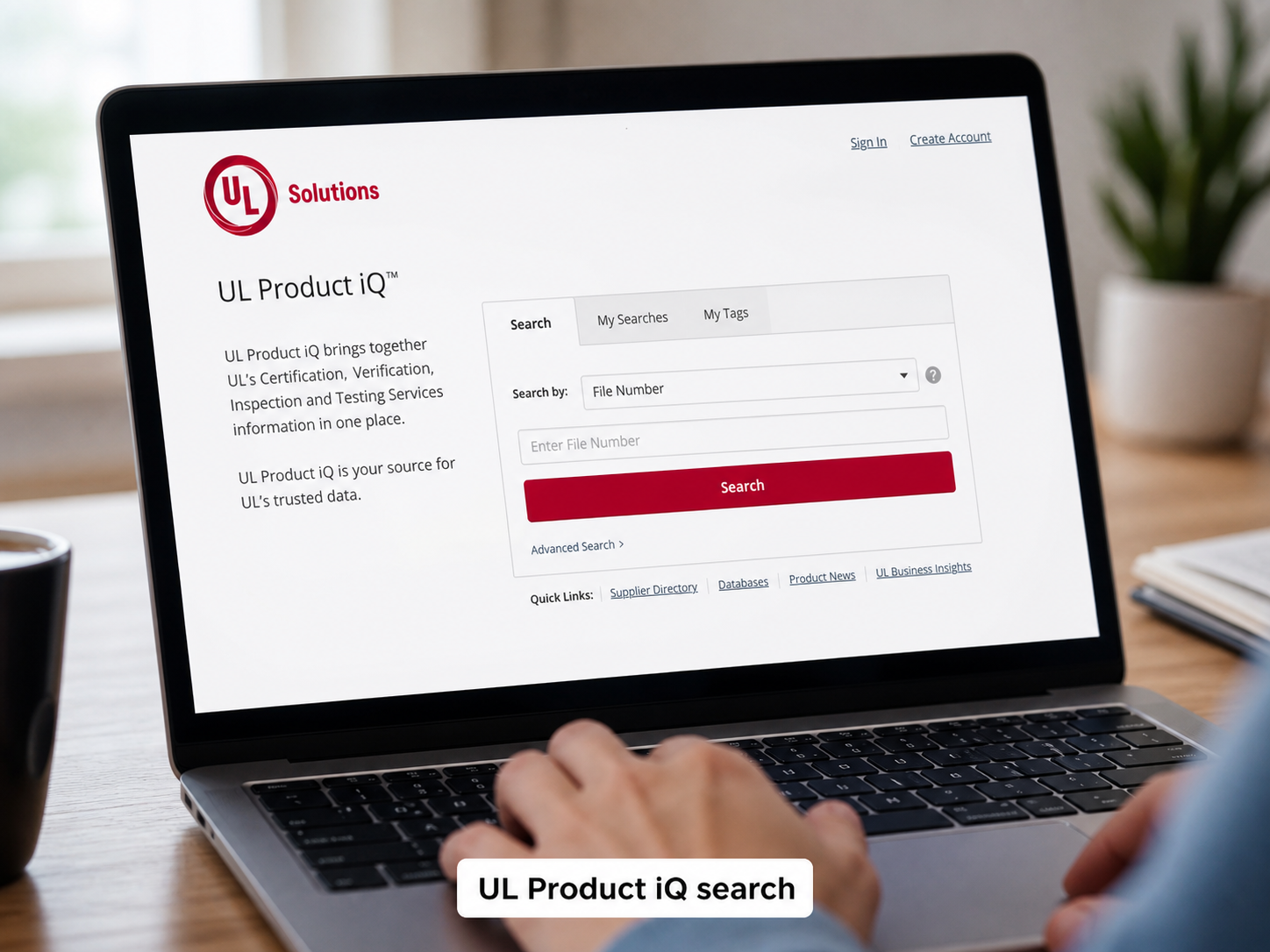
You can use UL’s official Product iQ system for queries. Basic access is usually free, but you need to register or create a free account first. After logging in, you can search by information such as file number, product category, manufacturer, and model.
After finding the results, you should carefully check several key points: whether the product category matches — for example, if you are looking for a power adapter but the result is for wires or other product categories, you cannot directly apply it; whether the model or model series covers the product you have; whether the listing company or manufacturer information matches; whether the rating, construction, or use conditions are consistent.
If you don’t find it the first time, don’t directly judge it as fake. You can try another keyword, such as searching by the manufacturer’s name, trademark, part of the model, or other identifiable information; also note that some detailed information may need further confirmation from the certificate holder or UL.
How to Judge Certification Validity
Many people think that UL certification is valid for life, and others think that as long as the query page shows “Active”, all products can be confirmed to be currently valid — both understandings are inaccurate.
UL certification does not have a uniform expiration period that consumers can infer solely from the production date. Certified products should be continuously produced in accordance with the approved construction, production location, and follow-up inspection requirements; after standards are updated, UL will decide whether the certificate holder needs to take corresponding measures in accordance with the applicable effective date and review procedures. The release of a new version of the standard does not mean that existing certifications will automatically become invalid immediately.
When verifying, you should focus on checking the product scope, model or series, ratings, and restrictive conditions in the certification file. If you need to confirm whether a certification is currently valid, you should contact the UL Solutions Customer Experience Center, or require the certificate holder to provide verifiable certification documents. Do not judge that the certification is definitely valid just by the word “Active”, nor just because the product was produced in the past 2-3 years.
Typical Suspicious Signs of Fake/Invalid UL Certification
Combined with the mark and query results, you should be careful when encountering the following situations:
• The UL mark on the product has an obviously abnormal style, blurry printing, is easy to peel off, or has obvious spelling errors;
• The product type and listing company found through the file number, control number, or other identifiable information do not match the actual product at all;
• The product model, model series, rating, or applicable conditions are inconsistent with the certification documents;
• The merchant only promotes “uses UL-certified materials/components” but avoids stating whether the finished adapter is within the corresponding certification scope;
• Other models of the same brand are certified, but the specific model or model series you bought is not within the coverage of the certification file.
Conversely, the absence of an E-starting file number on the product does not mean that the mark must be fake. The correct approach is to judge by combining the mark, product category, listing company, model or series, and UL query results.
Advanced: The Underlying Logic of UL Certification Rules
Some people may ask: why can’t different models in the same series share certification casually? Why do we need to recheck after a product is revised? In fact, behind these rules is the goal of ensuring that “the products covered by certification” are consistent with “the products actually sold”. Understanding these underlying logics can help you better judge whether certification documents are applicable.
The core premise of UL certification is the product models, model series, construction, ratings, key components, and production conditions specified in the certification file. Representative samples, test combinations, and coverable derivative models are determined by UL based on construction, rating, key components, and intended use. Products with higher power or more interfaces may require additional evaluation, but you cannot assume that it automatically covers the entire series just because it is the “highest version”; conversely, you cannot assume that every low-power model necessarily needs to undergo exactly the same independent test.
Precisely because the certification scope is related to product construction and production conditions, when the product construction, key components, rating, production location, or applicable standards change, the certificate holder shall submit the change to UL for review before the changed product continues to use the UL mark. UL will decide whether to update the follow-up service procedure, factory inspection, or supplementary testing based on the specific change. Unauthorized changed products cannot be regarded as approved under the original certification scope.
For example, changes in key components such as transformers, protection devices, and enclosure materials, adjustments to output specifications, number of interfaces, and plug types, modifications to internal structure, or addition of production locations may all require review. But it is not that the original certification automatically becomes invalid as soon as any change occurs; the key is whether the changed product is still accepted by UL and included in the corresponding certification scope.
As for why certification cannot be understood as permanent, it is because certified products usually need to undergo corresponding follow-up services and production consistency management to ensure that mass-produced products meet the approved construction. If a manufacturer wants to change the product design or components, it should report in advance, and UL will evaluate whether further measures are needed. Standard updates are also processed in accordance with the review and effective procedures set by UL, rather than all certifications under the old standard automatically becoming invalid as soon as the new standard is released.
Guide to Avoiding Pitfalls in Purchase and Use
Now that we understand the rules, let’s finally get to practical use: whether it’s purchasing or daily use, how to avoid UL-related pitfalls and how to judge safety?
Three Common Advanced Misconceptions
First, let’s correct three cognitive misconceptions that many people even small merchants fall into:
First, having a UL mark ≠ absolute safety — if it is a fake mark, counterfeit brand, or the manufacturer cuts corners during mass production, making the product different from the approved construction, then even with a mark, it cannot indicate that the product is reliable, which is why we need to check product information and certification scope;
Second, higher power ≠ higher certification level — UL certification is not understood as “the higher the power, the higher the level”. High-power products often bring different thermal management and structural risks, and whether they meet the requirements still depends on the specific product and its certification scope;
Third, certification documents cannot be extrapolated casually — you cannot assume that other products are automatically applicable just because the same brand, same series, or a certain product has certification. Product construction, rating, model series, and production conditions may all affect the certification coverage.
3-Step Checklist for Purchasing UL-Certified Adapters
Follow these three steps when purchasing, and you can basically avoid major pitfalls:
First step: check the mark. There should be a UL mark consistent with the certification category on the product body or the smallest packaging, and identity information such as product model, rated parameters, and listing company should be as clear as possible;
Second step: check the documents. Go to UL’s Product iQ system to verify the file number, control number, model, model series, listing company, and product category. If the public documents cannot confirm the coverage scope, you can request verifiable certification documents from the brand, and contact UL Solutions for confirmation if necessary;
Third step: choose the right channel. Prioritize buying from regular supermarkets and e-commerce self-operated channels, and try to avoid second-hand or bulk goods of unknown origin. Such products may have problems such as counterfeit branding, refurbishment, modification, or difficult-to-verify sources.
Key Points for Safety Judgment in Daily Use
In daily use, you should also pay attention to several points combined with common safety knowledge:
For normal use, place it in a ventilated and dry place, do not cover the heat dissipation holes, and do not place it in places exposed to direct sunlight or high-temperature enclosed spaces, such as charging under a pillow or in a quilt, which can easily cause heat accumulation and problems;
If the adapter becomes severely hot, has a burnt smell, the enclosure changes color, makes abnormal noises, smokes, sparks, or feels like an electric shock when touched, unplug the power immediately and stop using it;
If the adapter enclosure is cracked, the plug is loose, or the cable is damaged, stop using it even if it can still charge — there is already a safety hazard;
When using accessories, do not use low-quality adapters or extension cords, which may damage the original safety design;
Also, do not disassemble and repair a broken adapter by yourself. There are high-voltage capacitors inside, which may still store electricity even after the power is unplugged, easily causing electric shock.
Additional Precautions for Multi-Port Fast Chargers
Now many people use multi-port GaN fast chargers, here are a few additional reminders:
First, don’t just look at the total power. You should check the maximum output of each port and the power distribution rules when multiple ports are used at the same time. These will directly affect the actual use experience and are also related to whether the product is used correctly according to the manual;
Second, fast charging performance, such as whether it can trigger fast charging on a certain mobile phone or how fast the charging speed is, is not within the scope guaranteed by UL safety certification. Do not equate “good fast charging” with “safety”;
Third, when multiple devices are charging at the same time, the power drop of a single port is usually normal power distribution, which does not mean the certification is invalid, so don’t panic.
So far, regarding UL certification for power adapters, from basic cognition to document query to avoiding pitfalls in use, it has been explained very clearly. In summary, after learning this, you should be able to: distinguish the applicable scope of UL certification and know which adapters require corresponding safety certification checks; identify common UL marks and distinguish between whole-machine listing and component recognition; verify by yourself whether the certification documents match the product through UL’s official website; avoid common UL cognitive misconceptions and judge whether the product is covered by the certification scope; judge daily use risks combined with common safety knowledge and handle abnormalities correctly; and also distinguish between fast charging performance and UL safety certification, so as not to be misled by merchants’ marketing rhetoric.
Electricity safety is no trivial matter. Spending two more minutes looking at the mark and checking the product documents can avoid many unnecessary risks.