
Mr. Lin, who runs a cross-border e-commerce business, recently planned to list his store’s USB-C fast chargers on Amazon Japan. He had just submitted the materials when the platform rejected them, requiring him to provide PSE certification. He was a bit confused: my products already have UL and CE certifications, why do I need to get Japan’s PSE separately? Is PSE mandatory for all chargers exported to Japan?
This is a problem encountered by many sellers of charging products who are new to the Japanese market. Let’s first give the most direct core answer: **Mains-input AC adapters and USB chargers sold commercially for the Japanese market, if they meet the definition of “DC power supply devices” in the catalog of the *Electrical Appliance and Material Safety Law*, usually fall under the mandatory diamond PSE category**. However, whether it is required and which category applies cannot be judged solely by the product name, but must be determined according to official rules.
First, let’s clarify several most critical boundaries and premises to avoid going astray at the beginning:
First, all the rules discussed today **only apply to charging power products commercially exported to Japan for sale**. The rules for personal use carried into the country are completely different and cannot be applied here.
Second, the core judgment logic of PSE is “based on the items (product classification entries) in the official catalog and the rated parameters of the product”, which has no direct relationship with the product’s trade name, interface type, or power level — products called “chargers” may not require it, and products not called “chargers” may also be regulated.
Third, common applicable products are “independently sold AC-DC DC power supply devices connected to Japan’s 100V mains” (that is, wall-plug chargers that convert household alternating current to direct current for electronic products); while built-in power modules, test/exhibition samples, and bundled adapters cannot be directly exempted and need to be verified on a case-by-case basis.
Fourth, the final product classification is uniformly subject to the official issued by the Ministry of Economy, Trade and Industry of Japan (abbreviated as METI), and any third-party statements can only be used as reference.
If you are eager to advance your project now, you can take quick action in these 5 steps:
Step 1: First organize the 6 basic information of the product (which will be explained in detail later), and make a preliminary judgment against the boundaries of the PSE catalog;
Step 2: If you are unsure about the classification, you should first complete the verification based on the METI item list and legal definitions; if there is any doubt, you can consult the competent Economic and Industrial Bureau of METI, or entrust an institution with relevant professional capabilities to assist in the analysis. RCAB may conduct conformity assessment required for diamond PSE within the scope of its registered items, but it does not replace METI in making legal classification judgments;
Step 3: Clarify the filing entity within Japan (must be a local Japanese enterprise or individual), then complete testing/assessment, METI filing, and product marking according to the requirements of the corresponding category;
Step 4: The full set of compliance documents should be properly kept. If there are subsequent product changes, first assess the impact on compliance before making adjustments;
Step 5: Don’t just focus on PSE; you must also simultaneously meet other compliance requirements such as local power supply adaptation and labeling in Japan.
If you are new to Japanese market compliance, you may not be familiar with the terms PSE and RCAB mentioned above. Next, we will start from the basics and help you understand the rules and avoid pitfalls step by step.
First, Understand: What Exactly is Japan’s PSE?
Many people think PSE is a kind of “quality certification”, but it is not. In plain terms, **PSE is Japan’s mandatory safety access threshold for electrical appliances**, with the full name “Electrical Appliance and Material Safety Mark”. Its legal basis is Japan’s , and the competent authority is METI (Ministry of Economy, Trade and Industry of Japan) we just mentioned.
Its core function is only one: to verify that electrical products have no electrical safety risks such as electric shock, fire, and overheating. It is the core compliance certificate for products to be legally imported and sold in Japan — without it, you may face risks such as import inspection and sales restrictions, let alone listing them for sale.
However, special attention should be paid to the coverage boundary of PSE, and don’t treat it as a “universal certification”:
• It only covers **electrical safety**, and does not mean that the product’s charging speed, durability, performance and quality meet the requirements;
• It is also not equivalent to other types of certifications such as USB-IF (USB interface certification), Qi (wireless charging certification), TELEC (Japan radio certification), and environmental protection certification. These still need to be obtained separately if required.
There is another pitfall many people fall into: thinking that certifications from other countries can replace PSE. In fact, all overseas certifications such as CE, UL, and CCC cannot directly replace PSE; even if you have an internationally accepted CB report, it can only be used as a technical reference. You still need to complete local Japanese processes such as product classification, METI filing, and product marking to be considered legal and compliant.
Quick Self-Check: Does Your Charger Need PSE?
To judge whether PSE is needed, you can’t just ask “does my charger need it?” out of thin air; you must first clarify the basic information of the product. Please prepare the following 6 pieces of information before self-checking:
1. The **official model** of the product sold in the Japanese market (not the factory internal number);
2. The **input rated value** of the product: that is, the input voltage, frequency, and current marked on the charger, such as “100-240V~ 50/60Hz 1.5A”;
3. The **output rated value/maximum power, interface type** of the product: such as “5V3A / 9V2.22A / 20W, USB-C interface”;
4. **Power supply structure and plug form**: whether the power supply structure is AC-DC (plug into mains to convert to DC) or pure DC (only connected to direct current); whether the plug has fixed pins, detachable cord, or no AC plug at all;
5. **Sales form**: whether it is independent retail, bundled with other products, or built into other devices;
6. **Additional functions**: whether there are extra functions such as wireless charging, Bluetooth, WiFi, built-in lithium battery, etc.
After organizing this information, you can make a preliminary judgment against the typical boundaries below.
Typical Charger Categories That Usually Require PSE
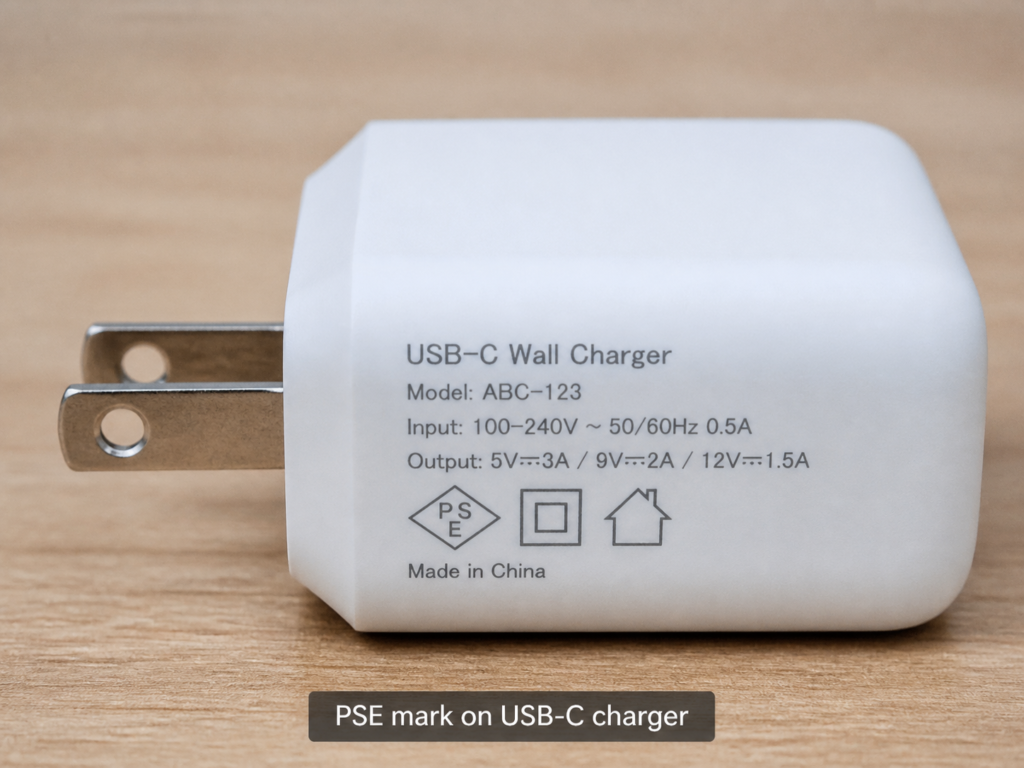
The following types of products are basically within the scope of PSE regulation, but the final decision is subject to the official catalog:
• Independently sold wall-plug USB/USB-C chargers for mobile phones, tablets, and laptops;
• Travel chargers and desktop power adapters with fixed AC pins;
• Wireless charging bases and multi-port charging stations with built-in AC-DC power modules.
Product Boundaries That Are Usually Not Included in Charger Category PSE
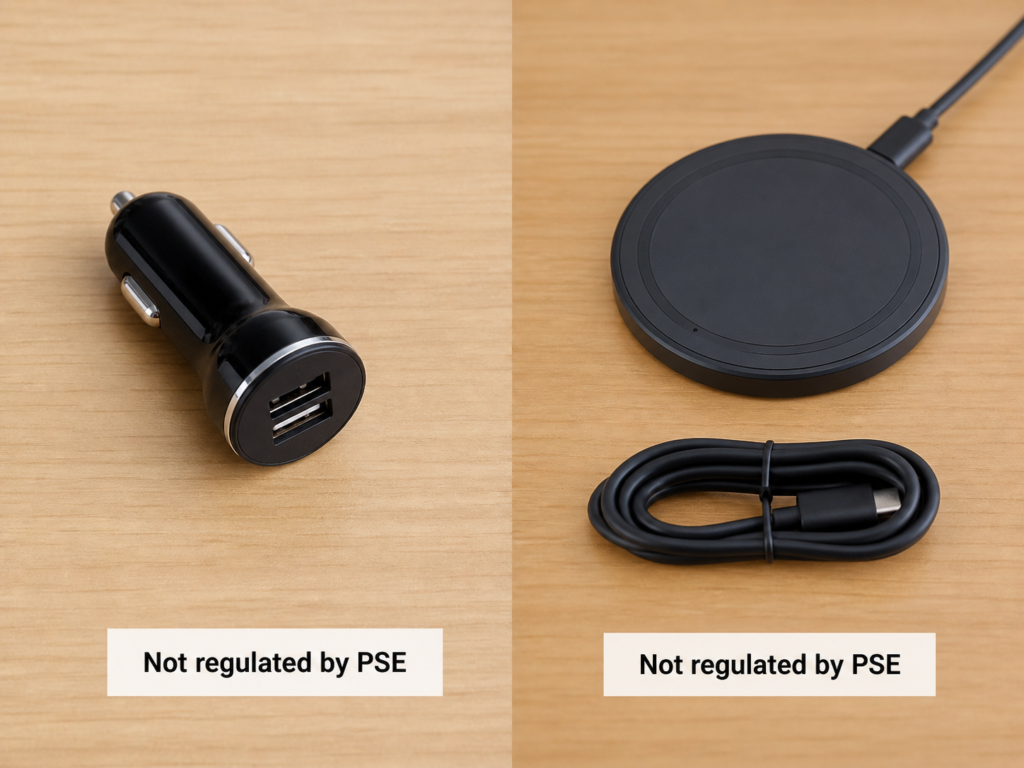
If your product falls into the following two categories, it generally does not need to apply for PSE as a charger category:
• Pure DC input car cigarette lighter chargers: they only convert the 12V DC power in the car to USB output, without the AC-to-DC process, so they are not within the scope of PSE regulation;
• Accessories with only USB/Type-C input: such as wireless charging bases that require a USB cable for power supply, and ordinary data cables, which do not connect to the mains themselves and are not AC-DC power supply devices.
3-Step Decision Self-Check Method
If you are still unsure after comparing the above boundaries, you can follow these 3 steps:
Step 1: First confirm whether your activity is **commercial import/sale for the Japanese market** — if it is for personal purchase and use, or brought back to the country by yourself, you don’t need to follow these rules;
Step 2: Compare the power supply structure, rated parameters, and sales form we just mentioned with the typical boundaries for preliminary matching;
Step 3: If you still have doubts, you should first complete the classification based on the METI item list and legal definitions; if there is any doubt, you can consult the competent Economic and Industrial Bureau of METI, or entrust an institution with relevant professional capabilities to assist in the analysis. RCAB may conduct conformity assessment required for diamond PSE within the scope of its registered items, but it does not replace METI in making legal classification judgments. Without full verification, circular PSE should not be used as the default treatment method.
3 Special Situations Prone to Misjudgment
There are several other points that people often get wrong, which we will mention separately:
1. **Low-power USB chargers**: 5W or the USB interface itself cannot determine whether PSE applies. For mains-input charging products, verification should be based on the rated input range, structure, purpose, and exclusion conditions of the corresponding items in the catalog; those that meet the definition of regulated items such as “DC power supply devices” must fulfill PSE requirements according to their legal categories;
2. **Wide-voltage products**: The product marked with “100-240V” wide voltage only means it can be used under Japan’s voltage, it does not mean it has met PSE requirements, and the necessary processes still have to be followed;
3. **Sales samples**: As long as they are samples entering the circulation and sales link, such as samples sent to channel partners or platform evaluation samples, they must be compliant as formal products. You can’t say “it’s just a sample so I don’t need to do it”.
Diamond PSE vs Circular PSE: What’s the Difference?
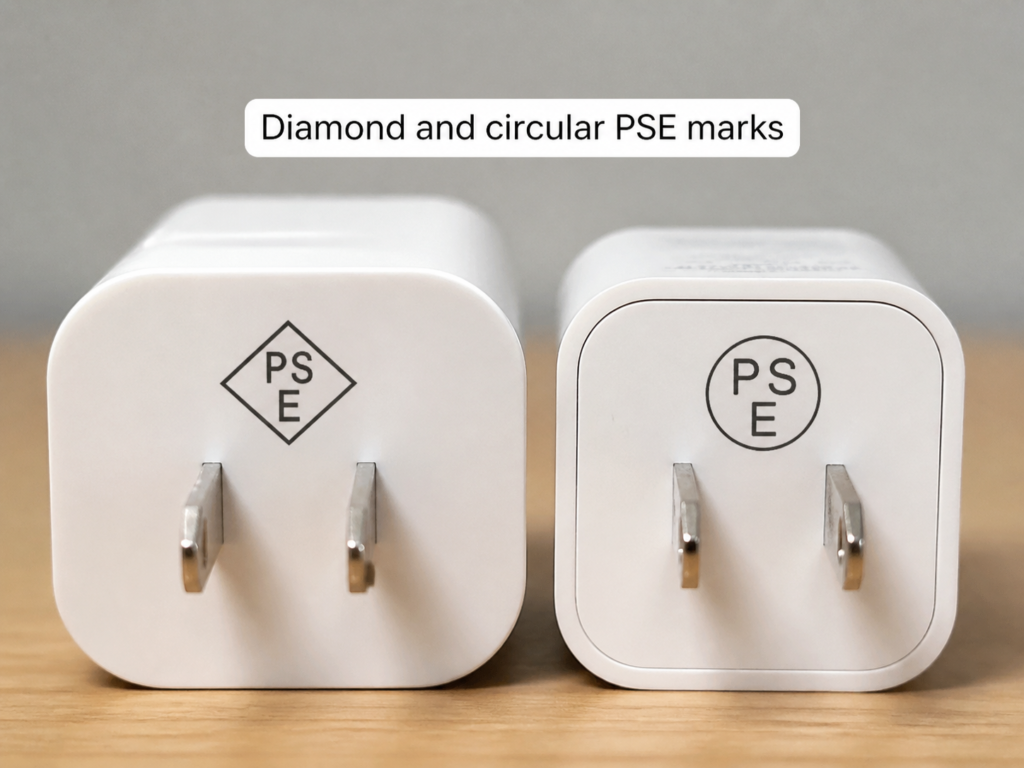
Many people think there is only one type of PSE, but in fact PSE is divided into two categories: diamond PSE and circular PSE, corresponding to products of different risk levels. **Both are mandatory compliance requirements**, it is not that the circular one is voluntary. The table below helps you quickly sort out the core differences between the two:
| Comparison Dimension | Diamond PSE (Specified Electrical Appliances and Materials) | Circular PSE (Non-Specified Electrical Appliances and Materials) |
| Classification and Risk Level | High-risk products, belonging to “specified electrical appliances and materials” in the METI catalog | Low-risk products, belonging to “non-specified electrical appliances and materials” in the METI catalog |
| Assessment Requirements | Conformity assessment must be carried out by a third-party organization (RCAB) recognized by the Japanese government | The filing entity within Japan may self-confirm that the product meets the standards and keep the technical documents on file |
| Labeling Requirements | The product must complete the legal PSE marking according to the applicable item. In addition to the diamond PSE pattern, the name of the notified business operator or the specified alternative mark, applicable rated items, etc. shall also be marked, and information related to the registered conformity assessment body shall be marked as required by regulations | The product must complete the legal PSE marking according to the applicable item. In addition to the circular PSE pattern, the name of the notified business operator or the specified alternative mark, applicable rated items, etc. shall also be marked |
| Filing Requirements | A domestic Japanese entity must submit a filing to METI | A domestic Japanese entity must submit a filing to METI |
Two points are added here: First, both must complete METI filing by an entity within Japan, and overseas enterprises cannot file directly; second, whether diamond PSE requires factory inspection and annual supervision depends on the applicable procedures and the rules of the RCAB you choose, and there is no unified requirement.
Which Category of PSE Do Chargers Generally Belong To?
As the saying goes: it cannot be judged solely by the commercial name, but must be matched with the items in the official catalog in combination with input parameters, structure, power, and sales form. However, from the actual situation, **common mains-input AC adapters and USB chargers, if they meet the definition of “DC power supply devices” in the catalog of the *Electrical Appliance and Material Safety Law*, usually belong to “specified electrical appliances and materials” and are subject to diamond PSE**. Whether other items apply or are not within the scope of the catalog must be judged item by item according to the rated input, structure, purpose, and exclusion conditions in the catalog; it cannot be directly judged as circular PSE on the grounds of low power.
4 Most Common Classification Misconceptions
Many people fall into pitfalls in classification because of these wrong perceptions:
1. **Misconception 1: Low-power chargers must apply for circular PSE**
Wrong. Power is only one of the reference factors for classification, not the only standard. The final decision is subject to METI’s official catalog. 5W or the USB interface itself cannot determine whether PSE applies. For mains-input charging products, verification should be based on the rated input range, structure, purpose, and exclusion conditions of the corresponding items in the catalog.
2. **Misconception 2: USB interface chargers do not need diamond PSE**
Wrong. The USB interface is not a decisive classification standard. For mains-input charging products, verification should be based on the rated input range, structure, purpose, and exclusion conditions of the corresponding items in the catalog; those that meet the definition of regulated items such as “DC power supply devices” must fulfill PSE requirements according to their legal categories.
3. **Misconception 3: Circular PSE is voluntary, you can just do it casually**
Wrong. Circular PSE is also a mandatory compliance requirement, except that the assessment method is self-confirmation and no third-party organization is required to issue a certificate. However, you must keep a full set of technical documents. Once you are found unqualified in a random inspection, you will still be responsible for rectification, sales suspension, recycling, etc.
4. **Misconception 4: Circular PSE has a unified third-party certificate**
Wrong. There is no legal third-party certificate for circular PSE. The core is “self-confirmation + METI filing”. If an institution tells you “you can buy a circular PSE certificate for money”, you must be vigilant, it is probably useless.
What Are the Consequences of Non-Compliance? Don’t Take Chances
Some sellers think “I’ll sell first, and deal with it if I get caught”, but in fact, the regulatory risk of PSE is higher than you think, and the consequences are quite serious.
First, **obstacles in import and circulation links**:
• If PSE documents or labeling do not meet the requirements, it may lead to risks such as import inspection, platform review, sales restrictions, and subsequent regulatory disposal, and may result in additional logistics and rectification costs. For products subject to PSE, they cannot be sold in Japan without completing legal requirements; the specific import customs clearance disposal shall be subject to the case-by-case requirements of customs and competent authorities;
• Most e-commerce platforms such as Amazon Japan and Rakuten require sellers to provide PSE certification to list related categories. If there are no compliance documents, the products may be directly removed from the shelves, and even affect the store’s weight. Of course, the specific platform disposal rules are subject to the official requirements of each platform and individual cases.
Second, **legal penalties from regulatory authorities**:
If non-compliance is found in random inspections by METI or local regulatory authorities, the lightest penalties include requiring rectification, suspending sales, recalling products, and disclosing violation information. In serious cases, the relevant responsible entities may also bear administrative or even criminal liabilities.
There is also the easily overlooked **commercial reputation risk**:
If you are complained by consumers or exposed by the media due to safety issues, it will greatly damage the long-term image of the brand, and may also affect your subsequent cooperation with Japanese channel partners.
We also remind you that in case of random inspection or product safety accidents, the following core documents need to be provided to prove compliance: METI filing information, conformity assessment documents (only required for diamond PSE), product test reports and technical documents, product label photos, list of key safety components, and product change records. So these documents must be properly kept and not lost.
Practical Guide: How to Complete the Entire PSE Compliance Process
Now that you understand the rules, let’s talk about how to operate specifically and how to divide the responsibilities of all parties to avoid mutual buck-passing.
How to Divide the Responsibilities of All Parties?
PSE compliance is not the responsibility of a single party, it involves multiple entities, each performing its own duties:
• **Filing entity within Japan**: bears the responsibility for METI filing, and must be a local Japanese enterprise or individual;
• **Brand owner/importer**: responsible for confirming product compliance, reviewing labels, keeping documents, and notifying relevant parties in time when there are product changes;
• **Manufacturer**: responsible for producing products that meet standards, providing complete technical documents, and ensuring that mass-produced products are consistent with the compliant version;
• **RCAB**: responsible for conformity assessment and certification of diamond PSE (if applicable).
It is recommended that you write the responsibilities into the contract before cooperation, clearly stipulating the model coverage scope, who is responsible for the label, the process of change notification, and how long the documents should be kept, so as to avoid mutual buck-passing when problems arise later.
Standard Version Compliance Processing Flow
Generally speaking, the complete PSE compliance process is divided into 7 steps:
Step 1: **Product classification confirmation**: First clarify whether the product belongs to diamond or circular PSE, and which item it corresponds to — this step is the foundation. If the classification is wrong, all the money spent later will be wasted;
Step 2: **Document gap assessment**: Prepare core verification materials, such as model parameters, circuit diagrams, bill of materials, key safety component information, Japanese label drafts, etc., and supplement what is missing;
Step 3: **Sample testing/conformity assessment**: If it is diamond PSE, you must find an RCAB qualified for the corresponding item to conduct assessment and testing; if it is circular PSE, you can test it yourself or entrust an institution to test it, but the test report and technical documents must be kept properly;
Step 4: **METI filing**: The filing entity within Japan submits a filing application to METI to complete the filing;
Step 5: **Confirm that the PSE mark meets the requirements**: The product must complete the legal PSE marking according to the applicable item. In addition to the corresponding diamond or circular PSE pattern, the name of the notified business operator or the specified alternative mark, applicable rated items, etc. shall also be marked; diamond PSE products must also mark information related to the registered conformity assessment body as required by regulations. The complete content, size, and position of the mark must comply with the rules of the corresponding item, and must be clear, durable, and not easy to fall off;
Step 6: **Mass production consistency guarantee**: During mass production, ensure that the product is completely consistent with the version tested for compliance, and do not randomly replace parts or modify parameters;
Step 7: **Document retention**: After listing, the full set of compliance documents shall be properly kept as required for random inspection.
It should be noted that the processing cycle and cost of PSE vary greatly due to different product types, PSE categories, and selected RCABs. There is no unified standard, and the specific amount shall be subject to the actual quotation of the institution.
5 Most Common Operational Pitfalls
Many people don’t want to be non-compliant, but they fall into pitfalls during operation, wasting money and failing to get things done:
1. **Pitfall 1: Finding an institution without RCAB qualification for the corresponding item to do diamond PSE**
RCAB qualifications are based on items, not all institutions can do diamond PSE for all products. If you find an institution without corresponding qualifications, the assessment results cannot meet the legal conformity assessment requirements of the item, which may lead to risks such as import inspection, platform review, sales restrictions, and subsequent regulatory disposal. For products subject to PSE, they cannot be sold in Japan without completing legal requirements; the specific import customs clearance disposal shall be subject to the case-by-case requirements of customs and competent authorities.
2. **Pitfall 2: Thinking that circular PSE does not require testing and filing**
Although circular PSE does not require third-party assessment, it is still necessary to confirm that the product meets the standards, keep technical documents, and complete METI filing. It is not just a matter of putting a circular mark casually.
3. **Pitfall 3: Only completing the filing, not completing the full legal PSE marking**
The product must complete the PSE marking according to the regulations of the corresponding item. It is not just printing the PSE pattern, but also checking the applicable content such as the name of the notified business operator or the specified alternative mark, and rated items. Filing documents alone are useless; if found, it will still be considered non-compliant.
4. **Pitfall 4: Ignoring the impact of product changes**
If the product has core components replaced or parameters modified, you must re-evaluate the compliance. You can’t say “I filed before so it’s fine”. Otherwise, if inconsistency is found in random inspection, it will be directly deemed non-compliant.
5. **Pitfall 5: Incomplete document retention**
All compliance documents must be kept as required. If you cannot produce them during random inspection, even if the product itself is compliant, it may be judged as non-compliant.
How to Optimize Compliance Costs?
Compliance costs money, but there are also reasonable money-saving tips:
• **Series product application**: If multiple models have similar structures, first ask the RCAB or testing institution to confirm in writing which models can be covered, then reuse the documents, without testing each model separately;
• **Pre-classification confirmation**: Before opening molds or conducting tests, clarify the product classification first to avoid repeated testing and waste of money due to classification errors;
• **Document reuse**: Keep complete test documents. For subsequent new products with the same structure, you can ask the institution to confirm and reuse valid data without testing from scratch.
Of course, not all changes can reuse documents. If changes involve these core contents, compliance must be re-evaluated: rated power, transformer, primary/secondary protection circuit, Y capacitor, optocoupler, PCB board, housing, plug.
Boundary Judgment: Easily Confused Products and Sales Scenarios
In addition to ordinary wall-plug chargers, there are many related products and sales scenarios where people often can’t figure out whether PSE is needed. We will clarify them all at once.
PSE Requirements for Related Charging Products
• **USB/USB-C data cables**: Ordinary data cables sold separately do not need PSE because they have no AC-to-DC function; but if it is a fixed cable integrated with the charger, it will be compliant together with the charger and does not need to be done separately.
• **Car chargers**: Car chargers with pure DC input (powered by cigarette lighter) do not need PSE; but if it is a dual-purpose charger with an AC plug (can be plugged into both mains and cigarette lighter), it must be verified whether PSE is required according to AC-DC products.
• **Wireless chargers**: Wireless chargers with AC plugs and built-in power modules need PSE; if it is a wireless charging base with only USB/Type-C input (requires a cable for power supply), it does not need to apply for PSE as a charger category.
• **Power banks**: The lithium-ion batteries used in power banks may be subject to separate circular PSE requirements, but this must be judged according to the definition, energy density threshold, and exclusion conditions of “lithium-ion storage batteries” in Japanese regulations; it cannot be deemed applicable just because the product contains a lithium battery. Whether the battery is built into the device or supplied as a separate product should also be verified separately.
• **Built-in power modules/bundled adapters**: They cannot be directly exempted. The judgment must be made in combination with the parameters of the module itself and the catalog attribution of the final complete machine. For example, the charger bundled with a laptop must also be separately verified whether it meets PSE requirements. It is not that “bundled gifts don’t need to be done”.
Differences in Requirements for Different Sales Scenarios
For the same product, different sales scenarios have different compliance requirements:
• **B2B export to Japanese brands/importers**: The factory only needs to provide test documents and consistency support, and METI filing is completed by the filing entity within Japan (that is, the Japanese brand owner or importer);
• **Direct sales on cross-border e-commerce platforms such as Amazon/Rakuten**: You need to upload PSE certification according to platform requirements, and ensure that the information on the sales page, the label of the actual product, and the information on the compliance documents are consistent, otherwise it is easy to be removed from the platform;
• **Test/exhibition samples**: If they are a small number of samples for non-sales purposes, you can apply for temporary import arrangements and confirm whether PSE is exempted on a case-by-case basis. You can’t directly say “samples don’t need to be done”;
• **Personal carry-on entry**: The rules for a small number of products for personal use are completely different from commercial exports. You must never use the rules for personal use as a basis for exemption for enterprise batch exports.
In Addition to PSE, Pay Attention to These When Exporting to Japan
Don’t think that everything is fine after getting PSE. There are several supporting compliance requirements, and if they are not done well, problems may still arise.
Electrical Specifications Must Adapt to the Local Power Supply Environment in Japan
Japan’s mains power is different from that in China, Europe and the United States, and products must be adapted to work normally:
• **Voltage**: Japan’s mains is usually AC 100V, and products must support 100V input. Of course, most wide-voltage products (100-240V) are fine now;
• **Frequency**: The eastern half of Japan (such as Tokyo) is 50Hz, and the western half (such as Osaka) is 60Hz. AC input products sold nationwide in Japan should usually be adapted to AC 100V, 50/60Hz; if sold or used only in a specific power supply area, it should be confirmed according to the power supply conditions and applicable standards of that area;
• **Plug**: The plug or power cord configuration should be compatible with Japanese sockets and applicable PSE/JIS safety requirements. Fixed-plug products usually adopt a two-flat-pin type adapted to Japanese sockets, but products such as detachable power cords should be judged according to their actual structure.
Japanese Instructions and Information Consistency
• The core legal information of PSE itself should mainly be marked on products and other carriers as required, which does not automatically mean that all chargers must be accompanied by Japanese instruction manuals. Whether Japanese instruction manuals, warning contents, importer contact information, etc. must be provided should be confirmed in combination with product categories, other applicable regulations, platform rules, and sales methods;
• It is best to keep the model, parameters, and brand information on the product body, packaging, and sales page consistent, otherwise it is easy to be complained by consumers and will also increase the probability of regulatory random inspection.
It should be noted that some of the above requirements are the needs of platforms, consumer communication, and risk control, and the specific ones shall be subject to applicable regulations and platform rules.
Other Possible Compliance Requirements
• If the charger has wireless functions (such as Bluetooth, WiFi), it is usually necessary to confirm whether the technical standard conformity certificate, construction design certification, or other wireless equipment requirements of the apply. MIC is the competent authority, and TELEC is just one of the registered certification bodies that can provide relevant certification services; it should be verified according to the wireless module, frequency band, and certification path;
• If the product contains a lithium battery, it must comply with Japan’s lithium battery-related safety and recycling regulations;
• Some power products also need to meet Japan’s energy efficiency regulations such as standby power consumption.
Generally speaking, whether PSE is required for chargers exported to Japan never depends on the product name, but on its power supply structure, rated parameters, sales form, and whether it is for commercial sale. Common mains-input AC-DC chargers, if they meet the definition of “DC power supply devices” in the catalog, usually fall under the mandatory diamond PSE category; whether other items apply or are not within the scope of the catalog must be judged item by item according to rated input, structure, purpose, and exclusion conditions. When in doubt, be sure to check METI’s official category list, consult the competent Economic and Industrial Bureau of METI, or entrust an institution with relevant professional capabilities to assist in analysis. Don’t guess blindly.
Compliance is not a mere formality, but the foundation to avoid import inspection, platform removal, sales restrictions, and regulatory penalties. At the same time, it is also necessary to take into account local Japanese requirements such as power supply adaptation, labeling, and other certifications. Only by laying a solid foundation can you successfully enter the Japanese market and do business for a long time.