
Sellers of chargers targeting the US market almost cannot avoid the issue of FCC compliance. Especially with the popularization of GaN fast charging in recent years, many people ask: GaN is a new semiconductor material, will there be exclusive FCC requirements for it? Can the compliance rules for ordinary silicon-based chargers be directly applied? Does my GaN charger really need separate FCC certification?
Actually, the core logic of this question is not complicated. FCC rules never focus on what materials a product uses, but on the product’s functions and sales form. Next, we will explain this thoroughly from basic conclusions to advanced judgments.
First, the Most Direct Core Conclusion
Let’s put the answer everyone cares most about first: **GaN chargers have no exclusive FCC compliance requirements**.
GaN (gallium nitride) is only a power semiconductor device inside the charger, and will not change the FCC classification of the product. All external AC-DC chargers, whether using traditional silicon-based materials or GaN materials, are evaluated according to the rules for power adapters. Compliance requirements will neither increase nor decrease due to the use of GaN, and there is no so-called “GaN-specific FCC certification”.
On this basis, you can first remember a simplified version of the compliance paths for GaN chargers with different functions:
• Ordinary wired charging models: follow SDoC (Supplier’s Declaration of Conformity), no FCC ID required.
• Models with wireless communication transmission functions such as Bluetooth and WiFi: the transmitter usually applies to Certification (third-party certification). If a certified wireless module is used, and the whole device fully meets the integration conditions such as antenna, installation, co-location, and labeling in the module Grant, it can be used under the module authorization and marked according to the rules, and it is not necessarily necessary to apply for a separate FCC ID for the terminal; if the conditions are not met, supplementary evaluation, application for a new certification, or authorization change may be required.
• Consumer-grade models with wireless charging function: usually follow SDoC under Part 18 rules, no FCC ID required.
As for whether it needs to be “done separately”, it depends on the sales form of the product: if it is a finished charger sold independently to the US market, separate compliance is required; for personal use only and not for sale, with no more than 3 devices imported at a time, the FCC equipment authorization import exception may apply, but this does not apply to commercial sales, nor can it be understood as a general compliance exemption for products on the market; for non-end products supplied as components to OEM factories where the OEM is responsible for overall compliance, separate compliance is usually not required. We will elaborate on the judgment of special situations such as private labeling and product changes later.
Understand 4 Core Product Configurations Before Judgment
Before specifically analyzing compliance requirements, you must first sort out your product configuration, focusing on 4 items:
The first item is **product form and core function**. First confirm whether it is an AC-DC external power adapter/charger, that is, what we commonly call wall-mounted charging heads, desktop charging stations, etc.; then check whether it only has a wired charging function, or integrates wireless charging and wireless power supply functions. This is the most basic basis for classification.
The second item is **whether there is an active radio transmission function**. Special attention should be paid here: “active radio transmission” refers to wireless functions used to transmit data/signals such as Bluetooth, WiFi, and remote control, which is not the same as wireless charging. The presence or absence of such transmitters is the core basis for judging whether Certification and FCC ID labeling requirements are involved; however, if the whole device compliantly integrates a certified wireless module with an existing FCC ID, it is not necessarily necessary to apply for a new FCC ID for the whole device.
The third item is **digital/control circuit function**. For example, whether it has a USB-C interface, whether it supports PD/PPS fast charging negotiation—many people mistakenly think that digital protocols equal wireless transmission. In fact, PD/PPS are power supply protocols for wired transmission, which only trigger the electromagnetic interference requirements for digital devices under Part 15, and do not trigger FCC ID requirements.
The fourth item is **structural and configuration details**. For example, the number and type of interfaces, output power levels, whether there are additional components such as a display screen or replaceable cables. These details will not change the overall compliance path, but will affect the judgment of the worst-case configuration for testing, and whether series models can share the report.
First, Some Basic Common Sense: What Exactly is FCC Compliance?
Some friends who are new to this may not be clear about the boundaries of FCC compliance. Here we first explain the basic concepts to facilitate subsequent understanding.
FCC is the abbreviation of the Federal Communications Commission of the United States, and its compliance requirements are one of the mandatory access thresholds for electronic products entering the US market. For ordinary non-wireless chargers, the focus of FCC compliance is the electromagnetic disturbance emission generated when the product is working—that is, whether it will leak excess electromagnetic signals that interfere with other electrical appliances or communication equipment. For products with wireless transmission functions such as Bluetooth and WiFi, the FCC also involves transmission frequency bands, power, bandwidth, spurious emissions, antenna configurations, and applicable RF human exposure requirements.
It should be specially noted that FCC usually does not replace requirements such as product safety performance, energy efficiency, and fast charging protocol compatibility. These are covered by other standards and certifications. Do not regard FCC as all the requirements for the US market.
Returning to GaN chargers themselves, their essence is external power adapters, which belong to the same FCC product category as silicon-based chargers that we have used for decades. The advantage of GaN material is only that it makes the charger smaller, more efficient, and less hot, which has nothing to do with compliance classification. At present, there are roughly three types of common GaN chargers on the market: single-port fast charging heads, multi-port desktop charging stations, and 2-in-1 products with wireless charging pads. Although their appearances are very different, the classification logic is the same.
Many people also ask: do matching charging cables need separate FCC compliance? Let’s clarify it uniformly here: ordinary passive charging cables, which only have wires inside and no active circuits, do not need separate FCC compliance; USB-C cables with E-marker chips usually do not need independent FCC authorization either, because E-marker is only a low-power wired communication chip used to transmit power supply parameters and does not radiate wireless signals; only cables with active circuits, signal conversion functions (such as USB-C to HDMI cables) or built-in wireless functions need to be evaluated for compliance requirements according to specific functions.
Next are the two types of FCC compliance paths that people are most likely to confuse. The core distinction standard is only one: **whether the product is a regulated device that actively transmits radio signals**.
The first is called SDoC, that is, Supplier’s Declaration of Conformity. Simply put, the manufacturer conducts testing according to FCC requirements, keeps the test report and declaration documents, and does not need to apply for an exclusive ID number from the FCC. This path applies to “unintentional radiators”—that is, devices that are not originally used to send wireless signals, but inevitably leak a little electromagnetic interference when working. Ordinary wired chargers fall into this category.
The second is called Certification, that is, third-party certification. This requirement is stricter. It requires an FCC-recognized third-party organization (TCB) to review the test report and product materials. After passing, a unique FCC ID number will be issued, and the product must be marked with this ID as required. This path applies to “intentional radiators”—that is, devices that rely on transmitting wireless signals to work, such as chargers with Bluetooth and WiFi.
Here we also need to mention the “module certification exception” that many people fall into: if your charger uses a Bluetooth/WiFi module that already has an FCC ID, it does not mean that the whole device is automatically compliant. You need to check the conditions in the module authorization document, such as whether the antenna type and gain are consistent with those during certification, whether the module installation method meets the requirements, whether it will co-locate with other transmission circuits and interfere with each other, and whether the labeling requirements are met. If the module Grant and FCC module integration conditions are met, the terminal can be used under the module authorization and marked with “Contains FCC ID: …” as required, and it is not necessarily necessary to apply for a new FCC ID for the whole device; if these conditions are not met, supplementary testing, application for a new certification, or authorization change is still required, and the module’s FCC ID cannot be directly used.
Core Judgment Logic: Understand Compliance Requirements from Three Dimensions
With the basics understood, we can systematically judge the FCC compliance requirements of GaN chargers from three dimensions.
Dimension 1: Look at Product Functions to Determine Applicable Rules and Paths
The core function of the product is the first basis for judging the compliance path. We divide common GaN chargers into three categories to correspond:
The first category is **models with only wired charging function**, including products that support wired fast charging protocols such as USB PD and PPS. This category belongs to “unintentional radiators” under Part 15 rules. It only needs to pass conducted and radiated interference tests to meet the requirements, follow the SDoC path, and no FCC ID is required.
The second category is **models with wireless communication functions such as Bluetooth and WiFi**, such as chargers with Bluetooth connection that can check charging power on a mobile phone. The wireless transmitters used in this category usually apply to the Certification path under Part 15 rules. If the whole device adopts a self-designed transmission scheme, or does not meet the integration conditions of the certified module, it is usually necessary to obtain the corresponding FCC ID; if a certified module with an existing FCC ID is used, and the antenna, installation, co-location, labeling and other conditions meet the module Grant, it can be integrated under the module authorization and marked according to the rules, and it is not necessarily necessary for the terminal to have its own FCC ID.
The third category is **models with wireless charging/wireless power supply function**, such as 2-in-1 GaN chargers with wireless charging pads. Here we need to specially correct a common misunderstanding: wireless charging devices are usually evaluated according to the ISM/WPT rules of Part 18, and Part 15 is not automatically excluded just because they do not transmit communication data. Consumer-grade products usually follow the SDoC path under Part 18, and no FCC ID is required. If the product contains digital circuits that are not directly related to ISM or wireless power supply functions, this part of the digital circuits must also meet the electromagnetic interference requirements for digital devices in Part 15 Subpart B; whether control circuits directly related to ISM functions are additionally subject to Part 15 shall be judged according to specific functions and rules. If it also has wireless communication functions such as Bluetooth and WiFi, the certification requirements for intentional radiation under Part 15 must be added.
For your quick reference, we have compiled a simple comparison table:
| Product Function Type | Applicable FCC Rules | Compliance Path | Is FCC ID Required? |
| Wired charging only (including USB PD/PPS) | Part 15 Unintentional Radiator | SDoC | No |
| With wireless communication such as Bluetooth/WiFi | Part 15 Intentional Radiator | Transmitter usually applies to Certification | When using a certified module and meeting the Grant integration conditions, it is not necessarily necessary for the terminal to have its own FCC ID; in other cases, the corresponding FCC ID is usually required |
| Consumer-grade with wireless charging | Part 18; if containing digital circuits not directly related to ISM/wireless power supply functions, Part 15 Subpart B also applies | SDoC | No (supplementary certification is required if wireless communication is added) |
Dimension 2: Look at Sales/Supply Form to Judge Whether Separate Compliance is Required
When many people ask “do I need separate FCC certification”, they are actually asking “do I need to complete the compliance myself”. This depends on how your product is sold:
If it is **independent retail**, whether on e-commerce platforms or offline stores, as long as it is sold as an independent finished product to US consumers, you, as the responsible entity, must complete the compliance separately.
If it is **bundled with the whole device for sale**, for example, a GaN charger is given as a gift when buying a laptop, then it is necessary to confirm whether this charger is already covered by the FCC compliance of the whole device. If it is covered, you don’t need to do it separately; if not, you still need to make up for it.
If it is **bare board/module supplied to OEM factories**, that is, your product is not an end product, but is installed into the whole device by others, then the whole device integrator is generally responsible for overall compliance, and you only need to cooperate to provide the materials required for testing; but if your product itself is a regulated wireless module, you still need to complete your own module certification.
If it is **private label/ODM procurement**, that is, you get a ready-made solution from the factory and sell it under your own brand, the key point is not just to see whether your brand is written on the original documents, but to confirm whether the product to be sold is consistent with the device corresponding to the test or authorization, how the US responsible party is arranged, and whether the labeling and document obligations are met.
For SDoC products, the responsible party may rely on test materials provided by the supplier, but must be responsible for the compliance of the actually sold products and keep corresponding records. For Certification products, if only the trade name is changed and the device itself is not changed, they can be marketed under the conditions of complying with FCC ID and labeling rules; but if changes involve hardware, antennas, RF parameters or transmission characteristics, it shall be evaluated according to applicable rules whether supplementary testing, authorization change or application for a new certification is required.
Dimension 3: Look at the Limits and Classification Boundaries of Applicable Rules
After determining the general path, you must also figure out the applicable limit levels, and you can’t choose randomly:
First is the Class A and Class B classification of Part 15 digital devices. Class B has stricter limits and is applicable to civil and household environments. All consumer-grade GaN chargers are required to comply with Class B by default; Class A has slightly looser limits and is only applicable to products in industrial and commercial environments, and must be accompanied by special warning instructions. This classification is determined by the product’s positioning and FCC rules, and cannot be chosen arbitrarily. For example, if you are clearly selling chargers to ordinary consumers, you cannot use Class A just to pass the test easily.
Then there are Part 18 wireless charging devices, which have their own limit and labeling requirements, do not apply the Class A/B classification of Part 15, and only need to be evaluated according to the corresponding rules.
Many people also ask if there are exemptions. Here we need to clarify: GaN chargers have no general industrial or scientific research exemptions. If you really think your product may meet the exemption conditions, you must find a local US compliance consultant to evaluate according to specific clauses. Do not claim exemption arbitrarily by yourself, otherwise it is easy to fall into pitfalls.
Advanced Q&A: Impact of GaN and Product Change Rules
Next, we will talk about two more advanced questions, suitable for friends who do product development and often change models.
What Impact Does GaN Have on Electromagnetic Interference?
Many people wonder whether GaN chargers are easier or harder to pass FCC certification. In fact, GaN has higher switching frequency and faster switching speed, which theoretically is more likely to generate conducted and radiated interference. But whether it will eventually exceed the limit depends on the circuit design, shielding design, and filtering design of the entire product, and there is no inevitable connection with whether GaN is used.
Precisely because of this, the electromagnetic performance of GaN chargers and silicon-based chargers of the same power may vary greatly, **the compliance documents of the two must never be used interchangeably**. Don’t think that if you had an FCC report for a silicon-based 65W charger before, you can directly use it for a 65W charger with a GaN solution now. This is completely non-compliant.
Do I Need to Redo Compliance if the Product is Changed?
When making products, it is inevitable to change components, structures, or firmware. How to judge whether retesting is needed at this time? Just remember the four-step method:
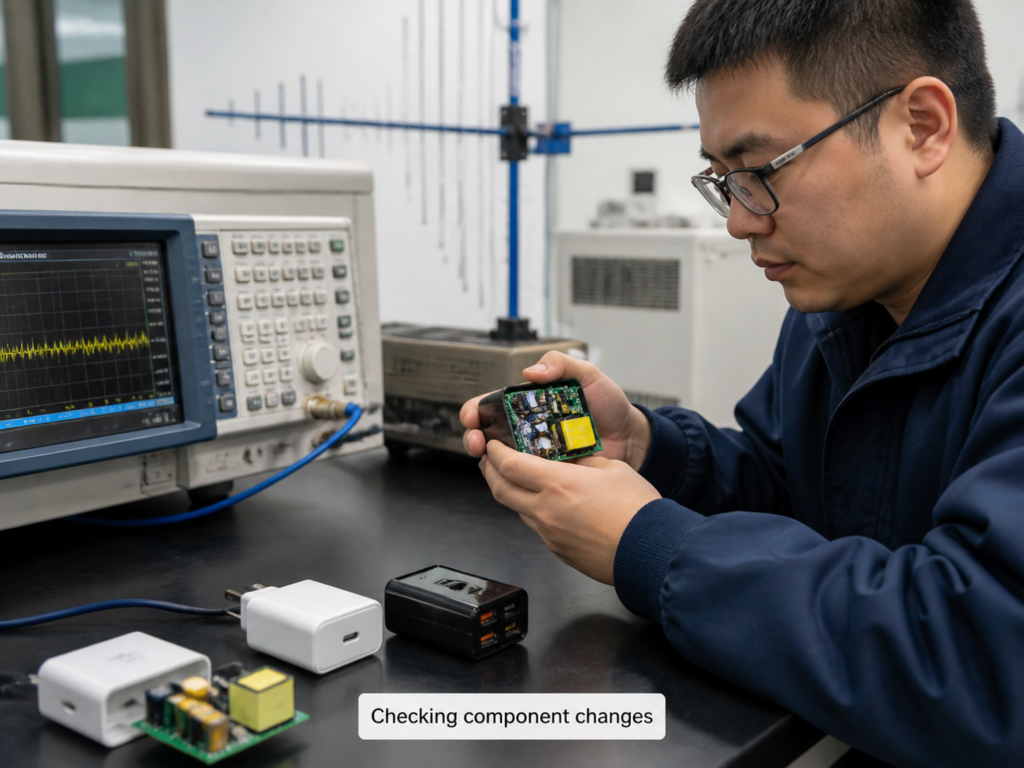
Step 1: First list all change items, whether it is changing a capacitor, modifying the circuit board layout, changing firmware, or changing the manufacturer, all must be listed completely.
Step 2: Evaluate whether these changes will affect the product’s disturbance emission level, RF parameters, certification authorization conditions, or the consistency between mass-produced samples and test samples. For example, just changing the color of the shell definitely has no impact; but if the power switch tube is changed, it may affect the electromagnetic interference level.
Step 3: Whether retesting is needed or not, written records of the engineering evaluation must be kept. If you are not sure, supplementary verification testing of the worst-case configuration shall be conducted.
Step 4: If the change has affected the basis of compliance, such as increased electromagnetic interference level or changed RF parameters, then supplementary testing, retesting, or even certification change (for products with FCC ID) is required.
Practical Essentials: Path Diversion and Document List
After talking about the judgment logic, let’s sort out some practical things for everyone.
First is the quick compliance path diversion for three types of products. If you can’t remember the previous content, just look at this:
• Wired charging only models: SDoC path, no FCC ID required.
• Models with wireless communication: the transmitter usually applies to the Certification path; terminals that use certified modules and fully meet the Grant integration conditions can be used under module authorization and marked according to the rules, and it is not necessarily necessary for the terminal to have its own FCC ID.
• Models with wireless charging: usually follow SDoC; if containing digital circuits not directly related to ISM/wireless power supply functions, they need to be evaluated according to Part 15 Subpart B; if wireless communication functions are added, supplementary certification is also required.
Then are the documents required for compliance, divided into two categories: mandatory requirements and recommended retention:
There are three types of **core documents required by laws and regulations**:
The first type is general basic documents, which are required no matter what path you take: electromagnetic compatibility test report, and product identification information (including model, specification, and responsible party information).
The second type is documents exclusive to the SDoC path: Supplier’s Declaration of Conformity, and contact information of the responsible party within the United States—the FCC requires that SDoC products must have a local US responsible party for the convenience of regulatory contact.
The third type is documents exclusive to the Certification path: FCC ID authorization document (i.e., Grant), grantee information, and FCC ID labeling design document.
**Traceable evidence recommended for retention**, although not mandatory by laws and regulations, is very useful when encountering random inspections or platform audits. It is best to have all of them ready:
• Model difference matrix for the same series of products: if there are multiple models of the same design, testing must be conducted based on the worst-case configuration, and then the differences of each model must be clearly listed before the report can be shared.
• Mass production consistency control records: ensure that mass-produced products are consistent with test samples.
• Test configuration records, list of key materials and firmware versions: convenient for evaluating the impact during subsequent changes.
• If a certified wireless module is used: the module’s Grant document, antenna specification, and installation verification records shall be kept to prove that you meet the module’s authorization conditions.
Pitfall Avoidance Guide: Common Misconceptions and Pitfalls
Finally, we have sorted out common misconceptions and pitfalls for everyone, especially friends who do cross-border e-commerce, must avoid them.
Cognitive Misconceptions
1. **GaN is a new material so no FCC is needed**: Wrong. FCC classifies by product function, which has nothing to do with the internal materials used. As long as it is an external power adapter entering the US market, it must meet FCC requirements.
2. **Low-power chargers don’t need FCC**: Wrong. Consumer-grade switching power supplies have no power exemption. Even a small 20W charging head needs FCC compliance.
3. **CE/UL can replace FCC**: Wrong. CE is the EU’s access requirement, UL is the US safety certification. They are completely different from what the FCC regulates, and are not interchangeable.
4. **Passing FCC means meeting all US requirements**: Wrong. For ordinary non-wireless chargers, the FCC focuses on electromagnetic disturbance emission; for products with wireless transmission functions, it also involves transmission technical parameters, antennas, and applicable RF exposure requirements. Other requirements such as safety, energy efficiency, and California Proposition 65 need to be checked separately.
5. **Using a certified wireless module means the whole device is automatically compliant**: Wrong. The module’s authorization conditions must be checked; only when the antenna, installation, co-location, and labeling conditions specified in the module Grant are met can the terminal be integrated under the module authorization. Otherwise, supplementary testing, application for a new certification, or authorization change is still required.
Operational Pitfalls
1. **Confusing SDoC and FCC ID**: Many people think that all FCC compliance requires an ID. In fact, ordinary wired models only need to follow SDoC. Products with active wireless transmission functions usually involve Certification; but when using a certified wireless module and the terminal fully meets the Grant integration conditions, it is not necessarily necessary for the terminal to have its own FCC ID.
2. **One report casually covers the whole series**: The premise for sharing reports among models of the same series is the same design, testing with the worst-case configuration, and a clear model difference matrix. If the core hardware is changed, the old report must never be used directly.
3. **Confusing labeling requirements**: SDoC devices shall provide a compliance information statement with the device as required, which includes the responsible party’s contact information and other content required by the rules; the FCC mark is voluntary for SDoC devices. Certification devices must be marked with the FCC ID as required; when meeting the conditions for electronic labeling, electronic labels can be used, so it cannot be generally understood that physical external labels must be used. SDoC products should not claim “FCC Certified”, which should only be used for products that have actually obtained Certification authorization.
4. **Inconsistency between test samples and mass-produced versions**: Test samples and their configurations should be able to represent the products to be marketed, and the worst-case operating mode or configuration in applicable tests shall be selected; mass-produced products must be consistent with the evaluated design and continuously meet the applicable limits. Engineering prototypes can be used for testing, but the differences between their design and subsequent mass-produced versions must be controlled and re-evaluated.
5. **Having a report from the supplier means you are exempt from liability**: Many sellers ask the factory for an FCC report and think everything is fine. In fact, the FCC responsible party shall be determined according to the equipment authorization path and supply chain arrangement. For SDoC, the responsible party shall be located in the United States, and can be the manufacturer, importer, or other eligible entity; whether the seller assumes this responsibility depends on its role in the supply chain and specific arrangements. In any case, the compliance obligations of the applicable responsible party cannot be exempted just because the supplier provides a report.
Exclusive Pitfalls for Cross-Border Channels
The requirements of different platforms and regulators will be adjusted over time, so be sure to follow the current policies and product attributes. In addition, special attention should be paid: never use counterfeit FCC marks or fictitious FCC IDs. Products that have not undergone Certification cannot be randomly marked with FCC ID, otherwise they will easily be removed from the platform, or even detained by customs.
1-Minute Self-Check List
If you have a GaN charger now and want to quickly judge the compliance requirements, you can self-check according to these 5 steps, and you can get the result in 1 minute:
Step 1: Confirm the product category. If it is an AC-DC external GaN charger, continue to judge below; if it is another category of power supply, evaluate according to the rules of the corresponding category.
Step 2: Judge the compliance path. Wired charging only models follow the SDoC path; for those with wireless communication such as Bluetooth and WiFi, the transmitter usually follows the Certification path. If a certified module is used and the whole device fully meets the Grant integration conditions, it can be used under module authorization and marked according to the rules, and it is not necessarily necessary for the terminal to have its own FCC ID; for those with wireless charging, priority is given to evaluation under SDoC of Part 18. If they contain digital circuits not directly related to ISM or wireless power supply functions, the requirements of Part 15 Subpart B must be supplemented, and if wireless communication functions are added, the corresponding certification shall be supplemented.
Step 3: Judge whether separate compliance is needed. Products sold independently to the US market require separate compliance; for those bundled with the whole device for sale, confirm whether they are within the coverage of the whole device’s compliance; for those supplied as modules to OEM factories, confirm who the responsible entity is; for personal use only and not for sale, with no more than 3 devices imported at a time, the equipment authorization import exception may apply, but it absolutely does not apply to commercial sales.
Step 4: Check existing documents (if any). For SDoC products, confirm that the equipment to be sold is consistent with the product corresponding to the existing test materials, and that obligations such as the US responsible party and record keeping have been fulfilled; for Certification products, confirm that the equipment is consistent with the equipment approved by the Grant, and that the FCC ID and labeling rules have been met. If changes involve hardware, antennas, RF parameters, transmission characteristics, or other changes that affect the basis of compliance, it is necessary to re-evaluate whether supplementary testing, change, or new certification is required.
Step 5: Confirm the limit classification. Part 15 digital devices for civil environments follow Class B limits; those for industrial and commercial use follow Class A limits (must meet classification requirements); Part 18 devices with wireless charging follow the corresponding limits.
Overall, the FCC compliance logic of GaN chargers is actually very simple: it depends on functions rather than materials, and on sales form rather than appearance. After reading this article, you should be able to quickly judge whether your GaN charger needs separate FCC compliance and what path to take, distinguish the rule differences between wired charging, wireless charging, and models with wireless communication, avoid common pitfalls in procurement, private labeling, and listing, and quickly check access compliance through the self-check list. If you encounter uncertain complex situations, such as products with special functions or uncertainty about whether you can claim exemption, it is recommended to consult a qualified US compliance consultant for confirmation. Do not judge by feeling to avoid unnecessary losses.