
If you shop for chargers or charging cables in the U.S., or operate in the U.S. market for charging-related products, you have most likely seen the ENERGY STAR logo with a white star on a blue background. Many people have questions: Is this certification a mandatory requirement in the U.S.? Can products clear customs or be listed for sale without it?
Here is the core conclusion first: ENERGY STAR is not a mandatory access certification at the U.S. federal level. It may be set as a requirement in specific scenarios such as public procurement, energy-saving incentive programs, or commercial contracts; however, state-level mandatory energy efficiency rules are independent compliance obligations and do not require ENERGY STAR certification for that reason. The vast majority of ordinary consumer-grade charging products are not subject to mandatory ENERGY STAR application requirements.
Don’t Confuse It: Differences from Other Core U.S. Compliance Requirements
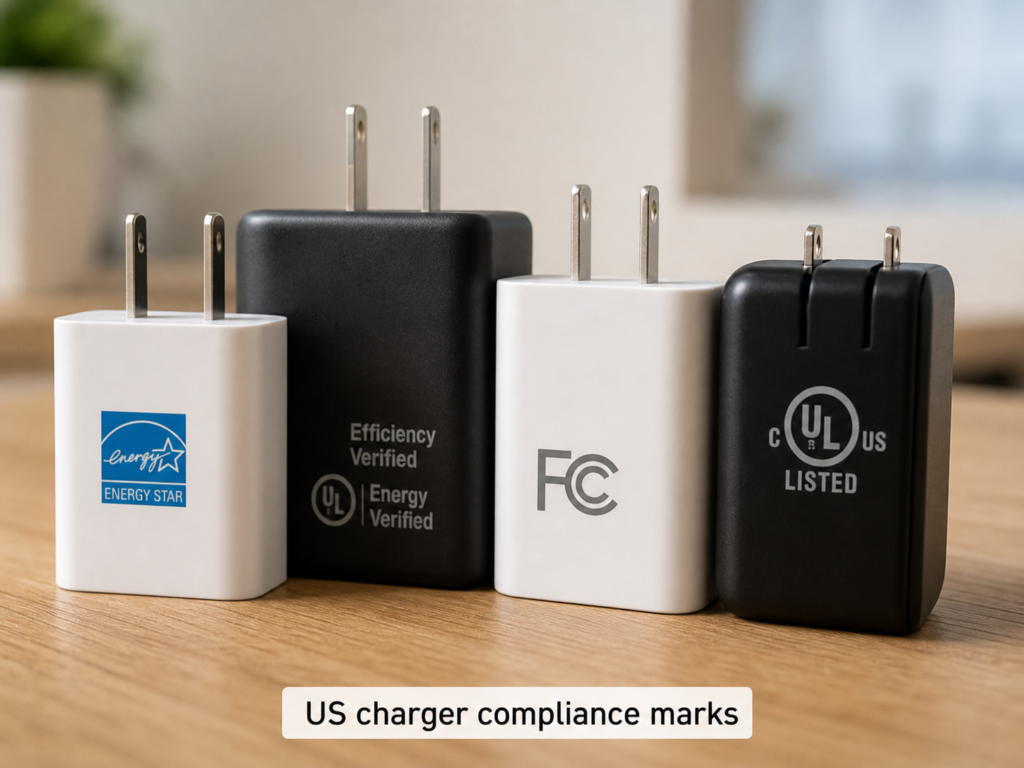
Many people confuse ENERGY STAR with DOE energy efficiency, FCC compliance, and UL safety certification. In fact, they govern completely different matters and are in no way interchangeable. Let’s go through them one by one:
1. DOE Mandatory Energy Efficiency vs. ENERGY STAR
The mandatory energy efficiency requirements of the DOE (U.S. Department of Energy) are the minimum access threshold at the federal level, and only apply to products such as external power supplies and battery chargers that fall within the scope of official definitions. DOE applicability must be judged based on the regulatory definitions of specific product categories, product functions and electrical characteristics, the relationship between the product and terminal equipment, and exemption clauses; a fixed set of conditions cannot replace the regulatory applicability analysis.
The two are completely independent systems: a product that meets DOE mandatory energy efficiency requirements does not mean it can obtain ENERGY STAR certification, nor can it use the ENERGY STAR mark; for products that are also subject to DOE mandatory energy efficiency standards, ENERGY STAR specifications usually adopt energy efficiency requirements higher than the minimum statutory threshold, but the scope of application and compliance obligations of the two systems are independent, and ENERGY STAR qualification cannot replace DOE applicability judgment or any DOE compliance obligations.
The consequences of violations are also different: violating DOE mandatory requirements may result in sales bans, rectification, civil penalties, etc., but not necessarily product recalls; unauthorized use of the ENERGY STAR mark (such as affixing it without certification) may result in revocation of certification qualification, product removal from shelves, and in serious cases, may trigger EPA enforcement, or even be penalized by the FTC (Federal Trade Commission) for false advertising.
2. FCC Compliance vs. ENERGY STAR
FCC (Federal Communications Commission) compliance is a federal regulatory requirement for radio frequency (RF)-related equipment. Its core focus is whether products generate unnecessary RF interference and whether they affect the normal operation of other devices, which has nothing to do with energy efficiency.
The applicable FCC path for charging products is determined by product functions (the final decision is subject to FCC official classification and the judgment of testing laboratories):
• Wired digital chargers/adapters: If they contain digital circuits and fall under the rules for unintentional radiators, they are usually evaluated under the Part 15 SDoC procedure — in short, the responsible party must ensure that the equipment meets applicable technical standards, and provide and retain compliance documentation in accordance with the rules; the FCC does not issue pre-certificates for SDoC. Whether testing is completed by a third-party laboratory and the documentation requirements shall be determined in accordance with applicable provisions and the responsible party’s compliance arrangements.
• Ordinary wireless chargers that only use inductive power supply such as Qi: The power transmission part usually needs to be evaluated against rules such as FCC Part 18.
• Smart chargers with RF communication functions such as Wi-Fi/Bluetooth: They need to be evaluated in accordance with the corresponding RF equipment rules.
• Ordinary passive charging cables: They are usually not managed as FCC equipment; however, active cables with electronic modules need to be evaluated based on their actual functions.
ENERGY STAR is a voluntary energy efficiency label. Its testing content is completely different from that of FCC, and the two cannot replace each other.
3. UL/ETL Safety Certification vs. ENERGY STAR
Marks such as UL and ETL are safety certifications issued by U.S. Nationally Recognized Testing Laboratories (NRTLs). They cover electrical safety risks such as electric shock and fire, and are common voluntary safety certifications on the market (may be required in some regions or channels).
ENERGY STAR only assesses energy efficiency and has nothing to do with safety at all. The two cannot prove each other’s compliance.
For your quick differentiation, we have organized these four types of core compliance requirements into a table:
| Compliance Type | Competent Authority | Key Focus | Federally Mandatory? | Applicable Scope for Charging Products | Interchangeable? |
| ENERGY STAR | Led by EPA, with DOE participation | Product energy efficiency (level of power saving) | No | Only some charging products are eligible for application; passive cables are completely ineligible. The specific scope is subject to the currently valid product categories of the EPA | No |
| DOE Mandatory Energy Efficiency | U.S. Department of Energy (DOE) | Minimum energy efficiency threshold | Yes (for specific categories) | Only external power supplies, battery chargers, etc. that fall under the definitions need to comply; applicability shall be judged based on product parameters | No |
| FCC Compliance | Federal Communications Commission (FCC) | RF interference, communication compliance | Yes (for specific categories) | Chargers, wireless chargers, etc. with digital circuits/RF functions need to comply; ordinary passive cables are usually not applicable | No |
| UL/ETL Safety Certification | Nationally Recognized Testing Laboratories (NRTLs) | Electrical safety (risks of electric shock and fire) | No (at the federal level) | Most charging products are eligible for application; may be required by some channels or regions | No |
The core conclusion is clear: no single compliance requirement can cover all U.S. market access needs, and they must be checked one by one according to product type and sales scenario.
Should Charging Products Apply for It? A 3-Step Judgment Method
If you are a seller or purchaser and are not sure whether your product needs ENERGY STAR certification, you can judge according to these three steps:
Step 1: First Confirm Eligibility for Application
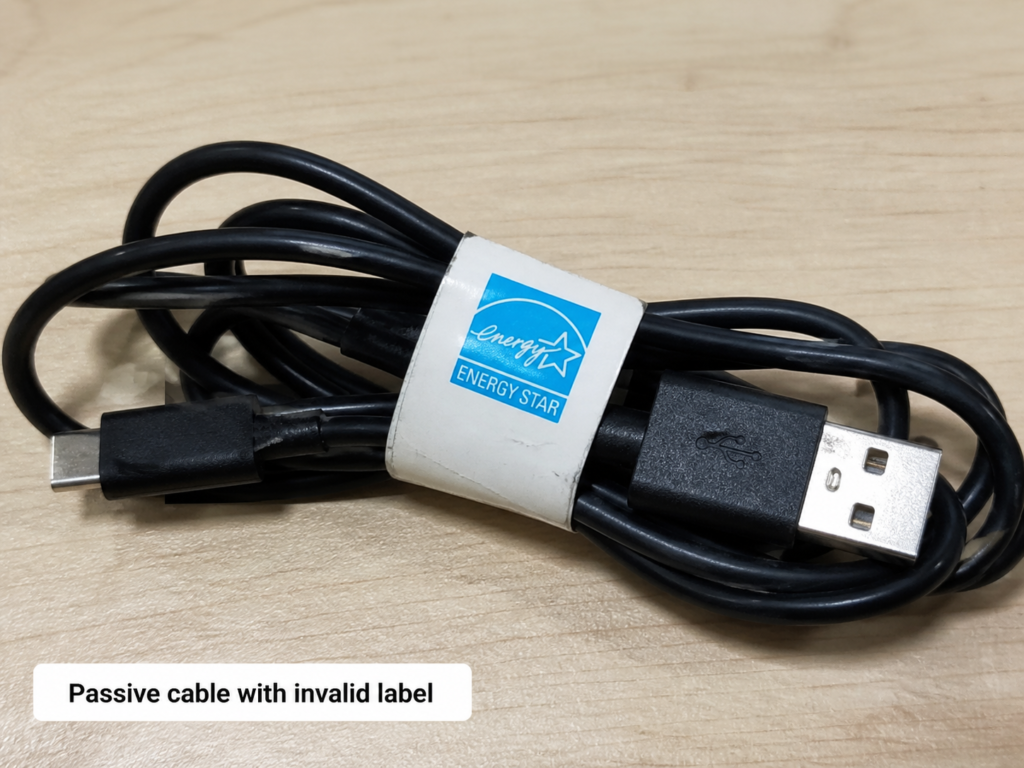
First, compare with the aforementioned coverage boundary for charging products to determine whether the product belongs to the certification categories currently open by the EPA. Passive cables are directly excluded from application eligibility.
In particular, note that the EPA’s ENERGY STAR specification for External Power Supplies has sunset, and external power supplies are no longer certified as of January 1, 2021. Ordinary wall chargers, desktop chargers, USB-PD adapters, etc., cannot be regarded as current ENERGY STAR categories for external power supplies that can be directly applied for.
For special products such as multi-port chargers, USB-PD fast chargers, and wireless chargers, it is recommended to first check the currently valid specifications on the EPA official website, or consult an EPA-recognized certification body, and do not apply blindly.
Step 2: Judge Necessity by Matching Sales/Usage Scenarios
• For ordinary consumer-grade retail or personal use: It is completely unnecessary, as long as the corresponding mandatory compliance requirements (such as FCC and DOE mandatory energy efficiency) are met.
• For other scenarios, check one by one against scenarios that may set requirements: if you want to enter specific supermarkets or e-commerce platforms, first check whether the platform’s entry rules have clear requirements; if you want to participate in government procurement or energy-saving subsidy programs, check in advance whether there are clear requirements in the program rules; if the product’s main selling point is high-end energy saving, you can also apply for it to build differentiated competitiveness.
Step 3: Evaluate Input-Output and Qualification Maintenance Costs
The cost of ENERGY STAR mainly consists of three parts: third-party testing fees, certification audit fees, and annual maintenance fees. The specific amount is subject to the quotation of EPA-recognized bodies, is greatly affected by product complexity, and there is no unified pricing.
The certification cycle also has no fixed duration, depending on factors such as the speed of sample preparation, whether rectification is needed for testing, the scheduling of certification bodies, and the progress of document review.
Also note that ENERGY STAR does not have a unified validity period, and it is not a one-and-done matter after obtaining it: you need to continuously pay attention to updates to official specifications, and update the certification in time if key components or models of the product change; you also need to cooperate with market spot checks, otherwise the product may be removed from the valid listing.
Action List by Group & Core Summary
Finally, we have organized the most direct action suggestions for different groups, and you can directly find the ones that apply to you:
Ordinary Consumers (Purchasing Charging Products)
• You do not need to list ENERGY STAR as a necessary purchase condition; just prioritize regular products with traceable sources and clear parameter labeling.
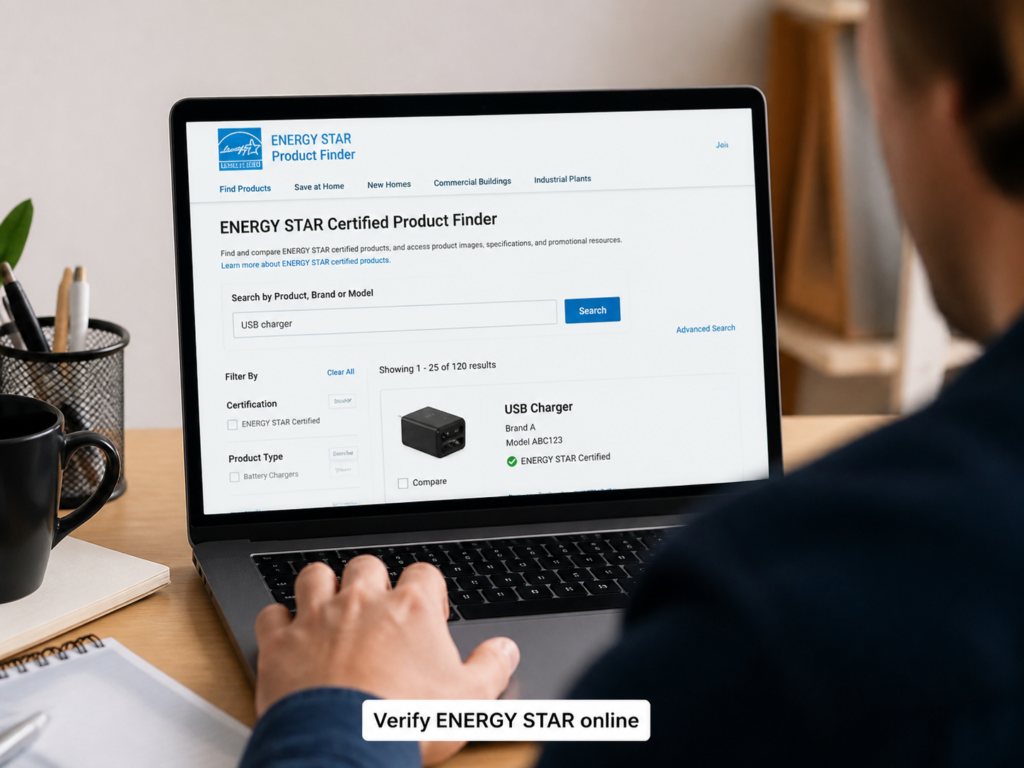
• If you have long-term energy saving needs, you can confirm the authenticity of the product’s ENERGY STAR qualification according to the qualification verification method above.
• If you see a charging cable (including fast charging cables) marked with ENERGY STAR, first check whether the mark is clearly attributed to the cable itself; if so, it is false advertising. If the mark may correspond to other products in the set, you should check the complete model, product category, and official listing.
Small and Medium Cross-Border Sellers (Entering the U.S. Market)
• First implement mandatory compliance: confirm the applicable FCC path and the applicability of DOE mandatory energy efficiency according to product type, complete corresponding testing, and retain the documentation properly.
• Apply for ENERGY STAR as needed: only consider applying when the target channel clearly requires it, the product’s main selling point is energy saving, or you need to participate in designated procurement/subsidy programs; do not invest blindly.
• Strictly abide by the compliance red line: products that are not within the certification scope must never be promoted as ENERGY STAR certified; nor can other compliance or energy efficiency statements be equated with ENERGY STAR certification.
Corporate/Public Procurement Personnel
• The wording of “mandatory/preferred/optional” should be clearly written in procurement documents. Do not blindly mandate ENERGY STAR, so as to avoid excluding qualified, cost-effective products.
• Require suppliers to provide queryable model certification proofs, and confirm their validity according to the qualification verification method; do not only look at the certificates provided by the supplier themselves.
• ENERGY STAR must never be used to replace the review of mandatory requirements such as FCC compliance and safety.
Core Summary
You only need to remember these three sentences to judge the vast majority of issues related to ENERGY STAR:
1. ENERGY STAR is a voluntary energy efficiency labeling program founded by the EPA in 1992, and the EPA and DOE now collaborate and co-manage product programs; it is not a federal mandatory access requirement, and ordinary consumer-grade charging products have no mandatory application requirements.
2. ENERGY STAR may become a de facto requirement only in scenarios such as public procurement/energy-saving incentive programs, and self-set requirements of commercial channels or customers; state-level mandatory energy efficiency rules are independent compliance obligations and do not require ENERGY STAR certification for that reason.
3. The compliance of charging products in the U.S. requires matching applicable mandatory requirements such as FCC and DOE according to product type; ENERGY STAR is only an energy-saving bonus item, not a mandatory item.