
If you often shop for charging cables or PD chargers online in the US, or run a charging-related business in the US market, you’ve most likely seen the California Prop 65 warning printed on packaging that reads “WARNING: Cancer and Reproductive Harm”. Many people wonder: My order is being shipped to Texas, not California, why does it have this label? Is California Prop 65 a nationwide regulation in the US?
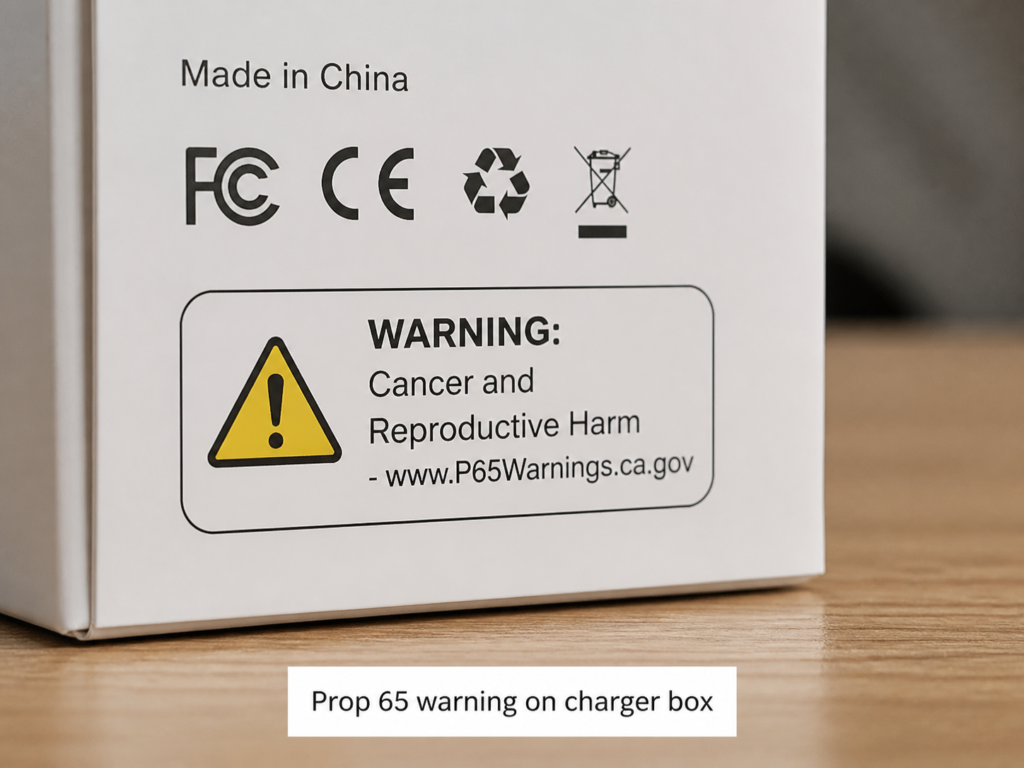
Today we’ll thoroughly explain this issue, covering legal rules, commercial practices, and how sellers can conduct self-checks, all in one go.
Core Conclusion: Legally Applicable Only to California, Often Covering the Entire US at the Commercial Level
Let’s start with the clearest conclusion: Legally, California Proposition 65 **only applies to California**, and is not a mandatory federal requirement of the United States. It is a California state-level consumer protection regulation, applicable to goods and businesses that sell in California or otherwise expose consumers to substances on the relevant list; whether a warning is required also needs to be determined in combination with the substance, exposure level, safe harbor level, and applicable exemptions.
Then why do many people think it applies nationwide? There are three main core reasons: First, cross-state e-commerce is so common now that many sellers use nationwide warehouses to stock products, and simply cannot completely isolate orders from California; second, most brands find it too troublesome to manage packaging and inventory by state, so they simply label all products uniformly in accordance with California Prop 65 requirements; third, there are other states in the US that have similar chemical or product regulatory rules, but with different standards, which are easily mistaken for the same regulation.
Let’s take three examples of the most familiar charging products, and you’ll immediately relate: If your charger is only sold in physical offline stores in Texas and is never shipped to California, you usually do not need to provide a warning for California Prop 65; if it is a USB-C cable sold on all sites of Amazon US, because it may be sold to California consumers, it usually needs to be evaluated under Prop 65, and a compliant warning must be provided when the warning conditions are met; if you run an independent site that clearly states “no sales to California”, and you actually implement this and never ship to California addresses, then products like power adapters may not fall within the applicable scope of the California sales chain, but you should still pay attention to the actual flow and other sales channels.
Must-Know Basics: What Exactly Does California Prop 65 Regulate?
Many people see this label every day but don’t know what California Prop 65 really is. Its full name is the Safe Drinking Water and Toxic Enforcement Act of 1986, and it is commonly referred to in the industry as Prop 65. The Office of Environmental Health Hazard Assessment (OEHHA for short) of California maintains a list of hazardous substances. The list contains more than 1,000 chemicals classified as carcinogenic or reproductively toxic, and the specific number changes as the list is updated. Its core requirement is not “products must be automatically labeled as long as they contain listed substances”, but: if a business’s operations will expose California consumers to listed substances, and the exposure level reaches the applicable warning standard, the business must provide a clear and reasonable warning that complies with the regulations; the location and method of the warning should comply with the applicable regulations of OEHHA. The original intention of the legislation is to allow California residents to know in advance the chemical exposure risks of products and reduce unnecessary exposure.
To understand its scope of application, just remember three core boundaries. The first is **geographical boundary**: it only depends on whether the product will be sold or delivered to California consumers, and has no direct relationship with the place of production or storage — even if the seller is in China and the warehouse is in Oregon, as long as the product is sold or delivered to California, the applicability of Prop 65 should be evaluated; whether a warning is mandatory also needs to be determined based on exposure, threshold, and exemption conditions. The second is **entity boundary**: it is not only brand owners that are responsible; manufacturers, importers, distributors, and retailers, as long as they are in the product circulation chain, may be held accountable, but the specific responsibility still needs to be determined based on facts such as their sales, distribution, knowledge, and control. The third is **product boundary**: almost all consumer goods may involve relevant requirements. Today we mainly use products such as charging cables, chargers, and power adapters as examples, but the logic is universal.
Here we must first clarify a most common confusion: California Prop 65 and FCC are completely different things. The FCC is a federal-level regulatory system for radio frequency and radio frequency interference, and its scope of application and authorization method depend on the product category and specific FCC rules; not all chargers require “FCC certification”, which should be determined in accordance with applicable requirements such as Part 15. California Prop 65 is a California state-level chemical warning regulation, focusing on consumer exposure caused by listed substances and whether notification is required. The two regulate completely independent dimensions and cannot replace each other — for example, when a PD charger is sold in the US, it should complete corresponding FCC compliance based on whether it is an FCC-regulated device and the applicable device authorization procedure; when sold to California, it should also be evaluated whether there is exposure to listed substances that requires a Prop 65 warning.
Why Do Charging Products Sold Nationwide Have the Label? It’s All a Business Choice
Since only California has legal requirements, why do many chargers and charging cables across the US have this label? This is not a legal mandate, but a business choice made by enterprises after calculating costs, and there are three very practical reasons behind it.
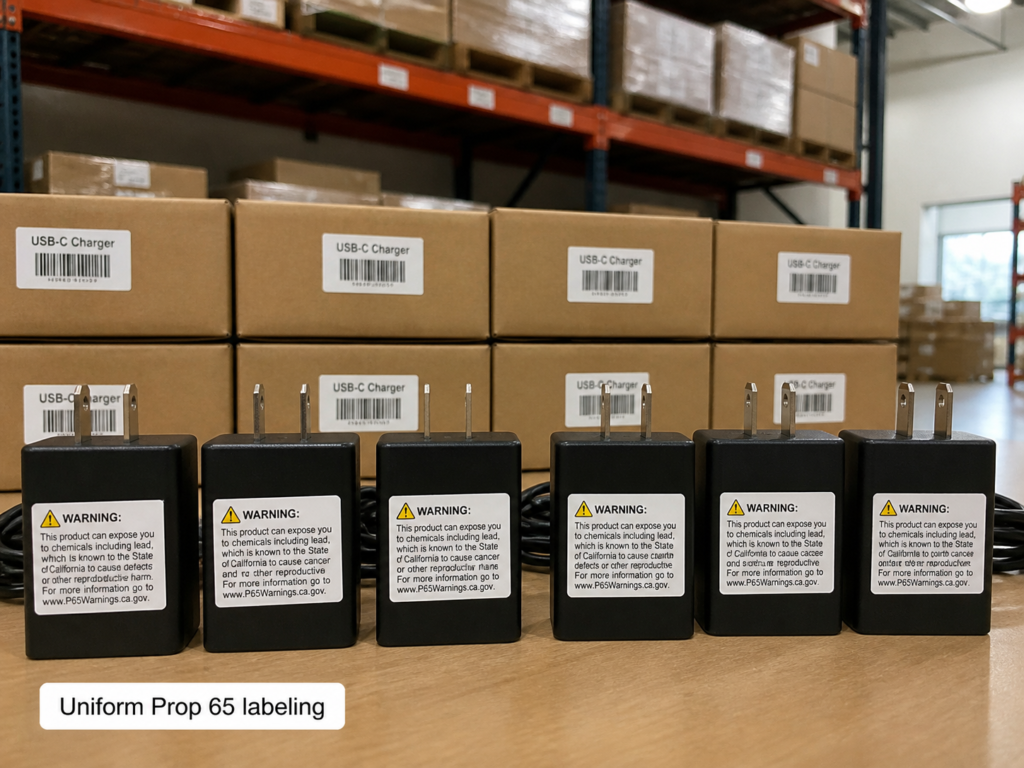
The first is **supply chain cost logic**: Uniform labeling is much more cost-effective than state-by-state management. Think about it, if you design a version of packaging specifically for California, then stock separately and manage by warehouse, labor, storage, and material costs will all increase. Especially for charging products with many SKUs, from 20W chargers to 100W fast charging cables, there are various models. Stocking by state can easily lead to wrong shipments and unsold inventory, which will result in greater losses. In contrast, the cost of printing a warning directly on all packaging is almost negligible.
The second is **sales channel logic**: The flow of cross-state circulation simply cannot be controlled. Most sellers doing e-commerce now either use Amazon FBA nationwide warehouses, or independent sites default to nationwide delivery, and simply cannot 100% intercept California orders; even if you only do B2B wholesale, downstream distributors may resell products to California, and enterprises in all links of the supply chain may face risks. However, specific responsibilities need to be determined based on facts such as their sales, distribution, knowledge, and control, and brand owners are not automatically liable.
The third is **risk aversion logic**: The cost of litigation may be much higher than the cost of labeling. California Prop 65 allows private enforcers to file Prop 65 enforcement actions after meeting statutory notice and procedural requirements; some cases are initiated by organizations or individuals that frequently file such cases. Whether attorney fees and costs are awarded after winning a case and who bears them shall be determined in accordance with applicable laws and court rulings. For enterprises, instead of taking the risk of being sued by managing by state, it is better to directly label uniformly, spending a small amount of money to avoid big trouble.
Here we must emphasize: Products sold nationwide with a California Prop 65 warning **do not mean that there are legal requirements nationwide**. When consumers in non-California states see this warning, it does not mean that your state mandates this label; at the same time, having the label does not mean the product is toxic or unqualified — many enterprises will proactively label even if the content is close to the safety threshold, or even below the threshold, just to avoid potential litigation risks.
Seller Practice: How to Determine Whether Charging Products Need to Comply with California Prop 65
If you are a seller of charging products, what you care most about is definitely “whether my products need to be compliant with California Prop 65”. Actually, don’t panic. Only when two core prerequisites are met first is further evaluation needed: First, your product may enter the California market — whether it is direct sales, delivery, free gifts, or resale by downstream customers, it may be included in the evaluation; second, the product has a “foreseeable exposure risk” to listed substances — note that it is not that the product must be labeled as long as it contains this substance, but whether consumers will be exposed to it during normal use. For example, lead in solder sealed inside a charger is not usually touched, so the exposure risk is much lower, but it still needs to be judged in combination with other reasonably foreseeable exposure pathways.
How to conduct self-checks specifically? We have sorted out a three-step method based on the characteristics of charging products, which even beginners can quickly use to judge.
Step 1: First confirm whether the product will flow into California. You can check from three directions: First, look at your sales and delivery scope, whether you stock on all sites and whether you can deliver to California addresses; second, look at the flow of customers, if you do B2B, will your customers sell the goods to California; third, look at warehouse settings and platform mechanisms, you should verify the actual delivery capacity of the platform, order destinations, inventory allocation, and whether products will be delivered to California consumers. The mere possibility that inventory is stored in California cannot, on its own, be deemed to give rise to a Prop 65 warning obligation.
Step 2: Check high-risk components and substances in charging products. You don’t need to check all more than 1,000 substances. The high-risk components and substances of charging products are relatively fixed: For cables, focus on phthalates (plasticizers) in PVC jackets, lead in solder and plating, and cadmium in dark plastics; for chargers and power adapters, focus on flame retardants and phthalates in the housing plastic, lead in internal solder, and bisphenol A in coatings; for connectors, Prop 65 listed substances should be verified based on the specific plating material and chemical form, such as certain nickel compounds or hexavalent chromium compounds, and further evaluate consumer foreseeable exposure. A warning cannot be determined to be required just because the connector has plating. Controlled plasticizers in plastic parts should also be confirmed in combination with specific material information.
Step 3: Compare with safe harbor thresholds to determine whether a warning is needed. California Prop 65 has clear “safe harbor” standards for two types of substances: For carcinogenic substances, look at the “No Significant Risk Level (NSRL)”, as long as the exposure is below this value, no warning is needed; for reproductively toxic substances, look at the “Maximum Allowable Dose Level (MADL)”, below this value also no warning is needed. Here we must emphasize again: The safe harbor level is for consumer exposure, not the total content of the material. Substances enclosed inside may not require a warning only when the actual or reasonably foreseeable exposure is below the applicable standard, and a conclusion cannot be drawn solely based on “being inside”. Wear and tear, damage, repair, disassembly, volatilization, migration, and other exposure pathways during normal use may affect the judgment.
Let’s give direct conclusions for the most common sales scenarios, you can match them accordingly:
• Sold only offline outside California, and can prove that the product will not flow into California: Usually no warning requirement for the California sales chain arises, but the basis for flow judgment should still be retained.
• Stocked on all US e-commerce sites, or using a warehousing and delivery system that covers California orders: Usually a Prop 65 evaluation is required; if there is exposure to listed substances that meets the standard, a compliant warning must be provided.
• Only supply B2B with written channel restrictions, and can actually reasonably control and prove that the product will not enter California: May reduce or eliminate California exposure risk for this sales chain, but written proof does not equal statutory exemption; if the product actually flows into California, re-evaluation is still required.
• Independent sites that clearly disable California delivery and have no other channels for products to flow into California: May not fall within the applicable scope of the California sales chain, but it should be ensured that the restriction measures are real and effective.
If you are still unsure, there are three low-cost verification methods: First, first check whether the sales platform you use has mandatory requirements for California Prop 65. For example, Amazon has clear category compliance rules, and platform requirements are generally more direct than regulations; second, you can request chemicals, testing or Prop 65 materials for specific models and materials from suppliers, but the completeness and applicability of the materials need to be verified by yourself, and you cannot assume that all suppliers will provide valid compliance declarations; third, you can refer to the labels of similar products from leading brands, but this can only be used as a preliminary reference, not as a compliance basis, after all, each brand’s supply chain and risk tolerance are different.
5 Most Common Compliance Misconceptions
In actual operation, both sellers and consumers are likely to fall into several common pitfalls, let’s clarify them all at once:
First misconception: Passing FCC certification means meeting California Prop 65 requirements. This is the most common confusion. The FCC mainly focuses on radio frequency, radio frequency interference and related equipment requirements, and the specific authorization procedure depends on product attributes, and does not involve the toxic substance exposure regulation of California Prop 65 at all. When charging products are sold to California, a separate evaluation should be conducted on whether there is exposure to listed substances that requires a Prop 65 warning.
Second misconception: Having a California Prop 65 warning means the product is toxic and unqualified. No, this warning is essentially a risk notification tool, not a criterion for judging product unqualifiedness. Many enterprises, in order to avoid litigation risks, will proactively label even if the substance content is close to the threshold, or even below the threshold, to avoid being targeted by professional plaintiffs.
Third misconception: Only local California enterprises need to comply. Completely wrong. California Prop 65 regulation depends on whether the product is sold or delivered to California consumers, and has no direct relationship with the enterprise’s registration place or business location — even if you are a cross-border seller in China, as long as the product may enter the California market, you should evaluate whether Prop 65 applies; whether a warning is required still needs to be determined in combination with listed substances, exposure level, safe harbor level and statutory exemptions.
Fourth misconception: Small sellers and small-batch orders do not need to comply. The regulation does have conditional exemptions for small businesses with fewer than 10 employees, but not all small sellers meet the conditions, and many e-commerce platforms have stricter requirements than the regulation. Even if you are a small seller, as long as you sell on the platform, you must comply with the platform’s compliance requirements, otherwise the products will be removed from the shelves.
Fifth misconception: If the substance content meets the standard, you don’t need to worry about California Prop 65. This is the most hidden mistake. The core judgment standard of California Prop 65 is “exposure level”, not the absolute content in the material. The same content of lead, if it is in the cable jacket and can be directly touched by hands, may exceed the standard; but if after evaluation, the listed substances in the circuit board will not cause consumer exposure that meets the applicable standard under normal or reasonably foreseeable use conditions, then a warning may not be required. A conclusion cannot be drawn solely based on the fact that it is inside or usually inaccessible.
Don’t Confuse: Differences Between California Prop 65 and Other US Regulations
Many people confuse California Prop 65 with other US compliance requirements. Let’s sort out several easily confused rules. First is the difference from the most familiar FCC requirements, which is clearer with a table comparison:
| Comparison Dimension | California Proposition 65 | FCC Rules and Equipment Authorization |
| Legal Level | California state-level consumer protection regulation | US federal-level regulatory system for radio frequency and radio frequency interference |
| Scope of Application | Goods and businesses that may be sold or delivered to California consumers and involve relevant exposure | Equipment within FCC jurisdiction that complies with corresponding technical rules |
| Regulatory Content | Exposure warnings for carcinogenic or reproductively toxic substances | Radio frequency, radio frequency interference and related equipment technical requirements |
| Enforcement Method | Coexistence of private enforcement actions and regulatory agency enforcement | Regulated by the FCC in accordance with applicable federal rules, specific procedures vary by equipment category |
| Authorization Method | Judged in accordance with exposure, warning and exemption rules | May be certification, Supplier’s Declaration of Conformity (SDoC) or other applicable procedures |
For charging products, when entering the US market, you should first confirm whether the product is an FCC-regulated device, which FCC rules apply, and which authorization procedure is required; it cannot be generally stated that all products must undergo “FCC certification”. When sold to California, a separate evaluation should also be conducted on whether there is exposure to listed substances that requires a Prop 65 warning.
Besides the FCC, many people think that California Prop 65 is the national chemical warning rule of the US, but that is not the case. Some states have reporting, restriction, disclosure or warning requirements for specific chemicals or products, such as chemical regulation of some products in Washington State and Oregon; these systems are not the same as Prop 65, and their scope of application, triggering conditions and obligations must be verified separately. California Prop 65 has a large number of listed substances, a prominent private enforcement mechanism, and has a wide influence on chemical risk notification for consumer goods; but it cannot be generally concluded that it is the strictest rule in the US in all dimensions. Therefore, the California Prop 65 label cannot directly replace the compliance requirements of other states.
As for the federal level, the US does not have a federal warning system that is completely equivalent to Prop 65 and generally covers all consumer product chemical exposures; but the Federal Hazardous Substances Act (FHSA), Consumer Product Safety Improvement Act (CPSIA), Toxic Substances Control Act (TSCA) and other federal regulations have labeling, restriction or disclosure requirements for specific hazardous products or chemical substances. Many enterprises simply do the entire US market according to California Prop 65 standards, which is just a business choice to simplify the compliance process, and is by no means a legal requirement.
Final Summary
Finally, let’s wrap up the core content. After reading this article, you should be able to independently judge three things:
First, at the legal level, California Prop 65 is only a California state-level regulation, mainly targeting business practices that may expose California consumers to relevant listed substances. It is not a mandatory nationwide requirement, and is completely different from the FCC regulatory system;
Second, at the practical level, as long as the product may be sold or delivered to California consumers, even in small quantities, the applicability of Prop 65 should be evaluated; whether a warning is required should be determined in combination with listed substances, consumer exposure level, safe harbor level and statutory exemptions;
Third, at the cognitive level, products sold nationwide with a California Prop 65 warning are just a business choice of enterprises to simplify management and avoid risks. It neither means the product is toxic or unqualified, nor means that there is a mandatory requirement locally.