
Charging product sellers who are new to Amazon US will most likely ask this question. Many either think “all electronic products must have FCC certification to be sold” or feel “I’m just selling a charging cable, no one will check” — in fact, neither statement is accurate. FCC compliance requirements are never determined by product name or sales channel, but by the product’s own functions and applicable rules; at the same time, Amazon’s platform requirements may be stricter than those of the US official authorities, so the answer is never a simple “yes” or “no”.
Core Conclusion First: Listing Eligibility Is Determined by Product Functions and Applicable Rules
For charging products, you can make a preliminary distinction based on functions and circuit conditions, but the following classifications should not be regarded as final legal conclusions:
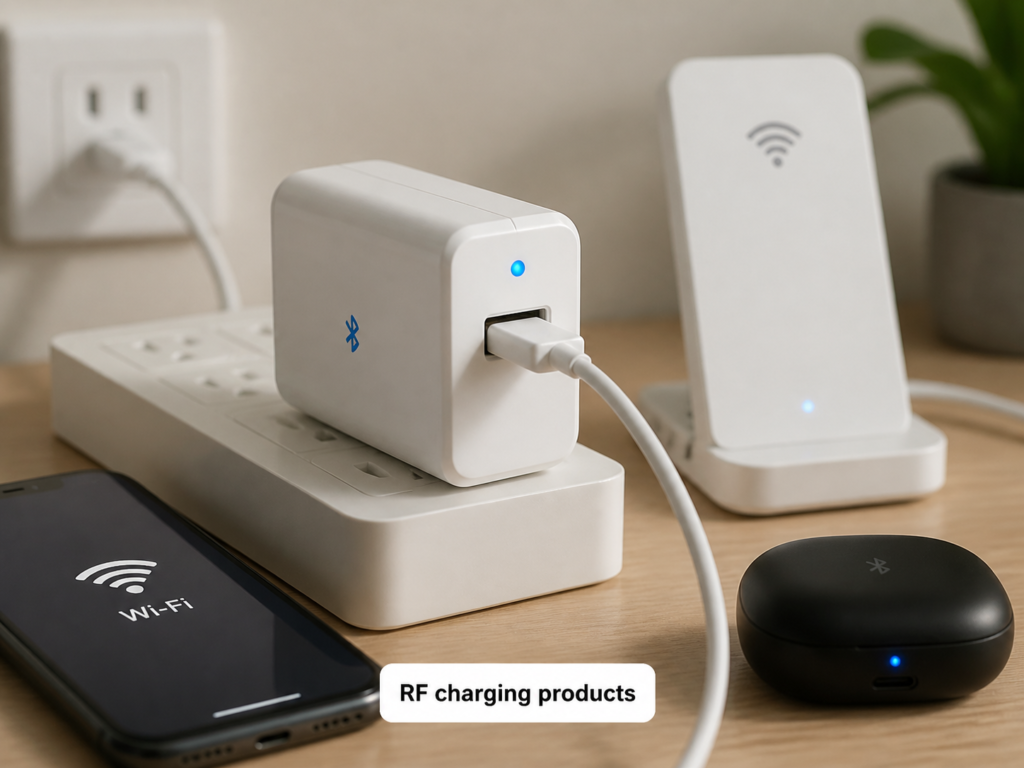
The first category is products with intentional radio frequency (RF) transmission functions such as Bluetooth and Wi-Fi. Such devices are usually subject to the FCC Part 15 intentional transmitter rules, requiring Certification and an FCC ID. Examples include charging heads with Bluetooth function, charging devices with Wi-Fi function, etc.
Wireless chargers, wireless power transfer devices, or other inductive devices cannot be generally assumed to require an FCC ID. For such products, the applicable device authorization method usually needs to be confirmed based on FCC Part 18, as well as the specific operating frequency, power, and device category, which may involve Verification, SDoC-related procedures, or Certification.
The second category is products without wireless transmission functions but containing electronic circuits, such as ordinary wired chargers, USB-C cables with E-Marker chips, multi-port charging hubs, etc. These products may fall under FCC Part 15 unintentional radiators, but it is necessary to first confirm whether an exemption applies, and whether SDoC, Verification, or Certification should be specifically used, and a conclusion cannot be drawn solely based on “having a chip” or “having a switching power supply”.
The third category is purely passive products without active electronic components, such as ordinary cables without chips and indicator circuits, and purely mechanical adapters. These products are usually not electronic devices requiring Part 15 device authorization, but it is still necessary to confirm that the product indeed has no active circuits, and separately verify Amazon’s category, product safety, energy efficiency, and import requirements. The inapplicability of FCC does not automatically mean that Amazon will definitely allow listing.
However, there are two key premises that must be kept in mind:
First, Amazon’s platform requirements may be stricter than those of the FCC official. Whether you can list the product ultimately depends on the platform requirements currently displayed in your category, product page, and seller backend.
Second, FCC is only a compliance requirement in the US for RF devices, electromagnetic interference, and related device authorizations, and cannot replace other regulatory or market requirements such as safety and energy efficiency. For example, safety certifications such as UL and ETL, or DOE energy efficiency requirements, still need to be obtained as required.
Why can’t the answer be a simple “yes” or “no”? There are three main reasons: First, FCC judgment is based on product functions, device categories, and applicable rules, not on whether you call it a “charging cable” or a “charger”; second, Amazon may conduct compliance audits based on its own policies, and not being required to submit qualifications when you list the product does not mean the product does not need to comply; finally, if your qualifications do not match the product, for example, borrowing documents from other models, manufacturers, or hardware solutions, there is the same risk as having no compliance qualifications.
Must-Know for Beginners: Basic Concepts of FCC Compliance
Seeing this, you may ask: What exactly is FCC? What are the differences between FCC ID, SDoC, and Verification? Don’t worry, let’s clarify the most basic concepts first, so that subsequent judgments will not be confused.
What Is FCC and What Does It Regulate?
The full name of FCC is the Federal Communications Commission of the United States. You can simply understand it as the official US agency responsible for regulating RF devices, the use of radio spectrum, and harmful interference from devices.
For chargers, adapters, and other electronic products, FCC rules may also involve unintentional electromagnetic radiation generated by devices, and whether the product causes harmful interference to wireless communications, broadcasting, or other electronic devices. For example, some switching power supplies and digital circuits, although they do not have wireless functions such as Bluetooth and Wi-Fi, may also need to be evaluated in accordance with applicable FCC rules.
It is important to note here: FCC compliance is not equivalent to product quality, safety, or energy efficiency certification. For example, whether a charger will cause electric shock, fire, or overheating is mainly an electrical safety and product safety issue; these requirements cannot be replaced by FCC documents.
Core Differences Between Common FCC Device Authorization Methods
What many people often call “FCC certification” is actually just a general term, and does not mean that all products have the same type of certificate. Common FCC device authorization methods include Certification, SDoC, and Verification. Which one to use specifically depends on the device type and applicable rules such as Part 15 and Part 18.
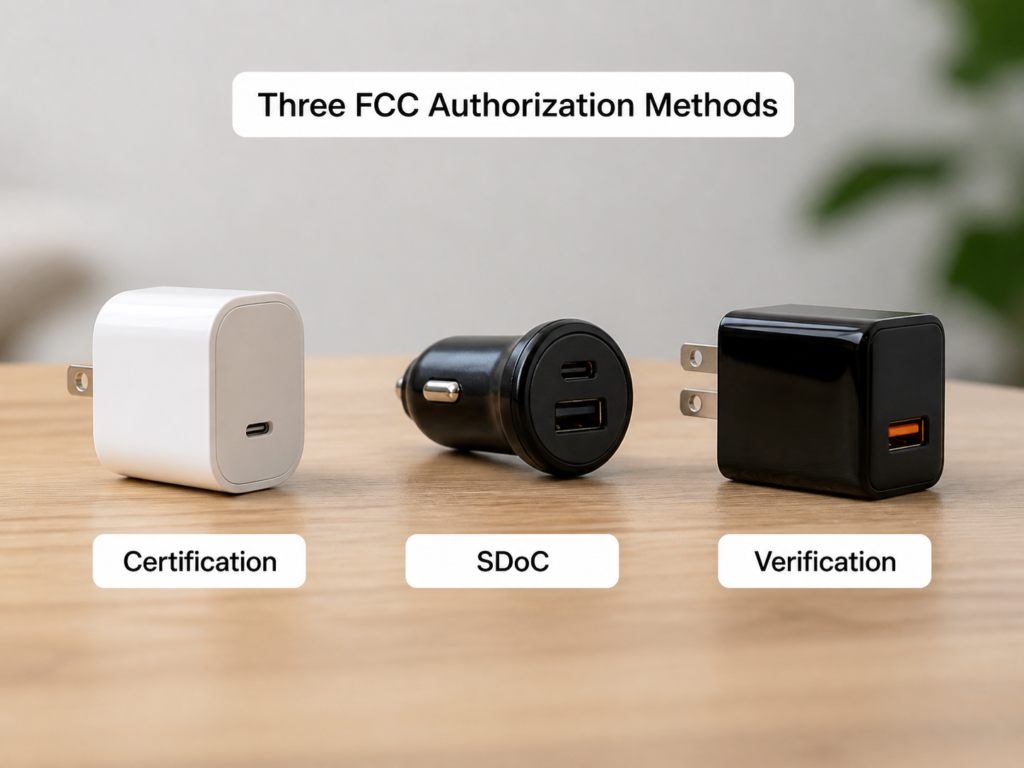
One is **Certification**. This usually applies to devices that require a certification process, such as many intentional RF transmitters like Bluetooth and Wi-Fi devices. After passing certification, the device will have a corresponding FCC ID, which can be queried in the FCC official database. It should be noted that the FCC ID is an identifier of Certification, not a universal certificate that all FCC-compliant products must have.
The other is **SDoC (Supplier’s Declaration of Conformity)**. It requires the responsible party to ensure that the product meets applicable technical requirements and issue a declaration of conformity. For products subject to SDoC, testing should be completed by a laboratory with corresponding capabilities and appropriate equipment. Whether it is mandatory to use an FCC-recognized laboratory must be confirmed in combination with whether the specific device requires Certification and applicable rules, and cannot be generalized.
There is also **Verification**. It is also a device authorization method under FCC rules, applicable to some eligible devices. For certain products, whether to ultimately use SDoC, Verification, or Certification requires checking the device category and specific provisions, and cannot be judged solely based on the two labels of “having circuits” or “having wireless functions”.
Boundaries Between FCC and Other Common Certifications
Many beginners easily confuse different certifications. Here we will clarify the boundaries directly, so you don’t waste money due to confusion:
• **UL/ETL**: These are common product safety certifications or testing marks in the US market. Although they are not necessarily unified mandatory requirements at the federal level, many platforms, insurance companies, channels, or purchasers will require them. They mainly focus on electric shock, fire, structural and electrical safety, and cannot replace FCC requirements;
• **CE**: This is a compliance mark under the EU regulatory system. Its scope of application and testing standards are different from those of the US, and it cannot replace the applicable FCC requirements in the US. If Amazon requires FCC materials for a certain product, you should submit FCC documents that comply with its current policy. The specific material requirements are subject to the corresponding category of the US site and backend notifications;
• **RoHS**: This is a restriction of hazardous substances requirement, focusing on restricted substances such as lead and mercury in products. Its regulatory scope is different from that of electromagnetic compatibility and RF device authorization.
Detailed Breakdown of FCC Applicability for Charging Products
Now that you know the basic concepts, let’s break down charging products in more detail. You can directly compare your own products to make a preliminary judgment. For easy comparison, I have compiled a simple table:
| Compliance Judgment Direction | Core Judgment Criteria | Common Examples of Charging Products |
| Certification and possible FCC ID | Intentional RF transmitting devices required to be certified by applicable rules | Bluetooth charging heads, Wi-Fi charging devices, etc.; wireless power transfer devices need to be confirmed based on Part 18 and specific categories |
| One of SDoC, Verification, or Certification | May be Part 15 unintentional radiators; need to first confirm whether exempted and the specific authorization method | Ordinary wired chargers, USB-C cables with E-Marker, multi-port charging hubs, car chargers, charging cables with digital display |
| Usually not within the scope of Part 15 device authorization | Purely passive structure, no active electronic components | Ordinary cables without chips and indicator circuits, purely mechanical adapters or extension cords |
Products That Require Key Confirmation of Certification and FCC ID
Devices such as Bluetooth and Wi-Fi that are subject to FCC Part 15 intentional transmitter rules usually require Certification and an FCC ID. The core here is not the product name, but whether the product actively transmits RF signals subject to the rules, and which specific rule applies.
Wireless chargers and other wireless power transfer devices need to be judged separately. They may involve FCC Part 18, and the applicable authorization method is affected by factors such as operating frequency, power, and device category. Therefore, the “inductive function of wireless charging” cannot be treated in exactly the same way as Bluetooth and Wi-Fi transmitters, nor can it be simply asserted that all wireless chargers must obtain an FCC ID.
There is another common pitfall here: if the built-in wireless module you use already has an FCC ID, the whole device does not necessarily have to obtain a new FCC ID. You need to check the integration conditions in the module Grant, including antenna, installation method, RF parameters, host identification, and user instructions, etc.
If the whole device meets these authorization conditions, integration may be completed in accordance with the module authorization method; if not, a compliance agency shall judge whether supplementary testing, submission of a Permissive Change application, or re-Certification of the whole device is required. It cannot be generally asserted that “if it exceeds the module authorization scope, a new FCC ID must be obtained”.
Products That May Require SDoC, Verification, or Certification
The absence of wireless transmission functions such as Bluetooth and Wi-Fi does not mean that the product is definitely not subject to FCC rules. Switching power supplies, digital circuits, and control circuits in ordinary wired chargers may generate unintentional electromagnetic radiation, so they may be classified as Part 15 unintentional radiators.
Common products include ordinary mobile phone chargers, USB power adapters, PD fast charging cables with E-Marker chips, data cables with fast charging identification chips, charging cables with digital display, multi-port charging stations, car chargers, and charging hubs with intelligent power distribution functions.
However, “having digital circuits” or “having a switching power supply” is only a signal that further evaluation is needed, and not a sufficient condition for automatic application of SDoC. You should first confirm whether the product is a device covered by FCC rules, whether exemption clauses such as 15.103 apply, and then determine whether to use SDoC, Verification, or Certification based on the specific device category.
Therefore, the core of judgment should be: whether the product is an unintentional radiator or other RF device covered by FCC rules, and which authorization method is required by applicable rules, rather than simply looking at whether there is a chip.
Products Usually Not Within the Scope of Part 15 Device Authorization
Purely passive products without any active electronic components are usually not electronic devices requiring Part 15 device authorization. For example, ordinary cables without chips, indicator circuits, or protocol identification functions, as well as mechanical adapters or extension cords that only serve physical adaptation and have no circuits.
But before making this judgment, confirm that there is indeed no active circuit inside the product. You cannot only look at the appearance or product name, nor can you directly assume that a product is passive just because the supplier calls it an “ordinary charging cable”.
In addition, even if the product does not require corresponding FCC device authorization, it may still be affected by Amazon’s category policies, product safety, energy efficiency, import, and labeling requirements. FCC judgment and Amazon listing eligibility are not the same issue.
Borderline Cases That Are Easy to Misjudge
Some products are between the two categories, and beginners can easily misjudge them. Here we clarify them specifically:
• **Cables with simple resistive LED indicators**: If it is only a power indicator with current limiting by a resistor, without other chips or digital circuits, it may still be a product that does not require Part 15 device authorization. However, this must be judged in combination with the actual circuit. If you are unsure, it is recommended to have a laboratory or compliance agency with corresponding capabilities confirm;
• **Cables with overvoltage protection chips**: Having a protection chip does not automatically mean that SDoC is mandatory. You should check whether the product thus constitutes an unintentional radiator or other regulated device covered by FCC rules, and then confirm the applicable exemption or authorization method;
• **Power products with AC-DC conversion**: Chargers and power adapters that are directly plugged into the wall usually require FCC applicability evaluation, because their switching power supplies and control circuits may involve unintentional radiation requirements. However, the final confirmation should still be based on the specific product and applicable rules, rather than drawing conclusions solely based on the product name.
Amazon Audit Rules and Violation Risks
After figuring out which category your product belongs to, the next step is to know how Amazon may audit FCC compliance and what the consequences may be if problems are found.
Core Logic of Platform FCC Requirements
Amazon’s basic logic is: sellers must comply with the applicable laws and regulations of the country of sale, while meeting the platform’s own category and compliance policies.
FCC compliance is an important requirement that may be involved when electronic and RF devices enter the US market. However, whether a specific product is subject to FCC rules and which authorization method is required still need to be judged in combination with the product’s actual functions and applicable provisions. The platform’s requirements may also be stricter than the minimum requirements of FCC regulations. For example, some products may not require device authorization under FCC rules, but Amazon’s corresponding category may still require sellers to provide compliance statements or other materials.
Amazon may not proactively inform you of all compliance requirements when new products are listed, so sellers need to check the backend pages, category requirements, and related notifications on their own.
Materials That the Platform May Require Submission
If required by the platform to prove compliance, different products may require different materials:
• **Certification or FCC ID category products**: May need to provide FCC ID number, authorization information in the FCC official database, corresponding test reports, product labels or nameplate photos, etc.;
• **SDoC category products**: May need to provide test reports, supplier’s declaration of conformity, responsible party information, product model and manufacturer information, etc.;
• **Verification or other applicable situations**: Documents that can prove the product meets the requirements should be prepared based on the applicable product rules and Amazon’s current notifications.
You should verify whether the products for sale are covered by the corresponding FCC authorization or SDoC documents, including the responsible party or manufacturer, model identification, RF module, antenna, key circuits, and authorization conditions, etc. If the model or hardware solution is different, confirm whether it is within the scope of the original documents, or whether re-evaluation is required. You cannot simply assume that any model difference will necessarily be non-compliant, nor can you directly mix documents from different products.
Common Scenarios That Trigger Audits
Amazon may initiate compliance audits based on categories, product information, complaints from consumers or other sellers, regulatory requirements, and the platform’s internal risk control.
Therefore, products with wireless functions, involving charging and power conversion, or whose product information contains specific function descriptions may be more likely to be required to provide compliance materials. However, how the platform specifically identifies, when it audits, and what the audit frequency is are dynamic platform policies. It cannot be asserted that there is a fixed keyword crawling mechanism, nor can it be asserted that Amazon will conduct a general survey on an annual or quarterly basis.
The safest approach is to follow the current notifications in the US site seller backend, category pages, and help center requirements.
Successful Listing ≠ Long-Term Compliance
It must be remembered: the system automatically passing when you list the product does not mean that the platform has completed all compliance reviews, nor does it mean that the product will not be required to submit supplementary documents later.
If the product’s chip, RF module, antenna, key circuits, software, or production configuration are changed, the original compliance documents may no longer cover the new product status. Even if it is only a change in appearance, you cannot judge whether the documents remain valid solely based on appearance; conversely, if the appearance does not change but the internal key circuits or RF parameters change, compliance may also be affected.
FCC authorizations usually do not automatically expire after a unified fixed period, but each time a product changes, it is necessary to evaluate whether supplementary testing, change filing, or re-authorization is required based on the original authorization conditions and applicable rules. For SDoC products, the responsible party also needs to continuously ensure that mass-produced products are consistent with the declaration and testing basis.
Compliance documents should also be kept for a long time, in case the platform, regulatory authorities, or partners request them later.
Three Types of Risks of No Compliance Qualifications
If the product actually requires FCC-related compliance but cannot provide valid documents, the consequences may be more serious than imagined, mainly divided into three categories:
• **Platform side**: May result in listing removal, prohibited display, restricted store permissions, frozen funds, or temporarily unsellable FBA inventory;
• **Official side**: If problems are found with the product during import or market supervision, it may face detention, return, or destruction, and may also involve FCC enforcement and fines;
• **Operation side**: If the product actually causes interference or has other problems, it may lead to negative reviews, increased return rates, damaged brand reputation, and in severe cases, may also trigger civil claim risks.
Self-Assessment Methods for Compliance
After talking about the risks, you may want to know: How do I judge what my product needs? How do I verify whether the qualifications provided by the supplier are real? Next, you can conduct a preliminary investigation according to the following methods.
3-Step Quick Judgment Method for Charging Products
You don’t need to memorize complex rules at the beginning; you can follow these three steps:
**Step 1: Check whether the product has intentional RF transmission functions such as Bluetooth and Wi-Fi.**
If yes, it usually requires Certification and an FCC ID in accordance with applicable Part 15 rules. However, if it is a wireless power transfer or inductive device, further judgment should be made based on Part 18 and the specific device category, and the conclusions for Bluetooth and Wi-Fi products cannot be directly applied.
**Step 2: If there is no intentional wireless transmission, check whether the product is an unintentional radiator covered by FCC rules.**
Having a switching power supply, digital circuit, or control chip only indicates that further evaluation is needed. You also need to confirm whether an exemption applies, and whether SDoC, Verification, or Certification is specifically used.
**Step 3: Check the requirements of the corresponding category in Amazon’s backend.**
Regardless of the official FCC judgment result, you must check the corresponding category, product page, and backend notifications of the US site. The platform’s requirements may be higher than the minimum regulatory requirements, and the final listing must also meet the platform’s own policies.
Methods to Query Amazon’s Official Compliance Requirements
How to check the official requirements of the platform? You can use the following three methods:
1. Go to the Amazon backend help page, search for “FCC compliance” or related product compliance keywords, and find the official description for the corresponding category;
2. When listing new products, check the “Compliance Attributes” column and the mandatory items prompted by the system;
3. When consulting seller support, try to keep written replies or ticket records, and confirm that the response is for the specific product and specific category.
Platform policies are adjusted, so you cannot rely solely on past experience, peer statements, or old screenshots.
Methods to Verify Suppliers’ FCC Qualifications
Many suppliers will say “we have FCC certification”, but whether it can be used and whether it is real must be verified by yourself. Don’t just listen to verbal promises:
• If the product has an FCC ID, you can query it in the FCC official database to check the applicant, model, product description, photos, and authorization conditions corresponding to the authorization;
• If it is SDoC, you should check the declaration issued by the responsible party, test report, applicable FCC rules and test items, and confirm that the testing institution has the corresponding ability to complete such tests. Whether it is mandatory to use an FCC-recognized laboratory must be confirmed based on whether the product requires Certification and specific rules;
• If it is Verification or other authorization methods, you should also confirm that the documents are consistent with the product category and applicable rules. You cannot assume that the documents are valid just because the title says “FCC”;
• Qualifications cannot be borrowed arbitrarily across models, manufacturers, or hardware solutions. If the model, RF module, antenna, key circuits, or software are different, you should confirm whether the original documents cover them, and re-evaluate if necessary.
Regarding the validity period, FCC authorizations usually do not have a unified fixed expiration period. However, when the product’s model, RF module, antenna, key circuits, software, or production configuration change, it is necessary to evaluate whether supplementary testing, submission of a change application, or re-authorization is required based on the original authorization conditions and applicable rules. You cannot judge solely based on “the appearance has not changed” or “the appearance has changed”.
Unreliable Judgment Methods (Pitfall Avoidance)
Some beginners like to use some “unofficial methods” to judge, which are actually very unreliable. Don’t learn them:
• **Judging solely by product appearance**: Products that look the same may have completely different internal chips, antennas, and power solutions, and applicable requirements may also be different;
• **Thinking you can sell just because peers are selling**: Peers may have completed compliance, or they may just have not been required by the platform to submit materials for the time being;
• **Thinking that cheap, low-sales products will not be checked**: Whether the platform audits should not be used as a basis for judging whether a product needs compliance, and low sales volume does not mean there is no risk.
Compliance Solutions and Cost Reference
If you find that your product has not completed relevant compliance, or has been required by the platform to submit supplementary documents, what should you do? Here are handling ideas for different situations.
Compliance Steps for Unlisted New Products (Safest)
If the product has not been listed yet, it is best to follow these steps for the lowest risk:
1. First use the previous judgment method to confirm whether the product is subject to FCC rules and the possible applicable authorization method;
2. Select a third-party laboratory or compliance agency with corresponding capabilities to conduct evaluation and testing, and obtain applicable reports, declarations, or certification documents;
3. Check Amazon’s backend requirements in advance, prepare and submit materials according to the platform’s requirements, and officially list after confirming the audit requirements;
4. Simultaneously check product labels, instructions, and packaging information to ensure that the marks used are consistent with the actual authorization method and documents. Do not affix the FCC mark arbitrarily just to “look compliant”.
Remedial Methods for Listed Products That Have Been Removed
If the product has been removed due to FCC or other compliance issues, don’t panic, follow this order:
1. Immediately handle the violating listing and inventory status in accordance with platform requirements to avoid the problem from continuing to expand;
2. Reconfirm the FCC rules and authorization methods actually involved in the product, so as not to supplement the wrong documents;
3. Find a laboratory or compliance agency with corresponding capabilities to evaluate the product and existing documents, and supplement testing if necessary;
4. Submit materials through the compliance appeal entry in the backend, and explain the actual situation of the product, rectification measures, and subsequent methods to prevent recurrence.
Compliance Cost and Cycle Reference
Many people care about how much money and time it takes to do compliance, but this part cannot be generalized with fixed numbers. The cost and cycle are affected by factors such as product category, applicable FCC rules, test items, product complexity, number of rectifications, laboratory scheduling, and whether Certification or change procedures are required.
• **Passive products that are usually not within the scope of device authorization**: Generally, there is no need to pay testing fees for FCC device authorization, but it is still recommended to prepare product structure descriptions or supplier materials for explanation when the platform requires clarification;
• **Products that may be subject to SDoC or Verification**: The cost and cycle need to be confirmed separately based on specific test items, product structure, and rectification situation;
• **Products that require Certification or involve wireless modules**: Usually, certification review, RF testing, module integration conditions, and possible change procedures also need to be considered, and the cost and cycle should also be quoted separately by the laboratory or compliance agency.
FCC regulations do not have unified provisions that “SDoC must take 1-3 weeks” or “FCC ID must take 3-6 weeks”, nor is there a unified testing fee standard. Therefore, do not take the fixed number of weeks or quotes you see online as a promise applicable to all charging products.
A final reminder: never buy fake certificates or use other people’s documents just to save money. Once discovered by the platform or regulatory authorities, subsequent penalties and inventory losses are usually much higher than normal compliance costs.
Methods to Select a Reliable Testing Laboratory
How to choose a reliable laboratory? Remember these points:
1. First confirm whether the laboratory has the ability and conditions to complete the corresponding tests. For products requiring Certification, further confirm whether they meet the applicable FCC-recognized laboratory requirements;
2. Require the other party to provide a clear test plan, applicable rules, test items, cycle, quotation, and report scope;
3. Avoid intermediaries that only issue “certificates”, do not conduct actual testing, and cannot explain applicable rules;
4. Prioritize laboratories with testing experience in chargers, power adapters, USB products, or wireless devices, as they are more familiar with product boundaries and rectification risks.
Guide to Avoiding Common Misconceptions
Finally, we have compiled 6 FCC compliance misconceptions that beginners are most likely to fall into. See if you have any of them.
Misconception 1: All Charging Cables Do Not Need FCC Certification
Many people think that charging cables are all passive and do not need FCC, but in fact, this cannot be generalized. Data cables with E-Marker, protocol identification, digital display, or other electronic circuits may be devices that require further evaluation under FCC rules.
Quick distinction method: Check whether the product detail page has descriptions such as “intelligent identification”, “PD fast charging”, “E-Marker”, “digital display”, etc., and then confirm with the internal circuit of the product. These promotional words alone cannot directly determine that SDoC is definitely required, but they indicate that the product may not be a purely passive cable.
Misconception 2: Affixing the FCC Mark Means Compliance
Some sellers think that printing an FCC mark on the product means compliance, which is wrong. The FCC mark or FCC ID must correspond to the actually applicable compliance documents, authorization method, and product. Affixing a mark without corresponding documents cannot make the product compliant, but may instead cause false labeling problems.
For purely passive products that usually do not require Part 15 device authorization, do not affix the FCC mark arbitrarily just to increase the “sense of compliance”. Whether marking is required should be confirmed based on actual applicable rules and platform requirements.
Misconception 3: Having CE/UL/RoHS Equals Having FCC
This is a very common confusion. CE is a compliance mark under the EU regulatory system, UL/ETL mainly focuses on product safety, and RoHS focuses on restriction of hazardous substances. The scope of regulation of all three is different from the US FCC’s requirements for RF, electromagnetic interference, or device authorization, and they cannot replace each other.
If Amazon requires FCC materials for this product, you should submit FCC documents that comply with its current policy. The specific requirements are subject to the corresponding category of the US site and seller backend notifications.
Misconception 4: If the Supplier Says “We Have FCC”, It Can Be Used Directly
You cannot fully believe what suppliers say. In many cases, the documents they provide may be copied, expired, or only correspond to other models, other wireless modules, or other hardware solutions.
The way to avoid pitfalls is to request complete qualification documents, and check one by one the responsible party or manufacturer, product model, RF module, antenna, key circuits, test items, and authorization conditions. Do not directly use documents that do not match.
Misconception 5: If the Platform Does Not Require Document Submission, It Means No Compliance Is Needed
Amazon not immediately requiring you to submit documents does not mean that the product has been confirmed compliant by the platform, nor does it mean that FCC rules do not apply. The platform may initiate audits later based on categories, complaints, regulatory requirements, or internal risk control.
Therefore, whether compliance is needed should first be judged based on the product and applicable FCC rules, and then materials should be prepared according to platform requirements, rather than taking “not being checked for the time being” as the basis for compliance.
Misconception 6: No Wireless Function Means No FCC Is Needed
Many people think that only products with wireless functions need FCC, but in fact, products without intentional wireless transmission functions such as Bluetooth and Wi-Fi may also be FCC Part 15 unintentional radiators. For example, switching power supplies and digital circuits in ordinary wired chargers may require FCC applicability evaluation.
The key judgment point is not as simple as “whether there is wireless function”. It also depends on whether the product is a device covered by FCC rules, whether an exemption applies, and whether SDoC, Verification, or Certification should be used.
Summary: Quick Judgment and Self-Check List
Finally, we have compiled a quick judgment method and a self-check list for you. After reading, you can directly compare with your own products.
3-Step Quick Judgment
• **Purely passive charging cables or adapters without active electronic components**: Usually not electronic devices requiring Part 15 device authorization, but confirm that there is indeed no circuit inside, and additionally check Amazon’s category, product safety, energy efficiency, and import requirements;
• **Products with circuits or chips but without intentional wireless transmission functions such as Bluetooth and Wi-Fi**: First confirm whether they are Part 15 unintentional radiators and whether an exemption applies, then determine whether to use SDoC, Verification, or Certification;
• **Products with intentional RF transmission functions such as Bluetooth and Wi-Fi**: Usually require Certification and an FCC ID in accordance with applicable rules; wireless power transfer or inductive devices need to separately confirm the authorization method based on Part 18 and specific device categories.
Final Judgment Principles
It must be remembered: FCC official rules are the basis for judging product compliance, while the official requirements for the corresponding category in Amazon’s backend determine the materials and listing conditions at the platform level.
If you are unsure, prioritize consulting Amazon official support, or find a professional compliance agency that can explain applicable rules and testing basis. Don’t just listen to suppliers’ verbal promises, nor take peers’ listing status as your own compliance proof.
After learning this content, you should be able to do the following: preliminarily distinguish whether your product involves FCC rules, and whether it may need FCC ID, SDoC, Verification, or is eligible for exemption; verify whether the FCC documents provided by the supplier match the actual product; decide whether to complete compliance before listing, or first deal with existing risks; and avoid 6 common FCC compliance misconceptions.
Quick Self-Check List
Finally, here are 4 questions for you to answer, so you can quickly check your compliance status:
1. Does my product have intentional RF transmission functions such as Bluetooth and Wi-Fi, or is it a wireless power transfer device?
2. Does my product have circuits that may affect FCC applicability, such as chips, switching power supplies, or digital circuits?
3. Do the documents I have cover the responsible party, model, RF module, antenna, key circuits, and authorization conditions of the currently sold products?
4. Have I checked the current compliance requirements of the corresponding category on Amazon US?
In general, FCC compliance does not mean that all products must obtain the same “certification”, nor does it mean that no judgment is needed at all if there is no wireless function. Especially for charging products, as long as you first look at the actual functions and circuits, and then compare with applicable FCC rules and Amazon backend requirements, you can avoid most judgment errors. Confirming in advance whether the product requires authorization and preparing documents that match the product is usually safer than subsequent listing removal, unsellable inventory, or restricted funds.