
If you run a USB cable business for the US market, or have purchased charging cables or data cables from overseas, you have most likely heard of the term “FCC certification”. Some people say that all USB cables must be certified, otherwise they cannot clear customs or be put on shelves; others say that ordinary cables do not need it at all, and it is all just service providers misleading people. Do USB data cables really need FCC certification? The answer is not a simple “yes” or “no”. The core depends on the structure and function of the cable, the type of chip, and the sales method. It is actually not difficult to understand the rules.
Core Conclusions First
First, here is a general direction for quick judgment, so you don’t have to scroll for a long time to find the key points:
Ordinary purely passive USB/USB-C/Micro-USB cables, that is, ordinary charging/data cables that only have conductors, shielding layers, and connectors, usually do not need to go through a separate FCC authorization process, but this does not mean there are no compliance requirements at all. If the cable has a built-in chip that actively processes signals, such as conversion, amplification, or retiming functions, it needs to be evaluated in accordance with FCC Part 15 regulations. Specifically, SDoC, Certification, Verification, or other provisions may apply, and the path cannot be determined solely by the name “active cable”. If the cable has functions that actively emit wireless signals such as Bluetooth and Wi-Fi, it usually needs to obtain the corresponding FCC authorization. However, if a pre-certified wireless module is used, you must first confirm whether it meets the module authorization conditions, and you cannot directly use the module ID as the whole-device certification.
Of course, the final compliance requirements must be comprehensively judged in combination with the specific structure, function, sales form, and channel of the cable, and cannot be generalized.
A special reminder here: **”No separate authorization required” is absolutely not the same as “no requirements at all”**. Ordinary passive cables usually do not need to obtain separate FCC equipment authorization, but cables may affect the electromagnetic emission performance of connected devices or systems. In addition, many e-commerce platforms, importers, or local US sellers may require you to provide compliance proof before putting products on shelves or accepting goods, even if the regulations do not require it.
In addition, the scope of application of this article should be clarified: what we are talking about are consumer-grade USB-A, USB-C, Micro-USB charging cables, data cables, adapter cables, and supporting ordinary consumer electronic products. Special cables for industrial and medical fields, as well as devices with built-in batteries and complete computing functions, are not within the scope of this discussion, and their compliance requirements will be more complex.
First Understand the Basic Logic of FCC Compliance
To judge the FCC requirements for USB cables, you don’t need to memorize regulations, just understand a few core concepts.
FCC is the abbreviation of the Federal Communications Commission of the United States, which is responsible for regulating radio frequency equipment and some electronic equipment that may generate radio frequency energy within its jurisdiction. Most devices subject to Part 15 need to meet the corresponding technical requirements, but some products or device categories may be exempt from equipment authorization. The core regulation that governs most consumer electronics is called **FCC Part 15**.
According to whether the device actively emits wireless signals, the FCC divides products into two categories, which is the basis for judging the compliance path:
One category is called **unintentional radiator**: it is not itself used to send wireless signals, but it will inevitably emit some electromagnetic radiation when working. For example, ordinary chargers and active adapter cables may fall into this category. The other category is called **intentional radiator**: devices designed to generate and intentionally emit radio frequency energy, such as Bluetooth, Wi-Fi and other wireless transmitting devices. Devices that only receive wireless signals shall be judged separately according to their specific functions and applicable provisions.
FCC devices may be subject to different paths such as exemption, Verification, SDoC, or Certification, depending on the device category and applicable provisions. For many Part 15 unintentional radiator digital devices, the common path is SDoC or Certification; intentional transmitting devices usually require Certification. It should be noted that these are not unified “from loose to strict” levels stipulated by FCC regulations, and cannot be judged solely by their names:
1. **Exemption or no separate authorization required**: Some device categories may not need to apply for separate equipment authorization, but may still be subject to applicable technical requirements, operating conditions, or other regulatory constraints;
2. **Verification**: The responsible party completes conformity confirmation and retains relevant materials in accordance with applicable rules. The specific scope of application depends on the device category and provisions;
3. **SDoC (Supplier’s Declaration of Conformity)**: A declaration is issued by a qualified US responsible party, promising that the product meets the applicable Part 15 requirements, while retaining test reports and other materials;
4. **Certification**: Usually applicable to intentional transmitting devices and other devices required by regulations to be certified. It is necessary to complete testing in accordance with regulations and submit an application to a TCB recognized by the FCC. The TCB reviews and issues the authorization, after which an FCC ID is obtained.
There is a very easy pitfall here: **the FCC responsible entity for SDoC must be located in the United States**, which can usually be a US manufacturer, importer, or other qualified US entity. Overseas suppliers can prepare technical materials and participate in signing, but cannot be the sole responsible entity within the United States; the actual responsible party and its contact information should be clarified. The applicant and responsibility arrangement for FCC ID certification should also be determined according to the specific certification method, product structure, and marketing model, and cannot be simply understood as all overseas sellers cannot participate.
There are several certifications that are easily confused with FCC, and the boundaries must be clearly distinguished: UL and ETL regulate product safety (such as whether there will be electric leakage or fire), USB-IF regulates USB interface specifications and compatibility, and CE is the EU access requirement. None of these can replace the FCC electromagnetic compliance requirements. Existing EMC test data can only be used as technical materials if the test method, limits, frequency bands, sample configuration, and cable conditions all meet the applicable FCC provisions; otherwise, supplementary testing or re-testing is still required in accordance with FCC requirements.
Core Classification of USB Cables: Passive vs Active
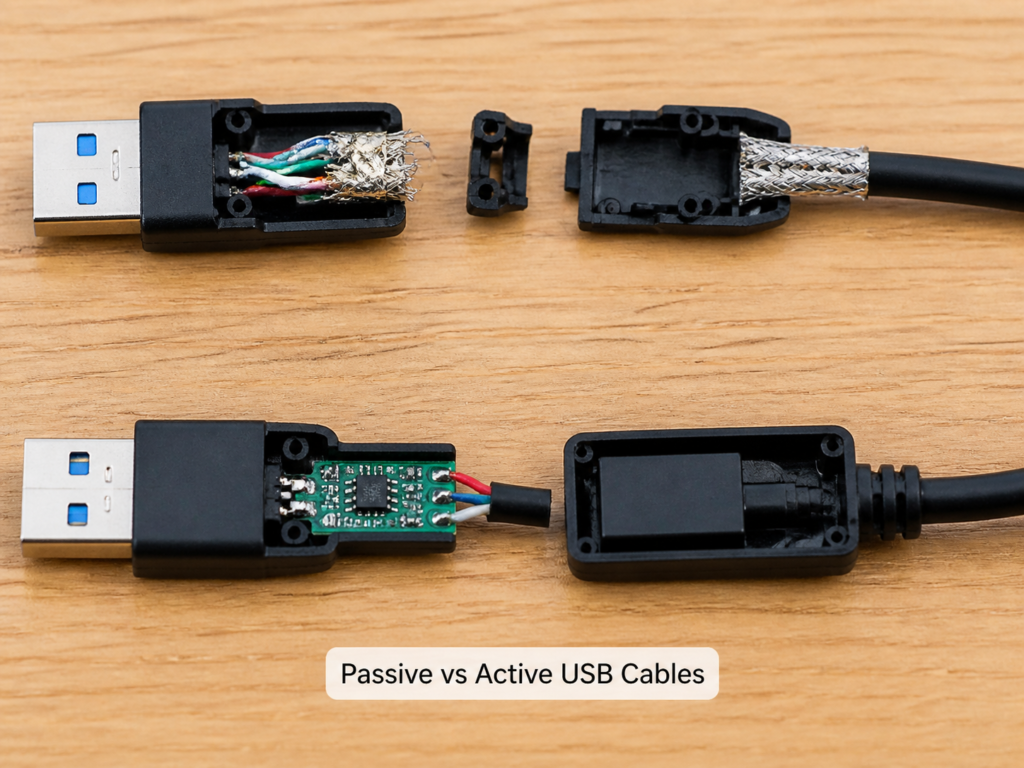
For USB cables, the core criterion for judging FCC requirements is whether it is a “passive cable” or an “active cable”. Many misunderstandings arise from the inability to distinguish between the two.
• **Passive cable**: The entire cable mainly consists of conductors, shielding layers, connectors, and shells, with no circuit for active signal processing. It only passively transmits power or data signals, and does not actively change the form of the signal. Ordinary mobile phone charging cables and short-distance ordinary data cables we usually use basically meet this characteristic.
• **Active cable**: A chip or circuit is built into the connector or the cable body, which needs to draw power from the USB interface to work, and will actively process, convert, and amplify signals. When this kind of circuit works, it will generate additional electromagnetic radiation, so the FCC requirements for it may be more complex.
What needs special distinction is: **Cables that only contain E-Marker for USB-C capability identification and PD-related communication, and have no signal amplification, conversion, retiming, or wireless functions, usually do not require separate FCC equipment authorization; but from the perspective of electrical structure, they are not completely free of electronic circuits, so the final judgment cannot be made solely based on the term “E-Marker”.**
4 Dimensions to Judge Compliance Requirements
After understanding the basic concepts, we can judge step by step what FCC requirements the USB cable in hand must meet from four dimensions.
1. Passive or Active (The Most Core)
The core of judgment is: whether there is an active circuit that requires power supply, and whether it will actively change the transmitted signal. If you don’t want to disassemble the cable, the fastest identification method is to look at the product detail page or specification sheet. As long as keywords such as “signal enhancement”, “conversion”, “active processing”, and “retiming” appear, it basically indicates that further confirmation is needed to determine whether it is an active functional cable.
2. Function of the Built-in Chip
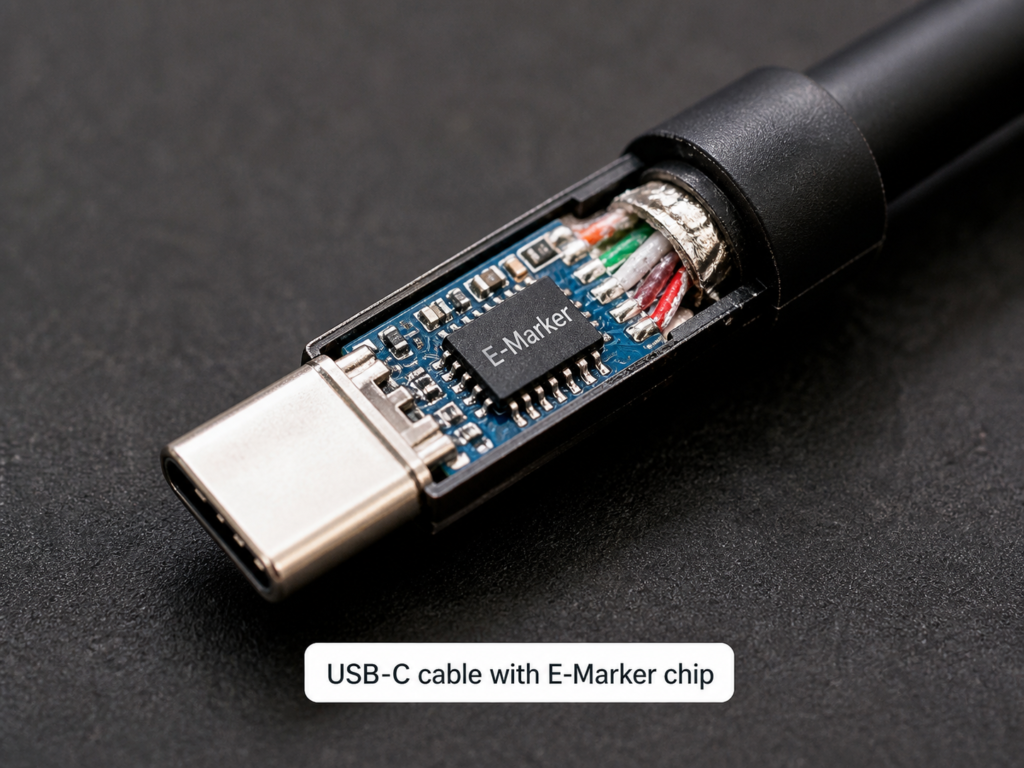
Many people think that “cables with chips need FCC certification”, but that’s not the case. For example, many USB-C PD fast charging cables now have an **E-Marker chip**, whose function is to participate in USB-C capability identification and PD-related communication, equivalent to an “identification card”. It usually does not process data or video signals. Therefore, cables that only contain E-Marker and have no other active functions usually do not require separate FCC equipment authorization.
However, strictly speaking, it is not completely free of electronic circuits, and the final conclusion cannot be drawn just because the product says “E-Marker”. A more reliable judgment can only be made after confirming that there are no active functions such as amplification, conversion, retiming, and wireless. If you are not sure, directly ask the supplier for the chip function description and complete circuit schematic diagram, and you will understand at a glance.
3. Transmission Rate and Length
Many people think that high-speed USB cables and long data cables need FCC certification, but that’s actually wrong. The higher the rate and the longer the cable, the higher the risk of electromagnetic interference, and better shielding design is required. But this only affects the difficulty of testing and evaluation, and does not alone determine the authorization classification of the product – if it is confirmed that there is no active signal processing circuit, separate authorization is usually not required just because of speed or length itself.
4. Sales Form and Channel
This is easily overlooked by many people. If the cable is sold separately, the compliance requirements are judged according to the properties of the cable itself. If it is sold as an accessory to a host that has passed FCC certification (such as a charging cable included with a laptop purchase), passive cables usually do not require separate authorization, but it is necessary to confirm that the FCC test of the host has covered this cable. If it is sold as a set (such as a set of charger plus charging cable), each component and its combined configuration must be evaluated separately. It cannot be done by simply saying “the whole set has FCC certification”, nor does it mean that each component must obtain independent FCC authorization.
In addition, it should be noted that official regulations are the bottom line, and the requirements of e-commerce platforms and importers may be higher. For example, offline sales only need to comply with regulations, but e-commerce platforms such as Amazon and Walmart may require you to provide relevant certificates before putting products on shelves, even for passive cables. You can’t just prepare nothing because it’s not legally required.
Quick Reference for FCC Requirements of Common USB Cables
For the convenience of quick comparison, we have sorted out the FCC requirements of the most common types of USB cables into a table:
| Product Type | Core Judgment Basis | FCC Compliance Requirements | Common Product Examples | Review Key Points |
| Ordinary passive charging/data cable | Mainly contains conductors, shielding layers, and connectors, no active signal processing circuit, only used for charging or ordinary data transmission | Usually no separate FCC equipment authorization required | Mobile phone USB-C charging cable, ordinary USB-A to Micro-USB data cable | Confirm no signal processing function, and understand whether there are other electronic circuits |
| USB-C PD fast charging cable with E-Marker | Only contains E-Marker for USB-C capability identification and PD-related communication, no signal amplification, conversion, retiming, or wireless functions | Usually no separate FCC equipment authorization required, but the final judgment cannot be made solely based on the term “E-Marker” | 100W PD fast charging cable, passive USB-C cable supporting 20Gbps transmission | Confirm that E-Marker is only used for identification and related communication, and is not matched with other active circuits |
| Active functional cable (signal processing/conversion type) | Built-in active chip, can process, amplify or convert signals, needs to draw power from USB | Usually requires equipment authorization evaluation based on digital circuits, interface functions, and applicable Part 15 provisions; SDoC, Certification, Verification, or other provisions may apply | Active Thunderbolt cable, high-speed USB cable with retimer, USB to HDMI/network port cable, photoelectric conversion cable | Confirm the type of active circuit, applicable Part 15 sub-clauses, and clarify the compliance path |
| Special USB cable with wireless function | Built-in intentional transmitting modules such as Bluetooth and Wi-Fi | Usually requires corresponding FCC authorization; pre-certified modules can only be integrated via modular approval if they meet the module authorization conditions | USB debug cable with Bluetooth, smart charging cable with Wi-Fi | Confirm the certification status of the wireless module, antenna and installation method and other conditions, and evaluate the finished product requirements |
Material Preparation for Different Compliance Paths
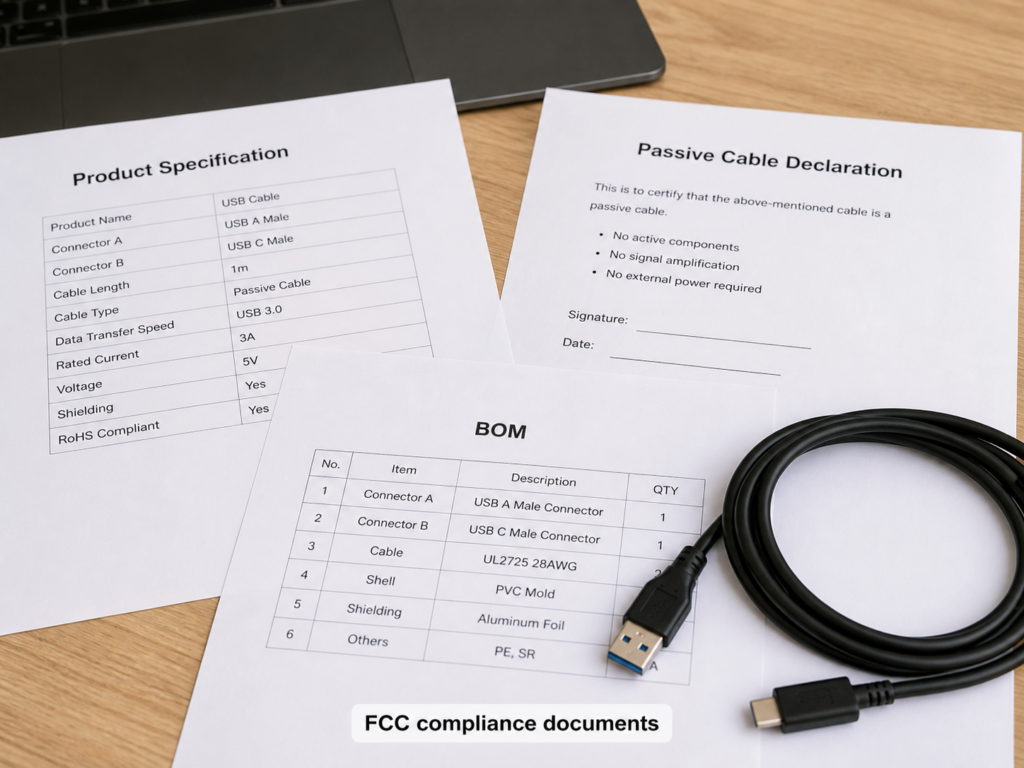
After figuring out which category your cable belongs to, you can prepare the corresponding compliance materials next. The requirements for different paths vary greatly.
If it is a passive cable that does not require separate authorization, according to FCC regulations, there is no need to submit any official materials or apply for any certificate. However, it is recommended that you keep the product specification sheet, passive attribute declaration, and bill of materials (BOM) well. In case of random inspection by the platform or importer, you can produce proof to avoid trouble.
If it is an active cable without wireless function, it is generally necessary to first determine the equipment authorization path based on its digital circuit, interface function, and applicable provisions, and cannot default to SDoC for all. If SDoC is applicable, the responsible entity here must be located in the United States, which can usually be a US manufacturer, importer, or other qualified US entity. Overseas suppliers can prepare technical materials and participate in signing, but cannot be the sole responsible entity within the United States. The materials to be prepared include: test reports meeting applicable Part 15 requirements, basic product information, information of the US responsible party, formal declaration of conformity, and compliance prompts in the product manual. In addition, it should be noted that SDoC is a self-declaration, there is no official “certificate”, and the test report is only a material kept for future reference, which is not equal to an FCC certification certificate. Don’t be fooled by unreliable service providers.
If it is a product with wireless function that requires Certification, the test shall be completed by a qualified laboratory, and an application shall be submitted to a TCB recognized by the FCC; the TCB reviews and issues the authorization based on the test and application materials, and then assigns an FCC ID. When using a pre-certified module, it should be judged whether modular approval can be adopted according to the module authorization conditions, and it cannot be generally said that no whole-device evaluation is required. The finished product still needs to evaluate the applicable requirements of the host and combined equipment, and carry out labeling and user information marking in accordance with FCC regulations. The common marking is “Contains FCC ID: [Module ID]”, and the module FCC ID cannot be directly claimed as the whole-device FCC certification.
Products requiring Certification must also mark the FCC ID or specified module integration information in accordance with applicable FCC labeling rules; electronic labels can be used when conditions are met, and it cannot be uniformly required to be physically printed on the product body.
In addition to regulatory requirements, attention should also be paid to channel and regulatory risks: before putting products on e-commerce platforms, be sure to read the platform’s compliance guidelines first. Even for products that do not require authorization under regulations, the platform may require uploading materials before they can be sold. If the compliance materials are incomplete, the product may be removed from the shelves in mild cases, or detained during customs clearance in severe cases, and even cause after-sales disputes. It should also be clarified that the platform’s review rules are not equal to the FCC’s legal obligations. Don’t confuse the two, but don’t take it lightly, after all, whether the product can be put on the shelf is the most practical thing.
Another point that people often ask about: chargers and power adapters should be judged whether they need to meet Part 15 requirements or equipment authorization based on their circuit structure, whether they contain digital functions, and applicable FCC provisions. When sold as a set, each component and its combined configuration should be evaluated. It cannot be assumed that a separate FCC authorization must be obtained just because of the name “charger”, nor can it be assumed that other devices in the set do not need to be judged just because the cable does not need separate authorization.
3-Step Quick Self-Inspection Method
If you have a USB cable and don’t know how to comply, you can follow these three steps for quick self-inspection, and you will basically not go wrong.
Step 1: Confirm the structure and function of the product. First look at the detail page and specification sheet to find keywords such as “active processing”, “conversion”, “amplification”, and “wireless”; if you are not sure, directly ask the supplier for a written judgment statement, chip function description, or even circuit schematic diagram, don’t guess by yourself.
Step 2: Confirm the sales form and channel. First figure out whether this cable is sold separately or as an accessory to a certified host; then verify whether the sales platform and cooperative importer have additional compliance requirements, don’t wait until the goods are shipped to find that they do not meet the platform rules.
Step 3: Prepare corresponding compliance materials. If it is a passive cable, prepare the specification sheet and passive attribute declaration to deal with random inspections; if it is active but has no wireless function, first confirm the applicable Part 15 provisions and equipment authorization path, then determine whether SDoC, Certification, Verification, or other procedures are needed, and clarify the US responsible party; if it has wireless function, first check whether the built-in wireless module is certified, confirm whether the module authorization conditions, antenna and installation method meet the requirements, then decide whether to adopt modular approval or conduct further finished product authorization evaluation, and use the corresponding markings in accordance with regulations.
Common Misconceptions and Pitfall Avoidance Reminders
Finally, let’s talk about a few pitfalls that people are most likely to step into. Avoiding these will basically not cause big problems.
5 Common Cognitive Misconceptions
1. **All USB cables need FCC ID**: This is the most common misunderstanding. Ordinary passive cables usually do not require separate FCC equipment authorization; active cables need to be evaluated according to specific device categories and applicable provisions, and SDoC, Certification, Verification, or other provisions may apply; products with wireless functions usually require corresponding authorization, but module integration conditions cannot be ignored just because of the three words “with wireless”.
2. **All USB cables with chips need FCC certification**: Cables that only contain E-Marker for USB-C capability identification and PD-related communication and have no other active signal processing functions usually do not require separate FCC equipment authorization; but the final judgment cannot be made solely based on the name E-Marker.
3. **No separate authorization required means no requirements at all**: Passive cables usually do not require separate FCC equipment authorization, but cables may affect the electromagnetic emission performance of connected devices or systems. Relevant hosts and devices must still meet applicable Part 15 requirements, and cable configurations that will not cause system non-compliance should be used; platforms and importers may also require you to provide compliance proof.
4. **UL, CE, USB-IF certifications can replace FCC**: The regulatory directions of these certifications are completely different: UL regulates safety, CE is for the EU, USB-IF regulates interface compatibility, none of which can replace FCC electromagnetic compliance requirements. Existing EMC data can only be used as technical materials if the test method, limits, frequency bands, sample configuration, and cable conditions meet the applicable FCC provisions; otherwise, supplementary testing or re-testing is still required.
5. **With shielding layer and magnetic ring, no compliance is needed**: Shielding layers and magnetic rings are only means to reduce electromagnetic interference, and will not automatically change the product classification or authorization requirements. As long as the cable contains active circuits that require further evaluation, compliance evaluation cannot be exempted solely by shielding design.
4 Practical Pitfall Avoidance Suggestions
First, ask the supplier for a written compliance judgment statement and chip function description at the time of procurement, to clarify the product structure. Don’t wait until you are about to put it on the shelf to find that it is an active cable and has not been compliant, which wastes time.
Second, be sure to confirm the platform’s compliance requirements in advance before putting products on e-commerce shelves. The rules of different platforms are different. Don’t wait until the goods are shipped to be removed from the shelves, losing freight and storage fees.
Third, if you are doing active cables, give priority to suppliers with Part 15 testing capabilities, and confirm the qualification of the US responsible party in advance, so as to avoid being stuck because you can’t find a suitable responsible party at that time.
Fourth, do not use an FCC ID that does not belong to the product for passive cables, nor use FCC logos or text to imply that the product has obtained non-existent FCC authorization; if any FCC compliance marking is used, it should be ensured that it meets the applicable marking rules and will not mislead consumers.
Summary
Generally speaking, to judge the FCC compliance requirements of USB cables, there are three core points: first, the structure and function of the cable, whether it does not contain active signal processing circuits, or has active processing functions; second, the type of built-in chip, whether it is an E-Marker only used for capability identification and PD-related communication, or a chip with active processing functions; third, the sales form and channel, whether it is sold separately or as an accessory, online or offline.
Understand the difference between passive and active, distinguish the different applicable scenarios of SDoC, Verification, and Certification, confirm the integration conditions of wireless modules, avoid the 5 common misconceptions mentioned above, and then prepare the corresponding materials according to your own sales channels, you can basically deal with most situations and will not step into big compliance pitfalls. If you are still not sure, the safest way is to ask the supplier for all the materials, or consult a professional compliance service provider, don’t judge by feeling.