
Sellers of wireless chargers targeting the U.S. market, or consumers who purchase wireless chargers via overseas shopping, have most likely heard of the term FCC ID. Some say all wireless chargers must have it, some say low-power ones do not, and others say CE certification can replace it. Do wireless chargers really have to apply for an FCC ID? We will first give a quick conclusion, then break it down step by step.
Quick Conclusion
First, here is a preliminary judgment you can use directly:
First, wireless chargers with wireless communication functions such as Bluetooth, WiFi, and active NFC readers/writers, as long as they are commercially sold in the United States, usually require FCC certification for the relevant transmitting functions and obtain the corresponding FCC ID; however, passive NFC tags or pure receiving functions cannot be directly judged by name alone.
Second, ordinary consumer-grade wireless chargers without communication functions still need to comply with applicable FCC rules, but do not necessarily require an FCC ID. For such devices, it is usually necessary to combine Part 18 rules, operating frequency, output power, operating mode, use environment, and device purpose to determine whether FCC Certification, SDoC, or other applicable authorization methods should be adopted. Mainstream e-commerce platforms may also generally require sellers to provide compliance certificates.
Third, for pure receiving accessories, passive structural parts, or products brought into the United States for personal use, it cannot be generally concluded that no FCC ID is required. Personal non-commercial imports, laboratory test samples, etc. may be subject to specific exceptions or import conditions, but equipment used for commercial distribution, sale, or normal operation should still confirm authorization requirements in accordance with specific FCC rules.
Finally, a special reminder: the absence of an FCC ID does not mean non-compliance; it just means the authorization method for compliance is different. Do not assume a product is counterfeit just because it does not have an ID.
First Understand 3 Basic Concepts
To understand the logic of these judgments, we must first clarify a few basic concepts that are most easily confused. You don’t need to memorize the terminology, just understand the meaning.
What are FCC and FCC ID
The full name of FCC is the Federal Communications Commission of the United States, a federal agency responsible for the supervision of communications and radio frequency equipment in the United States. It does not simply regulate “all wireless signals”, but determines which part of the rules should apply based on the device’s operating frequency, transmission method, purpose, and whether it includes communication functions.
Wireless chargers usually involve FCC Part 18 and other Industrial, Scientific, and Medical (ISM) device rules; if the product also has communication functions such as Bluetooth and WiFi, the relevant communication transmitters may be subject to FCC Part 15 and other rules. Therefore, even though they are all called “wireless chargers”, the authorization methods for different products may not be the same.
The focus of FCC supervision is mainly to reduce harmful interference from devices to radio communications and other electronic equipment, and to control relevant radio frequency energy and use conditions in accordance with applicable rules. It is not equivalent to certifying all product quality indicators.
The FCC ID is the authorization mark for FCC Certification equipment, usually granted by a Telecommunication Certification Body (TCB) recognized by the FCC after reviewing test data and application documents. It is not a universal number that all active transmitting devices or wireless power supply devices must have, because some devices can adopt SDoC or other authorization methods.
Note here: FCC ID only indicates that the relevant device or function has completed the corresponding FCC authorization, and has nothing to do with quality indicators such as charging speed, drop resistance, durability, and charging safety. Do not regard it as an all-around quality certification.
What is SDoC
In addition to the FCC Certification authorization method represented by FCC ID, there is another compliance method called SDoC, which stands for Supplier’s Declaration of Conformity in Chinese. Simply put, the supplier evaluates the product in accordance with applicable rules and issues a declaration of conformity, without submitting it to the FCC for official certification per unit, so there is no exclusive FCC ID.
For many power supplies, wired chargers, and digital devices without wireless communication functions, the relevant unintentional radiation parts may be subject to Part 15 Subpart B. Whether such products can adopt SDoC still depends on the specific device type, function, and applicable clauses, and cannot be determined solely by the product name “power supply” or “wired charger”. Some devices may also be subject to other prescribed authorization methods.
The core difference between it and FCC ID is: FCC ID usually corresponds to FCC Certification, granted after review by an accredited TCB; SDoC is a declaration made by the supplier assuming responsibility in accordance with the rules. The two apply to different device types and specific rules.
Why Are Wireless Chargers Regulated by the FCC
Some people may ask: wireless chargers are used for charging, not for communication, why are they also regulated by the FCC?
This is because the wireless charging transmitter generates radio frequency or alternating electromagnetic fields for energy transmission, which rely on this field to transmit electrical energy to the receiver. It usually belongs to wireless power transmission or ISM equipment regulated by FCC Part 18, so it needs to meet the corresponding frequency, transmission, interference, and use condition requirements.
If the product also contains communication transmitters such as Bluetooth, WiFi, and NFC readers/writers, the communication part may also be subject to Part 15 certification requirements at the same time. That is to say, the wireless charging function and the wireless communication function may be subject to different rules respectively.
You can understand it by comparison: the digital circuit of a wired charger may generate unintentional radiation, and the relevant part may be subject to Part 15 Subpart B; a wireless charger actively generates an electromagnetic field for energy transmission, which usually needs to be evaluated in accordance with Part 18 and other rules. The two cannot be simply judged by a one-size-fits-all standard of “whether it is wireless or not”.
3 Steps to Self-Judge Whether an FCC ID Is Required
Once you understand the basic concepts, you can use 3 steps to judge whether the wireless charger you have requires an FCC ID by yourself, without having to ask someone every time.
Step 1: List All Wireless Functions of the Product
First, list all the wireless functions of the product, and distinguish two completely different types of functions:
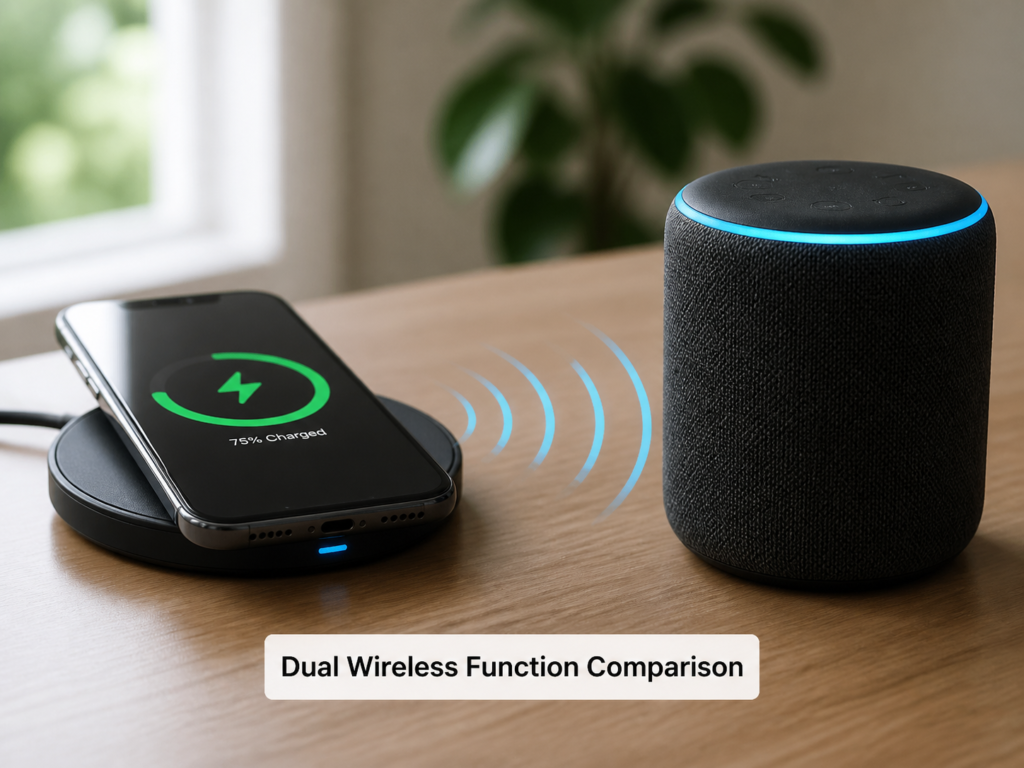
One type is **wireless charging function**, whose role is to transmit electrical energy, that is, the ability to charge devices through the air; the other type is **wireless communication function**, whose role is to transmit data, such as connecting to an APP via Bluetooth to adjust charging mode, connecting to smart home via WiFi, and pairing with a tap of NFC.
If the product only has a wireless charging function and no communication function, it is a pure wireless power transmission device, and further judgment is needed in combination with Part 18 and specific parameters.
If the product contains active Bluetooth, WiFi, NFC reader/writer or other wireless transmission functions, it is usually necessary to conduct FCC certification for the transmission function and obtain the corresponding FCC ID. However, passive NFC tags, pure receiving functions, or other functions that do not actively transmit radio energy still need to be judged according to specific circuits and rules, and conclusions cannot be drawn solely based on the name “NFC”.
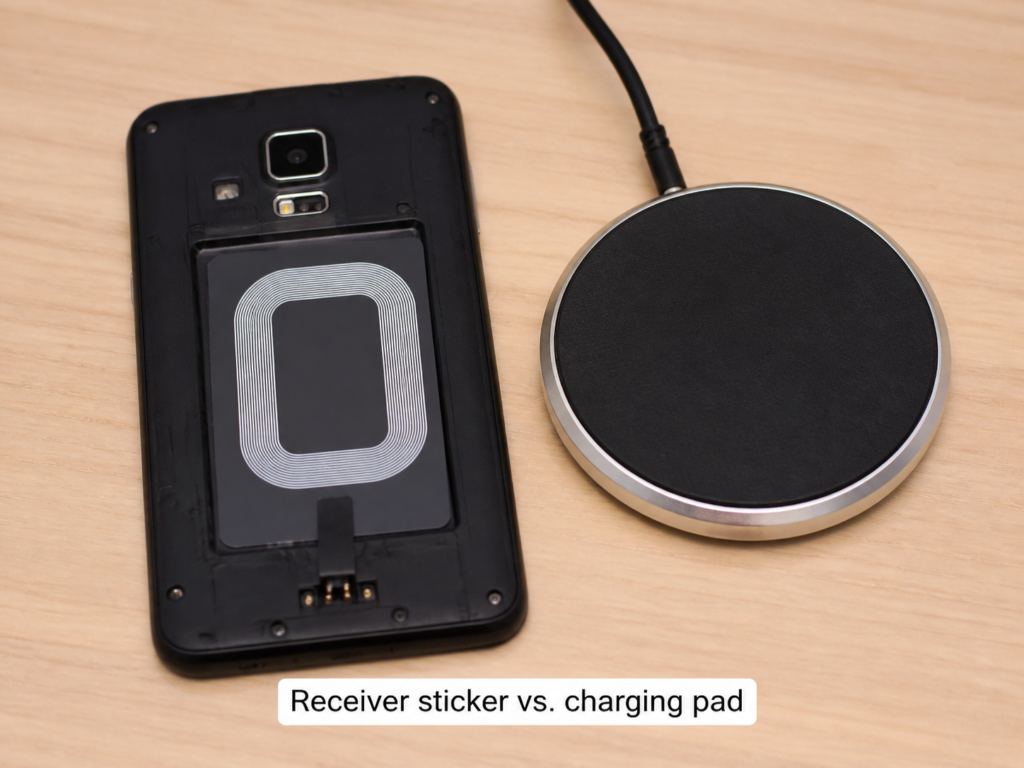
If the product is only used to receive energy, such as a wireless charging receiver sticker attached to the back of an old mobile phone, or powered by metal contact points, such as the charging base of many smart watches, it is usually not a wireless charging transmitter, and does not need to apply for an FCC ID as required for transmitters. However, the whole device, or its digital circuits and other transmission functions, may still have their own compliance requirements.
Step 2: Confirm the Sales Scenario and Purpose
Second step, see what you use this product for and in what scenario.
If it is **commercial sale** — whether it is e-commerce platforms such as Amazon and independent websites, or wholesale and offline physical stores, as long as it is for sale, it must meet the corresponding FCC marketing, import, and equipment authorization requirements. Commercial sale itself triggers corresponding compliance responsibilities, but it cannot alone determine whether a product must have an FCC ID.
If it is **brought into the United States for personal use**, or is a non-sale sample or gift, it cannot be directly concluded that no FCC ID is required. Personal non-commercial imports, laboratory test samples, etc. may be subject to specific exceptions or import conditions, but “personal use, samples, or gifts” do not automatically exempt from all FCC rules. As long as the product is used for commercial distribution, sale, or normal operation, authorization requirements should be confirmed in accordance with specific FCC rules.
Also note that the applicable rules for consumer-grade, industrial, and professional-grade are different. If you promote it for daily use by ordinary consumers, you must judge according to the rules for consumer devices; if it is marked for professional scenarios such as factories and medical equipment, you must evaluate according to the corresponding professional-grade use and rules, and the promoted purpose will affect the judgment.
Step 3: Match the Compliance Authorization Method
Third step, match the appropriate compliance authorization method according to the different functional modules of the product.
First, for the **wireless communication function part**, such as active Bluetooth, WiFi, or NFC reader/writer, FCC Certification is usually required in accordance with applicable Part 15 rules, that is, obtaining the corresponding FCC ID. The specifics still depend on the transmission frequency band, transmission method, and device category.
Second, the **pure wireless power transmission part** — that is, the part with only charging function and no communication — usually should first be judged according to Part 18 and its classification of consumer or non-consumer devices, and then adopt Certification, SDoC, or other applicable authorization methods based on specific clauses. Operating frequency, output power, operating mode, and use environment will all affect the evaluation, and the result cannot be simply determined directly by the two numbers of “frequency band and power”.
Finally, for the **power supply and ordinary digital circuit part**, such as the plug-in power supply of the wireless charger and the ordinary circuit that controls charging, the relevant unintentional radiation part may be subject to Part 15 Subpart B, and SDoC or other prescribed authorization methods shall be adopted according to specific clauses.
A reminder here: the same product may need to use multiple compliance methods at the same time to cover different functional modules, and it is not enough to just complete one. For example, for a wireless charger with Bluetooth, the Bluetooth function may require an FCC ID; the wireless charging transmitter part and digital circuit also need to be evaluated in accordance with their respective applicable Part 18 or Part 15 requirements.
Comparison Table of Common Product Judgments
Maybe you still find it a bit abstract. We have compiled a comparison table of common wireless charger-related products on the market, and you can directly match your product to the entries:
| Product Type | Whether a Separate FCC ID Application Is Required | Supplementary Notes |
| Smart wireless chargers with communication functions such as Bluetooth/WiFi/NFC | Usually required | Active communication functions usually require FCC Certification; passive NFC functions need to be judged according to specific circuits and rules |
| Pure wireless charging receiver accessories (receiver stickers, receiver cases) | Usually not required to apply as a transmitter | Only receives energy, usually not a wireless charging transmitter; other digital or wireless functions still need to be evaluated separately |
| Pure passive accessories (magnetic rings, stands, matching charging cables) | Usually no separate FCC ID application is required | No wireless signal transmission function, but if sold as part of a complete device or kit, attention should still be paid to the responsibility of the final device |
| Built-in wireless charging module integrated according to original authorization conditions | May not need to re-apply for an independent FCC ID for the module | The premise is that it is integrated according to the original authorization conditions, and the whole machine configuration does not exceed the module certification scope; other transmitters, digital circuits, antenna layout, and co-location conditions of the whole machine still need to be evaluated |
| Metal contact charging base | Usually not required to apply as a wireless power transmission transmitter | Conducts electricity through contact, not a wireless power transmission transmitter; but the power supply and digital circuit may still have other FCC requirements |
| Ordinary consumer-grade Qi wireless charging pads without communication functions | Evaluation required | Usually requires device authorization based on Part 18 and specific operating parameters; whether to adopt FCC Certification and display FCC ID, or adopt SDoC and other methods, cannot be judged solely by power |
| Industrial/medical/professional-grade wireless power supply equipment | Evaluation required | Applicable rules may be different from consumer-grade devices, and should be judged in combination with purpose and operating conditions |
| High-power wireless chargers above 50W | Evaluation required | Higher power usually requires more careful evaluation, but FCC rules do not use 50W as a universal authorization dividing line |
FCC ID Verification Methods and Consequences of Non-Compliance
Whether it is a buyer choosing a product or a seller stocking goods, you must know how to check the authenticity of an FCC ID and what the consequences of non-compliance are, so as to avoid pitfalls.
Consequences of Non-Compliance
First, let’s talk about the possible consequences of non-compliance:
First, for devices that require FCC authorization by law but have not completed authorization, have false markings, or do not meet import requirements, the FCC or U.S. Customs and Border Protection (CBP) may take enforcement measures such as refusing entry, detaining, recalling, or other measures. Sellers should keep applicable authorization and compliance documents, and cannot rely solely on a number.
Second, mainstream e-commerce platforms such as Amazon may require sellers to provide FCC compliance certificates. If they cannot provide them, they may face link removal, sales restrictions, or account penalties, depending on the platform policy and product situation.
Third, if the circumstances are serious, such as intentional fraud, selling unauthorized equipment, or causing harmful interference, the FCC may also take enforcement measures such as fines and stopping sales. The amount and handling method depend on the facts of the violation, and are not a fixed few thousand or tens of thousands of dollars.
How to Verify the Authenticity of an FCC ID
There are three simple ways to verify an FCC ID:
First, check the marking: products requiring FCC Certification should usually be marked with the FCC ID on the device body in accordance with applicable rules, or use an electronic label when conditions are met. In special cases such as the device being too small, relevant information may be provided in the manual, packaging, etc. in accordance with FCC regulations. Therefore, it cannot be simply assumed that “having a number on the packaging or manual” is necessarily sufficient, nor can authenticity be judged solely by the presence or absence of external markings.
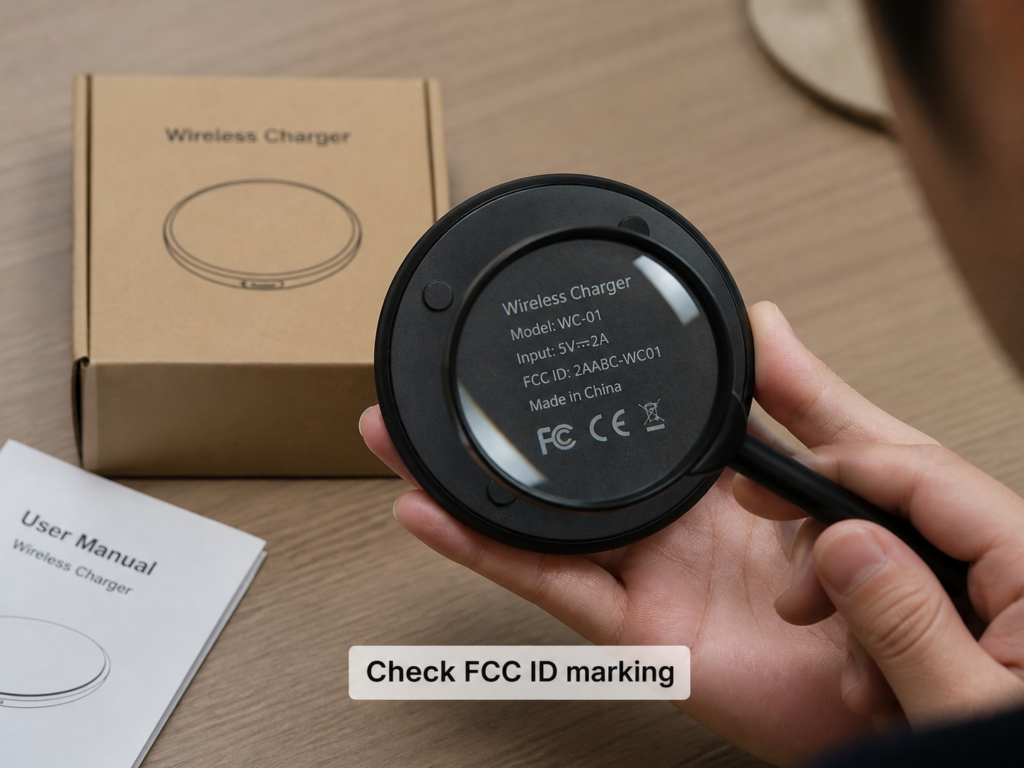
Second, identify the format: FCC ID usually consists of an FCC Grantee Code and a product code. The Grantee Code may be 3 or 5 digits, and the specific format and allocation shall be subject to the records of the FCC official database. The authenticity cannot be judged solely by the appearance of the string, let alone that the number is valid just because it looks like a string of letters and numbers.
Third, check the official website: you can directly go to the FCC’s official equipment authorization query system, enter the number, check the applicant entity, product model, photos, test reports, authorization date, and authorization conditions, and compare them with the actual configuration of the product. Just finding a similar number does not prove that the current product has obtained the corresponding authorization.
A small suggestion for everyone: buyers should try to choose products that are clearly marked as FCC compliant and can correspond to official records; sellers must confirm complete authorization and compliance documents before listing, and don’t wait until they are inspected to worry.
Basic Knowledge of FCC ID Application
If a seller needs to apply for an FCC ID, here are a few basic facts to understand first, to avoid being scammed by bad service providers.
Two Necessary Conditions for Application
Applying for FCC Certification usually requires a **U.S.-based Responsible Party**, that is, a responsible party that can assume compliance responsibilities and accept FCC contact. This requirement cannot be simply stated as “must be a U.S.-registered company or institution”, nor can it be absolutely excluded solely based on the identity of “individual”. The U.S. contact address and responsibility information should be confirmed in accordance with 47 CFR §2.911 and the specific situation of the applicant entity.
At the same time, prototypes or samples that can represent the final production configuration should be provided for testing. The FCC does not require that mass-produced products be used for every application; the key is that the sample can represent the final production configuration, and the test configuration must be consistent with the application materials and authorization conditions.
Subsequent mass-produced versions must also be consistent with the test samples, application documents, and authorization conditions. If the hardware, software, antenna, or radio frequency parameters are changed, it is necessary to re-evaluate whether the authorization needs to be changed or a new application is required.
Reference for Cycle and Cost
Let’s talk about the cycle and cost that everyone is most concerned about.
The cycle and cost are not fixed standards uniformly stipulated by FCC regulations, but are determined by the applicable authorization method, test items, scheduling of laboratories and TCBs, product complexity, service scope, and whether rectification is required. All-in-one products, products with multiple communication functions, or products that require more radio frequency and co-location evaluations are usually more complex than simple products.
Therefore, “4-8 weeks” or “several thousand to tens of thousands of RMB” cannot be regarded as the fixed industry answer for all wireless charger projects. The actual time and cost shall be subject to the project plan and quotation provided by the laboratory, TCB, or compliance service provider, and confirm whether the quotation includes testing, rectification, document preparation, and application services.
Precautions After Obtaining the Certificate
Obtaining the FCC ID is not a once-and-for-all matter. There are two requirements to note:
First, devices requiring FCC Certification shall be marked with the FCC ID on the device in accordance with FCC rules, or use an electronic label when the conditions for electronic labeling are met. In special cases such as the device being too small, information shall be provided in the manual, packaging, etc. in accordance with FCC regulations. E-commerce product detail pages can help platforms and consumers view information, but they are not a universal way to replace the legal marking of devices.
Second, this authorization only corresponds to the specific model and configuration at the time of application. If the hardware is changed later — such as replacing the wireless module or antenna, adjusting the power, changing the coil, layout, housing, or co-location transmission conditions — all need to be re-evaluated, and the original FCC ID cannot be used directly.
Clarification of Common Misconceptions
Finally, let’s clarify a few of the most common misconceptions, which many people even those who have been in e-commerce for a long time cannot figure out.
Misconception 1: FCC Compliance Means Having an FCC ID
Many people think that compliance must have an ID, but that is not the case. FCC compliance includes multiple authorization methods. FCC ID usually corresponds to FCC Certification, which is mainly applicable to devices or transmission functions that require certification; SDoC is a declaration of conformity made by enterprises in accordance with specific rules, and there is no exclusive ID.
Therefore, to judge whether a product is compliant, you cannot just look at whether it has an ID. You must first see whether the product is subject to Part 15, Part 18, or other rules, and which authorization method is required by the corresponding rules.
Misconception 2: Low-Power Wireless Chargers Do Not Need to Apply for FCC ID
Some people think that 5W and 10W low-power wireless chargers don’t need to be bothered with, which is also inaccurate. FCC rules do not automatically determine whether ordinary consumer-grade wireless chargers require an FCC ID based on 5W, 10W, or some unified low-power number.
Ordinary Qi wireless charging pads still need to be evaluated in accordance with Part 18 and specific operating parameters. Whether it adopts FCC Certification and displays FCC ID, or adopts SDoC and other methods, the key depends on conditions such as device classification, operating frequency, transmission method, output power, operating mode, and use environment, rather than just looking at the rated charging power.
Misconception 3: Other Certifications Can Replace FCC ID
Many sellers will say that I have CE certification, Qi certification, and UL certification, so do I not need to do FCC? Of course not.
CE is the compliance mark for the EU market, Qi mainly focuses on the compatibility of wireless charging and related technical requirements, and UL usually focuses on product safety. Their focus is different from that of the FCC, and they cannot replace the applicable FCC equipment authorization or compliance requirements in the United States.
But also note that U.S. compliance does not necessarily mean applying for an FCC ID. Devices without communication functions may adopt SDoC and other methods based on the specific rules of Part 18 or Part 15. Therefore, CE, Qi, and UL cannot replace FCC requirements, but “achieving U.S. FCC compliance” does not mean that all products must apply for an additional FCC ID.
Misconception 4: If a Certified Module Is Used, the Whole Machine Does Not Need to Be Concerned
Some sellers think that since the Bluetooth module I use already has an FCC ID, the entire wireless charger does not need to be processed anymore. This is inaccurate.
A certified module usually only covers the module’s own communication function, and does not automatically cover the wireless charging transmitter part, the whole machine’s digital circuit, antenna layout, housing, or other co-location transmission conditions. Only when integrated according to the original authorization conditions and the whole machine configuration does not exceed the module certification scope, it may not be necessary to re-apply for an independent FCC ID for the module.
If the whole machine changes the antenna, adjusts the power, changes the module layout, use environment, or co-location conditions, it needs to be re-evaluated, and the module’s ID cannot be directly used as the authorization for all functions of the whole machine.
Misconception 5: Selling Loose Parts or Semi-Finished Products Does Not Require Compliance
Some people take advantage of loopholes, thinking that if I sell loose parts and semi-finished products of wireless chargers, I don’t need to worry about compliance. In fact, whether authorization is required cannot be judged solely based on the fact that “buyers need to assemble it themselves”.
Whether components, kits, and semi-finished products are FCC devices that require attention shall be judged in combination with whether they are sold as operable devices, sales promotion content, the purpose after assembly, and applicable Part 15 or Part 18 rules. The FCC compliance responsibility for the final complete device cannot be exempted just because they are sold separately.
Even if separate housings, magnetic rings, coils, or conductive accessories themselves usually do not have wireless transmission functions, sellers should still note: when these components are combined into a complete wireless charging device, the final device may incur corresponding authorization and marketing responsibilities.
Summary
In general, whether an FCC ID is required requires a comprehensive judgment of whether the product contains an active communication transmitter, whether Part 15 or Part 18 rules apply, operating frequency and other parameters, device purpose, and the authorization method adopted by the whole machine. Commercial sale triggers corresponding marketing and authorization requirements, but it cannot alone determine whether a product must have an FCC ID.
For wireless chargers with communication functions such as active Bluetooth, WiFi, and NFC readers/writers, the relevant transmission functions usually require FCC Certification and obtain an FCC ID; pure receiving accessories, passive structural parts, and metal contact accessories mostly do not need to apply for an FCC ID as wireless transmitters; ordinary pure wireless charging pads need to be judged in combination with Part 18 and specific product conditions, and cannot be judged solely by 5W, 10W, or 50W.
You can also use the methods mentioned above to verify the FCC ID and its authorization records. If you are not sure, it is best to consult a professional compliance agency, judge according to the actual model, configuration, and sales scenario, and do not decide based on feeling.