
Sellers who run U.S. e-commerce businesses, or people who often buy electronic accessories from China and ship them to the U.S., have most likely encountered the issue of “FCC certification”: does an ordinary USB charger that costs only a few dozen yuan also need FCC certification? Is it only required for chargers with wireless charging? Can small sellers with low sales volume get away without it?
Many people’s understanding of FCC is either “all electronic products need it, it’s very expensive and troublesome”, or “mine is an ordinary product, I don’t need to worry about it” — both are actually wrong. Today we will thoroughly explain the FCC compliance issues for ordinary USB chargers, covering how to determine whether certification is needed, what process to follow, how to verify authenticity, and common pitfalls. After reading this, you will be able to judge for yourself without having to ask around.
First, Clarify: What Counts as an “Ordinary USB Charger”?
First, let’s define the scope of our discussion today to avoid misunderstandings:
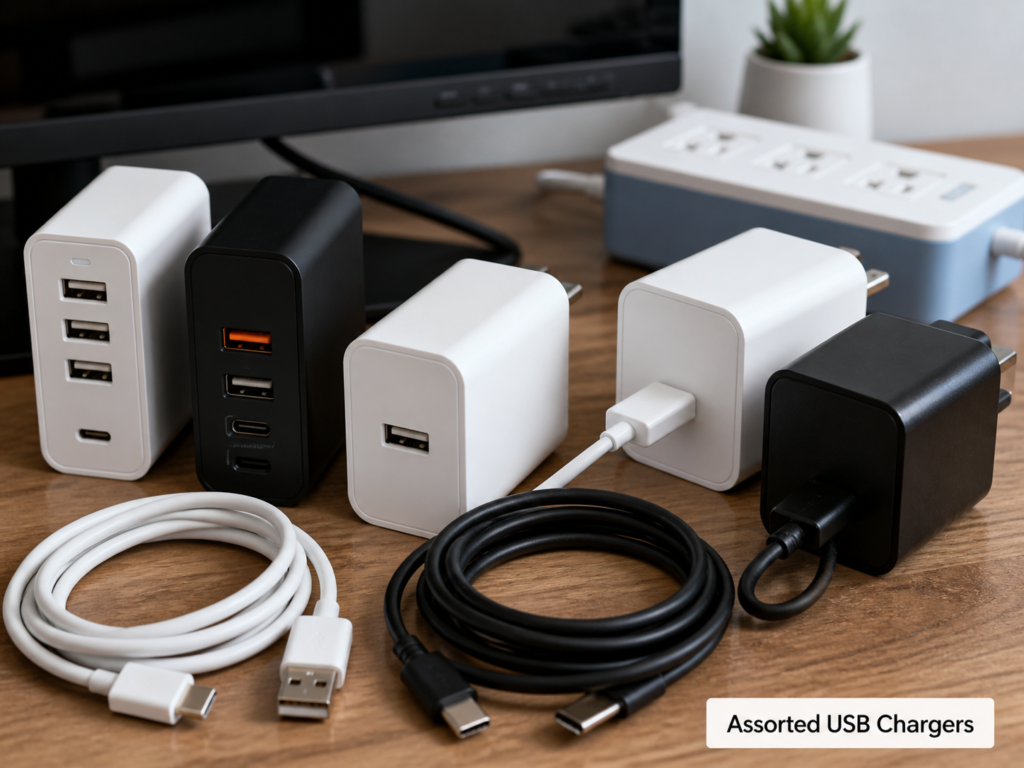
The ordinary models we refer to are **wall-plug/desktop, USB-A/USB-C output, AC-to-DC consumer-grade wired chargers**, including various wired fast chargers (such as PD and QC protocols). The common 5W old-style USB-A charger, 65W gallium nitride USB-C PD fast charger, and 100W four-port desktop charger all fall into this category.
However, whether a product is a device that requires FCC evaluation cannot be determined solely by whether it is a “charger”. It also depends on whether it contains digital control, digital interfaces, or other circuits that may be subject to FCC rules. Most ordinary USB chargers sold in the U.S. market that contain such circuits need to be evaluated in accordance with FCC rules; some power devices without digital circuits may be eligible for rule exemptions, which must ultimately be confirmed based on the specific circuit structure and product use.
What does not count? Chargers with wireless charging function, those with Bluetooth/WiFi/FM transmission, smart internet-connected ones, those with data expansion functions, as well as passive USB cables or mechanical adapters that truly contain no active electronic circuits — these are all outside the scope of “ordinary wired chargers”, and their requirements will be mentioned separately later.
Here’s the Core Conclusion First
Let’s give the most direct answer first, so you don’t have to rush to find it:
Most ordinary wired AC/DC USB chargers that contain digital control or digital interface circuits and are sold in the U.S. market need to be evaluated in accordance with FCC rules. For ordinary consumer chargers that are classified as unintentional radiators under FCC Part 15 Subpart B, the common compliance path is SDoC (Supplier’s Declaration of Conformity), not the “FCC ID certification” that people often hear about. Some power devices without digital circuits may be eligible for rule exemptions, so the final determination must still be based on product structure, internal circuits, and intended use.
If your charger has active communication functions such as Bluetooth, WiFi, or FM, the relevant transmitters usually need to obtain FCC certification and an FCC ID; if an already authorized wireless module is used, you must also check the module’s authorization conditions and complete the applicable evaluation of the host device. The final authorization and labeling method for the whole device shall be based on the specific configuration.
For chargers with wireless charging function, FCC Part 18 or other applicable FCC rules must be evaluated based on operating frequency, coupling method, power, and circuit design, while also verifying RF exposure and authorization requirements. You cannot determine the sole category just based on the words “wireless charging”.
Whether devices for personal use, R&D testing, or provided with the whole device can apply for import or authorization exceptions cannot be generalized. You must separately verify the quantity, use, labeling, sales method, and the authorization scope of the whole device.
In addition, here’s a reassurance for individual users: **the responsible parties for FCC compliance are usually U.S. importers, brand owners, and sellers across all channels**. If you only buy a few chargers via overseas shopping for your own use, you usually do not need to go through FCC procedures yourself, but you still need to comply with applicable import regulations and usage requirements.
Why Is a Charger Regulated by the FCC?
Some people may ask: a plug-in charger doesn’t emit wireless signals, why is it regulated by the FCC?
Let’s briefly explain what FCC is: it is the market access rule for electronic products formulated by the U.S. Federal Communications Commission, whose core focus is **electromagnetic interference** — that is, whether the product will leak electromagnetic waves when operating, interfering with the power grid, other electronic devices, or even radio communications. For example, when you use a low-quality charger, the nearby radio has static and the WiFi signal worsens — this is caused by electromagnetic interference, which is what the FCC regulates.
It should be noted that the FCC does not regulate safety issues such as electric shock and fire, nor does it regulate charging efficiency or compatibility with your mobile phone. These are regulated by other certifications or regulations, which will be mentioned later.
In ordinary wired chargers, common switching power supplies generate high-frequency current and voltage changes during operation. If the product also contains digital control, digital interfaces, or other regulated circuits, it may become what the FCC calls an “unintentional radiator” — a device that does not actively transmit communication signals, but may generate electromagnetic interference when operating.
If the product contains digital circuits subject to Part 15, ordinary consumer USB chargers are usually evaluated against the **Class B limits of FCC Part 15 Subpart B**; if there are no digital circuits, or the product falls into other device categories, it shall be judged according to specific rules. Class B is mainly for residential and consumer environments, and charging devices of all structures and uses cannot be automatically classified into the same category.
FCC-regulated devices related to chargers can generally be divided into three categories. Once you understand the classification, it will be easier to determine the compliance path later:
• **Unintentional radiator**: Does not actively transmit radio frequency (RF), but may generate and release electromagnetic interference during operation. Ordinary wired chargers containing regulated digital circuits usually need to be evaluated under Part 15 Subpart B;
• **Intentional radiator**: Actively transmits communication wireless signals, such as Bluetooth and WiFi. The corresponding rules usually include Part 15 Subpart C. Chargers with these functions require further evaluation of the wireless transmission part;
• **ISM RF equipment**: Uses RF energy to achieve specific functions, rather than being mainly used for communication. Wireless chargers usually need to be evaluated for Part 18 or other applicable FCC rules based on operating frequency, coupling method, power, and circuit design, and may also involve RF exposure and authorization requirements.
How to Determine Whether Your Product Needs Compliance?
Now that we understand the basic classification, let’s talk about the most critical point: under what circumstances is compliance mandatory, and under what circumstances is it not required?
Scenarios Where Compliance Is Mandatory
As long as the product is **publicly sold in the U.S.**, whether on e-commerce platforms like Amazon and Walmart, independent websites, offline stores, or even bulk second-hand sales, it is usually necessary to first confirm and meet applicable FCC requirements.
There are also two easily overlooked situations: one is **import for commercial use**, such as enterprises using them as gifts, event giveaways, or accessories bundled with other products. Even if they are not sold directly, they may still be for commercial use and need to be handled in accordance with applicable rules; the other is **chargers removed from certified whole devices and sold separately**. The original FCC authorization of the whole device does not automatically cover all included or independently usable chargers. When sold separately after removal, the whole device’s authorization cannot be directly cited to replace the charger’s own evaluation.
Scenarios Where Exceptions May Apply
These situations cannot be simply interpreted as “automatic exemption”. You need to separately verify the specific conditions in FCC import authorization and device rules.
The first is **import for personal use**: FCC import rules have specific exceptions for personal use, but they usually need to meet the specified conditions regarding quantity, use, and prohibition of sale. Those exceeding the specified quantity, used for resale or commercial activities, should not apply the personal use exception. Specifically, you should verify 47 CFR §2.1204 and customs declaration requirements, and cannot interpret “for personal use” as meaning any quantity is exempt from procedures.
The second is **R&D, evaluation, demonstration, or test prototypes**: Exceptions may apply only if they meet the FCC import exception requirements for use, quantity, prohibition of sale or lease, and are labeled as required. You cannot assume exemption just because the device has “engineering sample” written on it.
The third is **power adapters provided with the whole device**: Whether separate authorization is required shall be judged based on the authorization scope of the whole device, test configuration, charger circuit, and sales method. If the charger is imported, sold, or marketed as an independent product, the whole device’s FCC authorization cannot be directly cited to replace its own evaluation.
Core Rules for Judgment by Function
Simply put, it is “what function the product has determines which category it falls into”:
• Ordinary wired models without active RF or wireless functions are usually evaluated as unintentional radiators if they contain regulated digital circuits;
• For products with active communication functions, such as Bluetooth, WiFi, Zigbee, FM transmission, etc., the relevant transmitters usually need to obtain FCC certification and an FCC ID; if an authorized module is used, you must also check the module’s authorization conditions and complete the applicable evaluation of the host;
• For products with wireless charging function, evaluate Part 18 or other applicable rules based on operating frequency, coupling method, power, and circuit design, and confirm RF exposure and authorization requirements at the same time.
Edge Categories That Are Easy to Misjudge
There are several types of products that many people confuse, so let’s clarify them separately here:
1. **Car USB chargers**: Ordinary wired models still need to be judged whether they are FCC-applicable devices based on their internal circuits; those with communication functions also require evaluation of the wireless transmission part — it is not the case that they are unregulated just because they are plugged into a car;
2. **Power strips with USB ports**: The overall design and functions of the entire power strip need to be considered, and the USB charging part cannot be evaluated separately as a charger;
3. **High-power USB chargers**: For example, 240W multi-port fast chargers usually do not switch to the FCC ID path just because the output power increases, but they still need to be evaluated based on the specific circuit and device category. Power and multi-port operating modes mainly affect test configuration and worst-case judgment, and should not be simply stated as “the higher the power, the more different the FCC test threshold”;
4. **Chargers with PD/QC fast charging**: Fast charging protocols are transmitted through wired interfaces and are not equivalent to RF transmission themselves, so they are usually still evaluated according to the applicable rules for wired products, and do not automatically require an FCC ID just because they have fast charging function.
How to Choose Between the Two Compliance Paths?
After confirming that compliance is required, which path should you take? The most common ones are the SDoC and FCC ID mentioned earlier. Let’s clarify the differences with a table:
| Comparison Item | SDoC (Supplier’s Declaration of Conformity) | FCC ID Certification |
| Applicable Objects | Part 15 Class B unintentional radiators, such as eligible ordinary wired USB chargers | Intentional radiators requiring certification, as well as some other devices requiring certification |
| Audit Requirements | Usually no prior certification issuance by FCC or TCB is required, and the responsible party bears the conformity responsibility | Requires review and certification issuance by a TCB organization authorized by the FCC |
| Public Inquiry | Usually not entered into the FCC public database, and cannot be queried through the FCC ID database | Can be publicly queried in the FCC OET database |
| Labeling Requirements | A declaration of conformity, device identification information, and U.S. responsible party information must be prepared in accordance with the rules, and placed on the device, in the manual, on the packaging, or in other permitted locations as required | Usually requires the FCC ID to be marked in accordance with authorization rules, subject to applicable rules and authorization methods |
| Cost and Cycle | Low cost, short cycle | High cost, long cycle |
Many people think that SDoC means “just say you are compliant yourself”, but that’s not true — it also has clear requirements:
When ordinary wired chargers follow the SDoC path, common core test items include **conducted interference** (interference leaking from the power cord) and **radiated interference** (interference leaking through space). Testing should cover representative and worst-case operating modes required by applicable rules, including maximum load, simultaneous operation of multiple ports, and different input conditions when necessary.
For example, whether a four-port charger must be tested with all four ports at full load at the same time cannot be generalized. It should be determined based on product specifications, actual operating modes, rated conditions, and the laboratory’s judgment of the worst case. The key is not to mechanically test all combinations, but to ensure that the test state can represent the operating condition where the product may generate the maximum interference.
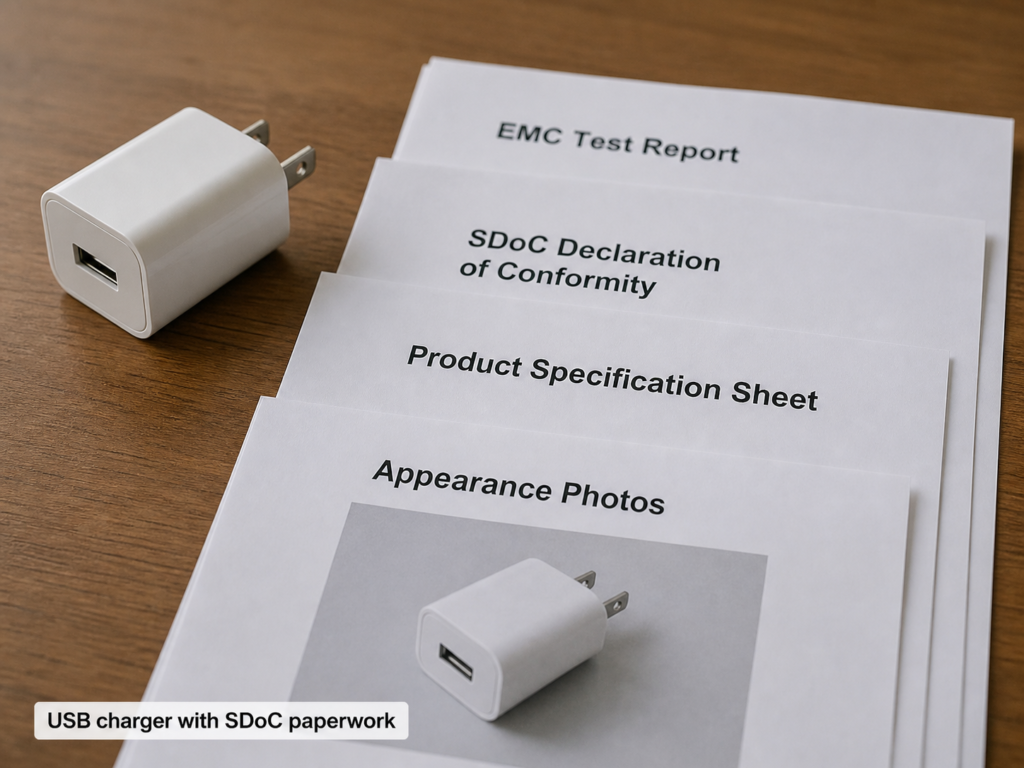
After the test is completed, three types of documents need to be kept: EMC test report, SDoC declaration of conformity, product specification sheet, and appearance photos. These documents must be available for inspection at any time. If there are subsequent changes to core components, such as switching power supply chips, EMC filter components, PCB layout, or output power, compliance must be re-evaluated, and the original report cannot be directly used.
Path Requirements for Products with Special Functions
If your charger has special functions, the path will be different:
• With active communication functions such as Bluetooth and WiFi: The relevant transmitters usually need FCC certification and an FCC ID, and additional RF transmission testing is required; if an authorized module is used, you must check whether the module is allowed to be installed in the current host, as well as authorization conditions such as module label, antenna, and installation method;
• With wireless charging function: Evaluate Part 18 or other applicable rules based on operating frequency, coupling method, power, and circuit design, and confirm whether FCC certification is required, whether an FCC ID is involved, and RF exposure requirements;
• Using FCC-certified power modules: Many suppliers will say “my module has FCC certification, so the whole device doesn’t need it”, which is inaccurate. After the module is installed in the whole device, the interference situation may change, and the host may also contain other digital circuits or wireless functions. Therefore, the whole device still needs to complete the applicable evaluation based on the specific configuration, and module certification cannot automatically replace the whole device’s SDoC or other authorization requirements.
Common Misconceptions About the FCC Mark
Many people think a product is compliant when they see the FCC logo printed on it when shopping, but that’s not the case. As early as 2017, the FCC had already eliminated the mandatory requirement to print the FCC logo, so whether the logo is printed or not is not important. The key is to check whether there is a valid declaration of conformity (for the SDoC path) or a real and applicable FCC ID (for the certification-required path). Don’t be fooled by products with a fake logo printed on them.
Practical Guide: How to Verify Whether a Product Is Truly Compliant?
Whether you are a seller sourcing from suppliers or a buyer who wants to confirm compliance when purchasing, you can use these methods to verify:
Preliminary Judgment by Product Label
The most intuitive way is to first check whether verifiable information is provided on the product, but you cannot determine whether a product is compliant solely based on the outer shell label:
• If there is an FCC ID, it usually means that the device or one of its functions has obtained FCC certification, but you should verify the applicable Part, authorization scope, and product configuration through the FCC database. You cannot conclude that it must be an intentional radiator solely based on the FCC ID;
• SDoC devices must have a declaration of conformity, device identification information, and U.S. responsible party information prepared in accordance with the rules. The relevant information can be placed on the device, in the manual, on the packaging, or in other permitted locations as required. You cannot require all these contents to be printed on the product’s outer shell;
• The absence of an FCC ID or FCC logo on the outer shell cannot alone determine that the product is non-compliant. You should continue to verify whether the product is an FCC-applicable device, whether there is an SDoC declaration, responsible party information, test records, and whether the actual hardware configuration is consistent with the documents.
Official Database Verification (Only for FCC ID Products)
If it is a product with an FCC ID, you can directly query the FCC’s OET Equipment Authorization Database. Enter the FCC ID to find the corresponding authorization information, and verify whether the product model, manufacturer, appearance photos, authorization status, and applicable device category are consistent with the actual product.
It should be noted here that **products following the SDoC path are usually not entered into the FCC public database**, so it is normal that they cannot be found. Don’t think that not being able to find them means non-compliance — this is a pitfall that many people fall into.
Key Points for Supplier Document Verification
If you are sourcing goods from suppliers, be sure to request the corresponding compliance documents and carefully verify them:
• Ordinary wired chargers: Request “FCC SDoC declaration + EMC test report”;
• Chargers with wireless or communication functions: Request “applicable FCC authorization documents or FCC ID information + complete test report”;
• General verification items: The product model, hardware version, test coverage scenarios, and U.S. responsible party information on the report must be consistent with the product you actually sell or purchase. If they are different, no matter how complete the report is, it cannot directly prove that the current product is compliant, and reports of other models or versions cannot be used as a substitute.
Requirements of Major U.S. E-Commerce Platforms
Major U.S. e-commerce platforms such as Amazon and Walmart may request materials such as FCC declarations, test reports, or FCC IDs from sellers based on category and risk control requirements. The specific requirements vary by platform, product category, sales site, and review rules.
Devices with wireless transmission functions that require certification must first meet FCC authorization requirements, but platform review rules cannot be generalized as a unified “no FCC ID means no listing at all”. Platform policies may be updated, and the specific requirements shall be subject to the latest requirements in the seller’s backend and corresponding product categories.
Besides FCC, What Other Requirements Must Be Met for the U.S. Market?
Many people confuse FCC with other U.S. market access requirements. Let’s clarify them here by the way — these are all parallel requirements and cannot replace each other:
1. **Safety certification (UL/ETL, etc.)**: Regulates safety risks such as electric shock and fire. At the federal level, not all products are required to obtain UL or ETL listing, but e-commerce platforms and offline channels generally pay attention to relevant safety compliance. This is completely different from the electromagnetic interference regulated by the FCC and cannot replace FCC compliance.
2. **Energy efficiency requirements (DOE/CEC)**: Regulates the standby power consumption and conversion efficiency of external power supplies. USB chargers that meet the definition of external power supplies and do not fall into the exclusion items may be subject to both DOE and the energy efficiency requirements of the state where they are sold; this should be confirmed according to the specific definitions, exceptions, and filing requirements of 10 CFR Part 430, 10 CFR §430.32(w), and California Title 20. Absolute judgments cannot be made for all USB chargers.
3. **USB protocol certification (USB-IF)**: Regulates the compatibility of USB interfaces and the consistency of fast charging protocols. It is a voluntary certification, and authorization is only required when using the official USB logo. It has no direct connection with the FCC and cannot replace FCC compliance.
4. **State-level special requirements**: For example, California’s Prop 65. If a product may cause California consumers to be exposed to chemical substances listed in Prop 65, and the exposure meets the applicable conditions of the regulation, a compliant warning is usually required; whether a warning is needed should be judged based on materials, consumer exposure, safe harbor levels, and applicable exemptions, and cannot be simply interpreted as “if the product contains harmful substances, a warning must be posted”.
6 Most Common FCC Misconceptions
Finally, let’s talk about the most common misconceptions. Many people either spend unnecessary money or fall into pitfalls due to fluke mentality:
1. **Misconception 1: Small sellers/low sales volume/direct shipping do not need compliance**
As long as the product is publicly sold in the U.S., regardless of the scale, sales volume, or shipping method (direct shipping or local warehouse), it is necessary to confirm and meet applicable FCC requirements. Violations may result in platform delisting, customs detention and return of goods, or even official law enforcement measures. The specific penalties shall be subject to law enforcement rulings. Do not take chances.
2. **Misconception 2: Low power/small size means exemption**
The FCC has not set a simple power or size exemption standard for USB chargers. Most products sold in the U.S. market that contain digital control or digital interface circuits still need to be evaluated according to specific rules; whether some power devices without digital circuits are eligible for exemption shall be judged based on the circuit structure and device use.
Power level does not directly determine a corresponding set of FCC limits. Output power and multi-port operating modes mainly affect test configuration and worst-case judgment, and cannot be stated as “the higher the power, the more different the FCC test threshold”. Even a small 5W charger, as long as it is an FCC-applicable device, cannot be automatically exempted from requirements just because of low power.
3. **Misconception 3: With CE/UL/USB-IF certification, FCC is not needed**
Different certifications have completely different regulatory focuses, have no mutual recognition relationship, and cannot replace each other. The FCC mainly focuses on electromagnetic compatibility and related wireless device authorization in the U.S. market, CE targets the EU regulatory system, UL and others mainly focus on safety, and USB-IF focuses on interfaces and protocols — none can directly replace FCC requirements.
4. **Misconception 4: “FCC certification” refers only to FCC ID**
The “FCC certification” that people usually talk about is actually a general term, which may include multiple compliance paths such as SDoC and FCC ID. If an ordinary wired charger falls within the scope of Part 15 Subpart B, it can usually adopt SDoC and does not have to get FCC ID certification. Don’t be scammed by unscrupulous service providers and spend unnecessary money.
5. **Misconception 5: Having a test report equals compliance**
Compliance is not just about having a test report. The absence of a declaration of conformity, or inconsistency between the model/hardware version on the report and the actual product, cannot fully prove that the current product is compliant. Reports of other models or versions cannot be used as a substitute.
6. **Misconception 6: Personal use also requires FCC procedures**
FCC import rules have specific exceptions for personal use, but they need to meet the specified conditions regarding quantity, use, and prohibition of sale. Personal use does not mean that any quantity or any import method is automatically exempt from procedures. If it is bulk purchasing on behalf of others, resale, or used for commercial activities, it is a commercial act and cannot apply the personal use exception — it must be handled in accordance with applicable rules.
Final: 3-Step Quick Self-Check Method
By now, you should have a complete understanding of FCC compliance for ordinary USB chargers. Finally, we have compiled a 3-step quick self-check method for you. When you encounter uncertain situations, just follow it:
Step 1: Confirm product attributes. First, check whether it is a plug-in active USB charger; then check whether there are digital control, digital interfaces, hubs, converters, signal processing, or other active electronic circuits inside, and whether it has RF functions such as wireless charging, Bluetooth, or WiFi. Passive USB cables or mechanical adapters that truly contain no active electronic circuits usually do not belong to Part 15 digital devices; adapter products containing chips, hubs, converters, signal processing, or power conversion circuits still need to be evaluated based on their specific structure.
Step 2: Confirm the usage scenario. If it is publicly sold in the U.S. or imported in bulk for commercial use, you must confirm and meet applicable requirements; if it is for personal use, R&D testing, or evaluation prototypes, you must verify the conditions such as quantity, use, prohibition of sale or lease, and labeling according to FCC import rules. Exceptions may apply only when the requirements are met. Chargers provided with the whole device must also be judged based on the whole device’s authorization scope, test configuration, and sales method, and cannot be automatically exempted.
Step 3: Match the compliance path. If an ordinary wired model contains regulated digital circuits, it is usually evaluated under FCC Part 15 Subpart B and adopts SDoC; transmitters with active communication functions usually require FCC certification and an FCC ID, but when using an authorized module, you must also check the conditions of the module and the host; for those with wireless charging function, the path is determined after evaluation under Part 18 or other applicable rules. If you are really unsure, consult a laboratory or compliance agency familiar with FCC device authorization rules for confirmation.
In general, the FCC issue for ordinary USB chargers cannot be summarized with just two answers: “yes” or “no”. First look at the internal circuit and product functions, then check whether it is sold in the U.S., and finally confirm the applicable authorization path. This way, you will not mistakenly think that all chargers must apply for an FCC ID, nor will you ignore the FCC compliance responsibilities that should be borne just because the product is small in size, low in power, or has no wireless function.