
Sellers of charging products operating on EU Amazon sites have most likely received WEEE compliance emails from Amazon, and their first reaction usually boils down to two questions: Is this registration mandatory? Is the platform asking for extra materials again? And how do I upload the number to the backend after getting it? Today we will break down these two questions thoroughly, covering judgment rules, practical operation steps, and common pitfalls, so that even new sellers who have just entered the industry can follow along and clarify the logic.
Core Conclusion First: Don’t Wait for Amazon’s Reminder to Take It Seriously
Many people think WEEE is a requirement from Amazon, but that’s not the case — the platform is just enforcing EU regulations, and whether it is mandatory is never up to the platform. Let’s state the most critical conclusions first:
First, **there is no unified mandatory rule across the entire EU**. Whether you need to complete WEEE registration depends on meeting three conditions at the same time: the product is an electrical and electronic equipment (EEE) under EU control, you are the legal responsible entity, and you have triggered the sales scenario obligation of the corresponding country.
Second, **mandatoriness has nothing to do with whether Amazon notifies you**. The fact that the platform has not sent an email does not mean you do not need to comply; when subsequent regulatory retrospection or platform supplementary inspections occur, the responsibilities you should bear may still be pursued.
Third, **there is no EU-wide universal WEEE registration number**. Each country has independent registration and independent performance of obligations. A registration obtained for Germany does not cover France, and vice versa.
As for uploading on Amazon, there is only one core prerequisite: you must first complete the statutory WEEE registration in the target country, complete declaration and payment, and obtain valid certificates issued by the official authority. And special attention should be paid: **Amazon’s approval only means that the certificate you submitted has passed the platform’s verification, and does not mean that you have fulfilled all statutory compliance obligations**. Subsequent sales declaration, fee payment, etc., still need to be continuously performed in accordance with the rules of the target country.
First Understand the Basics: What Exactly is WEEE, and How Does It Differ from Other Compliance Requirements?
To understand why it is required in some cases but not in others, we must first clarify the basic logic of WEEE.
Core Logic of WEEE
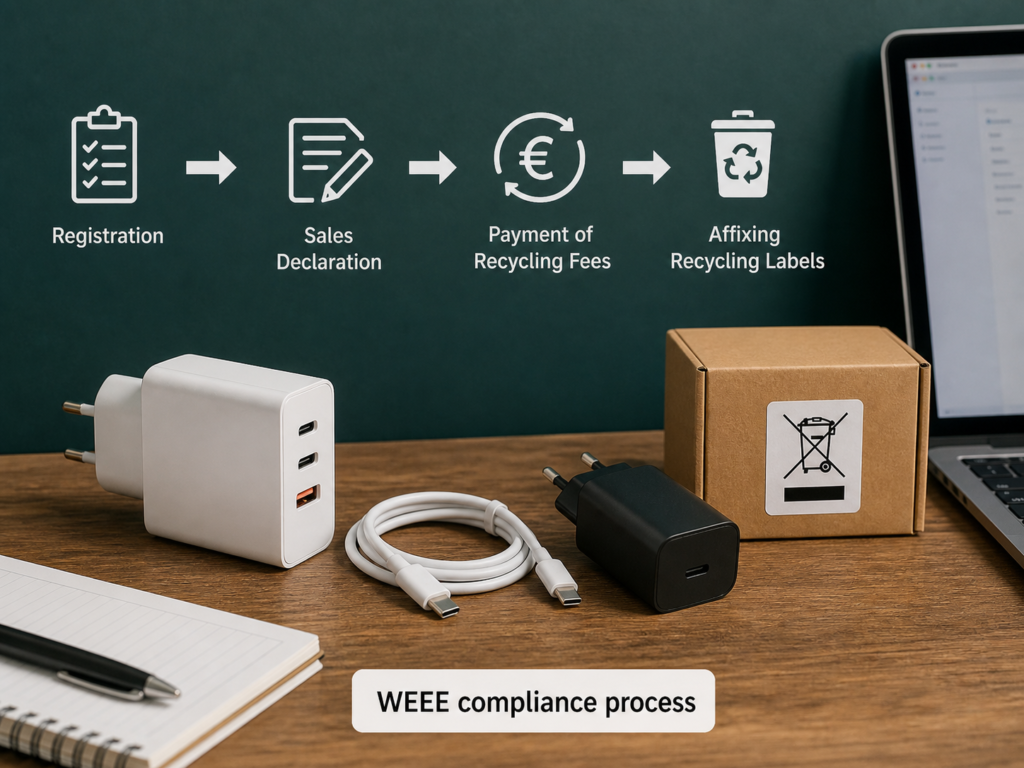
Put simply, WEEE is the EU’s “waste recycling responsibility system” for electrical and electronic products: producers and other legal responsible entities that place products on the EU market need to bear the responsibility for recycling and environmentally friendly disposal of products after they are scrapped in accordance with applicable rules, and cannot simply pass on the relevant costs to consumers or local governments.
From the institutional level, the EU only has one WEEE Directive as the general framework. The specific implementation methods, which products are regulated, and how much fees are charged are all implemented by each member state through their own domestic laws, so the requirements of each country are not exactly the same.
In each country, the competent authority is usually responsible for system supervision and registration management. Producers can fulfill producer responsibility obligations such as recycling, declaration, and fee payment through approved or recognized **PROs (Producer Responsibility Organizations)**; which specific institutions are responsible and what processes are adopted depend on the provisions of each country’s domestic law. Germany’s Stiftung EAR mainly undertakes statutory registration and management functions entrusted by the competent authority, and is not equivalent to a PRO in the general sense.
Many people think WEEE is just getting a registration number, but in fact the complete compliance process is “registration → sales declaration → payment of recycling fees → affixing recycling labels”. Registration is only the first introductory step, and the subsequent declaration and payment are long-term statutory obligations.
Core Differences from Common Compliance Concepts
Sellers who are new to compliance can easily confuse WEEE with terms such as CE and EPR. In fact, they are different requirements and cannot replace each other. Let’s clarify them with a table:
| Compliance Item | Core Function | Relationship with WEEE |
| CE | CE is a conformity declaration mark issued by the manufacturer that the product meets the requirements of applicable EU harmonized regulations. Its scope of application and specific requirements depend on relevant regulations. | Mutually independent from WEEE producer responsibility obligations, and cannot replace each other. |
| EPR | The general framework of EU environmental compliance, full name “Extended Producer Responsibility”, which requires producers to be responsible for the environmental protection of the entire product life cycle. | WEEE is a specific EPR requirement for electrical and electronic products, and is a branch of EPR. |
| RoHS | Restricts hazardous substances (such as lead and mercury) in electrical and electronic products, and controls pollution from the production source. | Obligations are independent. One regulates hazardous substances in the production stage, and the other regulates recycling after scrapping. They cannot replace each other. |
| Battery EPR / Packaging EPR | Respectively target the recycling responsibility of batteries and packaging, and belong to other branches of EPR. | Charging products with batteries need to complete battery EPR separately, and product packaging also needs to complete packaging EPR separately; WEEE cannot cover these. |
Four Easily Confused Roles
There are several roles in WEEE that are often confused, with very different responsibility boundaries. Don’t mix them up:
• **Local legal representative**: Some countries require non-EU producers to appoint a local authorized representative, who assists or undertakes duties such as statutory declaration and regulatory liaison within the scope of authorization. Specific responsibilities depend on the laws of the target country and authorization arrangements.
• **Importer**: An importer established in a member state that imports EEE from a third country and places it on the market of that country for the first time may usually be regarded as a WEEE producer in that country. However, when a Chinese seller sells directly to consumers remotely, the seller itself may also be a producer. It cannot be assumed that an entity bears all WEEE responsibilities just because it is the customs importer.
• **PRO**: An approved or recognized Producer Responsibility Organization, usually responsible for assisting in organizing recycling, declaration, and fee processing. Specific functions are determined by the laws of each country and relevant contracts.
• **Compliance agent**: A commercial service institution that helps you with registration and declaration processes. It only provides services and does not automatically bear statutory responsibilities. If problems arise, it still depends on the laws of the target country, the arrangement of authorized representatives, and the actual responsible entity.
How to Judge Whether Charging Products Need WEEE Registration?
Back to the question everyone is most concerned about: Do the chargers, data cables, wireless chargers, etc. that I sell need WEEE registration? Just judge step by step according to the three-step method.
Step 1: First Check Whether the Product Is Within the Control Scope
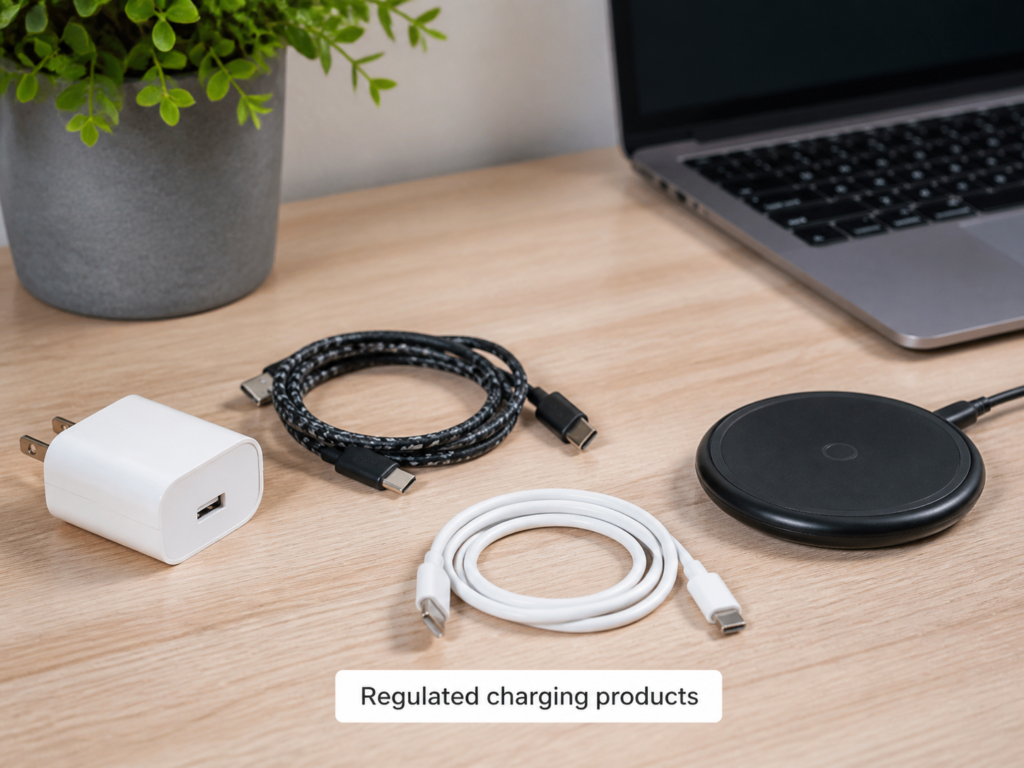
WEEE regulates **electrical and electronic equipment (EEE) that operates, transmits, or measures relying on electric current or electromagnetic fields**. However, the specific products included and their classification are not exactly the same in each country. There is no unified classification rule for charging products either, which must be matched with the official classification of the target country according to function and purpose.
For common charging products, we have sorted out several judgment dimensions, which you can check by yourself first:
• Does it have electronic components (such as fast charging chips, control circuit boards)?
• Is it sold separately (not a free gift given when buying a mobile phone)?
• Does it contain a battery?
• What is the core function (charging, data transmission, or adapter)?
• What is the size, and is it an exclusive component of other equipment?
According to the current general standards of various countries, USB wall chargers/power adapters, fast charging cables with chips, passive USB-C cables (sold separately), and wireless chargers are basically within the control scope. But a special reminder: **this is only for reference, and the final classification shall be subject to the written confirmation of the PRO or competent authority of the target country**. If you are unsure, directly submit product materials to apply for classification confirmation. Don’t guess by yourself, to avoid problems later.
Step 2: Then Check Whether You Are the Legal Responsible Entity
Even if the product is within the control scope, you may not necessarily be responsible. It depends on whether you are the legal responsible entity. There are several common situations:
• **EU local manufacturer**: Entities that produce and place products on the market in the EU are the responsible entities.
• **EU importer**: For products produced in non-EU regions, the importer established in a member state and responsible for placing EEE on the market for the first time may usually be regarded as a WEEE producer in that country, but the specific situation shall still be subject to the rules of the target country.
• **Private label sellers**: If you find a factory to manufacture products and sell them under your own brand, even if you are a Chinese seller, you may be regarded as a producer and bear WEEE responsibilities. You cannot directly use the factory’s registration number.
• **Remote seller**: If you sell electrical and electronic products directly to consumers in the target country (such as direct mailing from China to German consumers), you may also bear WEEE producer responsibility in that country, and you need to appoint an authorized representative or perform other producer responsibilities as required by the target country.
• **Platform**: In some scenarios, Amazon may withhold recycling fees, but this is only an assistance measure of the platform and does not exempt the seller from statutory obligations. Don’t think that you don’t need to worry about it just because the platform deducts the money.
Step 3: Finally Check Whether the Sales Scenario Obligation Is Triggered
Even if the product is within the scope and you are the responsible entity, not all situations are exactly the same. It must be comprehensively judged based on the following factors:
1. Which country the product is actually placed in or sold to remotely;
2. The place of establishment of the producer, inventory and import arrangements;
3. The flow of goods and sales targets, which country’s consumers the products are sold to;
4. Sales model, whether it is B2C retail or B2B wholesale;
5. The domestic law of the target country on producers, authorized representatives and responsibility allocation.
**Platform rules do not determine whether statutory obligations are triggered**, they only determine whether Amazon requires submission of certificates or takes platform measures. Whether the corresponding site requires sellers to submit compliance certificates should be handled separately as a platform operation issue, and cannot be used as a legal condition for judging whether regulatory obligations are established.
We have sorted out several of the most common sales scenarios for your reference:
• **Shipping from EU local warehouses (FBA/overseas warehouses)**: Judgment should be made country by country according to the member states where the products are actually placed or sold remotely, combined with the producer’s place of establishment, inventory and import arrangements, sales targets, and local domestic laws. The location of the warehouse or the actual shipping location itself is not the only judgment criterion.
• **Self-shipping via direct mail from China**: As long as it constitutes remote sales to the target country, it may be necessary to perform producer responsibilities in accordance with the rules of that country. Some platforms have less strict control for the time being, but this does not mean there is no regulatory risk. Local regulatory authorities may still pursue responsibility in accordance with the law.
• **Pan-European distribution**: The Pan-European Plan may trigger obligations in multiple sales destination countries at the same time. Judgment should be based on the actual sales and remote sales destination countries, combined with the producer’s identity, logistics and local laws, and cannot be judged solely by the warehouse location or site name. For example, if you operate a German site, but the Pan-European Plan ships from a French warehouse to French consumers, you may need to handle France’s WEEE obligations.
Boundaries of Several Special Scenarios
There are also several special scenarios that are easy to be uncertain about, let’s clarify them as well:
• **B2B wholesale to EU importers**: The attribution of responsibility shall be determined in combination with the sales chain, contract agreements, brand ownership, import arrangements and the laws of the target country. If the contract clearly states that the importer bears WEEE responsibilities and you can provide relevant certificates, you may not need to bear all obligations, but it is best to confirm with the PRO or competent authority of the target country in advance.
• **Products not entering the target country and not sold remotely**: In this case, there may be no WEEE obligation for that target country, but if the products enter the target country through Pan-European distribution, resale via EU warehouses, etc., obligations may still be triggered.
• **Second-hand compliant products**: If it can be proved that the product has completed WEEE compliance when it was first placed on the EU market, and the secondary sale does not change the attributes of the product, repeated registration is generally not required. The specific situation shall be subject to the rules of the target country.
Common Risks of Non-Compliance
If you fail to do what is required, you may face two types of risks:
• **Platform side**: Product removal, account restriction, invalidation of compliance marks. Some sites may directly withhold recycling fees. The specific situation shall be subject to Amazon’s current policy.
• **Regulatory side**: Goods detention, administrative fines, sales bans, payment of back recycling fees, etc. The specific situation shall be subject to the laws of the target country and the actual violation situation.
WEEE Registration Rules and Preparations for Germany and France
Sellers operating on EU Amazon sites most commonly handle WEEE registration in Germany and France. Let’s take these two countries as examples to talk about the core registration rules and precautions.
Core General Rules for Registration
Let’s first talk about several core rules common to all countries, to avoid basic pitfalls:
1. **Territorial principle**: Registration in one country only covers that country. There is no EU-wide universal registration number, and separate registration is required for Germany and France.
2. **Requirements for non-EU sellers**: It is necessary to confirm country by country whether a local legal representative is required and the scope of responsibilities of the legal representative. For example, Germany requires non-EU producers to have a local legal representative.
3. **Prerequisite for sharing registration numbers**: The same registration number can only cover the same entity, the same brand, the same category, and the same country. Amazon allows binding, but the products must be within the scope of registration. You cannot just use one number for all products.
4. **Common certificates**: Generally, they are the official registration number (called WEEE number in Germany, IDU in France), official registration certificate, and recycling contract. Amazon usually only requires the first two items.
Materials to Prepare for Charging Product Registration
Before handling registration, it is recommended to prepare these materials first, which can save a lot of time:
• **Product materials**: Product model, brand, function description, estimated annual sales volume, actual product photos.
• **Entity materials**: Seller’s business license, contact information, the registered entity name of the Amazon store (must be consistent with the registration entity).
• **Compliance materials**: Agreement of the local legal representative (provided by non-EU sellers as required by the target country).
Processing Cycle and Fees
Many sellers care about how long it takes to process and how much it costs. In fact, neither of these has a fixed value and is affected by many factors:
• **Factors affecting the cycle**: Equipment category, completeness of materials, PRO’s review progress, whether a classification certificate needs to be supplemented, and the agent’s work efficiency. The current industry reference cycle is: registration with Germany’s Stiftung EAR takes about 6-10 weeks (2024 reference, subject to the official current progress), and registration for France’s EPR electrical and electronic category takes about 2-4 weeks (also subject to the official current progress).
• **Factors affecting fees**: Equipment category, product weight/sales volume, number of brands, whether a recycling deposit is required, declaration cycle, and the agent’s service scope. Fees generally consist of three parts: registration fee + periodic declaration fee + recycling and disposal fee. The specific amount shall be subject to the PRO’s current fee schedule.
• **Maintenance rules**: Countries have different requirements for the continuous maintenance of registration, annual declaration, payment, recycling guarantees, and eco-organization contracts. Information should be updated and declaration and payment completed in accordance with the regulations of the competent authority or eco-organization; renewal is only handled when local rules clearly require it, and it cannot be generally assumed that all registration numbers have a fixed expiration date.
Core Differences Between German and French WEEE
The WEEE systems of Germany and France are quite different, and many sellers are easy to confuse them. We have sorted out the core differences:
| Comparison Item | German WEEE | French WEEE (EPR Electrical and Electronic Category) |
| Management Authority | The official registration authority is Stiftung EAR | It belongs to the electrical and electronic category under the general framework of French EPR, and is implemented by designated eco-organizations |
| Core Certificates | Official WEEE registration certificate + WEEE registration number | IDU (Unique Identification Number for Producer Responsibility), valid only in France |
| Registration Requirements | Usually need to be handled by producer, brand and equipment category; equipment for private household users also needs to submit corresponding recycling guarantees in accordance with ElektroG, and requirements for pure B2B equipment and other situations are different | Need to bind an eco-organization to complete annual declaration and payment; a separate IDU cannot prove full performance of obligations |
| Performance Requirements | Declare the placement volume according to sales volume/cycle, and the declaration frequency depends on the entity type and sales scale | In addition to declaration and payment, it must also comply with France’s specific consumer information notification and labeling rules |
| Universality | Only valid in Germany | Only valid in France, certificates of the two countries cannot replace each other |
Continuous Maintenance After Registration
Getting the registration number is just the beginning, and continuous maintenance must be done well later:
• Declare actual sales volume according to the cycle required by the target country (monthly/quarterly/yearly), and pay the corresponding recycling fee.
• If the registration information (entity, brand, product classification) changes, it must be updated to the registration authority in a timely manner.
• Complete recycling guarantees, annual declarations and other maintenance matters as required by the competent authority, eco-organization or contract. Failure to declare, pay fees or update information as required may lead to abnormal performance status and trigger platform or regulatory risks.
Amazon WEEE Upload Operation and Field Verification
After getting the official certificate, you can upload it to the Amazon backend. Many sellers fail to upload because they don’t check the details correctly. Let’s explain step by step.
Core Checklist Before Uploading
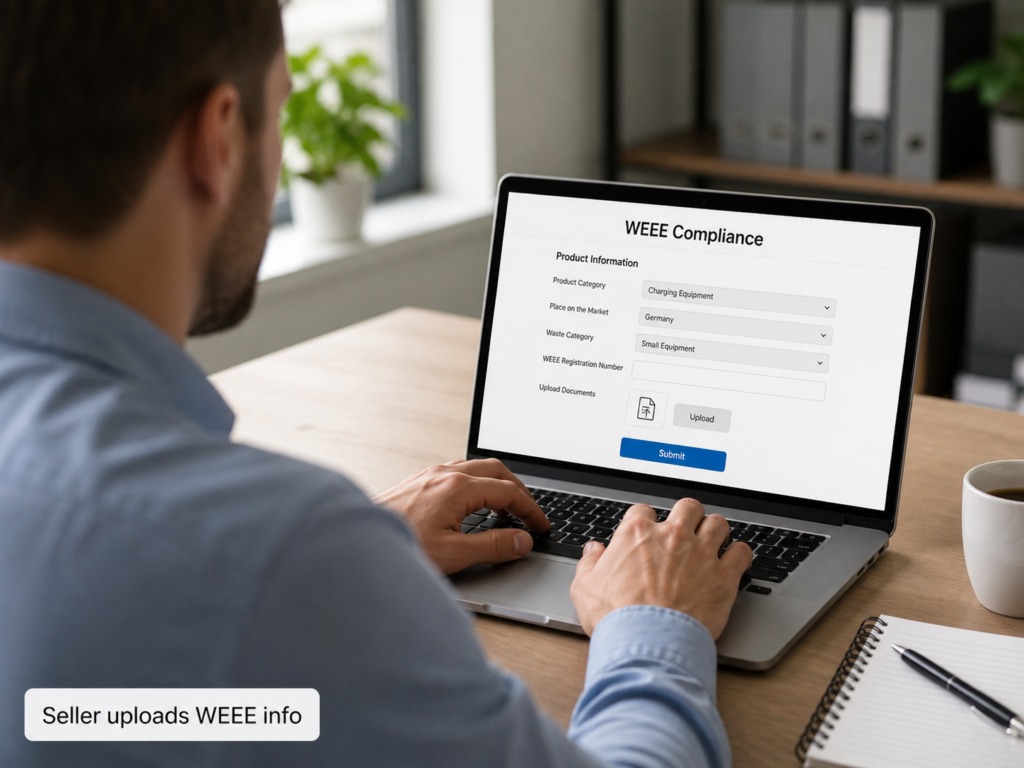
Before uploading, be sure to check against this list, which can avoid many common failures.
First, do pre-confirmation: first check the type of materials required by the corresponding site. Requirements may vary for different sites and categories. Don’t take it for granted and follow the experience of other sites.
It should be emphasized again: **Successful upload on Amazon only means that the platform verification has passed, and is not equivalent to completing statutory WEEE obligations**. Don’t think that everything is fine after uploading.
Pay attention to the following points for specific field verification:
1. **Sales country**: Must be consistent with the country covered by the registration number. For Pan-European distribution, it is necessary to confirm whether all relevant countries are covered in combination with the actual sales and remote sales destination countries, not just which site you operate.
2. **Producer name**: Must be substantially consistent with the Amazon store entity and the entity on the registration certificate. Name differences may cause the platform to require supplementary materials or reject the application.
3. **Brand**: Fill in according to the registration certificate of the target country and the requirements of Amazon’s current page, to ensure that the registration information is substantially consistent with the submitted information. Whether the brand is required to match verbatim and whether case sensitivity affects the review shall be subject to the prompts of the specific site and backend rules.
4. **Product category**: Must match the classification of WEEE registration. You cannot just choose a category casually.
5. **Registration number/IDU**: Fill in the complete official number format according to the registration certificate of the target country and the requirements of the Amazon page. The number format, whether there is a country prefix, and whether there is a validity period are not uniform across countries, and shall be subject to the registration system of the target country and the prompts of the specific site.
6. **Corresponding ASIN/SKU**: Must belong to the product scope covered by the registration. You cannot use the registration number of Product A for Product B.
7. **Supporting documents**: A clear PDF of the official registration certificate must be uploaded, and the language must meet the site requirements. The specific requirements shall be subject to the page prompts.
8. **Label compliance**: Usually, the crossed-out wheeled bin mark should be affixed to the device body in accordance with WEEE rules; if the size or function of the device really does not allow it, it should be marked on allowed carriers such as packaging, manuals or guarantees in accordance with the domestic law of the target country, and corresponding judgment basis should be retained.
Single Product and Batch Upload Operations
Amazon’s backend entrance is occasionally adjusted. Below are two common upload paths at present, which shall be subject to the actual display of the current backend:
Common Path for Single Product Upload
• Path 1: Click “Performance” → “Account Health” → “Manage Your Compliance” → “EPR Portal” → select the WEEE category to submit.
• Path 2: Go to “Manage Inventory” → find the corresponding product and click “Edit” → find the “Compliance Information” section → fill in the WEEE registration number/IDU.
Batch Upload Operation
If there are many products, you can use the batch upload tool:
1. Download the Amazon Inventory Loader template, find the corresponding WEEE fields under the “EPR Compliance” category, and fill them in in batches.
2. Prepare a mapping table of ASIN-SKU and registration number in advance to avoid mismatch.
Before submitting, be sure to check all information again against the checklist, and save screenshots of the filled content and supporting documents for future reference, which can be used as evidence in case of disputes later.
Review and Status Query After Submission
After submission, the general industry reference review cycle is 3-7 working days (2024 reference). It may be extended if manual verification is encountered, and the specific situation shall be subject to the actual progress of the platform.
There are four common review statuses: Submitted (pending review), Additional Materials Required, Approved, and Rejected. Whether it is approved or rejected, you must save the original review notification and work order number, which will be used if you need to appeal later.
Upload Rules for Special Scenarios
There are also upload rules for several special scenarios for your reference:
• **Multiple brands**: Each brand must submit the corresponding registration number separately. You cannot use the number of one brand to cover all brands.
• **Cross-site**: A valid registration number must be submitted correspondingly for each country where sales are actually made. For Pan-European distribution, it is necessary to confirm whether all relevant countries are covered in combination with the actual sales destination country and local rules.
• **Generic products**: Just submit the registration number of the corresponding entity according to the site’s guidelines. Whether brand information is required specifically shall be subject to the page requirements.
Upload Failure Troubleshooting and Appeal Methods
If your upload is rejected, don’t panic. The vast majority of failures are common problems, just troubleshoot against them. The general principle is: verify item by item against the pre-upload checklist, and prioritize troubleshooting high-frequency problems.
We have sorted out several types of the most common failure causes and solutions:
1. Country/Site Mismatch
• Common problem: Uploading the registration number of Country A to the site of Country B, or the actual sales destination country of Pan-European distribution is not covered.
• Solution: Submit the corresponding registration information according to the actual sales and remote sales destination countries, and complete the WEEE registration for whichever country is missing.
2. Entity/Brand Mismatch
• Common problem: The registered entity is inconsistent with the store entity, or the brand information is inconsistent with the registration materials.
• Solution: Either update the registration information or modify the backend information to ensure that both sides are substantially consistent; if it is a brand authorization situation, an official authorization certificate must be supplemented.
3. Product Category Mismatch
• Common problem: Charging products are incorrectly classified into other categories, or the registered classification does not cover the actual products.
• Solution: Apply to the registered PRO to confirm the correct classification, update the registration information, and then resubmit.
4. Certificate Validity Issue
• Common problem: The registration number has not yet taken effect, has an abnormal status, or is filled in incorrectly, and the French IDU is not bound to the corresponding eco-organization.
• Solution: Log in to the official registration system of the target country to verify the status of the registration number, contact the service provider or PRO to confirm the specific situation, and submit after handling it properly.
5. Material/Operation Error
• Common problem: Wrong files are uploaded (for example, CE, RoHS, packaging EPR files are uploaded), or the files are blurry and the language does not meet the requirements.
• Solution: Upload the official WEEE registration certificate as required, prepare a clear PDF file, and the language must meet the site requirements.
If there are still problems after troubleshooting, you can appeal in three steps:
Step 1: Check against the checklist again to confirm that the registration number is valid and all information is consistent.
Step 2: Supplement the missing supporting materials, such as brand authorization letter, PRO classification certificate, etc.
Step 3: Resubmit, or open a case to contact seller support, attach all certificates and previous submission records, and remember to keep the work order number.
High-Frequency Misconceptions and Self-Inspection Verification
Finally, we have sorted out the 10 most common pitfalls and a self-inspection checklist to help you clarify the logic of WEEE compliance at one time.
10 High-Frequency Pitfall Avoidance Misconceptions
1. ❌ Misconception: You can upload using the WEEE number of the supplier/factory.
✅ Correct: Private label sellers need to register in their own entity name. The factory’s registration number is bound to the factory’s entity and brand, and you cannot of course use it directly.
2. ❌ Misconception: Printing the crossed-out bin mark is equivalent to completing WEEE registration.
✅ Correct: That mark is just a recycling reminder. Registration, declaration, and payment are the core obligations. Printing the mark alone is useless.
3. ❌ Misconception: The French IDU is an EU-wide universal WEEE registration number.
✅ Correct: IDU is a local French EPR identification number, valid only in France and not recognized by other countries.
4. ❌ Misconception: Amazon’s approval is equivalent to the completion of WEEE statutory compliance.
✅ Correct: The platform mainly verifies whether the submitted materials and information meet the platform’s requirements. Whether the declaration and payment are actually made and all obligations are fulfilled still needs to be the responsibility of the relevant responsible entity in accordance with the rules of the target country.
5. ❌ Misconception: If Amazon doesn’t urge, you don’t need to register.
✅ Correct: The fact that the platform does not prompt does not mean that the regulations do not apply. Retroactive processing may occur later. Don’t wait until you receive an email to handle it. Registration and performance of obligations often require preparation time.
6. ❌ Misconception: Buying a “universal WEEE number” means you are compliant.
✅ Correct: Numbers that do not correspond to your own statutory producer identity, brand, product category, or target country must not be used as universal WEEE numbers. Before using registration or compliance services provided by third parties, you should verify the official registration records, responsible entities, authorized representatives or contractual relationships, and the status of declaration and payment. Legal consequences shall be determined by the law enforcement authorities of the target country based on the specific illegal acts.
7. ❌ Misconception: Only FBA shipping requires registration, and direct mail from China does not need it at all.
✅ Correct: As long as it constitutes remote sales to the target country, compliance may be required. Direct mail only has looser platform control for the time being, which does not mean there is no regulatory risk.
8. ❌ Misconception: All charging products are classified as small IT/communication equipment.
✅ Correct: Classification should be determined according to function, purpose and the rules of the target country. For example, some wireless chargers may be classified into other categories, and cannot be generalized.
9. ❌ Misconception: Getting the WEEE registration number is the end of the matter.
✅ Correct: You also need to declare sales volume and pay recycling fees periodically, and complete matters such as information update, recycling guarantee or eco-organization contract maintenance required by the target country.
10. ❌ Misconception: Passive USB-C cables definitely do not need registration.
✅ Correct: Whether registration is required depends on whether they are sold separately, length, the standards of the target country, etc. In many countries, separately sold passive USB-C cables are also within the control scope.
Self-Inspection Checklist for Charging Product WEEE Compliance
You can check against this list to see if your compliance is in place:
1. Product judgment: Confirm that the product is within the EEE control scope of the target country.
2. Entity judgment: Confirm that you are the legal responsible entity for WEEE in the target country.
3. Registration compliance: Registration for the corresponding sales country has been completed, the registration information is consistent with the store, and it is in a performable state.
4. Label compliance: The WEEE label is affixed to the statutory carrier as required by the target country.
5. Upload operation: WEEE information has been submitted on the corresponding site, and the status is Approved.
6. Continuous maintenance: Sales volume has been declared and fees paid as required, information changes are updated in a timely manner, and other maintenance matters required by local authorities have been completed.
Don’t Judge These Situations by Yourself, Confirm with PRO
If you encounter the following scenarios with blurred boundaries, it is recommended to directly submit materials to the PRO or competent authority of the target country for confirmation. Don’t guess by yourself:
• Products with blurred boundaries such as passive USB-C cables;
• Charging sets and combination products with batteries;
• Scenarios of B2B wholesale where the EU importer claims to have borne WEEE responsibilities;
• Multi-country obligation judgment for Pan-European distribution and cross-site sales;
• Confirmation of registration entities for multi-brand and white-label products.
Official Information Verification Channels
All rules may be adjusted. Don’t believe rumors on the Internet. Check official channels if you want to verify:
• Germany: Official website of Stiftung EAR;
• France: Official channels of the Ministry of Ecological Transition and designated eco-organizations;
• General: Official channels of the target country’s PRO, compliance policies of Amazon Seller Platform.
By now, you should be able to independently complete the following tasks: quickly judge whether your charging products and sales model trigger WEEE obligations in the target country, distinguish the certificates, requirements and differences between German and French WEEE registration, independently complete WEEE information upload and field verification in the Amazon backend, troubleshoot common upload failure reasons and complete appeal adjustments, identify the boundaries between WEEE and other compliance requirements such as battery and packaging EPR, and also avoid the vast majority of cognitive and operational misconceptions.
WEEE compliance may seem trivial, but the core is to first determine the producer and other responsible entities in accordance with the laws of the target country, and then the corresponding entities or legally appointed authorized representatives shall complete obligations such as registration, declaration, payment and recycling. Platform approval cannot replace these statutory obligations. As long as you gradually confirm the product, entity, sales destination country and continuous performance requirements in accordance with the rules of the target country, you can handle Amazon backend upload and subsequent compliance maintenance more steadily.