
Sellers of charging cables and external chargers who have just expanded into the EU market will most likely encounter two troublesome issues: first, the platform backend suddenly requires filling in “EU Authorized Representative” information, and products cannot be listed without it; second, after the goods arrive at the port, customs random inspections find that there is no information of the domestic responsible person on the packaging, and the goods are directly detained. Many people’s first reaction is: What exactly is an EU Authorized Representative? Is it mandatory for my charging products?
Let’s lay out the core conclusions clearly first, so you don’t have to scroll to the end to find the answers:
First, an EU Authorized Representative (commonly referred to as “EU Rep” in the industry) is an economic operator established within the EU, authorized in writing by a non-EU manufacturer in accordance with specific EU regulations, responsible for compliance liaison and related tasks within the scope of authorization. It is not a unified role that all products or all non-EU sellers must separately designate.
Second, it is not mandatory in all cases; it must be judged step by step according to the three-level logic of “sales entity and scenario → applicable regulations → domestic responsible entity”, and cannot be generalized.
Third, when a non-EU manufacturer places products covered by relevant EU product regulations on the EU market, it is usually necessary to ensure that there is a qualified EU economic operator, but this entity is not necessarily a separately designated authorized representative. For products such as ordinary passive data cables, whether GPSR or other regulations apply should also be judged in combination with the product’s use, structure, risk and specific regulations.
Fourth, the EU Rep and the manufacturer’s completion of product compliance are two different things. The EU Rep cannot replace the manufacturer in completing the applicable conformity assessment, signing the Declaration of Conformity (DoC) and affixing the CE mark; the manufacturer remains the first responsible party for compliance issues caused by product design and production.
First, Understand Several Common Roles in EU Compliance
To understand the positioning of the EU Rep, you must first distinguish several roles that are often confused; many pitfalls start from confusing roles.
What Are the Responsibilities of Core Roles
• **EU Authorized Representative (EU Rep)**: Designated in writing by a non-EU manufacturer in accordance with specific EU regulations, responsible for liaising with compliance matters within the EU within the scope of authorization. The authorized representative must accept the written authorization of the manufacturer and perform the clearly listed tasks in accordance with applicable regulations.
• **EU Importer**: A trading entity that first introduces products from outside the EU and places them on the EU market. It itself bears corresponding importer obligations according to law, and may also assume the role of EU economic operator or GPSR responsible entity when conditions are met.
• **GPSR Responsible Person**: For products that fall within the scope of the EU General Product Safety Regulation (referred to as GPSR) and whose manufacturer is not located within the EU, the regulation requires the existence of a domestic responsible entity within the EU. GPSR does not unconditionally cover all consumer products; for products already covered by specific product regulations, GPSR mainly applies to safety risks and aspects not covered by specific regulations. This responsible entity may be assumed by the EU Rep, importer or fulfillment service provider when conditions are met.
• **Fulfillment Service Provider (FBA/Overseas Warehouse/Logistics Provider)**: Usually only provides warehousing, packaging and distribution services, but when meeting the legal definitions and conditions, may bear the legal obligations of EU economic operator or GPSR responsible entity, and its responsibility cannot be completely excluded.
Special note here: The same company can concurrently hold multiple roles, but the legal obligations of each role are independent and cannot replace each other. For example, if you find an importer to help you clear customs, it does not mean that he automatically assumes all the obligations of the authorized representative or other responsible entities; in commercial cooperation, responsibilities should still be clarified through written agreements, but agreements cannot change the legal responsibility distribution stipulated by regulations.
What Do Several Commonly Heard Terms Mean
Don’t be afraid when encountering unfamiliar terms, first understand the basic concepts:
• **European Economic Area (EEA)**: Includes the 27 EU member states as well as Norway, Iceland and Liechtenstein. Many EU single market product rules will apply to these three countries through the EEA Agreement, but the scope of application and inclusion of specific CE regulations should still be checked item by item, and it cannot be simply assumed that all EU product regulations automatically apply to the entire EEA.
• **Declaration of Conformity (DoC)**: A written commitment issued by the manufacturer itself, stating that the product meets the corresponding EU regulatory requirements, and is one of the core materials in compliance documents.
• **EU Economic Operator**: A general term for legal entities within the EU that can bear specific compliance responsibilities, which may include EU-based manufacturers, importers, authorized representatives, and fulfillment service providers when conditions are met.
Roles Easily Confused in Charging Scenarios
Many people confuse the EU Rep with other roles, here we clearly explain the differences:
• Difference from testing institutions: Testing institutions can be responsible for product safety, electromagnetic compatibility (EMC) and other tests and issue test reports; the EU Rep is responsible for compliance liaison within the scope of authorization and related tasks required by regulations, and the two cannot replace each other. For example, if you ask TÜV to complete a certain test, it does not mean that you automatically have an authorized representative.
• Difference from UK Responsible Person (UKRP): The EU and the UK are two independent regulatory areas, and the EU Rep cannot automatically replace the UK’s UKRP; for the UK market, you must separately verify the UK’s responsible entity requirements.
• Difference from distributors: Distributors usually need to verify whether product labels, documents and supply chain information meet the requirements, but they do not automatically assume compliance responsibilities at the manufacturer level, and cannot be directly used as EU Reps.
Why Do You Need an EU Rep? What Are the Risks of Not Having One?
Many people think that the EU Rep is a threshold deliberately set by the EU, but the core reason is very practical: cross-border sellers are thousands of miles away, if EU regulatory authorities or consumers buy a problematic charger, they can’t fly to find you, right? The establishment of an EU economic operator is to solve the problem of “unable to find the responsible person” in cross-border supervision, so that regulatory authorities can contact domestic entities, obtain documents and promote necessary corrective measures.
Relevant economic operators should be able to obtain and provide technical documents, declarations of conformity and other materials to the competent authorities when required by supervision, and cooperate with investigations, recalls or other corrective measures. What regulations usually require is “ability to provide and cooperate”, which does not mean that all technical documents and DoCs must be physically stored within the EU.
If a qualified EU economic operator is not arranged in accordance with the requirements of applicable regulations, there are three common types of risks:
• **Customs Clearance Risk**: If the product lacks the information of the legal economic operator, or the relevant information does not meet the requirements, customs or market supervision authorities may suspend release, require correction, restrict sales, or take other legal measures. The specific consequences depend on applicable regulations, product conditions, member state procedures and case risks.
• **E-commerce Platform Risk**: Some e-commerce platforms will require sellers to submit EU responsible entity information in accordance with GPSR, market supervision requirements or the platform’s own policies. Missing information may affect product listing, sales or warehousing, and specific requirements shall be subject to the latest rules of the corresponding platform, site and product category.
• **Market Supervision Risk**: When market supervision authorities find that the product lacks a legal responsible entity, or the label or documents are non-compliant, they may require rectification, restrict sales, recall products, or take other legal measures such as fines.
Three Steps to Judge Whether Your Charging Product Needs an EU Rep
Don’t guess randomly whether you need to find an EU Rep, just deduce step by step according to the three-level logic, and you can stop when you reach a conclusion at any step.
First Level: First See Who You Are and What You Are Doing
First judge two basic conditions:
1. Is your manufacturer or sales entity registered outside the EU/EEA?
2. Is it a commercial sale or other market provision scenario?
If the manufacturer itself is located within the EU/EEA, there is usually already an EU-based manufacturer as the economic operator, and it is not necessary to additionally find an EU Rep; but it still needs to perform the manufacturer’s obligations under applicable regulations. If it is an overseas manufacturer doing commercial sales, then look at the second level below.
It should be noted that “market provision” does not only include paid sales. Free samples, gifts or other provision behaviors in commercial activities may also be considered market provision, and cannot be directly deemed as exempt just because they are free or in small quantities.
Second Level: See What Regulations Your Product Is Subject To
Different products are subject to different regulations and have different requirements:
• **Products subject to CE-related regulations**: First complete the conformity obligations in accordance with specific regulations, and check whether the regulation requires or allows an authorized representative, as well as the specific tasks of the authorized representative. At the same time, it is also necessary to judge whether the product falls within the scope of GPSR, and whether GPSR involves safety risks not covered by specific regulations. Non-EU manufacturers should also ensure the existence of an EU economic operator required by the Market Surveillance Regulation.
• **Consumer products mainly subject to GPSR**: If the product does fall within the scope of GPSR application, and the manufacturer is not located within the EU, then a qualified EU domestic responsible entity is required, but it does not necessarily have to be a separate authorized representative.
• **Products not subject to GPSR**: For example, some industrial-specific large charging equipment may be mainly subject to other specific regulations. Such products need to be verified separately in combination with specific use, structure, power supply parameters and applicable regulations.
Third Level: See If You Have an Existing Responsible Entity on the EU Side
If there is already an EU importer that assumes importer obligations according to law, and the other party performs corresponding obligations as the EU economic operator of this product, there is usually no need to separately designate an authorized representative to meet the requirement of “must have an EU economic operator”. However, specific product regulations may still require an authorized representative, and both parties should also clarify commercial responsibilities and authorization scope through written agreements. Written agreements can help divide work, but cannot change the responsibilities assumed by importers, manufacturers or other entities according to law.
If there is no qualified domestic responsible entity — for example, direct mail, or using FBA or overseas warehouse for delivery but no other eligible EU economic operator — then a qualified entity needs to be arranged according to applicable regulations. This entity may be an authorized representative, importer or eligible fulfillment service provider, depending on the regulations applicable to the product and the actual supply chain arrangement.
Quick Reference Matrix for Charging Products
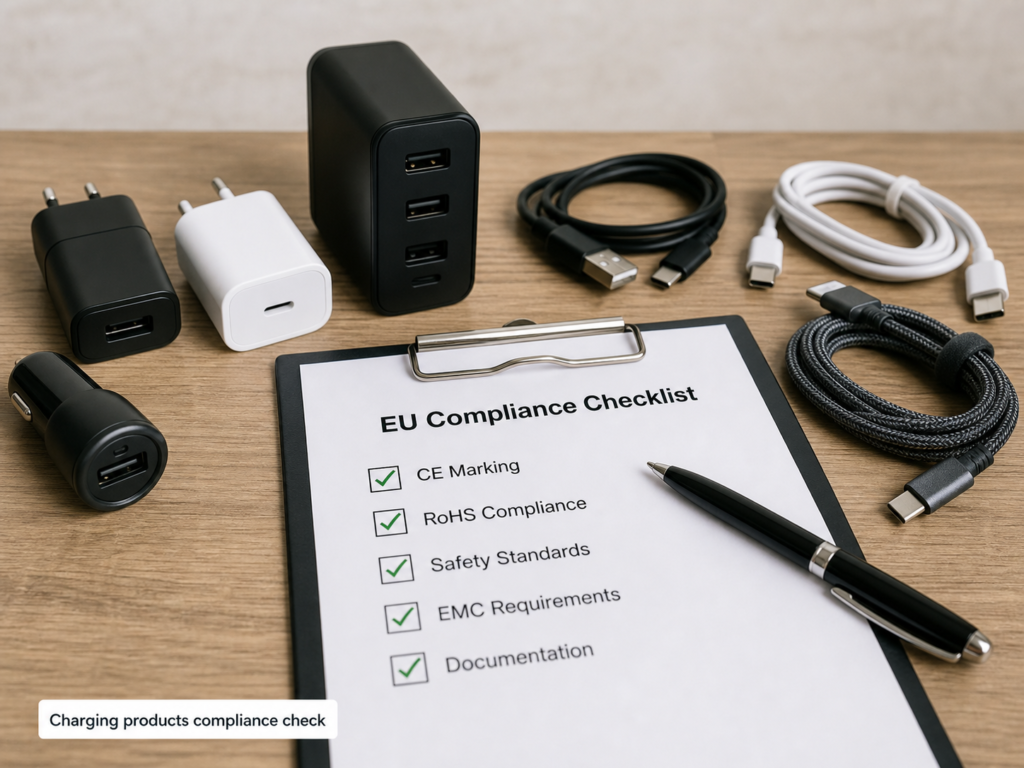
To facilitate sellers of charging products to conduct preliminary screening, I have organized the judgment directions of common charging products into a table. It can only be used as a starting point, and cannot replace the item-by-item verification of product electrical parameters, electronic circuits, wireless functions, use, structure and applicable regulations.
| Charging Product Type | Main Applicable Regulations or Judgment Direction | Is CE Required? | Do Overseas Sellers Need an EU Economic Operator? |
| External Charger/Power Adapter | Usually involves LVD, EMC, RoHS and other requirements, depending on product parameters and composition | Usually needs to be judged according to applicable regulations | Usually needs to be verified and arranged |
| Passive USB/USB-C Data Cable | Usually does not separately trigger LVD or RED due to passive transmission function, but may involve RoHS, GPSR and other applicable requirements | Usually does not separately require CE due to this function, but should be verified according to specific regulations | Should verify whether an EU economic operator is required |
| Active Fast Charging Cable with E-Marker Chip | Verify EMC, RoHS and other applicable regulations according to voltage, electronic circuit, product composition and function, cannot be deemed subject to LVD/EMC just because it contains an E-Marker chip | Judged according to specific applicable regulations | Should verify whether an EU economic operator is required |
| Wireless Charger | Usually verify LVD, EMC, RoHS; if it has wireless communication or other radio transmission and reception functions within the scope of RED, then verify RED | Judged according to specific applicable regulations | Usually needs to be verified and arranged |
| Charging Products with Bluetooth Function | Usually need to verify RED, EMC, RoHS and other requirements, other regulations depend on product structure and use | Usually needs to be judged according to applicable regulations | Usually needs to be verified and arranged |
| Pure Passive Charging Adapter | Judge in combination with electrical function, structure, use and whether it falls within the scope of relevant electrical and electronic products, also need to verify the applicability of GPSR | Depends on specific functions and applicable regulations | Should verify whether an EU economic operator is required |
Three Situations Where You Don’t Need to Find a Separate EU Rep
Of course, there are some situations where it is not necessary to separately designate an authorized representative:
1. The manufacturer itself is registered within the EU/EEA, and it performs the manufacturer’s responsibilities under applicable regulations.
2. An existing EU importer legally becomes the EU economic operator of this product and performs corresponding obligations. Whether an authorized representative is still needed depends on whether there are additional requirements in specific product regulations.
3. When an individual imports for personal use and does not involve commercial activities, the relevant market placement obligations may not apply. But this does not mean that all customs, product safety and responsibility requirements do not exist; free samples, gifts or other provision behaviors in commercial activities may still be considered market provision.
Four Most Common Misconception Pitfalls
Here we clarify four high-frequency misconceptions, many sellers fall into pitfalls because of these:
• **Misconception 1: If you have CE, you don’t need an EU Rep.** The CE mark and the EU economic operator are different issues. The CE mark means that the manufacturer has completed the applicable conformity assessment and issued a declaration of conformity; whether an authorized representative is needed depends on specific regulations and actual arrangements.
• **Misconception 2: Small batches or samples don’t need a responsible person.** If the sample is a market provision in commercial activities, it cannot be automatically exempted just because of small quantity or free of charge. Whether relevant obligations apply depends on the nature of the product and the provision scenario.
• **Misconception 3: If you have an importer, you definitely don’t need an EU Rep.** An importer that assumes importer obligations according to law can usually serve as the EU economic operator, but specific product regulations may still require an authorized representative. Entities that only help with customs clearance, warehousing or delivery may not automatically assume corresponding responsibilities.
• **Misconception 4: The EU Rep bears all responsibilities.** The manufacturer remains the core responsible entity for product compliance. The EU Rep only assumes corresponding obligations within the scope of authorization and the tasks stipulated by applicable regulations, and cannot replace the manufacturer in bearing the responsibilities of product design, production and conformity assessment.
What Exactly Does an EU Rep Do, and What Does It Not Do?
Before finding an EU Rep, you must clearly understand the boundary of responsibilities to avoid being scammed or making assumptions.
First of all, the general principle is very clear: the manufacturer is the first responsible party for product compliance. Core matters such as product design, risk assessment, conformity assessment, DoC signing, and technical document completeness are still the responsibility of the manufacturer. The domestic responsible entity may assume obligations such as liaison, document provision, supervision or cooperation with corrective measures, but cannot bear the product’s own compliance responsibility on behalf of the manufacturer.
Statutory Duties of the EU Rep
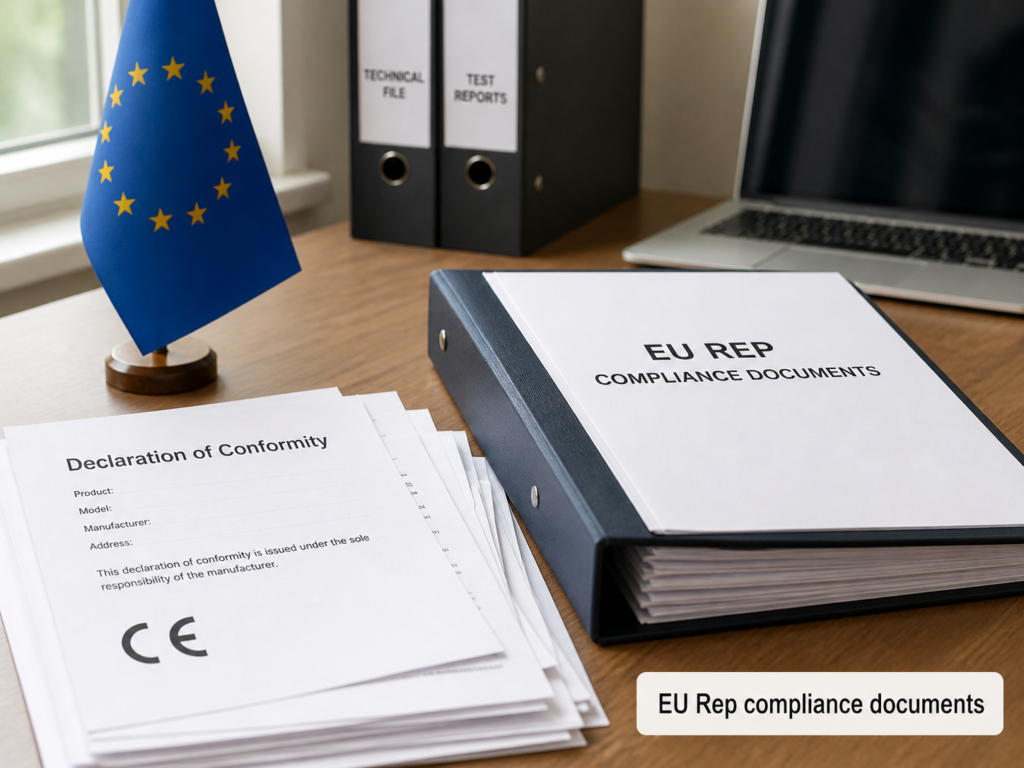
The specific statutory obligations of the authorized representative depend on the specific regulations on which they are based and the content of the written authorization. Generally speaking, the authorized representative may need to:
1. **Keep or be able to obtain compliance documents**: Keep or be able to obtain the technical documents and declaration of conformity required by applicable regulations within the scope of authorization, and provide them when required by regulatory authorities. The specific types and duration of documents shall be subject to applicable regulations; many product regulations stipulate that relevant documents shall be kept for 10 years after the product is last placed on the market. Regulations do not require all documents to be physically stored within the EU.
2. **Perform regulatory liaison obligations**: Communicate with market supervision authorities in accordance with the requirements of specific regulations, provide documents and information, and cooperate with investigations, recalls or other corrective measures.
3. **Assist in verifying responsible entity information**: In accordance with applicable regulations and supply chain arrangements, assist in ensuring that the product or its packaging, accompanying documents and online product pages display correct economic operator information. The specific labeling position and content shall be subject to applicable regulations.
If the authorized representative also serves as the GPSR responsible entity, it also needs to perform the obligations related to accidents, complaints, regulatory cooperation and corrective measures stipulated by GPSR. These tasks are not the same concept as the unified statutory obligations of all CE authorized representatives.
Matters That the EU Rep Cannot Replace
These things cannot be simply handed over to the EU Rep, don’t find the wrong person and waste money for nothing:
• **Cannot replace the manufacturer in completing the conformity assessment, signing the DoC and affixing the CE mark.** The CE mark is not a unified “CE certification”. Whether a notified body is required to participate depends on specific regulations and conformity assessment procedures.
• **Cannot automatically be responsible for customs clearance and sales operations.** An EU Rep is not equal to a customs broker, overseas warehouse or e-commerce operator, unless the two parties have another independent service agreement.
• **Cannot replace the manufacturer in bearing product design and production responsibilities.** Even if the EU Rep assists in coordinating testing, reviewing technical documents or arranging other compliance work, the manufacturer is still responsible for the final conformity of the product.
Practical Implementation Guide for Charging Product Sellers
After talking about the principles, how do we sellers of charging products specifically implement it? Just follow four steps, corresponding to the three-level logic above:
Step 1, Confirm the entity and scenario: Is it an overseas entity doing commercial sales or other market provision? When an individual imports for personal use and does not involve commercial activities, the relevant market placement obligations may not apply, but you cannot simply classify all free samples, gifts or private transactions as “no regulatory requirements”.
Step 2, Match product regulations: Sort out the product’s input and output voltage, whether it contains electronic circuits, whether it has wireless functions such as Bluetooth or Wi-Fi, actual use and product structure, then compare the charging product judgment matrix above to confirm the possibly applicable regulations.
Step 3, Verify existing domestic responsible entities: Is there an EU importer, authorized representative or eligible fulfillment service provider that assumes corresponding obligations according to law? Has the product and online product page displayed its information in accordance with applicable regulations?
Step 4, Assess your own risk level: If selling on e-commerce platforms, the platform may require submission of responsible entity information, and missing information may affect listing or sales; for independent stations, offline wholesale or other commercial sales, you may face customs and market supervision random inspections; private personal use imports may not be subject to some market placement obligations, but you cannot deduce from this that customs, product safety and responsibility requirements do not exist at all.
Compliance Self-Inspection Can Be Done According to This List:
1. Confirm the regulations that may apply to the product;
2. Confirm whether the manufacturer and sales entity are outside the EU/EEA;
3. Confirm whether there is already a qualified EU economic operator, such as an importer, authorized representative or eligible fulfillment service provider;
4. Confirm whether the product, packaging, accompanying documents and online product pages are labeled or display responsible entity information in accordance with applicable regulations;
5. Confirm whether the e-commerce platform backend requires uploading the responsible person’s authorization certificate or other compliance documents;
6. Confirm whether the product has completed the applicable conformity assessment, and the corresponding DoC has been signed by the manufacturer.
In addition, EU regulations are updated regularly, don’t just find an EU Rep and ignore it, you should regularly check the latest requirements. There are two official verification channels: EUR-Lex (EU official regulation database), and the European Commission’s product regulation page. The content that needs to be checked regularly includes: GPSR scope of application, CE-related regulation updates, target country language and labeling requirements, and the latest e-commerce platform policies.
How to Choose a Reliable EU Rep? What Should Be Paid Attention to in Labeling?
After confirming that you need to find an authorized representative, first avoid several most common pitfalls:
• **Pitfall 1: Directly use an overseas warehouse or logistics provider as the EU Rep.** Overseas warehouses and logistics providers usually mainly provide warehousing, packaging and distribution services, but when meeting legal definitions and conditions, they may also bear the obligations of EU economic operator or GPSR responsible entity. You cannot just look at whether the other party provides warehousing services to determine that it automatically has the qualification of an authorized representative; nor can you directly treat it as an EU Rep without clear authorization and responsibility arrangements.
• **Pitfall 2: Choose an EU Rep only based on low price.** Low-price services may only provide a contact address, and may not be able to cooperate with supervision, document retrieval and corrective measures. When choosing, you should focus on verifying its actual contact ability, service scope and response process.
• **Pitfall 3: Think that with an EU Rep, you don’t need to care about CE compliance.** If the product itself is non-compliant, the EU Rep cannot complete the conformity assessment or sign the DoC on behalf of the manufacturer, and the manufacturer is still responsible for product compliance.
• **Pitfall 4: The authorization scope is too broad.** The authorization agreement should clearly define the product scope, applicable regulations, authorization tasks and duration. Agreements with too general scope, unable to identify products or specific tasks, have compliance and implementation risks, but cannot be generally asserted to be necessarily invalid. Product categories or series can be used as the authorization scope, as long as the description is clear enough and consistent with applicable regulations.
EU Rep Due Diligence Checklist
When choosing an EU Rep, you can check item by item according to these:
1. Verify its actual establishment location within the EU, as well as the valid postal address and electronic address that can actually receive regulatory documents. Do not judge whether it is qualified solely based on the form of whether it has a physical office.
2. Understand whether it has experience in compliance services for charging electronic and electrical products, and is familiar with relevant regulations such as electrical safety, EMC, RoHS, GPSR, etc.
3. Can provide a formal written authorization agreement, clearly list the authorized products, regulation scope and specific tasks, and can provide relevant certificates according to platform requirements.
4. Will review whether CE-related technical documents and DoC are complete before providing services, not a nominal institution that accepts as long as it is paid.
5. Has clear service processes for regulatory liaison, complaint handling, accident reporting and recall cooperation.
The Core Clauses of the Authorization Agreement Must Be Clearly Written
Clarify the specific charging product models, series or product categories authorized; clarify the scope of applicable regulations and authorization tasks; clarify the division of responsibilities between the two parties, including the core responsibilities of the manufacturer and the authorization scope of the EU Rep; clarify the authorization period, renewal and termination conditions; clarify the requirements for technical document provision, storage or retrieval, as well as the regulatory response time limit.
Labeling Requirements for Charging Product Responsible Entity Information
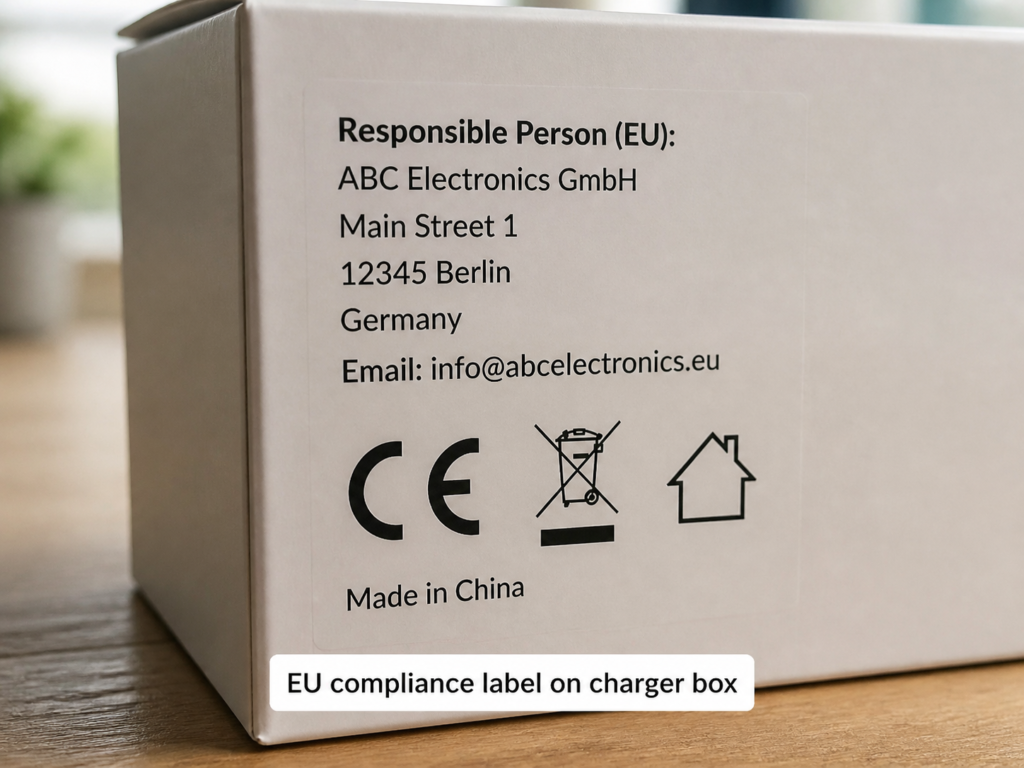
Wrong labeling will also cause problems, but the specific requirements depend on applicable regulations:
• **Labeling position**: According to applicable regulations, it can be labeled on the product, packaging, parcel or accompanying documents and other allowed positions. Which position to use specifically should be judged in combination with product size, readability and relevant regulations, not all products must be labeled on the body first.
• **Labeling content**: Usually need to label the name or trademark of the responsible economic operator, postal address, and electronic address required by applicable regulations. You cannot simply treat the “registered address” as a unified requirement for all products, nor can you only leave phone or email information that cannot meet regulatory requirements.
• **Online display**: When GPSR applies, the responsible entity and other product safety information should also be provided on the online product page in accordance with relevant requirements.
• **Labeling requirements**: The information should be clear, easy to read, able to be actually contacted, and consistent with the entity information in the authorization agreement and supply chain documents. The specific content and position shall be subject to applicable regulations.
After reading this article, you should already understand what an EU Rep is, and can also initially judge whether you need to find a separate EU Rep: you can not only distinguish the differences and responsibility boundaries between EU Rep, importer, GPSR responsible entity, and fulfillment service provider, but also use the charging product judgment matrix as a preliminary screening tool. However, for products such as active fast charging cables, wireless chargers and passive data cables, the final applicable regulations, CE requirements and EU economic operator requirements must still be verified item by item based on product electrical parameters, wireless functions, use, structure and specific regulations.
Doing cross-border compliance with sufficient basic work in advance may seem a little troublesome, but it can reduce the risks of goods detention, delisting, rectification and recall caused by unclear documents, labels or responsible entity arrangements later.