
Friends in the EU charging product business have most likely heard the term EPR — some say it is a certification just like CE, some say small accessories do not need to comply, and others say one number is valid across the entire EU. What exactly is EPR? Is it mandatory for all electronic products? In this article, we will thoroughly explain the EU EPR rules related to charging products, from basic judgment to practical pitfall avoidance; after reading it, you can conduct a preliminary screening on your own.
Before we officially start, two important premises must be stated first: First, EU EPR requirements are scattered in EU regulations or directives such as WEEE, batteries, and packaging. Member states are responsible for transposing, implementing, and setting specific rules for registration, declaration, labeling, and payment, so actual requirements may vary by the country of sale; this article is a general popular science for charging products and does not constitute legal advice. Second, the final compliance determination shall be subject to the latest requirements of the competent authority of the country of sale, the official registration system, or a formal compliance agency, and must also comply with the compliance guidelines of e-commerce platforms — in many cases, platform requirements are implemented earlier than regulations.
Must-Know Basics: Basic Rules of EPR
Who manages EU EPR?
Many people think there is a unified EPR registration agency in the EU, but that is not the case. The division of roles in this system is roughly as follows:
• **EU level**: Establishes relevant EPR frameworks through directives and regulations; member states are usually responsible for specific registration, declaration, supervision, and enforcement, but directly applicable EU regulations may also make unified provisions on producer obligations;
• **Member state level**: Each country formulates or implements its own detailed rules in accordance with EU requirements, establishes a registration system and competent authority, and is responsible for actual supervision;
• **Producer Responsibility Organization (PRO)**: A compliance scheme or third-party institution entrusted by producers and recognized, approved, or qualified in accordance with the rules of the country of sale; whether it can handle registration, declaration, and performance of obligations on behalf of producers depends on the local system;
• **E-commerce platforms**: Usually require sellers to upload EPR registration numbers or other compliance certificates earlier than regulations; if the review fails, sales will be restricted, such as removing products from shelves or blocking traffic.
What types of EPR obligations are involved in charging products?
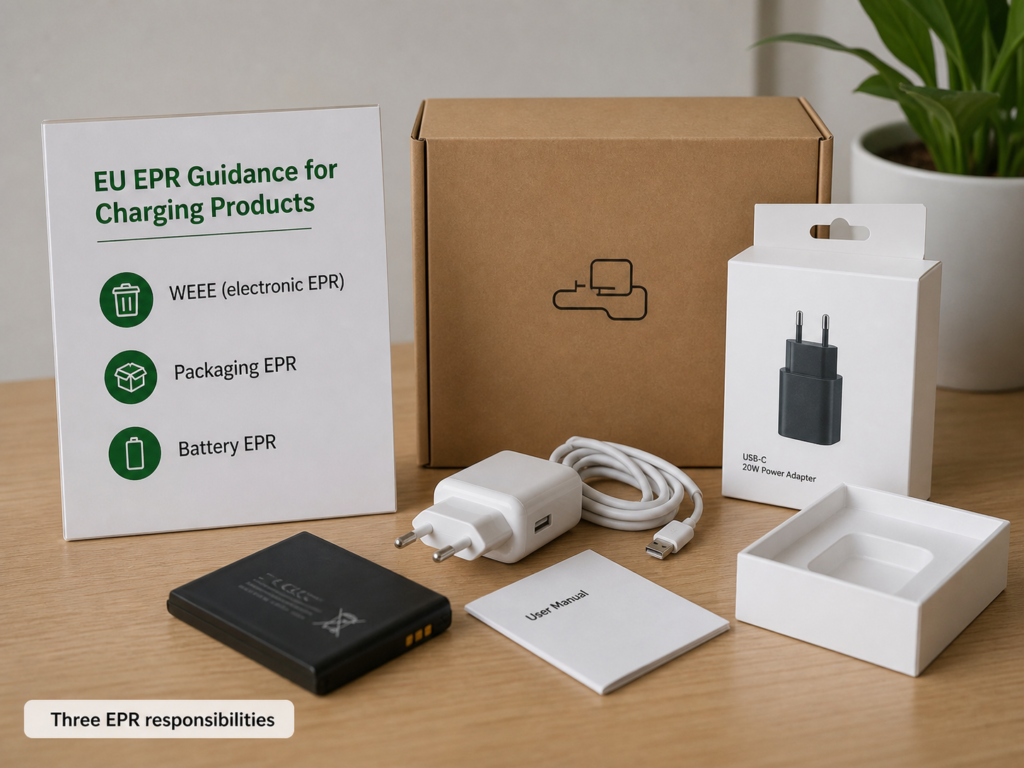
EPR is not a single requirement. Charging products usually involve **three types of independent EPR responsibilities**, and the triggering conditions need to be judged separately. Whether it is necessary to register separately, join different PROs, declare and pay fees separately shall be subject to the specific system of the country of sale:
1. **WEEE (electronic EPR)**: Targets charging products that rely on electric current or electromagnetic fields to work normally, and is the core EPR type for charging products;
2. **Packaging EPR**: Targets sales packaging, transport packaging, and filling materials of products, and is involved in almost all products sold commercially with packaging;
3. **Battery EPR**: Targets batteries built into products, included with products, or sold separately. If it is an ordinary charger or data cable without a battery, this type of obligation will not be triggered.
What is the judgment boundary of WEEE?
Many people think that as long as a product has electronic components, it is covered by WEEE, but that is not correct. Its core judgment standard is: **the product needs to rely on electric current or electromagnetic fields to achieve its normal function, and belongs to the category of electrical and electronic equipment listed in the regulations**. It cannot be based solely on “having electronic components” as the only basis, but must also be judged in combination with the core function of the product, the form of sale, and the specific rules of the target country.
Intermediate Judgment: 4 Core Dimensions for Complex Scenarios
If your product belongs to a boundary category, or your sales model and inventory arrangement are relatively complex, you can break down the judgment from four dimensions, and you can basically clarify the responsibilities:
1. Product dimension: Look at attributes and composition
First, thoroughly disassemble the product and ask yourself a few questions: Does the core function of the product rely on electric current or electromagnetic fields? Does it meet the core boundary of WEEE? Is it a finished product for end consumers or an independently sold accessory, or a component for downstream factories? Does it have components that trigger other EPR responsibilities, such as batteries and packaging? Is the designed use consumer-grade or industrial-grade? Is it a finished product or a component for production?
For example, for the same power adapter, if it is sold to consumers for direct use, it is a finished product; if it is sold to factories to be installed in production equipment, it may be an industrial component. However, the latter will not automatically obtain WEEE exemption just because it is B2B or used for assembly, and still needs to be judged in combination with specific rules.
2. Country dimension: Look at the rules of the target country of sale
This is the most likely point to make mistakes: there are differences in EPR implementation rules and specific performance methods among EU countries:
• The product classification, registration requirements, simplification or exemption rules, and labeling specifications of each country may be different. Independently sold passive USB cables are not automatically excluded from WEEE just because they have no chips; cables are usually included in the scope of WEEE in many member states, but still need to be confirmed according to the official classification of the country of sale;
• The so-called “simplified rules” do not mean exemption from registration or obligations. You must verify the specific conditions of simplification, such as whether only declaration is required without payment, or whether there is a sales volume threshold;
• EPR registration numbers, certificates, or other compliance documents usually only correspond to specific countries, categories, and responsible entities, and cannot be simply understood as one document valid across the entire EU; when selling to multiple countries, it is often necessary to verify and fulfill the requirements of each country separately;
• If you ship from overseas warehouses or FBA, you cannot only look at the country where the inventory is located, but must judge based on the three dimensions of inventory country, import country, and sales country. For example, if the inventory is in Germany and sold to French consumers, you must fulfill relevant obligations in accordance with French requirements.
When making a judgment, focus on these items: the rules of the country of sale, the local classification of the product, the arrangement of the importer, and whether the responsible entity has completed the corresponding registration or performance of obligations locally.
3. Sales model dimension: Look at sales targets and channels
Different sales models have different EPR obligations:
• **B2C (for end consumers)**: Usually need to fulfill applicable EPR responsibilities, but the specific registration and declaration methods still depend on the rules of the country of sale;
• **Pure B2B (only sold to industrial enterprises for production or integration)**: Some countries can exempt or simplify the process, but need to meet clear conditions and prepare supporting materials, and cannot be identified as B2B only by verbal statement;
• **Platform sellers (Amazon, Temu, etc.)**: In addition to complying with regulatory requirements, they must also meet the platform’s EPR upload requirements. Many platforms conduct reviews in advance, and sales may be prohibited without the corresponding registration number or compliance certificate;
• **Independent stores/offline retail**: Without platform reminders, you need to take the initiative to comply with the requirements of the country of sale, which is easy to miss.
4. Entity dimension: See if you are the responsible party
EPR obligations correspond to the responsible entity of “producer”, not the product itself, so first you need to figure out whether you are a “producer” recognized by EU or country of sale rules:
• Producers in EU and member state rules may include brand owners, importers, and cross-border e-commerce distance sellers within the EU. The specific determination shall be based on the rules of the country of sale;
• If you are an overseas seller, the performance requirements vary from country to country. Some countries require you to designate an EU authorized representative, while others allow you to fulfill obligations through local importers or compliance schemes;
• The authorized representative will not automatically assume all responsibilities on your behalf, but will only assume corresponding compliance obligations in accordance with applicable rules and the agreement between the two parties;
• If you are recognized as a producer in the country of sale, you usually need to complete the corresponding registration in your own entity, or ensure that a legally authorized responsible entity performs the obligations. You cannot borrow the registration number of a supplier or other company without authorization. If the supplier or importer assumes producer responsibility in accordance with the law, you should verify their scope of responsibility, coverage of sales countries, and written arrangements.
Sufficient for Beginners: Entry-Level Compliance Practical Guide
If you have confirmed that you need to complete EPR, the following entry-level practical points are sufficient for you:
What preparations should be made before compliance?
First, sort out all EU countries where you sell, and confirm the local rules one by one. Do not take it for granted to apply the requirements of a certain country; disassemble and classify your products, clarify which types of EPR responsibilities are involved (WEEE, packaging, batteries), and do not miss packaging EPR; confirm your identity as the responsible entity, and if you need to designate an EU authorized representative, connect with a local importer or PRO, contact them in advance.
Core compliance actions and required materials
The core compliance actions of EPR usually include registration, declaration, payment, and labeling, but the specific combination is determined by the country of sale and EPR category:
1. **Register or join a compliance scheme**: According to the country of sale and EPR category, register with the competent authority, join a PRO or other compliance scheme that meets local rules, and obtain the registration number, certificate, or other compliance documents required by the local authority. The number format may vary by category and country. The materials to be prepared generally include: basic information of the brand and manufacturer, basic product information (photos, models, weight), WEEE classification of the product if WEEE is involved, material and weight information of packaging, battery parameters if batteries are involved, as well as estimated sales volume and sales country data;
2. **Declaration**: Report data such as product sales volume and weight according to the locally prescribed cycle (some countries are annual, some are quarterly), and no false or omitted reporting is allowed;
3. **Payment**: Pay the corresponding recycling and treatment fees according to the product category and weight. The charging standards vary for different categories;
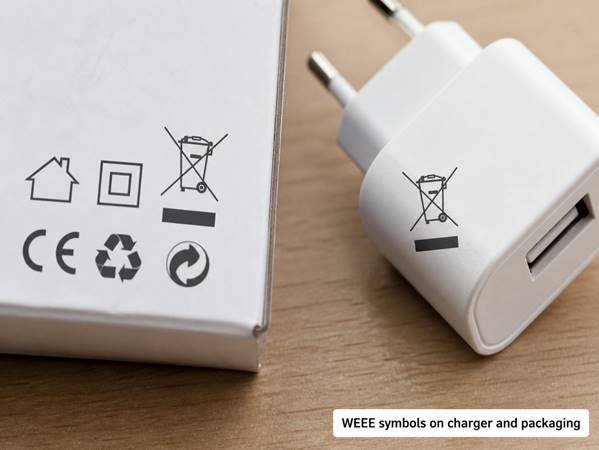
4. **Labeling**: Electrical and electronic equipment subject to WEEE should usually be marked with the “crossed-out trash bin” symbol in accordance with the WEEE Directive and the implementation rules of the country of sale. If the product cannot be directly marked due to size or function, it can be marked on the packaging, manual, or warranty certificate in accordance with the rules. The date mark shall indicate the time of placing on the market in accordance with applicable rules, and cannot be simply understood as the production year.
Compliance precautions
Registration certificates and declaration records must be kept properly for the period prescribed by the country of sale, as regulatory authorities may conduct random inspections; for different categories of products, such as chargers, data cables, and packaging, the recycling classification and fee standards may be different, so they should be calculated separately; do not buy so-called “ready-made EPR numbers”, many of which are fake. Their validity should be verified through the official registration system of the corresponding country or other formal channels, to avoid using documents that do not match the responsible entity, category, or country.
Must-Read for Pitfall Avoidance: Common Misconceptions and Violation Risks
5 Most Common Cognitive Misconceptions
We have sorted out several of the most common mistakes made by beginners, which must be avoided:
1. **Misconception: EPR is part of CE, so if you have CE, you don’t need to do EPR**
**Correction**: CE conformity requirements and EPR producer responsibility belong to different systems and cannot replace each other. Chargers usually need to judge the applicable CE regulations, and at the same time judge WEEE, packaging, and battery responsibilities separately; whether registration is required and the specific performance method depend on the product, the responsible entity, and the rules of the country of sale.
2. **Misconception: One EPR number is valid across the entire EU**
**Correction**: EU countries independently implement many specific EPR registration and performance systems. Registration numbers, certificates, or other compliance documents usually only correspond to specific countries, categories, and responsible entities. When selling to multiple countries, you must verify and fulfill the requirements of each country separately.
3. **Misconception: Small sellers, low sales volume, and small accessories are automatically exempt**
**Correction**: The vast majority of countries do not have automatic exemption rules for small sellers or small accessories. The so-called simplified rules are only process simplification, not exemption from obligations, so you must verify clearly.
4. **Misconception: If the supplier has an EPR number, you don’t need to do it yourself**
**Correction**: If you are recognized as a producer in the country of sale, you usually need to complete the corresponding registration in your own entity, or ensure that a legally authorized responsible entity performs the obligations. You cannot borrow the supplier’s registration number without authorization. If the supplier or importer assumes producer responsibility in accordance with the law, you should verify their scope of responsibility, coverage of sales countries, and written arrangements.
5. **Misconception: Only doing WEEE is enough**
**Correction**: WEEE, packaging, and battery responsibilities need to be judged separately. Packaging responsibility may be triggered independently, and products with batteries also need to judge battery EPR, so you cannot only do WEEE. Whether to register, declare, and pay fees separately depends on the specific system of the country of sale.
Common risks of non-compliance
If you fail to fulfill EPR responsibilities as required, you may face these risks, which vary depending on the country, platform, category, and enforcement mechanism:
• **E-commerce platform level**: Products are removed from shelves, accounts are restricted in traffic or even banned. Many platforms process faster than regulatory authorities;
• **Regulatory level**: May be required to make up registration, make up declaration, pay back fees, or face administrative penalties and sales restrictions;
• **Import or inventory level**: In some cases, non-compliance may affect import or inventory release, but it cannot be generalized as necessarily unable to enter the country;
• **Other losses**: Economic losses caused by inventory detention, damage to brand reputation, etc.
Final Summary
In general, EPR is not a certification certificate valid across the entire EU, but a producer responsibility system jointly constituted by relevant EU regulations or directives and member state implementation rules. It has different legal functions from requirements such as CE and RoHS, and they cannot replace each other.
For friends in the charging product business, you don’t have to think that all products need EPR at the beginning, nor can you take it for granted that small accessories are automatically exempt. You can first make a preliminary judgment against the tiered list. When encountering complex scenarios, break them down from the four dimensions of product, country, sales model, and responsible entity, and then check one by one with the five-step self-inspection method. You can make a preliminary judgment by yourself in most scenarios.
If you encounter a boundary category and are unsure, you must verify through official channels or formal service providers, confirm the local requirements for registration, compliance schemes, declaration, payment, and labeling methods. Do not believe the “general rules” spread online, to avoid unnecessary losses caused by non-compliance.