
Many sellers who are new to running independent e-commerce stores, especially those selling charging accessories such as chargers and USB-C cables, start with a misconception: finally, they are free from the rules and restrictions of third-party platforms, and can sell whatever they want and write product descriptions however they like. It is not until one day their goods are detained by customs, their payment accounts are frozen, or they even receive a warning letter from regulatory authorities that they panic — it turns out independent e-commerce stores are not lawless places, and since there is no pre-review by platforms as a safety net, sellers still need to handle the main compliance responsibilities themselves.
This article, from beginner to advanced levels, introduces common regulatory risks when operating independent e-commerce stores in the global market, especially when selling charging products, to help you identify and reduce common compliance risks, as well as learn to assess risks on your own and handle unexpected issues. This article cannot replace professional legal, tax, and product compliance advice for the target market; specific requirements should still be confirmed in combination with the product, sales model, and target market.
First, Understand the Basic Logic of Compliance for Independent E-Commerce Stores (Must-Know for Beginners)
First, it is important to clarify that compliance responsibilities for independent e-commerce stores are not the same as those for third-party platforms like Amazon and AliExpress.
When you open a store on a third-party platform, it is equivalent to renting a counter in a shopping mall. The platform may first conduct a round of basic reviews for you — for example, requiring submission of certification documents, restricting the sale of certain products, or providing a handling process when complaints occur. However, such reviews do not mean that the platform assumes all responsibilities on your behalf. An independent e-commerce store is your own brand official website; the platform will not eliminate compliance responsibilities for sellers, and sellers usually need to bear obligations related to product sales, consumer transactions, taxation, and data processing on their own. Specific responsibilities also depend on the legal division of labor among manufacturers, importers, local responsible persons, and other business entities.
Moreover, do not think that you only need to comply with the regulations of the destination country; you also need to pay attention to the relevant regulations of the exporting country and transit countries. For example, if goods are transshipped in Singapore and involve locally controlled electronic components, problems may arise. Even if you use an overseas warehouse and store goods in a warehouse in the target country, you will not be exempted from local responsibilities — on the contrary, having local inventory may trigger more local tax and registration obligations.
Many new sellers also ask: I use a major website building tool like Shopify, will they take responsibility for me? No. Website building tools only provide website construction functions, just like a construction team that decorates your storefront. They usually do not bear product, tax, or consumer compliance obligations in the destination country regarding whether the products you sell are legal.
Why do we specifically use charging products as examples? Because this type of product is a relatively high-risk category. Electrical products may cause electric shock, overheating, fire, equipment damage, and other problems, and are also likely to involve requirements such as product safety, energy efficiency, electromagnetic compatibility, environmental protection, labeling, and consumer rights at the same time. If you want to purchase product liability insurance, the insurer may require applicable test, certification, quality control, and recall records; whether coverage is provided and the underwriting conditions shall be subject to the specific insurance policy and the insurer’s underwriting requirements.
New sellers are most likely to fall into these four core misconceptions, which must be corrected first:
First misconception: Only large sellers need compliance. Many people think that since they only sell dozens of orders a month, regulators will not come after them. In fact, regulators may find problems through random inspections, consumer complaints, accident reports, or tip-offs. There is no uniform size threshold applicable to all regulations — even if you only sell 5 orders a month, you may encounter inspections or complaints.
Second misconception: Being able to clear customs equals legal sales. Customs clearance only means that customs allows your goods to enter the country, which is a different set of standards from whether the goods can be sold on the market. For example, some products may involve FCC equipment authorization when entering the United States, but California’s Prop 65 warnings and consumer product safety regulations administered or enforced by the CPSC are matters that need attention during the market sales stage. Not being caught during customs clearance does not mean you can ignore them during sales.
Third misconception: If the supplier has certification, I have no responsibility. Remember, sellers cannot be completely exempt from liability just because the supplier provides certification documents. Just like when a supermarket sells expired food, consumers usually go to the seller first; specific responsibilities should also be judged based on the product chain, contracts, import arrangements, and local laws. Even if the supplier gives you a stack of certificates, you must check whether the product is within the scope of the certificates yourself.
Fourth misconception: With CE and FCC, you can sell globally. The mutual recognition of certification systems in various markets around the world is not widespread. CE is the EU product conformity mark, FCC equipment authorization applies to specific products in the United States, and Japan may require PSE and other requirements. Each market cannot simply replace another. Do not think that you can expand to the global market with one or two certifications; you will most likely stumble in other markets.
What Risks Will You Encounter? What Are the Worst Consequences?
Now that we understand the basic logic, let’s look at what core risks you will encounter when running an independent e-commerce store for charging products, and how severe the consequences of different risks are.
First, let’s list the 7 most common core risks, each illustrated with examples of charging products. You can compare them with your own business to see if you are crossing the line:
The first type is product safety and certification risk, which is also the most common. For example, fast chargers may have risks of overheating, short circuit, or abnormal operation; USB cables with too small a wire diameter may overheat under high current; or if the product has not completed the conformity assessment required by the target market, it may lead to goods detention, removal from shelves, or required rectification after being found.
The second type is intellectual property risk. For example, selling Lightning accessories without MFi authorization or claiming to have MFi certification may involve licensing, trademark, certification mark, or other intellectual property risks; stealing the logos, appearance designs of big brands, or using unlicensed technology may also lead to complaints or even lawsuits. Whether it constitutes patent infringement requires search and legal analysis combined with specific products, valid patents, and sales behaviors.
The third type is tax and customs risk. For example, underreporting the value of goods to pay less tax, or failing to complete tax registration when sales reach the relevant threshold of the target market, may result in back taxes, interest payments, or penalties after being caught.
The fourth type is consumer rights risk. For example, EU consumers usually have a 14-day right of withdrawal in eligible online sales, but your website states “no returns or exchanges once sold”, or does not provide statutory warranty. After consumers complain to the regulatory authority, such clauses may not be enforceable against statutory rights.
The fifth type is data privacy and payment risk. For example, marketing emails without an unsubscribe option, or processing buyers’ personal information without necessary and legal basis, may violate applicable privacy regulations. Whether the EU GDPR and California CCPA apply depends on the business entity, business scale, consumer location, and data processing situation.
The sixth type is advertising and labeling risk. For example, falsely labeling fast charging power, marking 120W when it is actually 20W; or if there are no safety warnings in the local language on the product packaging, such as only writing English for the Canadian market and ignoring the applicable bilingual (English and French) requirements, may all bring compliance problems.
The seventh type is environmental protection and recycling risk. For example, when selling electronic products in the EU, failing to fulfill WEEE producer responsibility obligations according to the member state of sale and product category, or if the product’s RoHS hazardous substances exceed the applicable limits, may result in requirements for rectification, registration, or bearing relevant responsibilities.
The consequences of these risks can be divided into three levels according to severity:
Mild consequences are the most common, such as customs detention of goods, payment channel freezing of funds, and forced removal of product links. Generally, recovery is possible only after rectification or supplementary materials are provided.
Moderate consequences are more troublesome, such as administrative fines, confiscation of inventory, being ordered to stop sales, and even recall of already sold products, resulting in relatively large losses.
Severe consequences may directly ruin your business: for example, consumers getting electric shock or injured due to charger failure, or property damage caused by product fire, may lead to civil claims; specific cases may also involve more serious legal consequences. Another example is the collapse of brand reputation, where consumers no longer trust you, and previous investments may also be affected.
So how are these risks generally triggered? There are four main channels:
The most common is proactive random inspections by customs or market regulatory authorities. Regulatory agencies such as the U.S. CPSC may find problems through market random inspections, complaints, accident reports, recall information, or other investigation methods, and the specific methods vary by case and product.
The second is investigations triggered by consumer safety complaints. For example, if someone buys your charger that smokes and complains to the local regulatory authority, the regulatory authority may send a letter to investigate.
The third is reports from competitors or intellectual property rights holders. For example, if a rights holder believes that the Lightning accessories you sell involve unauthorized use of its marks or technology, they may send you a lawyer’s letter, or handle it through channels such as platforms, customs, and courts.
The fourth is social media public opinion or media exposure. For example, if someone posts a video of your charger catching fire on TikTok, after the incident attracts attention, the regulatory authority may further understand the situation.
Access Requirements for Charging Products in Core Markets (Beginner Level Recognition)
Since certifications from different markets are not universally applicable, what are the access requirements for the several core markets we operate in? Here we have sorted out the requirements of the main markets, with a comparison table for quick reference. Before actual sales, you should still confirm item by item according to the specific model, function, sales channel, and regulation version.
First, look at the North American market, that is, the United States and Canada.
For the U.S. market, FCC equipment authorization, applicable CPSC consumer product safety regulations, California Prop 65 exposure warnings, and state or local electrical safety requirements need to be determined based on specific products. Products with digital circuits or radio frequency functions that are subject to FCC equipment authorization rules may need to complete FCC authorization; the form of authorization may be Certification, or Supplier’s Declaration of Conformity (SDoC). Whether authorization is required, which form to use, and how to label shall be determined based on the specific product and FCC rules. FCC mainly addresses electromagnetic interference and radio-related issues, and is not a product safety certification in the general sense.
U.S. consumer products must comply with applicable safety regulations enforced or administered by the CPSC. Whether third-party safety certifications such as UL or ETL are required depends on product standards, state or local requirements, sales channels, insurance, and contract conditions, and cannot be generalized as a unified statutory requirement in the United States. Some channels, purchasers, insurers, or workplace electrical product requirements may recognize or require evaluation by corresponding third-party institutions, but payment gateways do not generally require all chargers to have UL or ETL certification.
Charging products may also involve energy efficiency requirements of the U.S. Department of Energy (DOE) or the California Energy Commission (CEC), depending on whether the product falls within the applicable scope. As for California Prop 65, it is not a simple product “lead content standard”. If a product may expose consumers to Prop 65 listed chemicals, it is necessary to determine whether to provide compliance warnings based on exposure assessment and applicable safe harbor levels; it cannot be uniformly concluded that a warning is required just because lead is detected.
For Canada, ISED requirements are mainly for applicable radio equipment or products subject to its technical rules, and not all chargers and cables require ISED certification. The electrical safety requirements for mains chargers are jointly determined by federal and provincial systems, applicable standards, and accredited certification bodies; CSA, cUL, etc. are just possible compliance paths. Labels and plugs should also be confirmed according to the sales province, product category, and applicable rules, and the bilingual (English and French) requirement requires special attention in many consumer-facing scenarios.
Next are the EU and UK markets.
For products subject to EU harmonized regulations, it is usually necessary to complete conformity assessment, compile technical documentation and EU DoC (European Union Declaration of Conformity) in accordance with applicable procedures, and affix the CE mark as required. Whether a notified body is required to participate, and whether a responsible person within the EU is needed, shall be determined based on specific regulations, products, and sales methods. It cannot be generalized that “CE, DoC, EU representative” is a fixed combination that all charging products must have simultaneously in all situations.
The core EU requirements may include low-voltage safety, electromagnetic compatibility, RoHS hazardous substance restrictions, general product safety, ecodesign, and producer responsibility. WEEE, packaging, and battery producer responsibilities usually need to be fulfilled according to the member state of sale and product category, which may include registration, declaration, joining a recycling system, and paying fees; specific requirements are determined by the implementation rules of each member state, and there is no unified “EU WEEE registration” that can cover all member states. Packaging law also does not mean that all packaging must meet a unified “recyclable” label requirement.
There are also two exclusive requirements for charging products that need attention. First, starting from December 28, 2024, portable radio equipment such as mobile phones and tablets included in the scope of the directive must meet USB-C and related charging requirements; laptops will be applicable from April 28, 2026. The specific scope and obligations shall be determined according to the annex of the directive. This is not a general requirement that all matching chargers and data cables must use USB-C.
Second, products such as external power supplies may be subject to EU ecodesign energy efficiency requirements, and technical parameters, information disclosure, and documentation obligations need to be checked according to the specific product scope and regulations; do not generally state that all chargers must post an “ERP energy efficiency label” or mark an energy efficiency grade.
For the UK, the UKCA and CE recognition periods in the GB market must be checked against the current rules of the UK government for specific product categories, and cannot be uniformly stated as ending by the end of 2025. The UK may also require a domestic responsible person, depending on the applicable product regulations and sales arrangements. Northern Ireland applies relevant EU rules; if a UK notified body participates in conformity assessment, it usually involves CE UKNI, rather than simply stating that only the CE mark is used.
Next, look at the Asia-Pacific and other key markets.
For Japan, whether PSE applies shall be determined based on the Electrical Appliance and Material Safety Law and product classification. Whether it belongs to “specified electrical appliances” shall be judged in combination with the specific product definition, rated input and output, and structure; not all products called chargers automatically belong to the same category. If it belongs to specified electrical appliances, the diamond PSE and corresponding conformity assessment requirements apply, and other categories may be subject to circular PSE or different requirements. At the same time, requirements such as local importer or responsible entity information must also be confirmed.
Australia and New Zealand cannot be simply understood as “only one RCM mark is enough”. Applicable products usually need to meet corresponding electrical safety, EMC, or radio requirements, and the responsible supplier must complete applicable compliance declarations, record keeping, and registration. RCM is one of the relevant compliance marks and cannot replace all product obligations. The C-Tick has been replaced by the RCM mark system, but this does not mean that any product can be sold with only the RCM mark.
Requirements vary greatly among countries in Southeast Asia and the Middle East. The competent authority, product classification, local importer, certification, labeling, and certification transfer rules should be confirmed country by country. Whether international test reports or certifications are accepted shall be subject to the regulations of local competent authorities or certification bodies. It cannot be generally assumed that the thresholds of these markets are lower than those of Europe and the United States, nor can it be assumed by default that re-evaluation is not required.
Many new sellers are easily deceived by fake certificates from suppliers. Here we teach you how to verify the authenticity and validity of certification documents:
First, verify the qualification of the issuing body to confirm whether the body is recognized by the target market or relevant certification system. For example, the body and documents issuing UL certification should be verifiable in the corresponding official or certification body system; certificates issued by a random small laboratory may not have the validity required by the target market.
Then verify whether the product matches: the model, specification, and standard version used on the certificate must be consistent with the product you are selling or within the clear scope of the certificate. For example, if the supplier gives you a UL certificate for a 20W charger, but you sell a 65W one, this certificate usually cannot directly cover your product.
It is also necessary to distinguish the validity of documents. The required evidence should be confirmed according to the target market and product regulations, which may include self-declaration of conformity, technical documentation, test reports, certification certificates, registration, or responsible entity information. Test reports can be used as important evidence for self-conformity assessment, but cannot automatically replace the certification required by regulations; similarly, it cannot be generally assumed that test reports have no access validity.
Here is a classification: compliance requirements are generally divided into three types: the first is mandatory conformity assessment or market access requirements, without which legal sales are not allowed; the second is registration, import, or producer responsibility requirements; the third is channel trust requirements, such as third-party safety certifications like UL and ETL, which may be important in some channels, insurance, or contracts, but are not necessarily unified legal mandatory requirements.
The method of verification is to directly go to the official website of the issuing body or competent authority, enter the certificate number to query, and do not just look at the PDF provided by the supplier. The documents themselves are low-cost and easy to modify, so it is even more important to check the certificate status, model, factory, and applicable scope.
If you sell kits, such as a combination of “charger + USB-C cable + adapter”, remember that each component must be evaluated separately according to applicable regulations. You cannot say that it doesn’t matter if the cable and adapter have no certification as long as the charger does. When the kit is sold as a whole, it is also necessary to confirm whether the combined label, instructions, and compatibility claims are accurate.
Finally, attention should be paid to the change management of documents and certifications. When regulations, standards, models, key components, or production locations change, a change assessment should be conducted; based on the assessment results, decide whether supplementary testing, updating technical documents, changing declarations, or re-certification is needed, rather than mechanically re-completing all certifications for every change.
| Core Market | Main Compliance Requirements | Possible Third-Party or Channel Requirements | Exclusive Requirements for Charging Products |
| United States | Determine FCC Certification or SDoC, applicable CPSC safety regulations, Prop 65 exposure warnings, and state/local requirements based on the product | Whether UL/ETL etc. are required depends on product standards, channels, insurance, and contract conditions | Chargers may involve DOE/CEC energy efficiency requirements; Prop 65 warnings are determined by exposure assessment when listed chemicals are contained |
| Canada | Radio products may involve ISED; safety requirements for mains products are determined by federal and provincial systems and applicable standards | CSA, cUL etc. may be compliance paths or channel requirements | Confirm bilingual (English and French), plug, and electrical safety requirements according to the sales region |
| European Union | Products subject to harmonized regulations usually involve conformity assessment, technical documentation, EU DoC, and CE; responsible persons and producer responsibilities are determined by specific regulations | Whether a notified body is required depends on applicable regulations and assessment procedures | Equipment subject to the directive scope applies USB-C and other requirements from December 28, 2024; external power supplies may be subject to ecodesign energy efficiency requirements |
| United Kingdom | Check UKCA and CE recognition periods for the GB market according to specific product rules; Northern Ireland applies relevant EU rules | Some situations involve UK responsible persons or CE UKNI | Confirm marks, responsible entities, and charging requirements according to product regulations |
| Japan | Determine whether PSE and corresponding conformity assessment requirements apply based on product classification | Local importer or responsible entity information may be required | Specified electrical appliances apply diamond PSE, other categories may apply circular PSE or different requirements |
| Australia and New Zealand | Determine electrical safety, EMC, radio, supplier declaration, record keeping, and registration obligations based on the product | RCM is one of the relevant compliance marks and cannot replace all obligations | Confirm requirements according to the respective product rules of Australia and New Zealand |
How to Judge Exclusive Risks of Charging Products (Beginner Level Identification)
As a seller, you don’t need to understand complex testing, but at least you must be able to judge basic safety risks on your own to avoid obvious pitfalls. We will discuss them in three categories: chargers, USB cables, and combined sales.
First is the safety risk judgment of chargers and power adapters:
First, check the core parameters: the input and output parameters must match the power grid of the target market. For example, the U.S. power grid is usually 120V, 60Hz. If the charger you sell only supports 220V input, it may be damaged when plugged in, and in severe cases, it may also pose safety risks.
Second, check safety protection. Risk controls such as electric shock, overheating, short circuit, abnormal operation, overvoltage, and overcurrent should be checked in accordance with the applicable product safety standards and test reports of the target market; compliance conclusions cannot be made solely based on whether the four protection functions of “overvoltage, overcurrent, over-temperature, and short circuit” are listed. You can read the product specification sheet and ask the supplier for applicable test materials. For suppliers who cannot provide basic safety materials, or whose products are obviously inconsistent with the test samples, you should be vigilant.
Third, check plug compatibility: the pins must comply with local socket standards. For example, EU standard pins are common in the EU, and UK standard pins are common in the UK. You cannot use inferior adapters to make do. Adapters themselves may also need to meet local safety, labeling, and certification requirements; unqualified adapters will instead increase risks.
It should also be remembered that products directly connected to the mains, that is, wall-plug chargers, usually face stricter safety assessments than products that only output low-voltage DC, because they are directly connected to high-voltage power. Specific requirements should still be determined according to product categories and target market regulations.
Here we correct a common misconception: higher power is not always better. Many sellers falsely label power to attract attention, marking 120W when it is actually 20W. When consumers use it with mismatched devices, chargers, or cable combinations, abnormal charging, overheating, or substandard performance may occur. Parameters must be consistent with the actual situation; false labeling may constitute misleading publicity and also increase safety risks.
Next is the compliance judgment of USB/USB-C cables and data cables:
First, remember: appearance does not equal capability. Cables with USB-C connectors look exactly the same, but some only support lower current and power, while some support higher power; some can only charge, while some can also transmit high-speed data. The internal structure and chips may be very different, so you cannot draw conclusions just by looking at the connector.
The rated power of the cable needs to be determined in combination with voltage, current, protocols such as USB PD, and device negotiation. Cable length, conductor specification, core material, connector, and chip design all affect resistance, heat generation, and actual performance. USB-C cables exceeding 3A usually need to meet the corresponding E-Marker requirements, but you cannot use “2A=10W, 5A=100W” as a fixed correspondence, because power depends on the combination of voltage and current, the protocol, and negotiation between devices. USB PD 3.1 also supports power levels exceeding 100W, and cable capability needs to be confirmed in combination with actual markings and specifications.
When promoting, you must pay attention to the boundaries: if you claim it is a fast charging cable, you must clearly state the compatible devices, supported protocols, maximum power, and test conditions — for example, “supports PD3.0 protocol, maximum 27W power when charging iPhone 15 with a 65W PD charger”. You cannot just write “super fast charging” and be done with it, otherwise it is easy to constitute misleading publicity.
Attention should also be paid to differences in product structure. For cables containing E-Marker or other active electronic circuits, it should be evaluated whether they fall within the scope of regulations such as EMC; passive cables may also be subject to RoHS, GPSR, labeling, and product safety requirements. The final judgment should be based on the specific structure, function, and target market regulations, and cannot be absolutely classified solely by “with chip” or “without chip”.
Finally, we correct a misconception: not all USB-C cables can achieve the same fast charging and data functions. Different combinations of cables, chargers, and devices may lead to reduced power, unavailable functions, or limited speed; using non-compliant or damaged cables may increase the risk of overheating and equipment damage. Therefore, do not promote “universal fast charging for all USB-C devices”.
If you sell in combination, such as a charger plus cable kit, you also need to pay attention to two risks:
The first is the boundary of compatibility claims. You cannot say “theoretically compatible” as “universal for all devices”. At most, you can say “compatible with XX type interface devices, fast charging requires matching the corresponding protocol”. Otherwise, if consumers can’t charge after using it, they may complain about false publicity.
The second is that the responsibility for the kit should be clear. It is best to write the model, parameters, and responsible entity of each component on the product page and packaging, not just the total parameters of the kit — otherwise, if something goes wrong, it is difficult for you to determine whether it is caused by the charger, the cable, or the adapter.
High-Frequency Compliance Pitfalls Exclusive to Independent E-Commerce Stores (Must-Avoid for Beginners)
Unlike third-party platforms, many compliance requirements for independent e-commerce stores are related to the website itself. Some of the review and handling processes that platforms may provide now have to be done by yourself. This part is the most likely pitfall for independent e-commerce store sellers, so be sure to focus on it.
First is website content and consumer rights compliance:
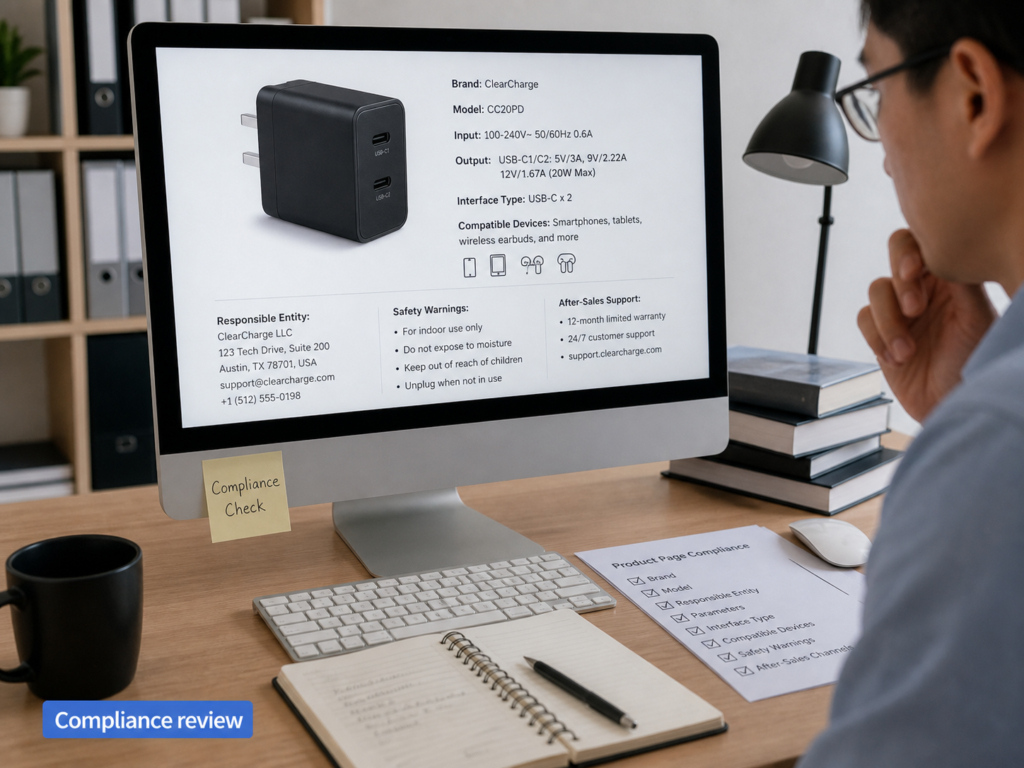
Your product page should provide the following information: brand, model, responsible entity, that is, your company information and contact details; it also includes detailed parameters, interface type, compatible devices, safety warnings, and after-sales channels. Whether it is necessary to display local responsible person information in markets such as the EU and the UK shall be confirmed according to applicable regulations. Don’t let consumers search for a long time without knowing who is selling, and can’t contact anyone when problems arise.
You should also screen high-risk publicity: absolute expressions such as “safest”, “number one”, “never damaged” cannot be used casually; unsupported claims such as “military-grade quality”, “aerospace-grade materials” should not be written if you cannot provide reliable materials; and parameter publicity without test conditions, such as only writing “100W fast charging” without stating under what conditions it is achieved, are likely to constitute misleading.
Statutory consumer rights must be clearly displayed: for example, EU consumers usually have a 14-day right of withdrawal in eligible online sales, and statutory warranty should also be explained in accordance with applicable rules. You cannot use standard clauses such as “no returns or exchanges once sold” to evade statutory rights — even if written, they may not be valid. If a complaint is filed with the regulator, you may still be required to correct or bear responsibility.
There is another very important point: safety-related customer complaints have the highest priority. If a consumer reports that your charger is overheating, leaking electricity, or smoking, don’t first think about how to dismiss the customer. First stop selling the involved batch of products, then investigate the cause — if it is really a batch safety problem, dragging it out may expand losses.
Next is data privacy and payment compliance:
Now global regulation of data privacy is becoming stricter. The EU GDPR and California CCPA are both systems that require key attention, but whether they apply to your business depends on the business entity, business scale, consumer location, and data processing situation.
The website should determine whether prior consent is required based on the visitor’s region and Cookie type, and provide corresponding disclosure and management mechanisms. Strictly necessary Cookies usually apply different rules, and you cannot treat all Cookies in the same way. For user requests for data deletion, they should be handled in accordance with the law, while conducting necessary identity verification, and paying attention to legal preservation obligations and other exceptions. Not all information must be unconditionally deleted immediately after a user requests deletion.
Two of the most common pitfalls must be avoided: first, marketing emails have no unsubscribe option. Many sellers collect buyers’ email addresses and send random advertisements without even an unsubscribe button; second, processing or storing buyers’ credit card information without legal basis and security measures.
If merchants process, transmit, or store payment card data, they should establish control measures in accordance with applicable PCI DSS requirements. Using compliant hosted payment pages or tokenization solutions can usually reduce the scope of merchants’ direct access to card data, but it will not automatically eliminate all merchant responsibilities. It is still necessary to confirm which PCI responsibilities the payment service provider and the merchant themselves bear respectively.
The practical principle of payment compliance is to prioritize the use of third-party payment gateways, such as Stripe, PayPal, etc., to let them handle payment information, and try not to directly contact complete credit card data yourself.
Next is tax and customs compliance:
Whether to register for sales tax or VAT cannot be determined solely by a globally applicable number. U.S. sales tax obligations need to be determined state by state based on each state’s economic nexus, physical nexus, product taxability, and platform collection rules, and a unified standard of $100,000 or 200 orders cannot be used.
For the EU, storing own inventory in a member state usually triggers VAT registration, declaration, or other obligations in that country, but it still needs to be confirmed country by country in combination with inventory ownership, warehousing arrangements, transaction structure, and local rules. It cannot be simply understood as “you must register no matter how much you sell”.
Eligible imported distance sales may consider using IOSS. It is usually conditional on the intrinsic value of a single shipment not exceeding 150 euros, and corresponding VAT obligations must be fulfilled through registration or an intermediary; product categories, excise taxes, platform transaction methods, etc. may also affect the applicable scope. Being below 150 euros does not mean that all goods automatically apply to IOSS.
When clearing customs, you must declare truthfully: HS code, goods value, and country of origin should all be declared according to the actual situation. Don’t underreport the goods value to pay less tax, or misreport the HS code — once caught, you may need to pay back taxes, interest, or fines, and in severe cases, it may lead to detention or confiscation of goods.
Emphasize again: if you use an overseas warehouse, local inventory may trigger local tax and registration obligations. Don’t think that you don’t need to worry about taxes if the goods are stored in an overseas warehouse. When you are caught and have to pay back taxes plus penalties, the loss will be huge.
Finally, intellectual property risk prevention and control:
There are two most common types of infringement for charging products: one is trademark infringement, such as using the names or logos of big brands, or packaging products as official products of a certain brand; the other is risks such as patents, appearance designs, copyrights, licenses, and certification marks.
Selling Lightning accessories without MFi authorization or claiming to have MFi certification may involve licensing, trademark, certification mark, or other intellectual property risks; whether it constitutes patent infringement requires search and legal analysis of specific products and valid patents, and cannot be directly determined as patent infringement just because of the lack of MFi authorization.
The basic self-check method is actually not difficult: you can go to the trademark and patent databases of the target market, such as the USPTO in the United States and EUIPO in the EU, to search for obvious conflicts in the brand name, product appearance, and technical solutions you use; you should also keep the authorization chain of all materials, such as whether the product pictures are taken by yourself or provided by the supplier, whether there is authorization, and whether the copy is written by yourself. Don’t copy others’ casually.
Here we correct another misconception: don’t think that if the supplier says it can be sold, it is not infringing. The supplier’s statement cannot replace your independent verification, nor does it necessarily bear the infringement liability arising from your sales in the target market. When you are complained or sued, the first thing to deal with is your sales behavior, so you must check it yourself and don’t be lazy.
Practical Steps for Full-Chain Compliance Prevention and Control (Beginner Level Application)
After talking about so many risks and requirements, you may feel a bit confused and don’t know where to start. In fact, as long as you follow the three stages of product selection, launch, and operation step by step, you can block most obvious risks in advance.
First is the pre-prevention and control in the product selection stage — this is the most cost-effective stage, because you haven’t purchased goods yet. If you find problems, you can just replace them directly, with the lowest cost.
The first step is to determine the target market and list the mandatory certifications, recommended certifications, and registration obligations of this market. For example, for the U.S. market, you need to confirm whether FCC applies, CPSC-related safety regulations, Prop 65 exposure warnings, state or local electrical safety requirements, and channel requirements respectively. All charging products that cannot provide basic safety materials, or whose product structure and certificate scope are unclear, should be carefully evaluated. Don’t touch obviously high-risk products.
The second step is to verify suppliers: ask the supplier for certification certificates, test reports, and product specification sheets, then go to the official website of the issuing body or competent authority to verify the validity of the documents yourself. The supplier’s existing certifications can be used as pre-materials, but you still need to check the model, brand, factory, key components, standard version, label, and responsible entity, and decide whether to supplement assessment or certification based on your own sales identity and product changes.
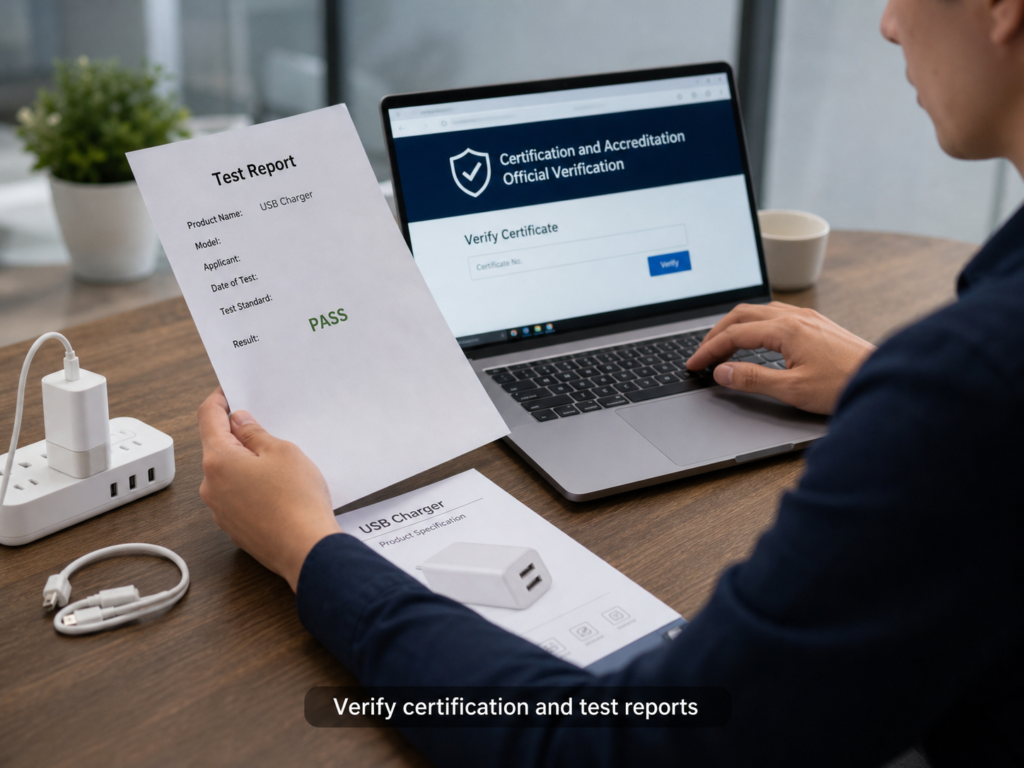
The third step is to confirm samples: after receiving the samples, carefully check whether the materials, processes, and labels of the samples are consistent with the bulk goods. For example, if the sample has pure copper core, will the bulk goods be replaced with copper-clad aluminum? If the sample has a certification mark, will the bulk goods not have it? It is best to write clearly in the contract that the bulk goods must be consistent with the samples.
The fourth step is to conduct infringement investigation: search the trademark and patent databases of the target market, avoid big brand styles without authorization, and don’t make counterfeit products; at the same time, confirm that the product pictures, copy, and materials are authorized, and don’t copy casually.
Then there is the compliance check before the website goes live. After the goods are ordered and the website is about to go live, do a final round of checks:
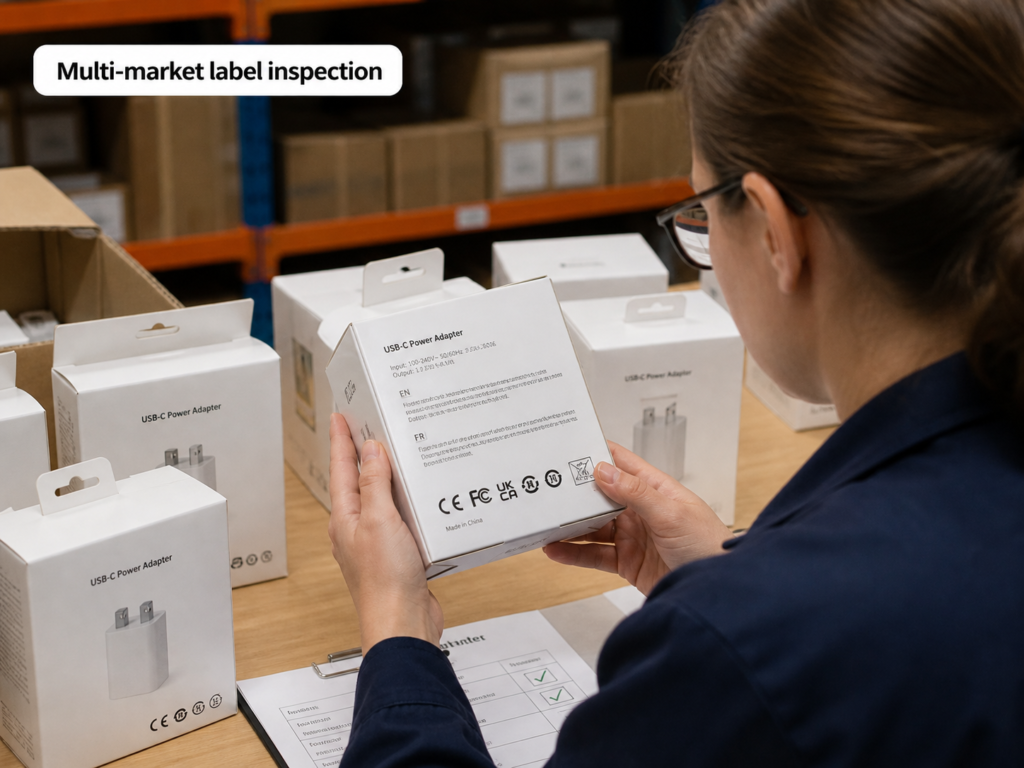
First check the products and packaging: whether the certification marks are applicable and complete, whether the labels meet the local language requirements, such as the bilingual (English and French) requirement in applicable scenarios in Canada, and for the EU, the language should be confirmed according to the member state of sale and specific regulations; also check whether the online parameters are consistent with the parameters on the offline packaging. You can’t write 65W on the website and 20W on the packaging.
Then check the website pages: are there necessary legal pages? Privacy policy, terms of service, return and exchange policy, Cookie statement — these should be prepared according to the target market and business model; is there any illegal publicity in the product description? For example, absolute terms, falsely labeled power, and parameters without test conditions should all be corrected.
Finally, check the backend configuration: whether the tax, payment, and logistics settings match the target market; whether the return and exchange process meets applicable statutory requirements. For example, eligible online sales in the EU usually involve a 14-day right of withdrawal, and backend processes and page descriptions cannot exclude statutory rights.
Next is the daily maintenance in the operation stage. Compliance is not a one-time thing, and regular inspections are required:
First, track regulatory changes. Every quarter, check whether there are updates to charging-related regulations in the target market, such as the effective dates of EU USB-C requirements for different device categories, and whether the Prop 65 listed substances and safe harbor levels in California have changed. You can subscribe to official notifications or industry information, don’t wait until the rules change and you don’t know.
Then review the supply chain. Each batch of bulk goods should be sampled and inspected to confirm that the supplier has not secretly replaced materials or changed processes; if the supplier replaces core components, changes the factory, or the product is modified, a change assessment must be conducted. Based on the results, decide whether to supplement testing, update documents, or re-certify. You cannot continue selling with previous certificates.
In addition, customer complaints should be handled by level: safety-related customer complaints are handled first, stop selling the involved batches immediately and investigate the cause; ordinary quality problems and after-sales problems should be responded to in a timely manner in accordance with applicable consumer rights rules and commitments.
Finally, there is advanced compliance matrix and change management, suitable for sellers who have been operating for a period of time and have many SKUs:
First, all documents should be stored centrally: certification certificates, test reports, order batch records, supplier information, and customer complaint records should all be saved in accordance with the target market and specific regulatory requirements. The retention period may vary in different markets. Don’t wait until the regulator wants to check to find that the materials are missing.
You can make a “market-product-evidence” compliance matrix: list the markets and sales channels you operate horizontally, and list the regulatory requirements, required documents, and responsible persons for each market vertically, then mark the compliance status for each product — this way you can see at a glance what materials are missing for which product in which market, without confusion.
You must set up launch blocking rules: products that have not completed applicable safety assessments, lack key materials, or have high infringement risks must never be listed. Don’t take chances, thinking that selling a little is fine. If you are caught, the cost may be huge.
In addition, product changes must be strictly managed: changing the production factory, replacing core components, such as the chip of the charger, the conductor material of the cable, or product modification, all require change assessment; each model should be filed separately, don’t mix them together.
Risk Classification and Emergency Handling (Semi-Proficient Improvement)
No matter how careful you are, you may still encounter violation complaints or regulatory investigations. How to handle them to minimize losses? This part is prepared for sellers who want to advance, teaching you how to judge risk levels, how to handle emergencies, and how to achieve compliance at low cost.
First is the risk classification method for charging products. You can quickly judge according to this standard:
High-risk items: those involving personal safety, large-scale infringement or tax evasion, and false certification — for example, chargers have serious overheating risks, or you sell a large number of suspected infringing products, or evade regulation through false materials. These are all high risks.
Medium-risk items: non-compliant labels, incomplete privacy policies, small parameter errors, missing environmental declarations — for example, the label is missing a language, the privacy policy is not perfect enough. These may not cause direct personal safety problems for the time being, but they should also be corrected in time.
Low-risk items: minor packaging defects, page text errors, delayed after-sales response — for example, the packaging is a bit crushed, there is a typo on the website. These small problems can be corrected.
The logic of rapid identification is simple: as long as it may cause personal injury, it should be listed as high priority and must be handled immediately; other risks can be handled in queue according to the scope of impact and legal deadlines.
Then are the emergency handling steps for common violations. Don’t panic when encountering these situations, follow the steps:
If you receive a regulatory warning or investigation notice, for example, the regulatory authority sends a letter asking whether your charger has safety problems, stop selling the involved products immediately, don’t sell them anymore; then find local compliance service providers, lawyers, or other professionals to assist in docking as soon as possible, to avoid inaccurate replies due to lack of understanding of local regulations and processes; then cooperate with regulatory requirements for rectification, and keep communication and rectification records.
If you receive an intellectual property complaint, for example, Apple believes that the Lightning cables you sell have problems of unauthorized use of marks or technology, first verify whether the complaint is true, what the scope of rights is, and whether you have valid authorization. If there are indeed infringement or licensing issues, promptly remove the involved products from the shelves and communicate with the rights holder with the assistance of professionals. Don’t wait until the dispute escalates.
If it is a tax or customs violation, for example, you are caught underreporting the value of goods, or the tax authority contacts you because you haven’t registered for VAT, promptly pay back taxes, make supplementary declarations, and contact a local tax agent or professional to handle it. Overdue may result in late fees, interest, or other penalties. The specific amount and calculation method depend on local tax or customs rules, and you should promptly contact the competent authority or professional consultant for confirmation.
If you encounter a safety-related recall, for example, your chargers have batch overheating problems, first keep the faulty samples and batch records well, don’t throw them around; then immediately suspend the sales of high-risk batches; after investigating the problem clearly, cooperate with the recall requirements of the regulatory authority in accordance with applicable rules, don’t conceal — the consequences of concealment may be more serious than timely recall.
Many small sellers will say that compliance costs are too high, is there a way to save money? In fact, as long as you find the right priority and use the right methods, you can achieve compliance at low cost:
First, prioritize: first handle high-risk items, then optimize medium and low-risk items. For example, first handle the items that are most likely to cause big problems, such as product safety assessment, tax registration, and core intellectual property, then slowly optimize medium and low-risk items such as labels and privacy policies. Don’t start by struggling with whether the words on the page are wrong, but miss high-risk problems.
There are three money-saving tips: First, you can prioritize suppliers with existing applicable certifications and technical documents, but you still need to check the certificate scope, model, factory, key components, labels, and responsible entities, and supplement assessment or certification according to product changes. The supplier’s existing certificates do not mean that you can directly cover all sales responsibilities.
Second, using compliance tools such as Cookie management and tax automation can improve efficiency, but tools cannot replace your judgment of applicable regulations, nor can they automatically eliminate all responsibilities.
Third, some certification bodies or countries may accept existing test data as assessment materials, but whether certification can be transferred, supplementary testing is required, or re-certification is necessary should be confirmed with the competent authority or accredited body country by country and product by product. You cannot assume that UL can be automatically converted to Canadian cUL, nor can you assume that CE can be directly converted to certifications in many Middle Eastern countries.
When do you need professional support? Remember three trigger points: first, when expanding into a new market, for example, you only did the U.S. before, and now you want to do the EU. The rules are different. Finding a local compliance service provider to help you sort it out is cheaper than stepping into pitfalls yourself; second, certification of high-risk products, such as safety assessment of fast chargers, the process may be relatively complex, and it is more reliable to seek professional assistance; third, when receiving regulatory or litigation notices, never tough it out yourself. Find a professional lawyer or compliance service provider to handle it and minimize losses.
Finally
Actually, compliance for independent e-commerce stores is not as hard as you think, and it’s not something only large sellers can do — the core is to remember that you are a key responsible party for your own business, put safety first, address high-risk items first, then optimize details step by step. You don’t need to pursue perfection right from the start, nor should you rely on luck. By following the steps to implement proactive prevention and control and daily maintenance, you can reduce common risks and run your business more stably and for the long term.