
Many new AliExpress sellers in the charging product category often run into their first compliance pitfall due to a taken-for-granted assumption: “If the platform let me list the product, what could go wrong?” As a result, either the goods are detained by customs halfway through shipment, or they are suddenly delisted in batches and the security deposit is frozen after half a month of sales; in more serious cases, sellers may face claims due to product fires. In fact, for cross-border sellers, compliance is never as simple as “passing platform review”. Because chargers and power adapters are directly connected to the mains supply, they usually involve more electrical safety, EMC, and energy efficiency requirements than passive cables; specific compliance obligations must still be confirmed item by item according to the product structure and target market, and a single misstep may render all previous efforts wasted.
Must-Know for Beginners: What Compliance Really Is and What It Costs to Make Mistakes
Core Definition and Boundaries of Compliance
Many people think compliance means “abiding by platform rules”, but that’s not correct – cross-border sales require at least simultaneous verification of **platform rules, applicable regulations of the country of sale or import, and import customs clearance and transportation requirements**, and corresponding responsibilities must be borne according to the roles of the seller and the manufacturer. Requirements for different links may not be the same; you cannot only look at whether the platform allows listing, nor can you only verify the regulations of the final country of sale.
Because charging products may involve issues such as mains supply, overheating, fire, wireless communication, or battery transportation, they usually require more detailed product and market judgment than ordinary goods. However, specific requirements still depend on whether the product is connected to the mains supply, whether it has wireless functions, whether it contains a battery, the country of sale, and applicable regulations.
You need to remember three core risk links: platform review, customs clearance, and market supervision in the destination country. Problems in any of these three links may lead to supplementary materials, delayed release, delisting, return shipment, recall, or administrative penalties; the specific consequences depend on the nature of the problem and applicable rules. Passing platform review does not mean you can sit back and relax – most platform reviews are formal thresholds. When customs or local regulatory authorities conduct random inspections, non-compliance may still result in goods detention, return shipment, or other regulatory measures.
The Real Cost of Non-Compliance
Don’t think compliance is “making a mountain out of a molehill”; the cost of actually making a mistake is much higher than you think:
• **Platform side**: The most common issue is batch delisting due to lack of certification, especially when the platform conducts special inspections. All charging products in the store may be delisted overnight, and store points will be deducted, the security deposit will be frozen, and participation in activities will be restricted; in severe cases, the store will be directly closed.
• **Logistics supervision side**: When goods arrive at the customs of the destination country, they may be detained, returned, or even destroyed due to lack of certification or incomplete documentation; even if they are sold, if they fail random inspections by local market supervision authorities, a market-wide recall may be initiated, resulting in losses not only of goods but also of reputation.
• **Operation side**: Non-compliant products are prone to problems such as overheating and short circuits, so return disputes will be much higher than those of compliant products. The store’s weight will decrease, traffic and conversion will be affected, and in the long run, brand trust will be lost.
• **Safety liability**: In the event of accidents such as electric shock or fire, manufacturers, importers, distributors, or sellers may bear product liability in accordance with the laws of the country of sale and their respective roles. Sellers cannot automatically be exempted from liability just because the supplier has provided documents.
4 Groups of Concepts That New Sellers Most Easily Confuse
Many compliance pitfalls are caused by confused concepts; you must clearly distinguish these 4 groups:
1. **Platform rules ≠ destination country regulations: being able to list ≠ being able to sell legally**. Platform review is only an entry threshold; in many cases, you can pass by uploading a certificate, but the regulations of the country of sale are substantive requirements. Customs and market supervision will inspect according to local rules, and the platform will not bear responsibility for you if problems arise.
2. **Certification ≠ test report ≠ declaration of conformity: the three cannot replace each other**. A test report is the test result of a sample by a laboratory, which can only show that “this sample has been tested”; certification is an official certificate issued by a third-party organization, and some require factory audits to prove that the product continuously meets the standards; a declaration of conformity is issued by the manufacturer itself, declaring that the product meets all applicable regulations, and the manufacturer bears the responsibility. The three have completely different functions; you cannot say that certification is unnecessary if you have a test report.
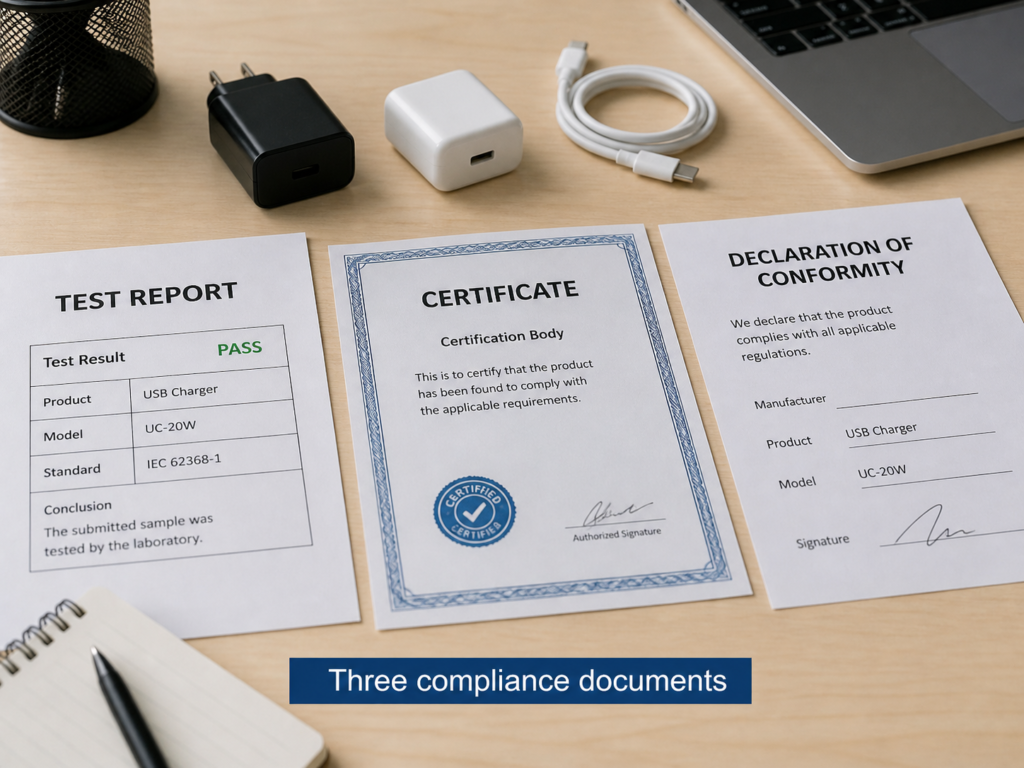
3. **General compliance ≠ charging product-specific compliance: electrical products have additional requirements**. For ordinary goods such as stationery and accessories, it is enough to meet environmental protection and labeling requirements, but charging products may also need to meet electrical safety, energy efficiency, EMC, or wireless requirements, so you cannot apply the experience of ordinary goods.
4. **Wide voltage (100-240V) ≠ global universal**. Many chargers have a 100-240V wide voltage mark printed on them, so sellers dare to label them as “globally universal”. But in fact, the plug shapes (US standard, EU standard, UK standard) are different, and without local certification, they still cannot be sold legally – voltage adaptation is only the foundation; both compliance and plugs must meet local requirements.
First Understand the Premise: Lock in the “Product-Market” Correspondence
Now that you understand what compliance is and how painful it is to make mistakes, next you need to clarify two most basic variables: what exactly is the product you are selling, and which market you are selling to. All compliance requirements revolve around these two variables; there is no such thing as “one set of certifications for the whole world”.
Risk Levels of Charging Products (From Low to High)
Different types of charging products have different risk levels, and the strictness of compliance requirements also varies greatly. They can be divided into three categories according to risk from low to high:
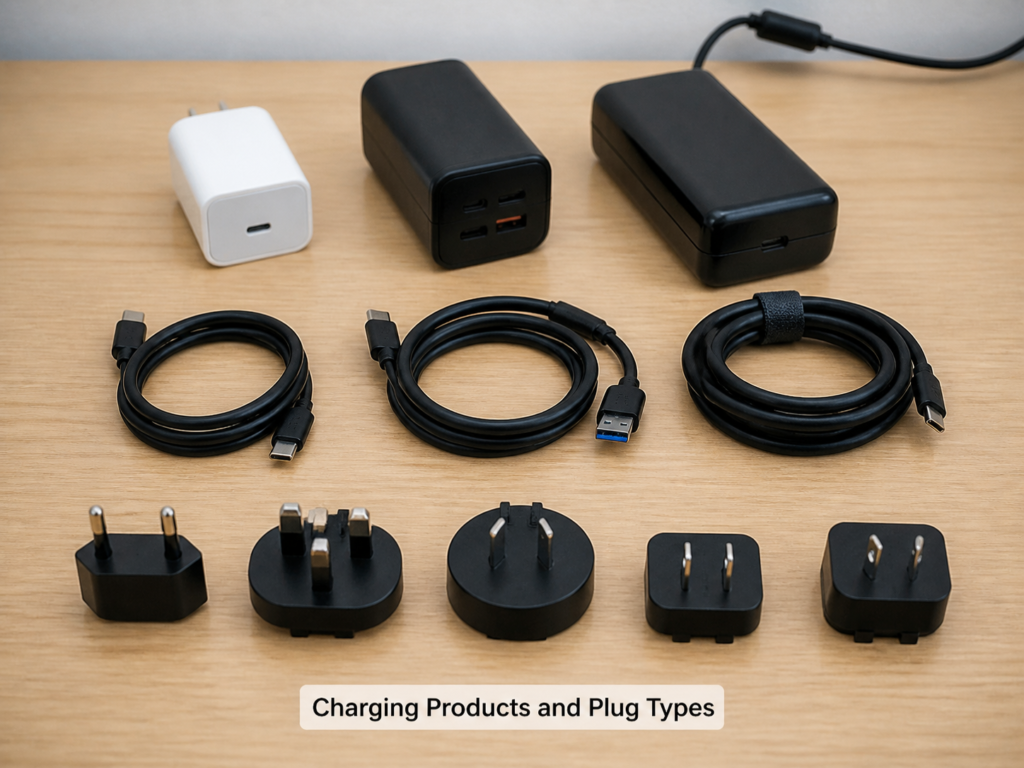
1. **Cable category (charging cables, USB-A/C cables)**: Core risks are overheating, short circuits, insulation damage, and excessive harmful substances. The evaluation items for cables should be determined according to the rated current or power, connector and wire structure, whether they contain E-Marker or other electronic components, and the requirements of the target market; they cannot be divided only by 5V/2A or 100W.
2. **Chargers/power adapters**: Because they are directly connected to the mains supply, the risk is much higher than that of cables. Core risks are electric shock, fire, electromagnetic interference, and non-compliance with energy efficiency standards, and compliance requirements are also much stricter than those for cables.
3. **Special models (wireless chargers, models with batteries, sets)**: Because these products have additional functions, special requirements need to be added on top of the basic requirements. For wireless chargers, it should first be determined whether their wireless power transmission and communication functions fall under the radio equipment or EMC rules of the target market; if they contain intentional transmission functions such as Bluetooth, Wi-Fi, or NFC, corresponding radio compliance assessments are usually required. Products with built-in batteries need to add battery safety, transportation, and recycling requirements, and each component in the set (such as charger + charging cable) must be compliant separately; it is not enough for only the main unit to have certification.
Judgment Rules for Target Markets
Many people get this wrong: compliance requirements are calculated based on **the country where the product is finally delivered**, not the registration location of your store, nor the shipping location. For example, if your store is registered in Hong Kong and ships from China, but the product is sold to France, then it must comply with EU regulations.
If you operate in multiple markets, you must match the regulations of each market separately; a single certification cannot cover the whole world. The CE mark is used to indicate that the product meets applicable EU harmonized regulations; it cannot replace the requirements of the US FCC or other markets. FCC equipment authorization mainly applies to the United States and cannot replace EU CE compliance. Some non-EU markets may accept or reference CE, but whether it is accepted still depends on local regulations; CE cannot be regarded as a globally universal access certificate.
If you cannot temporarily obtain the certification or other necessary documents for a certain market, just set that market as restricted for sale. Don’t force it, otherwise the cost of an accident will be much higher than the money you might earn.
Advanced Tip: Build Your Product Compliance Matrix
If you sell many product models and cover many markets, it is easy to miss things just by memorizing them. At this time, you can build a simple “product compliance matrix” and organize all information into a table for clear visibility. Here is the simplest example:
| Product Model | Target Market | Required Regulation Types | Qualification Status | Responsible Party |
| 65W GaN Charger (US Standard) | United States/Canada | Verify FCC authorization method, applicable DOE and state energy efficiency requirements, and Prop 65 exposure warning obligations according to equipment category; separately evaluate NRTL safety certification or customer/platform requirements | Obtained | Supplier A |
| 100W PD Charging Cable | European Union | RoHS, safety or other test requirements corresponding to product structure and scope of application | Pending supplementary testing | Supplier B |
The core dimensions of the matrix are product model, target market, regulation type, qualification status, and responsible party. Every time the product changes materials, power, or supplier, remember to update the matrix simultaneously to avoid omissions.
Core Regulation Directions for Charging Products: Focus on Priorities
No matter which market you sell to, the compliance requirements for charging products basically revolve around five core directions, ranked by risk priority from high to low. You can verify according to this line of thinking:
1. Electrical Safety (Electric Shock/Fire/Overheating Prevention)
This is the core compliance requirement for charging products, after all, it involves personal safety. External chargers and power adapters usually have high safety requirements, and high-power cables also require additional evaluation combined with their structure, materials, and usage conditions.
**Common misconception**: A wide voltage (100-240V) mark printed on the product does not mean it has passed local safety tests – many small factories print the wide voltage mark casually and have never conducted formal safety tests at all.
2. Electromagnetic Compatibility (EMC)
Electromagnetic compatibility is what people often call EMC. Simply put, it means your product will not interfere with the operation of other electrical appliances, nor is it easily interfered with by other electrical appliances. Charging products with switching power supplies, digital circuits, active chips, or wireless transmission functions usually require corresponding EMC assessments; whether passive cables have additional EMC obligations should be judged according to product structure and target market.
**Common misconception**: Passing safety tests does not mean automatically meeting EMC requirements – safety focuses on preventing electric shock and fire, while EMC focuses on electromagnetic interference; they are completely two different test items.
3. Environmental Protection and Hazardous Substance Restriction
RoHS mainly restricts specific hazardous substances such as lead, mercury, and cadmium in products. WEEE mainly stipulates the registration, labeling, recycling, and reporting responsibilities of producers of electrical and electronic equipment; Prop 65 requires evaluating whether a warning is needed based on listed substances, exposure routes, and safe harbor levels.
**Common misconception**: The “material compliance declaration” provided by the supplier does not mean full compliance with regulatory requirements – when actually inspected, it is necessary to confirm the specific products, materials, and regulatory scope covered by the declaration, and corresponding test reports or other technical documents must be provided if necessary; verbal declarations are not valid.
4. Energy Efficiency Requirements
Energy efficiency requirements mainly limit the standby power consumption of products and improve energy utilization efficiency. They target external power adapters, that is, chargers, and requirements for high-power models will be stricter. Common examples include the EU’s ErP Directive and the US’s DOE energy efficiency requirements.
**Common misconception**: Energy efficiency requirements usually examine indicators such as no-load power consumption and operating efficiency at the same time. Applicable categories and limits are related to the power supply type and rated output power; compliance cannot be judged solely by “fast charging” or rated power.
5. Additional Requirements for Special Functions
If your product has additional functions, corresponding special requirements need to be added: for example, for wireless chargers and products with Bluetooth/Wi-Fi, it is necessary to determine whether radio compliance is required based on whether they intentionally transmit radio signals, operating frequency band, power, and the definition of the target market; products with built-in batteries need to add battery safety, transportation, and recycling requirements.
**Common misconception**: Certification for wired chargers cannot be directly applied to wireless chargers or models with batteries – one more function means one more risk, and additional evaluation is necessary.
Mandatory Compliance Requirements for Common AliExpress Target Markets
The above is the general compliance direction for charging products. For each specific target market, mandatory requirements and enforcement intensity are different. Below we have sorted out the core requirements of several markets that AliExpress sellers most commonly operate in, which you can directly compare:
EU/UK Market
• **Mandatory access mark**: The CE mark applies to the EU, and the UKCA mark usually applies to the UK GB market; Northern Ireland still needs to use CE or other prescribed marks in combination with applicable rules. The CE mark indicates that the manufacturer declares that the product meets all applicable EU harmonized regulations; which specific regulations apply must be determined according to product category and function, and obligations such as WEEE producer responsibility cannot be replaced solely by the CE mark.
• **Core mandatory requirements**: Electrical safety, EMC, RoHS (hazardous substance restriction), ErP (energy efficiency), WEEE (recycling responsibility), but specific items must be judged according to product category and function; not all products are applicable at the same time.
• **Additional requirements for online sales**: Online offers for the EU market should provide manufacturer, EU responsible person (where applicable), product identification, and warning information in accordance with the GPSR. For the UK GB market, applicable UK product safety and responsible person requirements should be separately verified, and EU rules also need to be considered for Northern Ireland.
• **Special points for charging products**: EU Directive (EU) 2022/2380 requires that listed portable radio devices adopt USB-C charging ports from December 28, 2024, and laptop computers are applicable from April 28, 2026; this rule also includes charging power, protocol, and labeling requirements, and the specific scope of application needs to be checked against the device list.
• **Labeling requirements**: Determine the information that should be carried on the product, packaging, manual, and online page according to the target market and applicable regulations. Where applicable, CE or UKCA, model, and rated parameters should be marked, and information on the manufacturer, importer, or responsible person should be provided; the location and carrier of the mark shall be determined according to specific regulations, and the country of origin mark cannot be generalized as a unified requirement for all products. The CE/UKCA mark has size and proportion requirements, and cannot be deformed or used in an unrecognizable way.
North American Market (United States/Canada)
• **Mandatory requirements**: The United States shall complete Certification or SDoC as specified by the FCC according to equipment category; Canada shall complete applicable certification or declaration of conformity and labeling in accordance with ISED rules. Failure to meet the requirements may result in restricted import or sale, but it cannot be absolutely stated that customs clearance will definitely be impossible.
• **Highly recommended requirements**: UL/ETL safety certification, although usually not a federal mandatory certification by law, is required by platforms, overseas warehouses, insurance companies, and even buyers in actual operation, and is almost a standard access requirement.
• **Special requirements**: If the product causes foreseeable exposure to substances listed under California Prop 65 and there is no applicable exemption, a warning that meets format and display requirements shall be provided as required; it cannot be directly determined that a warning is necessary just because a certain substance is detected. For energy efficiency requirements for chargers, the US has DOE standards and California has CEC requirements; whether they apply must be verified in combination with product category, rated parameters, and sales methods.
• **Labeling requirements**: Certification marks, rated parameters, place of origin, and warning labels must all comply with local regulations and cannot be printed casually.
Russia and CIS Market
• **Mandatory access**: EAC applies to member states of the Eurasian Economic Union, which does not mean it covers all CIS countries. For specific products, it shall be determined whether to adopt a declaration of conformity or certification according to TR CU/EAEU technical regulations.
• **Core requirements**: Electrical products need to meet the safety requirements in applicable technical regulations, such as short circuit prevention and overheating prevention, and specific items depend on the product category and applicable regulations.
• **Customs clearance differences**: Customs facilitation for personal parcels cannot be directly regarded as product compliance exemption for commercial sales. For overseas warehouses and batch sales, local requirements should be confirmed before import, and corresponding conformity documents should be prepared.
Core Southeast Asian Markets (Malaysia/Thailand/Philippines)
• **Mandatory certification**: For Thailand, Malaysia, and the Philippines, TISI, SIRIM, or Philippine BPS requirements should be verified respectively according to product category, interface/voltage, import method, and local mandatory product lists; they cannot be simply judged by a certain power threshold.
• **Exemption rules**: Low-value parcels or personal imports may be eligible for certain customs procedure facilitation, but this does not mean automatic exemption from product safety certification. The certification systems and exemption conditions of the three countries are different, and must be subject to the specific regulations of local competent authorities.
• **Customs clearance requirements**: For electrical products, basic compliance documents, such as test reports or conformity documents, may be required during customs clearance. The specific requirements depend on the product and import method; otherwise, you may be required to supplement materials, experience delayed release, or be subject to other regulatory measures.
How to Match, Verify, and Store Compliance Qualifications
Now that you understand the requirements of each market, the next step is how to find the corresponding qualifications, how to verify the authenticity of qualifications, and how to store these documents.
Correspondence Table of Common Certification Types
For your quick correspondence, we have organized common regulations, conformity assessment, and industry certification schemes into a table by function. Note that not all of the following names belong to the same type of “certification”:
| Type | Corresponding Requirements | Common Examples | Function |
| Safety regulations/assessment | Electrical safety requirements | EU LVD conformity assessment (where applicable), UL, ETL | Prevent electric shock, fire, overheating |
| Electromagnetic compatibility regulations/assessment | EMC requirements | EU EMC conformity assessment, FCC, ISED applicable procedures | Prevent electromagnetic interference, resist interference |
| Environmental regulations/responsibility systems | Hazardous substance restriction, recycling responsibility, or warning | RoHS, WEEE, Prop 65 | Restrict hazardous substances, bear recycling responsibility, or fulfill warning obligations |
| Energy efficiency regulations/assessment | Energy efficiency requirements | ErP, DOE, CEC | Meet energy conservation standards |
| Wireless regulations/assessment | Radio and radio frequency requirements | CE-RED conformity assessment, FCC equipment authorization | Special compliance for wireless functions |
| Industry safety certification | Third-party safety certification schemes | UL, ETL, NRTL certification recognized in some markets | Provide third-party safety assessment, often concerned by platforms, customers, or insurers |
Quickly Match Basic Certifications by Product + Market
If you are a beginner and don’t know what certification to look for, you can first judge according to the following ideas:
• First determine whether the product falls under the safety, EMC, RoHS, energy efficiency, or wireless rules of the target market;
• Then select applicable standards according to rated input/output, topology, interface, and power;
• Whether the cable contains active electronic components and whether it supports specific protocols will also affect the scope of assessment;
• Do not use 5V/2A or 65W as a globally unified regulatory threshold;
• Whether wireless chargers are subject to radio rules shall be determined based on whether they intentionally transmit radio signals and the definition of the target market.
For different specific markets, just add the corresponding local mandatory requirements.
Advanced Tip: 4-Step Method for Supplier Qualification Verification
Many sellers fall into certification pitfalls because the qualifications provided by the supplier are problematic – either they are borrowed certificates, fake certificates, or they cannot cover the products you sell. You can use these 4 steps to verify:
1. **Consistency check**: The product model, brand, and manufacturer on the certification or test document must be completely consistent with the product you are selling. Don’t believe the supplier’s claim that “these two models only have different shells, the interior is the same”; as long as the key model, structure, or components change, it is necessary to confirm whether the original document still covers it.
2. **Scope check**: Low-power documents cannot automatically cover high-power products, single-port documents cannot automatically cover multi-port products, wired documents cannot automatically cover wireless products, and each component in the set needs to be checked for compliance separately; it is not enough for only the main unit to have documents.
3. **Authenticity verification**: Don’t just look at the PDF provided by the supplier; be sure to check the authenticity through appropriate official channels. The US FCC can be queried through its equipment authorization database; there is no unified official “CE certificate” database for EU CE, and not all CE products require the participation of a notified body. The manufacturer’s EU Declaration of Conformity, technical documents, and test reports should be verified; if regulations require the participation of a notified body, verify its authorization scope and notified body number through the EU NANDO database.
4. **Validity period check**: The maintenance rules for different documents are not unified. Confirm item by item whether the document has a clear validity period, maintenance conditions, and change trigger conditions; when product design, key components, manufacturing location, or applicable standards change, a re-evaluation should be conducted, and it cannot be uniformly judged as 1 to 5 years.
How to Store Qualification Documents
Don’t think that you can delete the qualification documents after passing the platform review. The correct storage method is:
• Archive electronic files according to the classification of “product model – target market”, for example, a folder named “65W Charger – EU”, which is very convenient to find;
• Documents that need to be retained include: certification reports, declarations of conformity, samples of labels/packaging/manuals, and purchase records, which are all needed in case of random inspection or appeal;
• Many EU product regulations require manufacturers or responsible entities to keep technical documents and conformity documents for at least 10 years after the last product is placed on the market, but this shall be subject to specific applicable regulations and requirements of the responsible entity, not the platform’s review period.
Practical Compliance Steps for the Entire Listing Process of Charging Products
If you are doing charging products for the first time, you can follow the 5 steps below. Each step has checkpoints so you won’t miss any items:
Step 1: Determine Product and Target Market
First clarify the product type and specific parameters (power, interface, plug, function) you want to sell, for example, “65W GaN charger, US standard plug, single USB-C port, supports PD3.0”. Then select the target markets you can cover; for markets where you cannot provide necessary documents, directly restrict sales, don’t force it.
**Checkpoint**: You have listed all mandatory compliance requirements for the corresponding market, with no omissions.
Step 2: Verify Supplier Compliance Qualifications
Request complete certification reports and declarations of conformity from the supplier, then use the 4-step method mentioned above to verify the validity of the qualifications, and confirm that all qualifications cover the products you want to sell and the target market.
**Checkpoint**: All qualifications correspond to the current product model and target market, with no missing items or borrowed certificates.
Step 3: Rectify Product, Packaging, and Manual
Determine the information that needs to be carried on the product, packaging, manual, and online page according to the target market and applicable regulations. The product itself, packaging, or manual may need to provide rated parameters, applicable marks, and information on the manufacturer, importer, or responsible person; packaging and manuals should also provide recycling information, warning labels in the language of the sales region, safe use instructions, and disposal guidelines according to local rules.
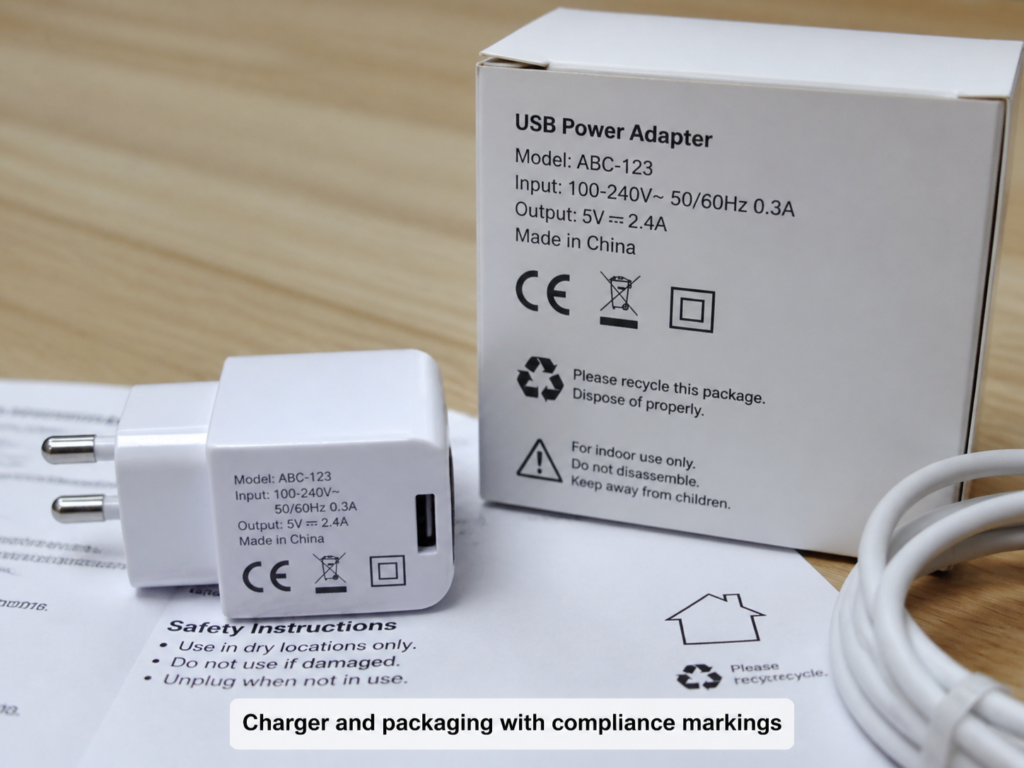
**Checkpoint**: All information on the product, packaging, and manual (such as power, parameters, applicable marks) is completely consistent, with no contradictions, and the placement meets the requirements of the target market.
Step 4: Page and Backend Preparation Before Listing
The parameters, certification marks, and promotional language on the detail page must be consistent with the actual product. Absolute expressions such as “globally universal” and “100% safe” cannot be used; certifications that have not been obtained cannot be marked, and power and fast charging protocols cannot be falsely labeled. In the backend, corresponding qualification documents must be submitted in the compliance center, and product attribute parameters must be filled in accurately.
**Checkpoint**: There is no false promotional content on the page, and qualifications have been submitted and correctly matched with the product.
Step 5: Continuous Compliance Maintenance After Listing
Compliance is not done once the product is listed; continuous maintenance is required afterwards: monitor platform review notifications and regulatory updates in the target country; collect buyer safety complaints (such as overheating, short circuits, smoking) and investigate problems in a timely manner; if there are product changes (chip replacement, power change, supplier change), re-evaluate compliance; also regularly review the validity period and maintenance conditions of qualifications, prepare for updates in advance, to avoid document expiration or continued use of old documents after product changes.
Common Compliance Pitfalls and Appeal Judgment Methods
No matter how careful you are, you may accidentally fall into a pit. Below are the most common pitfalls, ways to avoid them, and judgment criteria for whether you can appeal after a violation:
Common Pitfalls in Product and Promotion and How to Avoid Them
• **False parameter labeling**: For example, labeling 65W when the actual is 20W, which is easy to be inspected by the platform or complained by buyers. The way to avoid this is to strictly label according to the technical documents and test results corresponding to the current model, and don’t listen to the supplier’s bragging.
• **Missing labels**: If the product, packaging, or manual does not provide necessary information in accordance with applicable regulations, it may be directly delisted if found. The place of origin, rated parameters, applicable marks, or responsible party information should be completed according to the requirements of the target market.
• **Non-compliant interfaces**: Verify interfaces, cables, current, and protocol implementation according to USB Type-C, USB Power Delivery, and target market safety/EMC requirements; technical materials corresponding to specific models, configurations, and test items are required, and a general “USB-C compliance report” alone is not enough.
• **False promotion**: Using absolute expressions such as “best”, “globally universal”, and “top safety” is easy to be punished by the platform. Just be realistic when promoting.
Common Pitfalls in Certification and Qualification and How to Avoid Them
• **Misuse of marks**: CE is a compliance mark, not a quality certification, so you cannot say “CE certification quality assurance”; FCC is a device authorization or conformity procedure applicable to the United States, which cannot replace the safety or compliance requirements of other markets, so don’t mark randomly.
• **Borrowed/fake certificates**: The supplier gives you someone else’s certification with a changed model, or directly edits the image. The way to avoid this is to be sure to verify the authenticity through appropriate official channels, don’t find it troublesome.
• **Regional misuse**: Certification or conformity documents have clear applicable regions and product scopes. CE cannot replace local requirements in the United States or other markets, and FCC cannot replace EU CE compliance.
• **Insufficient coverage**: Selling high-power products with low-power documents, or selling multi-port products with single-port documents, are all non-compliant. Be sure to check the coverage scope of the documents.
Key Points for Differentiated Pitfall Avoidance in Different Markets
• **EU**: Focus on the size and proportion of the CE mark, which cannot be deformed or used in an unrecognizable way; at the same time, do not mistakenly think that obligations such as WEEE producer responsibility are automatically covered by the CE mark.
• **UK**: Pay attention to the transition policy between UKCA and CE. Policies may be adjusted, so you should check the latest requirements in time to avoid using inapplicable or expired marks.
• **Southeast Asia**: Do not use personal small order rules as the certification basis for commercial sales; before restricted sales or small-batch testing, you should also confirm whether there is a clear written exemption from the target country for the product and import method.
Judgment and Preparation for Violation Appeals
If you receive a violation notice from the platform, don’t rush to appeal first. First judge whether you can appeal:
• **Appealable situations**: The certification or conformity documents are real and valid, but they were uploaded incorrectly, or the product information was filled in incorrectly resulting in a mismatch. In this case, you can try to appeal, but it is still subject to the specific review standards of the platform.
• **Necessary materials for appeal**: Complete certification reports, declarations of conformity, real photos of product labels/packaging, and rectification instructions, explaining what you did wrong and how you have corrected it.
• **Non-appealable hard flaws**: If it is a forged certificate, model mismatch, or the product has obvious safety defects, don’t treat appeal as a substitute for rectification. Such problems are usually hard flaws, and serious ones may even lead to aggravated penalties.
Quick Self-Check List and Capability Summary
5-Step Pre-Listing Self-Check List
Finally, we have sorted out a quick pre-listing self-check list for you. Checking off items one by one can help find basic compliance problems:
1. **Product and market**: Clarify product parameters and mandatory requirements of the target market, and set restricted sales for markets that cannot be covered;
2. **Qualification documents**: The documents are real and valid, fully covering the model, structure, power, and target market of the products for sale;
3. **Product packaging**: Labels, parameters, applicable marks, and language all meet local requirements, and the information on the product, packaging, and manual is consistent;
4. **Detail page**: The promotional content is consistent with the actual product, with no false or absolute expressions;
5. **Backend qualifications**: Valid documents have been submitted in the compliance center, and product attributes are filled in accurately.
What Preliminary Judgments You Can Make After Learning
After reading this guide, you can use it for preliminary screening, data organization, and market restricted sales judgment of charging products:
• Preliminarily judge which AliExpress access requirements may be involved for charging products;
• Organize the basic regulations and conformity documents that need to be verified according to the target market;
• Preliminarily verify the authenticity clues and product coverage scope of supplier documents;
• Complete basic compliance self-check before listing charging products;
• Identify common compliance pitfalls and judge whether there is a document basis for further appeals.
However, before formal listing, import, and continuous sales, the current rules of AliExpress and the specific requirements of the target market’s competent authorities, conformity assessment bodies, or professional consultants shall prevail. Platform rules may change due to site, category, product, and time. The basic list cannot replace formal conformity assessment, technical documents, responsible party confirmation, and import arrangements.
In general, the compliance threshold for the cross-border charging product business is indeed higher than that of ordinary goods, but it is essentially a set of “product-market-regulation” correspondence logic, not some profound professional knowledge. As long as you take compliance into consideration from the product selection stage, instead of holding the fluke mentality of “list first, deal with it later”, and verify qualifications, rectify labels, and do a good job of archiving step by step, you can reduce common basic risks. Confirming details with local competent authorities, platform rules, and professional opinions before formal sales is the only way to lay a good foundation for long-term stable operation.