
Sellers of USB cables targeting the EU market, or people who frequently travel to and from the EU, have most likely been confused by the question of whether USB cables need the CE mark: some say all electronic cables must bear the mark, otherwise customs will seize the goods; others say ordinary charging cables don’t need it at all, and affixing it randomly will result in fines. Who should you listen to? Actually, the answer is not that complicated. We’ll first give you a quick conclusion in 30 seconds, then slowly explain the logic behind it and key points to avoid pitfalls. After reading this, you’ll be able to judge for yourself.
Figure Out If Your USB Cable Needs CE in 30 Seconds
You just need to do a 3-step self-check and compare with common scenarios, and you can basically get the answer directly:
3-Step Quick Self-Check Method
Step 1: First look at the sales scenario: Are you going to commercially sell, give away, or import into the EU for sale within the EU/European Economic Area (EEA)? If you only sell in non-EU countries, or bring a few cables for personal use, you usually don’t need to consider CE.
Step 2: Look at product attributes: Is your cable an ordinary USB cable, or a special cable with active functions or wireless capabilities? Here, you can’t just look at the label of “passive” or “active”; you also need to check whether the product is a cable or electrical and electronic equipment subject to RoHS, and whether it falls under the scope of other regulations such as EMC, RED, and LVD.
Step 3: Look at the sales form: Is it sold separately, or is it an original cable included in the original packaging of a main product that has already completed conformity assessment?
Direct Conclusions for Common Scenarios
For your convenience in comparison, we have organized the most common situations into a table:
| Common Product/Scenario | Is the CE mark required? |
| Ordinary USB charging cables/data cables (including PD fast charging cables with e-marker) sold separately | Usually need to complete corresponding CE compliance in accordance with RoHS, and should not be uniformly deemed as not requiring CE |
| USB cables with active functions (HDMI adapter, network card adapter, hub, fiber optic USB cable, etc.) | Usually require RoHS assessment, and item-by-item judgment on whether other regulations such as EMC apply |
| USB cables/adapters with radio frequency functions such as Bluetooth/Wi-Fi/wireless screen mirroring | Usually require assessment of requirements such as RED and RoHS, and complete CE compliance in accordance with applicable regulations |
| Original cables included in the original packaging of main products that have completed conformity assessment | Can be included in the conformity assessment and technical documentation of the complete product, but it cannot be presumed that the cable is automatically compliant just because the main product has the CE mark |
| Sold only in non-EU regions, brought into the EU in reasonable quantities for personal use, non-commercial handmade custom products | Usually do not fall under the EU commercial placement scenario mentioned in this article, but you still need to pay attention to the specific rules of the destination |
| Non-conductive USB decorative cables, lanyards | Usually do not fall under the same compliance scope as USB cables or electrical and electronic equipment, and should still be judged based on the actual product |
If your product is right on the boundary, or if you want to understand why there is such a difference and avoid pitfalls, we will first supplement a few basic common sense points, and then you will be able to judge like a semi-expert yourself.
First Understand a Few Core Common Sense Points
What Exactly Is the CE Mark?
Many people think CE is a “quality certification” issued by the EU official, but that’s not the case at all. In plain terms, CE is a mandatory market access mark of the EU, equivalent to a “EU market pass” — enterprises declare on their own that their products meet the applicable EU legal requirements on safety, health, environmental protection, etc., and can only affix the CE mark after completing the corresponding compliance procedures.
It is not a proof of quality grade, nor does it mean that the official has necessarily tested it; it is just the enterprise’s compliance commitment. However, if the product is found to be non-compliant, the penalty will be very heavy.
Why Do Some USB Cables Need CE, While Others Need CE Regulation Assessment?
CE does not apply the same set of rules to all electronic products; only products explicitly included in the regulatory scope by EU regulations need to complete CE compliance in accordance with the corresponding regulations.
There is a key point that is easy to overlook: the RoHS Directive explicitly includes cables used to connect or extend the connection of electrical and electronic equipment within its scope of application. That is to say, most USB cables placed independently on the EU market usually need to meet RoHS requirements, and complete the EU Declaration of Conformity and CE mark in accordance with RoHS requirements. Whether other regulations such as EMC, RED, and LVD also apply requires further judgment based on the overall structure, function, voltage, and intended use of the product.
Ordinary USB cables do not have complex signal conversion circuits, and usually EMC does not apply due to active functions, but “passive” does not mean that CE is completely unnecessary, nor can it be used as a reason to exclude RoHS obligations.
A Few Must-Know Basic Terms (Plain Language Version)
• **EU/European Economic Area (EEA)**: The core scope where the CE mark takes effect, including the 27 EU member states plus Norway, Iceland, and Liechtenstein. Products that require CE compliance sold in these places must meet the corresponding requirements.
• **Declaration of Conformity (EU DoC)**: A responsibility document issued by the enterprise stating that “the product complies with applicable EU regulations”. It needs to be signed and kept by the manufacturer, must be available during regulatory spot checks, and usually does not need to be actively shown to consumers.
• **EU responsible person or other economic operator within the EU**: For non-EU products subject to relevant market surveillance rules, manufacturers usually need an economic operator located within the EU that can liaise with regulators. Its name and contact information cannot only be placed on the website; they must also be marked on the product, packaging, parcel, or accompanying documents in accordance with the rules.
• **Passive/active USB cables**: Passive cables usually consist mainly of conductors, insulation layers, shielding layers, and connectors, responsible for transmitting power or signals; active cables have built-in electronic circuits that may perform functions such as signal conversion, amplification, protocol processing, or hub functions. However, whether a certain regulation applies ultimately depends on the product as a whole and the definition of the regulation.
Core Judgment: CE Requirements for Different Types of USB Cables
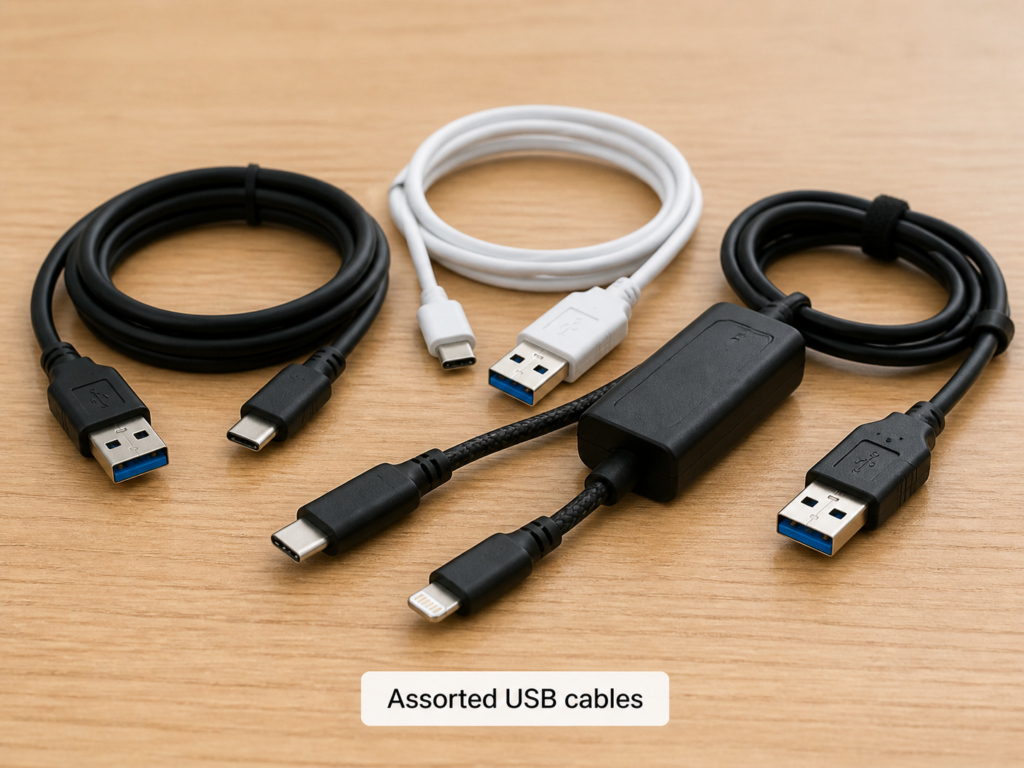
Now that you understand the basic concepts, we will break them down one by one according to the type of USB cable to help you make accurate correspondences:
1. Ordinary Passive Cables (Most Common)
This type of cable is the one we use most in daily life. Its structure usually includes conductors, insulation sheaths, shielding layers, and connectors, and there are no active circuits for application functions such as video, network, or hub. Typical products include USB-A to C charging cables, C to C ordinary data cables, Micro-USB charging cables, etc.
But a key understanding needs to be corrected: such USB cables placed independently on the EU market usually fall within the scope of cables referred to in the RoHS Directive, should meet RoHS requirements, and complete the EU Declaration of Conformity and CE mark in accordance with RoHS requirements. You cannot directly conclude that CE is completely unnecessary just because it is an “ordinary passive cable”.
Cable length and current magnitude alone do not determine whether a product is subject to RoHS or requires other CE regulation assessments, but they will affect the safety and performance requirements of the product. For example, longer cables or high-current fast charging cables require special attention to temperature rise, conductor cross-sectional area, insulation, and connector reliability.
2. USB-C Fast Charging Cables with e-marker Chip
Many people ask: PD fast charging cables have an e-marker chip, are they considered active? Here, it cannot be simply said that there is no electronic behavior at all.
The e-marker is an electronic marker in the USB Type-C electronically marked cable assembly, usually powered by VCONN, and responds to cable discovery or identity requests in accordance with the USB PD protocol, reporting cable capability information. It usually does not perform application functions such as video conversion, hub, or network conversion, but it is not a “passive label” with no electronic behavior at all.
Therefore, cables with e-marker should still be evaluated as a whole USB cable, and usually need to fulfill RoHS and corresponding CE obligations; whether other regulations such as EMC also apply shall be judged based on the specific product structure and regulatory definitions.
The common maximum supply voltage of traditional USB PD SPR is 20V; products supporting USB PD 3.1 EPR can use supply levels up to 48V and up to 240W. Even if LVD does not apply to high-current cables, attention should be paid to safety performance such as conductor cross-sectional area, temperature rise, insulation, connectors, and overcurrent protection.
3. Active Function Cables/Adapter Cables
This type of cable has a built-in active chip or circuit, which can realize functions such as signal conversion, amplification, protocol processing, and hub. Typical products include USB to HDMI adapter cables, USB to network card cables, USB hub cables with hub function, long-distance fiber optic USB cables, etc.
Finished products with electronic functions such as USB to HDMI adapters, USB network cards, and hubs should be assessed item by item for whether the EMC Directive applies. If the product is a device defined by the EMC Directive, it needs to meet EMC requirements and complete the corresponding CE conformity procedure.
Such products usually should also be assessed for RoHS; if they have wireless functions, RED should also be assessed. It cannot be generally stated that all active function cables necessarily only need EMC, nor can a single EMC test material replace the compliance documents of other applicable regulations.
4. Cables with Wireless/Radio Frequency Functions
If the cable has built-in radio frequency modules such as Bluetooth, Wi-Fi, or wireless screen mirroring, such as a wired USB Bluetooth adapter or a USB-port wireless screen mirroring dongle, then it is not just an ordinary cable.
Such products usually require assessment of Radio Equipment Directive (RED) requirements, and at the same time, regulations such as RoHS should be assessed according to the product scope. RED involves the use of radio spectrum, as well as requirements such as electromagnetic compatibility, safety, and health. The specific conformity procedure shall be determined according to the product design and applicable regulations.
5. Special Industrial High-Voltage USB Cables
LVD usually applies to electrical equipment designed for a rated voltage range of 50–1000V AC or 75–1500V DC. Whether it applies shall be assessed based on the product’s designed operating voltage and the definition of LVD, not just based on whether the product is labeled “industrial use”.
Standard USB PD products can reach up to 48V, and usually do not fall within the scope of LVD due to USB supply voltage. The common maximum of traditional USB PD SPR is 20V; cables and devices supporting USB PD 3.1 EPR can use supply levels up to 48V and up to 240W, which is no longer a simple summary of “maximum 20V”.
Special Situations Prone to Misjudgment
There are two common judgment misunderstandings that require special attention:
• Cable length and current magnitude do not directly determine whether a certain CE regulation assessment is required, but they will affect safety, performance, and material compliance requirements. For example, fast charging cables with 5A or higher current need to meet higher temperature rise, conductor, and connector safety requirements.
• Magnetic heads and all-in-one adapters, if they only do physical interface conversion, for example, a C to A adapter only connects pins correspondingly, usually do not have active conversion functions; if they have a chip to realize protocol conversion, signal conversion, or other electronic functions, they shall be assessed for applicable requirements such as RoHS and EMC based on the product as a whole.
Don’t Just Look at the Product, Sales Scenarios Also Affect the Conclusion
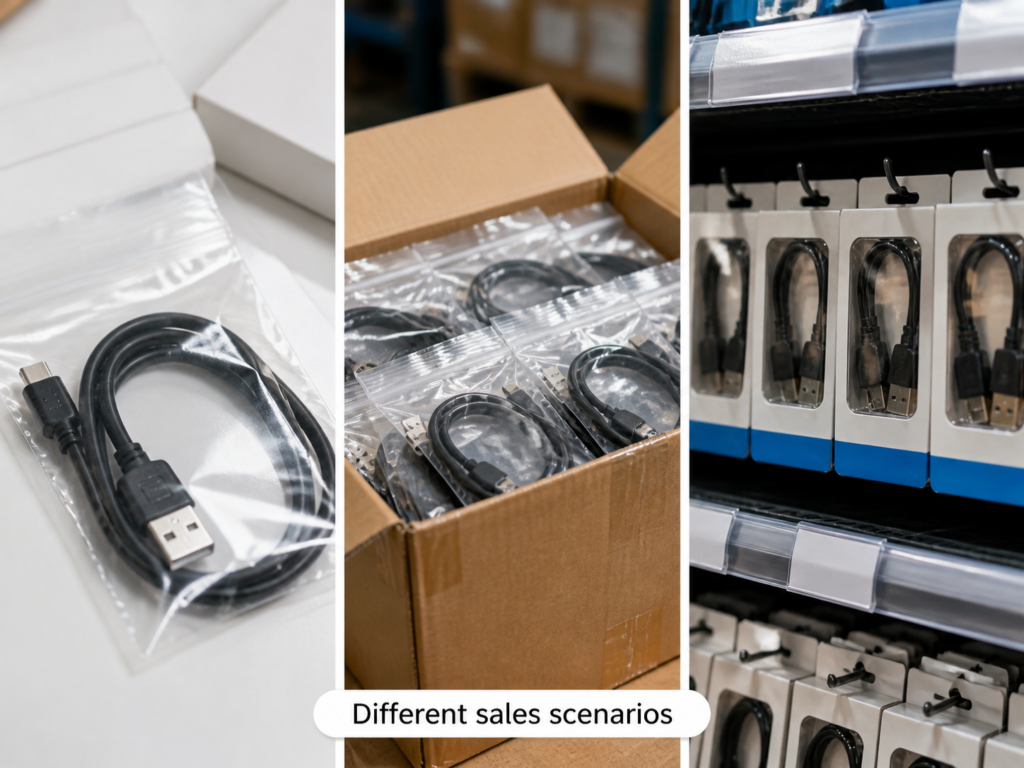
Many people don’t know that whether CE is needed depends not only on the product itself, but also on where and how you sell it. Different boundary conditions lead to completely different conclusions.
Sales Region and Purpose
• **CE assessment required**: As long as it is commercially sold within the EU/EEA, including online stores and offline shops, as well as giveaways in commercial activities, import into the EU for sale, etc.
• **CE not required to be handled according to the commercial sales scenario in this article**: Situations such as being sold only in non-EU regions, brought into the EU in reasonable quantities for personal use, non-commercial handmade custom products, etc., usually do not fall under the same type of commercial market placement scenario.
• Supplement: Although some European countries such as Switzerland and Turkey are not EU/EEA members, they may also recognize CE or have their own product requirements. When selling to these countries, it is recommended to follow the specific rules of the target country, and you cannot simply assume that all rules are the same as those of the EU.
Sales Form and Responsibility Division
• **USB cables sold separately at retail**: Judged based on the structure, function, and applicable regulations of the cable itself. Most USB cables usually require RoHS assessment and complete corresponding CE compliance as required; products with active functions, wireless functions, or special voltages also require assessment of other regulations.
• **Original cables included in the original packaging of main products that have completed conformity assessment**: Matching cables can be included in the conformity assessment and technical documentation of the complete product, but the manufacturer must ensure that the cable itself meets applicable requirements, including the usually applicable RoHS. It cannot be presumed that any included cable is already compliant just because the main product bears the CE mark.
• **Cables sold with main products that have not obtained CE**: If the cable itself is a product requiring CE compliance, it must complete the corresponding compliance separately.
• **Original second-hand cables resold within the EU**: As long as the original product was compliant when first placed on the market, re-doing CE is usually not required; but if the product has been substantially modified, the responsibility may change.
• **Refurbished or self-assembled USB cables**: Shall be re-judged based on the actual structure and sales form. After substantial modification, the original product’s documentation cannot be simply used.
Product Promotion and Actual Functions
To judge whether CE is needed, **only the actual structure and function of the product shall prevail**, not just the product title or promotional language. For example, if you sell an ordinary USB cable but the title promotes “video output”, “protocol conversion”, or “high-speed hub”, you may need to re-assess based on the actual promotion and function; conversely, if the cable actually has active conversion functions but the title only says “charging cable”, it may also be deemed as inconsistent description when inspected.
Therefore, product promotion must be consistent with the actual structure, functions, interface capabilities, and compliance documents.
Note: Whether CE Is Required or Not, It Does Not Mean That Other Compliance Can Be Ignored
Many people think that “as long as you judge whether CE is needed, you can sell freely”, which is completely wrong. When USB cables are sold in the EU, they may also involve requirements such as RoHS, REACH, WEEE, and GPSR.
RoHS Hazardous Substance Restriction Requirements
RoHS is a regulation that restricts the content of 10 hazardous substances such as lead, mercury, and cadmium in electrical and electronic products. The wires, connectors, metal contacts, etc. of USB cables usually fall within the relevant regulatory scope.
For USB cables placed independently on the EU market, RoHS is usually not only a material requirement, but also involves the EU Declaration of Conformity and the CE mark. It has different functions from regulations such as EMC and RED, but it can no longer be simply said that “RoHS does not require CE”.
You need to request material compliance declarations, material information, or corresponding test evidence from suppliers, and keep these materials together with your own compliance documents. A supplier’s verbal statement of “RoHS compliant” cannot replace the verification of specific models and materials.
REACH Chemical Substance Regulatory Requirements
REACH is the EU’s chemical regulatory regulation, with a focus on SVHC (Substances of Very High Concern). If materials such as plastic, rubber, and PVC of the cable contain SVHC on the Candidate List, the obligations need to be judged based on the specific content and product form.
For SVHC on the Candidate List in articles, if the concentration exceeds 0.1% (by weight), the supply chain usually needs to provide information sufficient for safe use in accordance with Article 33 of REACH, including at least the substance name; when a consumer makes a request, it shall be provided free of charge within 45 days.
This does not mean that sales are automatically prohibited as long as the content exceeds 0.1%. Whether sales are prohibited or restricted requires further verification of whether the substance is subject to the authorization requirements of REACH Annex XIV, or the restrictions and specific conditions of Annex XVII. Don’t just believe suppliers when they say “environmentally friendly, non-toxic”; it is best to obtain written material and chemical compliance documents.
WEEE Waste Electrical and Electronic Equipment Recycling Requirements
In simple terms, the WEEE requirement is “whoever sells is responsible for the recycling and disposal of waste products”. When applicable, producer registration may be required, and the “crossed-out wheeled bin” recycling mark must be affixed.
The specific rules for this requirement vary from EU country to country, and obligations may vary depending on the enterprise size and sales model. Cross-border sellers are best to confirm the regulations of the target country in advance. Also note that the WEEE recycling mark cannot replace the CE mark; the two are completely different things.
GPSR General Product Safety Regulation
GPSR applies to consumer products placed or made available on the EU market. For products already subject to EU harmonized legislation, GPSR mainly applies to safety risks, risk categories, or related aspects not covered by these harmonized legislations, and does not regulate all matters redundantly.
For USB cables, foreseeable safety risks should still be paid attention to, such as overheating, short circuits, insulation damage, loose connectors, insufficient plastic flame retardant performance, etc. High-current or fast charging cables also require additional attention to conductor cross-sectional area, temperature rise, and connector reliability.
Even if the product has completed CE compliance mainly in accordance with RoHS or other harmonized regulations, applicable product safety obligations cannot be ignored, and necessary risk assessment and product materials shall be kept according to the sales form.
If CE Is Indeed Required, How to Do Entry-Level Practical Compliance?
If your cable is an active function cable, has wireless functions, or is a special high-voltage device, and you indeed need to complete CE compliance in accordance with applicable regulations, don’t panic. The entry-level compliance process can be carried out according to the following ideas.
Core CE Regulations You Need to Comply With (Plain Language Version)
• **RoHS**: Restricts hazardous substances in electrical and electronic equipment and cables. USB cables usually fall within the scope explicitly included in RoHS, and this requirement should be assessed separately.
• **Electromagnetic Compatibility (EMC)**: Requires that equipment within the scope of the EMC Directive will not cause unacceptable electromagnetic interference to other equipment, and at the same time can withstand common electromagnetic interference. Products such as USB adapters, network cards, and hubs need to be judged in combination with the overall structure and function.
• **Radio Equipment Directive (RED)**: Products with wireless functions such as Bluetooth, Wi-Fi, and wireless screen mirroring need to be assessed for this regulation, which adds requirements in radio frequency, safety, health, etc. compared to simple EMC requirements.
• **Low Voltage Directive (LVD)**: Usually applies to electrical equipment designed for a rated voltage range of 50–1000V AC or 75–1500V DC. Whether it applies depends on the product’s designed operating voltage and regulatory definitions, and cannot be judged solely by the “industrial use” label.
Whether RoHS applies needs to be judged separately. USB cables are usually explicitly included in the scope of RoHS, and electrical and electronic equipment such as USB adapters and hubs usually also need to meet RoHS; but it cannot be generally stated that all products bearing the CE mark must be subject to RoHS.
Mandatory Markings and Documents
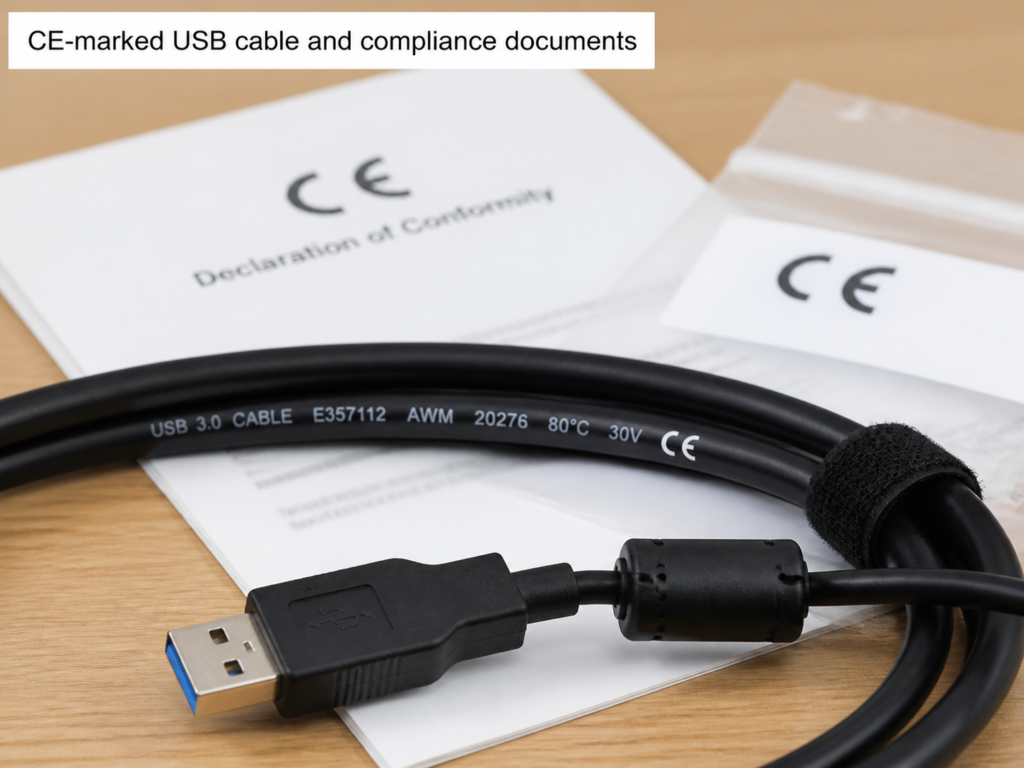
• Manufacturers shall complete conformity assessment in accordance with applicable regulations, prepare technical documentation, and retain evidence sufficient to prove that the product meets the requirements. Test reports can be common evidence, but whether they are needed, what type of test or third-party institution to use depends on the applicable regulations, the product, and the standards adopted.
• The CE mark shall be preferentially affixed to the product or its data nameplate in accordance with applicable regulations; only when the nature of the product does not allow or it is impossible to do so, can it be affixed to the packaging and/or accompanying documents. The mark shall be clear, legible, and not easily detachable.
• An EU Declaration of Conformity (DoC) shall be issued, listing the product model, applicable regulations, manufacturer information, etc., and signed by the manufacturer. EU regulations do not generally require a company seal.
• Manufacturers shall prepare and keep technical documentation and the EU Declaration of Conformity, usually for at least 10 years. Whether a test report in a specific format must exist depends on the specific regulations and product, and the same requirement cannot be applied to all products.
• For products subject to Article 4 of Regulation (EU) 2019/1020, the name and contact information of the economic operator within the EU shall be placed on the product, packaging, parcel, or accompanying documents. Remote sales pages shall also display manufacturer and, where applicable, responsible person information in accordance with GPSR; web page display cannot replace the physical marking on the product, packaging, parcel, or accompanying documents.
4 Steps for Entry-Level Compliance
Step 1: Compare with the previous classifications to confirm which regulations apply to your product, including RoHS, and possibly applicable EMC, RED, or LVD. Don’t do more or less than necessary.
Step 2: Complete conformity assessment in accordance with applicable regulations, and prepare technical documentation and corresponding evidence. Test reports are one of the common pieces of evidence, but not all products must be tested uniformly by so-called “EU-accredited laboratories”. Whether third-party institutions or notified bodies are required to participate depends on the specific regulations, product category, and conformity assessment path.
Step 3: Draft the EU Declaration of Conformity (DoC), signed by the manufacturer; if applicable, implement the EU-based economic operator and its information marking.
Step 4: Affix the CE mark in accordance with applicable regulations, keep the EU Declaration of Conformity and technical documentation for usually at least 10 years, and ensure that compliance is re-verified after product revisions, chip changes, or material changes.
Common Misconceptions and Compliance Pitfall Avoidance Guide
Correction of High-Frequency Cognitive Misconceptions
We have compiled 7 of the most common cognitive pitfalls, so don’t be misled anymore:
1. **Misconception: All USB cables must use the same set of CE rules** → Wrong. USB cables placed independently on the EU market are usually subject to the RoHS Directive and shall complete corresponding CE compliance in accordance with RoHS requirements; whether other regulations such as EMC, RED, and LVD also apply shall be judged based on product function, voltage, and use.
2. **Misconception: If RoHS is met, no CE mark is needed** → Wrong. For USB cables and electrical and electronic equipment within the scope of RoHS, RoHS itself includes requirements for the CE mark and EU Declaration of Conformity.
3. **Misconception: USB-IF certification can replace CE, or CE can replace USB-IF** → Wrong. USB-IF is a voluntary certification by the USB industry association, proving that the product meets USB technical specifications; CE is a mandatory market access requirement of the EU. The two are completely independent, and neither can replace the other.
4. **Misconception: You can just print the CE mark yourself** → Wrong. The CE mark cannot be printed randomly. You must first complete the conformity assessment required by applicable regulations, prepare technical documentation and the EU Declaration of Conformity, otherwise it is incorrect or fraudulent use of the mark, and you may face penalties or sales bans if inspected.
5. **Misconception: Charging cables and chargers use the same set of CE rules** → Wrong. Chargers are active power supply products, usually requiring assessment of multiple CE regulations; USB cables usually first involve RoHS, and whether EMC, LVD, etc. apply depends on the specific product. The two are independent products, and CE documents cannot be mixed.
6. **Misconception: Small batches and personal stores will not be inspected** → Wrong. Cross-border platforms may conduct active spot checks; even if you only sell a few dozen cables, they may be removed from shelves or seized, and customs may also conduct random inspections.
7. **Misconception: If the product has CE, no other compliance is needed** → Wrong. CE is only a compliance mark for applicable EU harmonized regulations, and cannot replace other obligations such as REACH, WEEE, and GPSR. Ordinary USB cables also cannot ignore material and product safety requirements just because the compliance scope is relatively simple.
Key Points for Practical Pitfall Avoidance
In addition to cognitive misconceptions, these 5 pitfalls in practice must also be avoided:
1. Don’t purchase “CE cables” without corresponding documents: Many suppliers say their cables have CE, but cannot produce an EU Declaration of Conformity or compliance evidence for the corresponding model, structure, and material. Supplier materials should match the actual product, not just look at whether there is a CE mark on the packaging.
2. Don’t ignore the requirements for EU-based economic operators: For non-EU products subject to relevant market surveillance rules, it should be confirmed whether the EU-based economic operator and its information marking meet the requirements. Web page display cannot replace the necessary information on the product, packaging, parcel, or accompanying documents.
3. Don’t use CE documents of other models or other products as a substitute: Compliance documents and technical evidence should be able to cover the model, specification, structure, and material of the actual product. After changing chips, materials, or key designs, re-verification should be carried out.
4. Don’t use the charger’s CE documents as the USB cable’s compliance documents: Chargers and cables are two independent products, with possibly different applicable requirements, and cannot be lumped together.
5. Don’t randomly affix CE to products that do not require a certain CE regulation: CE can only be used when the product falls within the scope of the corresponding regulation and has completed the corresponding compliance procedure. You cannot randomly affix it to products that are not applicable or have no compliance basis just to look more formal.
Methods for Preliminary Judgment of CE Compliance (Only for Products Requiring CE)
If you want to purchase cables that require CE compliance, you can use these simple methods to preliminarily judge compliance:
• **Check documents**: Is there an EU Declaration of Conformity, technical documentation, or evidence sufficient to prove conformity for the corresponding model? Are applicable regulations fully covered? For example, for products with wireless functions, has RED been assessed; for USB cables, has RoHS been assessed?
• **Check markings**: Is the CE mark correctly set in accordance with applicable regulations, and is the information of the manufacturer and applicable EU-based economic operator on the product or packaging complete? Does the information on the remote sales page meet GPSR requirements?
• **Identify the style**: For a correct CE mark, the two letters have the same height, the C is a perfect arc, and the three horizontal lines of the E have the same length. Marks with obviously wrong proportions are worthy of vigilance, but compliance cannot be confirmed solely by appearance.
Note: Compliance cannot be judged solely by the mark; it must be combined with the EU Declaration of Conformity, technical documentation, and the actual product. Also, “having a test report” cannot be simply equated with full compliance; the key is whether the documents correspond to the product, regulations, and actual functions.
Compliance Checklist for USB Cables Sold in the EU
Finally, here is a ready-to-use checklist. Go through it every time you launch a new product or stock up, and there will basically be no major problems:
Product Attribute Verification
• Confirm the product type: Is it an ordinary USB cable, an active function cable, or a product with wireless functions?
• Check whether there is a built-in electronic marker, active chip, conversion module, independent power supply, or wireless module?
• Confirm whether core parameters such as rated voltage, current, and cable structure are accurate?
• For USB PD 3.1 products, confirm whether they involve the EPR supply level of up to 48V and 240W?
Compliance Obligation Verification
• Clarify whether the product is within the scope of RoHS, and confirm whether it needs to be assessed in accordance with other regulations such as EMC, RED, and LVD?
• Have requirements under different regulations such as RoHS, REACH, WEEE, and GPSR been met?
• Confirm the responsibility division corresponding to the sales form (sold separately, sold with the main product)?
• If within the applicable scope, have the requirements for the EU-based economic operator and its information marking been implemented?
Document and Marking Verification
• Have supplier declarations, material compliance documents, EU Declaration of Conformity, technical documentation, and test evidence been kept?
• Is the CE mark correctly placed in accordance with applicable regulations, and is the information of the responsible entity on the product, packaging, parcel, or accompanying documents complete?
• Is the product description on the packaging and detail page consistent with the actual functions?
• Is the information of the manufacturer, importer, or applicable EU-based economic operator complete and traceable?
• After product revisions, chip changes, or material changes, has compliance been re-verified?
Summary
After reading this article, you should be able to do 3 things independently:
First, you can quickly judge which EU requirements your USB cable needs to be assessed for based on product structure, sales scenario, and sales form. The most important correction is: USB cables placed independently on the EU market usually fall within the scope of RoHS, and you cannot directly conclude that CE is completely unnecessary just because they are ordinary passive cables or have e-marker.
Second, you can distinguish the differences between CE and requirements/marks such as RoHS, WEEE, and USB-IF, and will not mistake one type of document or certification for another requirement.
Third, you can complete basic compliance verification for EU sales against the checklist, confirm that product functions, documents, markings, and sales pages are consistent with each other, and avoid most common pitfalls.
Compliance is never just to cope with inspections, but to avoid unnecessary losses and make business more secure.