
Friends who sell charging accessories via cross-border e-commerce, or plan to sell their own branded power banks to the EU, almost always ask this question first. The answer seems black and white, but there are many pitfalls hidden in actual operation: some people think they must spend a lot of money to find a third-party organization to issue a certificate, some think they can get away with just printing a CE mark casually, and others think they don’t need to worry about it if they use small parcel direct mail or have stock in overseas warehouses that hasn’t been sold yet.
Today, we will start from the most basic judgment logic, then move on to practical operation steps and common misconceptions, to explain this matter thoroughly. After reading this, you won’t need to consult a consulting firm; you can judge for yourself whether you need to do it, what needs to be done, and which pitfalls to avoid.
First, Understand the Core Judgment Logic
First, here are the two core levels of conclusions for everyone, please remember them well:
First, power banks first provided to the EU market through commercial means usually need to complete conformity assessment in accordance with applicable EU harmonized regulations, and affix the CE mark in accordance with specifications. Which specific regulations apply must be judged in combination with the product structure, function, and battery attributes, and cannot be concluded solely based on the phrase “commercial placement”.
Second, ordinary consumer-grade power banks can usually have their conformity declaration made by the manufacturer themselves, and there is no mandatory requirement to find a third-party organization to issue a “CE certificate” — this is a point that many people get wrong. However, self-declaration does not mean no assessment is done; the manufacturer still needs to prepare technical documents and relevant evidence sufficient to prove product compliance.
What Counts as “Placing on the EU Market”?
Many people think that only offline wholesale or large shipments entering supermarkets count, but in fact the scope is much wider than you think:
All sales behaviors targeting EU users, whether through cross-border e-commerce platforms, direct sales on independent websites, or offline wholesale, even gifts and free trial samples, may constitute placement or provision as long as they are ultimately provided to the EU market through commercial activities. The covered area is not only the 27 EU member states, but also Norway, Iceland, and Liechtenstein in the European Economic Area (EEA), which also recognize the CE mark.
The stock preparation method itself is not equivalent to placing on the market. Products stored in EU warehouses do not necessarily mean they have been provided to the market; however, import, provision to consumers, platform sales, or other commercial supply behaviors will trigger corresponding economic operator and product compliance obligations. You cannot assume that subsequent sales are exempt from compliance requirements just because the product “hasn’t been sold yet”.
4 Exception Scenarios Where CE Is Not Required
Of course, there may be cases that do not constitute commercial placement, but the boundary cannot be judged solely by the number of products; everyone can compare against the actual use and transaction background:
The first is **personal non-commercial self-use or non-commercial gifting**. For example, individuals carrying power banks to the EU for their own use, or giving them to foreign friends in a non-commercial context, usually do not constitute commercial placement on the market. However, EU regulations do not have a unified quantity standard of “1-2 pieces” or “more than 10 pieces”; it should be judged in combination with actual use, transaction background, and import method. Power banks carried or gifted by individuals may also be subject to transportation, customs, and battery safety rules.
The second is **transit under customs supervision or other special customs procedures**, that is, the goods only pass through the EU for transit and have not been released for circulation in the EU market. In this case, the product may not yet be placed on the EU market, but it does not automatically obtain a “CE exemption”. Once the goods are placed on the EU market, they still need to meet the requirements of applicable CE and other product regulations.
The third is **non-commercial test or exhibition samples**. For example, if you go to Germany to attend an electronics exhibition, bring a small number of samples for display, and take them out of the EU after the exhibition, it usually cannot be simply regarded as commercial placement. However, if you leave the samples with local distributors or customers for testing after the exhibition, even if it is free, it may constitute provision to the market, and compliance needs to be judged in accordance with applicable regulations.
The fourth is **special non-civilian models**, such as industrial, military, and medical power banks. These products may be subject to special regulations, and the judgment methods for ordinary consumer-grade products may not apply; they need to be evaluated separately in combination with specific uses, product classifications, and applicable regulations.
Core Consequences of Non-Compliance
If you export without proper compliance, handling at different stages may bring trouble:
The customs stage is the first checkpoint. If problems are found with product marks, conformity documents, or economic operator information, release may be suspended, supplementary or corrected documents may be required, and the goods may also be returned. For products that are seriously illegal, have safety risks, and cannot be rectified, regulatory authorities may also take measures such as recall, sales ban, or even destruction in accordance with the law.
If you do cross-border e-commerce, platforms will also conduct irregular inspections and require you to upload CE-related documents. If you cannot provide them, the lightest consequence is listing removal, and the heaviest is restriction of store permissions, or even freezing of funds.
If you are sampled by the market supervision department of an EU member state, the consequences may be more serious: they will directly buy samples for testing, and verify the authenticity of technical documents and the consistency between the product and the documents. If it is unqualified, you may face measures such as fines, product recall, and market sales ban; the specific handling depends on the laws of the member state, the nature of the violation, and the product risk.
Basic Understanding of CE (Exclusive for Power Banks)
Many people’s misunderstandings about CE come from the misleading word “certification”. Let’s correct the basic concepts first, so that the following content will not become more confusing the more you read.
What Exactly Is the CE Mark?
The essence of the CE mark is **the EU market access mark**, which indicates that the manufacturer declares that the product meets the applicable EU safety, health, environmental protection and other regulatory requirements, and is not a “quality rating” given by a third-party organization.
Manufacturers bear primary responsibility for product conformity and conformity declarations. Non-EU manufacturers should also, in accordance with applicable regulations, ensure that there is a corresponding economic operator within the EU, such as an importer, authorized representative, or other responsible entity required by regulations. Authorized representatives usually perform specific tasks within the scope of written authorization, and importers also have independent obligations of verification, marking, and cooperation; these arrangements do not exempt the manufacturer’s own primary responsibility.
For the power bank category, the compliance logic is relatively clear: ordinary consumer-grade wired power banks can usually have self-declaration by the manufacturer — that is, you don’t need to find an EU-designated organization to issue a certificate. As long as you complete the conformity assessment required by applicable regulations, prepare the corresponding technical documents and evidence, and sign the conformity declaration yourself, you can affix the CE mark and go on the market after meeting other conditions.
But note that self-declaration is not “whatever you say goes”. You must retain the corresponding technical documents and compliance evidence, and be able to provide them when regulatory authorities conduct random inspections. In addition, the CE mark cannot be printed casually; it must maintain the correct proportion, be clearly visible, and be durable in accordance with the requirements of applicable regulations.
Several Concepts That Are Most Easily Confused
Many people confuse CE with other compliance requirements. I have organized them into a table, you can compare them and don’t get them wrong again:
| Commonly Confused Concept | Relationship with CE Compliance |
| Third-party test report | It is supporting material for CE compliance, used to prove that the product meets relevant requirements, but cannot replace CE itself |
| RoHS Directive | It is an independent EU restriction of hazardous substances directive. For products within its scope, it forms a regulatory basis for the CE mark and conformity declaration, but still needs to separately meet the requirements of substance restriction, technical documents, and compliance certification |
| WEEE/Battery Law | Parallel compliance obligations in the EU, not completely equivalent to CE, need to be confirmed separately in accordance with applicable regulations and the requirements of the member state where sales take place |
| UN38.3 | Mainly used for lithium battery transportation safety, not equivalent to CE, nor can it replace product CE conformity assessment; however, its test summary and transportation documents may still be necessary documents for battery supply chain and transportation compliance |
| Quality certification | CE is a market access declaration, only representing that the product meets applicable regulatory requirements, and does not represent the level of performance or durability |
What Are the Compliance Requirements for Power Banks?
Not all CE directives apply, and getting CE done does not mean everything is fine. We will divide it into two parts: CE-related requirements and parallel obligations that need to be evaluated separately, so you can sort them out against your own products.
Applicable Directives Within the CE Framework
CE is a large framework with many regulations and directives under it. Power banks need to match according to their own parameters and functions:
• **EMC Electromagnetic Compatibility Directive**: Power banks with circuits usually need to be evaluated for electromagnetic compatibility. Simply put, it requires that the product does not generate excessive electromagnetic interference that affects other devices when working, and at the same time can withstand a certain amount of external electromagnetic interference and will not fail easily.
• **RoHS Restriction of Hazardous Substances Directive**: Within its applicable scope, power banks need to meet the requirements of hazardous substance restriction, control the use of restricted substances such as lead, mercury, and cadmium, to avoid unnecessary risks to the environment and human body.
• **LVD Low Voltage Directive**: Usually applicable to electrical equipment designed for use with a rated input or output voltage in the range of 50 to 1000V AC or 75 to 1500V DC. When judging, you cannot only look at the USB output terminal, but also check all power terminals and the overall structure of the product. For power banks or combined products with 230V mains input, even if the output is low-voltage DC, LVD cannot be excluded just because the USB output is lower than 75V.
• **RED Radio Equipment Directive**: Power banks with Bluetooth, Wi-Fi, NFC communication or other radio transmission and reception functions usually need to be evaluated for RED. Products that only have wireless energy transmission function cannot be directly deemed to be subject to RED just because of “wireless charging”; it must also be judged based on specific frequency, transmission and reception functions.
Parallel Compliance Obligations Outside CE and Requiring Separate Evaluation
These requirements cannot be simply classified as CE directives, but as long as you sell products to the EU, you may need to confirm them in accordance with specific regulations and member state rules:
• **Battery Regulation (EU) 2023/1542**: It is an important regulation that battery products must be evaluated separately, involving requirements such as battery safety, labeling, and recycling. Some conformity assessments and CE requirements are already applicable, while obligations such as carbon footprint, labeling, recycling, and due diligence need to be judged based on battery category and specific effective dates; not all power bank batteries are currently subject to all requirements immediately.
• **WEEE Directive**: Involves the responsibility for electronic waste recycling. WEEE and producer responsibility obligations usually need to be confirmed separately for registration, declaration, recycling, and labeling requirements according to the member state where sales take place. There is no WEEE number uniformly applicable to all countries in the EU.
• **REACH Regulation**: Controls the use of chemicals, with a focus on the content and information transmission of substances of very high concern (SVHC). If the SVHC in the product exceeds the applicable threshold, relevant information may need to be disclosed to users.
• **Packaging Law**: Packaging producer responsibility is also implemented by member states, and usually requires confirmation of packaging recycling, registration, declaration, and labeling requirements. There is no packaging recycling number uniformly applicable to all countries in the EU, nor can it be assumed that all packaging must be labeled with material in the same way.
• **GPSR General Product Safety Regulation**: Mainly applicable to consumer products within its scope, and plays a supplementary role in safety risks not fully covered by special regulations, as well as matters such as traceability, accident reporting, and recall. It cannot be summarized as a set of obligations that all CE products are fully subject to separately.
How to Match Products with Different Functions/Forms?
For different types of power banks, the requirements to be met are also different. You can directly compare:
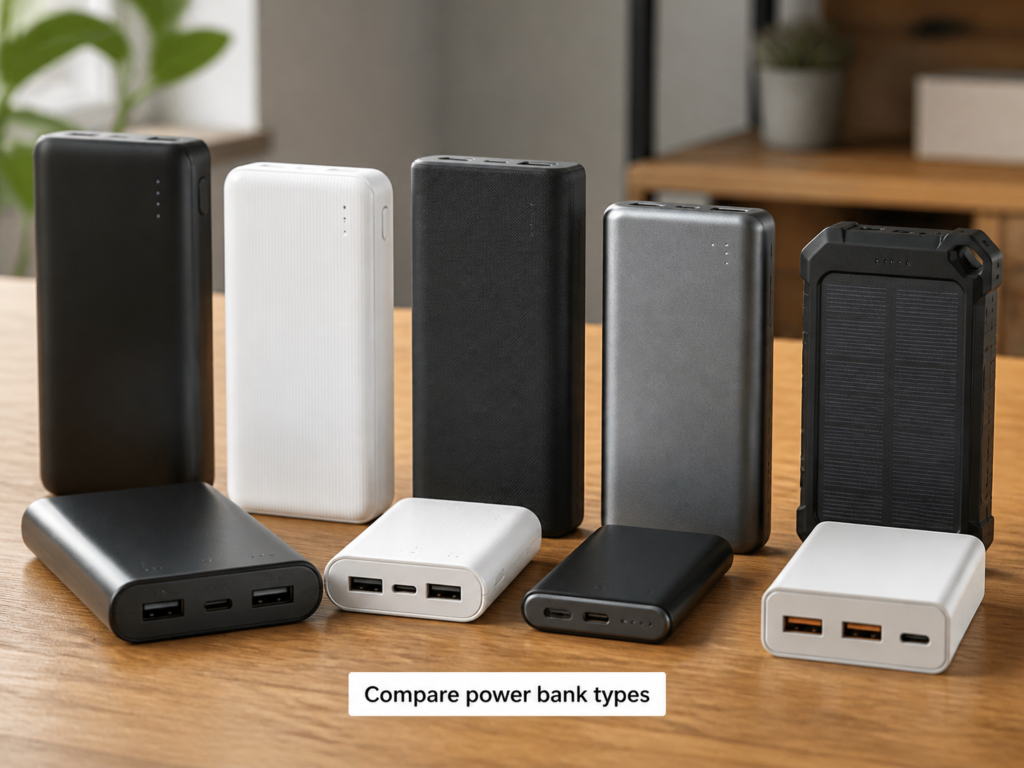
• Ordinary wired charging power banks: The core is to evaluate EMC and RoHS, then check whether LVD needs to be evaluated according to voltage, structure, and applicable scope;
• Those with radio communication functions such as Bluetooth, Wi-Fi, NFC: add the evaluation of the RED directive on the basis of the basic model;
• Those only with wireless charging function: cannot be deemed to be subject to RED just because of “wireless charging”; it must also be judged based on the specific wireless transmission, reception, and energy transmission methods;
• Those with special interfaces such as PD and fast charging: in addition to basic regulatory requirements, verification should also be carried out in combination with applicable harmonized standards, interface specifications, and product safety risks, such as USB-C PD related requirements;
• Those with AC pins, or car emergency start power supplies: need to evaluate whether LVD is triggered based on mains input, voltage range, product structure, and applicable regulations, and cannot only look at the USB output voltage;
• If it is a set of power bank + charger + cable: each component must be evaluated for compliance requirements separately, and a unified responsible entity must be clarified;
• If it is only a pure battery pack without charge and discharge management circuits: it does not belong to the category of power banks, and must be implemented in accordance with special regulations for pure batteries;
• Power banks for special purposes such as industrial, medical, and explosion-proof: whether the participation of an EU Notified Body (NB) is required should be judged based on applicable medical device, ATEX or other special regulations, as well as product classification and the selected conformity assessment module, and cannot be concluded directly based solely on the purpose.
What Does a Complete Set of CE Compliance Include?
Affixing a CE mark does not mean compliance. A complete set of CE compliance usually includes the following parts, and the specific content should be determined according to applicable regulations and product conditions:
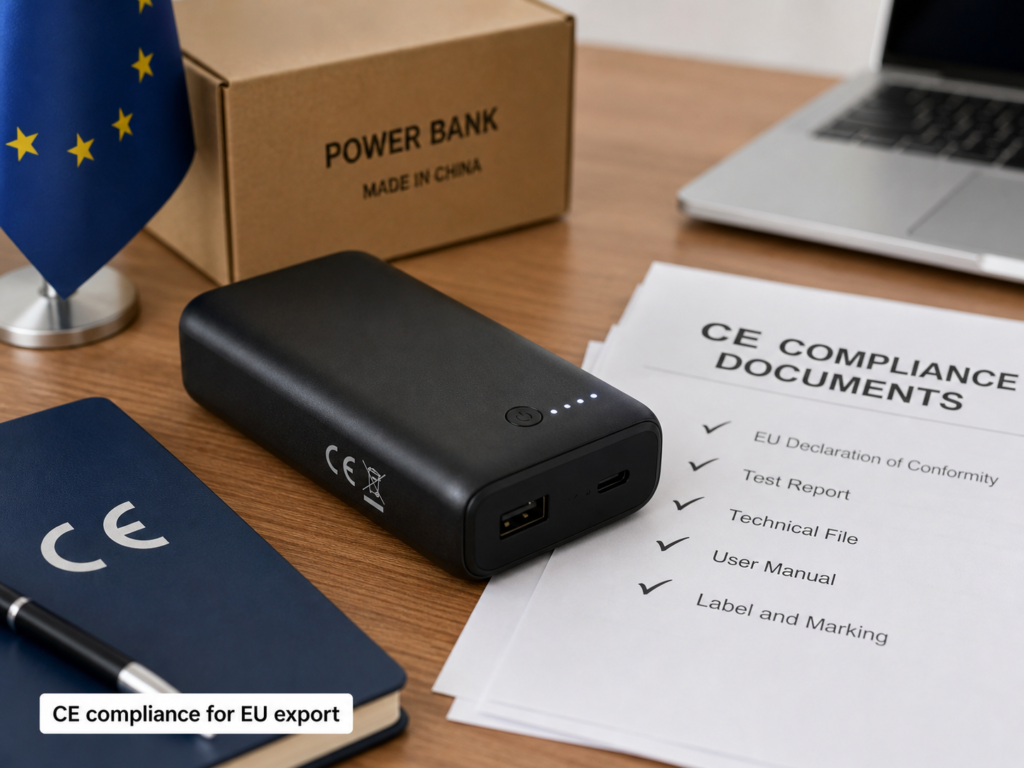
The first is the **EU Declaration of Conformity (DoC)**. This is an official declaration document, which in principle is signed by the manufacturer; an authorized representative can sign on behalf only when they have obtained written authorization and are within the scope of authorization. The document must list the specific model of the product, applicable regulations and harmonized standards, and information on the responsible entity. The declaration must clearly cover the products actually placed on the market, and cannot directly apply a general template that does not correspond to the product.
The second is the **Technical File**, which is equivalent to the “compliance file” of the product. It usually contains product description, circuit diagram, bill of materials (BOM), parameters of key components, risk assessment, test or other compliance evidence, instruction manual, label draft, etc. This document usually does not need to be shown to customers, but should be kept in accordance with applicable regulations; many regulations require it to be kept for at least 10 years after the product is placed on the market, and it must be available when required by regulatory authorities.
The third is **test or other compliance evidence**. The evidence should cover applicable regulations and product risks, with priority given to applicable EU harmonized standards. Testing can be completed by internal or external institutions with corresponding technical capabilities; ISO/IEC 17025 accreditation usually helps to prove laboratory capability, but it is not mandatory for all ordinary power banks when making CE self-declarations. Whether a notified body or specific qualification is required depends on the specific regulations and conformity assessment module.
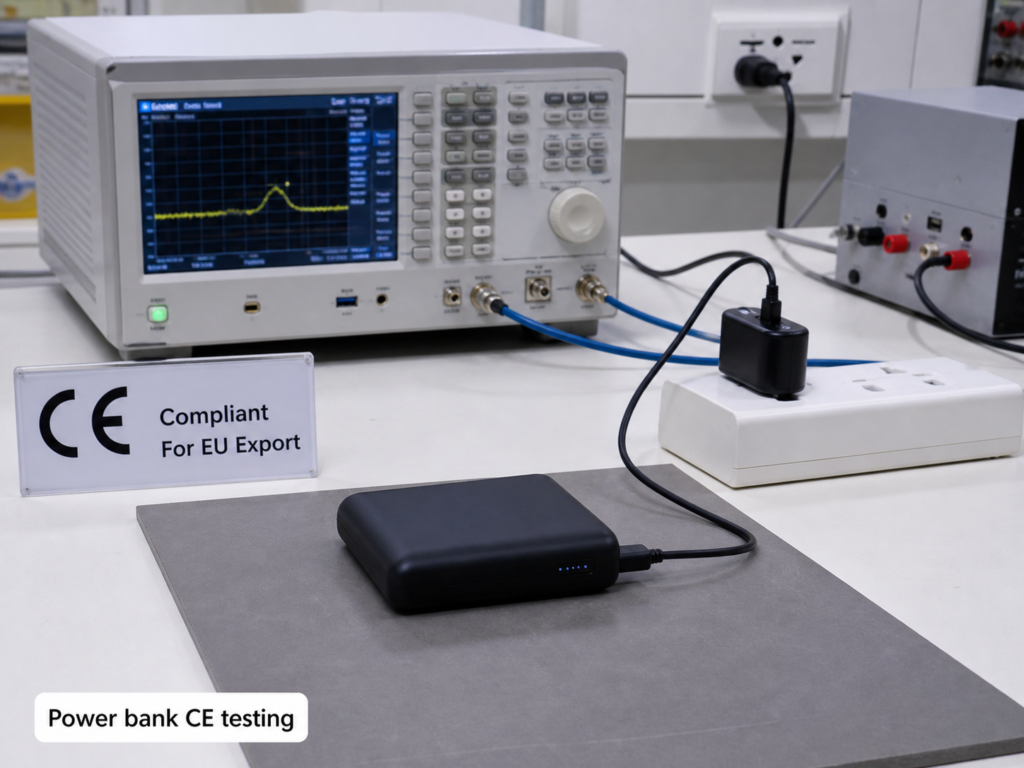
Test samples should be representative of the final mass-produced model, and cover the product’s functions, power, and working modes. You cannot test a low-config sample and then directly use it to cover models with significantly different structures, functions, or power.
Fourth is the **CE mark and product label**. The CE mark should usually be no less than 5 mm in height, maintain the specified proportion, be clearly visible, and be durable. Compliance stickers are not uniformly prohibited; the key is that they cannot be easily peeled off, erased, or misread, and at the same time must meet the labeling position requirements specified in specific applicable regulations.
On the product body or the smallest sales package, it is usually also required to mark the product model, production batch, manufacturer or other economic operator information, rated parameters, etc. in accordance with applicable regulations. The product manual should provide safety warnings and instructions for use in the language of the target sales country, and cannot only prepare an English version.
Fifth is the **economic operator within the EU**, which is what we often call the EU representative, importer, or other responsible entity required by regulations. If you are a manufacturer outside the EU, you should ensure that the corresponding economic operator within the EU performs statutory obligations in accordance with applicable regulations. The information of the manufacturer, importer, or authorized representative should be marked on the product, packaging, or accompanying documents in accordance with applicable regulations, and the specific content and position should be judged according to regulations.
Practical Judgment Steps: You Can Sort It Out Yourself
You don’t need to find a consulting firm. Follow these five steps, and you can sort out the compliance requirements of your product by yourself:
Step 1: First, judge whether your product belongs to the situation of “placing on the EU market”. The core standard is: whether the product is provided to the EU market in commercial activities through sales, gifting, trial use, etc. If it is personal non-commercial use, transit under customs supervision, or other situations that do not constitute commercial placement, it should be judged in combination with actual use and import method, and cannot be concluded solely based on quantity or a single scenario.
Step 2: List all parameters and functions of your product. Including battery type, rated capacity, input and output voltage and power, supported fast charging protocols, also confirm whether there are additional functions such as Bluetooth, Wi-Fi, NFC, wireless charging, lighting, etc. In addition, distinguish the power bank body from supporting accessories such as chargers and cables, because the compliance requirements for accessories may be different.
Step 3: Match applicable CE directives and parallel obligations. For basic wired models, first evaluate EMC and RoHS, then judge whether LVD needs to be evaluated according to voltage range, structure, and applicable scope; for those with radio functions such as Bluetooth, Wi-Fi, NFC, add RED evaluation; for those only with wireless energy transmission function, cannot directly apply RED. At the same time, don’t forget requirements that need separate confirmation such as battery regulation, WEEE, packaging law, and REACH.
Step 4: Check whether your existing compliance documents are valid. For example, whether the model, function, and test standard in the test or other evidence match the product you actually sell; whether the DoC and technical documents are complete, and whether the responsible entities on them are consistent; whether the CE mark, product label, and manual comply with applicable regulations.
Step 5: Confirm the responsible entity in the EU. Non-EU manufacturers should confirm the importer, authorized representative, or other economic operator within the EU in accordance with applicable regulations, and ensure that the responsible entity information in the product, packaging, DoC, and platform store can correspond to each other, and there should not be multiple contradictory entities.
After completing these five steps, compare against the necessary conditions for compliant export: all applicable CE regulations and parallel obligations have been identified, the conformity assessment required by applicable regulations has been completed, the DoC, technical documents, and evidence sufficient to prove conformity are ready, product labels, manuals, and responsible entity information are complete, and supporting obligations such as transportation and recycling are also implemented — only when all are met is it suitable to arrange export and sales.
Avoiding Common High-Frequency Misconceptions
These 9 misconceptions are pitfalls that many people have fallen into, so be sure to avoid them:
Cognitive Misconceptions
1. **Misconception: CE is only valid if a third-party organization issues the certificate**
Truth: Ordinary consumer-grade power banks usually allow manufacturer self-declaration, and there is no mandatory requirement to find a third party to issue a “CE certificate”. The core is to complete the conformity assessment required by applicable regulations, and prepare complete, authentic technical documents and compliance evidence corresponding to the product. Whether a notified body is required to participate depends on the specific product, special regulations, and assessment module.
2. **Misconception: CE is a quality certification, and having CE means the product is of good quality**
Truth: CE is only a conformity mark for the EU market, a declaration by the manufacturer that the product meets applicable regulations. It does not represent the product’s performance, durability, or quality level. Do not regard CE as a “quality endorsement”.
3. **Misconception: Getting CE done means all EU compliance is settled**
Truth: CE only corresponds to applicable EU harmonized regulations. Requirements such as battery regulation, WEEE, packaging law, and REACH still need to be confirmed separately according to product category, sales country, and specific effective time, otherwise there may still be compliance risks.
Practical Operation Misconceptions
4. **Misconception: If the battery has CE, the entire power bank has CE**
Truth: A power bank is a complete product, and compliance assessment of the whole machine is required. The relevant compliance documents of the battery can only be used as supporting materials for components or battery regulations, and cannot automatically replace the compliance verification of the whole machine.
5. **Misconception: Affixing the CE mark on the product means compliance**
Truth: The CE mark is only the external manifestation of compliance; the core is the technical documents, compliance evidence, and conformity declaration behind it. Without these supporting materials, just affixing a mark cannot prove that the product is compliant.
6. **Misconception: CE is valid for life once done**
Truth: CE does not have a unified fixed validity period, but if applicable regulations, harmonized standards, or the product itself changes, such as replacing the battery, modifying the circuit, or adding wireless functions, compliance needs to be re-evaluated, and it cannot be done once and for all.
Document Misconceptions
7. **Misconception: The general test report provided by the supplier can be used directly**
Truth: Whether the materials provided by the supplier can be used depends on whether they cover the model, function, and configuration of the product you actually sell, and whether applicable standards are adopted. If it is a general template, the model does not match, or only part of the functions are verified, it cannot be directly used as a complete compliance certificate.
8. **Misconception: A report tested with a low-config sample can cover high-power models**
Truth: Compliance evidence should cover the product’s working modes, power levels, and actual functions. For example, if you have a 100W fast charging power bank, you cannot test a 20W low-config sample and then directly use that document to cover the 100W model, unless you can fully prove its coverage scope based on applicable standards and technical analysis.
9. **Misconception: False capacity labeling does not affect CE compliance**
Truth: False capacity labeling may constitute information misleading, consumer protection, or battery regulation issues. If the actual capacity also causes protection, temperature rise, or other safety designs to fail to meet requirements, it may further cause product safety and CE conformity issues, which will ultimately be determined based on test results and regulatory investigations.
What Do Regulatory Inspections Check?
The focus of inspections at different stages is different, you can prepare accordingly:
• **Customs inspection**: Mainly checks whether there are obvious problems with the CE mark, conformity documents, and economic operator information. After finding problems, release may be suspended, supplementary or corrected documents may be required, sales may be banned, goods may be returned, or recall may be required; for serious products that cannot be rectified, measures such as destruction may also be taken in accordance with the law;
• **E-commerce platform inspection**: Usually requires sellers to upload DoC, test or compliance evidence, EU economic operator information, and compliance label certification materials. If they cannot be provided, listings may be removed, store permissions may be restricted, and in serious cases, funds may be frozen;
• **Member state market supervision inspection**: May randomly buy samples on the market for testing, verify the authenticity of technical documents, and the consistency between the product and the documents. If unqualified, fines, product recall, or market sales ban may be imposed; specific measures depend on local laws and product risks.
Final Summary
By now, you should have a clear answer to the question “Do power banks exported to the EU need CE?” After reading this content, you should have these three abilities:
First, you can quickly judge whether your situation requires CE — power banks provided to the EU market through commercial means usually need to complete conformity assessment and affix the CE mark in accordance with applicable regulations; but it still needs to be judged in combination with product structure, function, battery attributes, and sales scenarios, and cannot be concluded solely based on quantity or “whether it has been sold”.
Second, you can distinguish common misconceptions related to CE — you will no longer confuse CE with concepts such as third-party certificates, RoHS, WEEE, and UN38.3.
Third, you can independently sort out the compliance requirements of the product — you can match the corresponding regulations according to the product’s function, sales scenario, and battery category, and check the core compliance documents and the information of the economic operator within the EU.
CE compliance looks complicated, but as long as you sort out the logic and follow the steps, it’s actually not that difficult. The most important thing is not to take chances, nor be fooled by bad institutions to spend unnecessary money. According to your own product situation, properly implement the requirements of applicable regulations, technical documents, product labeling, transportation, and recycling, etc., so that you can enter the EU market more steadily.