
For cross-border sellers of charging products looking to expand to Amazon Korea, the first unavoidable compliance issue is KC and related regulations. Many sellers, due to not understanding the rules, either have their goods detained and returned by Korean customs, or have their listed Listings directly taken down, resulting in significant losses. In fact, Korean compliance is not as complicated as imagined; the key is to first determine which category of regulatory object the product falls into, then prepare documents according to the applicable system.
I. Essential Basics: Core KC Knowledge and Consequences of Non-Compliance
What Exactly is KC?
KC is not a single “unified certification” that all charging products must obtain. For products within the regulatory scope of Korea’s , sellers must complete the corresponding safety certification, safety confirmation, or supplier’s declaration of conformity before import, sale, or distribution. Products with wireless functions may also need to complete RRA conformity assessment in accordance with Korean radio regulations; some products may involve additional energy efficiency or standby power requirements.
KC-related systems are supervised or administered by the Korea Agency for Technology and Standards (KATS), while specific certification, testing, and declaration are completed by designated certification bodies, designated testing institutions, or suppliers as stipulated by law, respectively. Whether a certain compliance requirement needs to be fulfilled, and which procedure to follow, shall be determined based on product category, actual structure, rated parameters, and applicable regulations.
Whether Amazon requires sellers to upload KC documents is also not identical for all charging products. Specifically, it shall be subject to the current product compliance notices, help pages, and case-specific requirements displayed for that ASIN in the seller backend. Platform review and Korean statutory compliance are two separate matters: passing platform review does not mean the product has obtained permanent official compliance recognition from Korea; sellers still need to meet both platform requirements and obligations under Korean domestic regulations.
Differences Between KC and Other Common Certifications
Many sellers apply certifications from other markets to Korea’s requirements, which is a common misconception. Overseas certifications such as CE, FCC, and UL generally cannot directly replace the applicable safety certification or declaration in Korea; RoHS mainly controls hazardous substances and also cannot replace electrical safety requirements.
Ordinary third-party test reports themselves generally cannot replace the statutory KC procedure. Products falling within the scope of safety certification or safety confirmation shall have their testing and certification or confirmation procedures completed by the corresponding designated institutions; products falling within the scope of supplier’s declaration of conformity shall complete supplier self-confirmation in accordance with regulations and retain technical documents. If the product has wireless communication functions, it is also necessary to separately determine whether RRA conformity assessment is required, and radio compliance cannot be simply regarded as the same set of testing processes as electrical safety KC.
Two Types of Serious Consequences of Non-Compliance
The risks of non-compliance with KC or other applicable regulations come from two sides, both of which sellers should pay attention to:
• **Amazon platform side**: In mild cases, Listings are taken down and account performance points are deducted; in severe cases, inventory is forcibly removed, sales permissions are restricted, and even the operation of the entire store is affected.
• **Korean regulatory side**: Goods may face further inspection by customs or regulatory authorities after arriving at the port; if non-conformity is found in random inspections during market circulation, rectification, fines, or sales restrictions may be required, and in serious cases, recall of sold products may also be required.
The specific handling methods and consequences will be affected by product category, severity of the violation, sales status, as well as Korean regulatory and platform policies.
II. Quick Judgment: Does Your Charging Product Need KC?
The core basis for judging whether a product needs KC is the actual structure and parameters of the product, and conclusions must never be drawn solely based on product names such as “charging cable” or “adapter”.
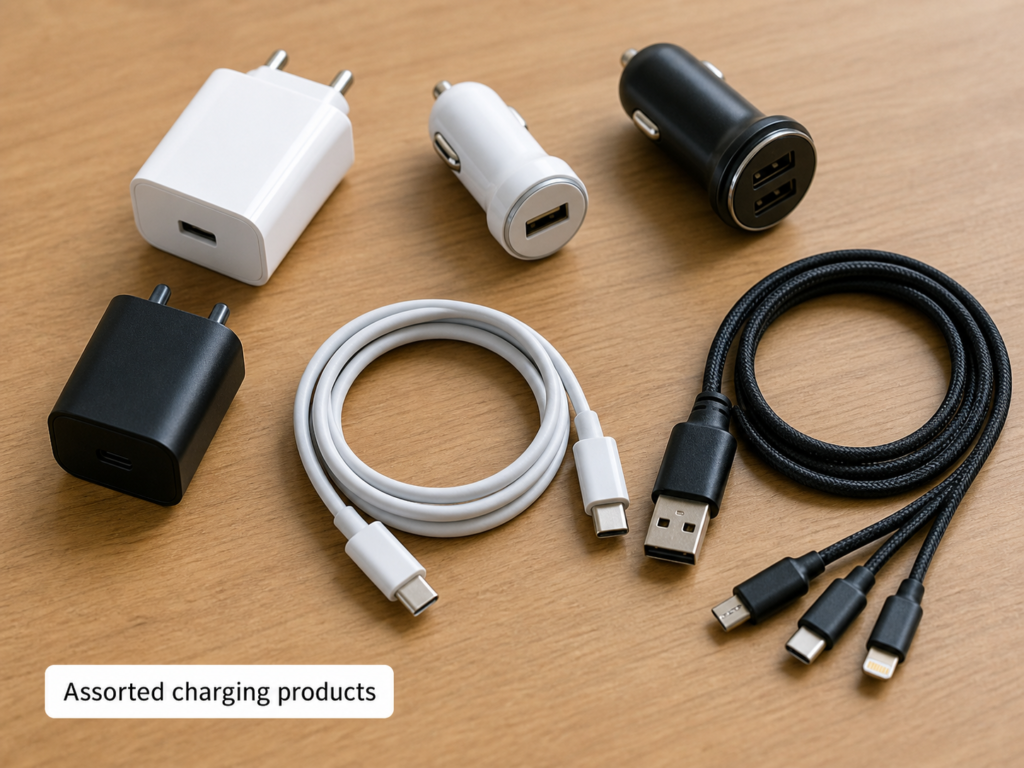
High-Probability Products That Mandate Key Verification
As long as any of the following conditions is met, priority should be given to verifying the applicable safety, radio, or energy efficiency systems in Korea:
1. **Products directly connected to Korean AC mains power**, such as power adapters, external chargers, wall chargers, and fast chargers, generally require key verification of their electrical safety regulatory category. Korean mains power is typically 220V, 60Hz, but the specific certification type cannot be determined solely by input voltage.
2. **Car chargers, cables with plugs, and other low-voltage products** cannot be judged solely by product name. It shall be confirmed whether they fall within the relevant regulatory scope based on actual circuits, input and output ratings, intended use, and official Korean product classification.
3. **Cables containing active electronic components**, such as USB/USB-C cables with built-in E-Marker chips, protocol conversion circuits, or power management circuits, shall be judged on a case-by-case basis in combination with rated input and output, product functions, and product classification. Having a chip does not automatically mean that the product is subject to KC safety certification.
4. **Products with wireless communication functions**, such as products with Bluetooth, Wi‑Fi, or other wireless transmission functions, generally require separate verification of RRA conformity assessment. Whether wireless charging products require RRA shall be confirmed based on operating frequency, transmission characteristics, and specific equipment classification, and cannot be generalized.
5. **Some power adapters or charging devices** may be subject to Korea’s standby power or energy efficiency management. Whether it is applicable shall be verified with the Korea Energy Management Corporation or the current competent authority in accordance with Korea’s current announcement catalog, product type, rated power, and other conditions, and cannot be judged solely by “high power”.
Borderline Products Requiring Further Confirmation
Some products are on the regulatory boundary, and conclusions cannot be drawn directly; official rules need to be verified:
• **Pure passive data cables or charging cables**: Cables without built-in chips that only support low-power charging or data transmission need to be confirmed against the official Korean product catalog, applicable standards, and rated parameters.
• **Adapters, extension cords, interface connectors**: Shall be judged based on structure, rated current, voltage, intended use, and whether they belong to wire products.
• **Set products**: For example, a combination of a charger and a charging cable, each live component shall be individually judged for applicable compliance requirements, and it cannot be assumed that the entire set only needs one declaration.
It should be particularly noted that active components, E-Marker, or USB-C fast charging capability do not automatically determine that a product is subject to KC safety certification. E-Marker is a protocol or capability identification component in the USB Type-C ecosystem; whether testing is required and what content is tested depends on the applicable Korean safety standards and product classification.
Accessories That Do Not Require KC at All
Non-electrical accessory parts that are not energized, such as packaging, manuals, storage bags, stickers, etc., generally do not require KC certification. However, it should be noted that exemption of accessories from certification does not mean the main product is exempt. When sold together with energized products, the main product still needs to complete compliance in accordance with applicable regulations.
Two-Step Quick Judgment Method
New sellers do not need to memorize the rules by rote; they can follow these two steps:
Step 1: First check whether the product is directly connected to Korean mains power, whether it has active electronic components, whether it has wireless transmission functions, and whether it may be subject to energy efficiency management. When any one of these is met, priority should be given to compliance classification, rather than directly assuming it “must be done” or “is exempt”.
Step 2: If unsure, you can seek a pre-assessment from KATS-related designated institutions or institutions with corresponding qualifications, and it is best to obtain a written classification opinion. Do not readily believe the supplier’s verbal promise that “it is not needed”; when problems actually occur, the losses are usually borne by the seller.
III. Detailed Rules: KC Compliance Models and Core Requirements
Korea has established systems such as electrical appliance safety certification, safety confirmation, and supplier’s declaration of conformity for different product categories. EMC, radio, and energy efficiency requirements may fall under separately applicable regulations or systems. Therefore, KC is not a unified certificate applicable to all charging products.
Comparison of Three KC Compliance Models
The three main safety systems have different application methods and responsibilities, and the specifics shall still be subject to product announcements and the judgment of designated institutions:
| Compliance Model | Applicable Basis | Core Requirements | Factory Inspection and Document Form |
| Safety Certification | Product categories included in the scope of safety certification according to law | Usually includes testing by designated certification bodies, certification, and production consistency management | Some products involve factory inspections, and certification documents are usually issued |
| Safety Confirmation | Product categories included in the scope of safety confirmation according to law | Usually requires testing by designated testing institutions, and declaration by the responsible subject according to law | Whether it involves follow-up management and declaration shall be implemented in accordance with current regulations |
| Supplier’s Declaration of Conformity (SDoC) | Product categories included in the scope of supplier’s declaration of conformity according to law | The supplier self-confirms compliance with applicable standards and retains technical documents | Certificates are not issued in the same form as KC certificates, but are subject to follow-up supervision or random inspections |
These three systems are not simply divided according to “high risk, medium-low risk, very low risk”. The specific applicable model is not chosen by the seller themselves, nor can sellers deliberately apply for a lower grade to save money; it shall be subject to Korea’s current product announcements and the judgment of KATS-related designated institutions.
Core Testing Requirements for Charging Products
The electrical safety system mainly revolves around applicable safety items, and common contents include:
• **Electrical safety**: Electric shock protection, insulation performance, withstand voltage, temperature rise, abnormal operation, flame retardant performance of enclosures and cables, etc.;
• **Structural and use safety**: Some products may involve applicable items such as interfaces, plugs, mechanical strength, plugging/unplugging, or bending;
• **Product-specific items**: Verify corresponding protection functions and safety characteristics based on product category, interface, circuit, and rated parameters.
Cables containing E-Marker, protocol conversion, or power management circuits shall be judged in combination with the specific product classification. If they are subject to relevant safety management, items such as electrical safety, abnormal operation, and interfaces shall be verified in accordance with applicable standards. E-Marker parameter verification shall not be described as a unified mandatory testing item for all KC cables.
EMC and radio conformity also need to be judged separately. Whether a product falls within the scope of Korean broadcasting and communication equipment or other applicable regulations depends on its functions, transmission methods, and technical characteristics. Obtaining electrical safety KC documents does not automatically mean that EMC or RRA compliance has been completed.
Samples used for testing shall be consistent with the final mass-produced sales version in terms of models covered by the certificate, key structures, key components, and safety characteristics. Engineering prototypes or modified samples cannot directly represent the mass-produced version. If changes occur subsequently, a change assessment shall be conducted first, rather than directly using the original documents.
KC Labeling and Localization Requirements
Obtaining certification or completing the corresponding declaration is only part of compliance; the labeling and localization information on the product must also be implemented in accordance with the specific system.
Sellers shall verify the KC mark and required information such as model, rated value, manufacturer, and importer in accordance with the safety system, announcements, and standards applicable to the product.
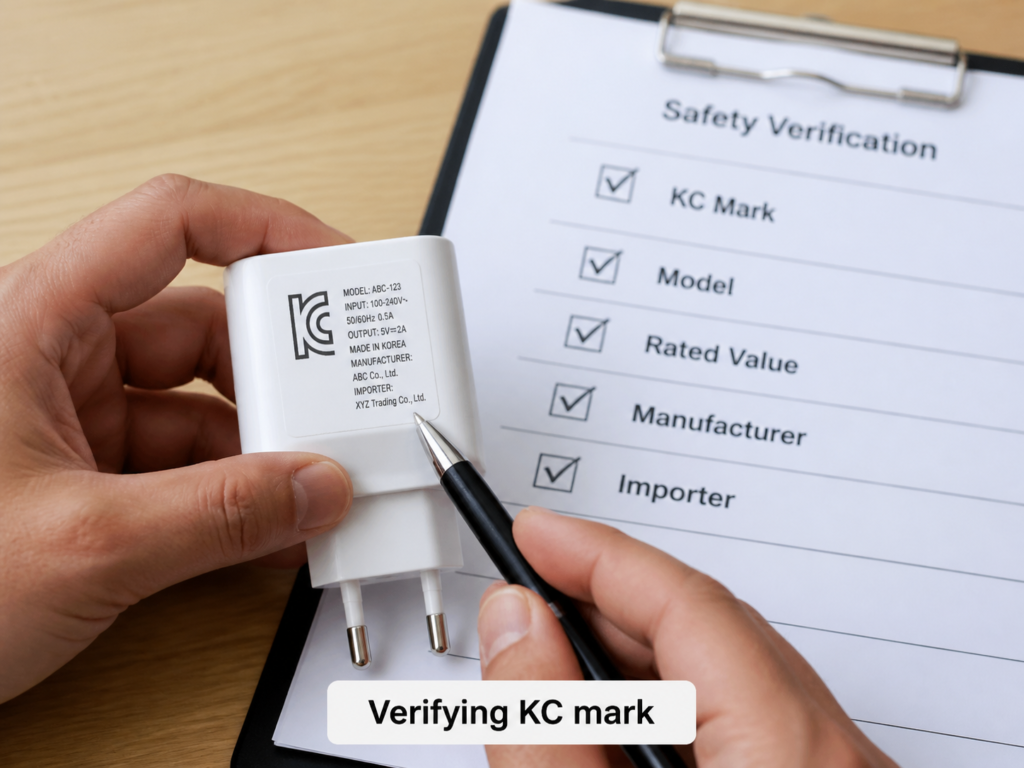
The certification number, mark position, and whether it needs to be displayed on the product body or the minimum sales package will also vary depending on the system and product category, and a single set of absolute requirements cannot be applied to all charging products.
The plugs used in chargers, rated input and output parameters, product models, and label information shall be consistent with the Korean sales version and declaration documents. Whether safety warnings, instructions for use, and other consumer notices must be in Korean shall also be verified based on product category, Korean labeling rules, and platform page requirements; for products sold to Korean consumers, preparing clear and accurate Korean information is usually more prudent.
Requirements for Korean Local Responsible Entities
For imported products, the manufacturer, importer, applicant, subject of the supplier’s declaration of conformity, and their responsibilities usually need to be determined in accordance with the specific system. Whether it is mandatory for a Korean domestic entity to apply, hold the certificate, or assume specific obligations shall be confirmed based on product category and current regulations, and it cannot be simply asserted that all KC-related products must have a Korean agent or importer as the certificate holder.
If Amazon has additional requirements for Korean responsible entity documents for a certain ASIN, the seller also needs to meet the platform requirements at the same time. When using compliance documents from suppliers or Korean partners, it is recommended to clarify in the contract the responsibilities such as the scope of use of the certificate or declaration, product changes, renewal, document provision, product delisting, and regulatory response, to avoid disputes later.
IV. Full Certification Process: Complete Steps from Preparation to Obtaining the Certificate
The Korean compliance process varies depending on product category and system, but it can generally be advanced in the order of “preparing documents – confirming classification – testing or declaration – verifying documents – continuous maintenance”.
Pre-Preparation: Materials, Samples, Institutions
Before certification or compliance assessment, three types of core content must be prepared first:
• **Materials**: Product specifications, bill of materials (BOM); for chargers, circuit schematics, key component information, factory qualification documents, production address, etc. are usually also required;
• **Samples**: Provide samples as required by the institution. Samples should be as consistent as possible with the final sales version, especially in terms of model, power, circuit, plug, interface, and key components;
• **Institution selection**: When safety certification or safety confirmation is involved, the corresponding designated certification body or designated testing institution shall be selected, and institutions with experience in charging accessories shall be given priority. Do not look for institutions that can only issue general test reports but cannot complete the corresponding statutory procedures.
If the product falls within the scope of the supplier’s declaration of conformity, it does not necessarily need to be handled by “applying for a certificate”, but the supplier shall still complete conformity confirmation in accordance with applicable standards and retain the required technical documents.
Product Classification and Scheme Confirmation
After submitting the prepared documents to the relevant institution, the institution will determine the applicable compliance system, testing standards, and declaration scope based on the product structure, rated parameters, and functions.
Key points to confirm in this step:
• Whether the product is subject to safety certification, safety confirmation, supplier’s declaration of conformity, or other regulatory systems;
• Whether the product’s rated input and output, interfaces, intended use, and structure are consistent with the classification judgment;
• Whether multiple models, different powers, or different interfaces can be included in the same product series or document scope;
• Whether the applicant, manufacturer, importer, production factory, and key components need to be included in the relevant documents.
If the product has Bluetooth, Wi‑Fi, wireless charging, or other wireless functions, it should also be separately confirmed whether RRA is involved. If it may be subject to energy efficiency or standby power management, the current announcement catalog should also be separately verified.
Testing and Rectification
For products that require testing, samples will be tested by the corresponding institution in accordance with applicable standards. If they are unqualified, the institution will provide rectification suggestions. Rectification issues that charging products may encounter include insulation, temperature rise, abnormal operation, flame retardancy, structural strength, interface safety, or changes to key components, etc.
If E-Marker is involved, it shall be verified whether its parameters are consistent with the actual functions of the product, but this item should not be understood as a unified KC testing requirement automatically applicable to all USB-C cables.
After rectification is completed, whether it is necessary to resubmit samples, conduct supplementary testing, or submit change documents shall be implemented in accordance with the requirements of the institution. Do not directly apply for certification after modifying the product on your own without obtaining confirmation from the institution, otherwise it may cause inconsistency between the documents and the mass-produced product.
Factory Inspection (May Be Required for Some Safety Certifications)
Some safety certification products may involve factory inspection or production consistency management, and not all safety confirmation or supplier’s declaration of conformity products uniformly require factory inspection.
If the product involves factory inspection, the certification body will usually focus on the quality system, production records, quality inspection processes, procurement of key components, and production consistency. Mass-produced products shall be consistent with the certified or tested samples in terms of models covered by the certificate, key structures, key components, and safety characteristics.
If key components, production factories, or product structures are replaced, a change assessment shall first be conducted in accordance with the requirements of the certification body and regulations to determine whether supplementary testing, change declaration, or re-certification is required, rather than requiring all details to be “completely consistent” under any circumstances.
Information Verification After Obtaining Documents
After testing, certification, or declaration is completed, certification documents, confirmation documents, declaration records, or supplier’s declaration of conformity and technical materials corresponding to the specific system shall be obtained.
After obtaining the documents, it is recommended to focus on verifying:
• Product model and product series;
• Rated input and output parameters;
• Information of manufacturer, applicant, importer, and production factory;
• Key components and product structure;
• Variants, brands, or sales versions covered by the document;
• Information on labels, packaging, and manuals.
These contents should be able to cover the actual sold products. The document forms and information items of different systems are not completely the same, and all documents cannot be treated as “KC certificates”. Relevant materials should be properly stored for use in Amazon reviews or Korean regulatory random inspections.
Logic for Estimating Cost and Cycle
There is no fixed figure for the cost and cycle of KC and related compliance, which are mainly affected by the following factors:
• The compliance system applicable to the product;
• Number of models and product series;
• Whether testing by a designated institution is required;
• Whether rectification or supplementary testing is needed during testing;
• Whether it involves factory inspection, RRA, or energy efficiency requirements;
• Institution scheduling and document preparation status.
Incorporating Korean requirements into the design during the new product development stage can reduce the cost of later modifications to circuits, materials, plugs, and labels. When products or the supply chain change, a compliance assessment should also be conducted first before adjusting production.
V. KC Document Submission and Review for Amazon Korea Site
After obtaining the relevant compliance documents, you also need to submit materials in accordance with the requirements put forward by Amazon for specific ASINs. The platform entry, required documents, whether proactive pre-review of new products is supported, and the review time limit may all change depending on the category, product attributes, site, and specific case.
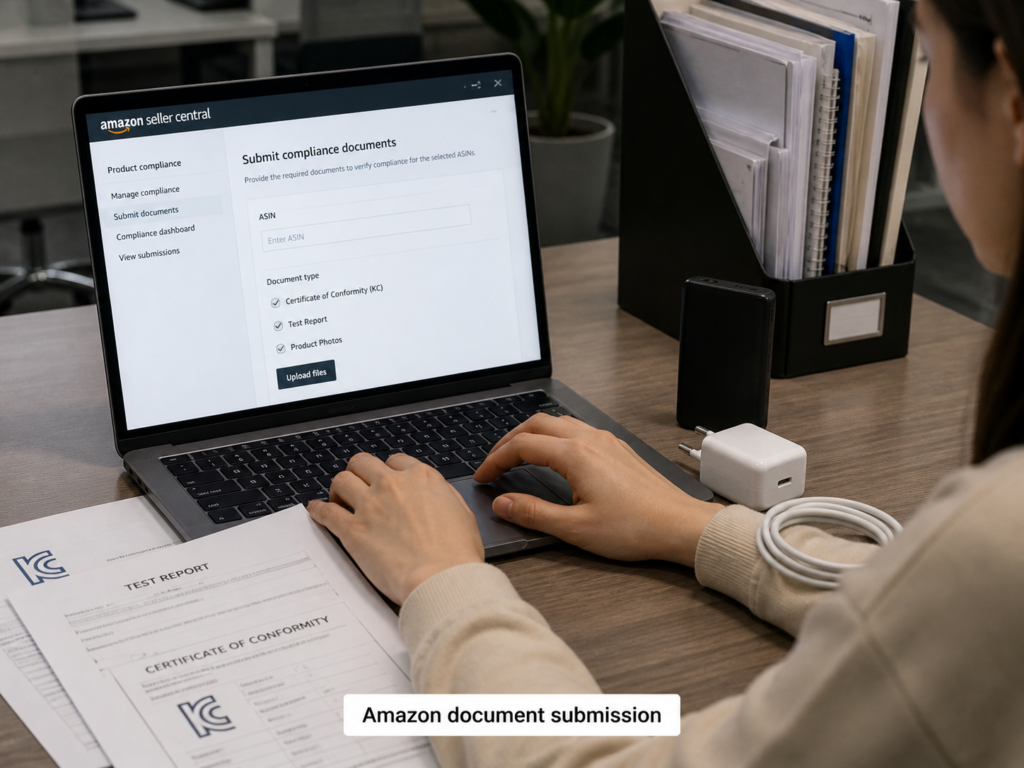
Two Scenarios Where Documents Need to Be Submitted
KC or other product compliance materials are usually required in the following scenarios:
• **Proactive submission or pre-listing preparation**: Some ASINs may receive product compliance document requirements before listing or sale, and sellers shall submit them as prompted in the backend;
• **Reactive submission**: When encountering platform random inspections, consumer complaints, Listing delisting, or restricted sales permissions, the platform may require supplementary documents to be submitted within a specified period.
Whether you can proactively upload before new product listing and whether it will be reviewed in advance shall be subject to the functions and notifications displayed for that ASIN in the seller backend. Submitting materials does not mean that sales permissions will necessarily be obtained immediately.
Key Points for Backend Upload Operations
The specific entry, document type, and upload steps shall be subject to the product compliance page and Amazon help page currently displayed in the seller backend.
Prepare the corresponding materials as required by the ASIN:
• Safety certification or safety confirmation documents;
• Supplier’s declaration of conformity and related technical materials;
• Testing materials required by the platform;
• Pictures of the product, label, or packaging;
• Manuals and safety warning information;
• Materials of the manufacturer, importer, or other responsible entities.
“KC certificate scan, complete test report, real photo with KC mark, Korean manual” cannot be regarded as unified mandatory materials for all ASINs. The document forms of different KC systems are different, and products under the supplier’s declaration of conformity may not have a KC certificate in the traditional sense. Supplementary documents such as complete test reports shall only be submitted when explicitly required by the platform.
When filling in information such as certification number, product model, issuing or testing institution, manufacturer, and importer, it shall be consistent with the actual compliance documents and the product. If it is a set of charger plus charging cable, the compliance documents of each live component shall be verified separately according to platform requirements, and only the overall picture of the set cannot be uploaded to replace all documents.
Troubleshooting and Appeal for Failed Review
If rejected, you shall troubleshoot item by item according to the specific reasons listed by the platform, and do not directly re-upload the original documents. You can focus on verifying:
1. **Product classification and document type**: Confirm that the submitted documents are the safety certification, safety confirmation, supplier’s declaration of conformity, or other regulatory documents applicable to the product;
2. **Model and parameters**: Verify the product model, rated input and output, number of interfaces, power, and Listing description;
3. **Information of manufacturer, applicant, importer, and factory**: Confirm that the relevant entities and document coverage are consistent with the actual sold products;
4. **Institution qualification or document status**: If the platform requires documents from a designated institution, confirm that the institution’s qualification and the documents are still in applicable status;
5. **Label, packaging, manual, and plug specifications**: Verify according to the product’s regulatory classification, applicable standards, and platform notices;
6. **Document validity status**: Confirm whether the document is expired, revoked, and applicable to the current model and production version.
Common case-specific issues may include inconsistent models, mismatched rated parameters, wrong document type, unclear label pictures, missing responsible entity information, or documents that cannot prove the current product coverage. When appealing, corresponding explanations and evidence shall be provided for each rejection reason, and submission records and case numbers shall be retained for subsequent follow-up.
VI. Advanced Pitfall Avoidance: Common Misconceptions and Continuous Compliance
KC and related compliance do not end forever after uploading documents once. When products, factories, document systems, and platform requirements change, reconfirmation may be required.
Clarification of Common Compliance Misconceptions
First, clarify several common pitfalls:
1. **Self-shipping or small batches definitely do not need KC**: Wrong. FBA, self-shipping, or general sales volume usually do not automatically exempt from applicable KC obligations. However, Korean regulations may provide exceptions or exemptions for specific uses such as personal use, samples, research and development, and exhibition, and sometimes require prior confirmation, declaration, or proof. Small-batch sales cannot be directly regarded as exempt from certification.
2. **Models with similar appearances can share documents**: Not necessarily. Changes in power, circuit, interface, core chip, housing material, production factory, or other key conditions may affect the document coverage. Whether they can be shared shall be subject to the judgment of the certification body or relevant regulations.
3. **All KC documents have a fixed validity period**: Inaccurate. Some safety certification or safety confirmation documents have statutory validity periods or maintenance requirements; for the supplier’s declaration of conformity, product conformity shall be continuously maintained and technical documents shall be retained as required. The specific period and renewal requirements shall be confirmed according to product category.
4. **Passing platform review means everything is fine**: Wrong. Amazon review is only part of the platform’s risk control; Korean customs and market regulatory authorities may still conduct inspections in accordance with the law, and re-evaluation is also required after product changes.
5. **Products can be listed while certification application is in progress**: For products that are required by law to complete safety certification, confirmation, or declaration before sale or distribution, the acceptance of certification application or ongoing testing usually cannot replace the final compliance documents. Whether the platform accepts materials under application shall be subject to the specific notice of that ASIN.
Method for Judging the Coverage of Certificates or Compliance Documents
To judge whether a document can cover the current product, you cannot only look at the model on a single certificate. You shall verify according to the applicable system:
• Product model, product series, and rated input and output;
• Manufacturer, applicant, or importer;
• Actual production factory;
• Key components and product structure;
• Brands, variants, and product scope approved or declared in the document;
• Product information on labels, packaging, and sales pages.
If there are differences in brands or models, or if the supplier provides series documents, written confirmation of the coverage from the certification body or the platform shall be obtained. When using supplier documents, it is also necessary to confirm whether the documents authorize the seller to use them, and whether they cover the current production factory and current mass-produced version.
The materials of the parent ASIN also cannot automatically cover all child variants. Each child variant shall be verified one by one for model, rated parameters, and document coverage.
Trigger Scenarios That Require Re-evaluation of Compliance
When the following changes occur to the product or supply chain, you should first seek assessment from the relevant designated institution or professional institution:
• **Hardware changes**: Replacement of core chips, power devices, circuit designs, housing materials, or plug specifications;
• **Parameter changes**: Adjustment of output power, number of interfaces, or supported fast charging protocols;
• **Supply chain changes**: Replacement of manufacturer, production factory, brand, or change of responsible entities such as applicant and importer;
• **Packaging and labeling changes**: Modification of product model, label information, product series, or compliance marks.
The assessment result may be no action needed, supplementary testing, change declaration, renewal, or re-certification, which cannot be generalized.
Archive Management Method for Continuous Compliance
Good compliance archive management can help sellers quickly respond to platform reviews and regulatory random inspections:
Relevant documents shall be stored by ASIN or product model, including certification or confirmation documents, supplier’s declaration of conformity, testing materials, label drawings, packaging drawings, manuals, manufacturer and importer materials, and Amazon submission records.
Also record:
• Applicable system and product scope of the document;
• Validity period, renewal, or technical document retention requirements;
• Product and supply chain change dates;
• Applicable market;
• Contact information of the certification or testing institution;
• Relevant platform case number and submission time.
When suppliers need to replace raw materials, chips, or other components, they shall first synchronize the information and assess the impact on compliance documents, and adjust production only after confirming the change procedures that need to be performed.
Compliance Decision-Making Tips for Borderline Products
For uncertain products such as pure passive cables, adapters, and low-voltage car chargers, the safest method is to seek a pre-assessment from KATS-related designated institutions or institutions with corresponding qualifications, and it is best to obtain a written classification opinion.
Do not hold the fluke mentality of “list first, make up later if caught”. Confirming the product classification, applicable system, and platform document requirements first is usually safer than delisting, cargo detention, or rectification due to insufficient documents after the product is launched.
VII. Quick Start Summary of KC Compliance for Charging Product Sellers
Finally, the core points are organized into actionable content for your quick verification before listing.
Pre-Listing Quick Checklist
Confirm the following items one by one, which can basically cover most basic compliance risks:
1. It has been confirmed whether the product falls within the regulatory scope of Korean electrical appliance safety, radio, or energy efficiency;
2. It has been confirmed whether the applicable system is safety certification, safety confirmation, supplier’s declaration of conformity, or other regulatory systems;
3. The compliance documents cover the currently sold models, rated parameters, manufacturer, applicant or importer, production factory, and key components;
4. The parameters of the product, packaging, manual, and Listing are consistent, and the labels and Korean information meet specific regulatory and platform requirements;
5. All documents required by Amazon have been prepared and verified in accordance with the current notice of that ASIN;
6. If the product has Bluetooth, Wi‑Fi, or other wireless functions, the RRA requirements have been separately confirmed;
7. If the product may be subject to standby power or energy efficiency management, the current Korean announcement catalog and applicable conditions have been verified.
Tasks That Can Be Completed Independently After Learning
After reading this content, you can already independently handle most of the basic KC compliance work:
• Preliminarily judge whether products such as chargers, power adapters, and USB cables need further verification of Korean safety regulations;
• Distinguish between safety certification, safety confirmation, and supplier’s declaration of conformity, and understand their differences from CE, FCC, and RoHS;
• Check document coverage by model, parameters, manufacturer, applicant or importer, factory, and key components;
• Prepare and submit corresponding product compliance materials according to the notice of Amazon’s specific ASIN;
• Identify high-risk issues such as incorrect product classification, insufficient document coverage, inconsistent labels, and incomplete platform materials.
Korean compliance may seem trivial, but in fact, as long as you first determine the applicable system for the product, then prepare documents consistent with the actual product, and continuously manage changes, most listing and sales risks can be reduced. Compared with remedial measures afterwards, clearly verifying product classification, document scope, and platform requirements in the early stage is a more prudent way to expand the Korean market.