
Many sellers of chargers and USB-C cables fall into the same pit when they first launch on Amazon Australia: just a couple of days after their products go live, they receive a platform notification stating that RCM compliance proof is missing, and the products are immediately taken down. Many people’s first reaction is: What is RCM? Can’t my CE/FCC/3C reports work? Is it enough to just get an RCM certification from an agency?
In fact, the pitfalls of RCM go far beyond these — it is not a standalone certification, but a unified compliance mark commonly used for electrical products in Australia and New Zealand, mainly used to indicate that the product has met applicable ACMA and/or EESS requirements. Some products must also additionally meet GEMS energy efficiency requirements, and GEMS registration cannot be replaced by the RCM mark. Charging products, in particular, are a high-priority category for Australian regulation and platform spot checks; a slight oversight can lead to pitfalls.
In this article, we will start from the most basic definitions, cover applicability judgment, compliance requirements, and platform submission processes for charging products, as well as rejection responses and long-term maintenance, to thoroughly explain all key points of RCM for Amazon Australia. New sellers can get started after reading, and experienced sellers can also avoid many hidden pitfalls.
1. First, Understand RCM: The “Compliance ID” for Australian Electrical Products
Many people, when first hearing about RCM, treat it as a “certification” like CE and FCC. In fact, this understanding is wrong from the root.
What Exactly is RCM
RCM is a common compliance mark for electrical products in the Australian and New Zealand markets. **It is not a standalone certification program, but a unified mark used after the product meets applicable regulatory and technical requirements.** Simply put, a product must first meet applicable requirements such as electrical safety, EMC, or radio requirements according to its own situation, and some products must additionally meet GEMS energy efficiency requirements, before the RCM mark can be used in accordance with regulations.
Therefore, RCM is more like a “compliance ID” than a standalone exam. Whether a product can use the RCM mark cannot be determined solely by whether there is a document called an “RCM certificate”, nor can the RCM mark replace GEMS registration or other legal obligations.
Who Manages RCM? 5 Entities to Distinguish
Many sellers cannot figure out Australia’s regulatory structure, wasting a lot of time by contacting the wrong department or asking the wrong person. In fact, there are several entities related to RCM, each in charge of their own area:
• **The RCM mark itself**: This is the unified compliance label, which cannot be printed arbitrarily. It must correspond to real safety, EMC, or radio compliance evidence, as well as other applicable requirements.
• **ACMA (Australian Communications and Media Authority)**: Manages compliance of electromagnetic compatibility (EMC) and radio products, for example, whether your charger will interfere with other electrical appliances. Products with radio functions such as Bluetooth and wireless charging may also need to meet additional ACMA radio requirements. ACMA is also responsible for rules related to marks and supplier information.
• **EESS (Australia-New Zealand Electrical Equipment Safety Regulatory Framework)**: Manages electrical safety, for example, whether a charger will leak electricity or overheat and catch fire. It classifies different levels according to equipment category and risk, and involves requirements such as responsible suppliers, equipment registration, certificates of conformity, and market spot checks.
• **GEMS (Australian Greenhouse and Energy Minimum Standards Scheme)**: Manages energy efficiency requirements for designated products. GEMS is an independent energy efficiency regulatory system. Whether it applies must be judged based on specific product categories, parameters, uses, and exclusions. GEMS registration cannot be understood as part of RCM.
• **Amazon Australia**: May require sellers to submit documents, restrict sales, or remove products in accordance with platform policies. Australian regulations require suppliers or responsible entities to ensure product compliance; Amazon’s platform review does not replace sellers’ legal compliance responsibilities.
Key Terms You Must Understand
These terms will be mentioned frequently when explaining rules later. Understanding them first will prevent confusion:
• **Declaration of Conformity (DoC/SDoC)**: This is not a report issued by a laboratory, but a “compliance guarantee letter” signed by the responsible party itself. It is equivalent to the responsible party confirming in writing that the product meets applicable requirements and assuming corresponding responsibilities.
• **EESS Supplier Registration Number**: The responsible supplier must complete supplier registration in accordance with EESS rules. Level 3 equipment usually also requires a valid Certificate of Conformity and completion of applicable equipment registration. The supplier registration number is not equivalent to high-risk product certification.
• **ACMA Supplier Identification Information**: According to applicable ACMA rules, suppliers, manufacturers, importers, or other relevant responsible parties may need to provide corresponding identity information or records.
• **EESS Risk Classification (Level 1/2/3)**: Levels classified according to equipment category and electrical safety risk. The higher the level, the more compliance evidence and registration requirements are usually required, but the level cannot be directly inferred solely from the product name or power.
Why Does Amazon Require RCM Documents?
Australian regulations require suppliers or responsible entities to ensure that products meet applicable requirements; Amazon may conduct document reviews, restrict sales, or remove products for specific ASINs or categories in accordance with its own platform policies.
Therefore, if documents are insufficient or products do not meet platform requirements, situations such as product removal, listing restrictions, or affected selling privileges may occur. Passing Amazon’s platform review does not mean that the product permanently meets Australian regulations; it may still be subject to official spot checks, complaint handling, or other platform policies in the future.
Charging products, in particular, are a high-priority category for Australian regulators and Amazon because they usually involve electrical safety and electromagnetic compatibility risks. Sellers should not rely on luck to sell.
6 Common RCM Misconceptions for New Sellers
These are lessons learned by countless sellers at great cost; avoiding them in advance can save a lot of money:
1. **RCM ≠ SAA certification**: Many new sellers think that getting SAA certification is equivalent to RCM. In fact, SAA usually refers to safety testing or certification services, which mainly address the electrical safety part. Products may also need to meet EMC, radio, or other applicable requirements before the RCM mark can be used in accordance with rules.
2. **Having the RCM mark does not mean you can skip platform review**: You can’t just print the RCM mark on the product and list it; Amazon may also require submission of the underlying compliance evidence. The two cannot be confused.
3. **Not all electronic products require RCM**: Low-risk passive products, such as purely mechanical products without any electronic components, may not fall within the relevant regulatory scope. The specific judgment must be made in combination with ACMA, EESS, and other applicable rules.
4. **CE/FCC/3C reports cannot directly replace local Australian requirements**: Compliance documents from other regions such as CE and FCC cannot automatically replace applicable Australian requirements. Reports issued by overseas accredited laboratories may be accepted, but their accreditation scope, applicable Australian standards or equivalent standards adopted, report coverage, and Amazon’s current document requirements must be confirmed.
5. **The RCM mark and supplier information cannot be handled arbitrarily**: In addition to the RCM mark, the required responsible supplier identification information must be marked in accordance with applicable ACMA and EESS labeling rules. Acceptable names, trademarks, codes, or registration information, as well as the marking position on the product body, nameplate, or packaging, must be confirmed item by item according to the official requirements of the corresponding regulatory system.
6. **USB-C cables with E-Marker chips do not necessarily require EMC**: EMC judgment cannot be based solely on whether there is an E-Marker chip, but on whether the product has active electronic circuits, data, or signal functions that affect the judgment. When in doubt, it is recommended to find a qualified compliance service provider for pre-assessment.
2. Does Your Charging Product Need RCM? Judge in 3 Steps
After understanding the basic concepts, what you care about most is definitely: do the chargers, data cables, and adapters I sell need RCM? In fact, as long as you clarify the regulatory boundaries and then compare them with product attributes, you can basically make a judgment.
First, Understand: RCM Regulatory Boundaries and General Exemptions
RCM-related requirements cannot be uniformly judged by just a voltage number. Purely passive products that are below the EESS voltage range and do not fall into other regulated categories are usually not EESS equipment; however, whether they need to meet ACMA EMC or radio requirements must still be judged separately, and exemption from RCM-related requirements cannot be directly determined solely by voltage.
Generally speaking, you can first focus on two aspects:
• Whether the product falls within the scope of EESS electrical equipment;
• Whether the product generates electromagnetic interference, has radio functions, or falls into other equipment categories under ACMA jurisdiction.
Products with purely mechanical structures and no electronic components usually do not involve electrical safety or EMC equipment requirements. But “low voltage” does not automatically equal “full exemption”; it also needs to be judged in combination with whether the product has active circuits, data transmission, identification functions, or wireless functions.
In addition, a special reminder: **Amazon platform requirements may be stricter than local Australian regulations**. For some borderline categories under regulations, the platform may also require submission of photos, specifications, or other compliance documents. Therefore, whether to submit documents ultimately depends on the backend notification for the specific ASIN and platform requirements.
How to Judge Charging Products Specifically? Clarify Two Scenarios
We divide common charging products into two categories: “most likely require further assessment” and “may not fall within the scope of relevant equipment”. You can directly compare:
**Charging products that most likely require further assessment**:
• Wall-plug power adapters/chargers, including PD fast chargers, GaN fast chargers, etc.;
• USB/USB-C cables with active electronic circuits, such as products that can trigger fast charging protocols, have LED displays, or have data or signal processing functions;
• Charging adapters with circuits, car fast chargers, multi-port charging docks;
• Integrated charging cables with Australian standard plugs, accessories with wireless charging functions.
Whether these products belong to EESS Level 2 or Level 3 should be queried based on EESS equipment category, rated input voltage, function, and specific structure. The level cannot be directly determined solely by “wall-plug”, “car”, or “active cable”. For products that do not fall within the EESS scope, ACMA EMC or radio requirements still need to be assessed separately.
**Charging accessories that may not fall within the scope of relevant equipment**:
• Pure conductive charging cables without any active components, that is, pure cables without chips, circuits, protocol triggering, data transmission, or signal regulation functions;
• Pure passive connectors and adapters used only in low-voltage scenarios.
But note: if these products are sold as a set with a charger, each regulated electrical component in the set must have its own compliance basis. You cannot ignore the compliance judgment of the entire set just because one cable may be an exempt product.
EESS Risk Levels for Charging Products
The EESS risk level affects compliance evidence, registration, and document requirements, but the level cannot be simply inferred from the product name. When determining, you need to check the equipment category, rated input voltage, function, and product structure listed by EESS.
| EESS Risk Level | Typical Judgment Method | Core Compliance Requirements |
| Level 3 (High Risk) | Can only be classified into this level if the product belongs to the Level 3 equipment category listed by EESS and meets the corresponding conditions | Usually requires a valid Certificate of Conformity, and completion of applicable equipment registration and supplier obligations |
| Level 2 (Medium Risk) | Judged based on EESS equipment category and relevant applicable conditions; cannot be determined solely by names such as “vehicle-mounted” or “external power supply” | Compliance evidence and registration requirements must be confirmed according to the specific equipment category and relevant state/territory implementation rules |
| Level 1 (Low Risk) | Applies to equipment that meets the EESS Level 1 definition; some low-voltage accessories may not fall within the EESS scope at all | Usually requires the responsible party to prepare and retain compliance evidence, while separately assessing ACMA EMC or radio requirements |
When determining the risk level, you usually need to check whether it is connected to mains electricity, rated input voltage, output parameters, product functions, equipment category, and specific structure. Direct wall-plug products with higher power require key assessment, but “direct-plug” or “high power” themselves cannot replace EESS classification queries.
3-Step Quick Self-Check, No Need to Guess Blindly
If you are not sure which category your product belongs to, you can do a quick self-check in these 3 steps:
Step 1 **Look at the product itself**: Is it connected to mains electricity? Does it have active electronic components? Does it have wireless functions? Does it have data, identification, or signal processing functions? This information helps determine whether further assessment of EESS and ACMA requirements is needed.
Step 2 **Check official requirements**: Go to the EESS equipment level and equipment registration pages, ACMA EMC or radio compliance pages, and the compliance page displayed by Amazon Australia for specific ASINs to verify the applicable scope.
Step 3 **Seek professional pre-assessment**: If you are still unsure after the first two steps, for borderline products such as USB-C cables with E-Marker, car chargers, or multi-function adapters, directly find a qualified compliance service provider or laboratory for pre-assessment. Spend a small amount of money to avoid big pitfalls later.
Amazon’s Additional Control: Charging Products Are a Priority
Charging products may be subject to key review by the platform. Even if a product is low-risk at the regulatory level or not within the scope of a certain equipment category, Amazon may require photos, specifications, test documents, or other materials for specific ASINs.
There is no unified public rule for the trigger time of review that applies to all accounts and ASINs. New product listings, daily spot checks, user complaints, or other compliance events may trigger reviews. Sellers should take the notification displayed in the backend for specific products as the standard.
3. Core Requirements for RCM Compliance of Charging Products (Statutory + Platform)
After confirming that the product requires further assessment or submission of RCM-related documents, the next step is to clarify exactly which requirements must be met to pass the review smoothly and also respond to official spot checks.
How to Correctly Mark the RCM Mark and Supplier Information
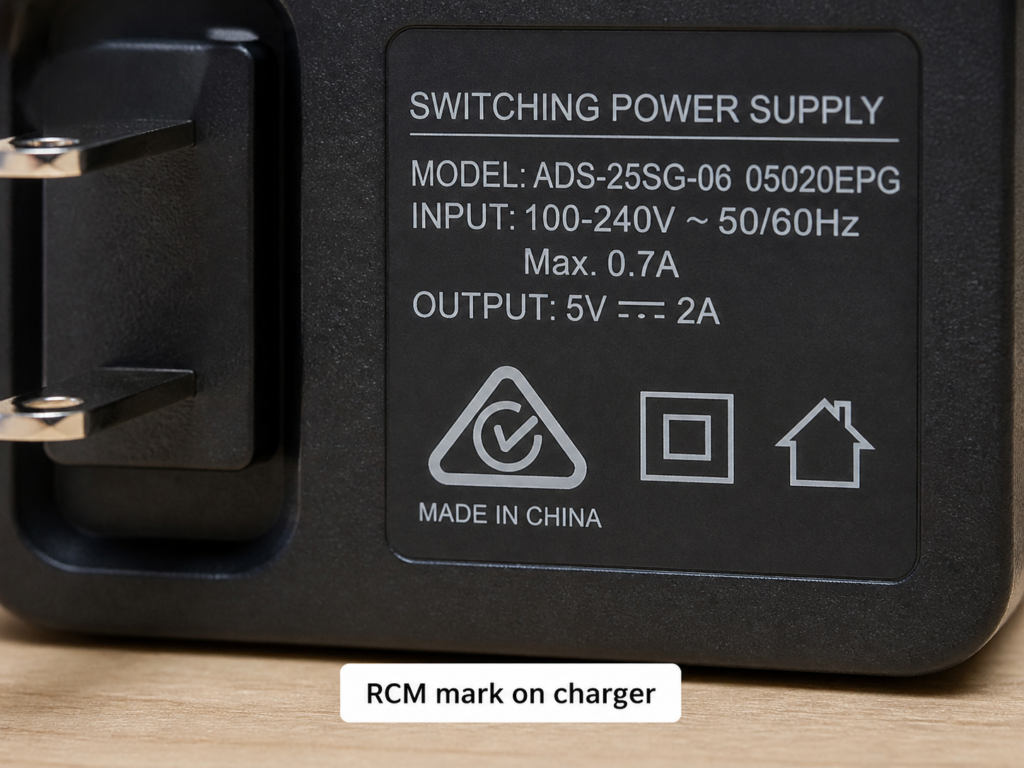
The RCM mark cannot just be printed on the product arbitrarily; the specific marking method needs to be confirmed in combination with applicable ACMA and EESS rules:
• **Basic requirements**: The mark style must comply with official specifications, be clear and durable, cannot be scraped off by hand, cannot have its shape or color changed, and must not mislead consumers.
• **Marking position**: Usually, priority should be given to the product body, nameplate, or packaging positions allowed by applicable rules. Whether small-volume products can be marked only on the packaging must be confirmed according to the official requirements of the corresponding system, and cannot be generalized.
• **Supporting information**: In addition to the RCM mark, responsible supplier identification information must be marked in accordance with applicable ACMA and EESS labeling rules. Supplier names, trademarks, codes, or other specified information may be used, but the specific content and position must be confirmed according to the corresponding system.
• **Prohibited acts**: Altering the mark style, having a blurry mark, making the responsible supplier unidentifiable, or omitting information that should be marked separately are common mistakes. You cannot simply understand the EESS registration number and ACMA identification information as a unified label that all products must print at the same time.
Technical Requirements: Judge Safety, EMC, and Energy Efficiency Separately
The technical requirements behind RCM-related compliance mainly involve electrical safety, EMC, radio, etc.; GEMS energy efficiency is an independent system, and whether it applies requires separate verification.
**Part 1: Electrical Safety Requirements**
Products must meet applicable Australian and New Zealand safety standards. Chargers may involve standards such as AS/NZS 62368.1, but the final confirmation should be based on product category, structure, and applicable scope. Key inspection items usually include insulation performance, electric shock protection, overheat protection, and flame retardancy.
Also note: for products with Australian standard plugs, the plug itself must meet applicable Australian plug and socket requirements; plugs from other regions such as US standard or Chinese standard cannot be sold directly in Australia.
**Part 2: Electromagnetic Compatibility (EMC) Requirements**
EMC, to put it simply, has two requirements: your product must not interfere with the normal operation of other electrical appliances, and at the same time must be able to resist normal electromagnetic interference. For example, a fast charger must not significantly interfere with home TVs, radio equipment, or other electronic products, nor can it easily fail due to normal electromagnetic environments.
Testing may involve items such as conducted interference, radiated interference, and immunity, depending on applicable standards and product categories. If the product has radio functions such as wireless charging and Bluetooth, it must additionally meet the corresponding ACMA radio compliance requirements; ordinary EMC testing alone is not enough.
**Part 3: GEMS Energy Efficiency Verification**
Not all charging products require GEMS; it must be judged according to the following steps:
Step 1: Based on the GEMS product register and corresponding product regulations, verify the product definition, rated parameters, use, and exclusions to confirm whether it is a regulated product. Some external power supplies and other power products may be GEMS-regulated products, but this cannot be directly determined solely by the name “wall-plug charger” or “external power supply”.
Step 2: If the product falls into a regulated category, then confirm the corresponding energy efficiency requirements, test standards, registration obligations, and whether energy efficiency labels are involved. Requirements vary by product category.
Step 3: Only after confirming that the product belongs to the relevant GEMS category and meets applicable conditions is it necessary to complete testing, registration, and other GEMS obligations as required. GEMS registration is an independent energy efficiency compliance matter and cannot be replaced by the RCM mark.
**Test Coverage Rules Exclusive to Charging Products**
Many sellers’ reports are rejected because of incomplete test coverage. However, the test scope cannot simply apply the absolute rule that “all gears and all combinations must be tested one by one”; it must be jointly determined by applicable standards, product rated operating conditions, laboratory test plans, and platform requirements:
• **Fast charging products**: Should cover representative and most unfavorable input, output, and protocol configurations required by applicable standards. Whether all gears and all fast charging protocols need to be tested must be confirmed by the laboratory based on standards, product rated operating conditions, and platform requirements. “Only testing 5V is definitely invalid” cannot be used as a unified statutory rule.
• **Multi-port chargers**: Should assess representative and most unfavorable operating conditions when using single port and multiple ports. Whether it is necessary to test multiple ports at full load at the same time, and which port combinations need to be covered, must be confirmed based on standards, product rated output capacity, and laboratory plans.
• **Active USB-C cables**: If the product is determined to have active electronic circuits, data, or signal processing functions, EMC and other safety requirements should be assessed according to applicable requirements, and it cannot be directly treated as a pure passive cable.
• **Set products**: Each regulated electrical component in the set must have its own compliance basis; you cannot default to using the main product report to cover all components. Whether components need separate testing or submission of separate documents must be confirmed according to their respective regulatory scopes and test plans.
• **Variant products**: Whether products of the same series can share one report depends on product structure, key components, rated parameters, differences, applicable standards, and laboratory series rules. Different power, interfaces, or core solutions may require difference assessment, supplementary testing, or may require re-testing; it cannot be generally concluded that completely independent testing is required.
Responsible Entity Requirements: EESS and ACMA Cannot Be Confused
RCM-related responsibilities in Australia cannot be simply reduced to “all products must be borne by the same type of local responsible entity”.
**EESS Responsible Supplier Requirements**:
For equipment under EESS jurisdiction, a qualified Australian or New Zealand responsible supplier must assume responsibility in accordance with EESS rules. Responsibilities usually include product safety compliance, supplier registration, applicable equipment registration, retention of compliance documents, and cooperation with official spot checks.
Cross-border sellers cannot directly treat Chinese companies as EESS responsible suppliers. When an Australian or New Zealand responsible supplier is required, their identity, scope of authorization, and ability to cooperate continuously should be confirmed.
**ACMA Responsible Entity Requirements**:
For EMC or radio requirements, the supplier, manufacturer, importer, authorized representative, or other relevant responsible entities, as well as the required supplier identification information and compliance records, must be determined in accordance with specific ACMA rules. ACMA responsibility arrangements cannot simply copy the EESS responsible supplier system, nor can it be generally assumed that all RCM products must be responsible for the same type of local entity.
**Two Common Options for Cross-Border Sellers**:
• **Option 1: Entrust a compliance service provider to provide Australia-New Zealand responsible entity services**: Suitable for small and medium-sized sellers or those with few SKUs. It has low cost, no need to register a company yourself, and is worry-free.
• **Option 2: Register a local Australian company as the responsible entity**: Suitable for large sellers or those with many SKUs. It is more controllable and may have lower costs in the long run.
No matter which option you choose, you must confirm the qualification, authorization scope, and ability to cooperate with spot checks of the responsible entity. You must never use a virtual entity that cannot assume actual responsibility.
How to Judge Whether Your Compliance Report Is Usable?
Not all reports made by random laboratories are recognized; they must meet these key points:
1. The qualification and accreditation scope of the laboratory or certification body meet relevant regulatory requirements, especially confirming whether they cover the adopted standards and test items.
2. The standard version used for testing is valid and meets applicable transition period requirements.
3. The models, parameters, and configurations covered by the report are consistent with the version you actually sell. You cannot sell a 65W product while the report only covers the 20W version.
4. The report content is complete, including necessary test items, laboratory qualification pages, issuer information, etc. There must be no missing pages.
5. The document format, language, and content meet Amazon’s current acceptance standards.
Reports issued by overseas accredited laboratories may be accepted, but ILAC mutual recognition itself does not automatically guarantee that the report will be accepted by regulators or Amazon. Before submission, confirm the accreditation scope, applicable Australian standards or equivalent standards adopted, report coverage, and current platform requirements.
4. Amazon Australia RCM Review Rules: When to Submit? What to Submit?
After sorting out the statutory compliance requirements, the next step is to face Amazon’s platform review. First, clarify when you may be required to submit documents and what to submit.
When Will RCM Document Submission Be Triggered?
It’s not only when new products are listed that you need to submit; the following scenarios may trigger document requirements:
1. **Category qualification review before new product listing**: Some charging products may receive document requests before listing or sale.
2. **Daily compliance random spot checks**: May be triggered by the system, complaints, or other compliance events; there is no fixed rule applicable to all accounts.
3. **Platform batch inspection of key products**: The platform may conduct inspections at specific times or for specific categories, but you cannot treat pre-year-end promotion reviews as a unified process that happens to all accounts.
4. **Product reported for non-compliance**: If reported by competitors or consumers for non-compliance, the platform may launch a special review requiring you to submit proof.
The specific trigger time, entry point, and material requirements depend on the account, category, ASIN, and platform notification, and shall be subject to the actual content displayed in the seller backend.
List of RCM Materials to Submit
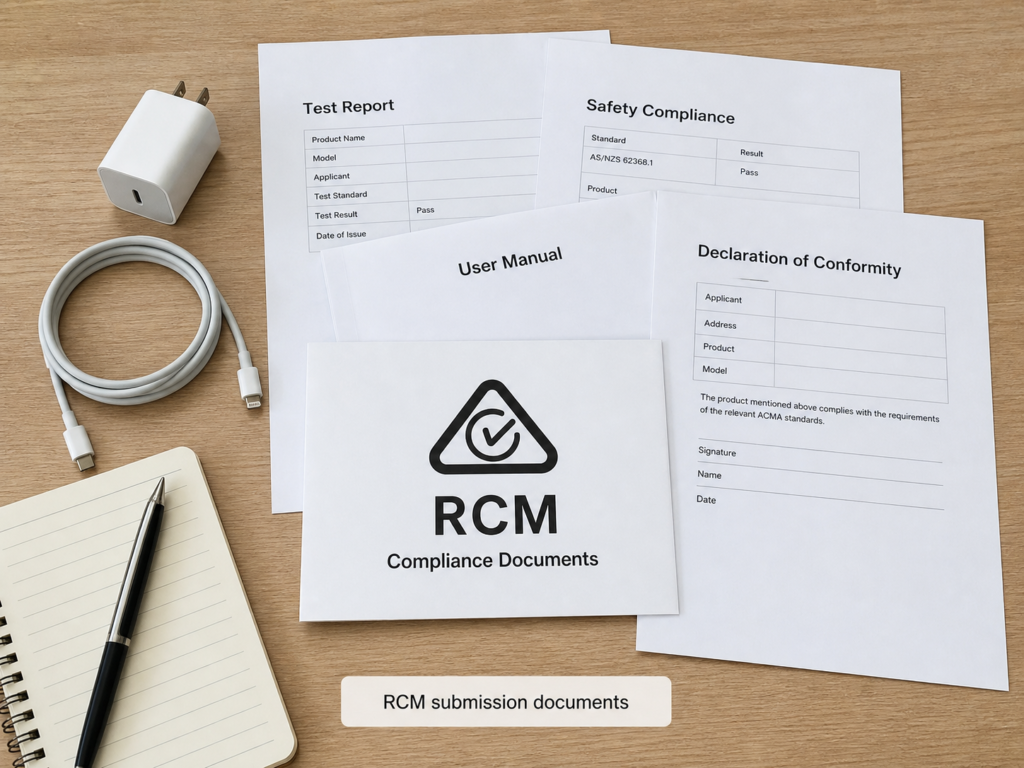
The materials you need to submit usually depend on the notification for the specific ASIN and the regulatory system applicable to the product. Common materials include:
The first category is **real photos of the RCM mark on the product or minimum sales packaging**. The photos should clearly show the mark and the responsible supplier identification information required by applicable rules. Whether the platform requires photos of the product body, nameplate, or packaging shall be subject to the specific notification.
The second category is **test reports that meet applicable requirements**, which usually may include electrical safety and EMC documents. If the product is verified to be a GEMS-regulated category, energy efficiency-related documents may also need to be supplemented.
The third category is **EESS responsible supplier registration certificate**, applicable to equipment under EESS jurisdiction and responsible supplier arrangements.
The fourth category is **ACMA-related compliance declarations or certificates**, which need to be prepared according to applicable rules for products involving EMC or radio functions.
The fifth category is **Declaration of Conformity (DoC) signed by the responsible party**, which is a written compliance guarantee issued by the responsible party.
The sixth category is **product specification sheet**. The information on it, such as model, input and output parameters, number of ports, etc., must be consistent with the listing, test report, and physical product, with no obvious discrepancies.
The seventh category is **Level 3 product documents requiring CoC**. If the product belongs to a Level 3 category that requires CoC, a valid Certificate of Conformity and applicable EESS equipment registration certificate should be submitted; for Level 2, corresponding compliance evidence should be submitted according to the specific equipment category and platform notification, and CoC cannot be uniformly required.
Core Judgment Criteria for Platform Review
During platform review, the following 4 points are mainly checked:
1. The qualification and validity of the report meet regulatory and platform requirements;
2. The information of the responsible entity corresponds to the information in the mark and registration documents;
3. The product’s model, parameters, appearance and other information match the content of the test report and listing;
4. Sets and variant products are covered by corresponding compliance certificates, with no missing items.
How to Submit for Multiple ASINs/Variants/Sets?
Many sellers have multiple variants or set products and don’t know how to submit documents. Remember these rules:
• For variants of the same model with different colors and different packaging, whether the same document can be shared depends on whether there are differences in color, material, structure, key components, and test plans that affect compliance, and shall be subject to laboratory and platform requirements;
• Products with different power, different interfaces, and different core solutions must first undergo difference assessment, may require supplementary testing or separate submission of corresponding reports, and cannot be directly shared;
• For set products, compliance certificates or applicable instructions for all regulated components must be prepared at the same time; you cannot only upload the main product’s documents;
• When submitting, be sure to carefully check all associated ASINs to avoid missing reviews leading to removal of some variants.
5. Complete Operation Steps for Submitting RCM Documents in the Backend
After the documents are prepared, you can submit them in the Amazon backend. What is mentioned here is a general approach; the entry point may vary slightly for different categories and accounts, and shall be subject to the actual display in your backend.
Preparations Before Submission
Before submission, first check all preparation items against the “Pre-Listing Self-Check List for Charging Products” below to avoid rejection due to low-level errors. Also pay attention to the format and language requirements of the documents:
• Real photos must be clear and unobstructed, with the RCM mark and supplier information required by applicable rules clearly visible;
• Test reports and certificate documents are recommended to be in PDF format, must not be altered, have complete page numbers, and include laboratory qualification pages if necessary;
• English documents are preferred. If they are original Chinese documents, an accurate English translation must be attached, and core information must not be modified;
• File naming is recommended to use “product model + file type”, such as “65W-GaN-Safety-Test-Report.pdf”, to facilitate quick identification by reviewers.
Specific Operation Steps
After logging into the seller backend, enter the submission page according to the product compliance request, account health notification, or seller support guidance displayed for the specific ASIN. Menu names and entry points vary by site, account, category, and review event, and you should not assume that all accounts have a unified “Australia RCM Compliance” entry.
After entering the specific submission page, you can usually operate in the following order:
Step 1: Confirm the ASIN, product, and rectification deadline corresponding to the platform notification.
Step 2: Upload the prepared photos, test reports, declarations, registration or other compliance documents as prompted on the page.
Step 3: Fill in information such as responsible party information, product model, input and output parameters, etc.
Step 4: Carefully check all information, and submit the review application after confirming correctness.
If there is no clear entry point in the backend, or you cannot confirm which type of document to submit, prioritize contacting seller support and keep communication records.
How to Check Review Progress and Results?
There is no unified fixed duration for review; the specific time is subject to the notification in the seller backend.
Review results may include:
• **Review passed**: Usually means that the review of this document is completed, but whether sales are resumed and continued is still subject to ASIN status and other platform policies; statutory compliance responsibilities will not disappear due to platform approval;
• **Review rejected**: The backend may indicate the specific reason for rejection, and you can resubmit after rectification as required;
• **Product sales suspended**: If it is caused by a spot check or report, sales may be suspended first. You need to submit a rectification plan and compliance evidence as required by the notification, and appeal according to the platform process.
Several Precautions for Submission
• Be sure to double-check the consistency of information before submission, such as model, parameters, and responsible party name. Many rejections are due to low-level errors such as spelling mistakes and mismatched parameters;
• If you have questions about submission requirements, prioritize contacting seller support for consultation, don’t guess on your own;
• All submission records must be kept properly for future query and appeal.
6. What to Do If the Review Is Rejected? How to Control Compliance Costs?
It is very common for the first submission to be rejected. Don’t panic; just find the reason and rectify it. In addition, the cost of RCM compliance is not low, and mastering a few methods can save a lot of money.
3 Most Common Rejection Reasons and Solutions
We have compiled the 3 most common rejection reasons for charging products and corresponding solutions, which you can refer to for handling:
| Common Rejection Reason | Core Solution | Precautions |
| Test report not recognized | First verify the laboratory qualification and accreditation scope, then confirm whether the standard version is valid. For missing test items, you can consult about supplementary testing | Not all missing items can be supplemented; subject to regulatory, laboratory, and platform rules |
| Responsible party information mismatch | Check whether the RCM mark, responsible party documents, and registration information are consistent. When changing the responsible party, check labels and records simultaneously | If the responsible party’s name changes, confirm whether an official change certificate is required |
| Product information inconsistency | Prioritize adjusting listing parameters to match the report. For product modifications, assess whether supplementary testing or re-testing is required. When model naming is inconsistent, supplement a description of the correspondence | All key parameters must be clear and accurate; vague expressions are not allowed |
For example, for the most common report non-recognition, don’t rush to redo it. First check whether the laboratory has the accreditation scope covering relevant standards and test items, and whether an inapplicable old standard was used. If only some configurations are not covered, you can consult the laboratory whether it can be resolved through difference assessment or supplementary testing. You cannot directly assume that full re-testing is definitely required, nor can you assume that all missing items can be supplemented.
4 Practical Compliance Cost Control Methods
The cost of RCM compliance is not low, especially for sellers with multiple SKUs. Mastering these methods can effectively control costs:
1. **Series testing for same-series products**: For products with the same core solution and same structure, you can ask the laboratory whether you can apply for testing as a series, instead of doing it separately for each SKU. Whether multiple models can be covered depends on key components, structure, rated parameters, differences, and laboratory series rules; they cannot be merged arbitrarily.
2. **Choose laboratories with corresponding accreditation scope**: Some domestic laboratories can conduct tests related to Australian and New Zealand standards, and the cost may be lower than local Australian laboratories. But before commissioning, confirm the laboratory’s accreditation scope, standards used in the report, regulatory acceptance, and Amazon’s current requirements.
3. **Plan compliance in advance to avoid temporary rush**: The test cycle and rush fee depend on the laboratory’s schedule, product complexity, standard version, and supplementary testing situation. You should obtain a written quotation and timeline from the laboratory in advance, and cannot use a fixed multiple or fixed lead time to estimate all projects.
4. **Do difference assessment first when modifying products**: When upgrading or modifying products, try to record changes in chips, transformers, main controllers, key safety components, shell materials, and port configurations, then let the laboratory or responsible entity judge whether supplementary testing of difference items is possible or re-testing is required. You cannot continue to use the original report just because “it looks similar”.
7. How to Maintain Compliance After Passing? Where to Check Official Information?
Many sellers think that passing the platform review is the end. In fact, RCM compliance is long-term, and there are still issues of maintenance and spot checks later.
How Long Should Compliance Documents Be Kept? When Should They Be Updated?
First, the full set of compliance documents must be retained in accordance with regulations and platform rules, covering the applicable statutory compliance look-back period. You cannot discard them after completion; you must be able to produce them during later spot checks.
Second, timely check and update compliance documents in the following situations:
• Change of responsible supplier;
• Product changes;
• Australian safety, EMC, or energy efficiency standards are updated, and you need to confirm whether to update the report within the applicable transition period;
• Changes in information in product registration, labels, or Declaration of Conformity.
Which Product Changes Require Re-Assessment of Compliance?
Not all product modifications require re-testing, but if the following changes affect safety, EMC, or energy efficiency, they should be re-assessed:
• Replacement of charging chips, transformers, main controllers, or key safety components;
• Change of input plug, output power, voltage range, or number of interfaces;
• Addition of fast charging protocols, wireless functions, display screens, or indicator lights;
• Change of responsible supplier or product model naming.
Changes in responsible supplier or model usually require checking whether labels, registrations, and compliance documents need to be updated, but do not necessarily lead to technical re-testing of the product. Whether changes in color, packaging, or shell require re-testing also cannot be generalized; it should be assessed by the laboratory or responsible entity based on materials, structure, key components, and impact on safety and EMC.
How to Deal with Daily Spot Checks and Complaints?
If you receive a spot check notification from the official authority or the platform, be sure to submit documents within the specified deadline, do not be late. If the documents are temporarily incomplete, you can first apply to the platform for an extension, then complete them as soon as possible.
**You must never submit false documents** — such as forged reports or modified parameters. Once discovered, this may lead to product removal, account restrictions, or other more serious consequences.
If a product is removed due to a complaint, handle it according to this process: first stop selling the problematic ASIN, then organize the full set of compliance certificates, go to the backend to appeal and submit materials. Whether sales are resumed later is subject to the platform review result and ASIN status.
Where to Check Official Information? Don’t Trust Third-Party Nonsense
Regulations and platform rules are dynamically updated. Don’t just listen to service providers; verify them yourself through official channels:
• **ACMA official website**: You can check RCM mark rules, EMC and radio compliance requirements;
• **EESS official website**: You can check electrical equipment classification, risk levels, supplier registration, equipment registration, and safety requirements;
• **GEMS official website**: You can check the energy efficiency control catalog, product definitions, level requirements, and registration process;
• **AS/NZS standard query channels**: You can verify the version and applicable scope of standards;
• **Amazon Seller Central Compliance Center and help pages**: You can check the latest platform review requirements and specific ASIN notifications.
All rules are subject to the latest official releases to avoid pitfalls due to outdated information.
8. Implementation Tools: Apply Directly from Cases to Checklists
Finally, we have prepared several practical implementation tools that you can use directly after reading.
4 Typical Cases of Charging Products (Borderline Judgment)
We have selected 4 of the most common charging products, which you can directly compare with your own products:
1. **Direct-plug charger (20W PD / 65W multi-port GaN)**: Connected to mains electricity, usually requires assessment of EESS electrical safety and ACMA EMC; whether it belongs to EESS Level 3 and whether it is a GEMS-regulated external power supply should be confirmed based on the specific model, rated input and output parameters, use, and official product scope. After confirming that it belongs to the relevant category, then handle the corresponding Certificate of Conformity, EESS equipment registration, or GEMS obligations. The test configuration is determined by applicable standards, laboratory plans, and product rated operating conditions.
2. **Pure conductive USB-C charging cable**: After confirming that the cable has no electronic components and does not belong to other regulated equipment, EESS equipment registration and corresponding EMC testing are usually not applicable. But if the cable has data, identification, signal regulation, or other electronic functions, the judgment will change; whether and what documents need to be submitted to Amazon shall be subject to the actual platform notification for that ASIN.
3. **USB-C cable with active protocol module**: Contains active electronic circuits, EMC and applicable safety requirements should be assessed, and it cannot be directly treated as a pure passive cable. Whether the product belongs to a certain EESS level needs to be judged based on the EESS equipment scope and specific structure. Test coverage and submitted materials shall be subject to applicable standards, laboratory assessment, and Amazon notifications.
4. **Charger + USB-C cable set**: The charger is judged according to its own EESS, ACMA, and possibly applicable GEMS requirements; the data cable is judged according to its own attributes. Each regulated component in the set should have its own compliance basis prepared; you cannot only submit the charger report.
Pre-Listing Self-Check List for Charging Products
Check item by item against this list before listing to reduce review rejections:
1. **Product judgment**: Confirm whether it falls within the EESS or ACMA related scope, and query the applicable equipment level;
2. **Responsible entity**: Designate a responsible entity that complies with the corresponding EESS or ACMA rules, and confirm the information is valid;
3. **Test report**: Qualified and compliant, covering representative and most unfavorable configurations required by applicable standards;
4. **Marks and labels**: The RCM mark and responsible supplier identification information comply with applicable rules;
5. **Platform documents**: Correct document format, listing parameters consistent with the report, physical product, and declaration;
6. **Document retention**: Full set of compliance documents backed up, meeting applicable statutory and platform retention requirements.
Core Field List of Compliance Evidence Chain (Can Be Applied Directly)
When organizing compliance documents, list these fields clearly. Whether it’s platform review or official spot check, you can quickly produce evidence:
• **Basic product information**: Model, input/output parameters, rated power, port combination, fast charging protocol, plug specification;
• **Variant information**: Correspondence and differences between each variant;
• **Responsible entity information**: EESS supplier name and registration information, ACMA-related responsible entity information;
• **Test information**: Test report number, applicable standard version, laboratory qualification information;
• **Platform information**: Corresponding ASIN, listing parameter version.
What Level Can You Reach After Learning?
• **Beginner level (can complete independently)**: Can quickly judge whether charging products require further assessment of Amazon Australia RCM-related requirements; can prepare compliance documents according to the process and complete RCM-related submissions in the backend; can identify common RCM compliance pitfalls to reduce review rejection and removal risks.
• **Semi-proficient level (can make basic decisions)**: Can judge test scope and compliance costs based on product structure, EESS equipment category, and applicable requirements; can preliminarily judge whether laboratory qualifications and responsible entity arrangements meet requirements; can judge whether re-assessment, registration, and document updates are needed when products change.
Follow-up Advanced Directions
If you want to further improve the compliance system for the Australian site, you can continue to learn about:
• Other compliance requirements for charging products in Australia, such as plug requirements, energy efficiency requirements, and applicable labels;
• General reuse methods for cross-border multi-site compliance, such as how to adapt compliance documents from one site to other sites to save costs.
Overall, RCM compliance for Amazon Australia may seem complicated, but in fact, as long as you first distinguish what ACMA, EESS, and GEMS are each responsible for, then judge applicable requirements based on product structure and official classification, and finally prepare documents according to specific ASIN notifications, you can reduce many misjudgments.
Especially for charging products, as a key priority category, doing a good job in product classification, responsible entity, test evidence, and label checks in advance is more worry-free than remedying after removal. Passing platform review is only a phased result; truly stable sales still rely on continuous and accurate statutory compliance.