
Sellers of charging products on Amazon UK have almost all run into pitfalls with UKCA: some think CE certification works for both the UK and EU, only to have their listings taken down right after launch; some believe small-batch self-fulfilled shipments won’t be inspected, and panic only when their entire shipment is detained by UK customs; others don’t even understand what UKCA is, so they randomly find a report to submit, get rejected directly, and even suffer hits to their account performance.
In fact, UKCA is not that complicated, but it is by no means a threshold you can pass with a perfunctory effort — especially for products like USB charging cables, Type-C fast charging cables, chargers, and power adapters. Every step, from determining whether it is required, preparing documentation, submitting via the seller backend, to handling audit failures, must be aligned with specific regulations and platform requirements. In this article, we will break down UKCA requirements, submission processes, and key pitfall avoidance tips for charging products on Amazon UK from basics to practical operations. Whether you are a new seller who has just joined the platform or an experienced seller who has already encountered pitfalls, you can use this to sort out your compliance preparations.
First, Understand UKCA: Does Your Charging Product Need It?
What Exactly Is UKCA?
UKCA stands for UK Conformity Assessed. It is a conformity mark for certain products entering the Great Britain market after the UK’s exit from the EU. Simply put, it indicates that the manufacturer has completed the corresponding conformity assessment in accordance with applicable UK technical regulations. It is important to note that UKCA is not issued by Amazon, nor is it a separate “certificate”. It is a compliance outcome based on applicable regulations, technical documentation, declarations of conformity, and other foundations. Amazon only conducts compliance management of products on its UK site in accordance with UK regulations and platform policies.
Which Charging Products Must Have UKCA?
Chargers, power adapters, and similar products usually require compliance assessments based on applicable UK regulations such as electrical safety, EMC, and RoHS. Whether USB cables, data cables, and connectors require UKCA and which regulations apply must be judged based on specific factors such as their voltage range, whether they contain active electronic circuits, and whether they are regulated devices — it cannot be generalized.
Here are several common questions that need special clarification:
• For commercially sold new products such as chargers and power adapters, compliance assessments required by applicable regulations usually need to be completed before placing them on the UK market. For USB cables, data cables, and interface connectors, judgment must be made based on their specific structure, rated voltage, and functions; conclusions cannot be drawn solely based on the product name.
• Whether it is self-fulfillment or FBA, large batch or small batch, applicable product safety and environmental protection obligations cannot be automatically exempted due to differences in sales scale or logistics methods.
• Some products also have additional compliance requirements: for example, power banks require extra attention to battery-related regulations; products with radio functions such as Bluetooth and Wi-Fi also require assessment under radio equipment regulations; and WEEE (Waste Electrical and Electronic Equipment) is a separate obligation, which is a different matter from UKCA and should not be confused.
• Second-hand or refurbished products are not automatically exempt from product safety responsibilities. Sellers must ensure that products comply with applicable UK product safety regulations; if a product has been substantially modified and re-placed on the market as a new product, it may require re-conformity assessment and marking, which shall be judged in accordance with applicable regulations.
Samples that are only for display or testing and not placed on the UK market usually do not fall under the scenario of UK market placement. Whether UKCA marking is required shall be judged based on applicable regulations and import purposes. Personal items for own use generally do not count as commercial market placement, but this does not exempt them from transportation, customs, or other safety requirements.
What Are the Consequences of Non-Compliance?
Many sellers think “it’s fine as long as it’s not caught”, but once non-compliance is detected, the loss may be far greater than the cost of compliance assessment. The main impacts come from three aspects:
• **Platform side**: In mild cases, listings are taken down and sales permissions are restricted; in severe cases, account performance points are deducted, and even the sales eligibility of the entire store is affected.
• **Logistics side**: If goods are inspected when entering UK customs, they may be detained, returned, or even destroyed, and you may not even get the goods back.
• **Regulatory side**: If non-compliance is detected by local UK regulatory authorities, you may also face fines, and even be required to recall already sold products, resulting in even greater losses.
3 Common Entry-Level Misconceptions for New Sellers
Sellers who are new to UKCA almost always fall into these three pitfalls. Avoiding them in advance can save a lot of trouble:
1. **Having CE means no UKCA is needed**: You cannot simply assume that CE can automatically replace UKCA. Whether GB accepts CE shall be judged based on specific product regulations, the location of the conformity assessment body, standards, and other conditions.
2. **Self-fulfilled/small-batch products do not need compliance**: As long as a product is sold commercially, applicable regulatory requirements cannot be ignored based on where it is shipped from or how many units are sold.
3. **UKCA is valid across the entire UK**: UKCA mainly applies to England, Scotland, and Wales, which is commonly referred to as the GB region. Northern Ireland has separate compliance rules, so you cannot directly use only UKCA for judgment.
Don’t Confuse Them: What Are the Differences Between UKCA, CE, and UKNI?
Many sellers who operate on European sites encounter the three marks UKCA, CE, and UKNI at the same time, and often confuse their scopes of application. In fact, you just need to remember the core differences.
Corresponding Markets Are Different
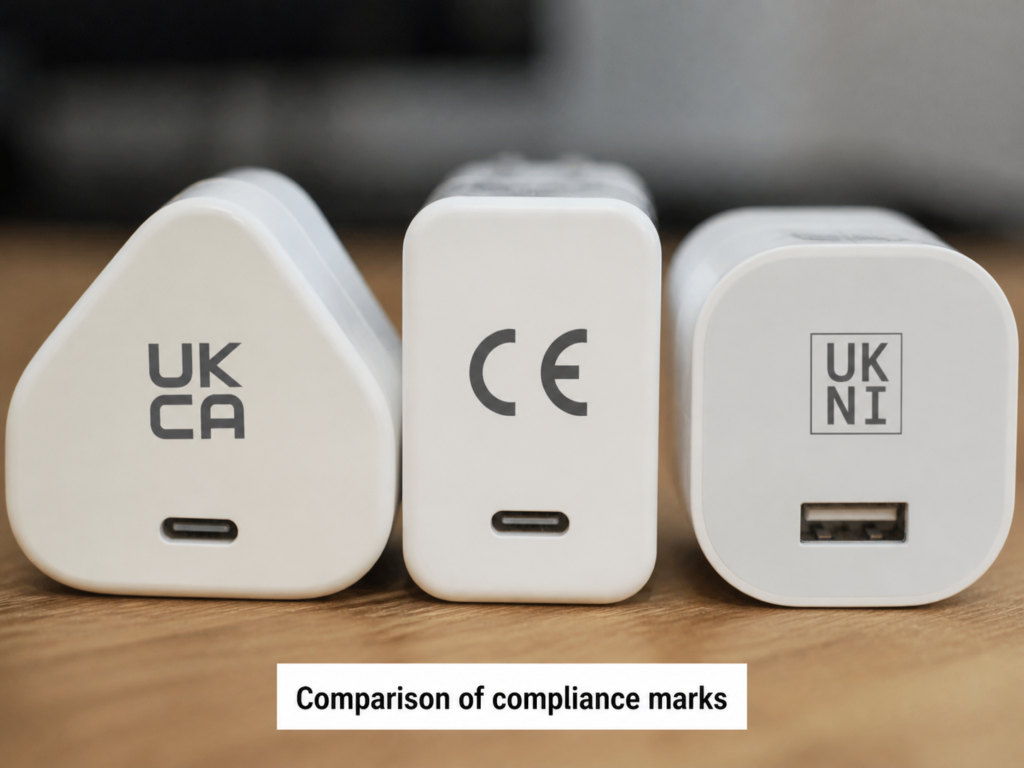
The core difference between the three marks is the market they apply to:
• **UKCA**: Mainly used in the Great Britain region of the UK, i.e., England, Scotland, and Wales.
• **CE**: Applies to the 27 EU member states. Whether GB accepts CE shall be judged based on specific product regulations, the location of the conformity assessment body, standards, and other conditions. The UK government currently continues to recognize CE under multiple regulations, but this does not apply to all products and all scenarios. You should check the latest regulations on GOV.UK item by item; UKCA is not the only alternative to CE in all cases.
• **UKNI**: For relevant products in Northern Ireland that require third-party conformity assessment. UKNI must be used together with the CE mark. UKNI cannot replace CE alone, nor can UKCA alone cover the corresponding requirements for Northern Ireland.
Conformity Assessment Requirements Are Different
In addition to applicable markets, the assessment rules for the three marks are also different.
First, the conformity assessment module shall be determined in accordance with applicable regulations. For charging products that allow self-declaration, the manufacturer can complete the corresponding assessment and sign the DoC. When regulations require third-party participation, GB products use a UK Approved Body within the corresponding scope, and EU products use a Notified Body within the corresponding scope. Whether a testing laboratory needs accreditation, the scope of accreditation, and the form of the report shall be specifically confirmed in accordance with regulations, standards, and platform requirements; UKAS-accredited reports cannot be universally required for all cases.
Second, UKCA compliance assessment is usually based on UK designated standards, while CE is based on applicable EU harmonized standards. The two may be similar in many technical contents, but this does not mean that documentation can be automatically interchanged.
Existing CE, IEC, or CB test data may be used as technical basis, but it is necessary to verify whether their standard versions, product models, parameters, and test scopes meet applicable UK regulations, and complete the corresponding compliance demonstration in the UK Declaration of Conformity and technical documentation. When regulations require the participation of an Approved Body, the prescribed assessment must also be completed by a body with the corresponding scope.
General Rules for Mark Use
The UKCA mark shall be used in accordance with the provisions of applicable regulations, which usually require it to be clear, visible, durable, and maintain the specified proportion. The general minimum height is 5mm, but specific regulations and their exceptions shall be checked. The CE mark shall also be implemented in accordance with corresponding EU regulations, and cannot be simply regarded as exactly the same as UKCA.
For the marking position, priority should usually be given to the product itself. If the nature, size, or technical conditions of the product make marking on the product itself infeasible, regulations may allow marking on the packaging or accompanying documents. No matter which position is used, it must meet the requirements of corresponding regulations for clarity, visibility, and durability.
If a product is sold to both the UK and the EU, both UKCA and CE can be used at the same time, but both marks must meet the regulatory requirements of their corresponding markets respectively. They must not obscure each other, nor can dual marking mislead consumers into thinking that one mark can replace the other.
How Is the Transition Period Calculated?
Many sellers struggle with “can I use CE for now and do UKCA after the transition period ends”. It should be clarified here: whether GB accepts CE shall be judged based on specific product regulations, the location of the conformity assessment body, standards, and other conditions. The UK government currently continues to recognize CE under multiple regulations, but this does not apply to all products and all scenarios. You should check the latest regulations on GOV.UK item by item; UKCA is not the only alternative to CE in all cases.
For sellers creating new listings, we recommend preparing complete documentation directly in accordance with the regulations applicable to the target market, rather than relying solely on a general understanding of transition arrangements. This avoids listing takedowns or cargo detention caused by changes in regulatory conditions or the product’s actual situation not meeting requirements.
What Do You Need to Prepare for UKCA Compliance of Charging Products?
After figuring out whether UKCA is needed, the next step is the specific compliance requirements. We will explain them separately for different types of charging products. You don’t need to memorize complex terms, just compare with your own products.
Technical Requirements Vary by Product
Not all charging products have the same test items. It depends on the product type, structure, and applicable regulations:
• **Chargers and power adapters**: Usually require assessment of requirements such as electrical safety, EMC (Electromagnetic Compatibility, which simply means the product will not cause undue interference to other devices and can withstand reasonable external electromagnetic interference), and RoHS (Restriction of Hazardous Substances).
• **Ordinary passive charging cables and data cables**: First determine whether the cable falls within the voltage and product scope of applicable electrical safety regulations, then assess requirements such as RoHS. Purely passive cables usually do not generate active electromagnetic functions and may not require separate EMC testing; cables containing electronic circuits, converters, or other active functions shall be assessed in accordance with EMC regulations and product design, and cannot be judged solely by the cable name.
• **USB-C fast charging cables with electronic marking chips, cables with conversion functions**: For example, a 100W fast charging cable with an E-Marker chip, or a charging cable with conversion functions, requires assessment of applicable regulations and EMC requirements combined with its electronic circuits and actual functions. The power rating stated on the listing must also be consistent with the actual product capability and the coverage scope of compliance documentation; false labeling is not allowed.
• **Products with communication or radio transmission/reception functions such as Bluetooth and Wi-Fi**: Usually require assessment under the Radio Equipment Regulations. Whether wireless charging functions are subject to this regulation shall be judged based on operating frequency, functions, and regulatory definitions; it cannot be automatically classified under radio equipment regulations just because it is wireless charging.
3 Types of Core Documents Commonly Required for Amazon Audits
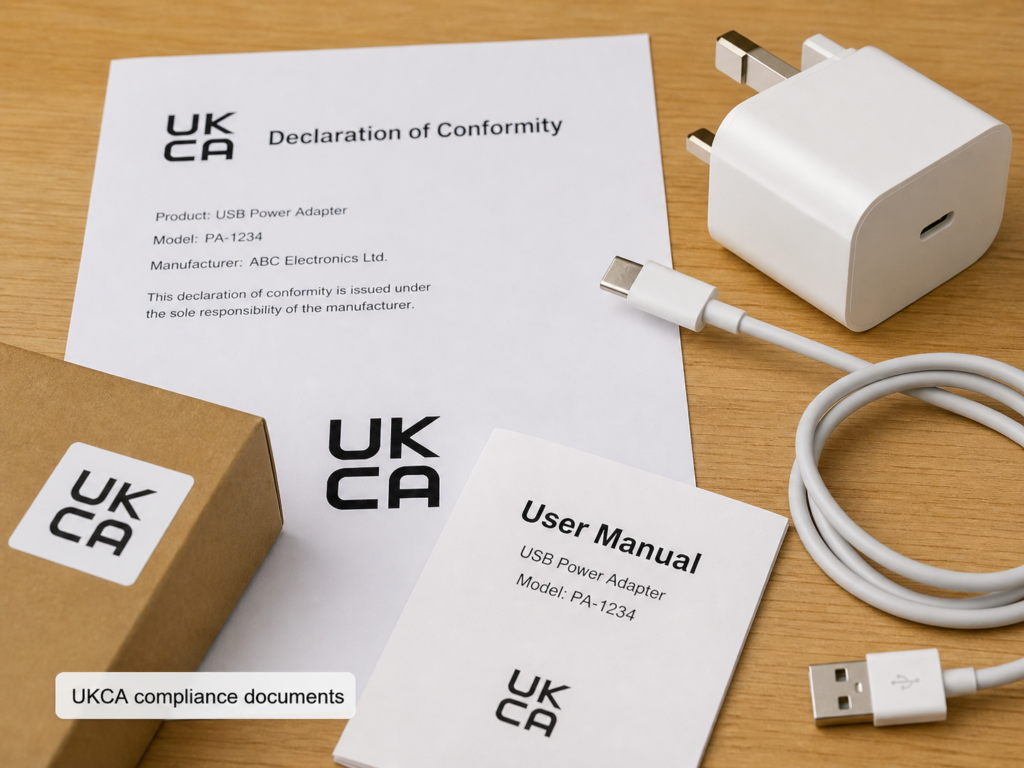
When submitting compliance documentation, the following types of documents usually need to be prepared, subject to applicable regulations and Amazon’s notifications for specific ASINs:
1. **Test or assessment documentation**: The documentation shall cover the core parameters, models, and applicable standards of the actual product. Whether it must be issued by a UKAS accredited laboratory depends on applicable regulations, assessment methods, test items, and platform requirements. There is no such thing as a “lifetime valid” report that is independent of product and regulatory changes; after product revisions or changes in regulatory conditions, its applicability shall be re-evaluated.
2. **UK Declaration of Conformity (DoC)**: This is a compliance declaration signed by the manufacturer. Its contents usually include mandatory information such as product identification information, manufacturer information, applicable UK regulations and standards, signatory, and signing date. Whether UKRP information needs to be listed shall be determined based on specific regulations and the arrangement of responsible entities.
3. **Technical documentation**: Includes product design materials, key component lists, test data, risk assessments, etc. Whether it needs to be submitted to Amazon depends on the specific platform request; the manufacturer shall still keep these materials in accordance with each applicable regulation for inspection by the platform or UK regulatory authorities.
What Information Should Be Marked on Products and Packaging?
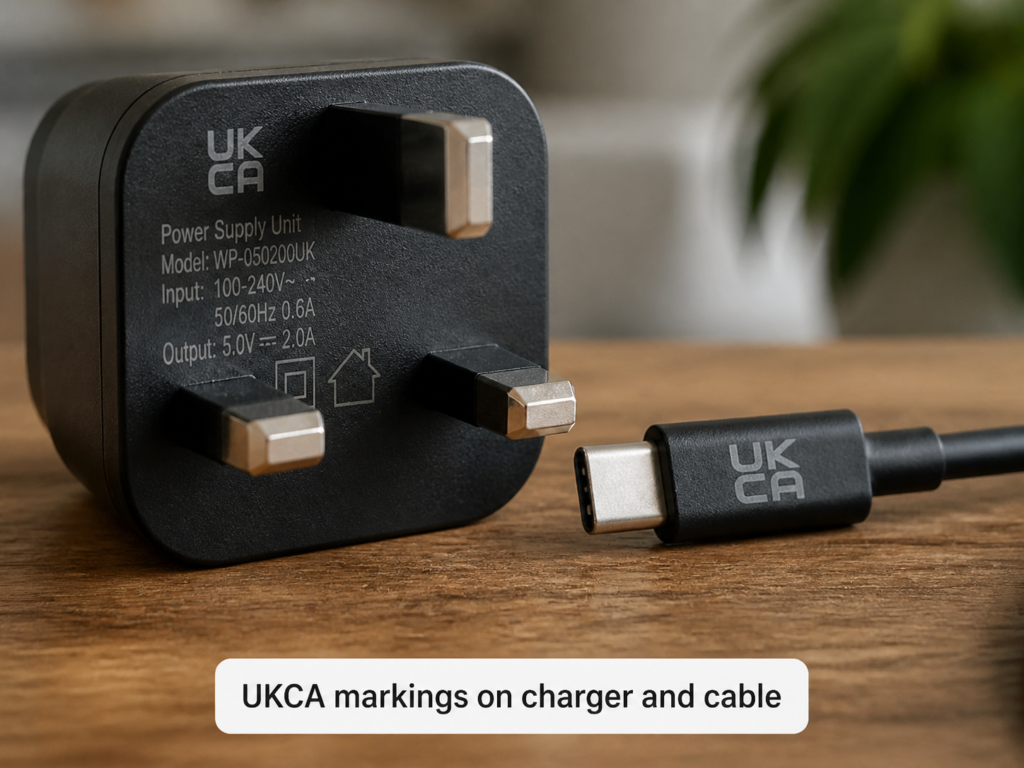
In addition to documentation, markings on products and packaging are also very important. Many sellers are rejected because their markings are incomplete or inconsistent with the documentation:
• The UKCA mark shall be used in accordance with applicable regulations, being clear, visible, durable, and maintaining the specified proportion. The general minimum height is 5mm, but specific regulations and their exceptions shall be checked. If the nature, size, or technical conditions of the product make marking on the product itself infeasible, marking shall be placed on the packaging or accompanying documents in accordance with applicable regulations.
• The manufacturer’s name, contactable address, as well as model number, batch number, serial number, or other traceable information shall be marked in accordance with applicable regulations.
• If specific regulations require the designation of a UK Responsible Person, the corresponding responsible entity information shall be marked in accordance with that regulation. UKRP information cannot be regarded as a universal mandatory marking item for all charging products.
• For products such as chargers and power adapters, key electrical parameters such as rated input and output shall also be marked in accordance with applicable electrical safety regulations.
• All marked information must be clear and durable, cannot be wiped off easily, and must not be obscured by other items.
You can see clear product markings and model information on the side of the plug pins of UK-standard chargers, and on the Type-C connector shell of charging cables. Specific confirmation shall also be made in combination with product size, applicable regulations, and actual label position; do not just copy the marking method of other products.
What Is the UK Responsible Person (UKRP), and Why Confirm It?
UKRP is the UK Responsible Person. It is not a universal mandatory requirement for all charging electrical products under UK law, nor can it be asserted that Amazon mandates UKRP for all relevant ASINs.
Sellers should first confirm whether the specific UK regulations applicable to the product require a UK Responsible Person, and whether Amazon additionally requires responsible entity information for that ASIN. If regulations require a UKRP, there must be a real UK address, clear authorization, and corresponding technical documentation and regulatory cooperation capabilities. UKRP is also not equivalent to a “UK-registered entity”, and its legal validity cannot be judged solely by whether it is registered or has a virtual address.
Therefore, the UKRP requirement cannot be generalized to all charging products. For specific ASINs, it shall be subject to applicable regulations, import and sales arrangements, and the actual compliance request in the Amazon seller backend.
Advanced Judgment: How to Choose a Cost-Effective Compliance Solution for Different Scenarios
After understanding the basic requirements, the next step is advanced decision-making logic — different products and different sales scenarios have different compliance solutions. Choosing the right one can save a lot of money and time.
How to Determine Which Tests Your Product Needs
You can use this logic to quickly determine which requirements your product needs further confirmation for:
• **Charging cables and data cables**: First check whether the product falls within the scope of applicable electrical safety regulations, then determine whether it has active chips, converters, or other active functions. Purely passive cables may not require separate EMC testing; active cables shall be assessed in combination with their design and applicable regulations.
• **Chargers and power adapters**: Confirm the conformity assessment procedure separately for each UK regulation applicable to the charger. You cannot directly infer whether an Approved Body is needed based on low or high power; an Approved Body with the corresponding scope is only required when relevant regulations explicitly require third-party participation.
• **Sales scenario**: If sold as a set, such as a charger and charging cable sold together, you need to confirm the regulations and documentation requirements applicable to each accessory in the set, and cannot only provide materials for the main product; if the accessory is sold separately at retail, the accessory itself must have compliance documentation matching its product scope.
What Are the Approximate Compliance Costs and Timelines?
UK regulations do not uniformly stipulate UKCA testing fees and processing cycles. The fees and cycles shall be subject to quotations issued by laboratories or Approved Bodies with corresponding capabilities for specific products, standards, and models. Product structure, applicable regulations, test items, number of models, number of samples, number of rectifications, and whether third-party conformity assessment is required will all affect the final cost and time. Therefore, a fixed British pound range or timeframes such as 2–4 weeks or 1–2 weeks cannot be used as a universal commitment.
If you want to control costs, you can ask the laboratory whether multiple models can be covered by the same group of tests. However, whether multiple models can be covered by the same group of tests shall be technically demonstrated by the manufacturer and the laboratory based on structure, key components, length, rated parameters, and worst-case samples, and the coverage scope shall be clearly stated in the report and technical documentation. Color differences are usually easy to combine, but changes in length, power, or circuits cannot be automatically combined.
For example, the same charger with only different shell colors is usually easier to assess uniformly than models with different power, circuits, or interfaces; even if the same fast charging cable only differs in length between 1 meter and 2 meters, you cannot assert that the same report can be shared just because they are “the same series”, because length may affect conductor resistance, temperature rise, voltage drop, EMC performance, and the applicability of rated power.
Compliance Judgment for 3 Boundary Scenarios
There are several boundary scenarios that are easy to confuse, so we will clarify them all here:
• **Northern Ireland orders**: If your product is sold to Northern Ireland, you cannot only use UKCA. You must apply the rules of CE or CE + UKNI, depending on the product regulations and whether third-party conformity assessment is required.
• **Second-hand and refurbished products**: Second-hand or refurbished products are not automatically exempt from product safety responsibilities. Sellers need to ensure that products comply with applicable UK regulations; if a product has been substantially modified and re-placed on the market as a new product, it may require re-assessment and re-marking.
• **Promotional compliance**: The product parameters stated on your listing cannot exceed the actual product capability and the coverage scope of compliance documentation. For example, if the documentation only supports 65W, the listing cannot arbitrarily mark 100W. False labeling may not only lead to audit rejection, but also trigger consumer complaints and regulatory risks.
Practical Operation: How to Submit UKCA on Amazon UK
After preparing all materials, the next step is the submission operation in the seller backend. It should be noted that Amazon’s compliance process may change dynamically based on category, ASIN, account status, and platform policies. You cannot regard the page seen on one account as a fixed process for all sellers.
When Will You Be Required to Submit UKCA?
Not all products are required to submit UKCA documentation in the same way when listed. There are usually three scenarios that may trigger documentation submission:
• When creating a new ASIN, category review requires product compliance documentation;
• The platform conducts random compliance spot checks or special rectifications, and your product is randomly selected;
• You are required to provide compliance documentation due to buyer complaints or reports, or account performance issues.
4 Checks You Must Do Before Submission
Be sure to do these checks before submitting, which can increase the probability that the documentation matches the product and avoid repeated supplementary submissions:
1. **Product scope check**: Confirm which UK technical regulations apply to your ASIN, and what specific documentation is required in this platform request.
2. **Documentation consistency check**: Verify that the test or assessment documentation, DoC, and the product model, manufacturer name, and power parameters on the listing are mutually consistent.
3. **Qualification validity check**: In accordance with specific regulations and platform requirements, confirm that the report issuing body has capabilities matching the tested standards and product scope; if regulations require third-party conformity assessment, also confirm the authorization scope of the relevant Approved Body. You cannot use inclusion in the UKAS list as the sole judgment standard for all products.
4. **Marking check**: Confirm that the UKCA mark, manufacturer information, model number, and other information required by regulations on the product or packaging meet the requirements. Whether UKRP is required shall be confirmed based on specific regulations and the actual platform requirements for that ASIN.
Specific Steps for Backend Submission
The specific entry name, submission fields, uploadable file types, and whether real photos of the product or packaging are required may vary by category, ASIN, account, and platform process.
When submitting, you shall follow the compliance request, help page, and platform notification actually displayed for that ASIN in the seller backend, and upload the corresponding documents and pictures as required by the platform. Usually, the following types of operations need to be completed:
1. Confirm the submission type and documentation list required by the platform in the corresponding ASIN compliance request.
2. Upload documents such as test or assessment documentation and UK Declaration of Conformity as required, and fill in the information of the manufacturer, importer, responsible person, or other entities required by the platform.
3. If the platform requires pictures of the product, packaging, or labels, upload pictures that can clearly show the actual markings and product information. Do not use post-processed pictures that are inconsistent with the actual product.
4. Files can be named in the format of “ASIN + file type + model”, for example, “B0XXXXXX65WCharger”, to help auditors identify the product corresponding to the documentation.
Do not present fixed entry names, checkboxes, or real photo requirements as a universal process for all charging products on the UK site; if the backend page is different from the above description, the display on the page at that time shall prevail.
How to Submit for Multiple ASINs/Variants More Easily
If your product has multiple ASINs or variants, you don’t have to assume that each needs a separate report, but you also cannot assume that one report can cover all models:
• **Conditions for reuse**: Only when products are of the same series and structure, have the same core parameters, key components, and circuit design, and only have appearance differences that do not affect compliance performance, can they possibly be covered by the same set of documentation.
• **Cases where direct reuse is not allowed**: If the product’s power, length, interface type, circuit design, chip, or key safety components are different, you cannot directly reuse the documentation just because they are “the same series”. Technical judgment must be made by the manufacturer and the laboratory.
• **Submission requirements**: If the report is universal for multiple models, the report and technical documentation shall clearly list or explain all covered models, parameters, and applicable scopes; when the platform requires submission by ASIN, also ensure that each ASIN corresponds to the actual product in the documentation.
What to Do If the Audit Is Rejected? Common Reasons and Appeal Methods
Many sellers are rejected on their first submission. Don’t panic, most problems can be remedied. We have divided common rejection reasons into four categories, and you can check against them.
Documentation Issues: The Most Common Rejection Reason
Documentation issues are the most common rejection reason, and there are roughly the following types:
• Test or assessment documentation does not match the product: for example, it does not cover the actual model, power, interface, or key configuration, or the capability of the body issuing the documentation does not match the test scope.
• Inconsistent information: The model, manufacturer, and power parameters on the test documentation, DoC, and listing do not match. For example, if the manufacturer on the report is Company A and the listing says Company B, it will definitely increase the risk of rejection.
• DoC is missing key information: for example, there is no company signature, no list of applicable UK regulations, no product identification information or signing information. Whether UKRP information is required depends on specific regulations and the arrangement of responsible entities.
• Invalid documents: for example, the documents are blurry, only a supplier’s declaration or ISO certificate is submitted, and there is no documentation that can prove the complete machine or actual product meets the requirements. These usually cannot replace the compliance documents required by the platform.
Check whether the report is issued by a body with corresponding product and standard capabilities, whether it covers the actual model and parameters, and verify whether specific regulations require a third-party body or UKRP. UKAS and UKRP cannot be regarded as mandatory items for all ASINs.
Marking Issues: Easily Overlooked Details
Many sellers think marking is a trivial matter, but in fact, many are rejected because of marking issues:
• The UKCA mark itself has problems: for example, the size does not meet specific regulatory requirements, it is blurry, easy to peel off, or the proportion is deformed or stretched.
• Missing information: Traceable information such as manufacturer information, product model, or batch number is not marked in accordance with applicable regulations.
• Improper position: The UKCA mark should be placed on the product itself first; if the nature, size, or technical conditions of the product make marking on the product itself infeasible, it shall be marked on the packaging or accompanying documents in accordance with applicable regulations, and at the same time meet requirements such as clarity, visibility, and durability. You cannot assert that markings on the packaging or manual are necessarily illegal or will definitely be rejected by the platform just because the charger is large in size.
Product Matching Issues: Direct Rejection If Parameters Don’t Match
This type of problem refers to the mismatch between your product and the submitted documentation, for example:
• **Charging cables**: The fast charging power rated on the listing exceeds the coverage scope of the documentation, or cables with electronic circuits or conversion functions have not completed the corresponding EMC and other applicable requirement assessments.
• **Chargers**: The rated power does not match that on the documentation, multi-port chargers do not specify the power distribution of each port, and the plug does not meet UK standard requirements.
• **Sets**: Only the charger report is submitted, without confirming the applicable regulations and documentation requirements for other accessories such as charging cables in the set, and not all accessories are covered.
Platform Rule Issues: Don’t Cross the Red Line
This type of problem is caused by violating platform rules, and is relatively more serious:
• Invalid responsible entity information: for example, the address is false, cannot be contacted, lacks necessary authorization, or does not have corresponding regulatory cooperation capabilities.
• Repeated submission: The same ASIN submits different versions of documentation multiple times, leading to audit confusion and even slower processing.
• Overdue submission: Failure to submit documentation within the period notified by the platform may result in product restrictions.
What Are the Correct Appeal Steps?
If the audit is rejected, follow these three steps to appeal for the highest efficiency:
1. First, carefully read the rejection reason in the backend to identify what type of problem it is, and do not blindly modify and resubmit.
2. Modify or supplement documentation in a targeted manner. For example, if the report does not cover the model, contact the laboratory or relevant body to confirm the coverage scope; if the marking is incorrect, recheck and produce markings that meet the requirements.
3. When resubmitting, clearly note what content you have modified. If there are still problems, you can also open a case to contact seller support for consultation.
A special taboo should be emphasized here: you must not submit tampered, forged, or inconsistent reports and pictures, otherwise it may lead to audit rejection, listing takedown, account restrictions, or even other platform penalties; the specific consequences shall be subject to Amazon’s policies and the handling results of individual cases.
Don’t Be Complacent After Passing the Audit: How to Maintain Long-Term Compliance
Many sellers think that everything is fine once the UKCA audit is passed, but that’s not the case. Compliance is a long-term matter. Changes in products or regulations may affect the validity of compliance.
Do You Need to Retest After Product Revision?
After a product is modified, whether retesting is needed depends on the content of the modification:
• **Cases requiring re-assessment and retesting if necessary**: Replacing chips, cable cores, connectors, power modules, changing rated power, fast charging protocols, interface types, or adding wireless functions. These changes may affect the product’s safety performance, EMC, or other regulatory requirements, and whether to retest shall be determined based on the degree of impact.
• **Cases requiring re-assessment**: Replacing shell materials, production factories, or key safety components. These changes require assessment of their impact on compliance. Retesting is not always necessary, but they cannot be completely unchecked.
• **Cases where only document updates may be needed**: If only the manufacturer’s name or brand is changed, and the product itself and production conditions have no substantial changes, usually you can first assess whether only documents such as the DoC need to be updated, and cannot directly use old documentation without judgment.
After standard updates, you shall check UK designated standards and applicable transition arrangements, and assess whether existing technical documentation and DoC can still prove compliance; you cannot generally assume that old reports are automatically invalid, nor can you generally assume that all products must be retested.
When organizing compliance documentation, keep test or assessment materials, UK Declaration of Conformity, and relevant responsible entity authorization documents together to ensure complete information consistency, facilitating quick verification during subsequent changes.
What Compliance Points Should Be Noted During Sales?
During daily sales, you should also pay attention to the following points to avoid compliance problems:
• **Inventory consistency**: The labels and parameters of the pictures on the listing, FBA inventory, and newly produced product batches must be consistent. You cannot have a listing with a UKCA mark but actually ship goods with a different set of labels or parameters.
• **Regulatory tracking**: Regularly check whether UK designated standards, UKCA-related policies, and Amazon platform rules have been updated. After standard updates, assess whether existing documentation is still sufficient in combination with transition arrangements and the actual situation of the product.
• **Complaint handling**: If you receive safety-related complaints, or the return rate suddenly rises abnormally, promptly check the compliance of the product. If necessary, notify the UK regulatory authorities, and do not delay handling.
• **Document retention**: Keep DoC, technical documentation, and records in accordance with each applicable regulation, and the retention period shall be subject to specific regulations. For products subject to regulations such as electrical equipment safety, EMC, and RoHS, corresponding documents shall usually be kept as required, with a common period of 10 years, calculated from the start time specified in the regulations.
3 Deep Misconceptions That 90% of Sellers Have
Finally, let’s correct several deep cognitive misconceptions that many long-time sellers also get wrong:
1. **UKCA is valid for life**: Wrong. When a product undergoes substantial changes that affect safety, EMC, or other regulatory requirements, re-assessment is needed, and retesting if necessary. After applicable standards are updated, existing documents must also be evaluated in combination with UK designated standards and transition arrangements. UKCA cannot be understood as a one-and-done matter.
2. **UKCA can be used in the EU**: Wrong. UKCA is mainly used in the GB region of the UK. To sell to the EU, you still need to complete CE-related compliance in accordance with applicable EU regulations. The two are not interchangeable.
3. **Passing Amazon’s audit means everything is fine**: Wrong. Amazon’s audit is only a platform step. Local UK regulatory authorities may still conduct spot checks on products on the market. If non-compliance is detected, you may still face penalties such as fines and recalls. Don’t think that passing the platform audit means you’re set for good.
Quick Self-Check List for UKCA Compliance of Charging Products
For your convenience in checking, we have compiled a quick self-check list divided into three stages. You can directly check off items:
| Self-Check Stage | Core Self-Check Items |
| Before listing | 1. Confirm which UK technical regulations the product is subject to<br>2. Prepare test or assessment documentation matching the product and standard scope<br>3. Sign a compliant UK Declaration of Conformity (DoC)<br>4. Confirm responsible entity information based on specific regulations and Amazon requirements<br>5. Correctly use the UKCA mark and mandatory information on products/packaging in accordance with applicable regulations<br>6. Listing parameters are completely consistent with compliance documents |
| Before submission | 1. Test or assessment documentation covers the submitted ASIN model, power, and interface<br>2. DoC information is completely consistent with the documentation and listing<br>3. Responsible entity information is true and valid, and has corresponding authorization and cooperation capabilities (if applicable)<br>4. All documents are clear and legible, with no traces of alteration<br>5. Multi-model documentation clearly covers all submitted ASINs/models |
| After changes | 1. After product revision/component replacement, compliance validity has been re-assessed, and retested if necessary<br>2. After standard/policy updates, UK designated standards and transition arrangements have been checked<br>3. After packaging/marking changes, they remain consistent with compliance documents |
Final Remarks
Overall, UKCA is not a threshold deliberately set by Amazon, but part of the UK market’s product compliance system. For sellers of charging products, the key is not to blindly look for a “UKCA certificate”, but to first determine which UK technical regulations apply to the product, then prepare assessment materials, declaration of conformity, product markings, and responsible entity information according to specific regulations, and finally submit them in accordance with Amazon’s requirements for specific ASINs.
You don’t need to be a professional compliance expert, but at the very least, you need to be able to independently determine which requirements apply to your products, distinguish the applicable boundaries of UKCA/CE/UKNI, prepare compliance documents and markings that match your products, complete backend submissions and troubleshoot common audit issues, plus regularly assess the impact of product changes and regulations, in order to more stably reduce compliance risks in UK site operations.