
New sellers who sell charging products on Amazon US site have most likely encountered these situations: new products get stuck in category review right after release, you suddenly receive a compliance random inspection notification when sales are going well, or even goods get delisted due to lack of qualifications as soon as they arrive at the FBA warehouse, with thousands or tens of thousands of inventory stuck and unable to be moved. Many people don’t understand what FCC and UL are, what the differences are, and how to submit them at first. They either get scammed by service providers and waste money, or suffer heavy losses due to non-compliance.
It should be clarified first that charging products may involve both FCC compliance and electrical safety compliance. However, whether FCC authorization is required, which FCC path to adopt, and whether UL or other safety standard reports are required should be confirmed item by item based on product functions, applicable regulations, sales categories, and Amazon’s notifications for specific ASINs. This article is for charging product sellers, and explains the entire process from applicable scenarios, core concepts, quick judgment, qualification handling to backend submission and rejection troubleshooting, to help you independently handle most FCC and UL compliance preparation work.
What Exactly Are FCC and UL? Stop Confusing Them
The most common mistake new sellers make is treating FCC and UL as the same thing. In fact, the two are completely different in direction and cannot replace each other. Whether charging products require both types of compliance documents cannot be generalized, and should be judged based on the actual product functions and platform requirements.
Plain-Language Core Definitions
**FCC** is the abbreviation of the Federal Communications Commission of the United States. Simply put, it mainly regulates whether the radio frequency energy generated by electronic devices will cause unacceptable interference to communications and other devices. For example, if some electronic devices affect wireless communications, broadcast reception, or other electronic devices when operating, they may be subject to FCC rules.
Products with digital circuits, wireless communication transmitters, or other products that may generate radio frequency energy subject to FCC rules need to be judged whether FCC Part 15, Part 18, or other FCC requirements apply based on their functions and device classification; conclusions cannot be drawn solely based on whether the product has a chip or circuit board.
FCC requirements involve U.S. federal regulations. If a product does not complete the applicable device authorization or violates FCC rules, it may face risks such as import refusal, detention, sales suspension, recall, or administrative penalties, depending on the specific violation facts and law enforcement measures.
**UL** generally refers to product safety standards, testing, and certification systems developed or adopted by organizations such as UL, focusing on electrical safety during product use, such as risks of electric shock, fire, overheating, short circuit, and insulation failure.
UL itself is not a mandatory statutory certification uniformly implemented by the U.S. federal government for all charging products. Whether Amazon requires UL standard test reports, NRTL certification, or other safety documents shall be subject to the specific ASIN, sales category, and platform notification.
If Amazon requires a third-party safety test report for a specific ASIN, it shall be submitted in accordance with the standards, laboratory qualifications, and document format specified in the notification. A laboratory accredited to ISO/IEC 17025 with an accreditation scope covering the corresponding tests helps prove its testing capability, but having only 17025 qualification does not mean that Amazon will necessarily accept the report.
Core Differences Between the Two
To facilitate quick distinction, a comparison table is organized:
| Comparison Dimension | FCC | UL and Other Electrical Safety Compliance |
| Competent authority or implementation system | Federal Communications Commission of the United States and relevant federal regulations | Third-party safety standards, certification bodies, and applicable market or platform requirements |
| Regulatory focus | Electromagnetic compatibility, radio frequency energy, and device interference | Electrical safety risks such as electric shock, fire, overheating, and short circuit |
| Source of mandatory requirement | A U.S. legal requirement for applicable devices | Whether it is mandatory depends on applicable regulations, sales scenarios, categories, and specific Amazon requirements |
4 Common Cognitive Misconceptions for New Sellers
1. **Misconception 1: FCC and UL are the same type of certification**
The two are completely independent and have different regulatory focuses. A product may be subject to both FCC and electrical safety requirements, or may only require one of them or other applicable documents. You cannot draw a conclusion directly just because you see “charging product”.
2. **Misconception 2: If you have FCC, you don’t need UL**
FCC mainly focuses on the radio frequency and electromagnetic interference issues of devices, and does not prove that the product has met electrical safety requirements. If the platform or applicable regulations require safety documents, FCC documents cannot be substituted.
3. **Misconception 3: Certificates provided by suppliers can be used directly**
Compliance documents must truly cover the products you sell, including brand, product model, rated parameters, manufacturing factory, product structure, and hardware configuration. Certificates for the supplier’s own brand cannot be automatically used for your private-label products.
4. **Misconception 4: UL must be done by UL organization**
Whether third-party laboratory reports can be used depends on Amazon’s specific notification, the laboratory’s accreditation scope, and the report content. It is not necessary to obtain UL official Listed certification in all scenarios, but it also cannot be simply assumed that any laboratory report with the words ISO/IEC 17025 will definitely be accepted.
Full Process of Obtaining FCC Qualification
After confirming whether the product is subject to FCC requirements, you can start preparing relevant documents. The specific process varies by device category.
Step 1: Confirm the path and test rules
First, confirm the applicable rules based on product functions, operating frequency, circuit structure, and sales method:
• For products that may be Part 15 unintentional radiators, it is necessary to confirm whether SDoC, certification, or other device authorization methods apply;
• Products with wireless communication transmission functions such as Bluetooth and Wi‑Fi usually need to be certified in accordance with applicable Part 15 rules, and the corresponding process shall be completed by FCC-recognized testing laboratories and TCBs;
• For pure wireless power transmission devices, it shall be judged whether Part 18 and its authorization method apply, and FCC ID cannot be directly applied just because the word “wireless” is in the product name;
• If you are unsure about the path, you can provide product information and samples to a laboratory with corresponding capabilities, and the laboratory will make a judgment based on the actual structure and functions.
The SDoC shall be signed by the responsible party under FCC rules, and the required U.S. domestic contact information shall be provided. Manufacturers, importers, suppliers, and Amazon sellers are not necessarily the same entity, and cannot be generally written as “signed by the supplier itself”.
Step 2: Select a laboratory and complete testing
When selecting a laboratory, pay attention to the matching of qualifications and business scope:
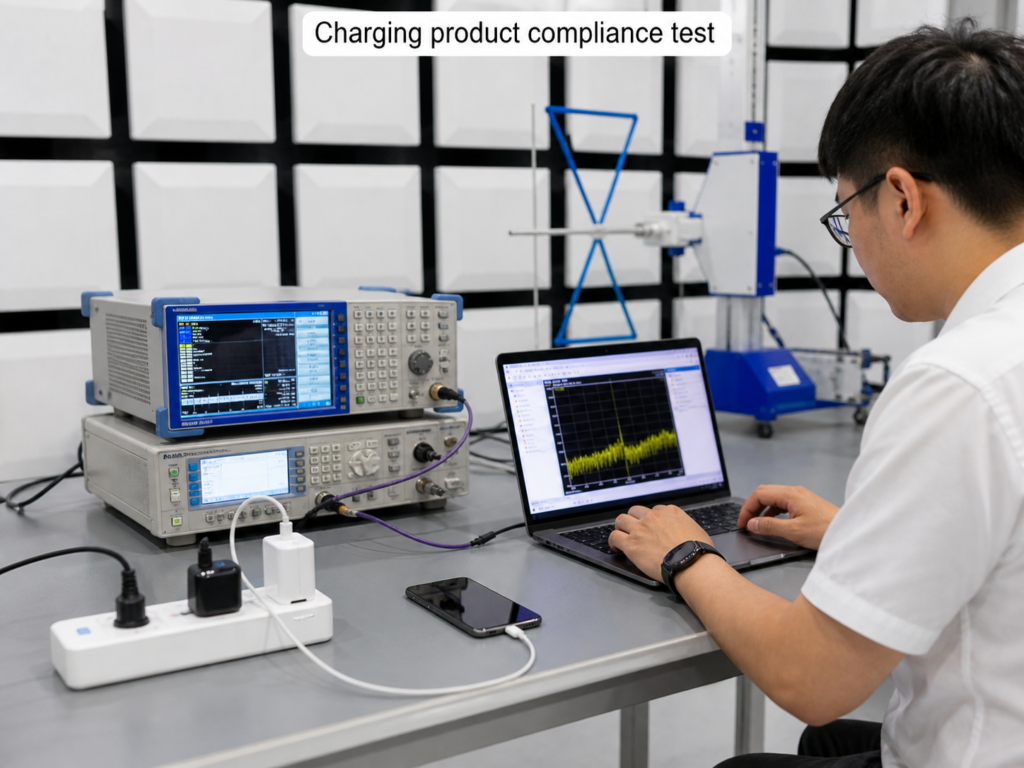
• For products using SDoC, a laboratory with corresponding FCC rule testing capabilities that can complete testing and provide complete records shall be selected;
• For devices requiring FCC certification, FCC-recognized laboratories shall be used, and TCBs shall complete the certification review;
• If Amazon’s notification specifies the laboratory type, accreditation body, or document format, the platform conditions must also be met at the same time.
In terms of cycle, it cannot be preset that all products can be completed within a fixed time. The test items vary greatly for ordinary wired products, products with wireless communication modules, Part 18 devices, and products that require rectification. After confirming the standards, test scope, number of samples, and rectification arrangements, you shall obtain a written schedule from the laboratory.
If the test fails, the product needs to be rectified, such as adjusting the circuit, adding filtering, or improving shielding, and then retested, which will extend the cycle. Therefore, it is recommended to complete the evaluation before listing and stocking as much as possible, and do not start just before the shipping deadline.
Step 3: Obtain documents and verify validity
After testing or certification is completed, documents shall be prepared according to the applicable path, and the content shall be carefully checked.
• **SDoC documents**: A declaration of conformity, responsible party information, device identification information, applicable label and instruction manual content shall be prepared, and corresponding test records shall be retained;
• **FCC certification documents**: Usually include test reports from accredited laboratories, FCC authorization information, FCC ID related information, and applicable label and instruction manual content.
The documents to be uploaded to Amazon are not exactly the same for all products, and shall be subject to the platform’s notification for that ASIN.
There are three key points for verification:
First, the brand, model, rated parameters, hardware configuration, responsible party, and production information in the report or declaration must truly cover the actual sold product; second, if FCC ID is involved, the corresponding information must be searchable in the FCC database; third, the content of labels and instruction manuals must comply with applicable rules and platform requirements.
Cost Reference (Per Single Model)
There is no unified price for FCC fees applicable to all products and laboratories. The actual cost may be affected by the following factors:
• Applicable regulations and test standards;
• Whether it includes wireless communication, wireless power transmission, or multiple frequency bands;
• Number of test items and sample complexity;
• Whether TCB review is required;
• Rectification and retesting after test failure;
• Laboratory location, scheduling, and expedited arrangements.
Therefore, you should first confirm the applicable standards, test items, certification or review fees, and then obtain a written quotation and schedule from the service provider. There is no unified ratio for the time saved and additional fees of expedited services, which must be subject to the quotation of the specific project.
Operation Guide for Compliance Submission in Amazon Seller Central
After the qualifications and test documents are prepared, you can submit them in Amazon Seller Central. The entry points for different categories, ASINs, and compliance events may be different, and you cannot only rely on a fixed path.
Common Submission Entries
There are two common submission entries, choose according to the situation:
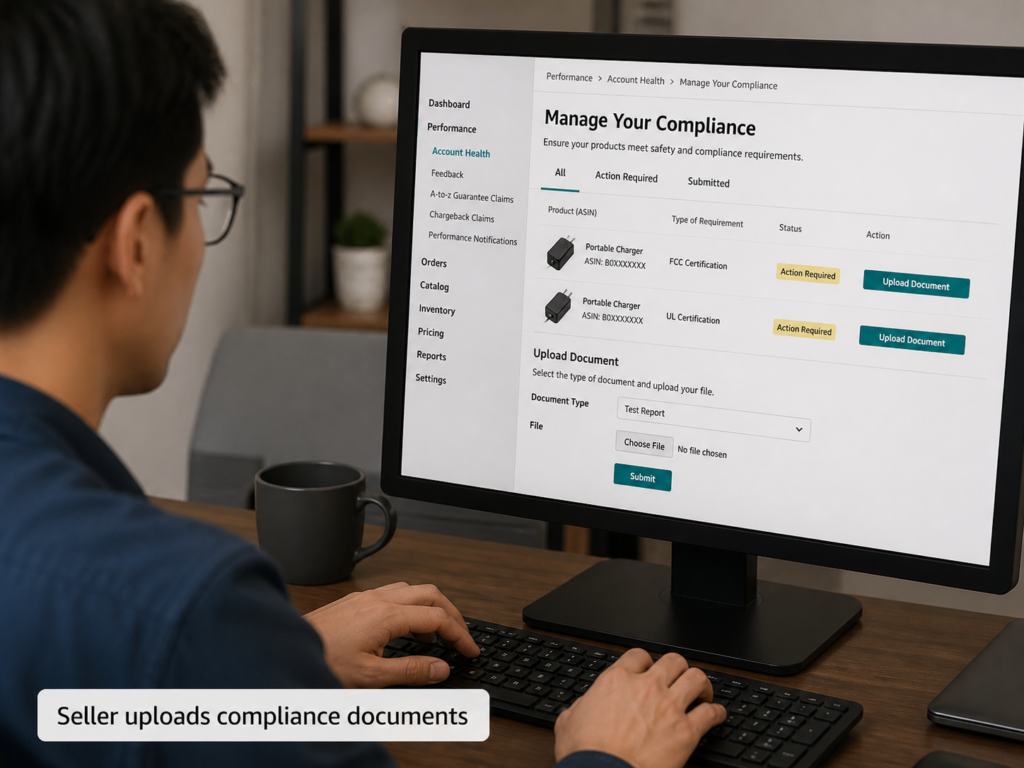
1. **Batch/platform required submission entry**: If you receive a platform compliance notification, random inspection, or appeal submission, you can usually enter from “Performance” → “Account Health” → “Manage Your Compliance” in Seller Central, find the corresponding ASIN and requirements, and upload the documents as prompted;
2. **Single ASIN proactive submission entry**: If you have not received a notification and want to upload compliance documents in advance, you can try to enter “Compliance Information” from the edit page of the corresponding Listing and upload the documents.
Key reminder: Everything shall be subject to the designated entry in the email or Seller Central notification sent to you by Amazon, and the entry may vary for different categories. When the platform does not have clear requirements, do not upload mismatched documents at will.
Key Points for Document Upload Operation
Before uploading, confirm three things first: whether it corresponds to the correct ASIN or SKU, whether the platform requires FCC documents or safety documents, and whether it is also required to supplement labels, instruction manuals, or responsible party information.
• **Uploading FCC documents**: Upload test records, declaration of conformity, certification information, label drafts, or other designated documents in accordance with the platform notification; if the product involves FCC ID, fill in the corresponding number as required;
• **Uploading safety documents**: Upload test reports, laboratory accreditation certificates, product nameplate pictures, or other designated materials in accordance with the platform notification;
• **Document format**: Submit in accordance with the language, format, size, and attachment requirements specified in Amazon’s specific notification. Only when the notification clearly requires English PDF should you prepare it in English PDF, and a unified format cannot replace the platform’s requirements.
File naming can use the format of “ASIN number + product model + file type”, for example, “B012345678 + 20W PD Fast Charger + Safety Test Report”, which is convenient for internal management and identification during review.
Follow-up and Evidence Retention After Submission
The review time after submission varies depending on the type of ordinary review, random inspection, complaint, or appeal, and it cannot be guaranteed that all cases will be completed within a fixed number of working days.
The status can be understood as follows:
• If it shows “Under review”, do not submit repeatedly for now, unless the platform requires supplementary materials;
• If it shows “Approved”, operate normally in accordance with the platform status and other sales requirements;
• If it shows “Rejected”, carefully check the specific reasons, and submit after supplementing, modifying, or retesting as required.
Regardless of the result, you must keep evidence well: uploaded documents, submission number, page screenshot after submission, as well as submission time and status should all be saved. If a re-review or dispute occurs later, these materials can help you explain the submission process and the correspondence of documents.
Common Rejection Reasons and Troubleshooting Methods
Many new sellers get rejected on their first submission. Don’t panic. First confirm what the platform actually requires, then troubleshoot according to the logic below.
Common FCC Submission Rejections and Solutions
1. **Laboratory or report does not meet requirements**: FCC ID certification shall use FCC-recognized laboratories; SDoC products shall use laboratories with corresponding testing capabilities that can complete testing in accordance with applicable FCC rules and issue complete records. Whether it is also necessary to meet the platform-specified qualifications shall be subject to Amazon’s notification;
2. **Product information is inconsistent with the Listing**: For example, the model, brand, power, or hardware configuration on the report is different from the Listing description. Check whether the documents truly cover the actual sold product, and if necessary, correct the page, update the documents, or retest;
3. **SDoC lacks responsible party information**: The SDoC shall be signed by the responsible party under FCC rules, and the required U.S. domestic contact information shall be provided. Manufacturers, importers, suppliers, and sellers are not necessarily the same entity, and the signing party shall be determined according to the actual role;
4. **FCC ID cannot be verified**: Confirm whether the TCB has submitted or published the relevant data, then check whether the FCC ID number, product model, and application information are filled in correctly.
Common UL Submission Rejections and Solutions
1. **Report or laboratory conditions do not meet platform requirements**: Verify whether the laboratory is accredited by the corresponding accreditation body in accordance with ISO/IEC 17025, whether the accreditation scope covers relevant products and test methods, and at the same time confirm whether it complies with Amazon’s notification;
2. **Test standard does not match product type**: Fixed standards cannot be directly applied. The applicable standard shall be confirmed according to the product’s use, structure, and rated parameters, and supplementary testing or retesting shall be carried out if necessary;
3. **The report lacks test items required by the platform or standards**: Test items are determined by applicable standards, product structure, and platform notifications. When missing items are found, confirm with the laboratory whether supplementary testing is needed and update the report;
4. **Using component UL certification to replace the whole product report**: UL Recognized certification for components usually cannot replace the whole product safety test report. Applicable safety documents that can cover the entire product shall be provided.
General Rejection Troubleshooting Steps (By Priority)
If you don’t know why you were rejected, troubleshooting in this order is the most efficient:
1. First confirm the document type required by the platform, the corresponding ASIN, and the deadline, and confirm whether what you submitted is FCC, safety test report, NRTL certification, or other documents;
2. Check the information of the report and Listing: brand, model, rated parameters, hardware configuration, responsible party, and production information, to ensure that the documents truly cover the actual sold product;
3. Check the laboratory’s accreditation status, accreditation scope, report completeness and clarity, and confirm whether there are missing pages or missing key attachments;
4. Confirm whether the description on the product page exceeds the coverage of the report, for example, the report only covers 20W configuration, but the Listing is written as 65W;
5. Finally, determine the solution: whether to supplement materials, modify the page, update the report, or need to retest. Don’t retest right away to avoid wasting money.
High-Frequency Pitfall Avoidance Reminders for New Sellers
These pitfalls are fatal and must never be touched:
1. **Buying counterfeit/generic reports**: That is the kind where the service provider says “I have a ready-made report, you can use it”, or the supplier provides a report that is not for your product. Submitting this may not only result in direct rejection, but in serious cases, it may also trigger account review or even store suspension;
2. **Shipping to FBA first before doing compliance**: Many new sellers are afraid of delaying time, so they ship the goods to FBA first. As a result, the review fails, the inventory is stuck in the warehouse with storage fees paid every day, and finally they can only be discarded, which causes much greater losses than doing compliance in advance;
3. **One-time compliance is valid for life**: If changes occur such as changing chips, changing wireless modules, replacing key safety components, adjusting power, or changing production locations, a change assessment shall be done first. Depending on whether the changes affect radio frequency characteristics, safety structure, and applicable rules, supplementary testing, document updating, or re-certification may be required;
4. **Variants sharing reports beyond the scope**: Only when the documents can truly cover the actual variants can sharing reports be considered. For variants with different power, interfaces, circuits, wireless modules, or key safety components, first confirm whether separate testing or supplementary documents are required.
Full-Link Compliance Planning and Self-Inspection
Compliance is not something done only before listing. It must be controlled from the source of procurement to fundamentally avoid risks.
Compliance Control Nodes from Procurement to Listing
• **Before procurement**: First verify the authenticity and coverage of the certificates provided by the supplier, confirm whether they include your brand, model, production information, and actual product structure. Don’t just listen to the supplier say “no problem”, directly reject vague promises;
• **Sampling stage**: Check whether the product’s nameplate, parameters, structure are consistent with the content on the compliance documents, keep sample photos well, which can be used for comparison if there are problems later;
• **Before listing**: Establish an ASIN-model-certificate correspondence table, clarify which model each ASIN corresponds to, which report is used, and which documents the platform requires, and stock up only after all materials are ready;
• **After listing**: Usually pay more attention to compliance notifications in Seller Central and buyer complaints. If the product changes chips, wireless modules, key safety components, adjusts power, or changes production locations, be sure to re-evaluate compliance.
Pitfall Avoidance Points for Selecting Compliance Service Providers
How to choose a reliable service provider? Remember these points:
• The quotation should clearly state whether testing, reports, basic modifications, retesting, and certification review are included, to avoid low initial quotations followed by continuous additional charges later;
• The laboratory’s accreditation status and accreditation scope should be queryable, and cover the products and test methods you need;
• Be wary of absolute promises such as “guaranteed pass on Amazon” and “100% pass”. Whether it is compliant ultimately depends on the product, documents, and platform requirements;
• Prioritize service providers with testing experience in charging products. They are familiar with common problems of products such as chargers, adapters, USB cables, and wireless chargers, which can save a lot of detours.
Quick Self-Inspection Checklist Before Submission
Go through these items before submission, and the pass rate can be increased by 80%:
1. The compliance scope, FCC path, and applicable safety standards of the product have been confirmed;
2. Qualified documents that can cover the actual product and meet platform requirements have been obtained;
3. The brand, model, rated parameters, hardware configuration, responsible party, and production information in the documents are consistent with the actual sold product;
4. All materials meet the language, format, size, and attachment requirements specified in Amazon’s specific notification;
5. The laboratory’s accreditation status and accreditation scope are queryable, and match the product and test methods;
6. The product page description does not exceed the coverage of the documents.
In general, the key to FCC and UL compliance for Amazon US site is not to apply the same list to all charging products, but to first confirm the product function and device classification, then verify the applicable regulations, test standards, laboratory conditions, and Amazon’s notification for the specific ASIN.
Planning the cycle and cost in advance, and controlling the consistency of product, document, and Listing information from the procurement source, can reduce the risks of delisting, inventory backlog, and repeated testing. When encountering a rejection, you should first determine whether the problem lies in the document type, product scope, responsible party, laboratory conditions, or page description, and then decide whether to supplement materials, modify the page, update the report, or retest.