
Many charging product sellers who are just expanding to Amazon Canada Site most easily fall into the first trap of “taking things for granted”: either they think certifications for the US site can be used directly, or they assume that passing the platform review means compliance. As a result, at best, Listings are taken down and inventory is frozen; at worst, goods are detained by customs and even regulatory fines are imposed.
In fact, the compliance logic of the Canada site is essentially different from that of the US site, and it is subject to dual supervision of “platform + official authorities”, neither of which is dispensable. In this article, we start from the most basic logic, and teach you step by step how to determine which certifications your products need, how to verify the authenticity of certificates, how to submit them to Amazon, and how to avoid the pitfalls that most sellers fall into.
Must-Know for Beginners: Basic Logic of Compliance
Core Boundary: Platform Review ≠ Official Regulations
First of all, we must firmly establish the most easily misunderstood core point: Amazon’s platform review and Canada’s official regulations are completely two different things.
Platform review governs whether you can sell on Amazon, and determines listing eligibility and account health. The reason for triggering the review is not necessarily a product problem; it may be that the category itself requires review, or it may be buyer complaints, peer reports, or even random platform spot checks. If the platform determines that there is a violation, at best, the Listing will be removed and performance points will be deducted; at worst, inventory will be frozen and the store will be directly closed.
Official regulations, on the other hand, govern whether you can sell legally in Canada, and are mandatory requirements of customs and market regulatory authorities. Even if you have been selling on Amazon for half a year, as long as you are found non-compliant in an official spot check, you may still have your goods detained, be required to recall them, and even bear legal liability for violating the (CCPSA).
In one sentence: passing platform review ≠ full compliance. You must meet the requirements of both sides, and cannot only focus on Amazon’s review results.
Four Types of Core Compliance Requirements (by Jurisdiction Level)
Canada’s compliance has a two-tier structure of “federal + provincial”. It can be divided into four categories by jurisdiction level. You can first compare with your products to get a general impression:
| Compliance Level | Applicable Objects (taking charging products as examples) | Competent Authority | Common Compliance Evidence | Exceptions |
| Provincial Electrical Safety | Electronic products connected to Canada’s 120V mains power (such as wall chargers) | Provincial electrical safety regulatory authorities, and certification bodies with corresponding accreditation | Safety certification certificates and marks issued for the Canadian market and covering the target province | Whether pure low-voltage passive accessories require approval shall be judged according to the specific province and product structure |
| Federal Wireless and Electromagnetic Compatibility | Products with digital circuits / intentional wireless transmission functions (such as fast charging cables with E-Marker, wireless chargers with Bluetooth) | ISED (Innovation, Science and Economic Development Canada) | ICES-003 test report / ISED equipment certification number | Pure passive low-voltage accessories without digital circuits usually do not involve these requirements, but still need to be judged in combination with the product |
| Federal Energy Efficiency | Power products included in the management scope of the and its regulations (such as external power adapters of certain power levels) | NRCan (Natural Resources Canada) | Energy efficiency test report, energy efficiency report and other applicable records | Products not included in the regulatory catalog |
| Consumer Safety and Labeling | Electronic products sold to consumers | Health Canada is responsible for the federal consumer product safety framework, and provinces may also have their own electrical, consumer protection and language requirements | Labels, instructions, safety warnings, and test or certification materials determined by product and regulations | There is no set of labeling rules that are exactly the same for all electronic products, which need to be checked according to the product and sales region |
Special reminder here: all consumer products must comply with the applicable CCPSA and specific product safety regulations, but this does not mean that all electronic products automatically apply the same set of labeling, bilingual instruction or safety warning requirements. The language and content of labels, warnings, packaging and instructions shall be confirmed separately according to the product, sales method, and applicable federal and provincial regulations.
In addition, compliance responsibility is not just the supplier’s business — Canadian importers, brand owners, and platform sellers shall bear joint responsibility. If you are an overseas seller, you cannot only rely on the international certifications provided by the supplier; you must confirm that these certifications meet local Canadian requirements, otherwise you cannot escape responsibility if something goes wrong.
Core Differences Between US and Canada Certifications (High-Frequency Misconceptions)
Many sellers who transfer from the US site most easily make the mistake of directly using US certifications. Although the US and Canada are close, their certification systems and regulatory requirements are not exactly the same. There are four core differences:
• Safety category: Certifications with only the US UL mark (without Canada-applicable marks or certification scope) cannot directly prove that the product meets Canadian requirements. It shall be confirmed whether the product has obtained applicable safety certification covering the Canadian market, such as the corresponding CSA Canada mark, cUL or cETL mark.
• Wireless/EMC category: US FCC Part 15 certification cannot directly replace Canada’s ICES-003 standard or ISED equipment certification, and can only be used as a reference for gap analysis at most.
• Energy efficiency category: US DOE energy efficiency certification and Canada’s NRCan energy efficiency requirements are two systems and cannot be used interchangeably.
• Plug category: The commonly used plug specifications in the US and Canada are generally the same, and common North American plugs are usually interchangeable in terms of physical specifications and 120V/60Hz power supply. However, complete machines sold in Canada must still comply with applicable Canadian electrical safety requirements, plug rated parameters, grounding/polarity and marking requirements; Canadian compliance cannot be proven solely by US certifications or US market compliance documents.
Compliance Path Decision: Matching Requirements According to Product Parameters
After clarifying the basic logic, what everyone is most concerned about next must be: what certifications do the products I sell need? In fact, you don’t need to memorize them by rote; you just need to judge step by step according to the product’s hardware parameters.
The core principle is very simple: certification requirements are only related to the product’s function, parameters, and sales scenarios, and have nothing to do with the “risk level” you think — even a low-power charger, as long as it is connected to the mains, must be evaluated for safety approval according to applicable requirements.
Before making the judgment, you must first sort out the core parameters of the product: rated input/output voltage and power, whether it is connected to Canada’s 120V mains, whether it has a built-in chip/digital circuit, whether it has wireless transmission functions such as Bluetooth/Wi-Fi/NFC, whether it contains a lithium battery, whether the sales province includes Quebec, and whether it is a combination set.
Below, we will clarify the compliance boundaries for the five most common types of charging products respectively:
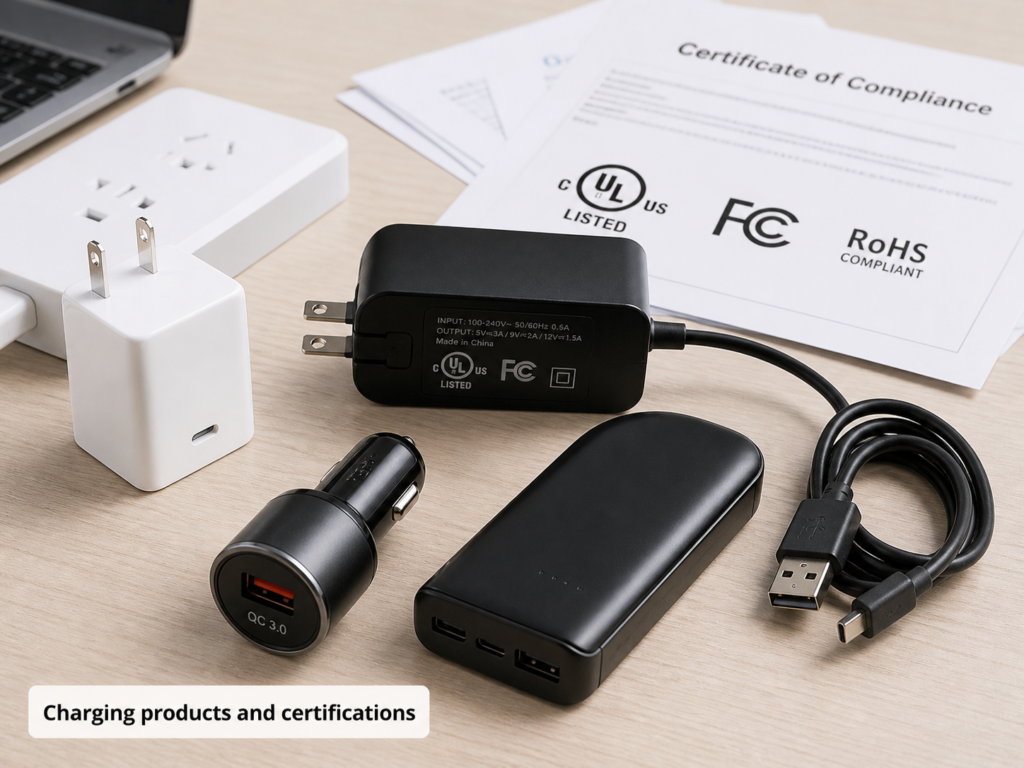
Category 1: Pure Low-Voltage Passive Charging Cables/Connectors
These are cables or adapters that have no chips or circuits and only transmit low-voltage direct current of ≤5V, such as ordinary USB-A to Lightning charging cables and simple non-functional adapters.
Such pure passive low-voltage cables or connectors usually do not involve wireless certification, and may not fall within the scope of mandatory electrical approval in some provinces. However, whether provincial electrical safety approval is required, what cable or flame retardant requirements apply, and what labels are required must be confirmed according to the sales province, product structure and applicable standards, and a unified national exemption conclusion cannot be made.
If the product is connected to the mains or has a voltage conversion function, it can no longer be judged as an ordinary passive cable. For products sold as a set with a charger, it is also necessary to confirm whether the complete sales configuration and the products requiring approval therein have been covered by applicable certifications or regulations, rather than assuming that the entire set of products has no additional requirements solely based on “the cable is low-voltage”.
Category 2: Charging Cables/Adapters with Circuits/Chips
For example, USB-C fast charging cables with E-Marker chips, charging cables with indicator lights, and adapters with protection circuits or conversion circuits all fall into this category. Compliance requirements depend on the situation: according to the operating voltage, whether it is connected to the mains, and the requirements of the sales province, judge whether safety certification is required; as long as it has a digital circuit, it is necessary to evaluate and comply with applicable electromagnetic compatibility requirements such as ICES-003.
In addition, Amazon has additional USB-IF certification requirements for some USB-C products. This is an industry specification, not mandatory by the Canadian government. Whether to do it shall be subject to the category notification in Amazon Seller Central, and there is no need to apply blindly.
There is a boundary case to note here: if it is an adapter with voltage conversion, such as a USB-C to laptop power adapter, it shall be subject to the requirements for power products, and cannot be counted as an ordinary adapter.
Category 3: Chargers/Power Adapters (Mains-Connected Type)
These are wall-mounted or desktop chargers or power adapters directly connected to 120V mains power, and are also the category with the most compliance requirements. There are three basic requirements: obtain applicable electrical safety approval or certification according to the sales province and product situation; evaluate ICES-003 for those with digital circuits; plugs and complete machines shall comply with applicable Canadian rated parameters, grounding/polarity, structure and marking requirements.
As for the NRCan energy efficiency that everyone often asks about, not all chargers need it. First, confirm whether the product belongs to regulated external power supplies or other regulated categories according to the and . When applicable, the required tests shall be completed, and obligations such as the NRCan energy efficiency report shall be fulfilled before import or sale. Low-power or special-purpose products may not be within the scope, so check the catalog first before deciding, and don’t waste money for nothing.
Category 4: Charging Products with Intentional Wireless Transmission Functions
For example, wireless chargers with Bluetooth that can connect to an APP to adjust power, and smart charging devices with Wi-Fi — as long as they have the function of actively transmitting wireless signals, applicable ISED wireless equipment certification shall be obtained in addition to the requirements of the corresponding basic product.
A clear boundary shall be drawn here: wireless chargers without communication transmission functions such as Bluetooth and Wi-Fi are usually not certified as conventional Bluetooth or Wi-Fi transmitters, but ISED’s RSS-216 for Wireless Power Transfer Devices and applicable electromagnetic compatibility requirements shall be checked. You cannot assert that the product does not require ISED-related compliance at all solely based on the name “Qi”.
Category 5: Charging Products Containing Lithium Batteries
For example, power banks and charging stands with built-in batteries all fall into this category. Compliance requirements need to be checked separately: applicable safety requirements for products and batteries, Canadian dangerous goods transportation requirements, and Amazon’s current document requirements for dangerous goods and FBA. In terms of transportation, materials such as UN 38.3 test and test summary shall also be prepared when applicable.
It should be noted that UN 38.3 is mainly a UN dangerous goods transportation test requirement, and is not equivalent to a unified battery safety certification. Transportation documents, product safety compliance, and platform review are three sets of different requirements and cannot replace each other.
Special Form: Combination Sets
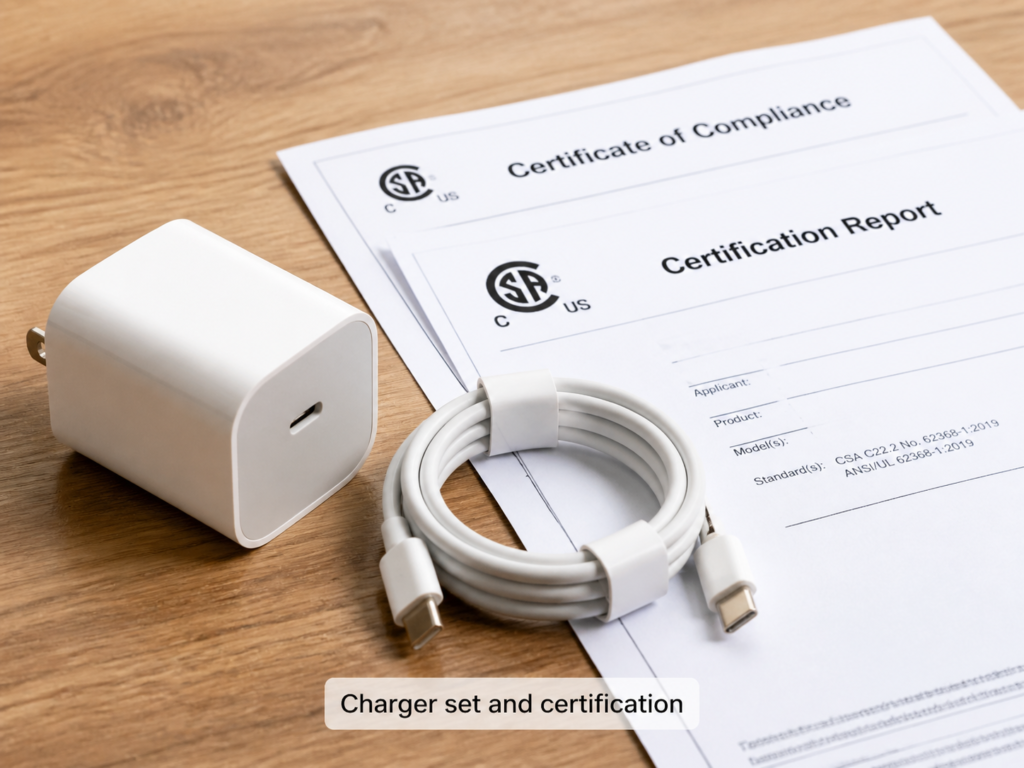
For example, when a charger and a charging cable are sold together as a package, the set shall ensure that the complete sales configuration and the products requiring approval therein are all covered by applicable certifications or regulations.
If the certificate only covers the charger, but does not cover the cable, combination configuration or the entire set model, you shall confirm with the certification body whether supplementary evaluation or separate certification is required. You cannot simply use the charger’s certification to cover the entire set, nor can you prove the compliance of the entire set of products solely based on the cable’s materials.
Detailed Explanation of Core Compliance Requirements
After knowing which certifications your products need, next we will explain the details of each certification thoroughly, so that you not only know what to do, but also know why to do it and how to judge whether it is qualified.
Provincial Electrical Safety Certification
The function of this certification is that a third-party body with corresponding accreditation evaluates the product according to applicable standards to confirm that its electrical safety risk is within the required range. The scope of application is mainly charging products connected to the mains. As for whether low-voltage products with circuits need it, it depends on the requirements of specific provinces.
Common Canadian safety certification marks include the CSA Canada mark, cUL, cETL, etc. The corresponding certification marks issued and permitted for use by the certification body for the Canadian market shall be used, and the validity cannot be judged solely by whether there is the letter “c” on the mark. The key is to verify the qualification of the certification body, the scope of the certificate, the product listing, and the acceptance of the target province.
The corresponding common standards include CSA C22.2 No. 62368-1, but the specific applicable standards shall be subject to the judgment of the certification body, and you should not apply them randomly by yourself.
It should also be noted that certificates issued by any random body are not useful — the issuing body must obtain accreditation for the corresponding scope, and the certification scope must cover Canada and your target sales province, otherwise the certificate may not be used as a basis for local electrical safety approval.
Electromagnetic Compatibility and Wireless Requirements
This part is divided into two sections, with different applicable scenarios:
Electromagnetic Interference of Digital Equipment: ICES-003
Its function is to ensure that products with digital circuits do not emit excessive electromagnetic interference that affects the normal operation of other electronic devices. Charging products with digital circuits usually need to evaluate whether requirements such as ICES-003 apply, and pure passive products generally do not involve such digital equipment requirements. The core is to prepare test reports that meet applicable requirements and retain technical documents for spot checks.
Emphasize again: the US FCC Part 15 report cannot directly replace ICES-003, and can only be used as a reference at most. Do not submit it directly to Amazon or regulatory authorities unless it has been confirmed that its content meets the applicable Canadian requirements.
Intentional Transmitters: ISED Wireless Certification
This is for products that actively transmit wireless signals such as Bluetooth, Wi-Fi, and NFC. Its function is to ensure that the transmission frequency and power of the product comply with Canadian regulations and do not cause unacceptable interference to other radio communications.
There is a common pit here: if your product uses a wireless module that already has certification, it does not mean that the complete machine can be ignored. You must confirm that the module’s certification conditions, antenna parameters, installation method, host configuration, radio frequency exposure and other requirements are met. You cannot assume that the module certification automatically covers the complete machine just because the module model is the same.
Intentional transmitters shall obtain applicable ISED certification, and provide the required certification number and compliance statement on the product, electronic label or instructions in accordance with ISED rules. Current regulation usually uses expressions such as “ISED certification number”. Do not generally write that all products must be marked with “IC ID” on the product or instructions.
NRCan Energy Efficiency Obligations
This is managed by Natural Resources Canada (NRCan). For products included in the management scope of the and , it requires them to meet corresponding energy efficiency requirements, with the aim of reducing unnecessary energy consumption.
Whether to do this, first of all, you must check the latest energy efficiency regulation catalog to confirm whether the product belongs to regulated external power supplies or other product categories. When applicable, the required tests shall be completed according to the product category, and obligations such as the NRCan energy efficiency report shall be fulfilled before import or sale, while relevant records shall be kept as required.
Do not take the “registration number” as a unified judgment standard for all products, nor do you generally say that all regulated products must complete a public registration for sellers. The core obligation of some products is to submit energy efficiency reports and keep materials. The specific process shall be subject to NRCan’s regulations for that product category.
When verifying, first confirm whether the product is within the scope of the regulations, and then check whether there are corresponding test reports, energy efficiency reports and other declaration vouchers.
Additional Platform Requirement: USB-IF Certification
This is an industry certification of the USB Implementers Forum (USB-IF), not mandatory by the Canadian government. Amazon requires some USB-C products to provide it to ensure product interoperability and avoid damaging user devices during charging.
Whether to do this is entirely subject to the latest category notification in Amazon Seller Central, and not all USB-C products require it. In addition, note that it is an industry certification and cannot be promoted as an official Canadian certification, otherwise it may trigger penalties for false publicity.
Label and Instruction Requirements
This is the most easily overlooked, but also the most prone to problems.
The nameplate shall be marked with information such as model, rating, manufacturer or responsible subject in accordance with applicable electrical safety standards and certification body requirements. The language and content of packaging, product name, quantity, warnings and instructions shall be confirmed separately according to applicable federal regulations, provincial regulations and certification standards, and cannot be generalized as all content must be bilingual in English and French.
The mainly targets pre-packaged non-food products within the applicable scope, and stipulates matters such as product name, net quantity, and dealer information. It does not mean that all nameplates, instructions and safety warnings of all electronic products automatically apply exactly the same English-French bilingual rules.
If you only sell in the province of Quebec, French requirements usually need to be checked separately and emphatically, and some information may need to give priority to French or meet stricter French usage requirements. You cannot simply assume that the general labeling practice at the federal level will definitely meet Quebec’s requirements.
In addition, all information on the Amazon Listing page, such as parameters, brand, model, and certification marks, must be completely consistent with the physical product and the certificate. You cannot have the Listing say 65W while the certificate only has 45W, nor can the model differ by one letter, otherwise the review will definitely not pass.
Labeling requirements may vary for different products and different provinces. It is best to check in combination with specific regulations, and do not take things for granted.
Certificate Validity Verification Methods
Many sellers, after getting the certificates provided by the supplier, do not know whether they are real or usable. As a result, they are rejected when submitting, and even have their stores closed due to fake certificates. In fact, verifying certificates is very simple, just follow the steps.
General Verification Logic
The general verification logic is divided into four steps:
Step 1: First, clarify your product attributes and the corresponding types of certificates required. Don’t use safety certification as a wireless certification.
Step 2: Check whether the core information on the certificate is completely consistent with the information on your sold products and Listing, not even a single letter can be different.
Step 3: Verify the qualification of the issuing body, and whether the certificate or certification listing is currently valid, suspended or revoked. Not all Canadian safety certificates have a fixed validity period; many product certifications are in a continuous listing or continuous certification status, depending on the rules of the issuing body.
Step 4: Keep the verification records and official query screenshots properly, mark them with dates, and they can be used as evidence in the future whether it is a platform spot check or regulatory inspection.
Core Dimensions of Verification
During specific verification, focus on six dimensions:
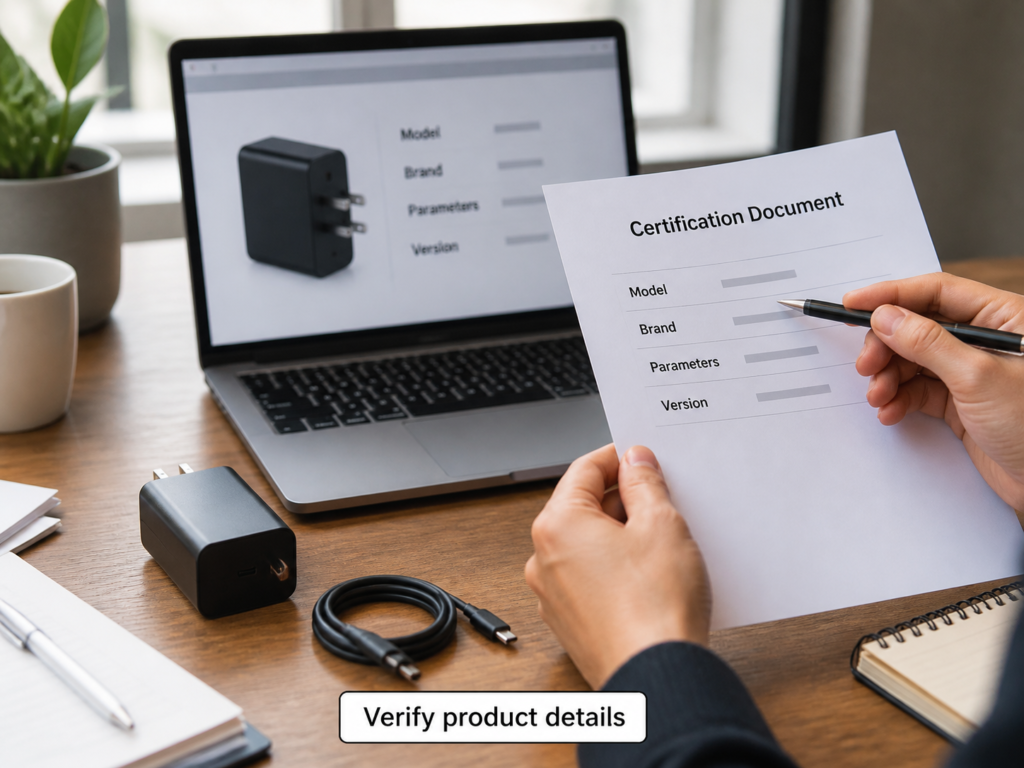
First is product information matching: the model, brand, parameters, and version on the certificate must be as completely consistent as possible with the products you sell and the Listing; second is production information matching: confirm that the manufacturer and factory information are consistent with the certificate or certification listing; third is qualification validity: the issuing or testing body must have corresponding qualifications, and the certificate or certification listing is not currently suspended or revoked; fourth is geographic coverage: the certificate or certification shall cover Canada and the target sales province; fifth is scope matching: applicable standards, product categories, models, structures and rated parameters shall match, and derivative models shall also be confirmed whether they are listed in the coverage scope; finally is voucher retention: not only the certificate, but also test reports, official declaration vouchers, and query screenshots shall be kept properly. Don’t just keep a PDF certificate and call it a day.
If a certificate clearly sets a validity period or batch limit, then check the corresponding date and batch. You cannot take “certificates must have a fixed validity period” or “each production batch must be listed on the certificate” as a unified rule for all certificates.
Exclusive Verification Points for Each Type of Certificate
Different types of certificates have different verification focuses:
• **Provincial Safety Certification**: First check whether the issuing body is in the SCC accreditation directory, and also confirm that the certification scope covers Canada and the target sales province. Don’t just look at the certificate PDF or surface marks; it is best to directly confirm the Canadian applicability with the certification body. Common invalid situations include rebranding and model modification on certificates, derivative models not included in the certification scope, and listing being suspended or revoked.
• **ICES-003/ISED Equipment Certification**: For digital equipment, check whether the applicable ICES test reports and technical documents are complete; for intentional transmitters, go to the ISED official database to check whether the certification number actually exists. If module certification is used, be sure to confirm that the module certification conditions, antenna parameters, installation method, host configuration and other applicable requirements are met. Common invalid situations are using FCC ID to replace Canadian ISED certification, and module certification conditions not being met by the complete machine.
• **NRCan Energy Efficiency**: The first step is to confirm whether the product is within the scope of the , and then verify the test report, energy efficiency report and other applicable vouchers. Different products have different fulfillment methods, and not all have publicly searchable registration numbers. Not finding the number does not mean that the materials are necessarily invalid. Common invalid situations are having only test reports but not completing the required energy efficiency report obligations, or the report model not matching the sold model.
• **USB-IF Certification**: Directly query on the USB-IF official website, focusing on confirming that the certificate covers the entire cable/complete machine model. If there is only interface certification, it cannot automatically prove that the entire cable or finished product meets the requirements. Common invalid situations are expired certificates, and only interface certification not covering the finished product.
Certification Processing and Platform Submission
If your product has not been certified yet, or has been certified and is ready to be submitted to Amazon, this part of the content can help you avoid a lot of detours.
Basic Steps for Certification Processing (Taking Wall Chargers as an Example)
We take the most common wall charger as an example to explain the basic steps of certification processing. The logic for other products is similar:
Step 1: Choose the right body. For safety certification, choose a body that has obtained corresponding accreditation and whose certification scope matches the target sales province; for wireless and EMC evaluation, choose a body with corresponding capabilities and qualifications. Don’t choose the wrong one and waste money.
Step 2: Submit materials. Sort out product samples, parameter sheets, brand models, and factory information and submit them to the body.
Step 3: Testing and rectification. The body tests according to corresponding standards. If it fails, retest after rectification until it passes.
Step 4: Check the certificate. After passing the test, get the certificate or report. Don’t just get it and be done; be sure to check the core information: model, brand, coverage scope, and whether the Canadian mark is correct, to avoid getting the wrong version.
Step 5: Fulfill official procedures. For products regulated by NRCan energy efficiency regulations, obligations such as required tests and energy efficiency reports shall be completed when applicable; for wireless products, applicable ISED equipment certification and related marking and compliance statement requirements shall be completed separately. You cannot generally refer to NRCan energy efficiency reports and ISED wireless certification as the same kind of “registration”.
The processing cycle for conventional products is generally 3-8 weeks, excluding the time for rectification, factory audits, or complex wireless products. It is recommended to plan in advance. In terms of cost, there are great differences between different products, certification projects, and bodies. You need to inquire specifically, and don’t believe in one-price offers.
Special attention should also be paid to change control: if the product is modified (chip replacement, shell replacement, power change, factory replacement, etc.), it must be submitted to the certification body to re-evaluate the validity of the certification. Don’t secretly modify it without saying anything, and then you won’t even know when the certificate becomes invalid.
Must-Ask List for Certification Bodies
Many sellers don’t know what to ask when looking for a certification body for the first time. These questions must be asked clearly in advance: whether the product requires provincial safety certification and what the applicable standards are; whether the certificate covers all sold models/power levels and whether derivative models require additional testing; whether changing chips, factories, or appearance triggers re-evaluation; what are the usage specifications of the certification mark; whether a local Canadian responsible subject (importer/brand owner) is required. Asking these clearly can avoid a lot of trouble later.
Submission of Compliance Certificates in Amazon Seller Central
After the certification is completed, it must be submitted to Amazon for review. The submission entry is subject to the current version of Seller Central, generally in the Account Health or Compliance Dashboard section. If you can’t find it, search for “compliance” or “certification”.
Materials to prepare include: scanned copies of certificates/reports, clear photos of product nameplates, photos of packaging, and instructions. When filling in, note that the certificate number, issuing body, and covered models must be completely consistent with the Listing, not a single word can be different; for documents involving validity period, also confirm that the submitted information is consistent with the document. The documents should be scanned clearly, and the naming is recommended to follow the format of “brand + model + certification type” to facilitate reviewers to find them.
The review cycle is generally 3-5 working days, which varies depending on the category and material completeness. It is recommended to submit in advance, don’t wait until it’s time to list, which will delay sales time.
Common Reasons for Submission Failure and Supplementary Material Logic
Many people get rejected on their first submission. Don’t panic. The common reasons for failure are nothing more than these categories: certificate model/brand/parameters do not match the Listing; certification scope, body qualification, and provincial acceptance do not match; certification listing has been suspended or revoked; pictures are blurry, and the nameplate/certification mark cannot be seen clearly; labels/instructions do not meet applicable language requirements; directly using US/EU certifications as substitutes.
Don’t modify randomly when supplementing materials. Check in this order: first confirm whether the product classification is correct and whether there are any missing applicable certification items; then check whether the certificate meets Canadian official requirements; finally check whether all information is completely consistent with the Listing and the physical product. If you are really unsure, consult an accredited certification body or professional compliance service provider. Don’t repeatedly submit unqualified materials, as too many times may affect account performance.
If you need to appeal, be sure to organize all test reports, certification vouchers, and official query screenshots, form a complete evidence chain and submit them together, and the pass rate will be much higher.
High-Frequency Pitfall Avoidance and Special Scenarios
After talking about the conventional process, let’s talk about the most easily fallen pitfalls in actual combat, and compliance judgments for some special scenarios.
Pitfall Avoidance List by Product Type
First, the core pitfall avoidance points are sorted out by product type, you can directly compare:
• **General Pitfall Avoidance**: Never use US/EU certifications to directly replace Canadian certifications, they can only be used as technical references at most; never rebrand/Photoshop others’ certificates, at best the store will be closed, at worst regulatory fines will be imposed; don’t only have test reports without fulfilling applicable official procedures; don’t promote parameters that are inconsistent with the certification, for example, marking 65W but the certification is only 45W, which will trigger penalties for false publicity.
• **Chargers/Power Adapters**: The commonly used plug specifications in the US and Canada are generally the same, but the complete machine still needs to comply with applicable Canadian electrical safety requirements. The rated voltage, pin structure, polarity, grounding, certification scope and certification mark shall be checked. Canadian compliance cannot be proven solely by US market compliance documents; for energy efficiency, first confirm whether it is within the scope of NRCan, and don’t register blindly and waste money.
• **Fast Charging Cables/USB-C Cables with Circuits**: Don’t only provide material test reports; whether electrical safety approval is required shall be judged according to product voltage, purpose and sales province; USB-IF requirements are subject to Amazon’s latest notification, and not all products require it.
• **Wireless Chargers**: Don’t confuse ordinary inductive power supply with products with additional communication transmission functions. Wireless chargers without communication transmission functions are usually not certified as Bluetooth/Wi-Fi transmitters, but ISED RSS-216 and applicable EMC requirements shall still be checked; don’t only use wireless module certification, you must confirm that the complete machine meets all corresponding requirements.
• **Charging Products Containing Lithium Batteries**: It is necessary to separately check the applicable safety requirements for products and batteries, Canadian dangerous goods transportation requirements, and Amazon’s current document requirements for dangerous goods/FBA. Prepare UN 38.3 test and test summary when applicable, but don’t take it as a unified product safety certification; the specific FBA document requirements for products such as power banks are subject to Amazon’s current review policy.
Compliance Judgment for Special Scenarios
In addition to conventional products, there are several special scenarios that many sellers get confused about:
• **Self-shipping vs FBA**: There is no difference at all in legal requirements between the two. There is no exemption for shipping methods, and all compliance certificates and label vouchers must be retained. Don’t think that self-shipping doesn’t require compliance; you will be fined the same if found out.
• **Small Batch/Temporary Promotion**: There is no exemption at all. As long as it is on sale, it must meet the requirements, and all vouchers must be kept. Don’t think that “only selling a few to try” doesn’t require certification.
• **Product Modification**: Re-certification may be required depending on the modification content. It must be submitted to the certification body for evaluation, and at the same time, the parameter comparison before and after modification and the certification body’s evaluation report shall be retained. Don’t think that changing the shell or slightly modifying parameters doesn’t require updating the certificate. For example, changing the flame-retardant shell material may affect the validity of the safety certification.
• **Combination Sets**: The complete sales configuration and the products requiring approval therein must all be covered by applicable certifications or regulations. If the certificate does not cover the cable, combination configuration or the entire set model, you shall confirm with the certification body whether supplementary evaluation or separate certification is required, and at the same time retain the compliance materials of each related single product and the entire set configuration.
• **Sold Only in Quebec**: The labeling practice at the federal level may not meet Quebec’s requirements. Labels/instructions need to be adjusted according to the applicable French regulations in Quebec, and at the same time, French labels, instructions and compliance certificates shall be retained.
• **Second-Hand/Refurbished Products**: They neither require no compliance at all, nor have exactly the same requirements as new products — such products still need to meet applicable safety and consumer protection requirements, and at the same time have additional regulations on labels, responsible subjects, etc. You must check the product status and platform policies, and retain refurbishment process descriptions, compliance certifications, and resale disclosure documents.
Pre-Listing Check and Official References
Finally, we have sorted out a quick pre-listing check list and official reference sources for everyone to facilitate self-inspection.
Quick Pre-Listing Check List
You can quickly check according to these four steps, which can avoid most low-level mistakes:
1. **Product Attribute Check**: Sort out all hardware parameters, list all required compliance items, and don’t miss easily forgotten points such as Quebec language requirements, energy efficiency, and wireless power transfer.
2. **Certificate Validity Check**: Confirm that the issuing body has corresponding qualifications, the certification listing or certificate is currently valid, not suspended or revoked, the information is consistent with the product/Listing, it covers Canada and the target sales province, and the applicable energy efficiency report or other official procedures have been completed.
3. **Physical Product Label Check**: Check that the nameplate parameters are clear, the certification mark is correct, it meets the applicable language requirements of the sales province, and the plug and complete machine meet the applicable Canadian electrical safety requirements.
4. **Backend Submission Check**: Confirm that the materials are complete, the information is consistent with the Listing/physical product, the documents are clear and the naming is standardized.
Judgments That Can Be Made Independently After Learning
After reading this article, you should be able to independently complete these things: quickly correspond to the Canada site compliance requirements required for your own charging products; distinguish whether the certificate is real and valid, and whether it is recognized by Canadian officials/Amazon; independently complete the submission of compliance certificates and basic supplementary materials in Amazon Seller Central; self-check common compliance risks and avoid high-frequency pitfalls; handle compliance judgments for special scenarios such as sets, modifications, and self-shipping.
Official Reference Sources and Timeliness Reminder
If you need more authoritative information, you can query through these official channels: SCC Accredited Bodies Directory (check the qualification of safety certification bodies), ISED official database and specifications (check equipment certification numbers, ICES standards and RSS-216), NRCan energy efficiency regulation catalog and product report requirements (check whether the product is within the coverage scope), Health Canada CCPSA official website (check consumer product safety requirements), official website of Quebec’s language-related competent authority (check French requirements), Amazon Seller Central (check the latest platform category requirements).
Finally, I would like to remind everyone: both regulations and platform policies may be updated, and all requirements shall be subject to the latest official version on the day of verification. Don’t use old information from a few years ago as the standard.
In general, the compliance of Amazon Canada Site seems complicated, but in fact, as long as you sort out the logic and follow the steps, there will be no big problems. The core is to first understand your own products, then find the corresponding requirements, find a reliable body to do the certification, verify clearly before submitting, and pay more attention to policy updates at ordinary times. Then you can sell your products steadily without worrying about being taken down or having goods detained every day.