
Many new sellers of charging products on Amazon US often fall into the first pitfall regarding certification: either they list products directly with the CE certification from the European site, only to have their listings taken down the next day; or they only discover that their products are subject to additional regulations or platform review requirements after the goods are shipped to the US, ending up having to return or even destroy the goods. In fact, although the compliance requirements for ordinary consumer charging accessories on the US site seem numerous, as long as you sort out the two lines of “statutory requirements” and “platform requirements”, and then correspond them to your own product type, function, sales region and specific ASIN, you will not be confused.
This article mainly discusses ordinary consumer charging accessories, including charging cables, USB/USB-C data cables, chargers, power adapters and interface connectors. Different products, sales channels, states, and specific Amazon review requests may result in additional requirements. This article should not be regarded as a unified certification list applicable to all electronic products.
Note: The content of this article only applies to ordinary consumer charging accessories. Products with built-in batteries (such as power banks), children’s, medical, automotive-grade and industrial-grade charging products have special compliance requirements and are not within the scope of this article.
Must-Know for Beginners: Market Access Basics and Boundaries
What is Market Access Certification
You can understand market access certification as “the compliance documents and conditions required for a product to legally enter the US market and meet Amazon’s listing review requirements”. It usually involves two levels at the same time: first, US federal and state laws and regulations, and second, Amazon’s own listing rules.
If non-compliant, in mild cases, listings will be taken down, reviews will be rejected, or stores will be penalized by the platform; in severe cases, you may face regulatory measures, recalls, fines or even legal liability after import, sales, or safety incidents.
Many beginners tend to confuse the difference between the two types of requirements:
• **US statutory requirements**: This is the legal bottom line. No matter which platform you sell on, you need to judge whether it applies according to the product category and sales region. For example, some digital devices or wireless devices may be subject to FCC rules; external power supplies that meet the definition may be subject to DOE energy efficiency requirements; products sold in California may also be subject to Prop 65 warning obligations.
• **Amazon platform requirements**: This is Amazon’s listing or review threshold. The platform may require safety tests, certification records or other compliance documents for a certain category, product type or specific ASIN, but platform review does not replace the US legal liability that sellers should bear.
Therefore, passing Amazon’s review does not mean that all legal compliance is automatically completed; conversely, meeting a certain legal requirement does not mean that you will definitely pass Amazon’s specific review.
Differences Between Three Types of Compliance Documents
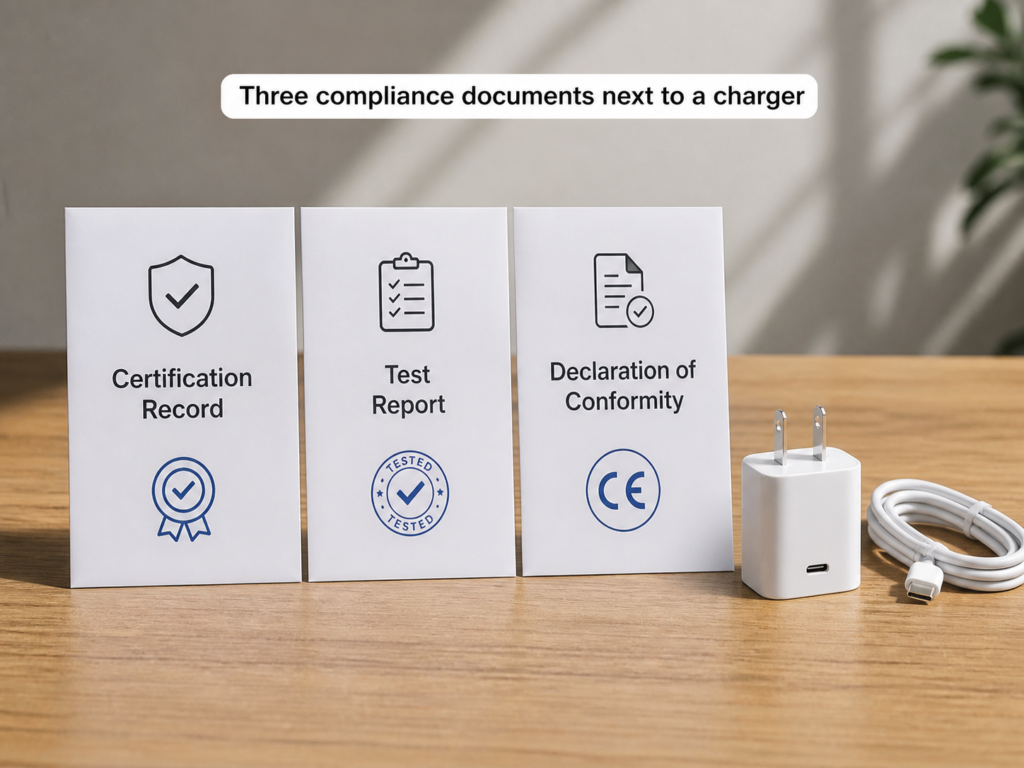
Many people think that “a document with an official seal is a certification”, but in fact, different documents have different functions. There are three common types:
| Document Type | Issuing Party | Core Features | Common Examples |
| Certification record or certificate | Accredited certification bodies or relevant authorized bodies | Reviewed for specific products, models and conditions, usually also involving subsequent maintenance or supervision | UL listing/certification record; FCC equipment certification authorization record (corresponding to FCC ID) |
| Test report | Testing laboratory | Indicates the test results of submitted samples under specific conditions, and does not automatically cover all mass-produced products | EMC test report, material test report, pre-test report |
| Declaration of Conformity (DoC) | Product responsible party, manufacturer or supplier | The responsible party declares that the product meets applicable requirements and bears corresponding responsibilities | FCC SDoC |
In short, certification records usually reflect third-party authorization or accreditation, test reports mainly prove the results of submitted samples, and declarations of conformity are compliance commitments made by the responsible party. Test reports or declarations of conformity should not be regarded as “universal certifications” applicable to all scenarios.
3 Most Common Misconceptions for Beginners
1. **EU CE/RoHS certifications can be directly used on the US site**
CE and RoHS are compliance requirements under the EU system and cannot directly replace US FCC, DOE, safety certification or state-level requirements. The regulatory systems, applicable scopes and certification methods of the US and EU are different. Using CE or RoHS documents to directly replace US requirements usually cannot solve Amazon review or US market compliance issues.
2. **Certification requirements for all charging products are exactly the same**
The actual differences are huge. Passive cables usually do not require separate FCC equipment authorization; cables with digital circuits may involve FCC Part 15 assessment, but you cannot conclude that SDoC is mandatory just because they “have a chip”; for wall-plug products, you also need to judge whether they are external power supplies as defined by the DOE; products with wireless transmission functions such as Bluetooth and Wi-Fi may require corresponding FCC equipment authorization.
3. **Having a certification number means 100% passing review or customs clearance**
Not necessarily. The number is only a verification entry. You also need to check whether the model, brand, manufacturer, factory, technical parameters, standard version and actual product match. Fake certificates, misappropriated certificates, expired records, or products beyond the coverage of the certificate may all be discovered by the platform or regulatory authorities.
Match Certification Requirements by Product
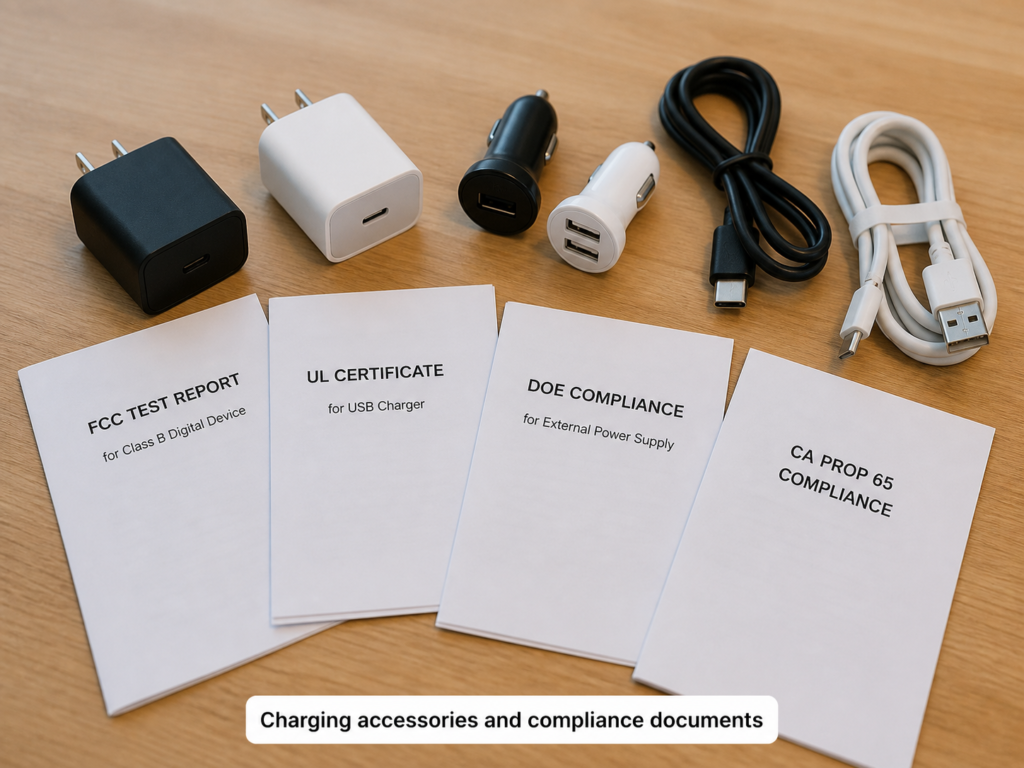
To determine what compliance documents are needed for charging accessories, you cannot only look at the product name. You should first confirm whether the product has digital circuits or radio frequency functions, whether it is connected to mains power, whether it falls under the DOE’s definition of external power supply, whether it is sold in California, and what requirements Amazon has put forward for the specific ASIN.
| Product Type | Main Judgment Directions | Amazon Platform Requirements |
| Passive pure-charging USB/USB-C cables | Usually do not require separate FCC equipment authorization; if sold in California, Prop 65 warning obligations also need to be assessed | Confirm whether safety testing or certification is required based on specific category and ASIN requirements |
| USB/USB-C cables with chips or data functions | Cables with digital circuits may be subject to FCC Part 15 requirements, and should be assessed based on circuit functions, whether they constitute digital devices or peripheral devices, and overall configuration | Confirm applicable safety documents based on specific product and ASIN requirements |
| Wall-plug chargers/power adapters | First determine whether they are external power supplies as defined by the DOE; if applicable, also check federal energy efficiency requirements. When sold in California, additionally check CEC Title 20 and Prop 65 | Usually need to select applicable NRTL safety certification or test documents according to product category |
| Car chargers | Usually not external power supplies connected to mains power; whether they involve FCC should be assessed based on their digital circuits and actual configuration; assess Prop 65 when sold in California | Confirm safety compliance documents based on specific category and ASIN requirements |
| Charging products with wireless functions | Products with intentional wireless transmission functions such as Bluetooth and Wi-Fi usually require corresponding FCC certification; the wireless charging function itself does not automatically mean that an FCC ID must be obtained, and should be judged based on Part 15, Part 18 and specific parameters | Usually require corresponding safety documents, as well as applicable wireless compliance certificates |
The following are additional precautions for each category:
• **Passive pure-charging cables**: Cables that have no chips and can only charge but not transmit data usually do not require separate FCC equipment authorization. However, the advertised charging power must be consistent with the actual tested capacity of the product, and false labeling is not allowed. If the product contains specific chemical substances, Prop 65 should also be assessed based on California consumer exposure, applicable thresholds and exemptions.
• **Active data cables or charging cables with chips**: For example, cables with E-Marker chips or other digital circuits, you cannot conclude that FCC SDoC is mandatory just based on whether they have a chip. FCC Part 15 assessment should be conducted based on their circuit functions, whether they constitute digital devices or peripheral devices, and the actual configuration after connecting with other devices. For high-power fast charging cables, it should be confirmed that safety tests cover their advertised power level.
• **Wall-plug chargers or power adapters**: The safety certification path should be selected based on product structure, purpose, output and applicable standards. If the product is an external power supply as defined by the DOE, it must also meet current federal energy efficiency standards, reporting and filing requirements. Power level will affect test parameters and applicability judgment, but you cannot simply conclude that all 20W or 65W products apply to the same set of standards.
• **Car chargers**: Powered by a cigarette lighter or vehicle power supply, they are usually not external power supplies connected to mains power, so DOE requirements are generally not judged according to external power supply rules. However, their digital circuits may still involve FCC assessment. When advertising, you cannot claim compatibility with devices exceeding the rated power; for example, a 20W car charger cannot claim to provide 65W fast charging for laptops that require 65W input.
• **Charging products with wireless functions**: If they contain intentional wireless transmission functions such as Bluetooth and Wi-Fi, they usually need to be handled in accordance with the corresponding FCC wireless device rules. For wireless charging devices, whether FCC Part 18, Part 15 or other paths apply should be judged based on operating frequency, transmission method and device composition. Even if the wireless module is already certified, if the complete device has modified antennas, enclosures, power or installation methods, re-assessment may be required, and module certification does not mean that the complete device is automatically compliant.
In-Depth Interpretation of Core Certifications
The requirements mentioned above seem to have many names, but in fact they each control different objects. First understanding what problems they solve, and then judging whether your own product is applicable, will be more reliable than blindly purchasing certificates.
FCC: Electromagnetic Compatibility and Wireless Device Requirements
FCC rules are mainly used to manage specific radio frequency devices, digital devices and unintentional radiation devices, to reduce harmful interference caused by products to other electronic devices or communication services. Not all products with active electronic circuits require the same type of FCC equipment authorization.
Products containing digital circuits or radio frequency circuits may be subject to FCC rules. The applicable compliance path should be specifically judged based on device category, actual circuit, operating mode and radiation characteristics. Common paths include:
• **SDoC (Supplier’s Declaration of Conformity)**: Applicable to devices that meet relevant rules and can adopt the SDoC path. The responsible party needs to complete necessary tests and technical records in accordance with applicable technical requirements, issue a declaration of conformity, and provide specified compliance information. It is not a general certificate issued directly by the FCC.
• **FCC Certification**: Applicable to device categories that require certification. Usually, testing needs to be completed by an FCC-recognized testing laboratory, and then the certification application is processed by an FCC-recognized TCB (Telecommunication Certification Body). A certified device will correspond to an FCC ID, and the authorization record in the FCC database can be used to check the holder, model and technical data.
The most common pitfall is “the module has a certificate, so the complete device does not need assessment”. If the complete device changes antenna type, enclosure, transmission power, RF layout or usage method, even if the module itself has an FCC ID, the complete device may require re-testing, authorization change or other compliance assessments.
Safety Certification (UL/ETL/CSA): Common Safety Threshold on the Platform
Safety certification mainly controls risks such as electric shock, fire, overheating and mechanical safety. Marks such as UL, ETL and CSA do not automatically have the same status in all cases. The key depends on whether the specific issuing body has obtained NRTL (Nationally Recognized Testing Laboratory) accreditation from OSHA within the scope of relevant products and standards.
US federal regulations do not uniformly require UL or other NRTL product certification for all ordinary charging accessories, but Amazon, insurance companies, offline retailers and commercial customers may put forward safety certification requirements based on product category or risk level. The final standard shall be subject to applicable regulations, the accreditation scope of the certification body, and Amazon’s review requirements for specific products.
The safety standards for charging products cannot be determined solely by product name. For example, wall-plug power products may need to select applicable power supply or information technology equipment safety standards based on product structure and purpose; UL 62368-1 is one of the common standards for some related products, but it is not the only or universally applicable standard for all wall-plug chargers.
For USB charging cables and data cables, whether third-party safety testing or certification is required and which standards apply should also be confirmed based on product structure, rated parameters, sales channels and Amazon’s requirements for specific ASINs. UL 9990 should not be regarded as a mandatory standard uniformly applicable to all USB cables.
Safety certification is not permanently valid after being processed once. Product modifications, standard updates, production factory changes and other situations may require notification to the issuing body, supplementary assessment, record revision or factory relocation approval. Whether the original certification is affected shall be confirmed by the applicable standards and the issuing body.
When selecting a body, also note: ISO/IEC 17025 mainly indicates that the laboratory has certain testing capabilities, which does not mean that the laboratory has NRTL product certification qualifications. Ordinary 17025 laboratories cannot alone replace NRTL to issue safety certifications.
Energy Efficiency Requirements: DOE Federal Requirements and California CEC
Energy efficiency requirements mainly focus on the energy consumption of power products in operating, no-load or standby states, with the purpose of reducing unnecessary energy waste. When making a judgment, you must first confirm whether the product is an external power supply under DOE rules, rather than directly applying the same requirements just because you see the word “charger”.
• **Federal DOE energy efficiency requirements**: Products that meet the DOE’s definition of external power supply need to be judged in accordance with the product definition, efficiency indicators, no-load power consumption and applicable exemptions of the current 10 CFR Part 430. Compliance also involves certification reports from manufacturers or importers and filing with the DOE Compliance Certification Management System (CCMS), not that sellers can legally sell after completing a simple “registration”.
• **California CEC requirements**: When selling applicable products in California, you also need to check the California Energy Commission’s Appliance Efficiency Regulations, namely CEC Title 20, as well as the corresponding database and filing requirements. You cannot take “CEC is definitely stricter than DOE” as an absolute conclusion for all products and all indicators.
The previously common Level VI statement cannot replace current regulatory judgments, nor is it a permanent unified conclusion applicable to all external power supplies. When checking energy efficiency compliance documents, you should focus on checking whether the product definition, applicable version, efficiency and no-load power consumption indicators, exemption conditions, product model and filing information are consistent with the actually sold products.
California Prop 65: The Easily Overlooked State-Level Warning Obligation
Prop 65, namely California’s Safe Drinking Water and Toxic Enforcement Act, is not a unified certification applicable to all products. It mainly focuses on whether products will expose consumers to California-listed chemicals and whether such exposure reaches applicable thresholds.
For charging products, listed substances such as lead and phthalates may need attention in cable sheaths, plug coatings, plastic enclosures and other materials. However, you cannot directly conclude that a warning must be affixed just because a certain substance is detected in the product, or because the product is “sold to California”.
A more accurate judgment method is:
• Whether the product contains Prop 65 listed chemicals;
• Whether it will cause consumer exposure during normal use, contact or handling;
• Whether exposure reaches applicable safe harbor levels or other judgment thresholds;
• Whether there are applicable exemptions;
• Whether the warning form and display position comply with OEHHA rules.
If the product does trigger warning obligations, enterprises usually need to provide clear and reasonable Prop 65 warnings to consumers in accordance with OEHHA rules. Warnings are not limited to a fixed “product or packaging sticker”, nor is there a set of universally mandatory warning templates applicable to all charging accessories. Whether a warning is required should be judged in combination with product materials, usage scenarios and exposure assessment.
CPSC General Safety Responsibility
In addition to specific FCC, energy efficiency or platform review requirements, the US Consumer Product Safety Commission (CPSC) is also responsible for handling consumer product safety risks. Sellers and manufacturers cannot assume that safety responsibilities can be ignored just because the product does not have a certain unified mandatory certification.
The CPSC does not mandate a unified “CPSC certification certificate” for all charging accessories, but if a product has fire, electric shock, overheating or other safety hazards, it may trigger incident reporting, recall, law enforcement or penalties. Amazon may also assess the safety risk of products through UL, ETL or other compliant safety documents.
Full Practical Process: From Certification Processing to Listing and Sales
Step 1: Confirm the Required Certifications for the Product
Don’t rush to find a body to process certifications first. You should first figure out the functions and configurations of the product, then make a preliminary judgment against the previous categories, and verify through official channels:
• Amazon Seller Central Help Center, search for requirements related to electronic product compliance, product safety or specific categories;
• FCC official rules and equipment authorization information;
• DOE external power supply regulations and CCMS information;
• California Energy Commission’s Title 20 and related databases;
• OEHHA Proposition 65 official guidelines.
At least the following four core points must be confirmed:
1. Whether the product is a passive cable or an active product with digital circuits;
2. Whether it is directly connected to US mains power;
3. Whether it has Bluetooth, Wi-Fi or other intentional wireless transmission functions;
4. Whether it is sold in California, and whether the product may trigger Prop 65 exposure and warning obligations.
Step 2: Select a Compliant Certification Body
When choosing a body, don’t just look at the price. First check whether it can handle your specific product and applicable standards:
• **FCC Certification**: Usually requires the use of an FCC-recognized testing laboratory, and the certification application is processed by an FCC-recognized TCB.
• **FCC SDoC**: The responsible party bears the responsibility for the declaration, and completes testing, technical records and compliance information preparation in accordance with applicable rules. Whether a laboratory with specific qualifications must be used should be confirmed according to the specific device category and applicable rules. SDoC and FCC Certification should not be confused.
• **Safety product certification**: It should be checked whether the issuing body is in the OSHA NRTL directory, and its accreditation scope covers your product and applicable standards. ISO/IEC 17025 laboratory qualification only indicates testing capability and cannot alone replace NRTL product certification.
Pitfall avoidance tip: Do not process fake certificates, do not buy so-called “universal ready-made certifications”, and do not choose a body just because the quotation is far lower than the market price. Whether the certificate can ultimately cover your model, factory and configuration is more important than whether the certificate picture is exquisite.
Step 3: Conventional Process and Cycle for Certification Processing
The documents that need to be prepared before processing usually include:
• Product specifications;
• Model list;
• Test samples in mass production state;
• Product information such as circuits, interfaces, input/output and wireless configurations;
• Brand, manufacturer and production factory information.
The cycles of different certifications vary greatly, and the following can only be used as reference. The actual time depends on product complexity, document completeness, sample qualification and body arrangement:
• FCC SDoC: Usually requires completion of testing and technical document preparation, and the cycle is subject to the laboratory and product conditions;
• Safety certification: The cycle depends on product structure, applicable standards, factory audit and subsequent rectification;
• FCC Certification: Usually also includes testing, application, TCB review and database recording processes.
There is no unified standard for fees. FCC-related testing, safety certification, factory audit, model extension and subsequent maintenance may all be billed separately, and shall be subject to the official quotation and service scope of the body.
Step 4: Required Documents and Key Points for US Customs Clearance
After the certification is completed, accurate import documents still need to be prepared during the customs clearance process. Commercial invoices, packing lists and country of origin marks are common basic documents, but FCC or DOE documents are not unified customs clearance documents that must be submitted with the goods for all charging accessories upon entry.
Corresponding compliance documents should be prepared according to the following situations:
1. Whether the product is a device requiring FCC authorization;
2. Whether the product is a DOE external power supply and involves federal energy efficiency reporting or filing;
3. Whether it is sold in California, and whether it involves CEC or Prop 65;
4. Whether customs, carriers or importers require supplementary product certificates.
The product name, model, quantity, manufacturer and other information on the commercial invoice and packing list should be consistent with the actual goods as much as possible. The country of origin mark should also be clear and authentic, for example, marking the place of production in accordance with applicable requirements.
Customs may require supplementary certificates during inspection, but you cannot simply assume that “without an FCC certificate, the goods will definitely be detained at the port”. The real risk depends on whether the product is subject to FCC rules, whether it has the required authorization, and whether the import documents are consistent with the actual goods.
Step 5: Submit for Review in Amazon Seller Central
The review entry will vary according to product category and specific situations. Common ones include category review entry, compliance appeal entry, and hazardous goods review entry (if applicable).
Documents that may need to be submitted include:
• Applicable certification records, test reports or declarations of conformity;
• Clear photos of product labels, packaging, nameplates and manuals;
• Product model, brand, manufacturer, rated parameters and function descriptions;
• If required by applicable regulations or Amazon’s process for specific products, information on the US responsible party, importer or contact person may also be required.
Non-US sellers do not have a unified obligation to submit a US responsible party for all electronic products just because the seller’s location is different. Whether relevant information needs to be provided shall be subject to applicable regulations and the specific requirements of Amazon Seller Central for the product. The submitted information must be true and valid, and you cannot randomly fill in a third-party company or an unreachable agent.
During review, the platform usually pays attention to whether the model, brand, manufacturer, factory, input/output parameters, wireless configuration and physical label covered by the certificate or report are consistent with the listing information. Don’t just check the document name, but also verify the document coverage scope.
Step 6: Troubleshooting and Appeal for Failed Review
If rejected, first check the following types of problems:
• Expired standard versions, incomplete documents or unverifiable documents themselves;
• Product information, including model, brand, parameters or manufacturer, is inconsistent with the certification documents;
• The documents do not cover the currently sold variants or actual factory;
• Lack of information on the responsible party, importer or contact person explicitly required by regulations or Amazon processes;
• The actual product, packaging and listing description are inconsistent with the submitted test samples.
The basic idea of appeal is to first confirm the specific requirements corresponding to the problem, then supplement the missing documents, correct the wrong information, or ask the certification body to confirm whether model extension, supplementary testing, certificate revision or re-assessment is required. Do not repeatedly submit a general report that cannot cover the actual product.
Advanced Pitfall Avoidance: Common Risks and Judgment Methods
Many sellers still fall into pitfalls after following the process, and the main problems are concentrated in certificate validity, private label use and multi-model coverage scope.
Judgment of Certificate Authenticity and Validity
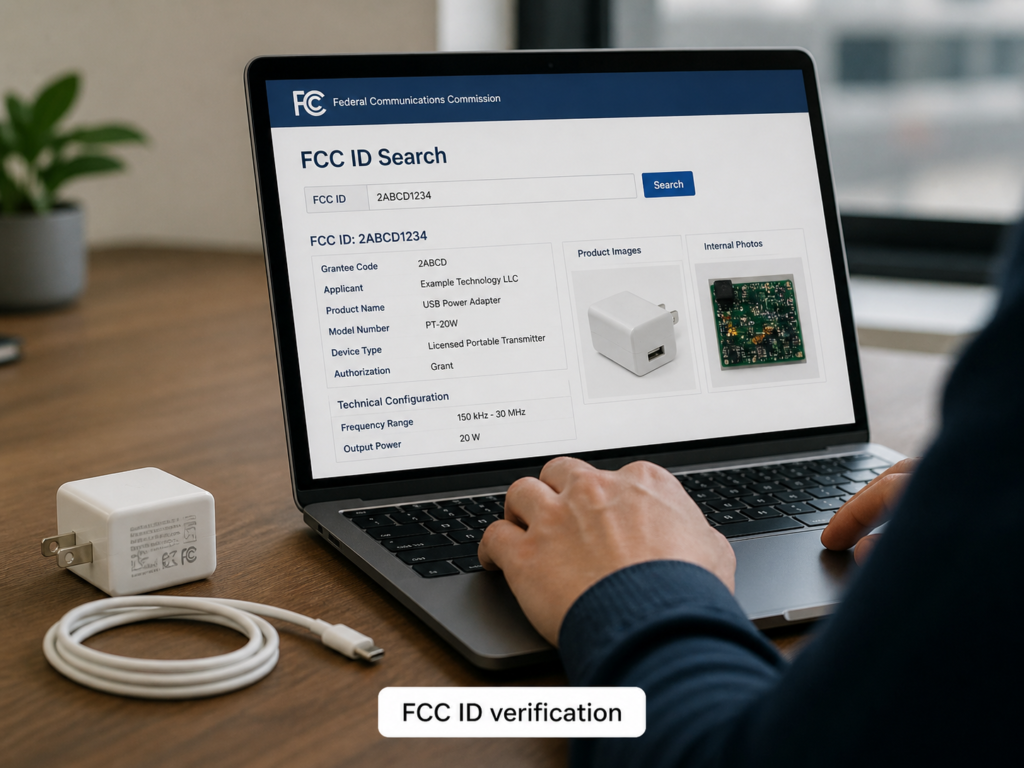
Don’t just look at the certificate pictures sent by the supplier, be sure to verify through official channels:
• **FCC ID verification**: Enter the FCC ID in the official FCC database to check the holder, model, device photos, technical configuration and authorization scope.
• **Verification of safety records such as UL/ETL**: Check the product model, certification scope, production factory and applicable standard version in the official database of the corresponding issuing body.
Product modifications, standard updates or factory changes will not automatically invalidate the certificate in all cases. In some cases, certification can be maintained through notification, difference assessment, supplementary testing, model extension, certificate revision or factory relocation approval. When changes occur, you should directly confirm the specific handling method with the issuing body, rather than judging on your own that the original certificate is still valid or will definitely be invalidated.
Rules for Certification Use of Private Label/White Label Products
Many sellers purchase white label products from suppliers and then affix their own brands. Whether the supplier’s certification can be used for private label products cannot be determined only by whether there is a letter of authorization, but also by checking:
1. Whether the certificate holder has the right to authorize the relevant brand or model;
2. Whether the certificate covers your brand, model and actual configuration;
3. Whether the product manufacturer, production factory, input/output parameters and internal structure are consistent with the certification records;
4. Whether the applicable market and sales channel match;
5. Whether the issuing body accepts such brand or model changes;
6. Whether Amazon accepts such documents as review materials for the current ASIN.
If it is a private label with your own brand, you must confirm whether the certification covers your own brand models. If it is not covered, you may need to ask the certification body to add models, revise records or re-assess. You cannot directly use the certificates of other models from the supplier for your own products.
Certification Coverage Rules for Multi-Model/Variant Products
Many sellers’ products have multiple variants, such as different colors, cable lengths, powers or plug types. Whether a single certification record can be shared depends on whether these differences will affect safety or electromagnetic performance.
• **Cases where sharing is possible**: Same series, same circuit and same structure, with differences limited to partial appearance, color, cable length or packaging, and the issuing body confirms that these models are covered by the same certification scope.
• **Cases requiring re-assessment**: Changes in power, plug, circuit design, enclosure, wireless module or key components. These changes usually require a difference assessment by the issuing body, but do not necessarily mean that each model must be fully reprocessed with an independent certification. Ultimately, methods such as model extension, supplementary testing, certificate revision or re-certification may be adopted.
The safest judgment method is to establish a “model-version-report-factory” correspondence table, and then ask the certification body to confirm the coverage method for each model. Do not share certificates based on “they look similar”.
Inventory of High-Frequency Pitfall Scenarios
We have sorted out the most common risks by process, and you can check against them:
• **Certification processing category**: Fake certificates, general certificates, documents that cannot be verified in official databases;
• **Supply chain category**: Mismatched certification for private label products, multi-models exceeding the certificate coverage scope;
• **Customs clearance category**: Inconsistent certification documents and actual shipping information, unclear country of origin marks;
• **Listing review category**: Incomplete documents, expired standard versions, inconsistent product information and documents;
• **Operation category**: Ignoring Prop 65 exposure assessment in California, inconsistent advertised parameters and actual tested or certified parameters.
Methods for Optimizing Certification Cost and Cycle
If you want to reduce rework and unnecessary costs, you can start from the following points:
• Prepare product documents, models and factory information in advance;
• Conduct pre-testing before formal testing to detect sample problems as early as possible;
• Choose formal bodies that can cover specific products and standard scopes;
• Before product modification, factory change or model addition, confirm the impact with the issuing body first;
• Before listing, check the platform’s latest document requirements for specific categories and ASINs.
Quick Pre-Listing Self-Checklist
Finally, we have compiled a quick pre-listing self-checklist for you, which can be checked item by item according to the actual situation of the product.
Statutory Compliance Self-Check
• Product type, function and parameters are confirmed to be correct;
• It has been judged whether the product involves FCC Part 15, Part 18 or other applicable paths;
• It has been judged whether the product is an external power supply as defined by the DOE;
• When sold in California, it has been checked whether CEC Title 20 and Prop 65 apply;
• If applicable regulations require information on the responsible party, importer or contact person, the relevant documents are true and valid.
Platform Access Self-Check
• Safety certification or test documents meet Amazon’s requirements for specific categories and ASINs;
• Certification documents cover all sold models and variants;
• The model, parameters, brand and manufacturer on the listing are completely consistent with the compliance documents;
• Product labels, packaging and manuals are consistent with the actual product;
• If US responsible party, importer or contact person information needs to be submitted, it has been submitted according to the requirements of Seller Central.
Customs Clearance Documents Self-Check
• Corresponding certificates have been prepared according to the applicable FCC, DOE, CEC or other requirements of the product;
• The information on certification documents matches the actually shipped products;
• Commercial invoices, packing lists and country of origin marks are complete and authentic;
• All document versions are valid, with no expiration, tampering or out-of-scope use;
• The actual product, packaging, documents and listing description are consistent with each other.
In general, the compliance of ordinary consumer charging accessories on Amazon US is essentially a dual judgment of “legal requirements + platform thresholds”. Do not use CE or a general report to replace US requirements, nor should you treat FCC SDoC, FCC ID, UL 9990, NRTL certification or Prop 65 warnings as unified mandatory conditions for all similar products. First classify according to product functions, whether connected to mains power, wireless configuration, sales state and specific ASIN, then check official regulations, certification records and platform requirements, so as to complete certification, customs clearance and listing review more accurately, and reduce compliance risks caused by certificate mismatch, document invalidation and product modification.