
Sellers who export products such as charging cables, USB-C chargers, and power banks will most likely be stumped by SABER when they first enter the Saudi market—some say it is a mandatory certificate, some say it is just a declaration platform, and others who fail to figure out the rules only find out they are missing the certificate when the goods arrive at the port, resulting in the goods being detained for more than ten days and losing tens of thousands of yuan in port detention fees alone.
In fact, the logic of SABER is not complicated, but it has many links and fragmented details, so it is easy to step into pitfalls when you first contact it. Today, we start from the most basic cognition, then cover the full process operation, pitfall avoidance and troubleshooting, and special situation handling. Even if you are handling a Saudi order for the first time, you can follow through the entire process.
Basic Cognition and Scope of Control Judgment
The first point that many people get wrong most easily: SABER is not a certificate, but an online compliance declaration platform operated by the Saudi Standards Bureau (SASO), used to replace the previous paper-based SASO CoC certificate. This platform is directly connected to the Fasah customs clearance system of Saudi Customs. The electronic certificate you get on the platform can be verified for authenticity by the customs with a scan of the code, and there is no need to go offline to submit paper materials.
In the entire SABER system, different roles have clear division of labor. Don’t mix up who should do what:
• SASO (Saudi Standards Bureau): Responsible for formulating product standards, supervising the entire certification system, and authorizing third-party auditing institutions; it is the rule-maker and supervisor.
• SABER Platform: It is only a tool for online declaration and certificate management; it does not issue certificates itself, nor is it responsible for product auditing.
• Conformity Assessment Body (CB for short): A third-party institution authorized by SASO, responsible for reviewing your materials and test reports, and issuing certificates if they are qualified; it is the actual certificate-issuing entity.
• Saudi Customs / Fasah System: Responsible for verifying the validity of certificates during customs clearance; goods will be detained if there is no certificate or the certificate is incorrect.
• Local Saudi importer: It is the first responsible entity for the entire compliance, must hold a local Saudi Commercial Registration Certificate (CR certificate for short), and all certification applications must ultimately be declared in the name of the importer.
• Overseas manufacturer / seller: You can register a SABER account by yourself, but you must obtain the importer’s authorization to operate; you are mainly responsible for providing product materials and test reports.
• Customs broker: Mainly assists in customs clearance, and can also help verify whether the HS code classification is correct.
Core Certificates and Basic Logic
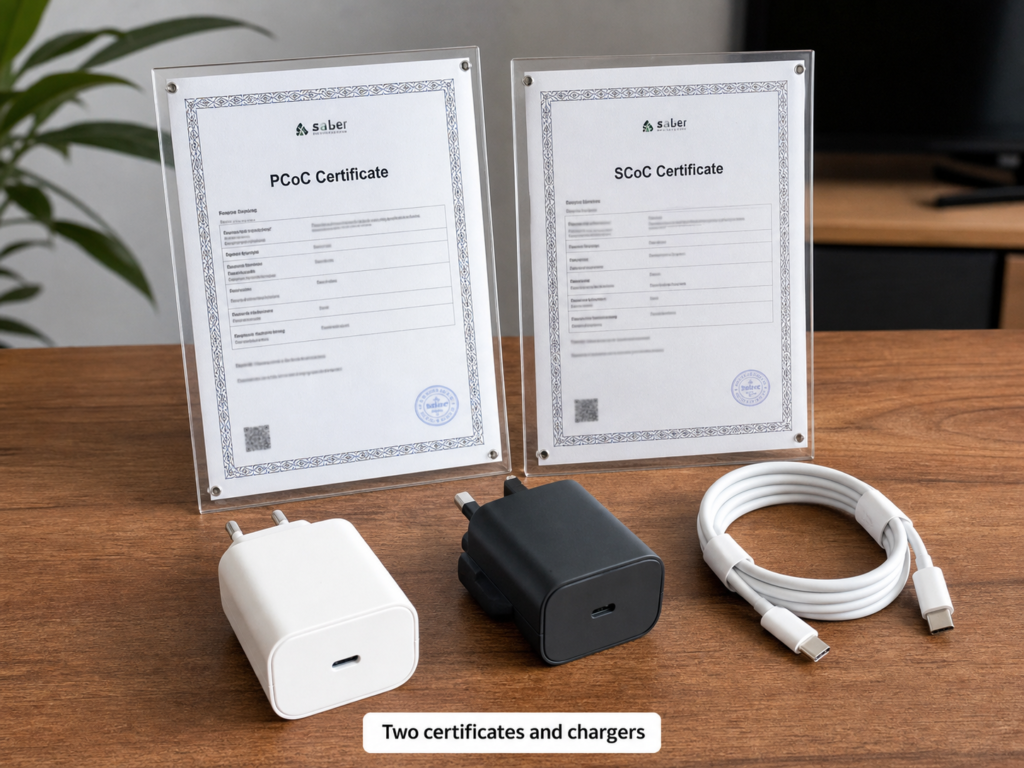
The two most core certificates in SABER, and understanding them means you understand half of the process:
The first is called PCoC (Product Conformity Certificate), which you can think of as the “Saudi market access pass for products”—as long as your product model and parameters remain unchanged and the certificate is within the validity period, it can be used no matter how many batches of goods you ship, and there is no need to re-audit the product for each batch.
The second is called SCoC (Shipment Conformity Certificate), which is equivalent to the “exclusive customs clearance ticket for each batch of goods”. It can only correspond to the quantity, amount, and waybill number of this batch of goods, and you need to re-apply for a new batch of goods.
The core logic of the entire process is very simple: for regulated products, first obtain a valid PCoC, then use the PCoC to apply for the corresponding batch of SCoC before each shipment, and you can clear customs with the SCoC.
How to Judge Whether a Product Needs SABER
Don’t just go to an institution to ask at the beginning. You can make a preliminary judgment according to the following steps, but the final result shall be subject to the SABER system results, current technical regulations, and the confirmation results of the importer, customs broker, and conformity assessment body:
Step 1: First confirm whether it is a commercial import—if it is a direct mail parcel for personal use or a sample for temporary exhibition, it may be exempted, but if it is commercial goods for sale, it is most likely necessary to check further.
Step 2: Check the HS code—whether the HS code corresponding to your product is in Saudi Arabia’s control list, which is the core basis for judgment. The classification of HS codes is related to the product’s structure, purpose, power, whether it has data transmission function, whether it has a battery, and whether it is sold separately. For example, for the same USB-C cable, the HS code may be different for one with data transmission and one for pure charging. A separately sold charging cable needs to be judged separately, while one sold as a set with a mobile phone can follow the mobile phone’s classification.
Step 3: Look at the pre-requirements of product parameters—for example, charging devices with Bluetooth need to apply for additional communication access, and chargers with plugs must meet Saudi plug standards, which will affect compliance requirements.
Step 4: Enter the accurate HS code and product information into the SABER platform to see the control requirements automatically prompted by the system, which is the most accurate.
Step 5: Ask the importer or authorized institution to recheck to avoid wrong classification by yourself.
There is a very common misunderstanding here: many people think that “since my goods are small in quantity and have no brand, I don’t need to apply for SABER”—that’s wrong. As long as it is a regulated commercial import, regardless of the quantity of goods and whether there is a brand, it is usually required to apply, unless you have obtained an official exemption notice in advance. Don’t take chances.
Requirements vary for different import modes: for general trade, cross-border e-commerce overseas warehouses, and goods purchased on behalf of others, basically both PCoC and SCoC are required; direct mail personal parcels, temporarily entered samples / exhibition goods may be exempted, but the importer must confirm with the customs or SASO in advance, and you cannot decide by yourself.
What are the consequences if you ship the goods without completing compliance? In mild cases, the goods will be detained, required to be rectified or fined; in severe cases, they will be directly returned. The port detention fees and storage fees incurred in the middle shall be borne by yourself. The final decision is made by Saudi Customs and SASO, so don’t gamble on the probability.
Pre-Application Preparation
After figuring out whether you need to do it, don’t rush to submit the application first. Doing the preparation work well can save you a lot of detours.
Account and Permission Configuration
First is the account issue. Accounts with different identities have different permissions:
If you are a local Saudi importer, you need to register an account with your CR certificate, legal person information, and contact information, and you can activate it only after passing the verification.
If you are an overseas manufacturer or seller, you can also register a SABER account by yourself, which will generate a unique identification number, but you do not have the permission to submit applications. You can only help upload materials and submit applications after the importer authorizes you in his account.
You must pay attention to permission configuration: it is enough to grant edit permission to agents or suppliers. Core payment permissions and administrator permissions can only be given to internal personnel. Don’t casually give the highest permission to unfamiliar agents, as it is prone to problems. In addition, check the account status regularly. If your CR certificate expires or your contact information is not verified, you will not be able to submit applications. Don’t wait until you are about to ship to find out that the account is unusable.
Application Materials and Consistency Requirements
The core requirement for application materials is “consistency”—the model, brand, parameters, and country of origin in all materials must completely match. Even a single word difference may lead to rejection.
The core materials required for PCoC are divided into three categories:
The first category is basic product information: product name, model, brand, HS code, country of origin, technical parameters (such as power, current, voltage), and manufacturer information.
The second category is labeling and packaging materials: photos of product labels / nameplates, outer packaging, and manuals. Product labels, warning information, and manuals usually need to provide Arabic content in accordance with applicable technical regulations, and some products also require bilingual versions; the specific required items shall be confirmed according to the applicable product regulations, SASO requirements, and the institution’s audit checklist, and the same fixed checklist should not be used for all charging products.
The third category is test and compliance documents: valid test reports, pre-certification documents (such as IECEE International Electrotechnical Mutual Recognition Certification, communication access certificate, etc.).
If you are applying for SCoC, the materials are much simpler: commercial invoice, packing list, bill of lading / waybill, and the corresponding PCoC certificate number.
Self-Inspection of Test Report Validity
Many people have their applications rejected after submission because the test reports do not meet the requirements. Here are a few self-inspection points, so you don’t have to wait for the institution to reject them to find out:
First, the standards must match—different products correspond to different safety standards. For example, for current audio-visual and information technology charging products, the general standard is IEC 62368-1, and the previous IEC 60950 series has been gradually replaced. Whether old reports can still be used shall be evaluated by the assessment body, and don’t assume that old reports are definitely valid.
Second, check the laboratory qualification—test reports should usually be issued by laboratories with the corresponding ISO/IEC 17025 accreditation scope, or laboratories that meet the requirements of relevant product certification schemes; they must also meet the applicable standards, accreditation scope, and report content requirements, and whether they are accepted shall be confirmed by the authorized conformity assessment body through review.
Third, the issue of CB reports—reports from the IECEE CB system can be submitted as technical materials, but whether supplementary Saudi national difference tests are required shall be determined by the institution’s review. It is not that a CB report will definitely pass.
Fourth, validity period—whether a test report is still acceptable depends on the applicable technical regulations, standard version, whether the product has changed, the laboratory’s accreditation status, and the audit requirements of the conformity assessment body, and cannot be judged solely by the year of issuance.
Reference of Regulatory Paths for Charging Products
Since we mainly deal with charging products, we have sorted out the compliance path references for common charging products here, saving you from checking one by one:
| Product Type | Common Compliance Requirements (Experience Reference) | Special Notes |
| Ordinary USB-C charging / data cable | Wire safety standards, electromagnetic compatibility (EMC, required in some cases) | Usually no IECEE required, no mandatory plug requirements |
| Mobile phone chargers / power adapters with plugs | For adapters or chargers included in Saudi Arabia’s IECEE control list, it may be necessary to first obtain or register the corresponding IECEE/SIRC requirements; in addition, EMC, energy efficiency, and plug requirements shall be verified in accordance with applicable regulations | These requirements cannot be generalized to all models |
| Wireless chargers | Need to be confirmed item by item according to the specific HS code, product function, input/output parameters, whether it contains a radio module, and the current SASO/CST product list | All requirements should not be judged solely by the product name |
| Charging devices with Bluetooth / Wi-Fi | IECEE, EMC, energy efficiency, communication access, plug standards | Additional Saudi communication regulatory access is required |
| Charging products containing lithium batteries (such as power banks) | Need to be confirmed item by item according to the specific HS code, product function, input/output parameters, whether it contains a radio module, and the current SASO/CST product list | Battery safety, transportation, and import document requirements shall also be verified separately |
| High-power power adapters | Need to be confirmed item by item according to the specific HS code, product function, input/output parameters, whether it contains a radio module, and the current SASO/CST product list | All requirements should not be judged solely by the name “high-power” |
Note that this is only an industry experience reference. The specific requirements must be subject to the applicable regulations automatically prompted by the system after you enter the HS code and product information into the SABER platform. Don’t judge solely by experience, and miss additional requirements such as energy efficiency, plugs, electromagnetic compatibility (EMC), communication, and batteries.
Description of Fees and Cycles
There is no unified official pricing for SABER. The fee generally consists of the following parts: the official fee charged by the platform, the service fee of the assessment body, the test fee (if supplementary testing is required), and the agency fee (if you find an agent).
There is no official commitment on the cycle either. We can only give you an industry reference: if the materials are complete, the PCoC audit generally takes 3-15 working days, and the SCoC audit generally takes 1-3 working days. If supplementary materials, supplementary testing, or random inspection are required, the time will be extended. There are many uncertain factors affecting the cycle: incomplete materials, failed tests, standard updates, rule adjustments, and random on-site inspections will slow down the progress. Therefore, it is best to reserve sufficient time in advance and don’t apply just before the shipping date.
Full Steps of PCoC Application
After the preparation work is done, you can start applying for PCoC. The process is actually very clear, just follow the steps.
Product Entry and Classification Confirmation
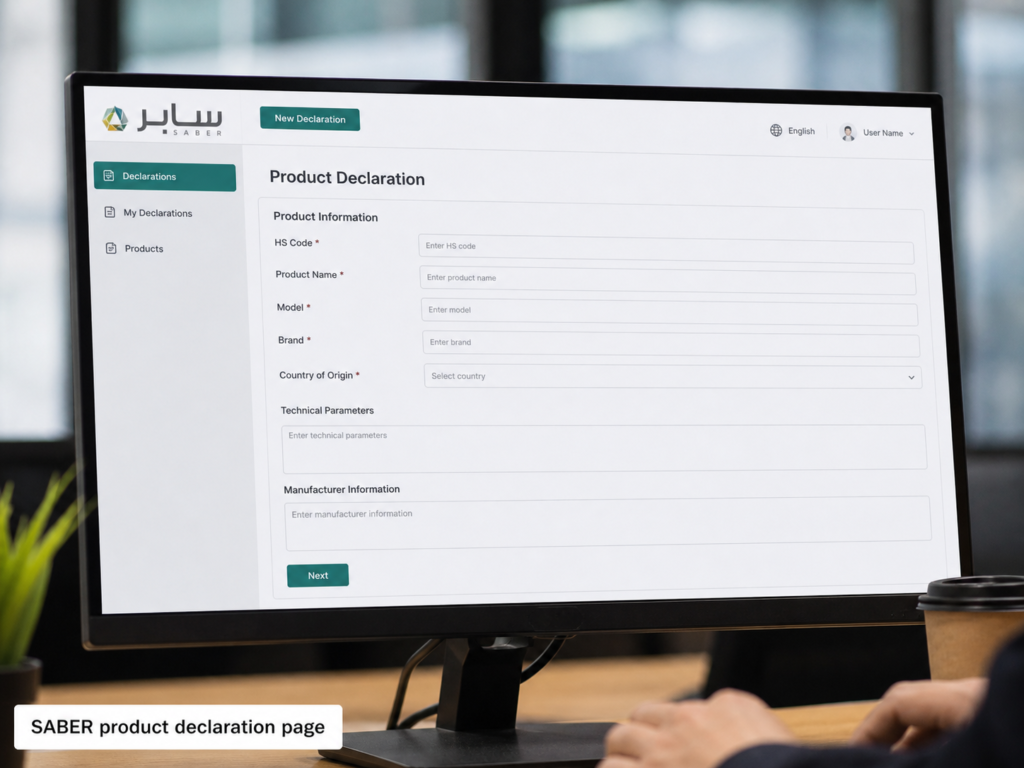
Step 1: Log in to the official SABER platform (saber.sa). Be sure to pay attention to identifying counterfeit websites and don’t enter the wrong one to be scammed. After logging in, find the entry for product declaration, and fill in the core information of the product: HS code, product name, model, brand, country of origin, technical parameters, and manufacturer information. These information must be accurate, especially the HS code. It is best to recheck with the importer and customs broker in advance. If the classification is wrong, even if you get the certificate, you may not be able to clear customs.
After filling in, the system will automatically determine the control type, risk level, and applicable regulatory requirements of this product. First check whether it is consistent with your previous judgment. If there is a problem, first confirm whether the HS code is filled in incorrectly.
Select Institution and Submit Materials
Note that you must choose from the built-in list of authorized CB institutions on the platform. Don’t find unqualified institutions outside the list, otherwise the issued certificate will be useless at all. After selecting the institution, upload all materials as required. It is recommended to name the files in the format of “model + file type”, such as “65W charger – test report”, which is convenient for the institution to review and for your own management.
If you apply for multiple models of the same series together, you need to submit a model difference description to explain the differences between different models. Whether they can be merged into one PCoC shall be determined by the institution’s review. Don’t merge them just because you think they look similar.
Before submitting, check the consistency of all materials from beginning to end by yourself, such as whether the model on the label is the same as that on the test report, whether the parameters are written correctly, and whether the brand spelling is correct. This can reduce a lot of trouble with supplementary materials.
Audit Follow-up and Supplementary Materials
After submission, fee payment and progress inquiry shall be carried out in accordance with the rules of the platform and the institution. Generally, the institution will give the audit result within a few working days. If your application is rejected, don’t rush to re-upload it first. First read the reasons for rejection clearly and handle them in priority order: first check whether the standard of the test report or the laboratory qualification does not meet the requirements, which is the most serious and must be solved first; then check whether there is a lack of materials; then check whether the information is inconsistent; and finally, the format problem.
When supplementing materials, be sure to modify them according to the rejection reasons before uploading. Don’t upload the original files again without any changes, which will only waste time.
Verification After Obtaining the Certificate
Many people ignore the certificate after getting it, which is very prone to problems. First, confirm that the status of the certificate is “valid”, not “pending review” or “rejected”. Then check the core information on the certificate: brand, model, parameters, validity period, scope of application, to see if there are any mistakes. The most important thing is to confirm that all models you plan to ship are within the coverage of this PCoC. Don’t miss a certain model and find out that you can’t apply for SCoC when the time comes.
Full Steps of SCoC Application
After obtaining the PCoC, you need to apply for the corresponding batch of SCoC before each shipment. This process is much simpler than PCoC, but you can’t be careless.
Application Prerequisites
To apply for SCoC, two basic conditions must be met: first, you must have a valid PCoC certificate for the corresponding product, within the validity period and in effective status; second, the goods have been prepared, and the model, quantity, amount, and waybill information of the shipment have been confirmed.
Here is a reminder: it is best to reserve the SCoC audit time before shipment. Don’t wait until the goods arrive at the port to apply. If you are randomly selected for inspection or there are problems with the materials, it is easy to incur port detention fees.
Submit Shipment Application
Log in to the SABER platform, find the SCoC application entry, bind the corresponding PCoC certificate, then enter the shipment information of this batch: invoice number, quantity, amount, waybill number, destination port, etc., then upload commercial invoice, packing list, bill of lading and other documents.
If the goods are mixed with multiple models, be sure to check one by one whether each model is within the coverage of the PCoC, and the quantity of each model must also be consistent with the declaration. Don’t over-declare or under-declare.
Audit and Certificate Use
After submission, wait for the institution’s audit. The audit progress and random inspection rules shall be subject to the requirements of the platform and the institution. If you are selected for on-site inspection, be sure to ensure that the goods are completely consistent with the information you declared, including model, quantity, parameters, and labels. Otherwise, if the inspection fails, you will not get the certificate.
After passing the audit, you will get the electronic SCoC certificate with an exclusive QR code. Just download and save the PDF. This certificate is bound to the shipment information of this batch of goods and cannot be changed at will. If you need to change or split batches, you must apply in accordance with the rules of the platform, and don’t modify the information by yourself.
Customs Clearance Linkage Practice
Many people think that getting the SCoC means everything is fine, but in fact, customs clearance is the final test.
Customs Clearance Verification Logic
Saudi Customs’ Fasah system is directly connected to the SABER platform. As long as the customs enters your SCoC number or scans the QR code on the certificate, they can directly check the authenticity of the certificate and the corresponding goods information. There is no need for you to submit a paper certificate at all. Just send the SCoC number or electronic PDF to the customs broker.
Key Inspection Points for Charging Products
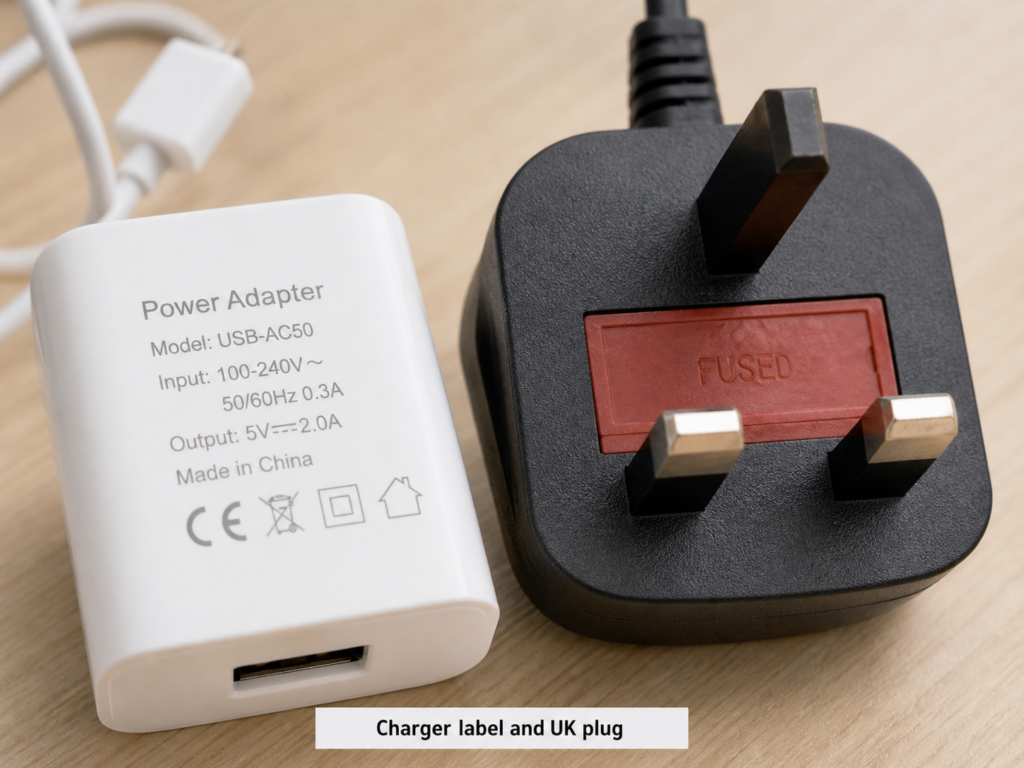
Charging products are the key inspection items of Saudi Customs, mainly checking the following aspects:
First, information consistency—whether the model, parameters, brand, and country of origin of the actual goods are completely consistent with the information on the PCoC and SCoC. Even a slight difference is not allowed.
Second, plug compliance—Saudi power supply is usually about 220–240V, 60Hz, and products with mains plugs usually need to meet the relevant standards of British plugs / sockets adopted by Saudi Arabia; pin size, grounding, fuse protection, and rated current shall be verified according to applicable standards and product ratings, and should not be uniformly written as 13A fuses. Chinese national standard (GB) plugs, US standard plugs, or plugs that do not meet applicable Saudi standards may lead to failure of conformity assessment, on-site inspection, or customs clearance, and shall be verified before shipment.
Third, labeling compliance—whether all required items on the product label are available, whether there is an Arabic version, whether the parameters on the label are consistent with those on the test report, and whether there is false labeling.
Fourth, parameter authenticity—whether there is false labeling of power and rated current. For example, the label says 65W, but the actual measurement is only 45W. Once this is found, the goods will definitely be detained.
Customs Clearance Document Package
Documents to be prepared for customs clearance are divided into two categories:
Required documents: electronic copy and number of SCoC, commercial invoice with completely consistent information, packing list, bill of lading.
Documents for reference: backup of PCoC certificate and test report, which can be provided immediately in case the customs asks for them during random inspection.
A reminder: be sure to do a final consistency check before shipment, and check the actual goods, labels, materials, and certificates all together. Don’t find out the mistake until you arrive at the customs.
Common Reasons for Abnormal Customs Clearance
The common reasons for abnormal customs clearance are as follows. If you encounter them, you can first check against them:
1. There is a problem with the SCoC status, such as not yet taking effect or already expired;
2. The model, quantity, and brand of the goods are different from those declared on the certificate;
3. There are compliance problems with the actual goods’ labels, plugs, and parameters;
4. Missing other documents required by supervision, such as products with Bluetooth that have not applied for communication access.
The specific handling method shall ultimately be subject to the requirements of Saudi Customs and SASO, and don’t operate blindly by yourself.
In addition, ordinary charging products generally do not involve other mandatory certifications of the Saudi Food and Drug Authority (SFDA), unless they are special products with medical functions, which need to be confirmed separately.
Common Pitfall Avoidance and Problem Troubleshooting
There are actually many pitfalls in doing SABER. Here we have sorted out the most common types and how to quickly troubleshoot when encountering problems.
Pitfall Avoidance for Fees and Cycles
First, don’t believe any “guaranteed pass” promises made by institutions; whether there are fees, priority processing or expedited services shall be subject to the current public rules of the SABER platform and authorized conformity assessment bodies. Don’t take the expedited service publicity of intermediaries as an official guarantee.
Second, if you want to shorten the cycle, the most reliable way is to prepare qualified test reports in advance, sort out all materials, and find a formal authorized institution. Don’t think about taking shortcuts.
Third, when comparing fees, be sure to ask clearly what services are included in the quotation, such as whether test fees, certificate fees, and agency fees are included. Don’t get a low price at the beginning, and then add various fees later, which will be more expensive instead.
Pitfall Avoidance for Product Compliance
Common reasons for PCoC application rejection include: the standard of the test report or laboratory qualification does not meet the requirements, the product label is missing items or the language does not meet the requirements, and the product parameters are inconsistent with the test report. These are common problems that may occur in practice, and should be checked emphatically before submission. However, the specific rejection reasons and supplementary material probability depend on the product, materials, and the institution’s audit results.
How to quickly verify whether the test report is qualified? Three steps: first check whether the laboratory has ISO 17025 or SASO accredited qualifications, then check whether the standard on the report matches your product, and finally confirm whether the model and parameters on the report are consistent with your actual product.
How to self-check the label? Just check item by item against the required items: model, brand, manufacturer / importer information, rated parameters, plug / interface specifications, country of origin, whether there is Arabic, especially plug identification and country of origin, which many people tend to miss.
Pitfall Avoidance for Accounts and Certificates
Account security must be paid attention to. Don’t give administrator permissions to unfamiliar agents, and regularly check the account’s operation records for abnormal operations.
PCoC is not valid for life. There are three common failure situations: the certificate expires, the product design or parameters change, and the applicable standards are updated. All three situations require re-evaluation, and the old certificate cannot continue to be used.
Red lines that must never be touched: borrowing certificates, using certificates for mismatched products—for example, products from two different manufacturers that look similar share one PCoC; or if the models are different, just change the label to make do. Serious or repeated violations may lead to consequences such as detention of goods, return shipment, fines, certificate revocation, and regulatory penalties for importers or relevant entities; the specific measures and whether to restrict subsequent imports shall be subject to the decisions made by the Saudi competent authorities in accordance with the law.
Quick Troubleshooting Logic for Common Problems
If you encounter problems, don’t panic. Check step by step in priority order for the highest efficiency:
• If the PCoC application is rejected: first check whether there are problems with the standard and qualification of the test report → then check whether the product label is compliant → then check whether the information of all materials is consistent → finally check whether there is a lack of materials.
• If the SCoC application fails: first check whether the corresponding PCoC is valid → then check whether the shipment information is consistent with the PCoC → then check whether the materials are complete → finally check whether you have been selected for inspection.
• If customs clearance is stuck: first check whether the SCoC status is normal → then check whether the information of all documents and certificates is consistent → then confirm whether there are compliance problems with the actual goods → finally verify whether other access requirements are missing (such as communication access).
Certificate Maintenance and Special Situation Handling
After getting the PCoC, it’s not once and for all. There are many follow-up situations to deal with.
PCoC Renewal and Change Handling
The validity period of PCoC shall be subject to what is written on the certificate, and the common one is 1 year. It is recommended to start the renewal 1-2 months before expiration. Don’t wait until it expires to apply, which will result in a gap period and you can’t ship goods. The condition for renewal is that the product design and parameters have not changed, and the test report still meets the requirements. In this case, you can submit the original materials to apply for renewal. Whether supplementary materials or supplementary testing are required shall be determined by the institution’s review.
If the product has changed, can you continue to use the original PCoC? It depends on the situation. Don’t decide by yourself. Be sure to confirm with the institution first:
• If it is only a minor adjustment of packaging language and label, and the product itself has not changed, you may only need to do a change assessment, no need to re-test.
• If only the cable length and shell appearance have changed, and the circuit and core parameters have not changed, after submitting the change description, the institution will judge whether supplementary testing is needed. In most cases, full testing is not required.
• If the power, PCB board, power supply scheme, or core chip have changed, this is a core change, which usually requires supplementary testing, or even re-applying for PCoC.
• If the manufacturer, brand, or model has changed, basically you need to re-apply or handle certificate change, and you can’t secretly use the old certificate.
Exemption / Simplification Situations
Are there any exemptions or simplifications? Yes, but they must be confirmed in advance and cannot be judged by yourself:
1. A small number of items for personal use: may be eligible for personal item exemption, but the final decision is subject to the customs’ judgment. Don’t think that you don’t need to apply just because your goods are small in quantity.
2. Samples for temporary entry for exhibition, testing, or maintenance: you need to apply for exemption from SASO or the customs in advance, and you can simplify the process after obtaining approval. If you ship without approval, you will still be detained.
3. Returned goods, non-regulated accessories: need to be confirmed in combination with the HS code and import purpose. For example, if you export the shell of a charger, which is not regulated, you don’t need to apply, but you should also confirm with the customs broker in advance.
All exemptions must be confirmed by the importer, customs broker, and competent authority before shipment. Don’t wait until the goods arrive at the port to say you want exemption, it’s too late at all.
Special Scenario Handling for Charging Products
For charging products, there are several special scenarios to pay attention to:
First, charging cables shipped as a set—if they are declared under the same HS code as the main product (such as mobile phones, laptops), they can be certified together with the main product, and there is no need to apply for SABER separately; but if they are declared separately and sold separately, they need to be handled separately.
Second, commercial samples—if they are a small number of samples that meet the exemption conditions, you don’t need to apply, but if they are samples for customer testing and subsequent resale, as long as they are for commercial use, you still need to apply for PCoC + SCoC.
Third, high-power power adapters—they are high-risk products, and the probability of customs random inspection is much higher than that of ordinary products. Be sure to do compliance verification in advance and don’t take chances.
Response to Platform Rule Updates
What if the SABER platform rules are updated? Don’t trust all kinds of hearsay. Be sure to read the official notification channels: the official website of the SABER platform and the official announcements of SASO. After the rules are updated, timely check whether your existing certificates meet the new requirements. If not, update them as needed. Don’t wait until the certificate becomes invalid to find out.
Practical Cases and Competence Self-Check
After talking so much, we use three common charging product cases to help you string the whole process together and see how to use it in actual operation.
Typical Product Practical Cases
**Case 1: 65W USB-C Power Adapter (British standard plug, sold separately)**
HS classification: Classified as power adapter, verify power, plug, and voltage transformation function, and confirm that it is in the control list.
Regulatory path: It belongs to the SABER control scope, and needs to verify IECEE/SIRC, EMC, energy efficiency, and Saudi plug standards, applicable to IEC 62368-1 safety standard.
Key points: The plug must meet the Type G British standard and applicable Saudi requirements. It is also necessary to verify the rated parameters of about 220–240V/60Hz and energy efficiency registration requirements. Don’t miss them.
**Case 2: USB-C to USB-C Charging Data Cable (with E-Marker, 5A, sold separately)**
HS classification: Classified as cable, verify whether it has data transmission, rated current, and whether it has a chip. The HS code may be different in different situations.
Regulatory path: First query the current SABER control status according to the actual structure, purpose, whether it has electronic components, and HS code; if the system determines it is a regulated product, then handle it in accordance with applicable cable, electrical safety, and EMC requirements.
Key points: The rated current must be consistent with that on the test report. The HS classification of cables with data transmission and pure charging cables may be different. Be sure to confirm with the customs broker clearly and don’t classify wrongly.
**Case 3: 15W Wireless Charger with Bluetooth (British standard plug)**
HS classification: Classified as wireless charging equipment, verify wireless communication function.
Regulatory path: It belongs to the SABER control scope, and needs to verify IECEE, EMC, communication access, and energy efficiency, applicable to IEC 62368-1 safety standard.
Key points: Because it has Bluetooth function, the CST’s type approval, technical specifications, and import requirements for wireless equipment shall be verified; whether specific approval is required and the required documents depend on the equipment parameters and current CST rules, and shall be confirmed before application.
Core Summary of the Whole Process
In fact, the core of the whole process is very simple, especially for charging products exported to Saudi Arabia: first confirm whether they are within the control scope through HS code + product attributes, then obtain the product conformity certificate within the validity period stated on the certificate; when the validity period is within and the product, standards, and scope of application have not changed that affects compliance, then apply for SCoC for each batch according to the rules for customs clearance. Keep the consistency of materials, actual goods, and certificates throughout the process, and there will basically be no major problems.
Competence Self-Check List
Finally, here are two competence self-check lists to see how much you have learned:
Entry-level Competence (Can be mastered after reading)
1. Able to judge whether common charging products need SABER certification;
2. Able to distinguish the functions and logic of PCoC and SCoC;
3. Able to prepare the basic materials required for PCoC and SCoC applications;
4. Able to complete the basic application operations of PCoC and SCoC.
Semi-proficient Competence (Can be mastered after more practice)
1. Able to preliminarily judge whether third-party test reports meet the basic requirements of SABER;
2. Able to identify common risk points such as “guaranteed pass”, “official expedited”, and mismatched certificates;
3. Able to quickly troubleshoot the common reasons for PCoC/SCoC application rejection and stuck customs clearance;
4. Able to judge whether the PCoC needs to be updated after the product changes.
Overall, although SABER certification has many links and fragmented details, the logic is very clear. As long as you figure out the rules in advance, do the preparation work well, find a formal authorized institution, and avoid common traps, most charging products can successfully pass the certification and complete customs clearance. The worst thing is to ship the goods with only a smattering of knowledge, take chances and think that you won’t be checked, and finally lose money and delay time, which is not worth the loss.