
For those engaged in cross-border sales of charging products to the U.S., almost everyone has heard of FCC certification and FCC ID, but many people have either vague understanding or misconceptions about the FCC Equipment Authorization System (EAS) — for example, thinking that all charging products need to go through EAS, or that a searchable FCC ID equals compliance. This guide covers everything from basic concepts to practical queries, application and maintenance, and pitfall avoidance, all centered on the actual scenarios of charging products, to help you go from “having heard of it” to “being able to use it”. This article is compiled based on the current public rules of the FCC. For specific requirements, please refer to the latest policies of the FCC, customs, and platforms.
I. First, Understand What EAS Is: System Boundaries and Core Value
Many people confuse EAS with the entire FCC compliance system when they first come into contact with it. In fact, it is only a sub-system within FCC radio frequency compliance, with very clear boundaries.
EAS System Boundaries
The full name of EAS is Equipment Authorization System, which is the official FCC backend dedicated to the submission and review of **Certification-type authorizations**. There is also a free and public FCC Equipment Authorization Database with the same data source, which is accessible to everyone, but this database only displays authorization records that follow the Certification path.
As for the commonly heard SDoC (Supplier’s Declaration of Conformity), it is a completely separate compliance path: the responsible party only needs to conduct tests as required, retain reports and declarations on its own, does not need to submit to EAS, will not have an exclusive FCC ID, and naturally cannot be found in the public database.
Why Cross-Border Practitioners in the Charging Industry Need to Understand EAS
For cross-border practitioners selling products such as charging cables, chargers, and wireless chargers, understanding EAS has at least three practical uses:
First, during procurement and product selection, you can use the official public database to verify the authenticity of FCC certifications provided by suppliers, instead of being fooled by photoshopped certificates;
Second, for compliance risk control, you can avoid risks such as customs detention, platform removal, and fines caused by invalid authorizations;
Third, whether it is U.S. Customs, importers, or e-commerce platforms like Amazon, the core basis for verifying the compliance of Certification-type products is the public records of EAS. Only by understanding the rules can you pass the verification smoothly.
Core Concepts That Beginners Must Know
First, let’s explain a few high-frequency terms in plain language, so you won’t get confused later:
• **FCC ID**: Only products that go through Certification have this. It is equivalent to the radio frequency compliance ID number of the product, and is also the core index for public database queries. The FCC ID is associated with the grantee and the specific product design.
• **SDoC (Supplier’s Declaration of Conformity)**: No FCC review is required. The responsible party conducts tests, retains reports and compliance declarations on its own, and there is no FCC ID.
• **TCB (Telecommunication Certification Body)**: A third-party review body officially recognized by the FCC. Certification applications must be submitted and reviewed through a TCB, and the authorization will be published after approval.
• **Grantee**: The holder and responsible entity of the certification. The FCC ID is bound to the grantee and the product design, not to the brand.
• **US Agent**: A local responsible entity that must be designated by grantees not based in the U.S., specifically responsible for liaising with the FCC and receiving regulatory notices.
• **FRN (FCC Registration Number)**: The unique identification number of an enterprise or individual in the FCC, which is required for all FCC-related business.
Common Misconceptions for Beginners Clarified
These are the most common pitfalls for beginners. Clarifying them in advance can save a lot of detours:
1. **Misconception**: All charging products need to go through EAS → **Correct answer**: Only wireless transmission products that require Certification need to go through EAS; ordinary wired chargers and passive charging cables do not.
2. **Misconception**: The public database can check all FCC compliance information → **Correct answer**: It can only check Certification-type authorizations; compliance information of SDoC and exempt products will not be made public.
3. **Misconception**: FCC equipment authorization has a fixed validity period → **Correct answer**: FCC equipment authorizations usually do not have a unified fixed expiration date, but continued manufacture, import, or sale may be affected by revocation, suspension, enforcement measures, or requirements of specific rules and transition provisions; applicable rules and the latest FCC notices should be checked.
4. **Misconception**: If the wireless module in the product has an FCC ID, the whole device is automatically compliant → **Correct answer**: The whole device is compliant only if all use conditions of the module authorization (such as antenna parameters and power limits) are met.
5. **Misconception**: Wireless charging products must have an FCC ID → **Correct answer**: Products with pure wireless power transfer need to first evaluate the applicable rules; some can follow SDoC and do not need an FCC ID.
II. Judge Before Acting: Does Your Charging Product Need to Go Through EAS?
You don’t have to look up IDs or find a certification agency right away. First, follow the process to determine which compliance path your product belongs to. Many products have nothing to do with EAS at all.
Five-Step Judgment Process
No matter what charging product it is, you can judge in this order:
1. **Function identification**: First confirm whether the product has active radio transmission functions, such as Bluetooth, Wi-Fi, NFC; if it is pure wireless charging (without communication function), further judgment is needed, because wireless power transmission itself is also radio frequency transmission, but not all require Certification.
2. **Rule matching**: Corresponding to the applicable FCC rules, for example, unintentional radiation of ordinary digital devices follows Part 15 Subpart B, intentional radiation of active communication follows Part 15 Subpart C, and some wireless chargers may apply to Part 18 (Industrial, Scientific and Medical Radio Frequency Rules).
3. **Authorization method determination**: Confirm whether it follows Certification, SDoC, or is fully exempt; only Certification needs to go through EAS.
4. **Responsible entity confirmation**: For Certification applications, if the applicant is not in the U.S., a US Agent located in the U.S. with written consent to act as agent must usually be designated in accordance with 47 CFR §2.911; for SDoC products, the US responsible party and declaration information should be confirmed in accordance with provisions such as §2.1077, and the path cannot be judged solely based on “whether it is a non-U.S. enterprise”.
5. **Label requirement prediction**: Corresponding to the labeling requirements of the compliance path, for example, Certification requires marking the FCC ID, and SDoC requires marking the compliance declaration.
If the product has multiple wireless functions (such as both Bluetooth and Wi-Fi), the corresponding rules and paths need to be evaluated separately.
Comparison of Compliance Paths for Common Charging Products
To facilitate quick correspondence, we have sorted out the compliance paths of common charging products, which can be directly compared:
| Product Type | Common Compliance Path | Confirmation Conditions | Is FCC ID Required? | Common Misconception |
| Ordinary wired USB/PD/QC chargers | Most products with digital circuits usually need to be evaluated for Part 15 Subpart B, and the common path is Class B SDoC | Confirm item by item according to the circuit, clock frequency, device definition and §15.103 exemption provisions; if Part 15B applies, the specific authorization method must also be determined, and corresponding test reports and compliance declarations must be retained | Depends on the specific applicable path | All chargers require an FCC ID |
| USB-C charging cables (including eMarker models) | Pure passive cables usually do not belong to digital devices that require equipment authorization; cables with active circuits require further evaluation | Confirm whether they contain active electronic circuits, specific functions, and whether they have wireless functions; if subject to Part 15B jurisdiction, then determine SDoC or other applicable authorization methods | Usually not required (except those with wireless functions) | Cables with eMarker must have an FCC ID |
| Pure wireless power transfer chargers (without communication function) | Determine whether Part 18 or Part 15 applies according to operating frequency, purpose, and transmission structure; if Part 18 applies, further determine verification or Certification in accordance with §18.203, and cannot be generally classified as SDoC | Comprehensive judgment based on usage scenarios, operating frequency band, transmission power, and whether there is additional communication function | Only required for those following the Certification path | Pure Qi wireless chargers all belong to Part 18, and the path can be determined only by looking at power |
| Smart chargers/sockets with Bluetooth/Wi-Fi/NFC | Part 15 Subpart C intentional radiators, usually follow Certification | Comply with transmitter rules; meet module reuse conditions (such as using certified modules); no exemption circumstances | Required | As long as it has wireless function, the module ID can be used directly |
| Docking stations/charging hubs with wireless modules | Judged according to the type of wireless function; those with intentional communication transmission mostly follow Certification | Confirm the type of wireless function, module authorization conditions, and requirements for simultaneous transmission of multiple modules | Only required for those following the Certification path | Wired docking stations with wireless modules also do not need compliance |
Boundary Judgment of Easily Confused Products
There are several types of products that are easy to confuse, which are explained separately:
• **Magnetic wired chargers**: If they only have magnetic positioning function, no wireless charging and no wireless communication, Part 15B, SDoC or exemption should be evaluated according to the specific digital circuit and emission characteristics; after confirming that they do not belong to Certification, there is no need to submit to EAS.
• **Bluetooth earphone charging cases**: If they only charge earphones and have no wireless transmission or pairing function, they do not need EAS; if they have wireless charging receiving function, or have Bluetooth pairing, find my device and other transmission functions, further evaluation is needed.
• **Smart chargers with display screens**: If there is no wireless communication function, only the unintentional radiation of the circuit needs to be evaluated, following SDoC, and no EAS is required.
Compliance Judgment of Certified Wireless Modules
Now many smart charging products will directly use wireless modules that have been certified. Here is a core principle to remember: **a module having an FCC ID does not mean the whole device is automatically compliant**.
To make the whole device compliant, all conditions of the module authorization must be met at the same time, including antenna parameters, radio frequency power, installation method, host configuration, simultaneous transmission rules of multiple modules, RF exposure requirements, etc. If you subsequently replace the antenna, adjust the transmission power, or change the wireless function, you must find a qualified laboratory or TCB to judge whether to make a change or re-apply for authorization, and you cannot change it directly by yourself.
Differences in EAS Requirements for Different Cross-Border Scenarios
The requirements of EAS have different focuses in different links:
• Procurement and product selection: First confirm the compliance path of the product. Only those that need to follow Certification should then check the validity of the FCC ID. Don’t blindly check SDoC products.
• Import customs clearance: The FCC ID of Certification-type products may be verified by U.S. Customs. If the information does not match, the goods may be detained.
• Platform entry: For products that need to follow Certification, platforms usually require submission of a publicly searchable FCC ID. If the review fails, the product cannot be listed.
III. Must-Learn for Beginners: Practical Operation of FCC Authorization Public Query (No Registration Required)
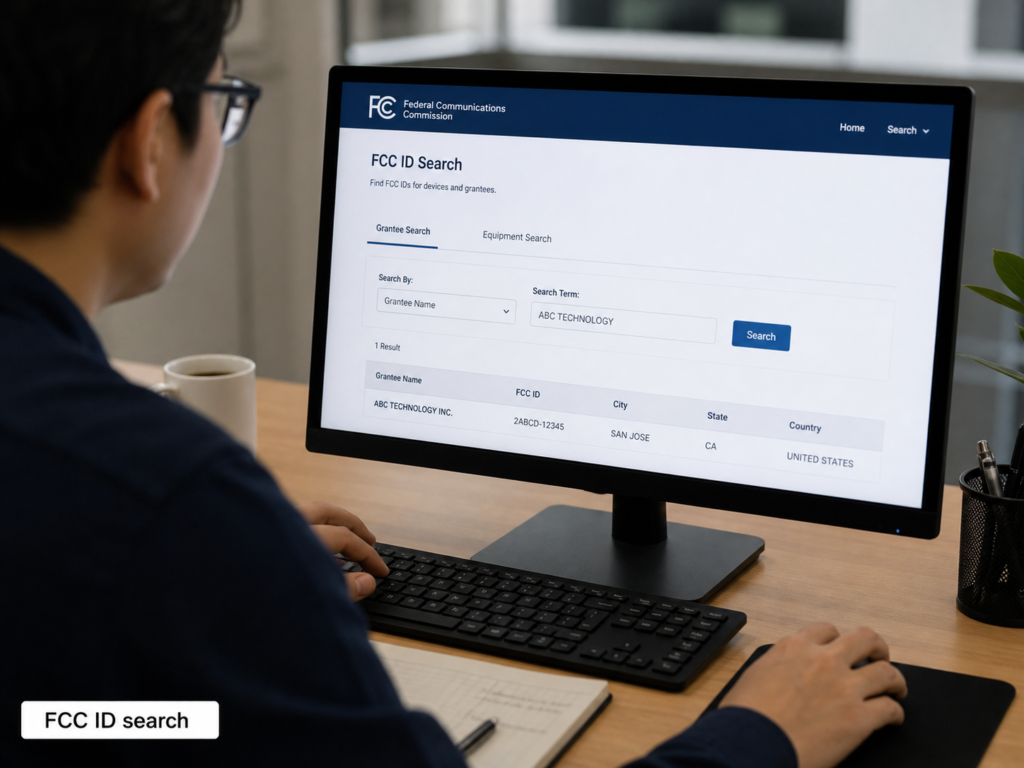
Checking FCC ID is a basic operation that every cross-border practitioner must master. It is free and requires no registration. The key is to be able to interpret the results, not just see “whether it can be found”.
Query Basics: FCC ID Structure and Entry
First, you need to understand the structure of the FCC ID, otherwise you may even input it incorrectly:
The FCC ID consists of two parts: the front is usually a **3-digit or 5-digit grantee code** (uniformly assigned by the FCC, an exclusive identifier of the certification holder), and the back is a **product code of up to 14 characters** (set by the grantee itself, corresponding to the specific product model). The two parts are directly connected without spaces or hyphens.
The official query entry is the FCC Equipment Authorization Public Database. You can find it by directly searching “FCC ID Search”. It is completely free and does not require registration of an account.
The FCC ID is usually printed on the permanent label of the product body, packaging, or instruction manual. Smart chargers with screens may use electronic labels, which can be found in the system settings.
Two Common Query Methods
The two most commonly used query methods are:
• **Query by FCC ID**: The most accurate method. As long as you enter the complete and correct FCC ID, you can directly locate the corresponding authorization record, which is suitable for verifying a single product.
• **Query by grantee/product type**: If you want to batch verify the full range of certified products of a company, you can enter the grantee name or product type to search, which is suitable for screening the compliance capability of suppliers during procurement.
Core Interpretation of Query Results (in Check Order)
After finding the record, don’t think there is no problem just because you see a result. Check one by one in this order:
1. **Entity check**: First check whether the grantee information matches the responsible entity. For example, if the supplier says the certification is its own, but the grantee is another company, you need to ask clearly about the authorization relationship.
2. **Identification check**: Confirm that the FCC ID and product model are completely consistent with the product you want to verify. Do not use the certification of model A for model B.
3. **Status check**: Check the Grant record, Grant date, whether there are revocation or suspension measures announced by the FCC, and related Permissive Change or other change documents; then compare the actual product’s model, radio frequency parameters and use conditions with the authorization documents item by item.
4. **Parameter check**: Check whether the authorized frequency band, transmission power, and antenna parameters cover the actual product’s parameters. For example, if the authorized maximum transmission power is 10mW but the actual product is 20mW, it is not compliant even if the ID is real.
5. **Condition check**: If you are checking the authorization of a wireless module, carefully read the module’s use conditions and confirm that the use method of the whole device fully meets the requirements.
6. **Document check**: The authorization certificate, appearance/label photos, and user manual can be downloaded from the database. Whether the test report is public or confidential depends on the requirements and review results at the time of application.
7. **Verification record keeping**: Finally, be sure to record the query time, because the authorization status may change later, and keeping records can prove that you verified it at that time.
If the database record found is inconsistent with the actual product, first verify with the supplier. If you are not sure, you can consult a TCB.
Common Reasons for Query Failure and Troubleshooting
If you can’t find the record, it doesn’t necessarily mean it’s fake. First troubleshoot these common reasons:
• **Incorrect ID format**: Spaces or hyphens are added when inputting, or the number of digits of the grantee code is wrong.
• **The product belongs to SDoC/exempt category**: Ordinary wired chargers and passive charging cables do not have FCC IDs at all, so of course they can’t be found.
• **The authorization is still under review**: The TCB has not passed the review, and the database has not published it yet, so naturally it can’t be found.
• **What is input is the brand model instead of the FCC ID**: Many beginners input the product’s brand model as the FCC ID, which definitely can’t be found.
• **The product follows the Part 18 path and has not gone through Certification**: Some pure wireless chargers follow the Part 18 verification path and do not have an FCC ID.
IV. Advanced Preparation: Accounts, Roles and Materials Before EAS Certification Application
If your product needs to follow the Certification path and you want to apply for an FCC ID yourself, you must first understand the preparation work before the application to avoid detours.
Description of Related Accounts and Numbers
Before applying, you need to get several accounts and numbers done first:
• **FCC account**: Set up enterprise administrators, individual users and authorized entrustment in accordance with FCC account policies. Do not register with a public email, as subsequent permission management and security will be prone to problems.
• **FRN**: An enterprise/individual identification number applied through the FCC CORES system, which is used to identify the applicant entity of all FCC business.
• **Grantee code**: Usually 3 or 5 digits, assigned by the FCC and forming the prefix of the FCC ID; the specific code and its corresponding entity shall be subject to the FCC allocation record.
• **Product code**: Assigned by the grantee itself in accordance with FCC rules. When combined with the grantee code, it forms the complete FCC ID.
Application-Related Roles and Responsibility Boundaries
The entire application process involves several roles, and the responsibilities must be clearly distinguished and not confused:
• **Grantee**: The holder and responsible entity of the certification, responsible for preparing application materials, maintaining authorization, and bearing compliance responsibilities; grantees not based in the U.S. must be equipped with a US Agent.
• **US Agent**: The local liaison entity for non-U.S. grantees, responsible for receiving FCC notices and cooperating with regulatory investigations. It must be an entity or individual within the U.S. territory.
• **Testing laboratory**: Issues test reports that meet FCC requirements; for the Certification path, the laboratory must have corresponding FCC recognition qualifications.
• **TCB**: Recognized by the FCC, submits applications to EAS on behalf of the applicant and completes the review. After approval, the authorization will be published in the database.
List of Application Materials for Charging Products
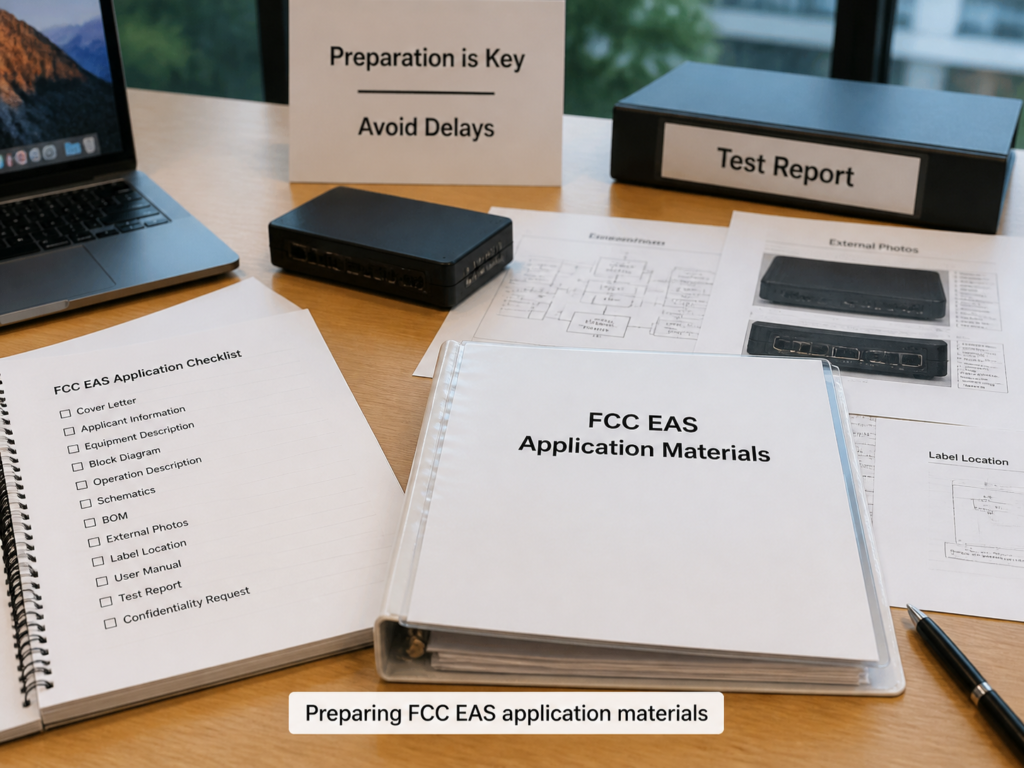
The materials required for application are roughly divided into three categories:
• **Basic information**: Product name, brand, model, difference description of series models, hardware/software version.
• **Technical materials**: Test report, circuit block diagram, appearance/label photos. Products with wireless functions also need to provide antenna parameters.
• **Compliance documents**: User manual, US Agent information. If there are materials that need to be kept confidential, a confidentiality application must also be submitted.
Judgment Criteria for Multi-Model Series Applications
If there are multiple models in the same series, whether they can be included in the same application depends on whether the wireless-related design has changed:
• **Can be applied in the same series**: Only differences in shell color, packaging, and non-wireless-related appearance details that do not affect radio frequency parameters.
• **Cannot be applied in the same series**: If the wireless chip, antenna, power, or core circuit changes, a separate application must be made.
Special attention should be paid here: e-commerce platform SKUs and color model names are not equal to FCC authorized models. Enterprises must establish a clear corresponding relationship internally, otherwise it is easy to mismatch during platform verification.
Checklist for Authorization Reuse of Modular Products
If the product uses a certified wireless module, check these points before application to confirm that the module authorization can be reused:
1. The FCC Grant status of the module itself is valid.
2. The antenna type and gain used by the whole device meet the limitations of the module authorization.
3. The installation method and power supply conditions of the module meet the authorization requirements.
4. The scenario of simultaneous transmission of multiple modules meets the authorization limitations.
5. Meet the relevant requirements of RF exposure assessment.
6. The module label position and the whole device label comply with FCC rules.
7. Confirm whether additional testing on the host side is required.
V. Advanced Process: Full Steps of EAS Certification Application
After the preparation work is done, you can go through the formal application process. The entire process is led by the TCB for submission, and the applicant only needs to cooperate in providing materials.
Basic Application Process
Follow the order, there are six steps in total:
1. **Pre-evaluation**: First entrust a qualified laboratory to conduct product evaluation to determine the applicable rules and authorization path, so as not to go the wrong way and waste time and money.
2. **Testing and prototype freezing**: Complete all required tests and freeze the final prototype version to ensure it is completely consistent with the subsequent mass production design. The mass production design shall be consistent with the authorized configuration; if the wireless module, antenna, radio frequency parameters or functions are changed, it shall first be determined in accordance with §2.1043 whether it belongs to Class I, Class II, Class III permissive change or requires a new authorization.
3. **Material preparation**: Sort out all application materials and confirm that they meet the submission requirements of the TCB to avoid being requested for supplementary materials due to incomplete materials.
4. **Submission and review**: The TCB submits the application to EAS on behalf of the applicant. If there are problems during the review, supplementary materials need to be provided as required.
5. **Publication and authorization**: The applicant first determines the FCC ID based on the grantee code and product code. After the TCB approves, it issues a Grant and publishes the authorization record in the database.
6. **Pre-launch inspection**: Before the product is launched, check again whether the product label, manual and authorization information are consistent, and whether there is any difference between the mass production design and the prototype. Sell only after there is no problem.
Key Precautions for Charging Product Applications
For charging products, there are several points that are easy to fall into pitfalls, which should be noted in advance:
• For pure wireless charging products, you must first evaluate whether Part 18 or Part 15 applies according to the rules; if Part 18 applies, you must also determine whether to use verification or Certification in accordance with §18.203, and cannot be generally classified as SDoC. Choosing the wrong rule will directly lead to rejection.
• For products with communication functions such as Bluetooth and Wi-Fi, confirm the reuse conditions of module authorization in advance to avoid supplementary testing later.
• Before submission, be sure to confirm that the FCC ID format is compliant and does not duplicate existing IDs.
• Public materials and confidential materials should be uploaded separately. Confidentiality applications must have reasonable commercial reasons, and confidentiality cannot be requested casually.
Common Reasons for Rejection/Supplementary Materials
We have sorted out several of the most common reasons for rejection or supplementary materials. Avoiding them in advance can save a lot of time:
• The test report is unqualified or missing items.
• The information on product photos, labels, and instruction manuals is inconsistent.
• The US Agent information is invalid.
• The difference description of series models is not clear enough to judge whether it meets the requirements of the same series.
• The applicable FCC rules are judged incorrectly.
Factors Affecting Cycle and Cost
Many people ask how long the application takes and how much it costs. Here is an explanation: the following are common market influencing dimensions, not official FCC commitments. The specifics depend on the product situation.
• **Cycle influencing factors**: The number of wireless functions, the complexity of testing, the scheduling of laboratories and TCBs, the number of supplementary materials, and the difficulty of rule application. A simple Bluetooth charger may take a few weeks, while a complex product with multiple wireless functions may take several months.
• **Cost composition**: Mainly includes testing fees, TCB service fees, and RF exposure assessment fees. If there are additional tests, confidentiality applications, or supplementary materials, corresponding fees will also be incurred.
VI. Advanced Maintenance: EAS Authorization Change and Daily Management
Getting the authorization is not once and for all. Subsequent product changes or inadequate daily maintenance may lead to invalidation of the authorization.
Change Classification and Judgment Logic
All changes involving product or authorization information must first consult the laboratory or TCB, and cannot be changed directly by yourself. According to the severity, they are roughly divided into several categories:
• **Administrative changes**: For example, grantee name change (but no entity transfer), address change, manual text update. Such changes that do not involve radio frequency parameters shall be evaluated by the TCB whether they can be updated directly.
• **Permissive Change**:
• **Class I**: Usually refers to changes that do not reduce the radio frequency characteristics of the device.
• **Class II**: Usually allowed changes that require supplementary materials or testing and are submitted to the TCB for review.
• **Class III**: Mainly used for specific antenna changes.
Changes in modules, antennas, firmware or radio frequency parameters shall not be directly classified according to examples, and shall be determined in accordance with §2.1043, the original Grant conditions and TCB evaluation.
• **Major changes**: Replacing wireless modules, antennas, adjusting transmission frequency bands or adding wireless functions may exceed the scope of the original authorization, but cannot be generalized. It shall be determined in accordance with §2.1043 and the original Grant conditions whether Class II, Class III and other permissive changes can be made, and a new authorization shall be applied for when the scope is exceeded.
• **Responsible party transfer (Grant assignment)**: If the certification is to be transferred to another company, a transfer application must be submitted, which will take effect after review and approval.
Basic Steps for Change Operation
If it is confirmed that the change process is needed, the basic operation is:
Use an EAS account with corresponding permissions to find the corresponding authorization record, upload change certification materials and difference descriptions, and submit them to the TCB for review. After the review is passed, the database will update and publish.
Daily Maintenance and Document Retention Requirements
In daily operation, two things must be done well:
First, **mass production consistency**: Mass-produced products must be consistent with the wireless design of the authorized samples, and wireless-related materials cannot be replaced at will. Otherwise, even if the ID is real, the product is not compliant.
Second, **authorization status monitoring**: Regularly check the authorization status to avoid compliance abnormalities caused by invalid information.
In addition, document retention must also meet the requirements, and different paths have different requirements:
• SDoC path: The responsible party shall retain test reports, compliance declarations and other records in accordance with FCC regulations (47 CFR).
• Certification path: Retain application materials, test reports, and authorization documents in accordance with FCC rules.
• Modular products: Retain both the module’s authorization documents and the confirmation records of the whole device’s reuse conditions.
• Enterprise procurement side: Retain verification evidence in accordance with customer or platform requirements.
FCC Label Requirements (General Principles for Charging Products)
Labels are an important part of compliance. The labels of charging products must meet these general principles:
• **Certification path products**: The FCC ID shall be displayed in accordance with §2.925 and electronic label rules. If the device is too small or unsuitable for direct marking, it shall be handled in accordance with the alternative methods allowed by the FCC.
• **SDoC path products**: The required FCC compliance declaration and responsible party information shall be provided in accordance with applicable rules. The specific location and form shall be determined in accordance with §15.19, §15.105 and applicable Subparts.
• **Modular products**: The module itself must meet the module’s label requirements, and the whole device must mark or explain the module’s authorization information in accordance with the rules.
• **Applicable conditions for electronic labels**: Users can easily view them through the product interface without disassembling the device.
• **Core reminder**: Core identifiers such as FCC ID and grantee code must be completely consistent with the information in the database.
VII. Pitfall Avoidance for All Scenarios: Key Points of EAS Compliance in Each Cross-Border Link
Finally, we have sorted out the pitfall avoidance points for all scenarios, which can be used in procurement, customs clearance, and platform operation.
General FCC ID Verification Checklist (Common for Procurement/Customs Clearance/Platform)
No matter in which scenario, the FCC ID must be verified according to these 6 items. Missing any one may cause problems:
1. The product indeed belongs to the path that requires Certification, not SDoC or exempt category.
2. The FCC ID format is correct, and the corresponding Grant record can be found in the public database.
3. Check the Grant record, Grant date, whether there are revocation or suspension measures announced by the FCC, and related Permissive Change or other change documents.
4. The relationship between the grantee and the supplier/brand party is legal, either self-owned or with written authorization.
5. The sales model, appearance, wireless functions, and parameters are all within the scope of authorization coverage.
6. If a module ID is used, the whole device meets all authorized use conditions.
Additional Compliance Precautions for Each Scenario
Different scenarios have additional points of attention:
• **Procurement scenario**: FCC compliance liability clauses must be added to the contract. If a third-party FCC ID is used, the supplier shall be required to issue an authorization certificate for use, and the test report shall be requested for retention.
• **Import customs clearance**: For devices that require Certification, it shall be ensured that the device label and the FCC public Grant are consistent with the actual product, and authorization documents shall be prepared in accordance with the requirements of specific customs, importers or platforms.
• **Platform operation scenario**: SDoC can only be used for devices applicable to SDoC, and cannot replace the FCC ID that is legally required for Certification. Whether the platform requires a public FCC ID and what review measures may be taken depend on the platform’s own policies.
Common Types of Invalid/Non-Compliant FCC IDs
Many people think that “a searchable ID is real and compliant”, but it is not. The following are all invalid or non-compliant situations:
• **Invalid format**: Does not conform to the standard format of FCC ID, and no record can be found in the database at all.
• **Invalid status**: Can be found in the database, but there are revocation, suspension and other measures, or the relevant authorization status needs further verification.
• **Misappropriated ID**: The ID of a legal grantee is used by an unauthorized entity without a legal authorization relationship, which is equivalent to “license plate cloning”.
• **Misused ID**: The FCC ID of the wireless module is directly used as the whole device ID, but the module’s reuse conditions are not met.
• **Parameter mismatch**: Authorized antenna, power, frequency band and other parameters do not cover the actual product parameters.
• **Model mismatch**: The purchased or sold model is not within the scope of authorized models, which is an unauthorized variant.
Here we emphasize the core reminder again: **a searchable “real ID” does not mean that the corresponding product is compliant. All conditions must be checked**.
Compliance Evidence Chain Retention Checklist (For Verification Response)
Whether it is to respond to verification by customs, platforms or customers, a complete compliance evidence chain must be retained, including:
• Photos of the actual product/label
• Mapping table of e-commerce SKUs and FCC authorized models
• Screenshot of the FCC public Grant (with verification date)
• Test reports and authorization use certificates provided by the supplier
• User manual, module authorization condition confirmation letter
• Product change records (if any)
Boundaries Between EAS and Other Charging Compliance Requirements
Finally, you need to understand the boundaries of EAS. It is not omnipotent and cannot replace other compliance requirements:
• It does not replace electrical safety certifications such as UL/ETL.
• It does not cover energy efficiency regulations such as DOE/CEC.
• It is implemented independently of chemical regulations such as Proposition 65.
• It only covers FCC radio frequency-related Certification compliance, and does not include other FCC requirements of the SDoC path.
Learning Summary and Practical Tools
After learning this guide, you should be able to independently complete the following tasks:
Quickly judge the FCC compliance path of common charging products, distinguish whether they need to go through EAS and whether they have an FCC ID; be able to use the FCC public database to query FCC IDs and correctly interpret the authorization status and scope; understand the preconditions, basic process, and cycle and cost influencing factors of EAS certification applications; be able to distinguish different types of authorization changes and know when to consult a laboratory or TCB; be able to use the general verification checklist to investigate FCC ID compliance risks in procurement, customs clearance, and platform scenarios; know the applicable boundaries of EAS and will not confuse it with other compliance requirements.
To facilitate implementation, you can also be equipped with two practical tools: one is a **one-page decision tree**, starting from “whether the product has wireless transmission function”, covering the full-process judgment logic of rule matching, path determination, ID query, and verification record keeping; the other is a **compliance evidence chain template**, including standardized templates for supplier verification, product information matching, authorization status confirmation, and retained document list, which can be directly applied to quickly build your own compliance files.
EAS is the core tool in the U.S. FCC radio frequency compliance system. For practitioners engaged in cross-border sales of charging products, understanding it is not to become a certification expert, but to avoid unnecessary pitfalls in every link of product selection, procurement, customs clearance, and operation, so that products can go more steadily.