
Cross-border sellers of products such as charging cables, USB-C chargers, and power adapters have most likely encountered such frustrating issues: goods are detained by customs at the destination port due to alleged certification problems; or e-commerce listings are taken down just as sales start picking up, requiring submission of compliance documents. In many cases, it is not that the product quality is poor, but that you have not figured out “which platform to submit the certification to” and “how to submit it correctly”.
This article, from beginner to advanced level, sorts out the basic framework, common requirements, and common pitfalls of electronic certification submission platforms in various countries, with content focused on charging products. However, before actual submission, you must confirm item by item according to the latest requirements of product functions, rated parameters, import entities, destination competent authorities, and platforms, and cannot directly operate solely based on the content of this article.
General Preparations Before Submission (Applicable to All Countries/Platforms)
No matter which country you are going to or which platform you use, you must first prepare products and documents before submission. Complete documents and clear model numbers help reduce rejections caused by missing documents, inconsistent information, etc., but they do not guarantee that the review will definitely pass.
Identity Sorting of Charging Products (Avoid Model/Parameter Mismatch)
A common reason for the failure of charging product reviews is “identity mismatch”. You need to focus on confirming the following information:
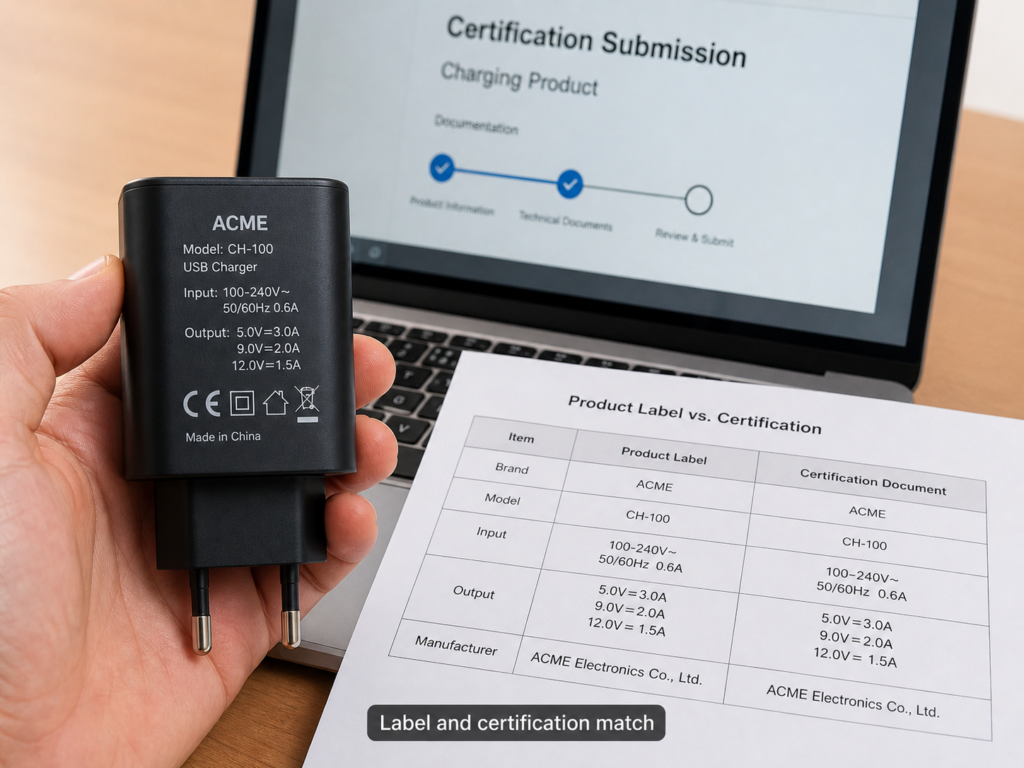
• **Unified identification information**: Legal product model, brand, manufacturer, and key parameters shall maintain a traceable consistent relationship with certification or conformity documents. SKU is a sales or inventory management identifier, not necessarily a legal product model, nor does it necessarily need to appear in certification documents; whether it is included in the documents shall be determined according to the specific platform and certification system. For example, if the certification says “UC-100W”, the sales page should clearly correspond to the same product, instead of being rewritten as the unmatchable “UC100W Super Fast Charging”.
• **Core parameter alignment**: Information such as rated power, input and output voltage and current, interface type, and wireless function shall be consistent with the certification documents and the actual product. For cables with nominal values exceeding the corresponding USB-C current or power and using electronic marker chips, the E-Marker and related USB-C specifications shall also be checked, and documents shall be prepared according to the requirements of the target market. E-Marker is not available in all USB-C products, nor is it a universally required submission material for all countries or platforms.
• **Series models cannot be shared arbitrarily**: Products with identical appearance but different parameters cannot naturally share the same certification. For example, for chargers with the same shell, the internal circuits of 20W and 65W may be different; you cannot directly use the certification of 20W products to cover 65W products, unless explicitly permitted by the specific certification system and certification body.
List of Required Submission Materials (Exclusive for Charging Products)
Preparing these materials in advance can reduce the trouble of temporarily looking for documents each time you submit:
• **Product materials**: Complete specifications, clear real photos (overall, label, interface, packaging, etc.), the model and parameters on the label shall be clearly identifiable, and instructions meeting local requirements shall be prepared.
• **Compliance documents**: Certification certificates, test reports, and declarations of conformity required by the corresponding country; the specific type of document required shall be confirmed according to the target market regulations and platform requirements.
• **Entity qualifications**: Enterprise business license, as well as information on local responsible persons or importers in the target country, such as economic operators in the EU, Japanese importers, etc. Many systems stipulate separate responsibilities for manufacturers, importers, authorized representatives, or declaration entities.
• **Supplementary materials**: If USB-C fast charging products use E-Marker, relevant specifications or test materials shall be prepared; for products with wireless functions, the wireless module model and corresponding compliance information shall be prepared, and whether submission is required is determined by the requirements of the target market.
3 Must-Checks Before Submission (Beginner Pitfall Avoidance)
Spending a little time checking these three points before submission can reduce rejections caused by basic information errors:
1. **Check certification matching**: Confirm that the legal model, product version, USB-C power and current and other information on the documents are consistent with the actual product and sales page.
2. **Check document status and entity qualifications**: Confirm whether the applicable system has a validity period, whether the certificate is in valid status, whether the issuing or assessment entity has corresponding qualifications, and whether the document covers the current product and applicable standards. Not all systems have a unified “certificate validity period”; for example, the EU CE Declaration of Conformity is usually not a certificate issued regularly by the government.
3. **Check mandatory scope**: First confirm whether your product falls within the scope of mandatory certification or registration in the target country, to avoid handling inapplicable items. Ordinary charging cables in some markets may be subject to voluntary certification or other requirements, but the final decision shall still be based on local regulations and platform rules.
Core Steps for General Submission
The specific processes in different countries are not exactly the same, but common operations roughly include:
1. Register a platform account and complete entity qualification verification, such as uploading business licenses, local responsible person authorization documents, or importer information.
2. Enter basic product information and core parameters, and pay attention to keeping them consistent with the certification documents and the actual product.
3. Upload the corresponding certification documents, and prepare the document format, name, and size according to platform requirements.
4. Submit for review, and save the application number, submission receipt, and subsequent notifications to facilitate progress inquiry or supplementary materials.
Certification Submission Operations on Cross-Border E-Commerce Platforms (For Listing)
In addition to official customs clearance and market access, many sellers also need to pass the compliance review of e-commerce platforms. This part belongs to platform rules and cannot be confused with the legal certification process.
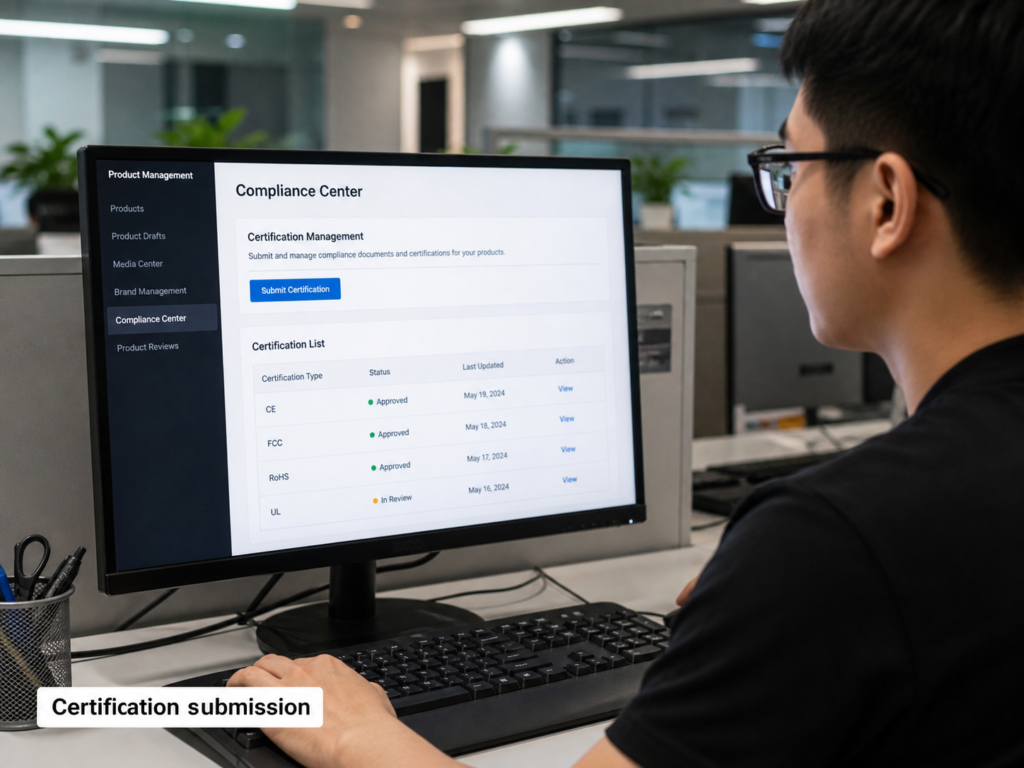
Amazon Global Sites: Compliance Center in Seller Central
The common certification submission entry on Amazon is located in “Performance → Account Health → Compliance Requirements” and other positions in Seller Central, but the specific entry and name may vary with the site, category, and account situation.
• **Charging product requirements**: Shall be subject to the current compliance notice of the specific site, ASIN, and Seller Central, and submit applicable test reports, certificates, DoC, labels, or responsible person information required by the platform. The US site, European site, and Japanese site may involve FCC, CE-related documents, PSE, or other requirements respectively, but not all charging products require the same document uniformly by site.
• **Review cycle**: The review time varies depending on the product, site, document completeness, and manual review situation, and shall be subject to the display in the backend and Amazon notifications.
• **Common pitfalls**: The certification model is inconsistent with the sales page model; power claims exceed the coverage of the documents. For example, if the document only covers 20W but the page says 65W fast charging, you may be required to supplement or resubmit materials.
Chinese Cross-Border Platforms (AliExpress/Temu/TikTok Shop)
The rules, sites, categories, and random inspection mechanisms of such platforms vary, and cannot be summarized with a fixed process or time limit.
• **General entry**: Generally can be found in “Product Management → Compliance Center/Certification Management” and other positions in the merchant backend; the names may vary slightly across different platforms and sites.
• **Charging product requirements**: Some platforms support batch upload of certification documents, and some sites or categories may also require additional quality inspection reports. All documents shall be traceable; submitting false certifications may result in product removal, account penalties, or even store closure.
• **Review cycle**: The review time varies depending on the platform, site, category, document type, and manual review, and shall be subject to the rules and notifications of each platform’s merchant backend.
• **Common pitfalls**: The same certification is bound to multiple SKUs with different parameters. For example, binding multiple chargers of different powers with a 20W product document may result in the entire batch of products being required to be re-reviewed.
Core Relationship Between E-Commerce Platforms and Official Certification
Two points should be clarified here to avoid duplicate work or omissions:
1. The same document may be submitted repeatedly when it meets the applicable scope, entity, model, and format requirements of the respective systems. However, this does not guarantee that it is applicable to both official customs clearance and e-commerce platforms, nor can a single platform review be regarded as completing legal certification.
2. The documents required by the platform may be more or less than the legal requirements. For example, the platform may require charging cables to submit test reports, even if local laws do not stipulate the same mandatory certification; conversely, legally mandatory items that the platform does not temporarily require still must be completed. Therefore, platform rules and official regulations need to be checked separately and cannot replace each other.
Semi-Proficient: Submission Decision-Making and Risk Control
If you operate in many markets and have many product models, just knowing basic operations is not enough; you also need to learn to judge and avoid pitfalls. This part is advanced content.
Judgment Method for Selecting Submission Platforms
Many people don’t know which platform to submit to; in fact, you can judge according to this line of thinking:
1. **First confirm legal obligations**: Do not decide the platform solely based on “wholesale customs clearance” or “e-commerce listing”. First confirm the target country’s market access, import, labeling, and customs declaration obligations for the product.
2. **Then look at product and destination rules**: Judge whether the product has wireless functions, what the rated power and voltage are, what type of electrical or wireless equipment it belongs to, and whether certification, conformity assessment, product registration, or responsible entity is required.
3. **Finally confirm the handling entity and system**: According to the system, confirm which system the manufacturer, importer, certification body, customs declaration entity, or e-commerce seller shall use for handling. Customs declaration systems, certification systems, and e-commerce compliance entrances may assume different responsibilities respectively.
Choice Between Self-Submission and Entrusting a Service Provider
Whether to submit by yourself or find a service provider can be judged according to your actual conditions:
• **Suitable for self-submission**: You have the qualifications of a local importer or responsible person in the target country, are familiar with platform operations, and have few product models, for example, only 1-2 charger models entering one market.
• **Suitable for entrusting a service provider**: You do not have local qualifications, are not familiar with the local language, or have many product models involving multiple markets; entrusting a professional service provider may be more worry-free.
• **Service provider selection criteria**: Verify whether the service provider has the accreditation, designation, or agency qualifications required for the specific project to be handled. Those that really require accreditation or designation qualifications are usually specific certification bodies, laboratories, TCBs, or registered conformity assessment bodies, not all consulting service providers must have “national official authorization”. At the same time, the other party shall be required to provide information on institutions, laboratories, and certificates that can be verified in the official database of the competent authority or certification body.
Submission Time Planning (Avoid Delays)
Do not take a fixed number of weeks as the unified deadline for all countries. A more prudent approach is to schedule the time backwards according to the specific certification body, transportation method, customs declaration type, and platform rules, and reserve time for testing, factory inspection, document supplementation, and inspection.
• **Official certification**: The processing time of items such as FCC ID, CCC, and KC varies depending on the product, test items, factory inspection, document correction, and certification body arrangements, and shall be confirmed with the specific institution in advance.
• **Customs platform**: Arrange the pre-declaration time according to the transportation method, carrier, declaration type, and system requirements. Systems such as ICS2 have their own entry summary declaration time points, which cannot be uniformly summarized as 3-5 days before the arrival of goods at the port.
• **E-commerce platform**: Time shall be reserved before product listing according to platform notifications and historical review situations; 3-7 working days or 1-5 working days cannot be regarded as a unified commitment of all platforms.
• **Additional preparation for charging products**: Information such as interfaces, power, wireless modules, and E-Marker may require supplementary explanations, so margin shall be left for document checking and supplementation.
Compliance Judgment for Product Changes (Avoid Certificate Invalidation)
If part of the product is changed, whether to re-do the certification cannot be judged solely based on a fixed list:
• **Major changes that require immediate notification to the certification body or compliance responsible person**: When changes occur in power, plug specifications, wireless modules, power chips, insulating materials, production factories, etc., the relevant institution or responsible person shall be notified immediately, who will judge whether it is change filing, supplementary testing, factory audit, or re-certification according to the specific system.
• **Medium-risk changes (require confirmation by certification body)**: Changes in shell, cable length, interface combination, label layout, etc., may affect safety, EMC, structure, or certification marks, and it shall be confirmed first whether supplementary testing or document update is required.
• **Packaging and instruction changes**: Packaging text and instruction layout shall also be subject to compliance review. If it involves rated parameters, warnings, legal marks, responsible person information, or usage conditions, relevant documents shall be updated simultaneously, or confirmed with the certification body. Even if it is just a layout change, change records shall be kept.
Quick Judgment Method for Certification Validity
When you get a certificate or test document, you can check it from three aspects:
1. **Check institution qualifications**: Confirm whether the issuing, assessment, or testing entity has the accreditation, designation, or registration qualifications required for the project.
2. **Check document information**: Check the model, product version, parameters, certificate holder, manufacturer, applicable standards, and document status to confirm that they are consistent with the actual product and entity.
3. **Check traceability**: Verify through the corresponding competent authority, certification body, or official database. If it cannot be queried, the certificate number, holder, certification body, and data update time shall be further checked; the certificate cannot be deemed fake just based on one query. FCC ID query is also only applicable to corresponding FCC certified equipment, not all products using SDoC or other procedures.
Long-Term Management Method for Compliance Documents
After operating for a long time, with more and more products and certificates, it is easy to get confused. The following methods can be used for management:
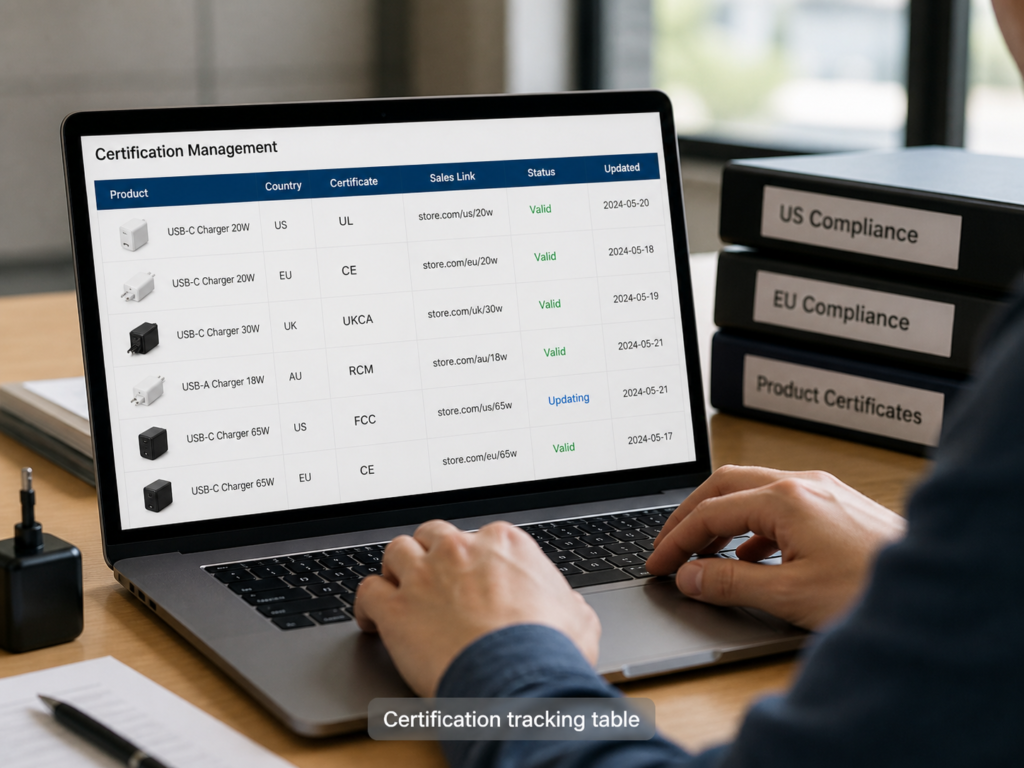
• Establish a correspondence table of “Product – Country – Certificate – Sales Link”, recording the applicable certification, corresponding sales link, document status, and update time of each model in each country.
• Clearly mark the holder, manufacturer, importer, local agent, and document storage responsible person of each document.
• Save all submission receipts, application numbers, approval screenshots, supplementary document records, and change confirmation documents, preferably with cloud backup, so that they can be quickly provided during appeals or regulatory random inspections.
Core Competency Summary
After reading this article, you can compare your own level:
Beginner User Competencies
• Can distinguish between electronic certifications for different purposes, government supervision, customs declaration, and e-commerce compliance platforms, and will not confuse them.
• Can prepare basic submission materials for charging products, reducing missing documents.
• Can complete basic submission operations on official or e-commerce platforms according to target market requirements.
• Can identify common beginner misunderstandings.
Semi-Proficient User Competencies
• Can judge which compliance procedures need to be handled according to sales goals, product functions, and destination rules.
• Can quickly troubleshoot common reasons for the failure of charging product reviews, and know how to prepare appeal materials.
• Can judge whether product changes require supplementary testing, filing, or re-application according to specific certification rules.
• Can select appropriate submission methods and service providers according to their own qualifications and project complexity.
Since charging products involve electrical safety and wireless functions, the regulatory rules of various countries will continue to be adjusted. Enterprises should continuously pay attention to the latest requirements issued by competent authorities, certification bodies, and e-commerce platforms in target markets. Checking the product scope, responsible entity, document purpose, and submission entrance in advance is more prudent than remedying after problems occur.