
Most sellers engaged in cross-border charging product businesses have had this experience: when sourcing goods from suppliers, the other party readily sends a stack of certification documents stamped with red seals and printed with foreign-language logos, which look very formal. But when the goods arrive at the destination port, they are either detained by customs on the grounds that the certifications are fake, or removed from the platform with a request to provide genuine certificates, ending up with both money and goods lost.
In fact, charging products belong to the high-risk electrical category. Customs authorities and e-commerce platforms in various countries conduct very strict random inspections of compliance documents, and there are particularly many pitfalls such as fake certificates, misappropriated certificates, and expired certificates. Today, we will thoroughly explain the methods for verifying supplier certification documents from beginner to advanced levels, all of which are practical methods for products such as chargers, data cables, and wireless chargers, and can be used directly after reading.
Pre-verification Preparation: First Establish the Correspondence Between “Product – Market – Document”
Many people start by checking the certificate number, and after searching for a long time, they find that they cannot even figure out which regulations or certification schemes the product corresponds to, which is completely a waste of effort. Only by aligning the three elements before verification can you get twice the result with half the effort.
First Lock in the Identity Information of the Purchased Product (Exclusive to Charging Products)
Compliance documents usually need to cover specific products or clear product series. A single letter difference in information may require further confirmation. You need to first clarify all the information of the purchased products:
• **Basic information**: Brand, complete model (including suffix), plug specification (EU/US/UK/AU);
• **Core parameters**: Input and output voltage and current, maximum power, interface type (USB-A/USB-C/PD fast charging);
• **Special configurations**: Whether there is a built-in battery, whether there are wireless modules such as wireless charging and Bluetooth.
It is important to note that the model on the product packaging, label, and manual should be clearly covered by the certification document, model list, series scope, or official model difference document. For example, if the model you purchase is and only appears on the document, you cannot judge that it is usable solely based on similar names, nor can you directly conclude that it is invalid just because of the extra suffix. You also need to confirm whether the rated values, structure, key components, and manufacturing location are within the scope covered by the document.
Clarify Exactly What Compliance Requirements the Target Market Has
Mandatory requirements vary by market, and common compliance matters for charging products can be referred to as follows:
• **EU market**: Obligations such as safety, EMC, RoHS, REACH, and ecodesign shall be fulfilled in accordance with the specific regulations applicable to the product, and the CE mark shall be affixed after meeting the conditions. CE is a compliance mark used after completing the conformity assessment specified in applicable regulations. Whether a notified body is required to participate depends on the specific regulations and product situation;
• **UK market**: For Great Britain, the current government regulations shall be checked. Qualified CE marks can usually still be used, and UKCA is not a universal replacement mark that all charging products must additionally obtain. For Northern Ireland, the applicable EU rules and UKNI application scenarios need to be checked separately;
• **US market**: First, it is necessary to determine whether the product is subject to equipment authorization rules such as FCC Part 15. Products with wireless transmission functions usually involve FCC certification and FCC ID; ordinary wired chargers usually adopt the Supplier’s Declaration of Conformity (SDoC) in accordance with applicable rules. Whether UL/ETL is required depends on the product category, installation specifications, channels, and platform requirements; California Proposition 65 mainly involves regulated chemicals and exposure warning obligations, and DOE energy efficiency requirements only apply to applicable product categories;
• **Asia-Pacific market**: For Japan, check the PSE applicable categories and conformity assessment requirements; for South Korea, check KC and possibly involved radio regulations; for Australia, check RCM applicable regulations, responsible suppliers, and EESS registration requirements;
• **Charging product industry schemes**: USB-IF certification is an optional industry compliance or interoperability certification, and whether it is required depends on product functions, customers, platforms, and channel requirements; MFi is Apple’s licensing scheme, and the corresponding authorization scope is only verified when the product uses technologies, accessory functions, or logos covered by Apple’s licensing scheme, and cannot replace safety, EMC, or other statutory compliance requirements.
What Documents Should You Request from Suppliers to Be Sufficient
Don’t just ask suppliers to send “certification certificates”. A complete set of verifiable document packages should request applicable materials according to the target market and specific regulations, including:
• **Necessary documents**: Declaration of Conformity (DoC, a compliance commitment document issued by the manufacturer), technical documentation, test reports, certification certificates, and product label/packaging materials. The specific documents required depend on the target market, regulations, and certification schemes;
• **Supplementary documents**: If a report or certificate covers multiple models, the issuing body or manufacturer should be required to provide official documents or records that can explain the coverage relationship of models, structures, and key components, and cannot only rely on the supplier’s verbal explanation;
• **Principal relationship documents**: If the certificate holder is not the supplier itself, a statement of the authorization relationship between the two parties needs to be provided, such as the authorization document between the foundry and the brand owner;
• **Format requirements**: Try to request complete, searchable PDF files. Blurry screenshots, documents with only the cover page, or even only photographed images are not acceptable.
Not all products must have a third-party “certification certificate”. For example, some CE compliance matters can be self-declared by the manufacturer under applicable conditions; REACH also cannot cover all obligations through a single unified third-party test report. Therefore, the focus of verification is not that the more documents the better, but to confirm that the document types match the requirements of the target market.
Use the Product Specification Sheet as the “Benchmark Ruler” for Verification

The product specification sheet is the “ID card” of the product. During verification, it should be used as the benchmark to check the information in the compliance documents:
• First check whether the core parameters such as rated power, number of interfaces, and plug type are consistent;
• Then check whether the shell material, cable specifications, and key chip models match;
• When changes occur in the product’s materials, chips, structure, parameters, factory, or key supply chain, it is necessary to confirm whether the original documents still cover the changes in accordance with applicable regulations and the change assessment rules of the certification body;
• If necessary, supplementary assessment, testing, or updated certificates/DoCs should be carried out. It cannot be directly assumed that the original document has become invalid, nor can it be assumed that no update is required at all.
Advanced Official Verification: Check Official Records, Status, and Applicable Scope
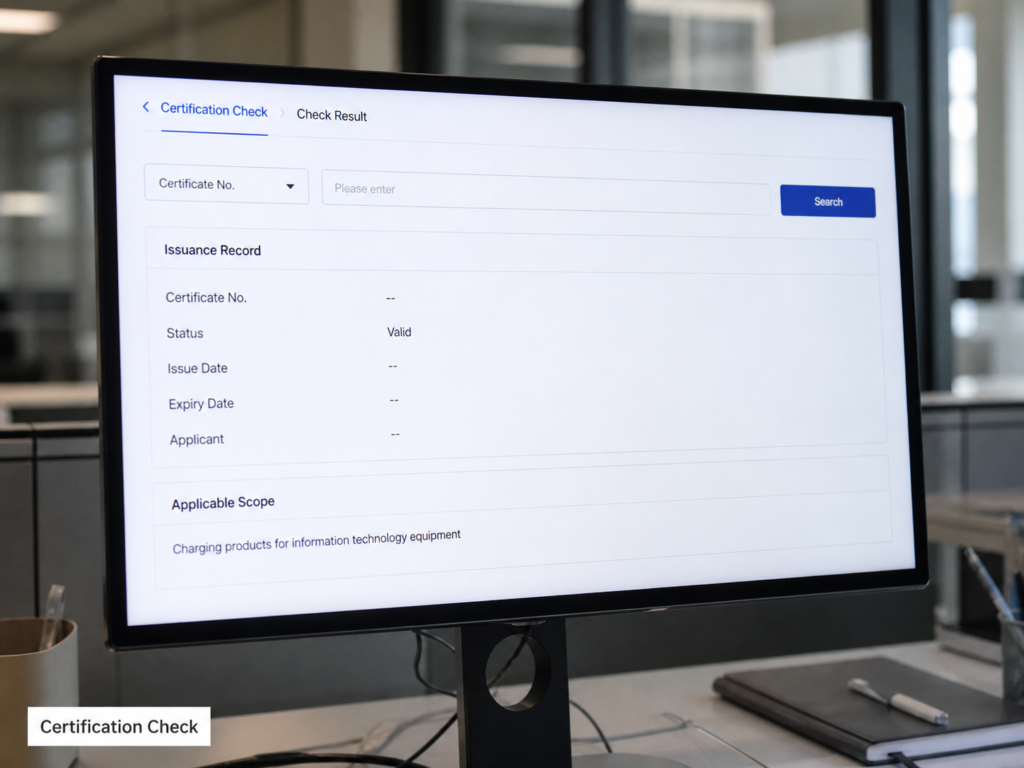
For documents with no obvious problems found in the initial screening, it is also necessary to check the issuance records, status, and applicable scope through official channels. This is a key step to confirm the authenticity and applicability of documents, but it cannot replace the verification of samples, bulk goods, factories, key components, and continuous production compliance.
The query paths for different types of compliance documents in different regions are not the same.
How to Check Certifications in the EU/UK Region
• **CE-related documents**: First identify the EU regulations and conformity assessment procedures applicable to the product. Only when regulations require the participation of a notified body, check the notified body and its authorization scope in NANDO, and verify the certificate with the body separately. If the manufacturer’s self-declaration procedure applies, the DoC signed by the manufacturer, technical documentation, and test/assessment basis should be checked, instead of requesting a non-existent NB certificate;
• **RoHS/REACH/Ecodesign**: Check the applicable regulations, product categories, responsible entities, and required technical documents respectively. RoHS and REACH should be judged in combination with materials, supply chain information, restricted substance assessments, and relevant declarations; for ecodesign and energy efficiency requirements, it is necessary to confirm whether the product is within the scope of specific regulations and whether there are corresponding test, filing, or DoC requirements;
• **UKCA-related documents**: For Great Britain, first check the current government regulations and whether CE is still applicable. Only when required by specific rules, check the UKCA conformity assessment body and its documents. Northern Ireland also needs to be judged based on applicable EU rules and UKNI scenarios.
The qualifications of third-party laboratories should be checked in accordance with target regulations and customer requirements, and ILAC qualifications cannot be regarded as a unified replacement condition for all markets and all regulations.
How to Check Certifications in North America
• **FCC certification**: Products with wireless functions, such as wireless chargers and chargers with Bluetooth, usually involve FCC certification and FCC ID, which can be queried in the official FCC database. Ordinary wired chargers usually do not use FCC ID, but adopt SDoC in accordance with applicable rules. Test reports, supplier declarations, and applicable laboratory qualifications should be checked;
• **UL/ETL certification**: Query in the official product database corresponding to UL or ETL by certificate number or UL File Number. UL/ETL are usually third-party certification marks, not a unified certification that the US federal government universally mandates for all charging products. Whether they are required depends on product category, installation specifications, channels, and platform requirements;
• **California Proposition 65, DOE energy efficiency**: California Proposition 65 should be judged in combination with regulated chemicals, exposure scenarios, and warning obligations; DOE energy efficiency requirements only apply to the specific product categories it covers, and corresponding test, filing, or declaration requirements should be checked. A general third-party report cannot be regarded as a unified proof in all scenarios.
How to Check Certifications in the Asia-Pacific Region
• **Japan PSE**: First confirm whether the product belongs to specified electrical appliances or other electrical appliances, then check the corresponding registration, conformity assessment, and marking requirements. There is no unified rule for PSE that all products can be queried by certificate number on the official website of the same body;
• **South Korea KC**: Verify in the corresponding official system according to specific systems such as product safety and radio. Safety products can be queried through systems such as South Korea’s Safety Korea; devices with wireless functions may also involve South Korea’s radio-related regulations;
• **Australia RCM**: Check applicable regulations, responsible suppliers, and EESS registration status. RCM is a compliance mark used under the regulatory framework of Australia and New Zealand, and EESS registration is not equivalent to a universally applicable “RCM certificate”.
How to Check Charging Product Industry Certifications
• **USB-IF certification**: Use the certification or product catalog currently provided by USB-IF, or directly verify the relationship between TID, product, and manufacturer with USB-IF. Query fields and public scope may change with official systems and permissions, and it is not guaranteed that all products can be publicly queried by model, TID, or supplier name;
• **Apple MFi certification**: Check whether the product is within the authorization scope through the official MFi account, authorized entity, and relevant licensing documents. MFi authorized products and licensing scope cannot be fully confirmed solely by screenshots or public web pages sent by suppliers, nor can it be assumed that there is a page where all products can be publicly queried.
What to Do If Documents Cannot Be Found in Public Information
Some bodies do not have public query systems for their documents. In this case, do not directly believe the supplier’s statement, and you can handle it as follows:
• Go to the official website of the body to find the public contact email to verify the issuance record, certificate holder, product scope, and document status. Do not use private emails or “liaison emails” provided by the supplier;
• Require the supplier to provide a complete PDF. The email chain when the body issues the document can only be used as auxiliary evidence and cannot alone prove the authenticity of the document;
• For high-value orders, you can entrust local compliance consultants or third-party bodies to recheck.
Verification results should also be interpreted with caution:
• **Complete match**: It only means that the official records are consistent with the submitted information, and it is still necessary to check whether the product is consistent with the bulk goods;
• **Partial match**: Release should be suspended, and the supplier should be required to supplement official basis for model, structure, key component, or factory coverage;
• **No public record found**: It should be marked as high risk, and further verified through the public contact information on the body’s official website. It cannot be directly determined as a fake certificate in all scenarios.
Full Process of Cross-border Procurement Verification: Directly Apply from Inquiry to After-sales
Certification verification is not something to be done only after getting the documents. It should run through the entire procurement process, from inquiry to after-sales, to minimize risks.
Inquiry Stage: State the Requirements Upfront to Avoid Later Disputes
Don’t wait until the goods are ready to remember to ask for compliance documents. Make the rules clear during the inquiry stage:
• Clearly inform the supplier that the authenticity, valid status, and product coverage of the documents will be verified;
• List the regulations, declarations, test materials, or certification schemes that need to be checked according to the target market, and require the provision of complete PDFs and verifiable information;
• If the certificate holder is not the supplier itself, require the provision of an authorization relationship statement in advance, such as the authorization document between the foundry and the brand owner;
• For documents that cannot be publicly queried, agree in advance that the supplier will cooperate in verification through the official contact information of the issuing body.
Before Sampling/Mass Production: Two-step Verification to Ensure Access Control
Before sampling or mass production, be sure to complete two steps of verification:
• Step 1: Use the quick method mentioned above for initial screening to find obvious problems such as fake certificates, tampering, expiration, or coverage issues;
• Step 2: Verify through official channels to confirm the document records, status, and applicable scope, and confirm that it does cover your product.
If there is any doubt, directly contact the issuing body or relevant responsible entity for verification, and do not only accept the supplier’s unilateral explanation. Official records can confirm information at the document level, but it still needs to be judged in combination with the consistency of samples, key components, factories, and bulk goods.
Bulk Goods Acceptance: Check Consistency Between Goods and Certificates to Avoid “Certificates Match but Goods Do Not”
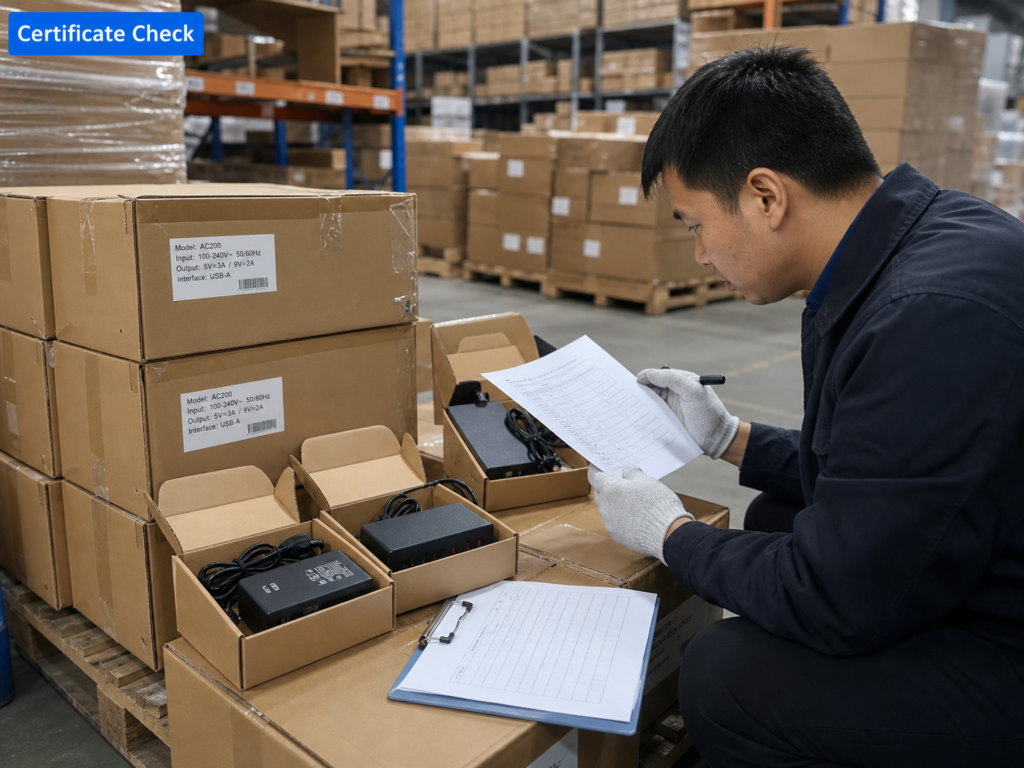
Some suppliers provide genuine documents, but the bulk goods are different from the products on the documents. In this case, you should also pay attention to:
• Check whether the marks on the bulk goods meet the mark, size, responsible entity, and label requirements of applicable regulations and certification schemes. It is not required that the position of the mark be completely consistent with the photo on the certificate;
• Randomly check the model, parameters, and labels of the products. For charging products, focus on checking power and interfaces, and confirm that the actual structure and key components do not exceed the scope covered by the documents;
• Prepare and save documents in accordance with the requirements of customs, market supervision, and platforms of the destination country. Whether a copy of the certificate needs to accompany the goods depends on the destination country, product, and import procedures. “Certificate accompanying the goods” cannot be regarded as a universal customs clearance condition.
Daily Management: Dynamic Tracking, Don’t Wait Until Documents Expire to Find Out
Certification and compliance documents are not once-and-for-all, and subsequent management must be done well:
• Determine the retention period according to target market regulations, product types, platforms, and contract requirements. For documents subject to relevant EU or UK product compliance rules, they should usually be kept for no less than 10 years after the product is placed on the market, unless otherwise specified by specific regulations;
• At the same time, save document versions, change records, official query records, DoCs, test materials, and communication records with suppliers;
• Remind suppliers in advance to update documents that are about to expire or need to be re-evaluated, to avoid products still being sold after the document status changes;
• Conduct a random check on the document status of cooperative suppliers once a year, paying attention to product changes, factory changes, certification suspension or cancellation, etc.
These 5 Situations Require a Higher Verification Level
Not all orders require the same amount of time for verification, but due diligence should be strengthened in the following situations:
• Suppliers that are cooperating for the first time, or whose quotations are significantly lower than the market price;
• Products with more complex structures such as high output power, multi-port, wireless chargers, built-in batteries, or wireless modules;
• Products that need to enter strictly regulated markets, such as the EU or California, USA;
• Frequent changes in the supplier’s entity, factory, or product model. Frequent changes can only be used as a risk signal for strengthening verification, and cannot directly infer that the supplier has ever committed fraud;
• Orders with old document versions, complex models, and long brand authorization chains, such as orders that go through multiple distributors or foundry entities.
Risk Handling and Procurement Decision-Making Logic
After verification, how to make decisions based on the results? How to communicate with suppliers when encountering suspicious documents? What should you do if you really find a fake certificate? These should also be clarified in advance.
How Verification Results Correspond to Procurement Decisions
Verification results can be divided into three categories, corresponding to different handling methods:
• **Low risk (releasable)**: Official records can be checked, the model, parameters, factory, market scope, and authorization relationship are basically matched, and no problems beyond the document scope are found in the samples or bulk goods;
• **Medium risk (supplementary materials required)**: The document records are genuine, but some information is to be confirmed, such as model suffix, factory address, series scope, or key components not clearly covered. The supplier should be required to supplement official materials, and release after confirming there are no problems;
• **High risk (should be suspended)**: Cannot be confirmed through official channels, there are obvious traces of tampering, the product is seriously inconsistent with the document, or the document has been cancelled, suspended, or expired. The use of relevant documents and shipment arrangements should be suspended, and a decision will be made after further verification.
How to Communicate with Suppliers When Documents Are Suspicious
When communicating with suppliers, do not directly accuse them of fraud when there is insufficient evidence, as it is easy to intensify conflicts. You can follow these principles:
• Use expressions like “need supplementary verification”, such as “We found some information that needs to be confirmed when verifying the documents”, don’t just say “Your certificate is fake” at the beginning;
• Clearly point out the specific points of inconsistency, such as “The power on the document is 20W, and what we purchased is 65W. Please confirm whether the document covers this model, or provide official basis for model and rated value coverage”;
• Set a deadline for supplementary documents, and specify in the contract the handling method when the supplier fails to complete the materials. Whether order cancellation, rejection, contract termination, or payment deduction is applicable shall be implemented in accordance with the contract and applicable laws, and cannot be handled solely based on verbal agreements.
What to Do After Confirming It Is a Fake Certificate
If it is confirmed through official channels that the document is forged, or the document is obviously not applicable to the actual product, the following steps should be taken:
• Immediately stop using the document for customs declaration, submission to platforms, or publicity;
• Suspend the shipment of related products, and stop printing relevant certification marks on products or packaging;
• Keep all evidence properly, including original documents, official query screenshots, body replies, sample photos, and communication records with the supplier;
• Claim return and refund, rejection, compensation, or other remedies in accordance with the contract and applicable laws. Whether customs fines, platform removal losses, recall costs, etc. can be recovered from the supplier shall be judged in combination with contract stipulations, causal relationship, loss scope, and local laws.
Add These Clauses in the Contract in Advance to Lock in Risks
To avoid disputes when problems arise, certification and compliance-related liability clauses can be added when signing the contract:
• The supplier guarantees that the provided documents are authentic and valid, and cover the actually supplied products;
• Clarify the losses, compensation scope, liability determination, and evidence requirements that may arise from false documents or non-compliant products;
• When changes occur in the product’s parameters, materials, factory, process, or key components, the supplier shall notify the buyer in writing in advance, and update or re-evaluate relevant documents in accordance with applicable regulations and certification schemes;
• The buyer has the right to randomly check documents, contact the issuing body for verification, or arrange factory audits within the scope permitted by the contract;
• Agree on the deadline for supplementary documents, as well as the conditions for rejection, suspension of payment, contract termination, claim, or deduction when the supplier breaches the contract. Specific liabilities and remedies shall be confirmed based on contract terms under applicable laws, and professional legal advice shall be sought when necessary.
Final Summary
Verification of supplier certification documents is not a highly technical task. The core is “first correspond, then check, verify with official channels”: first figure out which regulatory obligations your product and market need to fulfill and which documents to prepare, then check whether the document information matches the product, and finally verify through the official channels of the issuing body, regulatory database, or responsible entity.
For high-risk categories such as charging products, spending a little more time verifying a document may help you save a lot of losses. But remember, official queries can only confirm document records, status, and part of the applicable scope, and cannot alone prove the continuous compliance of bulk goods. When encountering complex authorization chains, key component changes, factory inconsistencies, or high-value orders, finding local compliance consultants or third-party bodies for recheck is usually more cost-effective than dealing with cargo detention, removal, and recall afterwards.