
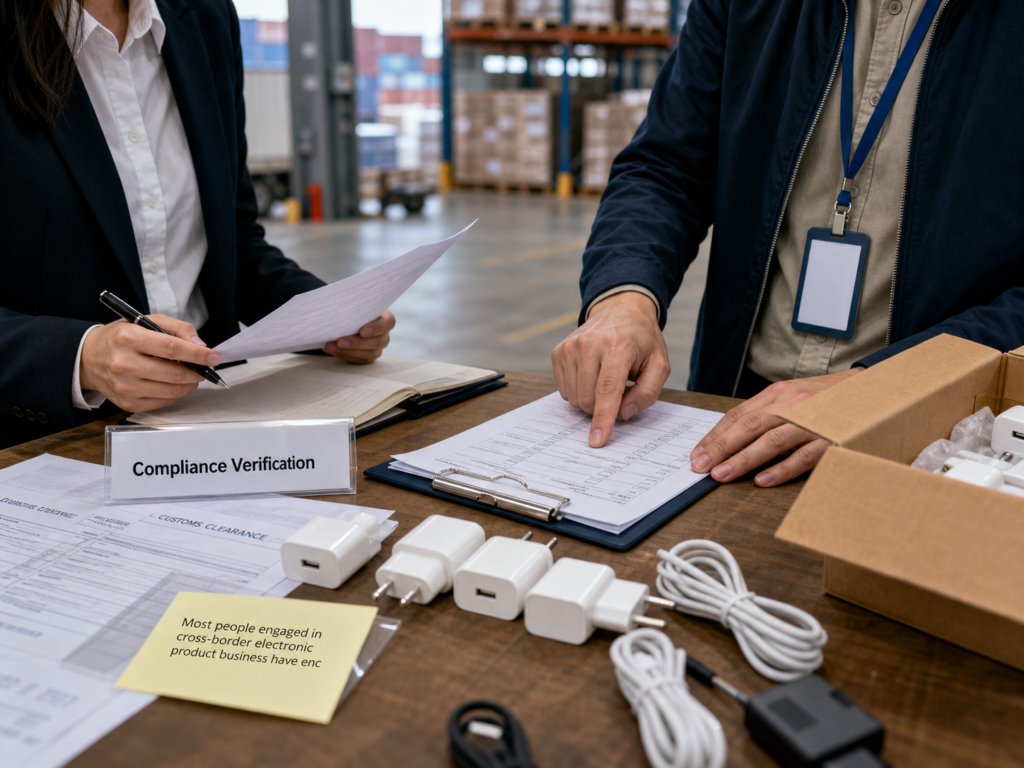
Most people engaged in cross-border electronic product business have encountered compliance pitfalls: either goods are detained, returned or even destroyed by customs after arriving at the port, or a well-selling listing is suddenly removed from the platform. In mild cases, freight and fines are lost; in severe cases, accounts are restricted and brand reputation is damaged. Many procurement novices think compliance is just asking suppliers for a certificate, but in fact, from product selection, supplier sourcing to product inspection, customs clearance and after-sales service, every step has clear statutory requirements.
This article mainly focuses on common charging products such as chargers, USB/USB-C charging cables, and charging interfaces (including fast-charging models). It sorts out everything from basic concepts that beginners must know, to whole-process check points, and then to pit-avoidance tips that only experienced procurement professionals understand. After reading this, you can conduct basic compliance checks and reduce common risks of cargo detention and listing removal, but it cannot replace professional compliance assessment for the target market.
3 Core Boundaries That Must Be Clarified Before Procurement
Figure out these 3 things before placing an order, otherwise you won’t even know what certificates to ask suppliers for.
1. Determine Regulatory Attributes Based on Product Functions
Different charging products have very different levels of regulatory strictness:
• **Chargers/Power Adapters**: directly connected to mains electricity (household sockets), are high-risk products, and usually require key verification of electrical safety, EMC, energy efficiency, labeling and responsible entity requirements of the target market;
• **USB/USB-C Charging Cables**: for cables with E-Marker or fast-charging chips, their supported current, power and protocols should be checked, and whether they fall within the mandatory regulatory scope should be confirmed according to the target market; ordinary passive cables usually have relatively fewer requirements, but may still be subject to electrical safety, EMC, RoHS, labeling or consumer product regulatory requirements;
• **Charging Interfaces/Connectors**: if sold separately, they must comply with corresponding safety specifications; if included as accessories with main products such as chargers or mobile phones, applicable requirements usually need to be determined in combination with the main product and its sales method, and it cannot be simply assumed that no separate verification is required at all;
• **Additional Attributes**: if the product has wireless charging, near field communication or other wireless transmission functions, it is necessary to determine whether radio, EMC or other conformity assessment is required based on frequency, transmission power and target market; when using trademarks such as Qi or claiming compatibility, it is also necessary to verify the authorization and certification requirements of the corresponding organization. Designs such as multi-port output and replaceable plugs may also increase corresponding compliance requirements.
No matter what type of product it is, these parameters must be recorded in advance: input and output power, fast-charging protocol, interface type, plug type, product model/brand, which will be used for later certification verification and product inspection.
2. Principles for Determining the Target Market
The final place of sale is the main basis for judgment, but it is also necessary to verify the applicable requirements of the markets where production, export, warehousing, import, transshipment and the platform are located. For example, if you produce in China and ship from a Singapore warehouse to the United States, the US regulations of the final place of sale are still important, and may also involve the export of the producing country, import of the warehousing country, transshipment and platform rules.
If selling to multiple countries at the same time, technical solutions can be reused as much as possible at the design and testing levels, but the applicable regulations, responsible entities, labeling, instructions and conformity assessment requirements of each market must be verified separately. For example, if selling to the EU and the UK at the same time, the obligations of the other market cannot be exempted solely by the same design, nor can it be directly concluded that only one set of certification is required.
Also note: in addition to the official mandatory requirements of the target country, you must also meet the additional requirements of the sales platform you use; many platforms have stricter review standards than the official ones.
3. Division of Statutory Responsible Entities in the Supply Chain
Compliance is not the responsibility of a single party; the statutory responsibilities of different roles must be clarified:
• **Manufacturer**: responsible for product design, testing, initial conformity assessment, and bears primary compliance responsibility;
• **Importer/Brand Owner**: responsible for verifying compliance in the destination country, producing compliant labels and documents, and handling recalls. If sold under OEM or own brand, the brand owner may be regarded as the manufacturer and bear corresponding responsibilities;
• **Platform Seller/Distributor**: responsible for checking product labels, instructions, and obvious safety risks, and cooperating with investigations by regulatory authorities; it is not possible to avoid liability by claiming “I just sell goods”.
Before Placing an Order: Supplier Compliance Verification Checklist
After determining the product and market, when looking for suppliers next, you cannot only look at the quotation, but also conduct these compliance verifications.
Verification of Supplier Basic Qualifications
First confirm that the supplier is a formal entity to avoid encountering scammers or middlemen who resell goods:
1. **Legal Operation**: must have a business license and import and export qualifications, confirm that it is a formal production or trade entity, and do not look for individuals who cannot even provide qualifications;
2. **Capacity Matching**: the business scope must include the production or sale of charging products; it is best to be a factory specializing in charging products, to avoid middlemen who sell everything and cannot be held responsible when problems arise;
3. **Compliance History**: no bad records such as certification fraud or product detention, which can be verified through industry circles and public cargo detention information.
3-Step Authenticity Verification Method for Core Certification Documents

This is the most critical step. Many novices do not notice fake edited certificates, and only regret it when the goods are finally detained. Follow these three steps:
1. **Step 1: Information Matching**: the product model, parameters, applicant, and manufacturer on the certificate must be consistent with the product you want to procure. For example, if the certificate is for an 18W charger and you are procuring a 65W one, this document cannot be directly used to prove that the 65W product is compliant;
2. **Step 2: Authenticity Verification**: query the certificate number through the official website of the issuing body or the official public database, and do not accept certificates that only have scanned copies and no query path;
3. **Step 3: Status and Applicability Confirmation**: verify whether the document is still accepted by the target market and the issuing or certification body, and whether there are impacts from suspension, revocation, standard transition period or product changes. Validity or invalidity cannot be judged solely by the document date or standard version, nor can all documents be understood as having a unified validity period.
Common invalid or inapplicable documents include: misappropriated certificates (one certificate covering multiple models), fake certificates, suspended or revoked documents, documents beyond the model scope, and old documents that have not been confirmed in combination with the standard transition period and product changes.
Test Report and DoC Verification
In addition to certification certificates, test reports and declarations of conformity are also indispensable:
• **Test Report**: must cover the model you are procuring, and the sample parameters must be consistent with the actual product. It should be confirmed that the laboratory has the capabilities and qualifications matching the standards and test items used; only when required by specific regulations or conformity assessment modules, the participation of a notified body or designated accreditation body is required;
• **Declaration of Conformity (DoC)**: it should list the manufacturer’s information, product model, applicable regulations or standards, and the name and position of the signatory responsible person, with no missing items.
Let me emphasize again: the test report only proves the test results of the submitted sample under specific conditions, and does not mean that the bulk goods are necessarily compliant; it must be verified during the later product inspection.
Supply Chain Traceability and Change Management
Many suppliers secretly replace cheaper materials in bulk goods, leading to non-compliant products, so the rules must be clarified in advance:
1. **Request a List of Key Materials**: for example, a list of key components such as power boards, wire diameters, connectors, and chips, to confirm that they are consistent with the materials of the certified sample;
2. **Agree on a Change Notification Mechanism**: if the supplier wants to replace key materials, chips, or production factories, they must notify you in writing in advance, and the change can only be made after you re-evaluate the compliance;
3. **Require Batch Consistency Commitment**: bulk goods must be consistent with the submitted samples; if necessary, suppliers can be required to provide test reports for each batch.
Intellectual Property and Protocol Authorization Verification
Compliance is not only about safety requirements; the consequences of intellectual property infringement may be more serious, and even direct account removal is possible:
1. **Interface and Protocol Implementation**: it should be confirmed whether the USB-C and USB PD implementations comply with relevant technical specifications; if using USB-IF logos, certification marks or conducting certification promotion, corresponding authorization must be obtained;
2. **Fast-Charging Protocol Authorization**: QC and proprietary protocols of various brands should be verified in accordance with the right holder’s permission, trademark and certification requirements. It cannot be simply assumed that all protocols must obtain the same “official authorization”, nor can relevant trademarks or promotional slogans be used without permission;
3. **Trademarks and Patents**: confirm that the product does not infringe on others’ design patents or technical patents, and do not copy others’ designs.
Logistics Customs Clearance and Post-Market Compliance Management
The shipment of goods is not the end; there are many compliance matters to pay attention to during the sales process.
Logistics and Customs Clearance Inspection

Customs clearance is the link where problems are most likely to occur; make these preparations in advance:
1. **HS Code Classification**: chargers, power adapters, and data cables belong to different customs tariff codes, so classification must be accurate. Incorrect classification will not only affect tariffs, but may also lead to cargo detention due to mismatched regulatory requirements;
2. **Import Responsible Entity**: confirm that there is a statutory importer or economic operator in the destination country. For products subject to Regulation (EU) 2019/1020, it should be confirmed that a qualified economic operator exists and is indicated within the EU, which can specifically be undertaken by the manufacturer’s authorized representative, importer or eligible fulfillment service provider;
3. **Customs Clearance Documents**: prepare commercial invoices, packing lists, certificates of origin, copies of certification certificates, and copies of DoCs in advance; do not wait until the goods arrive at customs to supplement them;
4. **Special Market Requirements**: for example, Saudi SABER, Kenya PVoC, etc., corresponding conformity assessment documents should be processed in advance according to whether the specific product is included in the regulatory catalog, the identity of the importer and procedural requirements;
5. **Battery-Containing Products**: for products containing lithium batteries, the UN 38.3 test summary, dangerous goods declaration, packaging and labeling requirements should be verified according to battery type, Wh capacity, packaging method and transportation method, and applicable exemption or simplification conditions should be confirmed.
E-commerce Platform Sales Compliance Inspection
Many people think that everything is fine once the platform review is passed, but that is not the case:
• Upload certification documents in accordance with the requirements of the platform category to ensure that the model, parameters and product page are consistent;
• **Key Reminder: Passing platform review does not equal compliance with government regulation**. The platform only reviews according to its own rules, and official statutory requirements still need to be met by yourself; do not wait until an official spot check finds non-compliance;
• Common platform compliance risk points: exaggerated publicity on the detail page, mismatch between certified model and sold model, lack of instructions in local language.
Long-Term Post-Market Compliance Management
After the product is sold, long-term compliance management must also be done well:
1. **Establish Compliance Files**: archive certification certificates, test reports, procurement contracts, sealed samples, and label photos; generally, they should be kept for several years after the product is discontinued, in case of customs or platform spot checks;
2. **Track Regulatory Updates**: regularly pay attention to updates of mandatory catalogs, test standards, and energy efficiency requirements in the target country, and adjust products in a timely manner. For example, the EU common charger rules need to be verified in a timely manner according to device categories and applicable dates;
3. **Spot Check Response**: if encountering customs or platform spot checks, provide compliance documents as soon as possible, cooperate with the investigation, and do not conceal;
4. **Handling of Problematic Products**: if the product is found to be non-compliant, immediately remove it from shelves and stop sales, negotiate with the supplier on responsibility division, rectification or claims, and take the initiative to recall if necessary to avoid more severe penalties.
Semi-Proficient Pit Avoidance: Compliance Traps and Judgment Methods
After working in procurement for a long time, you will encounter various compliance traps; learning these will help you avoid them in advance.
6 Untrustworthy Supplier Statements
When suppliers say these things, raise a question mark directly; there is a high probability that it is a trap:
1. **”We have the CE mark, so we can sell globally”** — CE cannot automatically replace the mandatory certification or market access requirements of other countries. It is necessary to verify separately whether the target market accepts CE or EU test materials, and whether local marks, registration or responsible entities are still required;
2. **”The factory has been exporting for decades, no need to look at reports”** — how many years of export has nothing to do with whether your batch of goods is compliant;
3. **”The same series has been certified, so all models are universal”** — universality cannot be judged solely by “same series”. The model scope, key parameters and structural differences listed in the certificate and attachments should be verified; if necessary, the certification body should be asked to confirm whether certificate expansion or re-evaluation is required;
4. **”If customers don’t require certification, there’s no need to do compliance”** — applicable product safety, EMC, wireless, environmental protection, energy efficiency and labeling regulations must be complied with; whether third-party certification, registration or specific marks are required should be confirmed according to the target market and specific product category;
5. **”Changing packaging or brand does not affect certification”** — before changing the brand or packaging, it should be confirmed whether the manufacturer or brand owner’s responsibilities, labeling and DoC need to be updated, and verify with the certification body whether additional models, certificate changes or re-testing are required; it cannot be generally asserted that certification must be redone;
6. **”It’s just a data cable, no compliance check is needed”** — cables may also be subject to electrical safety, EMC, environmental protection, labeling and consumer product regulatory requirements in the target market; having an E-Marker or fast-charging chip does not automatically determine a globally unified certification conclusion.
Identification Signals of High-Risk Products/Suppliers
Be extra vigilant when encountering these situations:
• The quotation is far lower than the industry average, which may indicate cutting corners on materials and workmanship or false documents, but the price itself cannot alone prove that the product is non-compliant;
• Certification documents have no query path, no model photos, no signatory information;
• The parameters on the product are obviously inconsistent with those on the certification report;
• The supplier refuses to provide the original test report, key material list or change records;
• For products with wireless, high-power, multi-port features, only certification documents for ordinary cables are provided, which is obviously a mismatch.
Compliance Cost Estimation Method (2024 Reference)
The reasonableness of compliance costs can be used to assist in judging whether the supplier’s statement is credible:
• **Certification Cost Range**: CE testing and conformity assessment may range from several thousand to ten-thousand yuan level; North American safety certifications such as UL may reach tens of thousands to hundreds of thousands of yuan level, depending on product parameters, number of models, test items and institutions;
• **Total Cost Composition**: in addition to testing fees, labeling and printing fees, packaging revision fees, recycling registration fees, etc., must also be counted, all of which should be included in the procurement cost;
• **Reasonableness Judgment**: cost can only be used as a reference for commercial reasonableness, and the authenticity of the certificate cannot be judged by a fixed proportion of the product unit price. The test items, model scope, laboratory, certificate status, maintenance fees and official query results corresponding to the quotation should be verified.
Key Conditions That Will Change Compliance Conclusions
Compliance is not a once-and-for-all matter; when these conditions change, compliance requirements will change:
• Requirements will vary with different places of sale, places of production, places of warehousing, import modes, transshipment methods and sales platforms;
• The regulatory level varies depending on whether the product is connected to mains electricity, whether it has wireless functions or a battery;
• Applicable documents vary with different rated power, number of interfaces, plug versions, and sales methods (sold separately/sold as a set);
• After regulatory updates, the end of transition periods, adjustments to mandatory catalogs, or key changes to products, previous documents may need to be re-evaluated, and the document date alone cannot be relied upon.
Quick Checklist and Capability Summary
Four-Step Quick Checklist for Entry-Level Users
If you are new to the industry and can’t remember so much, follow these four steps to reduce most common problems:
1. **Determine the Market**: clarify the final country of sale, and at the same time confirm the applicable requirements of production, warehousing, import and platform links;
2. **Determine the Category**: find the corresponding check items according to product type (charger/cable/interface);
3. **Check Documents**: request certification documents from the supplier, verify their authenticity through official channels, and confirm that the model, parameters, responsible entity and scope of application match;
4. **Check the Physical Product**: verify that the product labeling, structure, and packaging are consistent with the certification documents.
Phased Inspection Template (Can Be Directly Reused)
This template can be used in daily procurement, verified by phase:
• **Before Placing an Order**: confirm the target market, sort out applicable certification or conformity requirements, and verify supplier qualifications and certificate authenticity;
• **During Production**: verify key materials, confirm pre-production samples, and implement the change notification mechanism;
• **Before Shipment**: check labels, packaging, instructions, conduct spot checks on bulk goods consistency, and keep sealed samples;
• **After Arrival at Port**: verify customs clearance documents, upload platform compliance materials, and archive all compliance files.
Capabilities That Can Be Mastered After Learning
• **Entry Level**: able to independently complete basic compliance checks, identify obvious non-compliance problems, and reduce common risks of cargo detention and listing removal;
• **Semi-Proficient Level**: able to preliminarily judge the authenticity and applicability of certification documents, estimate compliance costs, avoid procurement traps, and establish a basic compliance management process.
Core Conclusion
Cross-border compliance of charging electronic products must be included in procurement planning in advance. Applicable product safety, EMC, wireless, environmental protection, energy efficiency and labeling regulations need to be verified item by item, but whether third-party certification, registration or specific marks are required depends on the specific product, target market, sales method and regulatory requirements. Don’t wait until the goods are detained or the listing is removed to think about making up the certification, as that will often increase the costs of rectification, return shipment and re-testing.