
Many sellers of cross-border electronic products easily run into pitfalls with market access when expanding to the South African market for the first time: they either cannot figure out which of the two certificates, ICASA and NRCS, they need to apply for, or assume that CE/FCC certification is sufficient for customs clearance, only to have their goods detained by customs and suffer heavy losses. This article takes charging electronic products (wired chargers, wireless chargers, USB/USB-C charging cables, power adapters, etc.) as examples to break down the market access rules of the South African market in detail, covering all core content from basic knowledge to pitfall avoidance tips, from beginner to intermediate proficiency.
Basic Knowledge of Market Access (Must-Know for Beginners)
Electronic product access in South Africa is not decided by a single authority; four departments each manage their own areas. Once you understand their division of responsibilities, you will not go to the wrong department.
The first is the Independent Communications Authority of South Africa (abbreviated as ICASA), which mainly regulates products with regulated radio transmission or communication functions. Its core focus is to reduce interference with local radio spectrum and communication networks, which is equivalent to granting communication access to qualified wireless products.
The second is the National Regulator for Compulsory Specifications of South Africa (abbreviated as NRCS). NRCS manages relevant electrical and electronic products in accordance with applicable Compulsory Specifications (often abbreviated as VC), mainly involving product safety; some products may also involve electromagnetic compatibility (EMC) or energy efficiency requirements, which depend on the product category, applicable compulsory specifications, relevant standards and the latest official list. It cannot be generally assumed that all charging products are subject to unified NRCS review of safety, EMC and energy efficiency.
The third is the South African Bureau of Standards (abbreviated as SABS), which is mainly responsible for formulating standards for various products and providing testing services, but does not directly issue access certificates. It is equivalent to the party that sets and grades exam papers, not the one that issues exam admission tickets.
The fourth is the customs department under the South African Revenue Service (SARS Customs), which is responsible for customs supervision and clearance. For goods subject to import licenses, compulsory specifications or other regulatory requirements, SARS may require the provision of corresponding documents, and may also conduct inspections or detentions in conjunction with relevant regulatory authorities.
The charging products we commonly deal with may involve these requirements: wired chargers, power adapters, wireless chargers, USB/USB-C charging cables/data cables, charging connectors, adapters, etc. However, whether different products are subject to compulsory specifications cannot be judged only by their names, but also by their rated voltage, intended use, internal structure, whether they are connected to the mains, and whether they have wireless functions.
Industrial-grade large power supplies, medical-specific charging equipment, and automotive high-voltage charging equipment also cannot be directly classified as “requiring no certification at all”. Such products cannot be judged as ordinary chargers; NRCS, ICASA and other applicable industry regulations and compulsory specifications should be verified separately according to their intended use, rated parameters, whether they have wireless functions, and product category.
If you ship goods to South Africa without compliance, the consequences may be more serious than many people think. On the customs side, goods may be detained, returned, or incur additional costs such as storage fees; on the market side, non-compliant products may be refused sale, required to be removed from shelves, recalled, or subject to other law enforcement measures. Specific fines, costs and liabilities shall be determined in accordance with applicable regulations, case facts and law enforcement decisions, and cannot be simply summarized as “several times the value of the goods”. In actual business, South African local importers, application entities or certificate holders usually bear important compliance responsibilities, and overseas sellers should also clarify responsibilities and document obligations in contracts.
Beginners are most likely to fall into several cognitive pitfalls, and avoiding them in advance can save a lot of money:
First, assuming that CE, FCC, and CB reports can be used directly — wrong. Marks such as CE and FCC themselves usually cannot replace South African access. Relevant test reports may be submitted as technical materials, but whether they are accepted by ICASA or NRCS, whether supplementary testing is required, and whether testing can be reduced must be confirmed by the corresponding authority or application agent based on the specific product.
Second, assuming that only one of ICASA or NRCS certification is needed — wrong. If a product falls within the applicable scope of both ICASA and NRCS, it needs to meet the corresponding requirements respectively. Which one to apply for or whether dual compliance is required depends on the actual functions of the product and applicable regulations.
Third, assuming that all charging cables do not require certification — this judgment is too simplistic. Ordinary passive cables and cables with identification chips, power management circuits or other functions may be subject to different product requirements. Whether an NRCS LOA is required cannot be judged solely by “whether there is a chip”, but should be confirmed based on specific compulsory specifications, product structure, rated parameters and intended use.
Fourth, assuming that if the wireless module has passed ICASA certification, the whole device does not need to be certified — wrong. Module approval does not necessarily cover the whole device. The installation method, antenna, housing, software, transmission parameters and usage scenarios of the whole device may affect the assessment. When replacing the module or adjusting wireless parameters, the original module materials cannot be directly applied.
Fifth, assuming that wireless chargers only need ICASA certification — wrong. Wireless chargers also require separate assessment of their wireless power transmission, inter-device communication and mains input. Products with mains input that fall within the scope of applicable compulsory specifications may also require an NRCS LOA.
3-Step Quick Judgment Method for Certification Requirements
Since the requirements of the two certificates are easy to confuse, is there a simple way to quickly determine which certificate a product needs? Remember these 3 steps, which can be used for initial screening of most charging products, but they cannot replace the final confirmation of official regulations and product classification.
Step 1: First check whether the product has radio transmission or communication functions regulated by ICASA.
Functions such as Bluetooth, Wi-Fi, and cellular communication usually require further type approval. NFC, wireless charging and wireless power transmission cannot be generalized; they must be confirmed item by item based on operating frequency band, power, intended use and applicable exemptions. “Wireless charging” itself is not a sufficient condition to automatically trigger ICASA requirements.
Step 2: Then check whether the product falls within the scope of compulsory specifications applicable to NRCS.
Whether an NRCS LOA (Letter of Authority) is required cannot be judged solely by whether the product has a fast charging chip, E-Marker or other active circuits. Wall-plug chargers and power adapters that fall within the scope of applicable compulsory specifications for electrical products usually require further LOA application; USB cables, adapters and accessories with chips should be confirmed separately based on specific compulsory specifications, product definitions and rated parameters.
Step 3: If you are unsure, check the latest official requirements of ICASA and NRCS, or find a professional certification body for pre-judgment. The final conclusion should be based on product specifications, applicable compulsory specifications, relevant standards and potentially applicable exemptions, not just on product names or promotional terms.
For greater clarity, here is a comparison table of certification requirements for common charging products for your reference:
| Certification Type | Common Products |
| Usually require further verification of NRCS LOA | Ordinary wired chargers, laptop power adapters, wall-plug USB-C adapters, and other products falling within the scope of applicable compulsory specifications for electrical products |
| May require separate assessment by ICASA and NRCS | Smart charging heads with Bluetooth/Wi-Fi communication functions, wireless charging devices with regulated radio transmission functions and simultaneous mains connection |
| Usually require separate confirmation | USB-A/USB-C cables, cables with E-Marker, charging connectors, adapters and other interface accessories |
| May not trigger the above mandatory requirements | Specific passive cables, pure metal adapters or interface converters without circuits, but product classification and the latest official list should still be verified |
*Note: The final requirements are subject to the latest official compulsory specifications, product definitions and applicable exemptions; when sold as a set, the mains chargers, active accessories and other regulated products in the set need to have their certification requirements verified separately.
Of course, there are also some gray areas that are easy to misjudge, so do not take things for granted.
For example, some people say that USB-C cables with E-Marker do not need certification — this statement is incomplete. E-Marker is an identification or configuration chip in USB-C cables, and the presence of this chip alone cannot be used to determine whether a cable definitely requires or definitely does not require an NRCS LOA. It should be confirmed based on applicable compulsory specifications, product structure, rated input/output and intended use.
Some people say that “smart chargers” definitely need ICASA certification — wrong. The key is whether it contains radio transmission or communication functions regulated by ICASA. If it only has wired fast charging and automatic power identification, but no regulated wireless functions such as Bluetooth or Wi-Fi, it usually does not automatically trigger ICASA requirements just because of the promotional name “smart”; however, NRCS applicability still needs to be judged separately.
Some people say that with a CB report, you don’t need to do NRCS certification — wrong. IEC CB reports that meet applicable standards and conditions can be used as the technical basis for NRCS LOA applications, but whether they are accepted and whether supplementary materials or testing are required are still subject to NRCS review and decision. A CB report is not a certificate that can directly replace an LOA when brought to South Africa.
Others say that Qi wireless chargers definitely need ICASA certification — this statement is also inaccurate. Wireless chargers should be assessed separately for wireless power transmission and inter-device communication functions. If they contain radio transmission functions regulated by ICASA, type approval is required or applicable exemptions must be confirmed; it cannot be judged solely by the name “Qi” whether ICASA is definitely required or definitely not required. If the product is connected to the mains, NRCS requirements must also be verified according to its product category.
Certification requirements are not static either; several situations can lead to changes in requirements: on the product side, if wireless or communication functions are added, ICASA assessment must be re-conducted; if there are major adjustments to circuits, structures, key components, rated parameters or usage methods, re-assessment of NRCS or ICASA may also be required. On the regulatory side, if official compulsory specifications, standards or exemption scopes are updated, products that were originally out of scope may need supplementary compliance. On the sales side, if entering mainstream South African e-commerce platforms such as Takealot, the platform may also require additional compliance certificates, which are more specific than general sales document requirements.
ICASA Type Approval Core Requirements (Exclusive for Charging Products)
The essence of ICASA type approval is to conduct South African communication access assessment for regulated radio equipment, with core focus on the frequency, power, transmission method of wireless signals and whether they meet applicable spectrum and technical requirements, with the aim of reducing interference with other radio services. It mainly addresses wireless communication compliance issues and is not equivalent to product safety certification; product safety still needs to be assessed in accordance with applicable NRCS compulsory specifications or other requirements.
Among charging products, which may require ICASA certification? Smart charging heads with Bluetooth, Wi-Fi or cellular communication functions usually require further type approval; wireless charging devices with communication functions also need to be confirmed in combination with the specific transmission frequency band, power and communication method. Active USB-C cables with wireless transmission functions also cannot be judged solely by product name; it should be confirmed whether they actually contain regulated radio transmission functions.
Which usually do not automatically require ICASA just because of their names? Ordinary wired chargers, cables without wireless functions, and desktop charging stations without regulated radio transmission functions usually do not trigger ICASA requirements just because of these product names themselves. However, wireless charging devices cannot be simply classified as “required” or “not required”; they should be assessed based on specific technical parameters and applicable exemptions. A quick judgment method is to check the product specification sheet to see if there are functions such as Bluetooth, Wi-Fi, cellular communication, wireless transmission, App communication, etc., and then further verify ICASA requirements.
The core requirements for application mainly include three aspects.
First is testing and technical materials. Test reports from accredited laboratories that meet ICASA requirements and relevant technical materials should be submitted. Existing test reports such as CE and FCC can be used as assessment materials, but whether they are accepted, whether supplementary testing or item reduction is required shall be confirmed by ICASA or its designated application process based on the product and report content. The CE or FCC mark itself is not a basis for automatic test reduction or exemption.
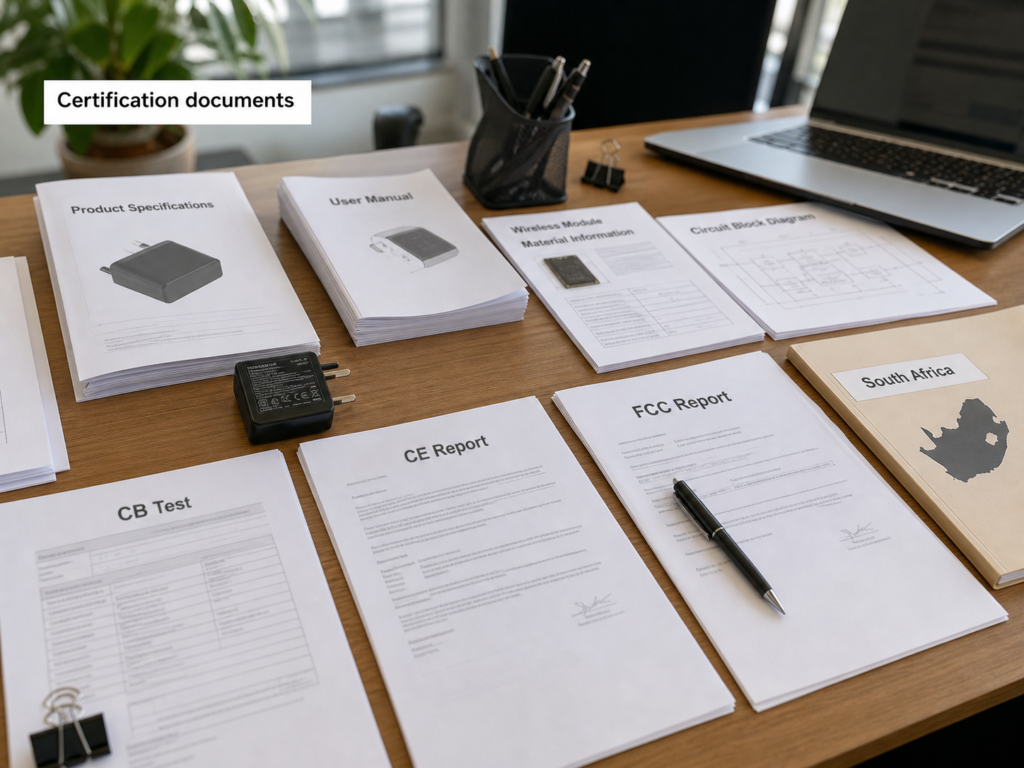
Second is application materials. Usually, it is necessary to prepare product specifications that clarify wireless parameters, operating frequency bands, transmission power and antenna information; at the same time, prepare nameplates, manuals, circuit block diagrams, wireless module materials and applicant entity materials. The actual document list is subject to the latest ICASA application requirements.
Third is the applicant entity. Applications usually require a South African local application or certificate-holding entity that meets ICASA requirements, or a qualified local representative. Specific qualifications, authorization relationships and required documents shall be subject to the latest ICASA application form, company registration qualifications and representative authorization documents, and cannot be simply summarized as all overseas enterprises must appoint a local authorized representative.
Attention should also be paid to certificates and labels. The validity period and renewal requirements of certificates shall be subject to the certificates issued by ICASA and current regulations; not all type approval certificates can simply apply a fixed term. When the product’s wireless module, frequency band, power, antenna, software wireless parameters or other key technical conditions change, it should first be confirmed whether a re-application or certificate modification is required.
After obtaining type approval, the corresponding marks and approval numbers shall be used on the equipment, packaging or instructional materials in accordance with ICASA regulations, and the specific location, size and usage method shall be confirmed according to the approval conditions. Common mistakes include inconsistent marks or numbers with the certificate, incorrect product model numbers, label positions that do not meet approval requirements, and self-printed marks based only on old templates.
Core Requirements for NRCS LOA Safety Access (Exclusive for Charging Products)
NRCS LOA is the safety access letter of authority, but it is not a universal certificate automatically applicable to all mains products. NRCS LOA is mainly applicable to products falling within the scope of corresponding compulsory specifications. Safety, EMC and energy efficiency requirements must be confirmed separately according to specific VCs, and different products may be subject to different specifications and standards.
Mains charging products that fall within the scope of NRCS applicable compulsory specifications usually need to obtain the corresponding LOA before import, manufacture or sale. Failure to obtain the applicable LOA may lead to obstacles in import, sales or regulatory law enforcement, but it cannot be generalized that every shipment of mains goods without an LOA will “absolutely fail customs clearance”.
Among charging products, wall-plug wired chargers, laptop power adapters and other mains equipment falling within the scope of applicable compulsory specifications for electrical products usually require further verification of NRCS LOA requirements. For USB cables, pure metal adapters, interface accessories and cables with identification chips, conclusions cannot be drawn solely based on “active” or “passive”; they should be confirmed based on specific VCs, product structure, rated input/output and intended use.
In terms of application, IEC CB reports that meet applicable standards and conditions can be used as the technical basis for NRCS LOA applications, but whether they are accepted and whether supplementary testing is required are subject to NRCS review and decision. Test reports should come from laboratories that meet applicable accreditation requirements and have the corresponding standard testing scope. You cannot assume that a report will definitely be accepted just because the laboratory claims to have “done NRCS projects”.
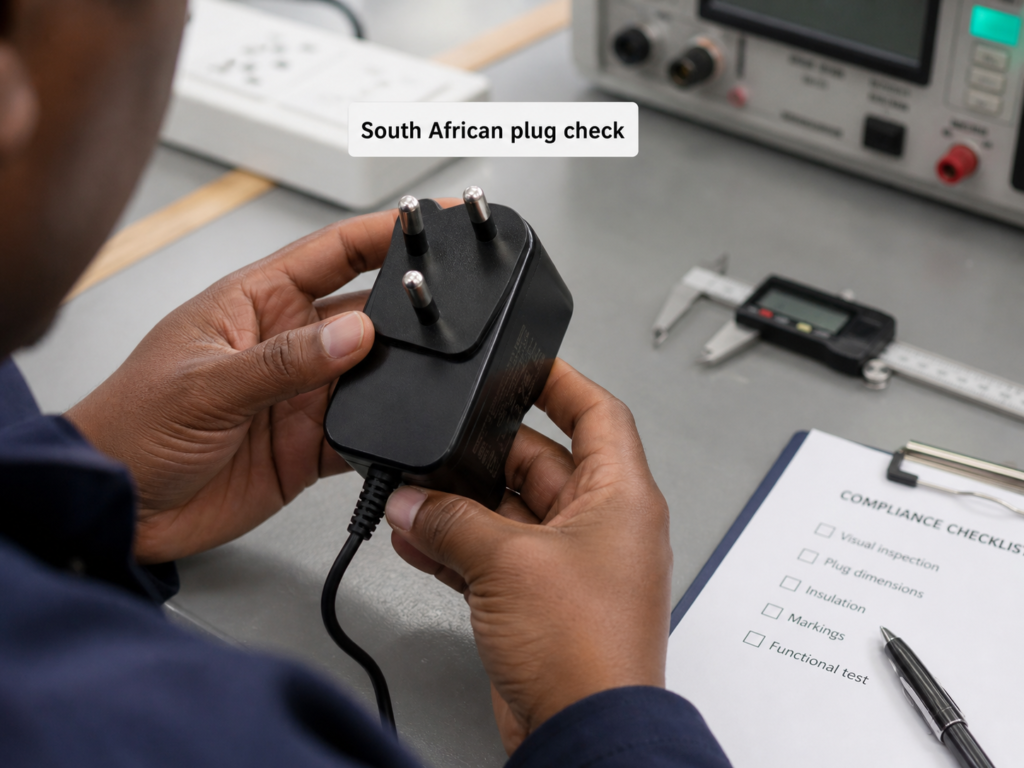
Products should also be designed and verified in accordance with South Africa’s 230 V, 50 Hz power grid and applicable SANS standards. For products with mains plugs, it should be confirmed that the plugs used meet applicable South African plug standards, such as relevant SANS 164 requirements; which specific plug to use and which standards apply should be judged in combination with the product category, whether it has a plug, and the sales configuration, and “large South African plug” alone cannot be used as a regulatory conclusion.
Regarding the applicant entity, specific certificate-holding qualifications, importer requirements and local application arrangements shall be subject to NRCS’s current application requirements and applicable compulsory specifications. In actual operation, overseas enterprises usually need to cooperate with qualified South African local entities, importers or application entities to complete the application.
The validity period, renewal and modification requirements of the LOA shall be subject to the documents issued by NRCS and applicable compulsory specifications, and it cannot be uniformly generalized that all charging products have a fixed three-year validity period. Products shall be marked with required information such as rated values, manufacturers and importers in accordance with applicable SANS standards and regulations; whether and how to mark the LOA number shall also be confirmed according to specific product requirements.
Common mistakes include plug or voltage configurations that do not meet applicable standards, incorrect marking of rated parameters, inconsistent models and certificates, and the use of labels that are easily worn or cannot be identified for a long time. These problems may cause trouble during testing, import or market spot checks.
Full Process of Dual Certification Application and Estimated Cycle & Cost
If a product involves both ICASA and NRCS, it is not necessary to wait for one process to be completely completed before starting the other. As long as product classification and document conditions allow, some preparatory work can be carried out in parallel. However, whether parallel processing is possible and which materials can be shared must be confirmed by the specific project.
Let’s first talk about the pre-preparation before application. Completing the preparation of materials, samples and local applicant entities in advance helps reduce supplementary submissions and waiting time, but the actual time saved depends on the product situation, and a fixed time ratio cannot be preset.
On the product side, verify South Africa’s 230 V, 50 Hz power grid requirements, plug configuration and applicable standards in advance, and reserve space for certification marks. It is best to conduct pre-testing first to check for obvious problems, instead of waiting for formal testing to find that it cannot pass.
On the materials side, prepare product specifications, nameplates, manuals, wireless module materials, circuit block diagrams and existing test reports, such as CB, CE, FCC, etc., in advance. Whether existing reports can be used as the basis for application or reduce supplementary testing must be confirmed by the corresponding authority based on the specific content.
On the qualification side, determine in advance the qualified South African local application, certificate-holding or representative entity. Specific entity qualifications and authorization documents should be confirmed with ICASA, NRCS or a professional agent before submission.
The core steps of parallel processing are as follows:
Step 1: First conduct a pre-assessment of product compliance, confirm which requirements need to be verified, check for obvious non-conformities, such as unclear plugs, voltages, wireless parameters or product classification, and rectify them in advance.
Step 2: Prepare test and application materials simultaneously. The safety or other applicable tests involved in NRCS and the radio frequency materials involved in ICASA can be prepared separately when conditions permit, and there is no need to mechanically wait for one process to be completely completed before starting the other.
Step 3: Submit applications separately according to the actual applicable scope of the product. For those requiring NRCS LOA, submit the corresponding application to NRCS; for those requiring ICASA type approval, submit the application according to the ICASA process.
Step 4: Follow up on supplementary submissions and reviews. If the authority requires supplementary materials, provide them as soon as possible; if there are problems with the test, it is necessary to confirm whether supplementary testing is required after rectification.
Step 5: After receiving the documents, be sure to check whether the model, brand, manufacturer, production location and other identification information on the certificate or approval document are consistent with the actual product. A single letter, suffix or version difference may also cause inconsistency between the documents and the goods.
The cycle and cost that everyone is most concerned about need to be treated with particular caution. The official materials of ICASA and NRCS should not be generalized as a fixed number of weeks applicable to all products; the actual cycle may be affected by product classification, document completeness, laboratory scheduling, report acceptance, supplementary submissions, supplementary testing and regulatory review speed.
Therefore, whether applying for NRCS LOA alone, ICASA type approval alone, or both in parallel, you should confirm with the laboratory, agent or regulatory authority based on the specific product, and reserve time for testing, supplementary submissions and review. Whether dual certifications can be processed in parallel also depends on whether the two sets of application materials and product status are ready, and a unified “saving several weeks” cannot be preset.
In terms of cost, the fee for applying for NRCS LOA alone or ICASA type approval alone usually varies with product complexity, test items, acceptability of existing reports, number of supplementary tests and scope of agency services. Existing materials such as CB, CE or FCC may reduce some duplicate work, but it does not mean that the cost will definitely be reduced.
Parallel processing may reduce some duplicate project management or logistics costs, but there may also be no obvious savings due to test items, application fees or supplementary testing requirements. The total cost of dual certification must be confirmed based on the product, test items, report acceptability and the official quotation of the agent, and a unified 10%–20% discount cannot be preset.
Obtaining the certificate is not a once-and-for-all matter; when the product is revised, it is necessary to judge whether the certification needs to be updated.
Changes that do not affect safety, EMC, radio frequency parameters and certificate identification information, such as appearance color and packaging text, sometimes do not require re-application, but change records should still be kept and it should be confirmed whether the issuing authority needs to be notified. You cannot directly assume that replacing a certain “non-critical component” definitely does not require assessment, because the component may still affect safety or radio frequency performance.
Any change that affects safety, EMC, radio frequency parameters, structure, key components, manufacturing location or certificate identification information shall be confirmed with the corresponding authority before launch whether modification, supplementary testing or re-application is required. Changes in information such as brand, model and manufacturer should also be judged in combination with specific certificate rules, and cannot be treated in a one-size-fits-all manner.
If you are unsure, submit a change description to the corresponding authority or confirm according to the application process it requires. The actual processing time limit is subject to the authority’s review, and do not take “1–2 weeks” as a universal commitment.
Key Points for Customs Clearance and Market Circulation Compliance
After the certificate is obtained, you cannot be careless about customs clearance and market circulation. Many people still encounter problems even after getting the certificate, just because they did not pay attention to these details.
General customs clearance documents such as commercial invoices, packing lists and bills of lading should be prepared in advance, and ensure that product descriptions, models and quantities correspond to the actual goods. For regulated products, applicable LOA, ICASA type approval, import licenses or other supporting documents should also be prepared according to commodity classification and regulatory requirements.
DOC, English manuals and copies of test reports are not necessarily unified mandatory documents for all goods and all customs clearance links, but enterprises should keep them properly and provide them when required by regulatory authorities, customs, platforms or partners. Importers should also prepare qualification documents related to their identity and business.
There are three main common reasons for cargo detention or obstructed customs clearance:
Certification-related, for example, the product does fall within the scope of relevant requirements but has no applicable documents; the certificate or approval document has expired; the model, brand, manufacturer or production location in the document is inconsistent with the goods.
Product-related, for example, the plug configuration or rated parameters do not meet applicable standards, or the actual functions of the product are inconsistent with the application materials.
Document-related, for example, the product model on the invoice or packing list is inconsistent with the certification document, or the commodity classification or import license materials are incomplete.
When it comes to the market circulation link, attention should also be paid to compliance. Enterprises shall keep certification and test materials in accordance with applicable regulations, LOA conditions, type approval conditions and contract requirements. If specific regulations do not stipulate a unified retention period, the retention time shall be determined in combination with the latest requirements of regulatory authorities, product liability risks and the enterprise’s internal compliance system.
Certificates or approval documents shall be used within the validity period and scope of conditions, and it shall be confirmed in time whether updates are required when products change. When encountering regulatory spot checks, relevant documents must be provided as required; if non-conformities are found, timely cooperation with removal from shelves, rectification, recall or other regulatory measures shall be carried out.
If you are doing e-commerce, you should also pay attention to platform requirements. Platforms such as Takealot may require applicable compliance certificates for specific categories or spot checks. The required documents and submission methods are subject to the platform’s current seller policies, and it is not automatically equivalent to all charging products having to submit both ICASA and NRCS certificates. Some platforms may additionally require product test reports, declarations of conformity or label photos.
Common Pitfalls and Pitfall Avoidance Guide
Finally, we have sorted out the common pitfalls in the entire application process, which have all been encountered by predecessors. Avoiding them in advance can save a lot of detours.
Common Pitfalls Before Application
First, applying blindly without scope judgment: either applying for useless certificates and wasting money, or missing required certificates leading to obstructed customs clearance or sales. The way to avoid this pit is very simple: first conduct initial screening by yourself using the 3-step method mentioned above, then find a professional certification body for confirmation based on the latest official compulsory specifications and product materials, and do not take things for granted.
Second, finding a laboratory without appropriate qualifications for testing, resulting in reports not being accepted by ICASA or NRCS, and money spent being useless. To avoid this pit, you should verify whether the laboratory has relevant national accreditation qualifications and applicable standard scopes, and confirm in advance whether ICASA or NRCS accepts its reports. Do not just ask for a general “ICASA/NRCS accreditation certificate”.
Third, ignoring South Africa’s plug and voltage requirements, only to find that the plug is wrong and the voltage does not match during testing, wasting time on repeated rectifications. To avoid this pit, verify according to South Africa’s 230 V, 50 Hz power grid and applicable SANS standards at the product design stage; for products with mains plugs, also confirm whether the plug meets applicable South African plug standards.
Common Pitfalls During Application
First, incomplete materials leading to repeated corrections, which may significantly lengthen the review cycle. To avoid this pit, prepare all materials in advance according to requirements, and it is best to ask an agent to conduct a pre-review first, and submit only after there are no problems.
Second, sample testing fails, requiring rectification and retesting, which both increases costs and delays time. To avoid this pit, conduct pre-testing before formal testing to check for common safety, EMC or radio frequency problems as much as possible.
Third, there is no qualified local application, certificate-holding or representative entity, leading to obstructed application arrangements. To avoid this pit, contact South African local cooperative entities in advance, and confirm whether their qualifications, authorization relationships and documents meet current application requirements.
Common Pitfalls After Obtaining the Certificate
First, labels or product marks do not meet requirements, leading to problems in customs clearance or market inspection. To avoid this pit, after obtaining the approval document, design the marks in accordance with applicable regulations, standards and approval conditions. After the design is completed, have it reviewed by the agent or application authority first, and then print it after there are no problems.
Second, product revisions are not re-assessed, resulting in the actual product exceeding the coverage of the original document. To avoid this pit, consult the corresponding certification body before the revision to determine whether modification, supplementary testing or re-application is required, and do not regret it until problems arise.
Third, continuing to use the certificate or approval document after it expires. To avoid this pit, establish a validity period ledger, start the renewal or re-application process in advance, and confirm whether continued import and sales are allowed during the renewal period.
Common Cognitive Pitfalls
First, using the same certificate for models with different suffixes. For example, for chargers with the same appearance, one is 20W and the other is 65W, and the model only differs by a suffix, so people think the same certificate can be used, which may result in inconsistency between the certificate and the goods. To avoid this pit, models with the same appearance but different hardware, functions, rated parameters or versions should either be applied for separately, or confirmed in advance with the issuing authority whether they can be included in the same series or share documents. Do not decide by yourself.
Second, only the main unit is certified for set sales. For example, when selling a set of wireless charger plus active charging cable, only the wireless charger documents are prepared, and as a result, the requirements for the cable or other accessories are not verified, and the whole batch of goods may be affected. To avoid this pit, the mains products, active accessories and other potentially regulated components in the set must have their certification requirements verified separately, and do not miss any.
Final Summary
After reading this article, you should already be able to make preliminary judgments on most issues related to access of charging products in South Africa. In summary, you can first complete three things now:
First, use the 3-step judgment method and product comparison table for initial screening to confirm whether the product may involve ICASA type approval, NRCS LOA or other requirements. But this is only initial screening; the final conclusion must be confirmed in combination with the latest official regulations, compulsory specifications, product specifications and applicable exemptions.
Second, understand which factors affect the certification cycle and cost, confirm with the laboratory, agent or regulatory authority based on specific projects, and reasonably plan the launch time and budget.
Third, identify common risks related to materials, products, labels, models and revisions, prepare in advance and avoid problems in customs clearance or sales links.
You can also complete two things independently: first, prepare general customs clearance documents such as commercial invoices, packing lists and bills of lading, and sort out applicable LOA, type approval or other supporting documents according to the actual regulatory scope of the product; second, conduct a preliminary assessment of product revisions based on the degree to which the changes affect safety, EMC, radio frequency, structure, key components, manufacturing location and certificate identification information, and then find the corresponding authority for confirmation if you are unsure.
Market access in South Africa seems complicated, but in fact the core is to clarify product attributes and corresponding applicable requirements, and keep the actual goods, application materials and customs clearance documents consistent. As long as these basic tasks are done well, subsequent customs clearance, listing and market maintenance will be more stable.