
If you deal with charging-related accessories such as charging cables, USB/USB-C data cables, chargers, power adapters, interface connectors, wireless charging devices, and power banks, and want to enter the Indonesian market, you cannot avoid access requirements such as SDPPI and SNI. As the largest consumer electronics market in Southeast Asia, Indonesia has always had stable demand for charging accessories. Offline stores, Shopee, Tokopedia, and Lazada are all mainstream sales channels, but compliance is the foundation of long-term operation. Non-compliant products may not only fail to be imported normally, but also may be restricted from being listed or sold on e-commerce platforms.
It should be noted first that this article is an introductory reference guide. All access requirements are subject to the current effective regulations of the Indonesian competent authorities. Before formal application, be sure to verify the latest rules through official channels or authorized service providers.
Must-Know for Beginners: Three Types of Core Compliance and Basic Common Sense
Many merchants who are new to the Indonesian market are most confused by various certification abbreviations. In fact, you can first understand the core compliance requirements by dividing them into three categories, but their scopes of application are not exactly the same:
The first category is **communication equipment certification**. This type of certification is still often referred to as “SDPPI certification” in the market. It used to be generally associated with the Indonesian Directorate General of Posts and Telecommunications Resources and Equipment, and mainly targets devices with wireless or communication functions, with the core of ensuring that wireless devices comply with local spectrum and equipment technical requirements. Since Indonesian competent authorities and official systems may be adjusted, formal applications shall be subject to the institution names, catalogs and procedures currently announced by Indonesia’s current competent department of communications and digital affairs (Komdigi) and its official certification system.
The second category is **mandatory SNI (SNI Wajib)**, which is the mandatory safety certification in Indonesia’s national standard system, similar to China’s CCC certification, and mainly covers product electrical safety and related quality requirements. Whether it needs to be applied for depends on whether the product falls within the current mandatory catalog and the scope of specific technical regulations, and cannot be generalized for all electronic products.
The third category is **K3L-related compliance**. K3L is a compliance requirement for safety, health, safety and environmental protection for specific commodities in Indonesia’s trade field. The competent authority, scope of application and handling form shall be subject to current trade regulations and specific commodity catalogs, and not all charging electrical products are automatically applicable. K3L also cannot replace applicable SNI, communication equipment certification or other special requirements.
Local Basic Electrical Parameters
Before talking about certification, we must first confirm that the product is compatible with Indonesia’s local electrical environment. The nominal voltage of Indonesia’s power grid is usually 230V, 50Hz. Products should confirm that their rated input range can cover the local actual power supply and comply with applicable standards.
Plugs and sockets shall comply with the applicable structural, grounding and safety requirements in Indonesia. US-standard or Chinese-standard flat plugs cannot be sold directly as local versions without taking compliant adaptation measures. Whether a certain type of plug can actually be used shall also be judged in combination with the product category, whether it is equipped with compliant conversion components, and applicable safety standards.
Common Sense Pitfalls That Beginners Most Easily Fall Into
New merchants are prone to make mistakes in basic cognition. Here we clarify in advance:
First, international certifications such as CE, FCC, and CB can only be used as technical references and cannot directly replace Indonesian local certifications. Do not think that with these certificates, you can directly clear customs and list products.
Second, SNI is divided into mandatory and voluntary categories. Not all electronic products require mandatory SNI. Many ordinary accessories may only need to meet other applicable safety or labeling requirements, depending on the product category and parameters.
Third, certification requirements are determined based on the actual functions and parameters of the product, not just the sales name. For example, for products also called “USB-C cables”, products with different structures, uses and technical parameters may have different applicable requirements.
Finally, HS codes can only be used for preliminary screening and cannot be used as the basis for final certification exemption. Even if the HS code does not seem to be in the mandatory catalog, as long as the actual function of the product meets the regulatory requirements, further verification is still required.
General Risks of Non-Compliance
If you enter the market with a fluke mind without compliance, you will face risks at three levels: In the import link, the customs may detain the goods or even return them, which will not only lose freight but also delay the sales cycle; In the sales link, e-commerce platforms may verify qualifications, and products that do not meet the requirements may be removed from the shelves, and in serious cases, store permissions may be restricted; If found in the supervision link, you may face administrative penalties, certificate disposal, and even the brand being included in the supervision list, making it difficult to enter the market later.
Quick Judgment: What Certificates Does Your Product Need?
After clarifying the basic concepts, what you are most concerned about must be: what certifications does this product in my hand actually need? In fact, the judgment logic is very clear. As long as you follow the steps, you can do a preliminary assessment by yourself.
Step 1: First Organize the Product Information Card
Before judgment, you must first sort out the core parameters of the product clearly, otherwise you cannot make an accurate judgment. You can organize it against the table below:
| Information Category | Specific Content |
| Electrical Parameters | Input/output voltage, current, power, plug type |
| Functional Configuration | Whether it contains a battery, whether there is an active wireless transmission module, module frequency/power/standard |
| Sales Attributes | Whether it is sold independently, manufacturer information, HS code, Indonesian product name |
Overall Judgment Logic Sequence
After organizing the information card, judging in this order will not be confusing:
1. Split all functions of the product. For example, a wireless charger with Bluetooth cannot be regarded as an ordinary charger only. The power supply part, wireless charging part, and Bluetooth function must be evaluated separately;
2. Judge whether to apply for communication equipment certification based on whether there is an active wireless transmission function;
3. Judge whether to apply for mandatory SNI based on product category, parameters, and sales form;
4. Verify potentially applicable trade compliance requirements such as K3L;
5. For special scenarios such as sets, modified models, and samples, conduct separate evaluations.
Quick Judgment Rules for Three Types of Compliance
Applicability of Communication Equipment Certification
Its core trigger condition is: the product has the function of actively transmitting radio waves, such as Bluetooth, WiFi, cellular network, NFC, etc. Points to be verified include the frequency band used, transmission power, antenna design, and whether the device category is in the regulatory catalog.
This type of certification is still often referred to as “SDPPI certification” in the market, but formal applications shall be subject to the names, catalogs and procedures currently announced by Indonesia’s current competent department of communications and digital affairs and its official certification system.
**Boundary Reminder**: Products with only wired fast charging and wired data transmission usually do not trigger communication equipment certification due to wired functions; For pure magnetic induction wireless charging, that is, Qi wireless chargers that only have energy transmission and no communication function, whether certification is required should be checked against the current regulatory catalog, and cannot be simply generalized.
Applicability of Mandatory SNI
Chargers, power adapters, plugs, power cords, specific cables and power banks shall be verified in accordance with the current mandatory SNI catalog of the Indonesian Ministry of Industry and product technical regulations respectively. Only models included in the mandatory scope by specific regulations are subject to mandatory SNI obligations; products not included cannot be presumed to be required to obtain SNI based on this.
During verification, it is necessary to check the product definition, rated parameters, use, structure, HS code, whether it is sold independently, and whether it is in the current mandatory catalog. Charging cables shall be judged based on the product definition, rated voltage or current, use, structure, independent sales form and applicable catalog in the current mandatory SNI regulations. Active conversion chips can only be used as factors for technical classification and test evaluation, and cannot be used as separate exemption or trigger conditions.
Applicability of K3L
For electrical and charging products entering Indonesia, it is necessary to verify whether they are currently under K3L management, and whether corresponding registration, certification or labeling requirements are required. Products not included in the applicable scope cannot be presumed to be required to handle K3L solely based on the attribute of “electrical charging products”.
Preliminary Compliance Judgment of Common Charging Products
For your convenience, we have compiled preliminary judgment conclusions for 6 types of common charging accessories:
| Product Type | Communication Equipment Certification Requirement | Mandatory SNI Requirement | Core Verification Points |
| 65W GaN USB-C Wired Charger | Not required | To be verified | Whether rated parameters are in the mandatory catalog, whether sold independently, HS code requirements |
| Pure Wired USB-C Charging Cable (no chip, no data) | Not required | To be verified | Whether it is in the current cable mandatory catalog, rated voltage level, whether sold independently |
| Wired USB-C Cable with Data Transmission | Not required | To be verified | Product definition, rated parameters, structure, current mandatory catalog requirements |
| Pure Magnetic Induction Qi Wireless Charging Base (no communication module) | To be verified | To be verified | Whether it is within the regulatory scope of communication equipment, power supply parameters, current catalog requirements |
| Smart Wireless Charger with Bluetooth | Required | To be verified | Wireless module frequency/power, power supply parameters, whether it is in the mandatory SNI catalog |
| 20000mAh Power Bank with Battery | To be verified (if with wireless charging/Bluetooth) | To be verified | Battery safety requirements, rated parameters, whether sold independently, current catalog requirements |
Note: The above are preliminary judgment conclusions, and the final result shall be subject to the current official catalog of Indonesia and the review of the certification body. Power banks shall also be separately verified for requirements such as battery safety, dangerous goods transportation and import management.
Judgment Rules for Special Scenarios
If you encounter the following situations, you cannot directly apply the judgment logic of ordinary products, and need to evaluate separately:
• **Set Products**: Each component must be judged separately. The requirements for accessories sold with the set and those sold separately may be different. For example, the requirements for charging cables included with mobile phones may be looser than those sold separately.
• **Product Modification/Parameter Change**: As long as the wireless module, power supply parameters, interface, or key components are changed, the compliance requirements must be re-evaluated. Do not think that it is okay because you have obtained the certificate before.
• **Small Batch Samples**: If they are non-sales samples for testing or exhibition, you can apply for customs exemption in accordance with regulations, without completing all certifications in advance.
• **Multi-model Series**: Only those with exactly the same wireless module, power supply parameters, and key components can be preliminarily evaluated for whether certification can be shared. The final possibility of sharing shall be subject to the review of the certification body, and you cannot share it just because you think they are similar.
SDPPI Certification: Detailed Explanation of Wireless Function Access
After the preliminary judgment that communication equipment certification is required, you can first understand its core rules to avoid detours. This type of certification is still often referred to as “SDPPI certification” in the market, but formal applications shall be subject to the institution names, procedures and catalogs currently announced by Indonesia’s current competent department of communications and digital affairs and its official certification system.
The core evaluation objective of this type of communication equipment certification is to ensure that the wireless transmission of products complies with Indonesia’s spectrum management and equipment technical requirements, and will not interfere with the local communication order. For charging products, the key inspections are the compliance of working frequency band, transmission power, communication standard, and antenna parameters. There is no unified standard for the validity period of the certificate, which shall be subject to the time stated on the certificate and current regulations, and varies by product category.
Common Boundary Misconceptions
Many merchants have three typical misconceptions about communication equipment certification, which must be avoided:
1. **Misconception 1: No need for certification if wireless power is low** — As long as the product has an active wireless transmission function, it is necessary to first evaluate whether it is within the regulatory scope. Low power does not automatically grant exemption.
2. **Misconception 2: If the wireless module is certified, the whole machine does not need certification** — Module certification does not mean that the whole machine can be exempted, and the whole machine still needs to be evaluated separately.
3. **Misconception 3: All wireless charging requires certification** — For wireless charging devices with pure energy transmission and no communication function, it is necessary to check the current catalog to confirm, not all require certification.
Basic Application Requirements
• **Applicant Entity**: Usually, a local legal entity in Indonesia is required to hold the certificate, and overseas manufacturers can designate a local representative as the certificate holder.
• **Sample Requirements**: There is no unified standard for the quantity, which is determined according to product complexity and laboratory requirements.
• **Core Documents**: Technical specifications, wireless module parameters, product photos/labels/manuals, circuit block diagrams, manufacturer authorization letter.
Application Paths and Applicable Conditions
There are two main paths for applying for this type of communication equipment certification, with different applicable conditions:
The first is the **local testing path**, where samples are sent to relevant laboratories recognized by Indonesia for testing, and after passing the test, they are submitted to the official system of the competent authority for approval. This is a common path.
The second is the **overseas report conversion path**, but there are many restrictions: First, the report must be issued by an international laboratory recognized by Indonesia, the standards must meet Indonesian requirements, the product parameters are completely consistent with the report, and the report is within the validity period. Even if these prerequisites are met, the certificate conversion still needs to go through official review, and approval is not guaranteed. If it does not meet the requirements, re-testing is still required.
SNI Certification: Detailed Explanation of Electrical Safety Access
Next, let’s talk about the more familiar SNI certification, first clarify its system architecture:
SNI is divided into two categories. One is mandatory SNI, which is an access threshold: products without the certificate cannot be imported or sold. The other is voluntary SNI, which is not a mandatory requirement, mainly used to enhance consumer trust, and has no access effect.
The division of labor in the entire system is: the Indonesian National Standards Agency (BSN) is responsible for formulating standards, the competent authority issues the mandatory product catalog, the officially recognized certification body (LSPro for short) is responsible for implementing certification, and the importer bears the primary responsibility for compliance. To judge whether a product requires mandatory SNI, the most direct method is to check the mandatory product catalog currently announced by BSN and relevant competent authorities, and then confirm it in combination with the product’s parameters and use.
For charging products, the core evaluation objective of mandatory SNI is to ensure that the electrical safety and quality of products comply with Indonesian national standards. The key inspections are electric shock protection, insulation performance, temperature rise, and the authenticity of nameplate information. There is no unified standard for the validity period of the certificate and subsequent supervision and audit, which shall be subject to applicable regulations, LSPro requirements and the time stated on the certificate, and varies by product category.
Common Boundary Misconceptions
Regarding mandatory SNI, there are also three common misconceptions to avoid:
1. **Misconception 1: Having the SNI mark printed means compliance** — There must be a corresponding valid certificate, and the product must be within the coverage of the certificate to be considered compliant. Printing the mark randomly is useless.
2. **Misconception 2: If the whole machine has SNI, accessories sold separately can also use it** — Accessories sold independently require separate SNI certification. For example, if a mobile phone has SNI, and you sell the charger for this mobile phone separately, the charger must have its own mandatory SNI.
3. **Misconception 3: Voluntary SNI can replace mandatory SNI** — Only mandatory SNI has access effect. Voluntary SNI is just a bonus item and cannot be used as an access voucher.
Basic Application Requirements
• **Applicant Entity**: Usually, a local Indonesian entity is required to hold the certificate, and overseas manufacturers shall cooperate to provide relevant factory information.
• **Factory Audit**: For SNI certification schemes that require factory audit or quality management system evaluation, LSPro will conduct initial factory audit in accordance with applicable regulations and certification schemes, and carry out supervision as required; whether to audit, the content and frequency of the audit shall be subject to corresponding regulations and LSPro procedures.
• **Sample Requirements**: There is no unified standard for the quantity, which is determined according to product type and laboratory requirements.
• **Core Documents**: Product specifications, simplified BOM, factory information and quality certificates, product photos/Indonesian manuals, qualification documents of the local certificate holder.
Other Necessary Compliance Requirements
In addition to communication equipment certification and mandatory SNI, there are several potentially applicable compliance requirements that cannot be ignored.
Basic K3L Compliance Requirements
K3L is a compliance requirement for safety, health, safety and environmental protection for specific commodities in Indonesia’s trade field. It is not uniformly regulated by the Indonesian Ministry of Manpower as a general electrical product safety certification. Its scope of application is different from that of communication equipment certification and SNI, and they cannot replace each other.
For products such as chargers, data cables, and power banks, it is necessary to first verify whether they are currently under K3L management, and whether registration, certification or labeling procedures are required. The specific competent authority, product scope, application form and required documents shall be subject to the current regulations, official systems and product catalogs of the Indonesian trade competent authority.
Import Entity Qualification Requirements
Importers must hold a valid Business Identification Number (NIB for short, equivalent to the legal business ID card of Indonesian enterprises) and the import qualification for corresponding products; the importer is the primary responsible person for product compliance; overseas manufacturers cannot directly act as importers, and must entrust a qualified local Indonesian importer to clear customs.
Product Identification and Labeling Requirements
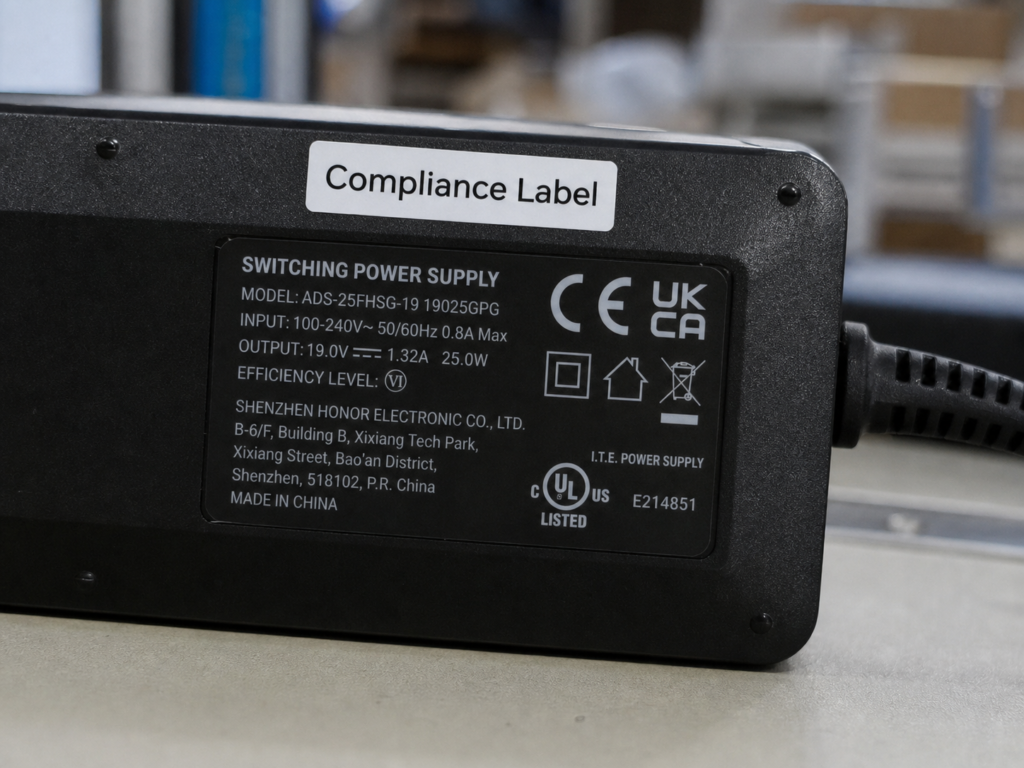
This is easily overlooked, but it is the focus of spot checks.
Information such as rated parameters, manufacturer and responsible entity shall be marked in accordance with specific product regulations, SNI schemes and Indonesian commodity labeling rules. For products subject to Indonesian language labeling requirements, English labels alone cannot replace the required Indonesian language information.
In terms of certification marks, both communication equipment certification and mandatory SNI marks shall be used in accordance with their respective current rules, and the relevant numbers, styles and positions shall meet applicable requirements. The plug part shall also be marked with rated parameters and the applicable safety standards.
The most important point is that all information on the label must be completely consistent with the certification certificate and import declaration documents, and there must be no discrepancies. A compliant product nameplate needs to clearly mark rated parameters, manufacturer information and applicable certification information, which is also the focus of customs and market spot checks.
E-commerce Platform Filing Requirements
Platforms such as Shopee, Tokopedia, and Lazada may require submission of certification, import or safety documents for specific products or sellers, and the specific requirements shall be subject to the listing category and the current rules of the platform. Product titles and detail page parameters shall also be consistent with certification certificates and product labels.
It should be noted that the fact that the platform does not require uploading documents does not mean that the product can be exempted from Indonesia’s statutory compliance obligations. Common spot check scenarios include new product listing, pre-promotion verification, and consumer complaints. Do not think that everything is fine after listing.
Practical Application: From Pre-review to Certificate Obtainment
After understanding all the requirements, how to apply specifically? In fact, as long as you do a good job in preliminary preparation and follow the process, it will not be too messy.
Preliminary Common Preparation Work
Doing this step well can save a lot of rework time:
First, the final configuration of the product must be frozen, including model, parameters, wireless module, set composition, and key components, which cannot be changed casually, otherwise the test will be in vain.
Second, the local Indonesian certificate holder/import entity must be confirmed, and their qualifications must be verified to meet the requirements. Don’t find out that the entity is not qualified after submitting all the documents.
Third, organize the product information card and a full set of technical documents to ensure that the samples submitted for testing are completely consistent with the mass-produced version, and “special samples” cannot be used for testing.
Fourth, you can first do a pre-review, entrust an authorized service provider to do preliminary classification and evaluation, find problems in advance, and reduce the probability of subsequent rework.
Application Process and Parallel Skills
The overall logic of handling several types of compliance is the same: product classification pre-review → sample testing/document review → official or certification body approval → certificate obtainment → import filing → market sales. For each category, the process is slightly different:
• Communication equipment certification process: submit application → sample testing (or certificate conversion review) → official system approval of competent authority → certificate obtainment
• SNI process: match standards → sample testing → factory audit (if applicable) → LSPro approval → certificate obtainment
• K3L compliance: first confirm whether the product is within the K3L management scope based on current trade regulations; if yes, handle corresponding registration, certification or labeling procedures in accordance with the regulations of the Indonesian trade competent authority, and prepare required test reports, product documents and import entity documents, which cannot be uniformly simplified as submitting with customs clearance documents
Here is a time-saving tip: document preparation and sample testing can be carried out simultaneously, without waiting for one certification to be fully completed before starting another, which can shorten the overall cycle a lot.
Core Influencing Factors of Cycle and Cost
Many merchants will ask about the processing cycle and cost. In fact, there is no fixed unified value, which is mainly affected by these factors:
• Factors affecting cycle: product complexity, laboratory scheduling, document completeness, whether re-testing/rectification is required, official approval speed
• Factors affecting cost: product type, number of certifications, test items, whether factory audit is required, local service content, number of re-tests
If someone tells you “fixed number of days to guarantee certificate obtainment” or “all-inclusive one-price”, you should be more careful.
Common Reasons for Certification Failure and Rectification
There are three main common reasons for certification rectification:
The first category is document problems, such as inconsistent product parameters, incomplete documents, and translation that does not meet requirements.
The second category is testing problems, such as substandard electrical safety and wireless parameters exceeding the compliance scope.
The third category is factory audit problems, such as inconsistency between mass-produced products and samples, and missing quality control records.
After the rectification is completed, you can resubmit for review. The specific requirements shall be subject to the notice of the certification body.
Selection Criteria for Certification Service Providers
When looking for a certification service provider, you should choose according to these criteria to avoid pitfalls:
1. Must have service qualifications recognized by Indonesian official authorities, and can provide corresponding authorization certificates. Do not look for unqualified small agents.
2. Must have certification experience in charging products, and can quickly and accurately classify products, otherwise you can’t even figure out whether certification is required.
3. The quotation must clearly include the costs of all links, with no hidden consumption. Don’t quote a low price at the beginning and then add various fees later.
4. Do not credulously believe false promises such as “guaranteed pass” or “extremely fast certificate obtainment”. Formal certifications all follow procedures, and there is no such thing as 100% guaranteed pass.
Post-certification Maintenance: Avoid Wasting All Previous Efforts
Many people think that everything is fine after getting the certification. In fact, maintenance after obtaining the certificate is the key to long-term operation.
Consistency Check in Import Link
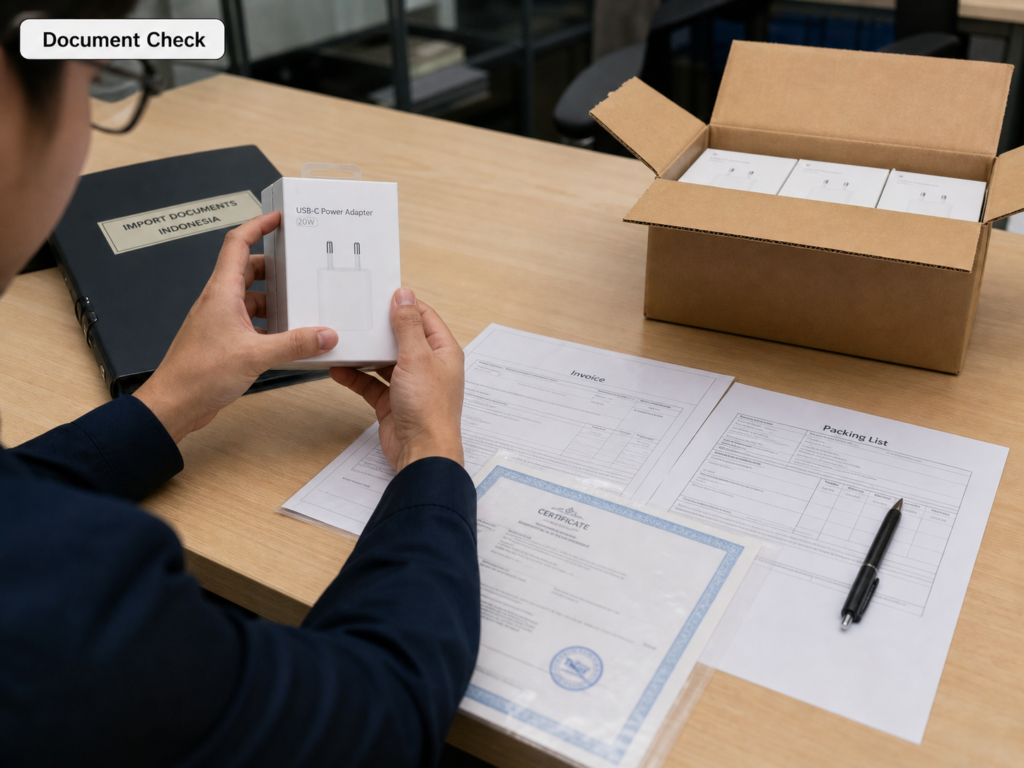
Check these points for each shipment:
The product name, model, brand, and manufacturer declared for import must be completely consistent with the information on the certification certificate;
The information on invoices, packing lists, certification documents, and product packaging must also be consistent;
You cannot use “similar models” not covered by the certification to replace the certified models, even if they look exactly the same;
Accessories in the batch cannot exceed the coverage of the certification. For example, if you certify a single charger, you cannot include charging cables that have not completed applicable compliance verification for sale together.
Certificate Maintenance and Change Rules
You must apply for renewal before the certificate expires. The specific advance time depends on the requirements of the certificate and the certification body. Don’t wait until it expires to remember to renew.
If you encounter the following situations, you must re-evaluate or make certificate changes: replacement of wireless module, power supply parameters, key components, factory, brand, local certificate holder. Any change that affects compliance must be verified in advance whether the certification needs to be updated, and you cannot secretly change it and then ship the goods.
Response to Official Spot Checks
Common spot check scenarios include customs inspection, market supervision spot checks, consumer reports, and platform spot checks. If the spot check fails, the consequences may be product detention, return, removal from shelves, rectification, administrative penalties, and certificate revocation.
The core points for responding to spot checks are: keep the original of the valid certificate, ensure that the mass-produced products are completely consistent with the certified samples, keep records of production quality control and factory inspection, and be able to produce evidence to prove compliance when encountering spot checks.
Pitfall Avoidance Self-check: High-frequency Pitfalls for Beginners
Finally, we have compiled high-risk compliance cases that beginners are most likely to encounter. You can check against them to avoid making the same mistakes:
1. Smart chargers with Bluetooth are declared as ordinary wired chargers to evade communication equipment certification, resulting in customs detention of goods;
2. Using FCC/CE wireless reports to directly replace Indonesian communication equipment certification, resulting in customs clearance failure;
3. Mistakenly believing that all USB-C cables do not require mandatory SNI, and being removed from the platform due to lack of certification;
4. Only paying attention to the samples submitted for testing, ignoring the consistency between mass production and samples, resulting in failure in market spot checks;
5. Different models of the same series share the SNI certificate, and are punished for exceeding the coverage scope;
6. Finding an unqualified agent to get a fake certificate, which is found during customs clearance verification.
Self-check List Before First Shipment
Before the first shipment, you can check one by one against the list below to ensure everything is safe:
□ Organize a complete product information card, and lock in functions, models, factories and set composition;
□ Complete the applicability verification of communication equipment certification, mandatory SNI and K3L, and meet current regulatory requirements;
□ Confirm that the qualifications of Indonesian importers, authorized representatives and certificate holders are valid;
□ Verify that samples, labels, packaging, and manuals are completely consistent with certificate information;
□ Confirm that the certificate covers all actually sold models and key accessories;
□ Prepare all compliance documents required by customs and e-commerce platforms;
□ Establish a re-evaluation process after product changes;
□ Verify the validity of the certificate through official channels.
Overall, the Indonesian charging accessories market has great opportunities, but compliance is an important threshold for entry. After reading this guide, you should be able to quickly sort out the core information card of charging products, preliminarily judge the applicability of requirements such as communication equipment certification, mandatory SNI and K3L, clarify the basic logic, application paths and core boundaries, also prepare basic application documents, identify reliable service providers, avoid common access pitfalls for beginners, and do a good job in post-certification maintenance and special scenario evaluation. Compliance is not a one-time job, but the foundation for long-term operation in the Indonesian market. Only by figuring out the rules in advance can unnecessary losses be avoided.