
Friends who do cross-border e-commerce selling chargers and charging cables to Vietnam have most likely heard terms like “MIC” and “CR Mark” — some say wireless chargers must have MIC, some say charging cables don’t need anything, and others have had their goods detained and fined at the port just for missing a mark. In fact, Vietnam’s access rules are not that mysterious, but there is no one-size-fits-all answer. The core is to first figure out who is in charge of what, whether your product falls under their jurisdiction, and what procedures to follow.
1. Basic Access Knowledge (Must-read for Beginners)
First, clarify the most core concepts to avoid getting more confused as you read on.
Overview of Core Obligations
Vietnam’s electronic product compliance is not managed by a single department from start to finish. Different requirements correspond to different competent authorities and marks:
• **MIC**: Short for the Ministry of Information and Communications of Vietnam, mainly responsible for signal/communication compliance of telecommunications, radio transmission, and some ICT (Information and Communications Technology) products. Simply put, “products with wireless communication functions will most likely need to assess MIC requirements.”
• **CR Mark**: Also known as the CR conformity mark, it is not an independent “certification”, but a conformity mark that can be affixed to the product only after the product has completed Vietnam’s mandatory conformity assessment and meets the corresponding technical requirements.
• **QCVN**: Vietnam’s national technical regulations, which are legally mandatory technical requirement documents. Safety, EMC, radio and other requirements for specific products may be stipulated by the corresponding QCVN, but labeling, energy efficiency, customs and other regulatory obligations must be based on corresponding laws and regulations respectively.
• Another point to pay special attention to: commodity labels, energy efficiency labels and so on are independent regulatory requirements, which do not conflict with MIC and CR Mark. It is not that if you complete one, you don’t need to take care of the others; all applicable requirements must be met.
• The most core principle: all determinations are subject to the **official control lists and regulatory texts in effect on the date of import**. There is no universal one-size-fits-all rule like “all charging cables don’t need anything” or “all chargers require CR Mark”.
Scope of Applicable Products
The determination logic and cases mentioned in this article are mainly for consumer charging products that everyone often deals with: USB/USB-C charging cables, data cables, wall chargers, car chargers, power adapters, wireless chargers; Bluetooth/Wi-Fi accessories with charging function can refer to the determination logic, but must be evaluated in combination with their own functions.
Charging equipment for special industries such as medical, automotive, and hazardous chemicals has special regulatory rules and is not within the scope of this article.
Core Impacts of Non-Compliance
Many people think “Vietnam’s inspections are lax, so you can take a chance”. In fact, the cost of non-compliance exists throughout the entire chain from customs clearance to sales:
• **Customs clearance stage**: In mild cases, goods will be detained, supplementary materials will be required, and a fine proportional to the value of the goods will be imposed; in severe cases, goods will be directly confiscated or returned, and you won’t even get the goods back.
• **Sales stage**: Online e-commerce platforms will directly remove non-compliant products, offline stores will be punished, and brands may also face stricter risk management. Non-compliance may lead to administrative penalties, rectification, return of goods, confiscation or cessation of circulation; whether subsequent goods will be subject to increased inspections depends on the risk management of customs and market supervision departments and the specific circumstances of the case.
• **Long-term impact**: Once there is a non-compliance record, the probability of subsequent market spot checks may increase. If you want to operate in the Vietnamese market for a long time, the compliance cost will be higher instead.
Regulatory Version and Verification Statement
This guide is compiled based on the current regulations at the time of publication, but Vietnam’s competent authorities, control lists, and QCVN versions are dynamically updated. Before actual operation, be sure to verify the latest official effective documents. This article is for reference only and does not constitute legal advice. It is recommended that when querying the official list, you keep **official website screenshots with the query date or official written replies** as evidence for subsequent compliance.
Core Tips for Beginners
Friends who are new to the Vietnamese market, first remember the three most common pitfalls:
1. Products with wireless/communication functions may need to meet multiple requirements such as MIC, CR Mark, labeling, and energy efficiency at the same time. One procedure cannot cover all compliance obligations.
2. Overseas documents such as CE, FCC, and CB usually cannot automatically replace the applicable certification, declaration of conformity, or registration obligations in Vietnam. Whether their reports or certifications are acceptable shall be confirmed by the Vietnamese competent authority or designated body based on the specific QCVN, Vietnamese regulations, qualifications of laboratories or certification bodies, and applicable mutual recognition arrangements.
3. Purely passive charging cables/adapters without any electronic components (such as ordinary charging cables that only have copper wires and metal contacts, no chips, and cannot transmit data) may be exempted from some requirements, but you must check the official list and cannot assume exemption by yourself.
2. Quick Determination of Access Types (Core Framework)
After clarifying the basic concepts, what everyone is most concerned about is definitely “whether my product needs MIC and whether it needs to be affixed with CR Mark”. Determination is not based on guessing. You must first prepare basic materials, and then check step by step according to the logic.
Preparation Before Determination: First Sort Out the Product Compliance Profile

Just like when you go to the hospital, you have to tell the doctor your symptoms first. Before determining compliance requirements, you must first sort out the basic information of the product, which we call the “compliance profile”, and the supporting materials are the “evidence package”:
• **Basic information**: Product name and use, brand, manufacturer, model, HS code, and the entity responsible for import/sales.
• **Technical attributes**: Rated input/output parameters (such as wattage, voltage and current range), whether it needs to be connected to mains electricity, whether it has a built-in battery, whether it has a chip or active circuit.
• **Functional attributes**: Whether it has wireless function, what standard it uses (Bluetooth/Wi-Fi/NFC, etc.), what frequency band it uses, whether it has an antenna; interface type, whether it can transmit data; what fast charging protocols it supports.
• **Sales attributes**: Whether it is sold separately or sold as a set with the main device; whether the sales channel is online e-commerce or offline stores.
• **Required evidence package**: Multi-angle photos of the product, photos of the nameplate, principle block diagram, bill of materials (BOM), wireless module parameters (if any), instruction manual, HS code classification suggestion, and sales form proof (such as a contract for bundled sales).
The more complete these materials are, the higher the accuracy of the determination. They can also be used in subsequent applications, so you don’t have to sort them out repeatedly.
MIC Applicability Determination Logic and Easily Confused Boundaries
MIC is only in charge of matters related to “communication/radio transmission”. Many people tend to equate “with wireless” with “needing MIC”, but that’s not the case. The core determination criterion is: **whether the product is in MIC’s mandatory control list, verified in combination with HS code, function, and interface**.
You must remember clearly the several most easily confused boundaries:
• Pure wireless power supply is not the same as wireless communication such as Bluetooth and Wi-Fi. Whether it is under MIC supervision must still be confirmed item by item based on the operating frequency, transmission technology, equipment use, MIC list in effect at the time of import, and applicable QCVN. Exemption cannot be judged solely by the Qi name.
• Fast charging protocols such as PD/QC do not trigger MIC: Fast charging protocols are rules for negotiating power supply voltage and current between chargers and devices, which belong to the power supply function and are not within the scope of communication control.
• Ordinary USB data cables do not automatically trigger MIC just because they “can transmit data”. You need to check MIC’s ICT equipment list; not all cables with data function are under MIC’s jurisdiction.
• The EMC (Electromagnetic Compatibility, simply put, not interfering with other electrical appliances and not easily interfered with by others) requirements for wireless power supply are two sets of rules from radio transmission supervision. You cannot say that it is under MIC control just because EMC testing is required.
CR Mark and Conformity Assessment Determination Logic
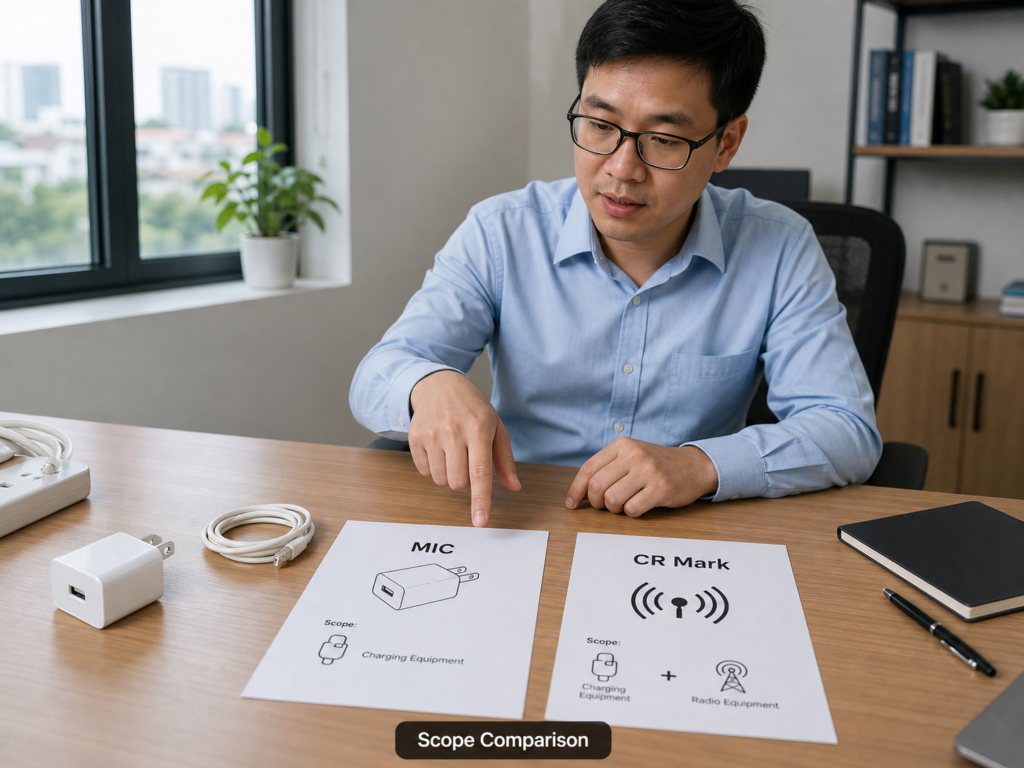
CR Mark corresponds to “mandatory conformity assessment”, which governs general technical requirements such as product quality and safety, and is different from MIC’s regulatory direction.
First of all, it must be clear: CR Mark is not an independent certification, but a **conformity mark that can only be used after the product meets the corresponding QCVN and completes the specified conformity assessment procedure**.
The determination steps are:
1. First check whether the product is included in Vietnam’s mandatory conformity assessment product catalog;
2. If it is in the catalog, then confirm which QCVN is applicable and what the corresponding conformity assessment method is (third-party certification, self-declaration, sampling inspection, etc.);
3. Finally, confirm whether testing is required, what documents to submit, and how to affix the mark.
There are also several easily confused boundaries:
• Power and other electrical parameters usually cannot replace catalog judgment alone, but in some catalogs or QCVNs, they may constitute applicable scope, thresholds or product classification conditions, and must be verified in combination with complete technical parameters and HS classification.
• Most purely passive accessories without electronic components may be exempted, but you still need to check the official catalog and cannot decide by yourself.
• Energy efficiency and commodity labeling are parallel independent obligations, which do not fall within the scope of CR Mark. Do not confuse them.
Key reminder: For common products such as wall chargers, power adapters, car chargers, wireless chargers, and USB cables, you must check the mandatory conformity assessment catalog and HS code classification at the same time, and cannot draw conclusions just by looking at the product type.
Initial Screening Matrix for Typical Products
For everyone’s quick reference, we have compiled the preliminary determination results of the 8 most common types of charging products into a table. Note that this is only a **preliminary screening conclusion**, and the final result shall be subject to the official list:
| Product Type | Preliminary Conclusion | Content That Must Be Verified | Statements That Absolutely Cannot Be Directly Determined |
| Ordinary pure-charging USB cable (no chip, no data function) | Usually does not trigger MIC; CR Mark requires further verification | Vietnam’s current mandatory product catalog, applicable QCVN, import/conformity assessment list issued by the competent authority, and HS code | Pure charging cables are definitely exempt from all compliance requirements |
| USB/USB-C cable with data transmission (no active chip) | Does not automatically trigger MIC due to data function; CR Mark needs to be evaluated according to the list | MIC’s current ICT equipment list, Vietnam’s current mandatory product catalog, applicable QCVN and HS code | Cables with data function need to go through MIC procedures |
| USB-C cable with E-Marker chip | Usually does not trigger MIC; CR Mark needs to be evaluated according to the catalog | Vietnam’s current mandatory product catalog, applicable QCVN, conformity assessment list issued by the competent authority, and HS code | Products with chips definitely require mandatory conformity assessment |
| Ordinary wired charger (e.g. 5V2A) | Usually does not trigger MIC; CR Mark needs to be confirmed according to the catalog | Vietnam’s current mandatory product catalog, applicable QCVN, import/conformity assessment list issued by the competent authority, and HS code | Low-power chargers do not require CR Mark |
| High-power PD fast charger (65W and above) | Usually does not trigger MIC; CR Mark needs to be confirmed according to the catalog | Vietnam’s current mandatory product catalog, energy efficiency regulations, corresponding QCVN and HS code | Power level determines the conformity assessment method of CR Mark |
| Wireless charger with only wireless power supply | Whether MIC is applicable needs to be confirmed in combination with operating frequency, transmission technology and MIC list; CR Mark needs to be confirmed according to the catalog | MIC’s current radio equipment list, Vietnam’s current mandatory product catalog, applicable QCVN and HS code | Wireless chargers definitely need MIC, or definitely do not need MIC |
| Wireless charger/smart fast charger with Bluetooth/Wi-Fi | Most likely need to assess MIC; CR Mark needs to be evaluated according to the catalog | MIC’s radio equipment list, Vietnam’s current mandatory product catalog, corresponding QCVN | All products with wireless function require type certification |
| Purely passive metal adapter/connector | Usually does not trigger MIC; CR Mark requires further verification | Vietnam’s current mandatory product catalog, applicable QCVN, import/conformity assessment list issued by the competent authority, and HS code | Purely passive accessories are definitely exempt from all compliance requirements |
Key Conditions That Change Determination Results
Why is it that the same product didn’t need to be done last year but needs to be done this year? Or why do others’ same products don’t need it but yours does? Because the determination result is affected by these conditions:
1. Whether the product has a **wireless communication module** (note that it is communication, not wireless power supply);
2. Whether it has active electronic components and whether it is connected to mains electricity;
3. Whether it is sold separately or sold together with the main device;
4. Updates to Vietnam’s regulatory lists and QCVN regulatory versions;
5. Whether sales channels have additional compliance requirements (for example, some e-commerce platforms require additional certificates);
6. HS code classification result (different HS codes may correspond to different regulatory requirements).
Special Exemptions and Exceptional Circumstances
There are several special situations where you may not need to go through the complete compliance procedure, but all have strict prerequisites:
• **Samples/exhibits/small batches carried by individuals (non-sales use)**: Whether samples, exhibits, R&D test products or personal carried items can enjoy exemption must be confirmed based on specific product regulations, import purpose, quantity and requirements of the competent authority; exemption usually does not mean that they can be directly converted to commercial sales, and should be re-verified when the subsequent use changes.
• **Embedded wireless modules that have obtained MIC compliance**: Some tests may be simplified, but you must first check the coverage of the module certificate. It is not that if a compliant module is used, the whole machine will automatically be compliant, and the obligations of the whole machine cannot be automatically exempted.
• **OEM/ODM products**: It is necessary to clearly distinguish entities such as certificate holders and manufacturers. Different compliance procedures have different requirements for certificate authorization and model coverage, and you cannot use others’ certificates casually.
• **Accessories sold together with the main device**: Only when the certificate of the main device clearly covers the model and specification of this accessory, there is no need to apply separately; otherwise, separate compliance is still required.
Keep Records for Per-Model Determination
It is recommended that everyone create a determination record form for each product model, clearly recording: list query date, HS code, applicable QCVN, conformity assessment method, whether testing is required, applicant entity, and labeling requirements.
Don’t think it’s troublesome. This record is your compliance evidence chain. When renewing certificates, making product changes, or responding to market spot checks in the future, you can take it out to prove that you did it in accordance with regulatory requirements, and you don’t have to look for materials everywhere temporarily.
How to Verify When in Doubt
If you are not sure, don’t listen to what non-professionals say casually. Find these channels to verify, and be sure to keep written confirmation materials:
1. Query public control lists on the MIC official website, official websites of relevant professional competent authorities, and government regulatory databases;
2. Conduct pre-assessment at Vietnamese designated or accredited laboratories;
3. Verify with qualified local compliance agents or importers.
3. Compliance Determination Cases for Typical Products
Just looking at the rules may still be a bit abstract. Let’s take 3 of the most common products as examples, and you can apply them to your own products.
Case 1: 65W USB-C PD Wall Charger (sold separately, no wireless function)
• **Known facts**: Input 100-240V mains, 65W PD fast charging, no wireless function, sold in separate packaging.
• **Lists to query**: Vietnam’s current mandatory product catalog, energy efficiency regulation catalog, applicable QCVN, and import/conformity assessment list issued by the competent authority.
• **Possible compliance obligations**: If in the mandatory catalog, CR Mark, energy efficiency label (if in the energy efficiency catalog), and Vietnamese commodity label are required.
• **Conclusions that absolutely cannot be blindly inferred**: You cannot say “65W definitely requires/does not require CR Mark”, nor can you say “it must be third-party certification/it must be self-declaration mode”. These must be determined by checking the catalog and corresponding QCVN.
• **Documents to prepare**: Product nameplate, specification sheet, HS code, proof of separate sales.
Case 2: USB-C to C Cable with E-Marker Chip (100W, sold separately)
• **Known facts**: With E-Marker power negotiation chip, supports 100W PD, no data transmission function, sold separately.
• **Lists to query**: Vietnam’s current mandatory product catalog, applicable QCVN, and import/conformity assessment list issued by the competent authority.
• **Possible compliance obligations**: If in the mandatory catalog, CR Mark and Vietnamese commodity label are required.
• **Conclusions that absolutely cannot be blindly inferred**: You cannot say “products with E-Marker chips definitely require mandatory conformity assessment”, nor can you say “they fall within the scope of MIC control”. E-Marker is just a power negotiation chip and does not belong to communication functions.
• **Documents to prepare**: E-Marker chip parameters, product specification sheet, HS code, sales proof.
Case 3: Desktop Charger with Qi Wireless Charging + Bluetooth Speaker (sold separately)
• **Known facts**: 15W wireless charging, with Bluetooth speaker function, 12V DC input, sold separately.
• **Lists to query**: MIC’s radio equipment list, Vietnam’s current mandatory product catalog, applicable QCVN, and import/conformity assessment list issued by the competent authority.
• **Possible compliance obligations**: MIC compliance procedure (due to Bluetooth communication function), CR Mark if in the mandatory catalog, and Vietnamese commodity label.
• **Conclusions that absolutely cannot be blindly inferred**: You cannot say “Bluetooth function definitely requires type certification” (it may also be DoC, depending on the list classification), nor can you say “wireless chargers definitely fall within the mandatory scope of CR Mark”.
• **Documents to prepare**: Bluetooth module parameters, product specification sheet, HS code, sales proof.
4. MIC Regulatory Access Compliance Procedures
If your product is determined to require MIC procedures, next we will talk about how to operate specifically and what to pay attention to.
Common Compliance Procedure Types and Selection Basis
The type certification, declaration of conformity, frequency or other registration/licensing obligations applicable to MIC shall be determined in accordance with the equipment category, current MIC list, corresponding QCVN and specific implementation documents, and cannot be summarized solely by high or low risk.
Which one to choose is not up to the enterprise itself, but depends on which category the product belongs to in the MIC control list, the requirements of the corresponding QCVN, and whether there are additional requirements from sales channels. Not all products with communication functions have “either/or” options; the specific situation shall be subject to current regulations.
Possible Test Items (Conditional)
Not all MIC products require a full set of tests; it is based on the product’s functions and the requirements of the corresponding QCVN:
• **Radio Frequency (RF) test**: Only products with wireless transmission function may need it, to verify whether the signal power and frequency band meet Vietnam’s QCVN requirements and whether they occupy frequency bands indiscriminately.
• **Electromagnetic Compatibility (EMC) test**: Subject to the requirements of the corresponding QCVN, to verify that the product will not interfere with the normal operation of other electrical appliances and is not easily interfered with by other electrical appliances.
• **Electrical safety test**: Applicable to communication products with mains/low voltage power supply, to verify electrical safety, such as electric shock protection and fire protection.
• **SAR (Specific Absorption Rate) test**: Only wireless products used at close range and with transmission power reaching a certain standard may need it, to measure the radiation impact of wireless products on the human body. Whether it is required depends on the requirements of the corresponding QCVN.
Testing shall be completed in Vietnamese designated/accredited laboratories or other qualified laboratories permitted by regulations and accepted by the competent authority in accordance with the applicable QCVN and specific procedures; whether the laboratory report is usable must be confirmed by the applicable procedure and the competent authority.
Basic Rules
• **Applicant entity**: Can be filed by the manufacturer, importer, or local authorized representative in Vietnam. The specific situation depends on the requirements of the corresponding regulations; not everyone can apply.
• **Validity period**: Different product types and different procedures have different validity periods, subject to the time specified on the certificate or filing document.
• **Factory audit requirements**: Low-risk charging products generally do not require factory audits, depending on the requirements of the corresponding procedure.
Key Points for Practical Pitfall Avoidance
1. All-in-one products shall separately evaluate each actually enabled and externally provided function. Whether the wireless function requires MIC procedures must be confirmed in combination with the final hardware/software configuration, transmission parameters, product use, list and QCVN, and an absolute conclusion cannot be drawn solely based on the existence of an unenabled radio frequency hardware.
2. Whether turning off the wireless function with software can change the compliance conclusion depends on the final hardware and software configuration put on the market and applicable regulations, and “turning off the function” cannot be used as the sole basis for automatic exemption.
3. If a compliant wireless module is used, you must verify in advance which test scopes can be simplified. You cannot assume that the whole machine does not need MIC; module compliance does not mean the whole machine is compliant.
5. Practical Key Points for CR Mark and Conformity Assessment
The mandatory conformity assessment corresponding to CR Mark is similar to MIC’s procedure logic, but the regulatory direction is different. We will focus on the differences from MIC.
Common Forms of Conformity Assessment and Applicable Scenarios
Third-party certification, self-declaration of conformity, inspection or other methods shall be determined in accordance with the specific mandatory catalog, QCVN and implementation documents of the competent authority; the body shall be a body designated or accredited in accordance with the law and with qualifications in the corresponding scope, and the requirements for reports and filing shall also be verified in accordance with specific procedures.
The basis for choosing which form is the category of the mandatory catalog to which the product belongs, the requirements of the corresponding QCVN, and the requirements of sales channels. As the saying goes: **Power usually cannot alone determine the form of conformity assessment, but in some catalogs or QCVNs, it may affect the applicable scope or product classification, and must be judged in combination with complete technical parameters**.
Possible Test Items (Conditional)
Similarly, testing is done on demand, not all items are required:
• **Electrical safety test**: Applicable to power supply products with mains/low voltage power supply and products with circuits, to verify safety requirements such as electric shock protection, fire protection, and mechanical strength. It is the most common test item for power supply products.
• **Electromagnetic Compatibility (EMC) test**: Only required when the corresponding QCVN has requirements; not all CR Mark products need EMC testing.
• **Energy efficiency test**: Only required when the product is included in the energy efficiency control catalog, and energy efficiency is an independent parallel obligation, which does not fall within the scope of CR Mark. Do not mix them together.
Testing also needs to be completed in laboratories accredited, designated by Vietnam, or permitted by regulations and accepted by the competent authority in accordance with the corresponding QCVN and specific procedures.
Basic Rules
• **Applicant entity**: Similar to MIC, it can be the manufacturer, importer, or local authorized representative in Vietnam, subject to regulations.
• **Validity period**: Subject to what is specified in the certificate or filing document, and varies for different products.
• **Factory audit requirements**: Whether a factory audit is required shall be confirmed according to the specific conformity assessment method, product category and implementation documents, and cannot be completely excluded just because the product belongs to the charging category.
Key Points for Practical Pitfall Avoidance
1. You cannot make a general determination based on “electronic products”. You must confirm against the mandatory catalog and corresponding QCVN, otherwise it is easy to spend unnecessary money or miss compliance.
2. Energy efficiency and commodity labeling are parallel obligations, which do not fall within the scope of CR Mark. Don’t think that after getting CR Mark, you don’t need to take care of energy efficiency and labeling.
3. For accessories sold in sets, you must verify the coverage of the main device certificate. You cannot assume that “if sold together with the main device, you don’t need to do it separately”. If the main device certificate does not cover this accessory, it is still non-compliant.
6. Multi-Regulation Coordination and Full Access Process
Many products (such as wireless chargers with Bluetooth) need to do MIC, CR Mark, labeling, and energy efficiency. These don’t have to be done one after another; they can be promoted in coordination, which can save a lot of time and money.
Core Precautions for Multi-Regulation Coordination
• **Test data reuse**: For overlapping test items in different procedures (such as EMC, electrical safety), test data may be accepted by different procedures, but you must get written confirmation from a Vietnamese accredited body in advance. You cannot say “I have already tested it so I don’t need to test it again” by yourself.
• **Application rhythm**: Different compliance procedures can be submitted simultaneously. You don’t have to wait for the MIC certificate to apply for CR Mark, which can shorten the overall access cycle.
• **Marking requirements**: The ICT conformity mark applicable to MIC, CR Mark, energy efficiency label, etc., must comply with their respective affixing specifications. They cannot be mixed, nor can they be affixed casually to positions that do not meet the requirements.
Full Access Process (Multi-Regulation Can Be Promoted Simultaneously)
Whether it is a single compliance requirement or multiple, the overall access process can be divided into 5 stages, and for multiple regulations, they can be promoted in parallel:
1. **Stage 1: Regulatory classification and determination**: Collect product compliance profile information, confirm which compliance requirements need to be met and what procedures correspond to them. This step is the foundation and must be done accurately, otherwise everything later will be wrong.
2. **Stage 2: Document preliminary review and plan confirmation**: Prepare basic materials, submit them to a laboratory or compliance body for preliminary review, confirm the test plan, and which existing reports can be reused to reduce repeated testing.
3. **Stage 3: Sample testing and application submission**: Send samples to an accredited laboratory for testing. After passing the test, submit applications for each compliance procedure separately.
4. **Stage 4: Certificate acquisition, filing and label review**: After obtaining the certificate or completing the filing, review the product labels and packaging in accordance with regulatory requirements to ensure that all marks and information meet the requirements.
5. **Stage 5: Import, launch and subsequent maintenance**: After completing all applicable certifications, declarations of conformity, registration/national quality inspections, labeling and other special requirements, the products can be imported and sold on the market in accordance with specific regulations. Usually, all compliance documents should be kept properly, and timely handling should be done in case of product changes or certificate expiration.
Project Schedule and Cost Reference
Many people will ask “how long does it take and how much does it cost”. What is given here is the common range in the industry, **not a statutory time limit, nor a unified price**, and the specific situation shall prevail:
• **Document pre-review**: 1-3 working days, mainly depends on whether your materials are complete. If the materials are complete, it is very fast.
• **Laboratory testing**: 1-4 weeks, depending on product complexity, number of test items, and whether retesting is required. The simpler the product and the fewer items, the faster it is.
• **Competent authority review/filing**: 1-6 weeks, depending on the type of procedure, the queuing situation of the body, and specific review requirements.
• **Label confirmation and customs clearance preparation**: 1-3 working days, very fast if there are no problems with the materials.
Main factors affecting the schedule: product complexity, completeness of materials, laboratory queuing situation, and amount of reusable data.
There is no unified public pricing for costs, and you need to inquire according to specific products. When inquiring, be sure to ask clearly whether the quotation includes all costs such as testing, certification, filing, local representative, etc., to avoid additional charges later.
Rules for Reuse of Overseas Reports
Many sellers already have overseas reports such as CE, FCC, and CB. Can they be used? The answer is: they cannot be used directly, but they may reduce repeated testing:
• Overseas CE/FCC/CB reports usually cannot automatically replace Vietnam’s compliance requirements. Whether they can be used as part of formal compliance documents depends on specific regulations, QCVN, body qualifications and applicable mutual recognition arrangements, and customs clearance cannot be done directly based solely on the marks.
• CB materials can only reduce repeated testing when the test items, methods, standard versions, models and hardware configurations are consistent with Vietnam’s requirements and are confirmed and accepted by the applicable accredited or designated body in Vietnam; whether to do CB first should be decided based on the target market and the pre-confirmation results of the Vietnamese body.
• Prerequisites for reuse: The laboratory issuing the report has corresponding qualifications, and the test items, product model, and hardware version are completely consistent with the product you are applying for.
If you are planning a multi-country market layout, whether to do CB certification first should be decided in combination with the target market demand, applicable procedures in Vietnam, and the pre-confirmation results of the body. CB cannot be regarded as a guarantee for automatic transfer to Vietnamese procedures.
7. Response to Labeling, Customs Clearance and Market Spot Checks
Many people spend a lot of money on certification, but end up having their goods detained because of wrong labels or incomplete customs clearance materials. It’s really unfair. You must pay attention to the details of this part.
Labeling Requirements (Differentiated by Type, Subject to Corresponding Regulations)
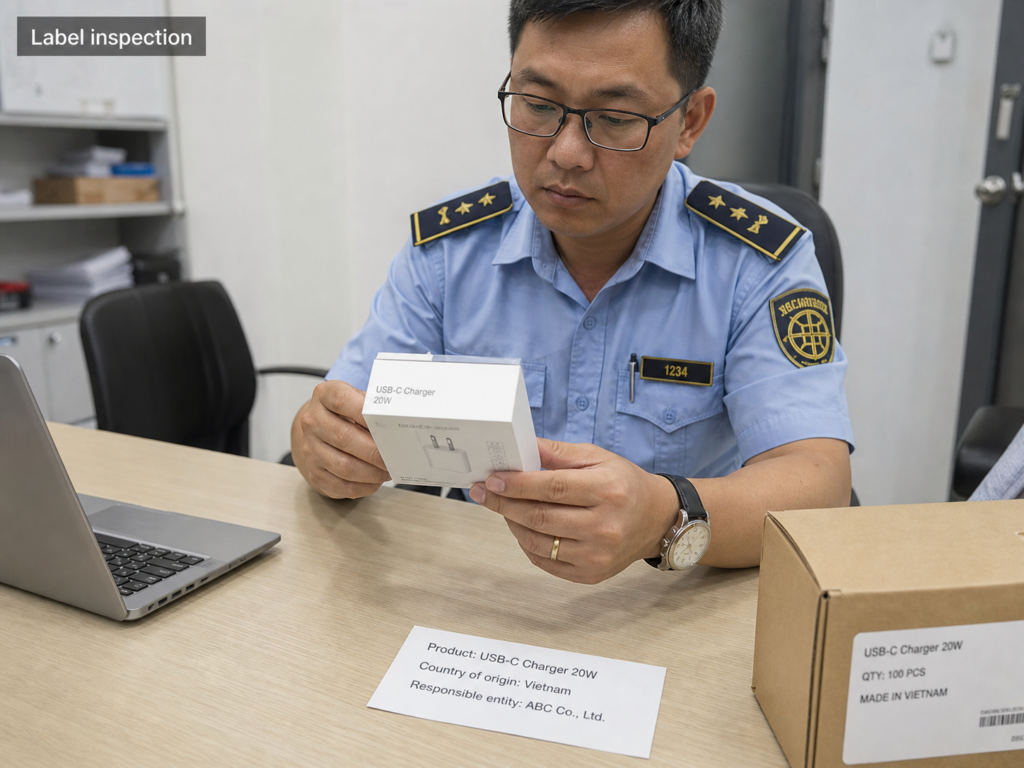
Vietnam’s labeling requirements are divided into several categories, each corresponding to different regulations, and all must be met:
• **Commodity label**: Imported commodities shall, in accordance with Vietnamese labeling regulations, indicate the applicable name, country of origin, responsible entity and information required by special regulations on the original label and/or Vietnamese supplementary label; specific models, parameters, warnings and instructions shall be subject to the commodity category and applicable special regulations.
• **Conformity marks (ICT conformity mark applicable to MIC, CR Mark, etc.)**: Shall be used in accordance with the requirements of the ICT conformity mark, CR mark and other special marks specified in the applicable documents of MIC; the position, size, method of the mark, and whether it can be placed on the packaging or accompanying documents when the product cannot be marked, shall be subject to specific regulations and QCVN.
• **Packaging and instructions**: The applicable core information shall be marked on the minimum sales packaging, and the Vietnamese safety prompts and other contents in the instructions shall be prepared in accordance with the commodity category and special regulatory requirements.
• **Online page information**: The parameters and marks on the e-commerce detail page must be consistent with the actual product, meet the platform’s compliance display requirements, and cannot be different from what is written on the page and the actual product.
• **Prohibited requirements**: Products that have not obtained certificates or completed filing cannot be printed with corresponding conformity marks; marks cannot be altered, nor can they be affixed to positions that are easy to fall off.
Customs Clearance Requirements
What documents are required for customs clearance is not fixed. Different products, different import modes, and different spot check situations have different requirements, subject to the actual requirements of customs and competent authorities:
• **Basic customs declaration documents**: Regular documents such as invoices, packing lists, and customs declaration forms. The certificate of origin shall be provided as required, not for every batch.
• **Compliance certification documents**: Applicable procedures and required registrations/certificates shall be confirmed before import; the handling time of specific certificates, declarations of conformity, national quality inspections or filings shall be implemented in accordance with product categories and regulations of the competent authority, and cannot be generalized as “all documents must be obtained before the goods arrive”.
• **Spot check reference documents**: Test reports, label samples, authorization documents, etc., are only required to be provided during spot checks, not for every batch of goods, but they must be prepared in advance so that they can be taken out immediately during spot checks.
Special attention: The brand, model, manufacturer and other information on the certificate/filing shall be consistent with the customs declaration documents and actual goods as much as possible; inconsistent information may lead to detention of goods, correction or fines, so be sure to check carefully.
Key Points for Responding to Market Spot Checks
It’s not all smooth sailing after the products are sold. Market spot checks in Vietnam are quite common:
• **Common spot check scenarios**: Spot checks during customs clearance, routine market spot checks, spot checks triggered by consumer complaints.
• **Key points of spot checks**: Whether there is sales without certificate/filing, whether marks and labels are compliant, and whether the actual parameters are consistent with the certificate.
• **Response methods**: Usually keep complete compliance documents, actively cooperate during spot checks, and rectify problems in time when found. Don’t delay, otherwise the penalty will be heavier.
8. Official Verification Channels and Compliance Maintenance
Compliance is not a one-time thing. Usually, you need to know where to check the latest regulations, and do a good job in daily maintenance to avoid certificate expiration or non-compliance after product changes.
Core Official Verification Channels
All rules are subject to official release. You must pay attention to these channels at the same time:
• **MIC compliance**: Official website of the Ministry of Information and Communications of Vietnam, where you can check MIC-related control lists, QCVN, accredited or designated laboratories and applicable procedures.
• **CR Mark and quality compliance**: You should simultaneously query the Directorate for Standards, Metrology and Quality of Vietnam (STAMEQ), the official website of the competent ministry responsible for the professional field of the product, the government regulatory database, and the corresponding list of designated/accredited bodies. You cannot rely solely on the STAMEQ website, because the mandatory product catalog, QCVN and conformity assessment bodies may be issued separately by different competent authorities.
• **Commodity labeling regulations**: Relevant official websites of the Ministry of Industry and Trade of Vietnam and the General Administration of Market Supervision, to check labeling requirements and regulatory rules.
• **Customs and HS classification**: Official website of the General Department of Customs of Vietnam, to check HS codes and import regulatory requirements.
Requirements for Retention of Compliance Verification Evidence Chain
When checking regulations, don’t close them after reading. Keep the evidence well to form a complete evidence chain. The verification logic is: **HS code + product function → competent authority list → corresponding QCVN → conformity assessment method → accredited body**.
Materials that need to be retained include: screenshots of the official website list (must have the query date), QCVN text, qualification certificates of the body, and official written replies (if any). These materials can be used in future responses to spot checks and certificate renewals.
Quick Reference Table for High-Frequency Misconceptions
We have compiled the most common pitfalls into a quick reference table, so you can quickly check if you have fallen for them:
| Misconception Type | Common Wrong Statement | Correct Conclusion |
| Product classification | Wireless chargers definitely need MIC | Wrong. Pure wireless power supply is not the same as wireless communication. Whether it is under MIC supervision still needs to be confirmed in combination with operating frequency, transmission technology, use, MIC list and applicable QCVN |
| Product classification | Charging cables do not need compliance | Wrong. Those with data/active chips need to be evaluated according to the list |
| Product classification | Models of the same series can share certificates | Wrong. It depends on whether the difference is within the coverage. Changes in power/chip/function require re-evaluation |
| Product classification | Fast charging protocols trigger MIC | Wrong. PD/QC are power supply negotiation rules and are not within the scope of communication control |
| Product classification | Power level determines the assessment mode of CR Mark | Wrong. The assessment method is determined by the mandatory catalog, QCVN and implementation documents; parameters such as power may affect the applicable scope or product classification in some catalogs or QCVNs |
| Product classification | USB cables with data function definitely need MIC | Wrong. Ordinary data cables do not automatically trigger due to data function, and need to be checked against the list |
| Procedure and testing | With CE/FCC/CB, you can clear customs directly | Wrong. Overseas documents cannot automatically replace applicable procedures in Vietnam. Whether they are acceptable needs to be confirmed in accordance with regulations, qualifications and mutual recognition arrangements |
| Procedure and testing | Declaration of Conformity (DoC) does not require testing | Wrong. Whether testing is required, the source of test reports, and declaration or filing requirements must be confirmed according to specific procedures |
| Procedure and testing | All products with communication function require MIC type certification | Wrong. The specific procedure is subject to the list, QCVN and implementation documents |
| Procedure and testing | All CR Mark products need EMC testing | Wrong. EMC requirements are subject to the corresponding QCVN |
| Procedure and testing | If a certified module is installed in the whole machine, there is no need to do MIC | Wrong. The coverage of the module certificate needs to be checked, and the obligations of the whole machine are not automatically exempted |
| Labeling and customs clearance | Labels in English are enough | Wrong. Applicable information shall be indicated through the original label and/or Vietnamese supplementary label in accordance with Vietnamese labeling regulations and special regulations |
| Labeling and customs clearance | It doesn’t matter if the certificate brand/model is slightly different from the actual product | Wrong. Inconsistent information may be determined as non-compliant |
| Labeling and customs clearance | All import batches need to provide certificate of origin and test report | Wrong. It depends on the import mode, product procedure and spot check requirements |
| Labeling and customs clearance | Sample exemption can be converted to commercial sales | Wrong. Whether the exemption applies and subsequent use restrictions depend on specific regulations; re-verification is required when the use changes |
| Change and maintenance | Test reports are permanently valid | Wrong. The validity period depends on regulations and certificate requirements, and re-verification is required when regulations are updated |
| Change and maintenance | Low-cost agents can do compliance | Wrong. Official authorization qualifications need to be confirmed to avoid fake certificates |
| Change and maintenance | Compliance can be supplemented after shipment | Wrong. Commercial import or sales shall not be carried out first without confirming the applicable procedures and statutory time points; the specific certificates, registrations, declarations or national quality inspection procedures that should be completed before import shall be determined in accordance with the corresponding regulations and product categories |
Key Points for Daily Compliance Maintenance
Compliance is not something you do once and then ignore. You also need to do a good job in daily maintenance:
• **Certificate renewal**: Apply in advance before the certificate/filing expires to avoid expiration and invalidation, which will affect sales and customs clearance.
• **Change management**: If the product undergoes major changes such as chip replacement, circuit modification, power adjustment or function change, it is necessary to re-test and update compliance documents, and cannot change it secretly without reporting.
• **Information change**: When information such as brand, responsible entity, and manufacturer changes, a change application must be submitted in time to ensure that the certificate information is consistent with the actual situation.
• **Record retention**: Retain all certificates, reports, and verification evidence in accordance with regulatory requirements for spot checks, and do not lose them casually.
Summary
After reading this guide, you should be able to independently complete the following tasks: collect the product’s compliance profile and evidence package, and initially evaluate the Vietnamese compliance requirements for charging products; distinguish the regulatory scope of MIC and CR Mark, and avoid common cognitive misconceptions; sort out the basic process of access applications, and know how to verify whether test data can be reused; master the core requirements of labeling and customs clearance to reduce compliance risks; know where to check the latest official regulations and how to retain compliance evidence.
One last reminder: Vietnam’s regulations and control lists are dynamically updated. All determinations must be based on the latest official documents at the time of import. Don’t make decisions based on experience or what others say casually. Compliance seems troublesome, but as long as you follow the process step by step, you can avoid most pitfalls and successfully sell your products to the Vietnamese market.