
Many overseas sellers of charging products who enter the Brazilian market for the first time most often fall into the pit of “only realizing local certification is required after the goods arrive at the port” — either the goods are detained at the port incurring high demurrage fees, or they are directly returned, resulting in heavy losses. Brazil’s market access rules are different from those in Europe, the United States, and Southeast Asia; CE, FCC or CB reports are not universally applicable, and Brazil has a compliance system involving multiple institutions and multiple links.
This article targets common charging electronic products such as wall chargers, power adapters, USB/USB-C charging cables, wireless chargers, car chargers, and power banks, sorting out the complete access certification logic from basic entry knowledge to practical pit avoidance, to help you avoid detours. It should be noted in advance that Brazilian regulations are dynamically updated, and all requirements are ultimately subject to the official opinions of INMETRO, ANATEL, the customs, and professional importers.
Essential Basics: The Fundamental Logic of Brazil’s Access
Charging products in Brazil may involve requirements in different links such as product conformity assessment, energy efficiency labeling, ANATEL radio equipment approval, import declaration or licensing, and lithium battery transportation. The specific applicable requirements need to be judged separately according to product definition, technical parameters, NCM code, regulatory catalog, import mode, and transportation method.
The entire access process is divided into three core links that are closely linked: First, **product compliance**, which is an important prerequisite for access, and rules are formulated by regulatory authorities. For products included in the mandatory regulatory catalog, failure to complete the corresponding conformity assessment or approval may lead to obstacles in import declaration, release or sales; Second, **import customs clearance**, where the customs verifies documents and levies taxes and fees according to the NCM code. Although not every batch of goods will be checked for compliance documents one by one, goods will be detained if missing documents are found. The verification of import licenses and compliance documents is jointly carried out by the customs and relevant regulatory authorities in accordance with the NCM code and specific regulatory rules; Finally, **market launch and sales**, where market supervision authorities will conduct random inspections of the labels and compliance of products on sale. The consequences of violations range from goods detention and fines to return of goods, platform delisting, market penalties, and even impact on subsequent import qualifications.
To understand the rules, you first need to clarify the division of labor of the three core regulatory authorities:
• **INMETRO (National Institute of Metrology, Standardization and Industrial Quality of Brazil)**: Equivalent to the official institution responsible for electrical safety, energy efficiency, and quality in China, it formulates conformity assessment rules for electrical products and implements them mandatorily according to the catalog.
• **ANATEL (National Telecommunications Agency of Brazil)**: Specializes in managing products with wireless/radio frequency transmission functions, such as devices with Bluetooth and WiFi, and regulates them by device classification, similar to China’s radio type approval.
• **Federal Customs**: Responsible for verifying documents and levying taxes and fees during customs clearance, and checking which access documents are required according to the NCM code. Specific product regulatory requirements may also be intervened by relevant regulatory authorities through systems such as Siscomex, and cannot be simply understood as the customs alone determines all product compliance.
Many beginners confuse the boundary between mandatory and voluntary compliance: Mandatory compliance must be completed for products included in the regulatory catalog, but even with mandatory certification, import release is still affected by the NCM code, import license, and real-time customs status; Voluntary compliance is not a legal requirement, but can enhance the competitiveness of channels and buyers. To judge whether mandatory compliance is required, you cannot only look at the product name, but must comprehensively judge based on the product’s defined use, rated parameters, mandatory catalog, NCM code, and import method.
Here we specially remind three cognitive pitfalls that beginners are most likely to fall into, which are common misconceptions for new entrants:
First, international certifications such as CE, FCC, and CB cannot replace local Brazilian compliance. They can only be used as technical references at most to help you reduce rectification time, but Brazilian authorities do not recognize these as access basis.
Second, products with different functions, parameters, and catalogs have completely different compliance requirements. For example, the certifications required for ordinary USB cables and wireless chargers with Bluetooth are very different, and cannot be generalized.
Third, compliance is not valid for life. If you change the circuit, parameters, or appearance of the product, or if regulations are updated, the original certification may become invalid and needs to be re-evaluated.
Product Classification: The First Step in Compliance Judgment
The root cause of many sellers’ compliance problems is that the product classification was wrong at the beginning. For example, a smart wireless charger with Bluetooth is treated as an ordinary wireless charger, missing ANATEL approval, and finally detained during customs clearance.
First, you need to understand the **NCM code**: this is the Mercosur Common Nomenclature, which functions similarly to the familiar HS code, and is used to determine tariffs and regulatory categories. However, it should be noted that the NCM code alone cannot determine which compliance requirements you need to meet; it must be judged in combination with the product’s functions, parameters, and mandatory catalogs. Nor can classification be based solely on product name. For example, for products also called “charging cables”, a fast-charging cable with an E-Marker chip and an ordinary passive USB cable may have different regulatory requirements, so the actual functions and parameters must be checked.
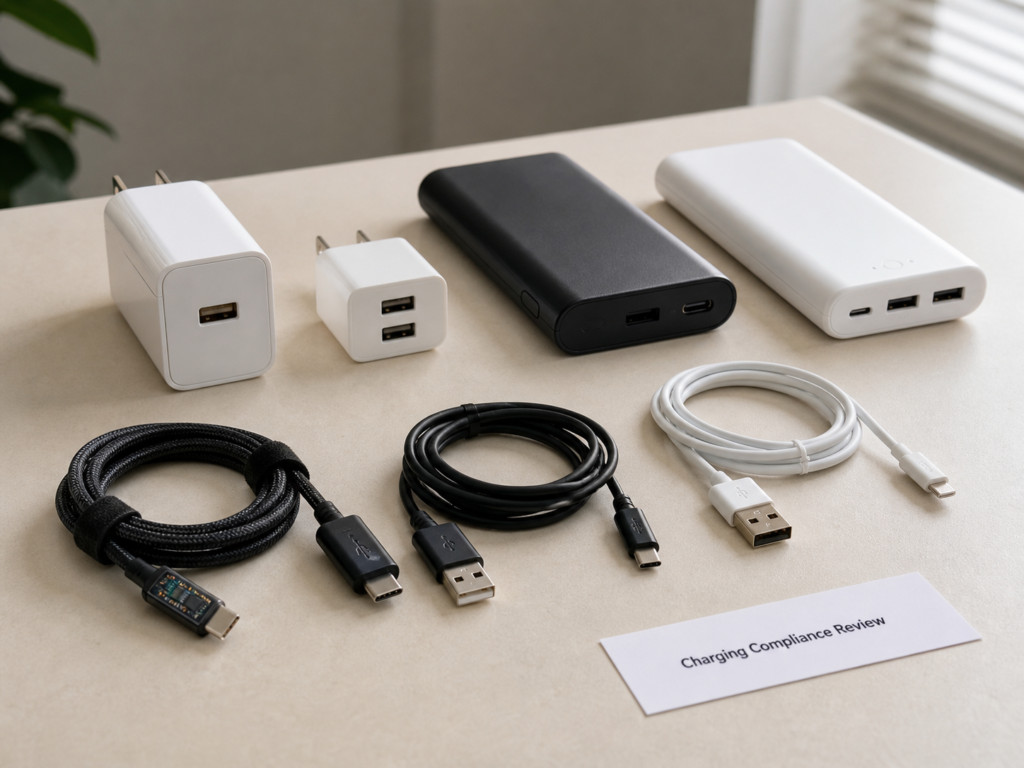
Classification is mainly judged from four core dimensions:
1. **Power supply method**: Whether it is AC plug-in (such as ordinary wall chargers), vehicle low-voltage (such as car chargers), or passive (such as ordinary USB cables, which do not carry electricity themselves and are powered by devices).
2. **Wireless function**: If the product has wireless communication or radio frequency functions such as Bluetooth, Wi-Fi, cellular, NFC, etc., it should be further checked whether it falls within the scope of ANATEL mandatory approval. You cannot directly conclude that approval is required solely based on the existence of a certain chip or interface.
3. **Cable attributes**: If it is a charging cable, it depends on whether it has a chip (such as E-Marker), rated parameters, and connector type (USB-A, USB-C, etc.).
4. **Other factors**: Whether there is a built-in lithium battery, rated power/voltage, and usage scenario (consumer-grade or industrial-grade).
Before consulting a compliance institution for evaluation, you can prepare these materials first, which can save a lot of communication time: product name, use, and usage scenario description; technical parameters such as input and output voltage, current, power, and interface specifications; function description (if there is a wireless module, the model should be provided; if there is a battery, battery parameters should be provided); product photos, manuals, and model list — note that products with different plugs, different power, and different interfaces are considered independent models even if they have the same appearance, and all must be listed.
Compliance triggers must be verified in a fixed order to avoid missing items:
1. Confirm the definition and intended use of the product. For example, whether it is a consumer-grade wall charger for charging mobile phones or a power supply for industrial equipment, the requirements for the two are completely different.
2. Query the corresponding NCM code to determine tariffs and basic regulatory categories.
3. Check the mandatory conformity assessment catalog and PBE energy efficiency catalog on the INMETRO official website to see if the product is listed.
4. Judge whether the product has wireless transmission function, then check the regulatory catalog on the ANATEL official website to confirm whether radio frequency approval is required.
5. Based on the previous information, determine the type of compliance system that needs to be handled.
6. Check additional requirements such as plugs, labels, lithium battery transportation/environmental protection.
If you are unsure, be sure to find an officially recognized institution for pre-assessment, and keep records of regulation inquiries; this will be your basis in case of disputes later.
Here is an initial screening reference for common charging products, covering categories such as ordinary USB cables, E-Marker fast-charging cables, single/multi-port wall chargers, ordinary/smart wireless chargers, car chargers, and power banks. Note that this is only an initial screening, not a final conclusion; the final result shall be subject to the current official catalog, product definition, and technical parameters.
There are also several very easily confused product boundaries that must be clarified:
• **E-Marker chip**: It is a chip used to identify power parameters in wired charging, which belongs to wired functions and will not trigger ANATEL’s radio frequency approval requirements.
• **Wireless charging without communication function**: It only charges devices through electromagnetic induction, has no communication functions such as Bluetooth or WiFi, and will not trigger ANATEL requirements either.
• **Complete machine with radio frequency module**: For example, wireless chargers with Bluetooth that can connect to APPs, and smart sockets with WiFi, as long as they have wireless transmission functions, ANATEL requirements must be verified.
• **Battery-containing products**: For example, power banks, their product access compliance (such as INMETRO) and transportation compliance (such as UN 38.3) are completely independent and cannot replace each other. Having transportation certification does not mean that the product can be sold on the market, and vice versa.
In general, the compliance of charging products is a set of combined measures. It is necessary to match the corresponding requirements of INMETRO, ANATEL, PBE, lithium battery transportation, customs clearance, etc. according to the specific product type. The combination of requirements varies for different products, and there is no universal “one-size-fits-all package”.
Core Mandatory Compliance Requirements (Exclusive for Charging Products)
This part is the core of access. We sort out the most common mandatory requirements for charging products according to priority.
INMETRO Conformity Assessment and Registration (Safety/Quality Category)
This is the first compliance consideration for most plug-in charging products, equivalent to Brazil’s “safety certification”.
• **Applicable conditions**: The product is in the INMETRO mandatory catalog and meets the corresponding product definition. Some external power supplies, chargers or similar products may be subject to INMETRO mandatory conformity assessment, but must be verified according to specific models, uses, input and output parameters and the current product catalog, and cannot be judged solely by the name “charger”.
• **Typical non-applicable cases**: Low-voltage passive cables not included in the catalog, industrial-specific power supplies, and some car chargers (the requirements for car chargers are special and must be verified separately against the catalog, not taken for granted).
• **Core testing content**: Mainly electrical safety (electric shock protection, fire protection, high voltage resistance, etc.), and electromagnetic compatibility (EMC) testing is also required if applicable to the product. Restriction of hazardous substances shall be confirmed according to specific regulations, and there is no unified requirement for all categories.
• **Certificate and labeling requirements**: The product must be marked with the INMETRO logo and certification/registration number, the style and position shall meet regulatory requirements, and the information shall be queryable in the INMETRO official system. If the official system cannot query, the use of the document shall be suspended, and the certificate type, number, holder, model and valid status shall be verified through INMETRO, the certification body or the responsible entity; import or sales cannot be carried out based on it without verification.
• **Maintenance and change**: The validity period of the certificate depends on the certification mode and regulations, and the official system status needs to be verified regularly. When the key parameters, circuit, or structure of the product are changed, the coverage scope must be re-evaluated, and the original certificate cannot be used directly.
PBE Energy Efficiency Label Requirements
Many people confuse PBE with INMETRO. In fact, PBE is Brazil’s energy efficiency labeling system, which is a mandatory label, but not a conformity certification — even if you pass the INMETRO safety certification, if the product is in the PBE energy efficiency catalog, you still need to make an energy efficiency label.
• **Applicable conditions**: There is no universal power threshold, and it is not required above a certain wattage. It must be checked against INMETRO’s current PBE energy efficiency catalog, product definition and corresponding regulations, subject to the catalog.
• **Typical non-applicable cases**: Products not included in the energy efficiency catalog, and industrial-specific/special-purpose power supplies.
• **Label requirements**: It is a mandatory label. The label style is specified by regulations, and there is no universal A-G rating (the energy efficiency rating division of different products is different), and cannot be labeled arbitrarily without authorization.
• **Maintenance and change**: The energy efficiency level changes with the product’s compliance status, and the requirements need to be re-verified when the catalog is updated, and old labels cannot be used all the time.
ANATEL Radio Frequency Approval System
This is for products with wireless functions, and many sellers of smart charging products easily miss it.
• **Applicable conditions**: It is only required when the product has wireless communication or radio frequency functions such as Bluetooth, WiFi, cellular, NFC, etc., and falls within the scope of ANATEL mandatory approval. Whether it is subject to supervision specifically shall be judged in combination with product definition, wireless interface, function and usage method.
• **Typical non-applicable cases**: Passive cables, ordinary plug-in wall chargers, and wireless charging pads without communication functions do not need ANATEL.
• **Core requirements**: Regulatory requirements and test items are determined according to device type, and complete technical materials need to be submitted. Note: Even if the wireless module used has been approved by ANATEL, the whole machine still needs to be evaluated whether supplementary testing is required. It is not that the whole machine automatically passes if the module passes, because the antenna and structure of the whole machine may affect radio frequency performance.
• **Certificate and labeling requirements**: The product needs to be marked with the approval number and specified marks, which shall be implemented in accordance with ANATEL’s current rules.
• **Maintenance and change**: The validity period and supervision rules of ANATEL certificates are independent of INMETRO, and the two are not interchangeable. Changes to core communication functions (such as replacing the wireless module) require re-evaluation.
Other Mandatory Compliance Requirements
In addition to the above three core systems, there are several easily overlooked mandatory requirements:
Brazilian Plug and Voltage Requirements
Many sellers think that changing to a Brazilian plug is all that is needed, but in fact, the plug is only one of the basic requirements.
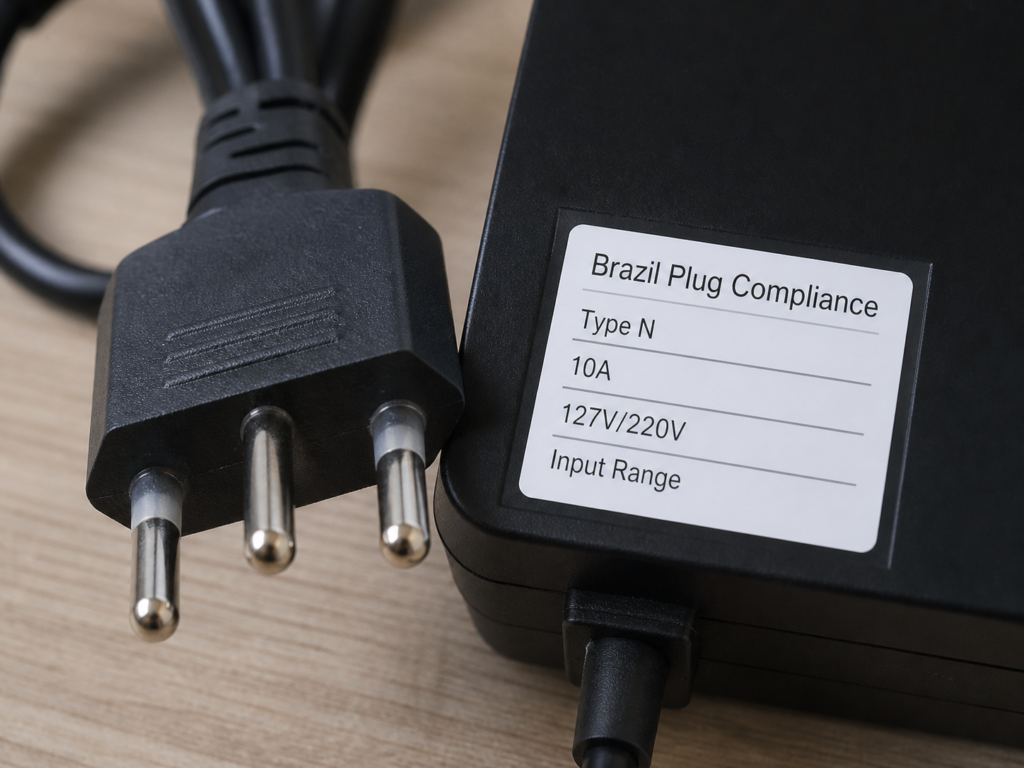
Brazilian plugs must comply with the NBR 14136 standard (i.e., Type N round pin plugs), divided into 10A/20A types, which must match the rated current of the product. A 10A plug cannot be used to mark 20A current. The commonly used nominal voltage in Brazil is 127V/220V, and the product must be marked with the true rated input range, and false marking is not allowed. Special reminder: Plug compliance does not mean overall safety compliance, it is only one of the basic requirements for access, and still needs to be judged in combination with other certifications.
ANVISA-Related Requirements
Ordinary chargers usually do not fall within the scope of ANVISA medical devices, but if the product design, intended use or publicity involves functions such as diagnosis, treatment, monitoring, disease prevention, medical disinfection, etc., it should first be confirmed whether registration, notification or other regulatory procedures are required in accordance with ANVISA’s medical device and health product rules.
Special Compliance for Lithium Battery Products
Products such as power banks and wireless chargers with batteries involve lithium battery compliance. This part consists of four types of independent requirements, which cannot replace each other:
1. **Product access**: Lithium battery-containing products (such as power banks) need to verify access requirements such as INMETRO according to the category, which is the prerequisite for market sales.
2. **Transportation compliance**: Lithium batteries are dangerous goods, and UN 38.3 test summaries need to be provided. Packaging, labeling, and declaration requirements are determined according to the transportation method (sea/air/land) and carrier regulations.
3. **Import documents**: For lithium battery-containing goods, UN 38.3 test summaries, dangerous goods declarations, packaging and labeling materials should be prepared according to the battery type, whether it is installed in the equipment, transportation method, packaging and carrier requirements; whether these materials need to be submitted as attachments to the import declaration shall be separately confirmed in accordance with Siscomex, carrier and applicable transportation regulations.
4. **Environmental protection / reverse logistics**: Electronic products, batteries and packaging may be subject to federal, state and local reverse logistics, recycling and producer responsibility rules, which shall be confirmed separately according to product category, sales region, importer identity and current federal/state rules.
Compliance Judgment Rules for Multi-Product/Sets
Many sellers sell charging sets (charger head + cable + power bank) and think that only one certification is enough, but this is completely not the case:
• For plug-in products with wireless functions, INMETRO and ANATEL requirements are independent and need to be verified separately, and cannot cover each other.
• For charging sets, the compliance requirements of each individual product must be verified separately. Bundled sales will not expand the compliance coverage. For example, if the charger head has certification but the cable does not, the set is still non-compliant.
• Compliance documents only cover the specific models/series products listed. Models not listed on the certificate cannot be used even if they have the same appearance.
Optional Value-Added Compliance Requirements (Non-Mandatory)
The above are all legally required items. There are also some non-mandatory compliance items that can be handled if conditions permit, which can improve product competitiveness:
• **PROCEL high energy efficiency label**: Only products included in the corresponding plan and meeting the highest energy efficiency requirements can apply, which is equivalent to the “top energy efficiency student” mark, and can improve the access competitiveness of government procurement and offline supermarkets.
• **System certification (such as ISO 9001)**: It is a commercial requirement, not a legal access condition, but can reduce factory inspection costs and improve buyer trust, especially suitable for B2B large customer orders.
• **Channel-specific requirements**: Cross-border e-commerce platforms may require compliance filing (this is a platform rule, not a legal requirement); offline supermarkets may require additional quality audits and factory inspections, depending on channel regulations.
• **Local environmental protection and after-sales requirements**: Electronic products, batteries and packaging may be subject to federal, state and local reverse logistics, recycling and producer responsibility rules, which shall be confirmed separately according to product category, sales region, importer identity and current federal/state rules; although Portuguese after-sales contact information is not mandatory in all regions, it can improve user experience and is required by many channels.
Full Process of Compliance Handling
After knowing which certifications to do, the next step is how to handle them.
Routine Handling Steps
1. **Demand pre-judgment**: First, initially judge the required compliance matters according to the previous decision tree, or you can find a regular compliance institution for free pre-assessment. Whether CB reports, overseas laboratory reports, etc. can be used as the basis for Brazilian assessment depends on the specific RAC, laboratory accreditation qualifications, report standard version and certification body audit; even if accepted, they usually cannot directly replace INMETRO certificates or registration. CE marks or declarations cannot directly replace local Brazilian compliance.
2. **Institution selection**: Be sure to check the institution’s qualifications and authorization scope under the corresponding system, such as whether it has INMETRO certification qualifications and whether it is recognized by ANATEL, to avoid getting fake certifications.
3. **Sample submission testing/assessment**: Representative samples shall be submitted in accordance with the requirements of the specific RAC and certification body; if engineering samples are used, it is necessary to confirm their consistency with the final mass production design, and complete mass production consistency and change management as required. If unqualified, rectification and retesting are required. Making the product solid in the early stage can save a lot of money.
4. **Audit and certification/registration**: Whether the application must be submitted by a Brazilian domestic entity shall be confirmed according to the specific system. The certificate can only be obtained or registration completed after official approval.
5. **Labeling and filing**: Print compliance marks in accordance with regulations, enter information into the official system, and ensure it is queryable.
Requirements for Local Brazilian Responsible Entities
Many sellers ask: What if I don’t have a local Brazilian company? The qualification requirements for applicants, importers, certificate holders and authorized representatives vary by system. It shall be confirmed separately whether a Brazilian domestic legal person, CNPJ or authorized representative is required in accordance with the specific INMETRO conformity assessment scheme, ANATEL approval rules and import system, and the responsibilities of all parties shall be clarified in the contract.
• INMETRO requires the certificate holder to meet the corresponding qualifications and bear joint and several liability for product quality.
• The ANATEL applicant can be a local enterprise or an authorized agent, subject to applicable rules.
If you do not have local resources, you can find a compliant Brazilian certification agency to act as the responsible entity, but you must verify clearly: the other party’s CNPJ qualification (Brazilian corporate tax number, equivalent to a business license in China), qualifications under the corresponding system, whether the authorization chain is complete, certificate ownership, and responsibility division. Moreover, the information of the responsible entity needs to be reflected on the label or packaging in accordance with regulations. The requirements may vary for different systems, subject to official rules and confirmation by the certification body.
Cycle and Cost Estimation
There is no unified official handling cycle applicable to all products; the cycle shall be estimated separately according to whether the product is subject to the INMETRO mandatory catalog, certification mode, laboratory schedule, number of rectifications, and whether additional ANATEL approval is required. Ordinary wall chargers without wireless functions usually do not require an additional ANATEL process for the wall charger itself.
There are many factors affecting the cost: product complexity (for example, multi-port fast charging is more expensive than single-port ordinary charging), number of models, test items, whether there is a reference report, number of rectifications, and local service fees will all affect the final price.
Money-saving tip: Series certification or representative model testing may only be adopted when permitted by the specific RAC and the models meet the series grouping conditions. Changes in interfaces, power, voltage, structure, key components, etc. must first be confirmed by the certification body for coverage scope; it cannot be guaranteed that each model does not require full testing.
Essential Compliance Clauses in Procurement Contracts
If you purchase products from suppliers, be sure to add these compliance clauses to the procurement contract to avoid later disputes:
• **Compliance responsibility**: Clarify the handling party, the party bearing the cost, and the ownership of the certificate.
• **Change notification**: Suppliers shall notify in advance of model changes, and clarify the responsibility and cost allocation for re-evaluating compliance.
• **Authenticity of materials**: Suppliers shall provide authentic and traceable technical materials and samples, which are consistent with mass production.
• **Maintenance responsibility**: The party responsible for and bearing the cost of annual review, random testing, and renewal.
• **Violation responsibility**: Allocation of responsibility for goods detention, fines, and recalls caused by invalid compliance or non-conforming products.
• **Cooperation obligation**: Suppliers shall cooperate in import batch traceability and cooperate with market supervision random inspections.
Customs Clearance and Import Compliance Requirements
Completing certification does not mean smooth customs clearance. Many people get stuck with incomplete documents or inconsistent information.
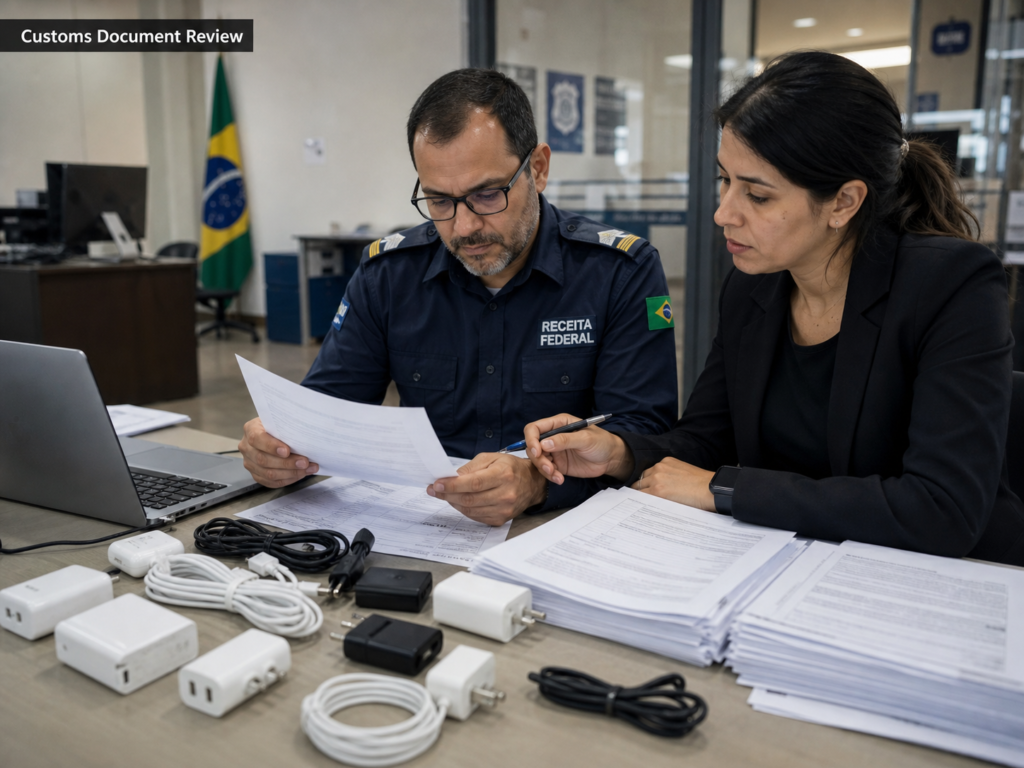
Customs Clearance Document Checklist
Customs clearance documents are divided into several categories:
• **Basic required**: Commercial invoice, packing list, bill of lading/air waybill, required for all goods.
• **Provided as applicable**: Certificate of origin (if tariff reduction is required), import license (determined according to NCM and regulatory requirements).
• **Compliance certificates**: Valid certification/registration documents, local responsible entity authorization documents.
• **Product materials**: Portuguese manuals (as required), label design drafts, technical specifications.
• **Special goods**: For lithium battery-containing goods, UN 38.3 test summaries, dangerous goods declarations, packaging and labeling materials should be prepared according to the battery type, whether it is installed in the equipment, transportation method, packaging and carrier requirements; whether these materials need to be submitted as attachments to the import declaration shall be separately confirmed in accordance with Siscomex, carrier and applicable transportation regulations.
Special note: Screenshots of official system queries are only for auxiliary purposes and cannot replace formal compliance documents; the customs does not recognize screenshots, and formal certificates or authorization documents must be provided.
Import Declaration and License Requirements
Import declaration is handled by the Brazilian importer or customs broker through the official foreign trade declaration system, subject to the current official rules. Import licenses are not required for all products, depending on the NCM code and regulatory authority requirements. Some products need to be applied for in advance, and customs clearance is impossible without them. The customs verification logic is to compare the NCM code with regulatory requirements through the system to determine whether to check compliance/license documents. Not every batch of goods is checked, but goods will be detained if missing items are found.
To help everyone clarify the responsibilities of all parties, here is a responsibility matrix:
| Responsible Party | Core Responsibilities |
| Exporter/Supplier | Provide authentic technical documentation and qualified samples, cooperate in compliance handling, and ensure shipped products are completely consistent with the filed records |
| Brazilian Importer/Responsible Entity | Act as the subject of compliance applications, and bear responsibilities for customs declaration, joint and several liability for product compliance, after-sales services and environmental protection obligations |
| Compliance Testing and Certification Institution | Conduct testing and certification in accordance with official rules, and ensure the authenticity and validity of certificates |
| Federal Customs | Verify customs clearance documents, levy taxes and fees, inspect goods, and check whether access documents are complete |
| Market Supervision Institution | Conduct random inspections of product compliance after market launch, and impose penalties for violations |
Common Customs Clearance Obstacles and Countermeasures
These are high-frequency pitfalls that predecessors have fallen into, and can be avoided by paying attention in advance:
1. **Compliance model inconsistent with declaration**: For example, the declared model is A, but the certificate says A-1, even a difference of one letter will lead to detention. Countermeasure: Carefully check that the model, parameters and filed records are completely consistent before shipment.
2. **Compliance number not queryable in official system**: The fact that a document cannot be queried in the official system does not necessarily directly prove that the document is fake; it may also be due to mismatches in certificate type, registration status, data synchronization, model, or certificate number query method. Countermeasure: Suspend the use of the document, verify the certificate type, number, holder, model and valid status through INMETRO/ANATEL, the certification body or the responsible entity, and confirm validity before shipping.
3. **Incomplete label information or no Portuguese**: Brazil requires that mandatory information must be in Portuguese, such as rated parameters and warning statements, and missing information will lead to detention. Countermeasure: Have a compliance institution review the labels before packaging and printing.
4. **Missing import license or wrong NCM classification**: For example, classifying power supplies into the accessories category, resulting in different required licenses. Countermeasure: Verify NCM and import license requirements in advance, and do not classify arbitrarily.
Market Compliance and Pit Avoidance Guide
Clearing goods into the country does not mean everything is fine. There is still supervision after market launch, and penalties for violations are equally severe.
Key Points of Pre-Launch Compliance Inspection
Be sure to check again before warehousing or listing:
• **Label and packaging**: All mandatory information is in Portuguese, certification marks are clear, and comply with regulations and consumer protection requirements.
• **Parameter consistency**: The parameters on the product body, packaging, manual, and publicity page must be completely consistent with the filed records. You cannot publicize 65W while the actual filing is 20W.
• **Channel requirements**: Upload compliance materials according to platform/supermarket requirements, pay attention to distinguishing legal obligations from platform rules. Do not treat platform requirements as legal requirements, nor assume that meeting platform requirements means meeting legal requirements.
• **Document retention**: Keep compliance documents and import vouchers for market supervision random inspections.
Official Verification Channels and Update Mechanism
You can query the rules and certificate validity through these official channels. Remember to keep screenshots and date records when querying:
• INMETRO official website: Query mandatory catalogs, certificate validity, and technical regulations.
• ANATEL official website: Query regulatory catalogs, approval number validity, and technical requirements.
• Foreign trade declaration system or customs official website: Check NCM and import license regulatory requirements.
• Official websites of corresponding regulatory authorities: Check current labeling specifications.
• Carrier official website: Check transportation rules for special goods such as lithium batteries.
Be sure to remember: All regulations, catalogs, and processes are dynamically adjusted, subject to the official information on the day of query. Do not use rules from several years ago as the basis.
High-Frequency Pitfalls and Avoidance Methods
These 5 pitfalls are the most frequent, and must be avoided:
1. **Fake/invalid certification pit**: Unscrupulous institutions sell fake or expired certificates, resulting in goods detention, fines, and delisting. Prevention: Verify in the official system immediately after getting the certificate, choose institutions with formal qualifications, and do not be greedy for cheap to find unknown small institutions.
2. **Product inconsistent with filing pit**: The certification uses the circuit of Plan A, but mass production is replaced with the cheaper Plan B, or the appearance and interface are changed without re-evaluation. Even if the certificate is real, it will become invalid, resulting in compliance invalidation, goods detention, and penalties. Prevention: Consult the compliance institution before any model change to confirm whether re-testing or certificate change is required.
3. **Wrong classification missing compliance pit**: For example, treating a smart wireless charger with Bluetooth as an ordinary wireless charger, missing ANATEL, resulting in obstructed customs clearance and post-launch penalties. Prevention: Strictly verify step by step according to the decision tree, do pre-assessment if in doubt, and do not take things for granted.
4. **Compliance invalidation pit**: Thinking that one certification is permanent, not knowing that the certificate has expired or regulations have been updated, and only finding out that it cannot be used when shipping, resulting in inability to clear customs. Prevention: Regularly verify the certificate status in the official system, cooperate with random testing and renewal, and prepare in advance.
5. **Small parcel exemption misconception**: Small parcels, express delivery or personal import do not automatically exempt from applicable product safety, wireless equipment, labeling, transportation or import supervision. Whether personal use, exhibition, maintenance or temporary import is eligible for exemption must be confirmed item by item in accordance with the corresponding system, import mode and specific conditions, and cannot be judged solely by “commercial sale/personal use”. Prevention: Do not take transportation channels or parcel size as the basis for automatic exemption, and verify regulations in advance for special situations.
Common Exemption Situations (Need to Be Verified One by One)
There are several types of situations that may be exempted from compliance, but they need to be verified one by one and cannot be applied by oneself:
• Items for personal use and in reasonable quantity;
• Display samples for exhibition (need to be re-exported);
• Spare parts for maintenance (need to meet corresponding requirements);
• Other exemption situations confirmed by the regulatory authority.
Small parcels, express delivery or personal import do not automatically exempt from applicable product safety, wireless equipment, labeling, transportation or import supervision. Whether personal use, exhibition, maintenance or temporary import is eligible for exemption must be confirmed item by item in accordance with the corresponding regulatory regulations, import mode and use of goods.
Pre-Shipment Self-Inspection and Evidence Archiving
To avoid the various problems mentioned above, it is recommended to do a quick self-inspection before each shipment, and keep good evidence at the same time, so that responsibilities can be clarified if there are problems.
Quick Self-Inspection Checkpoints
Conduct basic pre-shipment self-inspection against the following 8 items, but this list cannot replace formal verification based on products, NCM and current regulations:
1. Product classification: Complete NCM classification and mandatory catalog verification, and clarify all mandatory compliance matters.
2. Compliance coverage: All mandatory compliance is within the validity period, covering all shipped models and functions.
3. Model consistency: The model, parameters, and structure of the shipped products are completely consistent with the official filed records.
4. Label language: Mandatory label information is in Portuguese and meets the requirements of corresponding regulations.
5. Voltage and plug: The plug of plug-in products meets the Type N standard, the rated value matches, and the voltage marking is true.
6. Lithium battery: Lithium battery-containing products have completed transportation compliance preparations and meet the requirements of carriers and customs.
7. Import documents: Certificates, licenses, and authorization documents required for customs clearance are complete and in an officially accepted format.
8. Sales publicity: Publicized parameters are consistent with the filed records, and there is no exaggerated or false publicity.
Compliance Evidence Archive Package
These documents must be stored well, both in electronic and paper versions:
• **Regulatory basis category**: Query screenshots and date records of mandatory catalogs and technical regulations.
• **Classification basis category**: Product definition description, NCM classification opinion or judgment basis.
• **Compliance document category**: Certification/registration certificates, official system status query records, responsible entity authorization letter.
• **Product material category**: Finalized labels, Portuguese manuals, technical specifications.
• **Batch traceability category**: Shipment batch records, transportation compliance documents (if applicable).
Summary
Although the access of charging products in Brazil seems to have many links and detailed rules, as long as you master the core logic and proceed step by step, you can avoid most pitfalls.
For beginner sellers, achieving these four points counts as entry: being able to explain the division of labor between the two core institutions INMETRO and ANATEL and their corresponding compliance systems; being able to initially judge the mandatory compliance requirements for a charging product according to the decision tree; being able to verify the authenticity and validity of INMETRO and ANATEL compliance documents through the official system; being able to complete basic pre-shipment compliance inspection against the self-inspection checkpoints.
If you want to operate more stably and reduce operational risks, you can also master advanced abilities: being able to estimate the approximate cycle and cost range of compliance handling and identify core influencing factors; being able to avoid 5 common compliance pitfalls and reduce the risks of goods detention, delisting, and fines; being able to agree on key compliance clauses in procurement contracts and clarify the responsibility boundaries of all parties; being able to distinguish the different requirements and responsible entities of the three links: compliance filing, customs clearance, and sales.
The Brazilian market has a large demand for consumer electronics, especially charging products. As long as compliance is done solidly, you can operate stably for a long time without worrying every day about goods being detained or product listings being delisted.