
Sellers engaged in cross-border charging product business often encounter EAC certification as the first access threshold when expanding into Eurasian markets such as Russia and Kazakhstan. Many people have a vague impression of it: some think it is Russia’s “CE certification”, some believe that just printing the mark can get them through, and others spend money on a certificate but still have their goods detained and fined during customs clearance.
In fact, EAC is a systematic set of market access rules. It is not as mysterious as some think, but it is by no means “one certificate for all markets”. In this guide, we start from the basics, combined with actual scenarios of common products such as charging cables, chargers, and wireless chargers, to clarify scope judgment, mode selection, technical requirements, processing procedures and key pitfall avoidance points. After reading this, you will be able to independently complete most of the preliminary compliance judgments and avoid many detours.
1. EAC Basics: Definition, Scope of Application and Overall Decision-Making Logic
What is EAC: Not a Single Certificate, but a Set of Access Systems
First of all, it should be clarified that EAC is not a certain “universal certificate”, but a unified conformity assessment and marking system implemented by the Eurasian Economic Union (EAEU, referred to as the Eurasian Union). You can understand it as the “general framework of market access rules” of the Eurasian Union: different types of products correspond to different technical regulations. After meeting the regulatory requirements, you can obtain compliance documents, use the EAC mark, and enter the markets of the union’s member states. Its effectiveness is not uniform, but is determined according to the corresponding technical regulations and product types.
Let’s first clarify the two most core terms that many people easily confuse:
• **Certificate of Conformity (CoC)**: Issued by a certification body within the accreditation scope of EAEU member states, it is a third-party certification assessment result, equivalent to a qualified institution verifying whether the product meets the requirements.
• **Declaration of Conformity (DoC)**: Submitted by an applicant within the EAEU territory, it is a self-declaration assessment result, equivalent to a local qualified entity taking complete technical data and actively declaring that the product meets regulatory requirements.
Both are legal EAC compliance documents, and the EAC mark can be used after compliance. The core difference lies in the different applicable product lists and different primary responsible parties.
It should also be specially reminded that not all electronic accessories require mandatory EAC. Whether it is necessary to do so should be judged in combination with the function, purpose and sales form of the product. In addition, the four types of requirements commonly encountered should be distinguished: customs release and market sales are statutory access requirements; while platform rules and purchaser requirements are additional requirements at the commercial level, not mandatory standards for statutory access, so don’t confuse them.
Covered Markets and Country Differences
The Eurasian Union currently has 5 member states: Russia, Kazakhstan, Belarus, Armenia, and Kyrgyzstan. Conformity assessment documents completed in accordance with applicable EAEU technical regulations, valid within the specified scope and registered, can in principle be used for the markets of these five member states.
But this does not mean that all documents and all products can be “one certificate for all uses” without verification. When actually placing on the market, it is also necessary to confirm whether the product is within the scope of the document, whether it is affected by transition period regulations, and whether the label, language and member state implementation requirements are met. There are still differences among countries in language requirements, supervision intensity, random inspection frequency, and specific implementation rules. For example, the strictness of random inspections in Russia and Kazakhstan is different, and the implementation requirements must be checked country by country when finally landing.
Common Consequences of Non-Compliance
Many sellers have the mentality of “sell first, and make up for it if found out”. In fact, the cost of EAC non-compliance is not small, mainly reflected in three links:
• **Customs clearance side**: If products subject to mandatory certification do not have compliance documents, they will most likely be detained, may also incur fines, and in serious cases, be directly returned, resulting in losses of freight and goods value.
• **Sales side**: If products are found to be unqualified in random inspections after being put on the market, they may be required to be recalled, or even be included in the regulatory blacklist, making it much more difficult to enter the market later.
• **Platform side**: Many cross-border e-commerce platforms in Eurasia require sellers to provide EAC compliance documents to enter corresponding categories, and non-compliant products may be directly removed from the shelves.
4 Most Common Conceptual Misconceptions
There are many rumors and misconceptions about EAC. Here we clarify the four most common ones to avoid you falling into pitfalls:
1. **Misconception: EAC = Russia’s single-country certification**. In fact, EAC is a unified framework of the Eurasian Union. If conditions are met, the five member states recognize each other. It is only because the Russian market is the largest and people have the most contact with it that this misunderstanding exists. Of course, the implementation requirements of each country are different, so it is still necessary to separately check the landing rules.
2. **Misconception: CE/FCC/CB reports can directly replace EAC**. The regulatory systems of different regions are independent and do not recognize each other. These reports can only be used as technical data reference, and cannot be directly used as EAC compliance documents; customs will not recognize them during customs clearance.
3. **Misconception: Printing the EAC mark means compliance**. The EAC mark can only be used in accordance with regulations after completing the applicable conformity assessment and obtaining valid compliance documents. Use without conformity assessment or in violation of marking rules may be deemed non-compliant, and corresponding responsibilities shall be borne in accordance with the applicable laws of member states.
4. **Misconception: EAC is permanently valid once processed**. EAC compliance documents have a validity period, and if the product itself or the applicant subject changes, the compliance needs to be re-evaluated. The length of the validity period depends on the specific regulations and processing scheme.
Overall Access Decision-Making Framework
After understanding the basic concepts, you can make a preliminary judgment on EAC access in these three steps, with a clear logic:
1. Step 1: Determine whether the product is subject to the EAEU technical regulations. If it is not within the scope of jurisdiction, naturally there is no mandatory requirement.
2. Step 2: If it is within the scope of jurisdiction, then match the corresponding technical regulations and the corresponding conformity assessment scheme, that is, see whether DoC or CoC is required.
3. Step 3: Determine the type of compliance documents, registration requirements, and the landing implementation standards of the target market, such as language and label requirements.
Regulation Versions and Official Verification Channels
EAC regulations and product lists are updated, and many old materials on the Internet may be outdated, so the final information must be based on official channels. There are three commonly used official query portals: the official website of the EAEU Commission, the official websites of the competent authorities of member states, and the EAEU Unified Conformity Assessment Register. Through these channels, you can check the current version of technical regulations, product control lists, label requirements, as well as special rules such as radio and encryption.
The content of this guide is for your preliminary screening reference, and the final compliance judgment shall be subject to the effective regulations at the time you put the product on the market.
2. Scope Judgment of Charging Products: Classification Matrix and Boundary Verification
After understanding the basic logic of EAC, what everyone is most concerned about must be: do the charging cables, chargers, wireless chargers and other products I sell need EAC? Next, we will provide you with a set of classification matrix for rapid preliminary screening and boundary judgment methods for common charging products.
EAC Jurisdiction Preliminary Screening Matrix for Charging Products
The following table is a quick preliminary screening reference for 6 types of common charging products, to help you judge the general scope of jurisdiction at the first time:
| Product Type | Core Features | Core Reference Regulations | Key Judgment Boundaries | Common Judgment Difficulties |
| Chargers/Power Adapters (including GaN fast chargers, desktop chargers) | Connected to mains (AC 100-240V), with active power circuits | TR CU 004/2011 (Low Voltage Safety), TR CU 020/2011 (Electromagnetic Compatibility) | Power, circuit scheme, whether with wireless/battery functions | Chargers and power adapters connected to mains and falling within the scope of application of TR CU 004/2011 usually need to be checked against TR CU 004/2011; it is also necessary to check the exclusions in the annexes of the regulation and whether there are special technical regulations. |
| USB Cables/Adapters (including E-Marker cables, passive adapters) | Transmit electricity/data, divided into two categories: passive without chip and active with chip, with varying rated voltage/current | Determined by independent sales attribute, voltage, circuit structure | Whether sold independently, rated voltage/current, whether with active circuit, whether it is a matching accessory | Independently sold cables with active circuits may be classified as electrical equipment, while purely passive matching low-voltage cables may be on the exclusion list. |
| Wireless Charging Devices (including wireless charging bases, magnetic wireless chargers) | Powered by electromagnetic induction, with active control circuits, some with wireless communication functions such as Bluetooth/Wi-Fi | TR CU 004/2011, TR CU 020/2011 | Whether with Bluetooth/Wi-Fi, whether with built-in battery, transmission power and frequency band | Wireless communication functions may involve special access requirements; it is necessary to check the scope of application and exclusions of TR CU 020/2011, and separately check the EAEU unified list of radio equipment, frequency bands, and the licensing, registration or other use conditions of member states. |
| Powered Docking Stations/Adapters | Multi-interface expansion, with power supply/data transmission functions | TR CU 004/2011, TR CU 020/2011 | Number of interfaces, whether with wireless/storage functions, rated parameters | Additional functions may change the product category, which needs to be confirmed against the list. |
| Car Chargers | Input from car cigarette lighter (DC 12/24V), with step-down circuit, some with wireless/Bluetooth functions | DC 12/24V products are usually not subject to TR CU 004/2011 due to this voltage; TR CU 020/2011, TR EAEU 037/2016, TR CU 018/2011 (if they are regulated vehicle components) and radio requirements shall be checked | Input voltage, whether with wireless/Bluetooth, whether it is original vehicle accessory, sales scenario | Vehicle-mounted scenarios may fall under the vehicle parts regulatory system, rather than civil electrical regulations. |
| Battery-powered Charging Products (power banks, wireless chargers with built-in battery) | Contain lithium batteries, with both energy storage and power supply functions | Check requirements such as TR CU 004/2011 and TR CU 020/2011 according to power supply voltage, equipment category and applicable list | Battery capacity, whether sold independently, whether it is a built-in matching battery | Lithium batteries may have special safety requirements, and the judgment for independent sales and matching sales is different. |
Exception Scenarios Where Mandatory EAC Is Not Required (Conditions Need to Be Verified)
Of course, not all charging-related products require mandatory EAC. The following are common exception scenarios, but you must check the conditions clearly and cannot take it for granted:
1. **Purely mechanical accessories without conductive functions**: For example, cable organizers, cable protectors, and purely physically fixed brackets, which do not involve electrical functions at all, are naturally not within the scope of electrical regulations.
2. **Industrial/explosion-proof special charging equipment**: Special equipment for explosion-proof, vehicle, medical, transportation and other purposes shall be judged according to the actual use of the product and the annexes of the regulations; they may be subject to special regulations such as TR CU 012/2011 and TR CU 018/2011, or may not be subject to TR CU 004/2011 due to specific exclusions. “Industrial equipment” cannot be used as a unified exemption reason.
3. **Personal use/exhibition/test samples**: Whether such products require EAC must comply with the limit requirements of the customs of the importing country and the regulations on use declaration, which need to be checked case by case. It is not that samples do not need to be done at all.
4-Step Method for Independent Judgment of Boundary Products
If your product is just on the boundary, such as a USB-C cable with E-Marker, and you are not sure whether to do EAC, you can judge it yourself first in these four steps:
1. **Step 1: Determine the nature of the equipment**: Is it an independently sold electrical device, a matching accessory sold with other products, or a component of a product? Independently sold products have a higher probability of being regulated.
2. **Step 2: Check the applicable conditions of TR CU 004**: Only those with a rated voltage between AC 50-1000V and DC 75-1500V will fall within the jurisdiction of the low-voltage regulation, which is a very important threshold.
3. **Step 3: Check related requirements item by item**: Check the scope of application and exclusions of TR CU 020/2011, and for wireless transmission functions such as Bluetooth and Wi-Fi, separately check the EAEU unified list of radio equipment, frequency bands, and the licensing, registration or other use conditions of member states. At the same time, also check the restriction of hazardous substances, special scenario requirements and lithium battery related requirements.
4. **Step 4: Match the current regulation product list**: Confirm whether your product is within the scope of jurisdiction; the list is the most accurate basis for judgment.
Two important reminders need to be added here: First, low-voltage products (such as 5V passive USB cables) do not meet the voltage conditions of TR CU 004, but this does not mean that all EAC requirements are automatically exempted. For example, the hazardous substances regulation may still apply. Second, the HS code can only be used as a reference. The final judgment shall be based on the actual attributes of the product, and conclusions cannot be drawn solely by the HS code.
Scope Judgment of Set Products
Many sellers sell charging sets, such as a combination of a charger and a charging cable. Here are three rules to note:
1. The components in the set shall be judged for compliance requirements separately, and it cannot be assumed that the entire set shares one compliance document.
2. All models, components and combination forms must be clearly marked on the compliance document. Components not listed cannot be sold together with the set.
3. The outer packaging of the set must be marked with the necessary information of all components. If it is a very small component, the information can be placed inside the packaging or in the accompanying documents, but it cannot be completely absent.
Tips for Boundary Cases Prone to Misjudgment
Finally, let’s talk about two boundary situations that are most prone to misjudgment, which must be noted:
• **USB-C cables with E-Marker chip**: Many people think that those with chips need EAC, or none of them need it. In fact, this is not correct. It is necessary to first confirm whether it is sold independently, what the rated parameters are, and the attributes of the active circuit, and then judge in combination with the regulation list. It cannot be generalized.
• **Chargers with the same appearance but different power**: For example, chargers that are all small white squares have different powers of 20W, 30W, and 65W, and the internal power supply scheme and circuit structure may be completely different. In this case, they need to be evaluated separately and cannot share the same compliance document.
3. EAC Compliance Mode Selection: Application Logic of DoC and CoC
After confirming that the product is within the scope of EAC jurisdiction, the next thing to figure out is: should we do DoC or CoC? Can we choose by ourselves? In this part, we will explain the differences between the two modes and the selection rules thoroughly.
Core Differences Between the Two Compliance Modes
Many people easily confuse DoC and CoC. The following table is a comparison of the core differences between the two to help you quickly distinguish:
| Comparison Item | Declaration of Conformity (DoC) | Certificate of Conformity (CoC) |
| Core Logic | Self-declaration by the domestic applicant, effective after completing registration in accordance with regulations | Issued after review by a qualified certification body |
| Applicable Prerequisite | The product is within the DoC applicable list | The product is within the mandatory CoC list |
| Primary Responsible Party | Applicant within the EAEU territory | The applicant still bears the main responsibility, and the certification body carries out certification within its accreditation scope |
| Testing Requirements | Determined by technical regulations, not all require third-party testing | Usually required to carry out specified type tests according to the scheme |
| Production Condition Audit | Involved in some schemes | Required for most high-risk products |
| Applicable Scenarios | Self-declaration compliance scenarios | Mandatory third-party certification scenarios |
Specifically:
• **Declaration of Conformity (DoC)**: It belongs to the self-declaration mode. The core is that the applicant within the Eurasian Union territory self-declares that the product meets the requirements of the corresponding technical regulations based on complete technical evidence, and it takes effect after submission for registration. Many people think that DoC is just a random declaration, but this is not the case. The assessment requirements depend on the specific technical regulations, and not all DoCs do not require third-party testing.
• **Certificate of Conformity (CoC)**: It belongs to the third-party certification mode. The core is that a qualified certification body reviews the product and conducts corresponding type tests, and issues the certificate after confirming that it meets the requirements. Such products have relatively higher risks, so the requirements are stricter. Some high-risk products also need to have their production conditions audited, and there may be subsequent supervision and random inspections after the certificate is issued.
Core Rules for Compliance Mode Selection
Here is the key point: **The two modes cannot be chosen independently**. You must confirm which category your product belongs to against the product list and assessment scheme of the technical regulations.
There are also two prohibitions: First, it is forbidden to use voluntary certificates or ordinary third-party test reports to replace mandatory DoC or CoC, which are not valid compliance documents. Second, products that require mandatory CoC cannot be processed as DoC, otherwise they will be directly deemed invalid during customs clearance or random inspection, which means it is done in vain.
Validity Period and Applicable Types of Assessment Documents
EAC compliance documents are not permanently valid. According to different applicable scenarios, they are mainly divided into two categories:
• **Single-batch documents**: Bound to specific import orders, suitable for sellers with small-batch trial sales. Its validity depends on the specific assessment scheme, contract agreement and model scope, and generally only corresponds to one import.
• **Continuous production documents**: Suitable for long-term export sellers. The common validity period is 1-5 years, and the actual duration shall be subject to the information on the technical regulations and registration documents. If you want to renew, it is best to apply 1-2 months in advance. If the product has not changed, the renewal process can be simplified.
Boundaries Where Compliance Documents Cannot Be Shared
Many sellers will ask: if I change the brand or add a model, can I use the original certificate? When changes occur in the manufacturer, production address, trademark, model, rated parameters, key safety components, wireless modules, batteries, or set scope, the certification body or the declaration registration subject shall evaluate whether it falls within the scope of the original document before shipment. According to the evaluation results, it may be necessary to handle changes, supplementary tests, re-registration or re-assessment. Not every change will automatically invalidate the original document.
1. **Subject change**: Change of brand, manufacturer, production address, EAEU domestic applicant.
2. **Core design change**: Change of power supply scheme, circuit structure, key safety components (such as transformers, insulating materials).
3. **Parameter change**: Change of input and output rated parameters, plug specifications.
4. **Function change**: Addition of unlisted functions such as wireless modules, batteries, fast charging protocols.
5. **Scope change**: Addition of unlisted models, set combinations, detachable components.
6. **Invalidation situation**: When the document expires, is suspended or revoked, it shall not continue to be used.
4. Core EAC Technical Compliance Requirements: Regulation Application and Common Non-Conformities
After determining the compliance mode, the next step is to understand the core technical regulatory requirements, as well as the most common non-conformities of charging products, to rectify in advance and avoid failing tests or random inspections.
Low Voltage Safety Regulation (TR CU 004/2011)
The first core regulation is the low voltage safety regulation. Charging products connected to mains and falling within the scope of application of TR CU 004/2011 usually need to be checked against this regulation. However, it is not enough to only look at the input voltage; it is also necessary to check whether the product is an applicable object in the annexes of the regulation, and whether there are exclusions or special technical regulations.
Its applicable objects are: electrical equipment with a rated voltage between AC 50-1000V and DC 75-1500V, and also listed in the product list of the regulation. Only when both conditions are met will it be regulated.
It controls four core risks: electric shock prevention, fire prevention, mechanical injury prevention, and overheating prevention, all of which are directly related to personal safety. Common supporting documents include safety test reports, insulating material certificates, and structural inspection records.
Special equipment for explosion-proof, vehicle, medical, transportation and other purposes shall be judged according to the actual use of the product and the annexes of the regulations; they may be subject to special regulations such as TR CU 012/2011 and TR CU 018/2011, or may not be subject to TR CU 004/2011 due to specific exclusions. “Industrial equipment” cannot be used as a unified exclusion reason.
The most common non-conformities of charging products include: pin size not meeting the standards of the target country, insufficient insulation layer thickness, overheating during full-load operation, and unqualified flame retardant performance of the shell. These are key points to pay attention to during design and production.
Electromagnetic Compatibility Regulation (TR CU 020/2011)
The second core regulation is the electromagnetic compatibility regulation, which is commonly referred to as EMC.
Its scope of application and exclusions are stipulated by the text and annexes of the regulation, and cannot be simply judged according to a “product control list” that is the same as the low-voltage regulation. Whether the product is applicable shall be checked in combination with the equipment category, working mode and specific exclusions.
There are two core requirements: first, the product shall not interfere with the normal operation of other equipment when working; second, the product itself shall have sufficient anti-interference ability, and will not crash or malfunction due to external interference. Common supporting documents are EMC test reports and circuit design descriptions.
Purely passive accessories without circuits, as well as some special industrial equipment, may be excluded from this regulation. The specific scope of application and annexes shall still be checked.
Common non-conformities of charging products include: interfering with the signals of mobile phones and routers during operation, or poor anti-interference ability, which is prone to crash and charging interruption when there are high-power equipment nearby.
Restriction of Hazardous Substances Regulation (TR EAEU 037/2016, Eurasian RoHS)
The third is the restriction of hazardous substances regulation, also known as Eurasian RoHS, which is similar to the EU RoHS.
Its scope of application and exemptions are stipulated by the regulation and its annexes, mainly controlling the content of hazardous substances such as lead, mercury, cadmium, hexavalent chromium, polybrominated biphenyls, and polybrominated diphenyl ethers in electrical and electronic products included in the scope of application. Common supporting documents include hazardous substance test reports, material declarations, and technical data used to explain the scope of application or exemption conditions.
Some industrial equipment, medical equipment, and special parts may not be within the scope of application of this regulation, and the specific details shall be checked in the annexes of the regulation.
It should be noted for charging products: not all charging accessories are within the scope of application. It is necessary to first check the applicable products, exclusions and allowed exemptions in the annexes. When conditions are met, material declarations, technical basis or other certificates shall be retained in accordance with regulations, and it shall not be generally stated that one can “apply for exclusion” on its own.
Compliance Boundaries of Special Functions
In addition to the above three general regulations, some products with special functions or used in special scenarios may also involve special requirements. These do not necessarily all fall within the general scope of EAC, and need to be checked separately:
• **Radio functions (Bluetooth/Wi-Fi/wireless communication)**: Such products may need to comply with the EAC assessment of TR CU 020 at the same time, and also meet the unified rules related to EAEU radio equipment and the radio management requirements of member states. The unified list of radio equipment, frequency bands, transmission parameters and the licensing, registration or other use conditions of the target member state shall be checked. Whether the EAC mark can be used shall be confirmed according to specific regulations and equipment categories.
• **Encryption function**: First, check the EAEU unified list of encryption/cryptographic technology equipment and the rules on notification, licensing and exemption, and then confirm whether relevant procedures need to be handled according to the implementation procedures of the competent authority of the target member state.
• **Lithium battery related**: If it is a charging product with a built-in battery, such as a wireless charger with a battery, the safety requirements of the lithium battery will be included in the overall EAC assessment; but if it is a lithium battery transported independently, UN38.3 is a transport safety document, which can only be used for transport and cannot replace the EAC market access assessment. Don’t confuse them.
• **Vehicle-mounted use scenario**: For example, for car chargers, it is necessary to first confirm whether they belong to the vehicle parts regulatory system. If they are regulated vehicle components, they may involve TR CU 018/2011; if not, it is also impossible to directly judge the application or exclusion of a certain civil electrical regulation solely by the word “vehicle-mounted”.
EAC Mark and Label Requirements
After the compliance documents are completed, another very important link is marking and labeling. The specific size, position and information content shall be subject to the applicable technical regulations and the EAC mark use rules.
EAC Mark Requirements
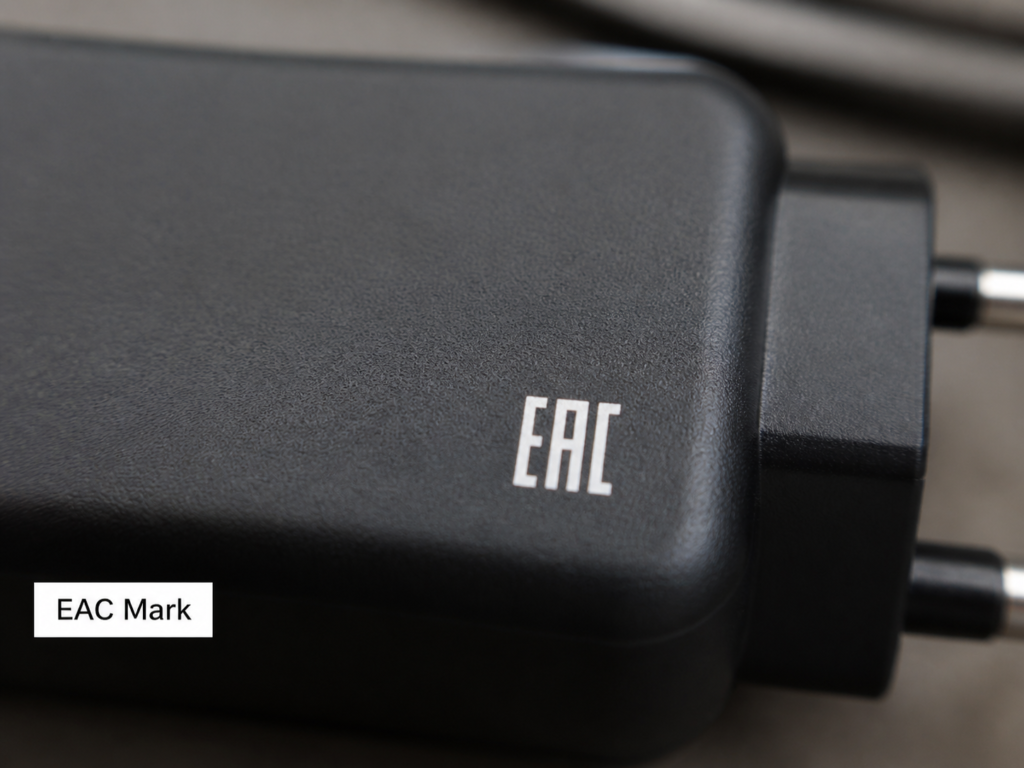
• **Size and position**: Determined by regulations. The minimum height of the EAC mark for conventional products is usually 5mm, and it shall be affixed in a conspicuous position that is not easy to be worn off.
• **Exception scenarios**: For particularly small products (such as micro adapters) that cannot fit the mark on the body, the mark can be placed on the packaging or accompanying documents according to regulatory conditions, and cannot be moved at will.
• **Prerequisite for use**: The EAC mark can only be used in accordance with regulations after completing the applicable conformity assessment and obtaining valid compliance documents. Use without conformity assessment or in violation of marking rules may be deemed non-compliant, and corresponding responsibilities shall be borne in accordance with the applicable laws of member states.
Label Information Requirements
The requirements for labels and documents in different technical regulations are not exactly the same. A certain set of information cannot be regarded as a unified list for all charging products. The content of products, packaging, manuals and accompanying documents shall be determined in accordance with applicable technical regulations and the consumer information and language rules of member states.
Usually, it is necessary to provide the product name or model, main rated parameters, manufacturer information, and the responsible subject information required by regulations according to the product category. Whether information such as serial number, batch, country of origin, and plug type must be marked shall also be confirmed separately according to applicable regulations, product characteristics and sales markets.
Some information of small-sized products can be moved to the packaging, manual or accompanying documents when meeting regulatory conditions, but cannot be completely missing.
Language and Accompanying Documents
Language requirements shall comply with applicable EAEU technical regulations and the language and consumer information regulations of member states. For example, the Russian market usually requires Russian, and the requirements of other member states shall be checked country by country. English cannot be used in all countries.
Accompanying documents shall be determined in accordance with applicable technical regulations, member state language and consumer information rules, customs and sales platform requirements. Manuals and safety information usually need to be provided in the language of the target market; whether copies of compliance documents, parameter data and other accompanying materials must be shipped with the goods shall be confirmed separately by applicable regulations, customs and sales channels.
5. Full EAC Processing Process: Key Nodes from Data Preparation to Implementation
After understanding all the requirements, many people will ask: how to handle EAC exactly? What processes need to be followed? What materials need to be prepared? In this part, we will clarify the key nodes of the whole process so that you have a clear idea.
Data Preparation and Responsibility Division Before Processing
Before processing, first prepare all the materials, and also clarify the responsibilities of each role to avoid disputes later.
**List of required materials**: Product specification sheet, model list, circuit diagram, BOM (Bill of Materials), manual and label design draft in target language, sales form certificate (such as whether it is sold independently or as a matching set).
**Division of responsibilities of responsible subjects**:

• Manufacturer: Responsible for product design, technical document preparation, mass production consistency control, and ensuring that the product is consistent with the test sample.
• EAEU domestic applicant: Submits assessment application/declaration, liaises with supervision, and bears primary compliance responsibility. This subject must be within the territory of the Eurasian Union; Chinese companies cannot directly act as applicants.
• Importer: Responsible for verifying the consistency of documents, marks and goods before putting them on the market, and ensuring that imported products are compliant.
• Brand owner/OEM: Confirms the model range and set combination, is responsible for the compliance of product changes, and cannot arbitrarily change models or add functions.
Testing and Production Condition Assessment Stage
After the materials are prepared, it enters the testing and assessment stage:
• **Sample requirements**: The submitted samples must be completely consistent with the mass-produced version, and cannot be specially made “test samples”. The number of samples shall be determined according to the assessment scheme.
• **Testing requirements**: The testing subject and laboratory qualification depend on the applicable technical regulations and assessment scheme; when third-party testing is required, a qualified accredited laboratory shall be used. For some DoC schemes, the technical evidence and test results of the manufacturer or applicant can be used. The specific test items are determined by the corresponding regulations and assessment scheme.
• **Production condition assessment**: Many people think that only CoC requires production condition audit, but this is not the case. Production condition assessment depends on the assessment scheme, and both DoC and CoC may involve it, but CoC requirements are more common.
• **Non-conformity handling**: If the test fails, it is necessary to investigate the problem, rectify it and then retest until it is qualified.
Registration and Implementation Stage
After passing the test, it comes to the registration and implementation link. DoC or CoC shall complete the required registration in accordance with applicable regulations, and then verify the status, scope and validity period in the official unified registration system. The specific effective rules, registration fields and required materials shall be subject to the current registration system.
• **Document verification**: Before issuing the certificate or submitting the declaration, be sure to carefully check the core information such as manufacturer information, model, parameters, applicable regulations, and set scope. Don’t write it wrong, it’s very troublesome to change.
• **Official registration requirements**: Complete the required registration of CoC or DoC in accordance with applicable regulations, and retain relevant evidence and materials as required by regulations, and cannot lose them.
• **Register inquiry**: You can check the document number, status, validity period, subject, model, applicable regulations, change records and other information in the official unified registration system. After getting the document, be sure to verify it to confirm that the document is true and valid, and the information is correct.
• **Label implementation and shipment verification**: After the registration is completed, you can print the EAC mark and product labels as required. Before shipment, be sure to do a verification: check whether the product, label, compliance documents, and customs declaration information are completely consistent, to avoid finding that they do not match when arriving at customs.
Change and Renewal Management
After getting the certificate, it is not once and for all. Attention should also be paid to subsequent changes and renewals:
• **Change assessment**: If the product, subject, parameters, or set combination changes, be sure to first check whether it is within the original compliance scope. When changes occur in the manufacturer, production address, trademark, model, rated parameters, key safety components, wireless modules, batteries, or set scope, the certification body or the declaration registration subject shall first evaluate. If necessary, handle changes, supplementary tests, re-registration or re-assessment, and cannot directly continue to use the original document.
• **Renewal application**: If it is a continuous production document, the renewal application shall be submitted 1-2 months before expiration. If the product has not changed, the renewal process will be much simplified, and there is no need to go through the whole process again.
• **Data retention**: Technical documents and compliance documents shall be kept for the period required by regulations. Each subject shall bear its own retention responsibility, and be able to produce them during regulatory random inspections.
Cycle and Cost Reference (Market Reference, Not Statutory)
Finally, what everyone is most concerned about is the cycle and cost. What is given here is a common market reference value, and the specific situation depends on the product and service provider:
• **Conventional cycle**: DoC usually takes 2-4 weeks, CoC usually takes 4-8 weeks. This time does not include the time for rectification, logistics, and translation. If the product is unqualified and needs rectification, the time will be longer.
• **Cost composition**: Mainly includes testing fees, registration fees, translation fees, and service fees. If production condition assessment is required, this part of the fee will also be added.
• **Cost range**: Depending on the complexity of the product and the processing mode, it ranges from several thousand to tens of thousands of RMB. For example, the cost of simple passive cables and wireless chargers with Bluetooth varies greatly.
• **Items to be confirmed for quotation**: When asking a service provider for a quotation, be sure to confirm the number of models, whether plugs/cables are included, whether there is wireless/battery, and which testing and service items are included, to avoid low-price drainage and random price increases later.
6. Pitfall Avoidance in Procurement and Customs Clearance: Key Verification Points at Implementation Level
Many sellers purchase products from suppliers, or find service providers to handle certification. There are many pitfalls here. In this part, we will talk about the key verification points in procurement and customs clearance links to help you avoid common traps.
Key Points of Compliance Verification on the Procurement Side
If you purchase ready-made products, you must do these verifications well to avoid getting fake certificates or non-compliant goods:
1. **Official verification of the register**: After getting the EAC documents provided by the supplier, be sure to check them in the official unified registration system to confirm that the documents are valid and the core information is correct. There are many fake certificates, so don’t trust them easily.
2. **Consistency verification**: It is necessary to confirm that the information in the registration system is completely consistent with the model, parameters, and subject of the product you purchase. For example, a single letter difference in the model is not allowed, and mismatched parameters are also not allowed.
3. **Mandatory clauses in the contract**: When signing a contract with the supplier, be sure to add compliance-related clauses, clarify the coverage of the compliance documents and the responsibility for authenticity, and who will bear the loss if goods are detained or fined due to non-compliance, to avoid disputes later.
4. **Multi-model/set procurement**: If you purchase multiple models or set products, check each model and each component one by one to see if they are in the list of compliance documents. You can’t only check the main model, otherwise the cables in the set are not covered, and they will still be detained during customs clearance.
Pitfall Avoidance Actions on the Customs Clearance Side
Customs clearance is the last pass, and also the link where problems are most likely to occur. Doing these points well can help you reduce a lot of troubles:
There is only one core requirement: the model, parameters, and marks of the product must be completely consistent with the customs declaration and compliance documents, not a single bit of difference.
There are four most common reasons for detention: no manual in the target country language, non-compliant EAC marks, product parameters inconsistent with those on the certificate, and components in the set not listed in the compliance documents.
The pitfall avoidance method is very simple: prepare the labels and documents before shipment, do a pre-review, send them to the customs clearance agent in advance for verification, and confirm that there is no problem before shipping. Don’t wait until the goods arrive at customs to find problems, then the handling cost will be high.
Key Points for Verification of Service Provider Selection
When looking for a third-party service provider to handle EAC, you must keep your eyes open and don’t fall into the trap of fake certificates:
• **Be wary of illegal promises**: For example, those who claim “certificate issuance in 3 days” or “can be processed without samples” are most likely fake certificates, or documents not registered officially, which are useless at all.
• **Qualification verification**: It is necessary to verify whether the certification body or laboratory is accredited by the accreditation body of the member state, whether it is included in the corresponding EAEU list of conformity assessment bodies or laboratories, and confirm that its business scope covers the relevant technical regulations. DoC or CoC shall complete the required registration in accordance with applicable regulations, and then verify the status, scope and validity period in the official unified registration system.
• **Service scope verification**: It is necessary to confirm whether the service provider can cover all applicable regulations. For example, if your product has Bluetooth, you must confirm whether they can handle the special requirements of radio, and also see if there is follow-up support for changes and renewals. Don’t lose contact after getting the certificate.
• **Pitfall avoidance reminder**: Don’t just compare low prices. Low prices often mean fake certificates or incomplete services. If goods are really detained and fined, the loss is much more than the little certification fee saved. Be sure to prioritize confirming the authenticity, coverage and follow-up service capabilities of the documents.
7. Pre-Shipment Verification Checklist and Typical Decision-Making Cases
Finally, we have compiled a quick pre-shipment EAC verification checklist for charging products, as well as several typical product decision-making cases, for your reference during actual operation.
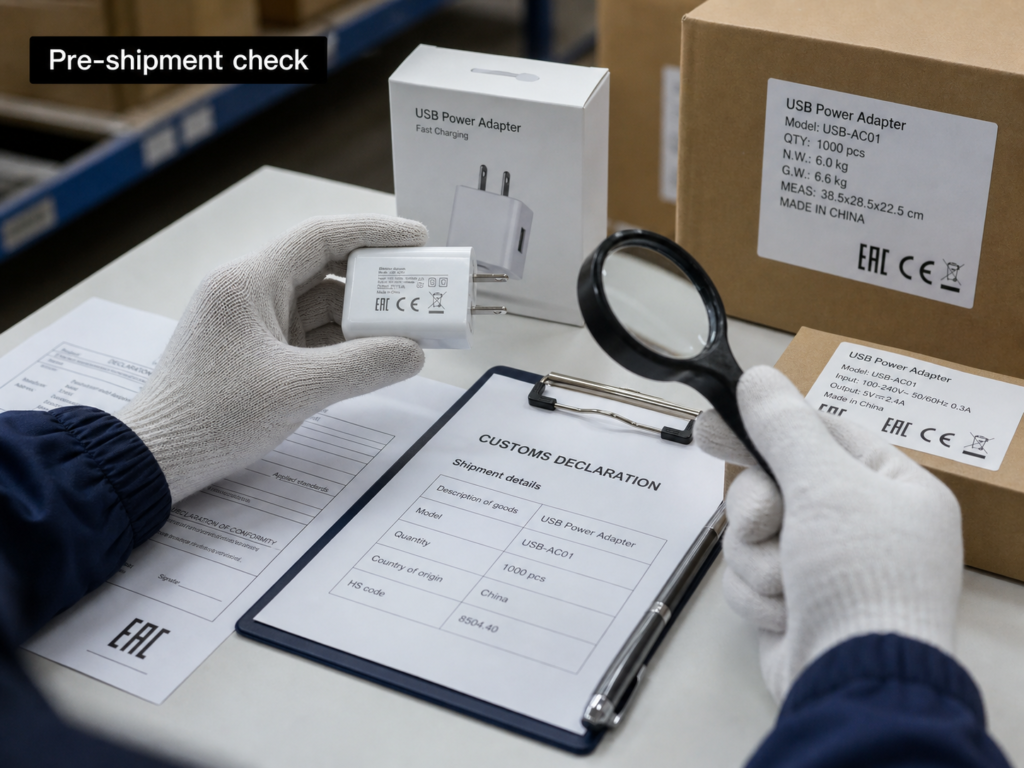
Quick Pre-Shipment EAC Verification Checklist for Charging Products
You can check one by one according to these four points, and ship only when there is no problem:
1. **Compliance documents**: The status in the official registration system is valid, the model, parameters, and subject are completely consistent with the actual goods, and they are still within the validity period.
2. **Technical marks**: The size and position of the EAC mark meet the regulatory requirements, the product label has complete information, and is consistent with the information on the compliance documents.
3. **Accompanying materials**: Manuals and safety information are prepared in accordance with the target country language and applicable regulations; copies of compliance documents, parameter data and other accompanying documents shall be confirmed item by item in accordance with applicable regulations, customs and sales channel requirements.
4. **Set products**: All components are within the coverage of the compliance documents, and the information on the packaging is complete.
Typical Product Decision-Making Deduction Cases
We have selected four of the most common charging products to demonstrate how to use the previous method for preliminary judgment. You can apply it to your own products:
Case 1: 65W GaN Charger (sold independently, connected to mains, no additional functions)
• Preliminary judgment: It is highly likely to be subject to mandatory EAC jurisdiction, and needs to match low voltage, EMC, and hazardous substances regulations.
• Items to be checked: Confirm the assessment mode with the current regulation list, target country language and label requirements, and plug type compliance.
Case 2: USB-C Fast Charging Cable with E-Marker (sold independently, rated 20V)
• Preliminary judgment: USB-C cables with a rated voltage of 20V usually do not meet the voltage threshold of TR CU 004/2011; relevant requirements shall be separately checked according to whether they are applicable products of TR CU 020/2011 and TR EAEU 037/2016 and whether they have wireless functions.
• Items to be checked: Whether it is within the specific scope of application of relevant regulations, judgment of active circuit attributes, and target country label requirements.
Case 3: Rated 5V Passive USB Cable (sold independently, no chip)
• Preliminary judgment: It does not meet the voltage application conditions of TR CU 004, and does not automatically exempt all requirements.
• Items to be checked: Judge according to the specific scope of application and exclusions of TR CU 020/2011 and TR EAEU 037/2016. It should not be presumed to be subject to these regulations just because it is an electronic accessory or low-voltage product; at the same time, check the sales, label and customs requirements of member states.
Case 4: Wireless Charging Base with Bluetooth Function (built-in battery, sold independently)
• Preliminary judgment: First confirm whether there is mains input and its rated voltage; when only powered by low-voltage DC, TR CU 004/2011 is usually not applicable, but it is still necessary to check TR CU 020/2011, TR EAEU 037/2016, radio requirements, as well as battery and transportation related requirements.
• Items to be checked: Radio access requirements, lithium battery safety requirements, matching of assessment mode and applicable scope of relevant regulations.
Reading this, you should have a relatively comprehensive understanding of EAC certification in the Eurasian Union. To sum up, after learning this guide, you should be able to independently complete the following things: accurately distinguish the core differences and applicable prerequisites of the EAC system, DoC and CoC; quickly screen the possibility of EAC jurisdiction over charging products through the classification matrix; find the verification direction of applicable regulations and assessment modes according to the overall decision-making framework; identify common EAC risks in procurement and customs clearance links, and avoid them in advance; complete the pre-shipment compliance preliminary inspection according to the pre-shipment verification checklist.
Of course, EAC has many detailed rules and they are updated. If you encounter uncertain boundary situations, be sure to check the latest regulations through official channels, or confirm with a reliable professional service provider. Don’t make decisions based on experience. Compliance is always the first step in expanding overseas markets.