
Friends who export charging products almost always encounter two unavoidable certifications: UL and PSE, one for the United States and one for Japan. Many people get confused when first encountering them: since both are safety certifications, are they just different in name? Can you sell directly in another market after getting one? Why do some cables require certification while others don’t? Today, we take civilian charging products (wall chargers, power adapters, USB cables, charging connectors, etc.) as examples to thoroughly explain UL and PSE from basic concepts to practical decision-making. After reading, you will not only be able to distinguish the differences between the two, but also judge what certification your product needs on your own.
Basic Understanding: First Grasp the Essence of the Two Certifications
UL: U.S. Third-Party Safety Assessment Service
UL itself is a globally renowned third-party safety organization, not a U.S. government agency. The safety assessments it provides are generally not universally mandatory at the federal level. Some platforms, supermarkets, purchasers, insurance companies, or local competent authorities may require UL or other accredited body certifications. The specific requirements depend on product category, sales channel, and installation/usage scenario. UL cannot be generalized as a unified “entry ticket” that all consumer products must have.
A key background to mention here: the U.S. Occupational Safety and Health Administration (OSHA for short) has authorized a number of qualified third-party organizations called “Nationally Recognized Testing Laboratories” (NRTLs). Marks such as ETL and cTUVus are issued by corresponding OSHA-accredited NRTL organizations. In workplace scenarios where OSHA applies, NRTL certifications that meet corresponding requirements generally have regulatory equivalence; however, state and local competent authorities, insurance companies, and sales channels may still specify specific marks or organizations, and the final requirement shall prevail based on actual needs.
For charging products, UL’s related assessment services may cover wall chargers, power adapters, USB/USB-C cables, charging connectors, and other products. The specific type of service to be used shall be confirmed based on product structure, applicable standards, and certification scope.
PSE: Japan’s Statutory Compliance System under the Electrical Safety Law
Unlike UL, PSE is not a certification from a single organization, but a statutory compliance system stipulated in Japan’s Electrical Appliance and Material Safety Law (abbreviated as the “Electrical Safety Law”), regulated by Japan’s Ministry of Economy, Trade and Industry (METI for short). As long as a product is listed in the Electrical Safety Law catalog, it cannot be imported or sold in Japan if it is non-compliant. Violations may result in fines, recalls, and other penalties, with specific responsibilities and measures depending on the nature of the violation.
PSE is divided into two categories: “Specified Electrical Appliances and Materials” and “Non-Specified Electrical Appliances and Materials”:
- Diamond PSE: Specified Electrical Appliances and Materials generally must undergo conformity inspection by a registered inspection body, and the diamond PSE mark may be used after completing the required procedures;
- Round PSE: For Non-Specified Electrical Appliances and Materials, the business operator shall conduct self-inspection, confirm compliance, and keep records in accordance with regulations, and the round PSE mark may be used after meeting requirements.
Specific classification is not simply based on a general “high risk/low risk” ranking, but shall be determined in accordance with the Electrical Safety Law classification table, as well as the product’s structure, intended use, and rated parameters.
Among charging products, most wall chargers and power adapters fall within the catalog scope; some cables and connectors need to be checked against the statutory classification table, and cannot be judged by product name alone.
Three Core Concepts Most Easily Confused
Many people run into pitfalls because they fail to distinguish these three terms; here we explain them clearly in plain language:
- Testing: A laboratory tests your samples and issues a report. The report can be used as part of technical documentation or compliance evidence, but a standalone test report does not automatically equal completed market access, nor can certification marks be used solely based on the report. For Diamond PSE, statutory procedures such as conformity inspection by a registered inspection body must also be completed; for Round PSE, business operators may conduct self-inspection, confirm compliance, and keep records in accordance with regulations. This is like taking a dish to test for hygiene: passing the test does not mean the restaurant has completed all business licensing procedures.
- Certification: Under certain certification models, a third party not only tests samples but also evaluates production control. After passing, it authorizes the use of the corresponding mark, and there may be follow-up surveillance requirements. The Round PSE category mainly adopts a business operator self-confirmation model, and does not require unified third-party certification issuance.
- Market Access: You must meet all local regulations, import requirements, and platform rules to sell legally. Certification or statutory compliance is only the most core part of this; having certification does not mean everything is settled.

Align the Premise Before Comparison: Avoid Haphazard Comparisons
To make the conclusions more referential, we first clarify the premises of the comparison, so as not to apply rules indiscriminately to different types of products.
Product Scope of Comparison
What we discuss today are all civilian ordinary charging products, which mainly include: wall chargers, AC-DC power adapters, passive/active fast-charging USB cables, and charging connectors. Special categories such as industrial power supplies, medical power supplies, power banks, and car chargers are not within the comparison scope, as their rules are different.
Core Comparison Dimensions
We compare six dimensions in order of importance from high to low: regulatory attribute and responsibility boundary, certification classification and corresponding products, testing focus and mutual recognition rules, certification process and cycle, labeling requirements and authenticity verification, and cost and subsequent maintenance.
Conclusions Are Not Fixed, They Are Affected by Three Factors
Don’t memorize conclusions like “chargers must have UL certification” by rote; the final requirements depend on specific circumstances:
- Product attributes: Rated parameters, internal circuit structure, input method, statutory category. Note: Power level and whether there is an e-Marker chip are not decisive factors for determining whether certification is mandatory;
- Sales scenario: Online or offline, ordinary consumer scenario or workplace, how importer responsibilities are defined, whether the platform has additional requirements;
- Sales form: Finished product or component, sold separately or bundled with other products. For example, requirements for cables in a set and cables sold separately may be different.
Item-by-Item Comparison of Core Dimensions
1. Regulatory Attribute and Responsibility Boundary: One is Market-Driven, the Other is Statutorily Mandatory
This is the most essential difference between the two; all other differences stem from this.
UL (United States)
UL requirements generally do not come from unified federal regulations for all consumer charging products, but may come from multiple channels:
- It mainly depends on the specific sales channel, such as whether platforms, supermarkets, or purchasers list UL or other accredited body certifications as entry requirements;
- Some U.S. state or local competent authorities may impose requirements on electrical equipment used in buildings through local electrical codes;
- For some workplace electrical products covered by OSHA electrical safety regulations that require the use of “approved” equipment, certification by an OSHA-accredited NRTL is generally required. Whether it applies shall be determined in combination with equipment category, installation method, and specific regulations.
Regulatory boundaries also need to be understood separately: OSHA mainly covers some workplace electrical safety requirements, and the U.S. Consumer Product Safety Commission (CPSC) is responsible for consumer product safety supervision and recalls. Whether ordinary consumer charging products require a certain type of certification shall also be determined in combination with the product, channel, and usage scenario. The responsible subject depends on the specific certification and transaction arrangement, and certification applicants usually include the manufacturer or brand owner.
PSE (Japan)
The mandatory nature of PSE comes directly from the Electrical Appliance and Material Safety Law, as stipulated by law. Its regulatory boundary is also very clear: only products listed in the Electrical Safety Law need to complete compliance in accordance with regulations, and products not within the scope cannot be affixed with the PSE mark arbitrarily to increase “credibility”.
Japanese importers and other entities bear corresponding obligations under the Electrical Safety Law, such as notification, inspection, labeling, and technical documentation. Sellers shall not sell products that are not compliant and labeled in accordance with regulations. Overseas sellers shall confirm, based on import declaration, responsible subject, and sales model, whether a local Japanese importer or other entity capable of bearing statutory obligations is required. In cross-border e-commerce, specific responsibilities cannot be determined solely by who sells on the webpage, but also by the actual import and transaction structure.
Core Differences
UL is a market-driven third-party safety assessment. Whether it is needed and which service to choose depend largely on the channel and specific usage scenario. PSE is a law-driven statutory compliance system. First, it depends on whether the product falls within the Electrical Safety Law catalog and its specific classification.
2. Certification Classification and Corresponding Charging Products: Two Completely Different Logics
UL Classification Logic
UL classification is mainly understood by the type of assessment service and product application scope, and is not a unified statutory risk grading system:
- Listing: Generally applicable to end finished products, which need to meet complete product standards and corresponding certification scope;
- Recognition: UL Recognized Component is used for complete machine or system matching, and cannot replace UL Listing or other applicable finished product certifications for end products. Whether it can be sold separately depends on the regulatory requirements and sales positioning of the product itself.
Special attention should be paid to charging products: component recognition marks cannot be used to impersonate finished product certification, nor can the certification scope of a certain component be extended to the complete machine or other models.
PSE Classification Logic
PSE is divided into Specified Electrical Appliances and Materials and Non-Specified Electrical Appliances and Materials:
- Diamond PSE: Specified Electrical Appliances and Materials generally must undergo conformity inspection by a registered inspection body and complete other procedures required by the Electrical Safety Law;
- Round PSE: For Non-Specified Electrical Appliances and Materials, the business operator shall conduct self-inspection, confirm compliance, and keep relevant records in accordance with regulations.
The specific classification of charging products shall be confirmed based on the classification table, intended use, input/output structure, and rated parameters, and cannot be judged by product name alone.
Cable category rules: Most low-voltage USB cables without AC input do not belong to the specified categories, and the PSE mark cannot be used arbitrarily. If the product belongs to a certain type of wire or other statutory category, the classification table must be further checked.
Set rules: Components sold separately need to have their applicable compliance requirements confirmed separately. The certification or labeling of the complete set of products cannot be automatically split and reused for components sold separately.
Core Differences
UL is mainly divided by assessment service type and applicable scenario, while PSE is divided by product category and compliance procedures stipulated in the Electrical Safety Law. “Listing/Recognition” and “Diamond/Round” cannot be directly regarded as the same set of level correspondences.
3. Testing Focus and Mutual Recognition Rules: Core Is Similar, Standards Are Not Directly Interchangeable
Testing Focus for Different Products
Whether it is UL or PSE, the core of testing is safety, but the focus varies for different types of products:
- Chargers/adapters with AC input: Because they are directly connected to mains power, the risk is higher. The focus is on electric shock prevention and fire prevention, such as insulation performance, voltage withstand capability, safety distance (creepage distance) between live parts and the enclosure, safety during abnormal operation (such as short circuit), enclosure flame retardancy, operating temperature rise, etc.;
- Passive USB cables: These are ordinary cables without built-in active electronic components. The focus is on conductor and structural reliability, such as conductor resistance (whether it is too thin and causes overheating), insulation voltage withstand, bending/tensile life, terminal firmness, flame retardancy, etc.;
- Cables with active components: For example, fast-charging cables with e-Marker chips require additional test items to be determined based on specific structure, rated parameters, functions, and applicable standards. The test scope or certification level cannot be presumed solely based on whether there is an e-Marker.
As for differences in grid adaptation: the U.S. uses 120V/60Hz, and Japan uses 100V/50-60Hz. Both tests are based on their respective national grids. There is no general conclusion that one standard is “overall stricter” than the other; they just adapt to different scenarios.
Mutual Recognition Rules
The standard systems of the two countries are different, UL and PSE certifications are not directly mutually recognized. That is to say, having UL certification does not allow direct sales in Japan, and having PSE certification does not allow direct sales in the U.S. However, if your product has already obtained one of the certifications, some basic test data can be shared on the premise of acceptance by the organization, and only test items with differences between the two sides need to be supplemented, which can save part of the cost.
5. Labeling Requirements and Authenticity Verification: Marks Cannot Be Affixed Arbitrarily, Verification Methods Differ
UL Labeling Requirements
Different UL service types correspond to different marks, which may include identification information such as control numbers.
The position, content, and carrier of the label shall be implemented in accordance with the specific product category, applicable standards, and UL follow-up service requirements. It cannot be generally assumed that all products with AC plugs must use the same body labeling method; cables, finished products, and components may also have different requirements.
Note: The mark must be consistent with information such as service type, certification scope, model, manufacturer, and production location. It cannot be used beyond the scope; for example, component recognition marks cannot be used as finished product certification marks.
PSE Labeling Requirements
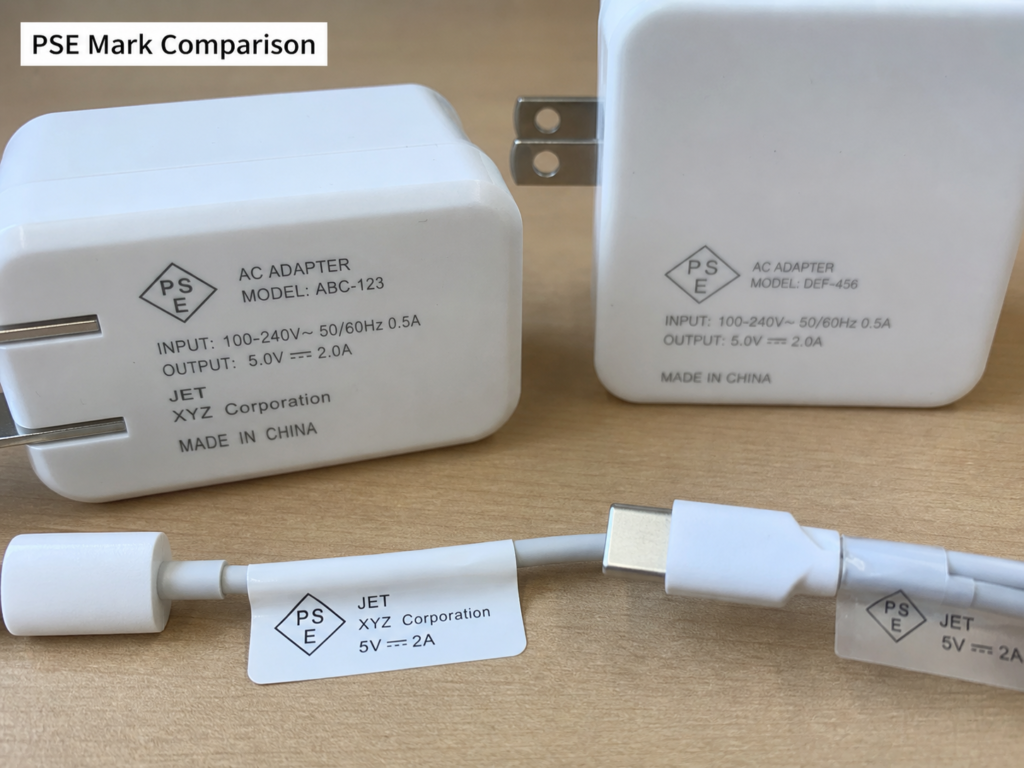
- Diamond PSE: Applicable to Specified Electrical Appliances and Materials. The mark is in the form of a framed diamond pattern and the letters “PSE”, and is accompanied by relevant identification information as required;
- Round PSE: Applicable to Non-Specified Electrical Appliances and Materials. The mark is in the form of a framed circular pattern and the letters “PSE”.
Information such as the Round PSE mark, business operator name, and rated parameters shall be set in accordance with the statutory labeling regulations for specific product categories, and in principle shall be marked on the product body. It cannot be generally assumed that placing them on packaging or manuals is sufficient; any exceptions shall be subject to the enforcement rules and METI requirements.
Overall, the statutory PSE mark, notified business operator name, rated parameters, and other required information shall be marked according to the specific electrical appliance category, and shall be placed on the product or a carrier permitted by regulations in accordance with provisions. Only products that fall within the statutory scope and have completed corresponding compliance procedures may use the PSE mark.
Authenticity Verification Methods
- UL: Can be queried through UL Product iQ or UL official certification information channels, and verified against control number, model, manufacturer, production location, and certification category. Some detailed information may require an account or corresponding access rights;
- Diamond PSE: Can be queried through the METI official website or registered inspection body channels to verify product information and the scope of the conformity inspection certificate;
- Round PSE: Because it mainly adopts the business operator self-confirmation model, there is no unified public query channel. Do not believe the so-called claim that “Round PSE can be checked on the official website”.
There is a common requirement for charging products: labels must be clear, durable, and set in accordance with specific regulatory requirements. You cannot determine that a product is compliant just by looking at a mark on the outer packaging.
6. Cost and Subsequent Maintenance: Obvious Differences in Investment and Maintenance Logic
How to Judge Cost
UL Listing, Diamond PSE, and Round PSE cannot be ranked by fixed cost. The three may differ in charging items, applicable standards, test scope, number of factories, number of models, rectification status, and responsible subject arrangements. Quotations shall be provided separately based on the following factors:
- Product category, power, and structural complexity;
- Applicable standards and number of test items;
- Number of applied models and production factories;
- Whether factory inspection or continuous surveillance is required;
- Fees of testing and inspection bodies;
- Rectification and retesting after failing the test;
- Compliance costs of Japanese importers or other responsible subjects.
Therefore, it cannot be simply asserted that “UL Listing is definitely the most expensive, Diamond PSE is second, and Round PSE is the cheapest”. For some products, the cost of PSE conformity inspection, factory audit, or local Japanese compliance may also be higher than specific UL projects.
Validity Period and Continuous Compliance
- UL: The specific valid status depends on the certification scheme, whether the product is redesigned, whether applicable standards are updated, and whether follow-up surveillance requirements are continuously met. The frequency and cost of surveillance inspections depend on the specific scheme;
- Diamond PSE: The validity period of the conformity inspection certificate shall be determined in accordance with the statutory provisions corresponding to the product category, and renewal or re-obtainment shall be handled in accordance with applicable procedures. During production and sales, technical requirements must continue to be met, and inspections or supervision required by law must be accepted;
- Round PSE: There is no unified validity period for third-party certificates, but when the product is redesigned, standards are updated, or the structure is changed, compliance needs to be re-evaluated. Business operators still need to continuously perform self-inspection, record-keeping, and other statutory obligations.
Note: The above are all general rules. Specific requirements shall be subject to the official documents of certification bodies, METI, and relevant regulations. Do not memorize them by rote.
How to Determine Which Certification Your Product Needs?
After the comparison, we will introduce a set of general decision-making steps that you can follow to judge step by step, without guessing blindly.
5-Step General Classification Decision-Making Process
- Step 1: Check if the product has AC power input — Products with AC input often require priority verification of the mandatory scope or channel requirements of the target country;
- Step 2: Check the statutory classification table of the target country — Confirm whether the product is in the mandatory catalog, such as Japan’s Electrical Safety Law classification table;
- Step 3: Combine product parameters, structure, and intended use — Confirm applicable standards and certification types, such as UL Listing or Recognition, Diamond or Round PSE;
- Step 4: Confirm additional requirements of sales channels and scenarios — For example, whether the channel specifies the UL mark, or whether the product is used in a workplace covered by relevant regulations;
- Step 5: Finalize the certification scheme.
Supplementary Notes for U.S. UL Judgment
- For some workplace electrical products covered by OSHA electrical safety regulations that require the use of approved equipment, certification by an OSHA-accredited NRTL is generally required; whether it applies needs to be determined in combination with equipment category, installation method, and specific regulations;
- For ordinary consumer charging products, specific requirements mainly come from channels, local electrical codes, insurance requirements, or other regulations applicable to the product itself;
- If the finished product is sold externally, prioritize confirming whether the channel requires UL Listing, and do not use component recognition to replace finished product certification.
Supplementary Notes for Japan PSE Judgment
- First, confirm based on import declaration, responsible subject, and sales model whether a local Japanese importer or other entity capable of bearing statutory obligations is required;
- All technical documents, test reports, and self-inspection records must be kept as required for regulatory inspection;
- Products not within the mandatory scope cannot be affixed with the PSE mark for promotional purposes.
Typical Charging Product Cases
We take three of the most common products as examples to help you understand how to judge:
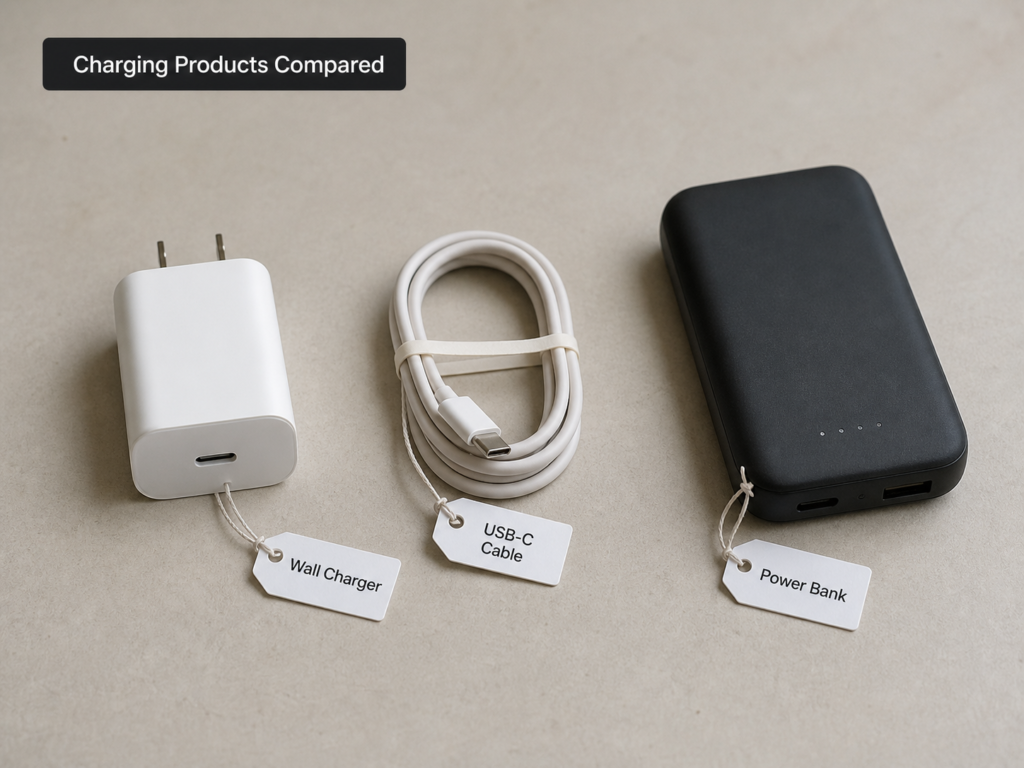
Case 1: 65W USB-C Wall Charger
- Judgment basis: With AC input, belongs to power conversion products;
- U.S.: Generally need to confirm NRTL certification requirements based on product category and sales scenario; mainstream channels may specify UL or accept other NRTLs;
- Japan: Most likely belongs to the “DC power supply device” category of Specified Electrical Appliances and Materials (Diamond PSE), final determination is subject to the classification table and specific product conditions;
- Additional confirmation: Rated input range, number of output channels, whether there are additional functions (such as wireless charging).
Case 2: Passive USB-C to C Data Cable
- Judgment basis: No AC input, only low-voltage power and signal transmission;
- U.S.: No federal mandatory requirements, mostly voluntary requirements from channels;
- Japan: Generally does not belong to PSE specified electrical appliances and materials, cannot be labeled arbitrarily; if it belongs to the wire category, the classification table needs to be checked separately;
- Additional confirmation: Rated current, cable structure, whether there is shielding.
Case 3: USB-C Fast-Charging Cable with e-Marker
- Judgment basis: No AC input, but with built-in active electronic components;
- U.S.: Confirm the corresponding UL assessment service type based on product structure and applicable standards;
- Japan: The e-Marker chip does not determine the PSE level; it is still necessary to confirm whether it is within the scope based on statutory category, structure, and parameters;
- Additional confirmation: Chip function, whether it involves power conversion, rated parameters.
Common Misconceptions and Pitfall Avoidance Guide
Many sellers run into pitfalls due to cognitive errors, which range from wasting money to having products detained and fined. These 5 most common pitfalls must be avoided.
Misconception 1: UL is a unified mandatory certification at the U.S. federal level
Correction: UL has no unified mandatory requirements at the federal level. Specific requirements may come from channels, local regulations, or specific scenarios where OSHA applies. Other qualified NRTL certifications generally have regulatory equivalence in workplace scenarios where OSHA applies, but local competent authorities, insurance companies, or channels may specify specific marks.
Risk: Misjudgment will lead to two outcomes: either spending unnecessary money on unneeded certification, or being delisted for not having the certification required by the channel.
Misconception 2: PSE is a single type of third-party certification, and all charging products need Diamond PSE
Correction: PSE is the compliance system of the entire Electrical Safety Law, divided into Specified Electrical Appliances and Materials and Non-Specified Electrical Appliances and Materials, corresponding to Diamond PSE and Round PSE respectively. Most passive USB cables are not within the mandatory scope at all, and cannot be affixed with the PSE mark casually.
Risk: Misuse of marks will lead to product detention, fines, and even recalls.
Misconception 3: Having a test report means passing certification and you can use the mark
Correction: A standalone test report does not equal completed market access, nor can certification marks be used solely based on the report. Diamond PSE requires completion of statutory procedures such as conformity inspection by a registered inspection body; although Round PSE does not require unified third-party certification issuance, business operators still need to conduct self-inspection, confirm compliance, and keep records in accordance with regulations, and test reports can be used as part of technical documentation.
Risk: Using test reports to impersonate certification will result in platform penalties and delisting in minor cases, and investigation and punishment by regulatory authorities in serious cases.
Misconception 4: Different models of the same series and set components can share one certification
Correction: Certification or compliance confirmation only covers models, structures, and production sites specified in regulations or documents. The certification of a set cannot be split for use by components sold separately.
Risk: Using marks beyond the scope is a violation, which will lead to product delisting and recalls.
Misconception 5: Certification is valid for life after one application, and minor changes do not require re-application
Correction: When a product is redesigned, key components are replaced, applicable standards are updated, or the certificate/certification status changes, compliance needs to be re-evaluated. Whether re-testing, document modification, or re-application is required shall be handled in accordance with the requirements of the corresponding system and organization.
Risk: Continuing to sell after the certification or compliance status becomes invalid will trigger regulatory penalties.
Planning Suggestions for Both U.S. and Japanese Markets
If you plan to enter both the U.S. and Japanese markets, you can plan in advance to save time and cost.
Cost Optimization Methods
- Although certifications are not directly interchangeable, some basic test data can be shared on the premise of acceptance by the organization, and only differential items need to be supplemented;
- Adapt to the requirements of both sides simultaneously during the product design stage: for example, use replaceable plugs, make the enclosure flame retardancy level meet both sides’ standards, and design the input voltage to be 100-120V wide-range compatible, so there is no need to open two sets of molds;
- Confirm channel requirements in advance, and do not do unnecessary certification items. For example, if the channel accepts other qualified NRTL certifications, there is no need to force UL certification.
Time Planning Tips
- You can prioritize starting projects with a longer expected cycle, and simultaneously prepare tests and documents for the other market, advancing both processes in parallel;
- Prepare PSE-specific materials such as Japanese labels and arrangements for Japanese importers or other responsible subjects in advance to avoid getting stuck midway;
- Be sure to reserve buffer time for rectification, and do not schedule certification right up to the launch time, as delays will occur if the test fails.
Long-Term Compliance Maintenance
- Establish separate compliance document lists for the U.S. and Japan, do not mix them, to facilitate inspections from both sides;
- When products are redesigned or key components are replaced, evaluate the validity of certifications for both countries simultaneously, and do not miss either side;
- Pay attention to regulatory updates in both countries, such as adjustments to mandatory catalogs and changes in standard versions, and update certification or compliance documents in a timely manner.
Quick Reference Table for Core Differences of Charging Products
For your quick comparison, we have compiled a concise comparison table:
| Comparison Dimension | UL (United States) | PSE (Japan) |
|---|---|---|
| Regulatory attribute | Not a unified federal mandatory requirement for all consumer products; specific requirements depend on the market, channel, and usage scenario | Statutory compliance system stipulated by the Electrical Safety Law; products within the catalog must be compliant as required |
| Responsible subject | Usually the certification applicant such as the manufacturer or brand owner bears corresponding responsibilities; specifics depend on certification and transaction arrangements | Japanese importers and other entities bear corresponding statutory obligations; sellers shall not sell non-compliant products |
| Classification logic | Understood by assessment service type and application scope (Listing/Recognition) | Divided into Specified and Non-Specified Electrical Appliances and Materials (Diamond/Round) |
| Corresponding charging products | Finished products generally confirm finished product certifications such as Listing; components use Recognition | Charging products within the specified scope may involve Diamond PSE; most low-voltage cables are not within the mandatory scope |
| Testing focus | Based on U.S. applicable standards, adapted to 120V/60Hz | Based on Japanese applicable standards, adapted to 100V/50-60Hz |
| General cycle | Estimated by the organization based on product, model, factory, and test scope | Determined by the organization or business operator based on product category, documents, inspection, and test scope |
| Labeling requirements | Content, position, and carrier are implemented in accordance with product category, applicable standards, and UL requirements | Statutory PSE mark, business operator name, rated parameters, and other information are set according to product category |
| Cost ranking | Cannot be ranked in a fixed order of high/low with PSE categories | Cannot be ranked in a fixed order of high/low with UL categories; quotations shall be provided separately |
| Substitution rules | In OSHA-applicable scenarios, other qualified NRTL certifications generally have regulatory equivalence, but channels may specify UL | Non-Specified Electrical Appliances and Materials are subject to self-inspection and compliance confirmation by business operators in accordance with regulations |
| Mandatory scope for cables | No unified federal mandate; mostly channel or scenario requirements | Most low-voltage USB cables are not within the mandatory scope |
| Continuous compliance requirements | Meet surveillance and change management requirements according to the specific certification scheme | Continuously meet technical requirements during production and sales, and fulfill corresponding inspection, record-keeping, and supervision obligations |
| Authenticity verification | Can be queried through UL Product iQ or official channels; need to cross-check information such as control number, model, and manufacturer | Diamond PSE can be verified through METI or relevant organization channels; Round PSE has no unified public query channel |
Proficiency Level Classification
After reading this content, you can compare with the following levels to check your proficiency in UL and PSE:
- Beginner (understand basics): Can distinguish the country of origin, core positioning, and mandatory logic differences between UL and PSE; can distinguish the three core concepts of testing, certification, and market access; can state the general compliance requirements of common charging products.
- Intermediate (can judge): Can understand UL and PSE certification marks, and can use official channels to query compliance status; can determine the certification type for charging products entering the U.S. and Japanese markets according to the decision-making steps; can identify 5 types of common certification misconceptions and avoid core pitfalls.
- Semi-Proficient (can make decisions): Can select suitable certification schemes based on target market and sales channel; can judge cycle and cost based on product category and project scope, avoiding applying fixed rankings; can plan the certification order and basic cost optimization direction for both U.S. and Japanese markets.
Overall, although both UL and PSE are related to electrical safety, their essential logics are completely different: UL is a U.S. market-driven third-party assessment, with specific thresholds coming from channels, local requirements, and specific usage scenarios; PSE is a Japanese law-driven statutory compliance system with clear mandatory scope and legal responsibilities. For charging product export, you don’t need to memorize all rules by rote. As long as you first clarify product attributes, target market regulations, and channel requirements, and judge step by step, you can avoid most pitfalls. If you are unsure about the classification or requirements, it is best to confirm with a reliable certification body or local compliance consultant in advance, and do not guess based on experience.