
If you are a seller of products such as chargers, USB-C cables, and power adapters who is just planning to enter the Indian market, the first things that come to mind may be BIS quality certification and WPC wireless certification, but it is easy to overlook an environmental requirement directly related to market access — e-waste EPR registration. Many sellers have their listings on Amazon India and Flipkart directly taken down, or are required to supplement relevant certificates during specific customs clearance or supervision processes because they did not handle it in advance, unnecessarily increasing storage and logistics costs.
This guide will start from the most basic concepts, covering the entire process from product judgment, responsible entity identification, registration practice, to long-term compliance, helping you go from beginner to being able to independently complete most EPR compliance work and avoid common pitfalls.
1. First, Get It Straight: What Indian EPR Is and Why It Must Be Taken Seriously
Many people think EPR is a qualification of “paying money to get a certificate” when they first hear it, but that is not the case at all.
Core Logic of EPR
The full name of EPR is Extended Producer Responsibility. In plain terms: **Whoever puts charging electronic products into the Indian market is responsible for the recycling and treatment of the products after they are scrapped**. It is not a qualification that requires a one-time payment, but a long-term requirement to continuously fulfill recycling obligations and declare regularly based on your annual market placement volume. The core logic is to transfer the cost and responsibility of recycling from the government and consumers to the merchants who place the products, reducing the environmental impact of e-waste from the source.
Who is in Charge, and What is the Basis
The implementing regulation for Indian EPR is the issued by the Ministry of Environment (MoEFCC), of which Schedule I is the core basis for the scope of controlled products. The Central Pollution Control Board of India (CPCB for short) is responsible for e-waste EPR registration, portal management, and central-level supervision; State Pollution Control Boards (SPCB) or Pollution Control Committees (PCC) participate in supervision, inspection and law enforcement within their respective functions and powers.
In principle, producer registration is handled through the official CPCB e-waste EPR portal. Specific supplementary materials, regulatory communication, or case handling shall be subject to the current requirements of the CPCB and relevant competent authorities.
Binding Relationship with Market Access
Applicable producers shall complete CPCB registration and fulfill EPR obligations in accordance with the before placing controlled EEE in India. E-commerce platforms may require sellers to upload EPR registration information, and customs or other competent authorities may also require relevant certificates at specific links. Actual requirements shall be checked against the current platform and regulatory rules respectively.
Non-compliance may lead to consequences such as e-commerce listing removal, account restrictions, supplementary materials during customs clearance, or regulatory penalties. The implementation requirements of different platforms, customs, and competent authorities are not exactly the same, and it cannot be simply understood that all goods will be automatically intercepted due to the lack of EPR.
Boundaries with Other Compliance Requirements
Many people confuse EPR with other certifications. Here we clearly draw the line:
• It is **not BIS/WPC certification**: BIS governs quality and safety, WPC governs wireless access, and EPR governs environmental recycling obligations. The three are independent, need to be handled separately, and cannot replace each other.
• It is **not battery EPR**: If your charging product has a built-in battery, you need to additionally evaluate the EPR obligations for battery waste. The two belong to different regulatory systems.
• It is **not plastic packaging EPR**: The environmental obligation of product packaging is governed by the plastic waste rules and is not included in the accounting scope of e-waste EPR.
• You cannot directly use HS codes to judge whether EPR is required: The final judgment shall be based on product functions and the official classification of the CPCB. HS codes can only be used as a reference.
Several Common Misconceptions
Here we first clarify the most common cognitive pitfalls to avoid detours later:
1. **”Only local Indian companies need to register”**: Wrong. Overseas producers without an Indian entity shall designate an authorized representative in India in accordance with the current CPCB procedures, who shall be responsible for ensuring that the requirements of the rules are fulfilled. The authorized representative does not automatically replace the overseas producer as the statutory producer. Whether an Indian importer or an overseas brand placed under its own brand bears producer obligations shall be judged based on actual import, brand sales, and placement arrangements.
2. **”EPR is just a recycling qualification”**: Wrong. It is a complete set of compliance requirements of “registration + annual recycling obligation + regular declaration”. Registration is only the first step, and recycling targets must be completed and reports submitted every year thereafter.
3. **”Small-batch/low-value products can be exempted”**: This cannot be judged so simply. Low unit price or small sales volume of products is usually not a general basis for exemption in itself; however, it is also necessary to check whether the enterprise belongs to micro-enterprises clearly excluded by the rules and other statutory exclusion situations.
4. **”Everything is fine after registration”**: Wrong. Registration has a specified validity period, and producers must still fulfill EPR targets and reporting obligations on an annual basis. Overdue or non-compliance may lead to environmental compensation, suspension or revocation of registration, and affect subsequent renewal. Whether specific measures are taken shall be subject to the handling decisions of the CPCB and applicable regulations.
5. **”Second-hand charging products do not need EPR”**: Wrong. Second-hand electronic products placed in the Indian market also need to comply with the special rules of EPR, and are not directly exempted.
2. Pre-Judgment: Does Your Charging Product Need Registration?
You don’t need to prepare materials right away. First, judge whether your product is within the controlled scope according to the process, which can save a lot of useless effort.
Controlled Scope Verification Process
The judgment shall be carried out in two steps, and cannot be decided arbitrarily:
1. Step 1: Check against Schedule I of the to confirm whether the product is controlled EEE (that is, electrical products with circuits or electronic components).
2. Step 2: Go to the product classification library of the CPCB EPR portal to match the corresponding official category. You cannot preset the classification by yourself.
Evidence must be retained during the judgment process: product brand, model, function description, input and output parameters, whether it is sold independently, BOM list, and net weight of a single product. These will be used for subsequent registration and verification. If you are unsure about the classification, either submit a written inquiry directly to the CPCB or entrust a compliance agency to issue a professional opinion. Be sure to retain the basis to avoid being deemed as having a classification error later.
Which Situations Are Clearly Excluded, and Which Cannot Be Exempted
E-waste EPR does not apply to products that are only for export and not placed in India, as well as specific equipment or waste streams clearly excluded by the rules. At the same time, it is also necessary to check other exclusions or separately applicable systems in the rules such as micro-enterprises, waste batteries, and plastic packaging, and cannot judge only by the product name.
However, the following situations **cannot be exempted casually**:
• B2B/industrial charging products are not automatically exempted. They must still be judged against Schedule I, and as long as they are within the scope, they must be compliant.
• Spare parts for maintenance and replacement shall be evaluated according to their placement attributes. If they are placed on the market as independent products, they shall also be counted.
• Gifts and promotional items: Free charging accessories are also considered market placement and must be included in compliance accounting. They cannot be excluded just because no money is made from them.
How to Judge Edge Scenarios of Charging Products
There are several edge scenarios for charging products that are easy to be uncertain about. Judge according to the following rules:
• **Pure passive copper core charging cable**: Not directly exempted. The final judgment shall be made in combination with the sales form and the official classification of the CPCB.
• **Accessories included with the product**: Shall be included in the product scope and weight accounting of the actual placing entity. Whether separate listing or separate registration is required depends on whether the accessory is controlled EEE and the declaration requirements of the CPCB portal. When sold separately or placed by different entities, the registration obligations of the corresponding producers shall be evaluated separately.
• **Industrial/vehicle-specific non-retail charging modules**: Even if they do not enter the civilian retail channel, they must also be checked against Schedule I and CPCB classification to confirm whether they are excluded, and cannot be directly assumed that they do not need to be handled.
3-Step Quick Judgment Method
If you want to get a preliminary conclusion quickly, you can self-check according to these three steps:
1. Will the product be independently placed in the Indian market? Sales, gifting, and promotion all count as placement.
2. Does the product fall within the scope of controlled EEE listed in Schedule I?
3. Is there a domestic Indian placing entity that meets statutory requirements, or an applicable arrangement for an authorized representative in India?
If all three answers are “yes”, then basically you need to further confirm the registration obligation. Also note: If the product is later changed from an included accessory to separate sale, functional parameters are adjusted, or the sales model changes, the scope must be re-judged, and the previous conclusion cannot be applied.
3. Determination of Responsible Entity: Who Fulfills EPR Obligations
The responsible entity for EPR is not determined by how your internal contract is signed, but by the statutory definition in the regulations. This is very important. Many cross-border sellers find the wrong responsible entity, resulting in a mismatch between registration and actual business.
Criteria for Determining Statutory Responsible Entities
The core basis is the definition of “producer” in the , which usually involves three types of roles: local Indian manufacturers, importers of EEE products, and brand owners who place products on the market under their own brands.
Commonly used items such as trademark ownership, import documents, sales invoices, and actual placement arrangements are only evidence for judgment and cannot replace the statutory definition. The core principle is: **each independent placing entity is responsible for its own placement volume**; no matter how you divide labor and agree on responsibilities in internal contracts, they cannot override statutory responsibilities, and regulators will still determine the responsible entity in accordance with regulations.
Responsibility Attribution for Different Cross-Border Models
For different cross-border cooperation models, the responsible entities are different. Several common situations:
• Own brand manufactured locally in India: The local manufacturer is the responsible entity.
• **Overseas brand + Indian importer**: Responsibility shall be comprehensively determined based on who imports, who sells under its own brand, who actually first places EEE in the Indian market, and the arrangement of authorized representatives. Indian importers may usually be producers; when overseas brands are placed under their own brands, they may also be producers and need to designate an authorized representative in India, and statutory responsibilities cannot be excluded solely based on contractual agreements.
• Multiple independent importers: If your product has several independent Indian importers, each importer must register and fulfill responsibilities separately for its own placement volume, and cannot privately designate one entity to cover all import volumes.
• Platform warehouse/agency operation model: Whoever actually holds the placement right and bears sales responsibility shall register. It is not that the agency operation company or the platform is automatically responsible.
Requirements for Domestic Performance Entities and Entrusted Service Providers
Overseas producers without an Indian entity shall designate an authorized representative in India in accordance with the current CPCB procedures, who shall be responsible for ensuring that the requirements of the rules are fulfilled. The authorized representative does not automatically replace the overseas producer as the statutory producer. Whether an Indian importer or an overseas brand placed under its own brand bears producer obligations shall be judged based on actual import, brand sales, and placement arrangements.
Many people will find compliance service providers to help handle EPR affairs. It should be clarified here: Entrusted service providers only assist in filling in forms, docking with regulators, and sorting out materials, **and do not replace the producer’s ultimate legal responsibility**. When signing an entrustment agreement with a service provider, be sure to clearly write down these essential clauses: scope of responsibilities, validity period, division of responsibilities, data ownership, communication mechanism, and account permissions.
Special attention should be paid to account security: Producers must retain control of the administrator account of the EPR portal, and cannot hand over the sole authority to a third party. Otherwise, once the service provider has a problem, you can’t even log in to the account, which will put you in a very passive position.
4. Pre-Registration Preparation: Document List and Pre-Arrangement
Before officially registering in the system, preparing the documents and pre-arrangements first can greatly improve the audit pass rate and avoid repeated corrections.
Entity Qualification Documents
First are entity-related documents:
• Proof of local Indian responsible entity: Company registration certificate, GST registration certificate, PAN card.
• Materials of overseas brand owner: Brand registration certificate, cooperation or authorization documents with the Indian responsible entity.
• If a service provider is entrusted, you also need to prepare a power of attorney, the service provider’s local office proof, and contact information.
Prepare documents according to the current forms and upload instructions of the CPCB portal. If the documents are not in the language or format accepted by the system, English versions, translations, or certified copies shall be provided according to current requirements. Notarization and authentication shall not be understood as unified mandatory conditions for all application materials. The specific requirements shall be subject to the current portal requirements, notices, or case-by-case corrections.
Exclusive Documents for Charging Products
Product-related materials are the focus of the audit. For charging products, prepare the following:
• Basic product list: including model, brand, function description, input and output parameters, whether it is sold independently, and net weight of a single product.
• Product supporting materials: appearance pictures, simplified technical specifications, screenshots of sales pages.
• If declaring by product family: Products of the same brand, same function, and same structure can be declared by product family, but a complete model list and consistency statement must be attached. Products of different categories cannot be forced into one product family.
• Classification supporting materials: Basis for category matching of the CPCB portal. If there is a written classification opinion from the CPCB, it should also be attached.
Pre-Preparation of Recycling Chain
The core of EPR is recycling, so the recycling chain must be built before registration, and you cannot wait until after registration to find it:
• PROs, recyclers, or registered recycling operators shall be selected and verified in accordance with current CPCB procedures. You cannot randomly find institutions without corresponding registration or treatment capacity.
• Sign a recycling service agreement and an annual recycling service estimate statement in advance.
• Before signing, verify the registration status, treatable categories, and actual treatment capacity of the partner respectively. If EPR certificates are used for performance, the certificates must be generated by the system by recycling operators that comply with the rules and are registered on the portal. The registration and performable scope of ordinary recyclers, PROs, and recycling operators are different.
Common Pitfalls in Document Preparation
These mistakes are most commonly made by novices. Avoid them in advance:
1. The product classification does not match the category of the CPCB portal, and the application is directly rejected by the audit.
2. The weight of a single product is estimated casually, and the deviation from the actual weighing is too large, which will affect the accounting of recycling targets later.
3. The entrusted service provider found is non-compliant, for example, no fixed office location, no EPR compliance experience, which not only can’t help, but may also cause trouble.
4. Confusion of statistical caliber: mixing import volume, sales volume, and market placement volume. The correct caliber is that all products placed in the Indian market, whether sold or given away, must be counted.
5. Practical Steps for CPCB EPR Portal Registration
After the materials are prepared, you can go to the official CPCB EPR portal to register. In principle, registration is completed online. Specific pages, fields, and supplementary procedures shall be subject to the current requirements of the portal.
Official System Account Registration
The registration entry is the e-waste module of the official CPCB EPR portal. Do not enter from third-party links to avoid phishing websites.
The most important thing during registration is **account role selection**: Be sure to select the corresponding producer, importer, or brand owner role according to the type of statutory responsible entity. You cannot choose the wrong one. If you choose wrong, it will be very troublesome to modify later, and may even lead to inconsistency between registration information and actual business.
Required information includes the contact phone number, office address, and authorized signatory information of the domestic Indian responsible entity or authorized representative, all of which must be completely consistent with the qualification documents.
Information Filling and Document Uploading
When filling in information, pay attention to several key points:
• The entity information must be completely consistent with the qualification documents. Even if a suffix is missing from the company name, it may be rejected.
• Product information shall be filled in according to the previously matched CPCB categories. Enter models and estimated annual placement weight in batches. Do not randomly select categories by yourself.
• The recycling plan must clearly state the annual recycling estimate, information of the cooperative recycling party, and recycling implementation plan, which must correspond to the recycling agreement you signed earlier.
• Documents must be uploaded in the format and size specified by the system. The documents must be clear and legible. Do not upload blurry scanned copies.
Fee Payment and Audit Follow-up
The registration fee shall be subject to the standard currently announced on the CPCB portal. Before submitting, be sure to take a screenshot of the fee page to avoid subsequent disputes.
Payment must be made through officially designated channels. After payment, keep the payment voucher well, and submit or upload it as required by the system.

Check the audit progress directly in the portal. There are only three common reasons for correction: classification error, incomplete materials, and inconsistent entity information. If you receive a correction notice, be sure to correct and resubmit within the time limit specified by the system, and at the same time keep the comparison record of materials before and after correction for future reference.
Certificate Acquisition and Information Verification
After the audit is passed, the certificate is issued electronically and can be downloaded directly from the system.
After getting the certificate, check the core information immediately: registration number, validity period, applicable product scope, name of the responsible entity. This information must be accurate, and if there is an error, apply for modification immediately.
The registration number shall be used in accordance with the requirements of platforms, customs, and current regulations. At the same time, keep all usage records, such as screenshots of uploading to the platform and relevant vouchers submitted during customs clearance.
6. Exclusive Pitfall Avoidance for Filling in Charging Products
There are several high-frequency pitfalls in filling in information for charging products, which are specifically mentioned here to help everyone avoid them.
Common Product Classification Matching Cases
Different charging products correspond to different categories and cannot be applied indiscriminately:
• Independently sold chargers, power adapters, car chargers: Match the corresponding EEE category, and at the same time retain input and output parameters and function descriptions as the basis.
• USB/USB-C data cables with electronic components (such as those with PD chips, E-Marker chips): Match the corresponding cable or accessory category, and cannot be declared as chargers.
• Pure passive charging cables and charging docks: Check Schedule I and portal categories one by one, and cannot directly apply the classification of chargers.
If the category is mismatched, the light consequence is audit rejection, and the serious consequence is incorrect calculation of recycling targets, and you will have to bear compliance risks later.
Logic for Filling in Placement Volume and Weight
The filling of placement volume and weight is directly related to your recycling cost and compliance risk, and must be done according to the rules:
• Statistical caliber: Calculated based on the net weight of products placed in the Indian market, excluding packaging. All sold and given away products must be included.
• Estimation basis: Refer to past sales data and annual sales targets. Do not fill in too high or too low.
• Deviation risk: If you fill in too high, the recycling obligation will be heavy and the cost will increase; if you fill in too low, it may be rejected by the audit or punished during subsequent verification.
• Special scenarios: For set products, the weight of individual products must be split and counted separately; for returned products and export returned products, keep the vouchers well, and the placement volume can be adjusted.
Key Compliance Points for EPR Targets and Recycling Plans
EPR targets shall be calculated or confirmed in accordance with Schedule III of the , current CPCB guidelines, and portal procedures, and are usually based on the EEE placement volume of the specified base year and the applicable recycling ratio of the current year. Newly registered entities shall submit verifiable placement volume data and confirm targets in accordance with CPCB requirements, and cannot determine statutory obligations solely based on self-filled annual estimates.
Note: The recycling volume is calculated by weight, not by the number of products, which many novices get wrong. In addition, the recycling plan must match the treatment capacity of the cooperative recycling party, and cannot be falsely reported. Otherwise, if the target is not completed by then, the responsibility is still yours.
EPR Certificate Performance Rules
If the current system applies, the recycling gap can be offset by purchasing compliant EPR certificates, but pay attention to several rules:
• Only EPR certificates issued by CPCB-registered recycling operators and verifiable on the portal are valid. Paper vouchers without traceability cannot be used.
• The validity period, carry-over restrictions, and transaction window of certificates shall be subject to the current CPCB rules and portal SOPs. Do not listen to the one-sided words of third-party service providers.
• Certificates used for performance must be verified for authenticity on the portal, and transaction records and certificate numbers must be kept.
7. Post-Registration Annual Compliance and Data Governance
Registration is only the beginning of EPR compliance. The continuous compliance every year thereafter is the key point. Many people just ignore it after registration, which eventually leads to the expiration, suspension or revocation of the qualification, or affects subsequent renewal.
Product Labeling and Channel Compliance Requirements
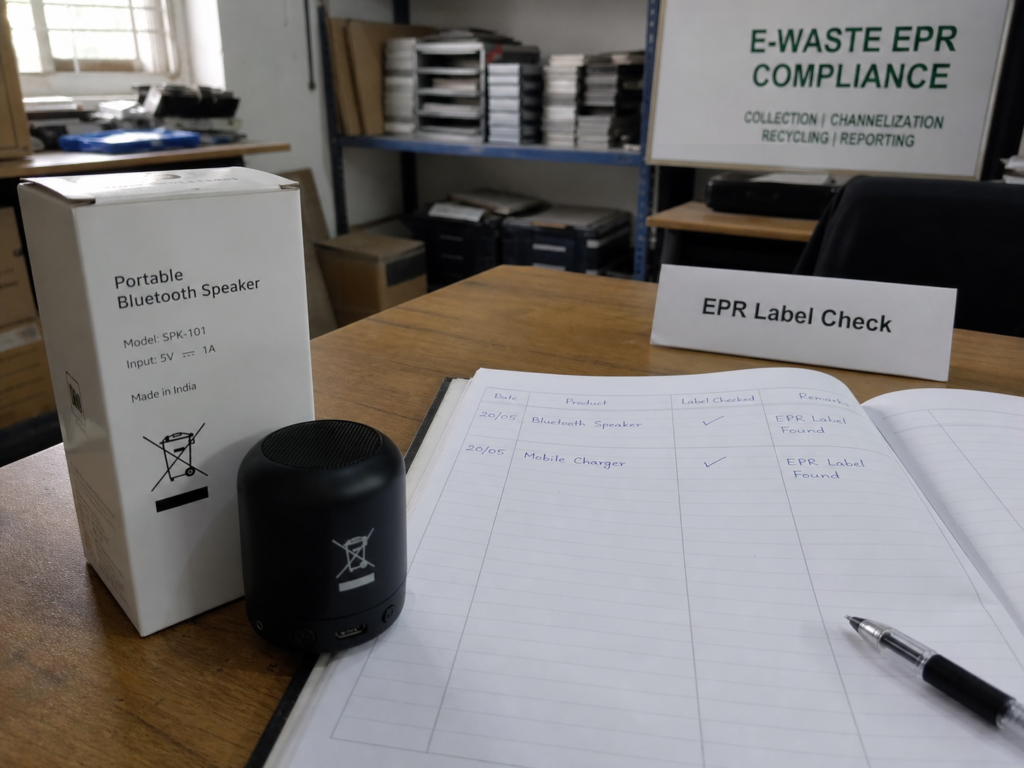
First is the labeling on the product itself and packaging: The crossed-out wheeled bin symbol shall be marked on the product and its packaging in accordance with the and applicable CPCB requirements. The pattern, visibility, and applicable method of labeling shall be subject to current rules, CPCB guidelines, and relevant product labeling requirements, and shall not be generally understood as having a unified mandatory size.
There are no unified mandatory requirements for channels, which shall be checked separately: If the e-commerce platform requires uploading the registration number, upload it according to the platform requirements; if it is needed for customs clearance, provide it according to customs requirements; whether it needs to be marked on packaging or sales vouchers shall also be in accordance with current regulations.
All labeling design documents and channel upload records must be kept for verification.
Completion and Verification of Annual Recycling Targets
At the beginning of each year, the annual EPR target displayed on the portal and confirmed in accordance with regulations shall prevail. Remember to take a screenshot and save it to avoid that the basis cannot be found after system updates later.
Vouchers for completing the recycling target must be complete: recycling handover forms, weighing vouchers, transportation records, compliance certificates of recyclers or recycling operators, EPR certificate transaction records. All of these must be kept well. It is absolutely forbidden to use false vouchers without real flow directions, nor to reuse the same recycling voucher.
It should be clarified that producers bear ultimate responsibility for the authenticity of data and target completion. PROs or recyclers only provide services and do not replace your statutory responsibilities, so you must regularly check the progress yourself.

Annual Report Submission Requirements
An annual report must be submitted every year. The submission time shall be subject to the deadline announced in the current CPCB notice, and do not be overdue.
The core content of the report includes: placement volume of the current year, actual recycling volume, use of EPR certificates, and target completion status. The submission channel is online submission through the CPCB EPR portal. After submission, be sure to keep the submission receipt and a copy of the report.
The consequences of overdue submission shall be subject to current regulations, which may include environmental compensation, suspension or revocation of registration, and affect subsequent renewal.
Certificate Change and Renewal
The certificate is not unchangeable once obtained. Apply for change in time when the following situations occur: adding new product models, changing the responsible entity, adjusting annual placement volume, replacing recycling partners.
Registration has a specified validity period. Renewal shall be applied for in advance according to the certificate validity period and the current portal notice, submitting the compliance certificate of the previous year and the recycling plan of the next year. The audit progress shall be subject to the portal notice. Be sure to plan in advance. Do not apply until the certificate expires, resulting in a gap in compliance.
Monthly Data Ledger and Audit Evidence Chain
The core of long-term compliance is to do a good job of the data ledger. Otherwise, when it is time to declare at the end of the year, you simply cannot produce accurate data.
The core fields of the ledger include: SKU, corresponding CPCB category, net weight of single product, import volume, sales volume, gift volume, return volume, export return volume. Each data field must have corresponding original vouchers, such as customs declaration forms, GST invoices, weighing records, recycling vouchers, portal screenshots, etc., forming a complete evidence chain.
Data cannot be tampered with at will. For each adjustment, the reason, approver, and original basis must be retained. The retention period of compliance records shall be implemented in accordance with the retention period required by the current CPCB.
8. Compliance Risk Self-Check and Frequently Asked Questions
Finally, we have sorted out common risks, pitfall avoidance methods, and self-check lists for you, to facilitate your regular verification of your compliance status.
Common Compliance Risk Matrix
We divide common risks into three categories, organized into a table for easy comparison:
| Risk Type | Triggering Behavior | Possible Consequences | Corrective Actions |
| Platform risks | Failure to upload EPR qualification, failure of annual compliance | Listing removal, account restrictions, deduction of security deposit | Re-upload qualification, complete compliance rectification |
| Regulatory risks | Unregistered, false declaration, failure to complete recycling targets, overdue submission of reports | Environmental compensation, fines, suspension or revocation of registration (subject to current regulations) | Make up registration, adjust declaration, make up for certificates, submit rectification report |
| Import risks | Customs clearance without valid EPR qualification, false declaration | Obstacles to goods customs clearance (subject to the law enforcement basis of customs or competent authorities) | Complete qualifications, declare truthfully |
Pitfall Avoidance in Choosing Third-Party Service Providers
Many sellers will find third-party service providers to handle it on their behalf. Here, pay attention to avoiding several traps:
• Judgment criteria for compliance agents: Must have local Indian service capabilities, can provide official query paths, and the service scope and fees are clearly written in the contract.
• Common agent traps: Selling fake certificates, hidden charges after low-price drainage, only responsible for registration and not covering subsequent compliance.
• Key points for verifying recyclers or PROs: The registration status shall be checked according to the current CPCB directory or portal information, confirm that the treatment categories match your products, and require past cooperation cases to be provided.
• Core precautions: Always retain control of the portal account and ownership of the original data. Do not let the agent monopolize account permissions. Otherwise, once a problem occurs, you won’t even have a chance to remedy it.
Exclusive Risk Points for Charging Products
Charging products have several unique risks that require special attention:
1. **Underreporting of low-value charging accessories**: Don’t think that data cables and adapters don’t need to be declared just because their unit price is low. Low unit price itself is not a general basis for exemption. As long as the product is within the controlled scope, it is necessary to further confirm compliance obligations.
2. **Category mismatch caused by wrong parameter filling**: In order to reduce recycling costs, falsely reporting power or functions to match categories with lower requirements. Once found, it will be rejected or even punished.
3. **Incorrect classification of set sales**: For sets of charger + data cable, failure to split the declaration, or directly declaring as a complete machine, leading to deviation in placement volume data.
4. **Illegal merging of product families**: Forcibly declaring products with different functions and different categories as a product family, for example, putting chargers and docks into one product family, which is illegal.
Full-Process Self-Check List
You can regularly self-check according to the list below to ensure compliance:
Pre-Registration Self-Check
□ The product falls within the scope of controlled EEE
□ Micro-enterprises and other statutory exclusion situations have been checked
□ There is a clear local Indian responsible entity or applicable authorized representative arrangement
□ The product will be placed in the Indian market
□ The three types of EPR obligations for electronics, batteries, and plastic packaging have been distinguished
Pre-Registration Submission Self-Check
□ Product category matching is correct and has a basis
□ Materials are complete and information is completely consistent
□ Annual placement volume and weight filling are reasonable
□ The registration status, treatment categories, and treatment capacity of recycling partners have been verified
Annual Compliance Self-Check
□ Product and packaging labeling comply with current regulations and CPCB requirements
□ Relevant requirements of platforms and customs have been checked and met separately
□ Annual recycling target is completed and vouchers are complete
□ Annual report has been submitted on time
□ Certificate information is consistent with current business
Re-Evaluation Triggers (Re-judge compliance requirements if the following situations occur)
• New product models or functions added
• Change of responsible entity
• Change in sales form
• Regulatory updates
After reading this guide, you should already be able to independently judge whether charging products need Indian EPR registration, confirm the statutory responsible entities that may be involved in your business, independently complete registration material preparation and system filling, build a basic compliance data ledger, identify common risks and third-party traps, and judge your own compliance status through self-check. Several of the most frequently asked questions — such as how to check the Indian EPR registration number, whether chargers need Indian EPR, and how to write off EPR certificates — can find corresponding answers in the previous chapters.
Overall, Indian e-waste EPR is not a one-time “certificate application”, but a long-term compliance obligation that runs through the entire product life cycle from placement to recycling. For charging products entering the Indian market, making judgments in advance, registering according to the process, and doing a good job of long-term ledgers and declarations can avoid unnecessary losses and carry out business stably.