
Most merchants exporting charging products to India have heard of the terms BIS and WPC, but many only figure out what these two regulatory requirements are really about after their goods are detained by customs, incur demurrage charges, or even are returned. This guide is specifically for products such as chargers, power adapters, USB/USB-C cables, active cables, wireless chargers, and smart charging accessories, and explains the core rules, judgment methods, and practical operation processes of BIS and WPC for Indian importers, cross-border sellers, and supply chain practitioners.
Please note in advance: This article is only for reference in compliance screening, and cannot replace the official final determination. All specific rules are subject to the latest regulations in effect by Indian authorities at the time of product import.
Beginner’s Basics: First Understand What the Two Regulatory Schemes Cover
When many people first enter the Indian market, they think BIS and WPC are either-or certifications. In fact, the two are regulations of completely different dimensions. As long as a product falls under the jurisdiction of both departments, it needs to meet the requirements of both simultaneously.
Commercial importers must first determine whether BIS or WPC is required based on the QCO/CRS list in effect at the time of import and the actual wireless functions of the product. Small batches themselves usually do not constitute a general exemption, but products that are not included in the relevant mandatory scope and do not contain regulated radio transmission functions will not automatically require BIS or WPC certificates just because they are commercially imported.
The primary responsible party in India’s import process is usually the local Indian importer. That is to say, the importer needs to confirm whether the product falls within the applicable scope of BIS or WPC before shipment, and ensure that the import declaration, the product, and relevant documents are consistent with each other. Non-compliance may lead to cargo detention, return, or even destruction during customs clearance, as well as liability for demurrage and storage fees. In serious cases, fines or other law enforcement measures may be imposed.
A concept needs to be clarified first here: IEC (Import Export Code) and GST registration are not the same type of requirement. IEC is usually the core qualification required for conducting imports; whether GST registration is required shall be determined based on the importer’s sales in India, taxable supplies, and applicable GST rules. Before customs clearance, customs, tax, and other applicable registration requirements should also be confirmed. Having IEC or GST registration does not mean the product itself can be exempted from BIS, WPC, or other product access requirements.
BIS: The Official Regulatory Body for Electrical Safety
BIS stands for Bureau of Indian Standards. It is India’s official product safety regulatory body, not a third-party certification body. Its core responsibility is to oversee the electrical safety risks of products, such as electric leakage, fire, and unqualified performance, which can harm consumers.
The common access route for consumer charging products to enter India is CRS mandatory registration. Simply put, BIS includes some products in the mandatory list. As long as a product falls within the scope of the list in effect at the time of import, it must be sent to a BIS-recognized laboratory for testing in accordance with the corresponding Indian National Standard (referred to as IS standard), and registration must be obtained as required before import and sale. For products on the list, failure to have the corresponding registration may result in inability to clear customs or sell normally. Many people think all BIS certifications require factory audits, but that is not the case. CRS registration usually does not require on-site audits of the production factory; ISI certification requires factory audits, and ordinary consumer charging products usually do not follow the ISI route.
WPC: The Regulatory Body for Radio Spectrum
WPC stands for Wireless Planning and Coordination Wing, a spectrum regulatory body under the Department of Telecommunications of India. It does not regulate the general electrical safety of products, but the compliance of spectrum use by regulated radio transmitting equipment — in plain terms, to prevent products from interfering with normal spectrum activities such as India’s communications and broadcasting when using radio spectrum.
For radio equipment that falls within the applicable scope of WPC and is not subject to relevant exemptions, ETA or other required approvals shall be obtained in accordance with the WPC/DoT procedures in effect at the time. Whether ETA is required shall be confirmed in combination with the equipment’s operating frequency band, transmission power, standard, purpose, and the latest official policy, and cannot be generalized for all wireless products.
ETA is usually used to prove that the radio transmission parameters of relevant equipment comply with India’s spectrum management regulations. However, different licenses, exemptions, or declaration routes may apply to specific equipment, so it cannot be simply understood that all wireless products must obtain the same type of ETA certificate.
Core Differences Between the Two Regulatory Schemes (Not Either-Or, Can Be Overlapping)
Many people easily confuse the two regulatory schemes. In fact, their core differences are very clear, and they are not an either-or relationship at all. If a product meets the applicable scope of both, it must meet the corresponding requirements respectively.
| Comparison Dimension | BIS (Bureau of Indian Standards) | WPC (Wireless Planning and Coordination Wing) |
| Regulatory Focus | Electrical safety and product quality | Compliance of radio spectrum use |
| Applicable Scope | Products included in the CRS/QCO mandatory list | Products with regulated radio transmission functions |
| Access Logic | Registration after testing according to corresponding IS standards | Obtain corresponding approval or declaration based on frequency band, power, standard, purpose, and applicable policies |
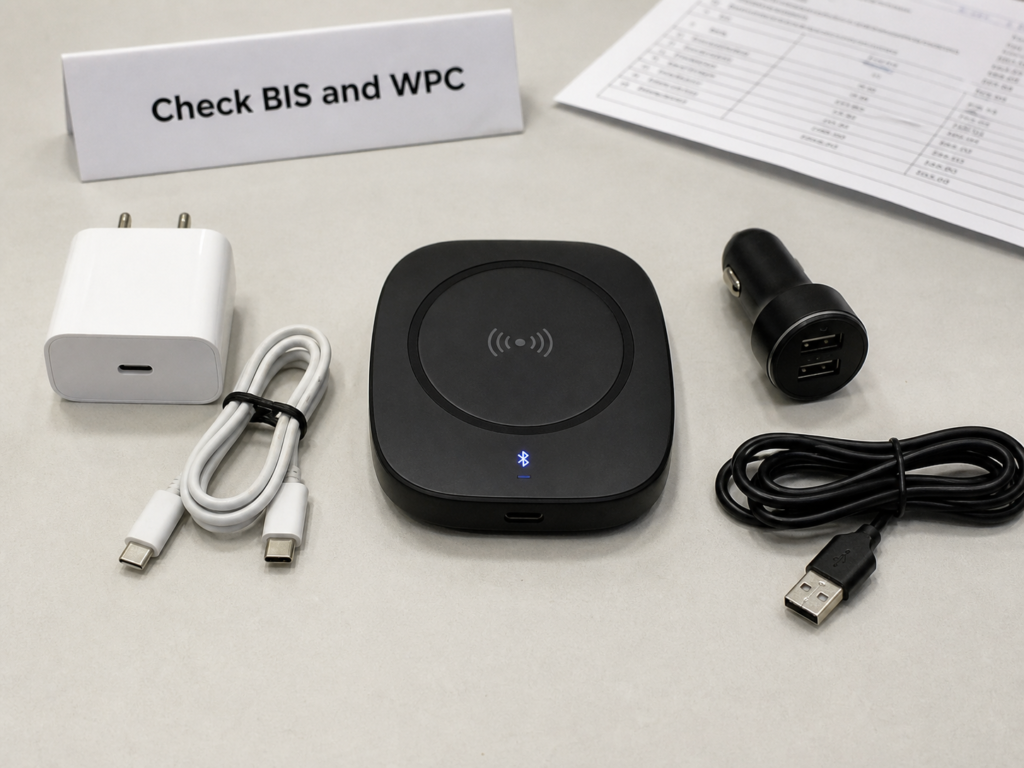
Take a simple example: ordinary wired USB-C chargers do not have wireless transmission functions, so BIS requirements should usually be checked first; smart wireless chargers with Bluetooth function should have the applicable scope of both BIS and WPC checked at the same time. Only after confirming that the Bluetooth device is not subject to relevant exemptions and meets the corresponding WPC conditions can it be further determined whether ETA is required.
5 Most Common Misconceptions for Beginners
Merchants new to the Indian market are most likely to fall into these 5 common misconceptions, which are clarified all at once here:
1. **Small-batch commercial imports do not require certification**: Small batches themselves usually do not constitute a general exemption. Commercial importers still need to determine whether the product is included in the BIS QCO/CRS list in effect at the time, or whether it is a wireless device subject to WPC. However, products not included in the relevant mandatory scope will not automatically require BIS or WPC certification just because they are commercially imported. For imports of samples, R&D, testing, or exhibition purposes, the applicable procedures and exemption conditions shall be verified with Indian Customs, DGFT, and relevant competent authorities before shipment, and the goods shall be used for the approved purpose; if goods enjoy an exemption for non-sales purposes, they shall not be resold in violation of the exemption conditions.
2. **CE/FCC/3C can replace local certification**: India usually does not automatically consider products to meet local BIS or WPC requirements just because they have overseas certifications such as CE, FCC, or China 3C. Whether relevant Indian registration or approval is still required shall still be determined in accordance with Indian rules.
3. **Only big brands need to comply**: Whether it is a large importer or a small seller, they shall fulfill the requirements based on whether the product actually falls within the mandatory scope. Scale itself usually does not invalidate applicable product access rules.
4. **Either BIS or WPC is sufficient**: The two regulate completely different dimensions. If a product falls within the applicable scope of both BIS and WPC, it needs to meet both sets of requirements respectively; missing either may affect import or sales.
5. **Products with USB-C/wireless charging require WPC**: USB-C is just an interface and has no direct relation to radio transmission; wireless charging such as Qi mainly transmits electric energy through electromagnetic induction, and it cannot be determined that WPC is required just because of the term “wireless charging”. Products with functions such as Bluetooth, Wi-Fi, NFC, or radio frequency remote control shall have the applicable scope of WPC further checked, but it cannot be directly concluded that ETA is definitely required just based on the function name.
Compliance Judgment: Does Your Product Need BIS/WPC?
After understanding the basic logic of the two regulatory schemes, the next core question is: Does my product need BIS? Does it need WPC?
Before making a judgment, you must first collect complete product information, otherwise it is impossible to make an accurate judgment. The information to be collected is mainly divided into four categories: basic attributes (model, brand, purpose, country of origin, full name and address of the production factory), electrical parameters (input and output voltage and current, rated power, power supply method, whether it has active circuits), wireless attributes (whether it contains a radio transmitter, module model, operating frequency band, maximum transmission power, antenna type), and import attributes (import form is complete machine/accessory/set, whether it is sold separately, whether it contains a built-in battery). These may seem like a lot of information, but each item may affect the final compliance determination, so do not find it troublesome.
How to Determine the Mandatory Scope of BIS
The core basis for determining the mandatory scope of BIS is the QCO (Quality Control Order) and CRS mandatory list in effect at the time of product import, as well as the corresponding IS standards. The determination shall be comprehensively verified in combination with the product’s purpose, rated parameters, and applicable standards, and cannot be based solely on the presence of a certain chip or component.
For example, many people think that USB-C cables with E-marker chips must have BIS, but that is not the case. E-marker is just a chip used to transmit information such as power negotiation. Whether BIS is required still depends on whether the category and parameters of the cable fall within the mandatory list in effect at the time, and cannot be determined solely by the chip.
From the actual situation, products such as power adapters and chargers usually belong to categories that require key BIS verification; while ordinary passive USB charging cables, simple plastic adapters, and separate connector parts may not be within the relevant mandatory scope, but the final determination shall be subject to the official list and product definitions in effect at the time of import.
There is also a boundary rule to note: accessories shall first be judged based on whether they themselves fall within the effective QCO/CRS scope. Accessories provided with the complete machine may be treated as part of the complete machine configuration only if explicitly permitted by applicable regulations or BIS, and are not imported or sold as separate regulated products. It cannot be generally assumed that they are exempt from certification. If accessories are imported and sold separately, they shall be judged based on the category and parameters of the accessories themselves.
How to Determine the Mandatory Scope of WPC
The WPC determination path can be divided into several steps: first check whether there is a radio transmitter in the product; if yes, then check the operating frequency band, transmission power, standard, and equipment purpose; then confirm whether it falls within the applicable scope of WPC, whether there are relevant exemptions, and whether ETA or other approval or declaration procedures are required.
Common charging products that require further verification of WPC requirements include products with Bluetooth, Wi-Fi, NFC, or radio frequency remote control functions, such as smart wireless chargers with Bluetooth, charging sockets with Wi-Fi function, etc. However, having these functions only means the product has wireless transmission functions, and cannot alone lead to the conclusion that ETA is definitely required. Whether ETA is required still depends on specific technical parameters, equipment category, applicable license-free policies, module or complete machine declaration conditions, and WPC rules in effect at the time.
Let me emphasize again: wireless charging such as Qi itself cannot be directly equated with radio communication transmission. Do not confuse “wireless power transmission” with “radio transmission”. On the other hand, even if the equipment operates in a license-free frequency band, it is necessary to confirm whether ETA or other procedures apply, and it cannot be taken for granted that no declaration is required at all.
Compliance Reference for Common Charging Products
For your quick reference, we have compiled compliance references for 6 common charging products. Note that this is only a general reference, and the specific situation shall be subject to the actual product parameters and the official lists and policies in effect at the time of import:
| Product Type | BIS Requirement | WPC Requirement | Remarks |
| Wired USB-C Charger | Priority check, most likely required | Usually not involved | No wireless transmission function |
| Ordinary Passive USB-A Charging Cable | Low probability of being required | Usually not involved | Need to confirm according to the latest list |
| USB-C Fast Charging Cable with E-marker | Need to check BIS requirements | Usually not involved | No wireless transmission function; not determined solely by E-marker |
| Qi Wireless Charger Without Communication Function | Priority check, most likely required | Usually not involved | Qi is inductive charging; WPC requirement cannot be determined solely by wireless charging |
| Smart Wireless Charger with Bluetooth | Need to check | Need to check | After confirming it is not exempt and meets corresponding conditions, then determine whether ETA is required |
| Car Charger Without Wireless Function | Priority check, most likely required | Usually not involved | Mainly involves electrical safety |
Why You Cannot Judge Solely by HS Code
Many people, for the sake of convenience, like to judge whether certification is required solely by HS code. This approach is very prone to pitfalls.
HS codes are mainly used for customs classification and tax calculation. Products under the same HS code may have vastly different functions and parameters, so the corresponding compliance requirements may naturally be different. For example, for USB cables under the same HS code, some are passive ordinary charging cables, and some are fast charging cables with active circuits. The conclusion on whether BIS is required may be completely different.
Therefore, the final compliance determination must be confirmed by combining the actual functions and parameters of the product with the official mandatory list, and conclusions cannot be drawn solely by looking at the HS code.
BIS CRS Mandatory Registration: Core Rules for Safety Access
If your product requires BIS, you must understand these core rules below, which can help you avoid many detours.
The mainstream access type for consumer charging products is CRS mandatory registration. Unlike ISI certification which requires factory audits, CRS usually does not require on-site audits at the production factory. The core requirement is that the product passes the corresponding IS standard test in a BIS-recognized laboratory.
Many people think BIS registration can only be applied for by Indian local companies, but that is not the case. CRS registration is targeted at overseas manufacturers and production factories as the core subjects. Overseas manufacturers can apply directly, but usually need to appoint a qualified “Authorized Indian Representative”, referred to as AIR. AIR is equivalent to the compliance contact person of the overseas manufacturer in India, with responsibilities including liaising with BIS, cooperating with relevant verifications and market spot checks, etc. If an Indian importer meets the relevant qualification requirements of BIS, it may also serve as AIR, which shall be specifically confirmed according to the rules of BIS at the time.
It should be noted here that BIS CRS certificates usually involve information such as manufacturer, production factory, brand, model, and applicable IS standards. When product or enterprise information changes, you cannot assume on your own that the original certificate still covers the changes. You must evaluate according to BIS’s change, expansion, model addition, or re-registration procedures.
Application Process and Core Materials
The overall process of CRS registration is not complicated: first determine the IS standard applicable to the product, then select a BIS-recognized laboratory, send samples for testing, prepare a full set of materials after passing the test and submit them to BIS for review, and obtain registration according to the procedure after passing the review.
The core materials required for application include: product specification, circuit schematic diagram, list of key safety components, factory qualification documents, and AIR authorization documents. If the test fails, you need to make rectifications and then retest, and resubmit the materials. Therefore, getting the product parameters accurate and preparing the materials well in the early stage can save a lot of time.
Certificate Coverage and Change Boundaries
Many people care about whether a small change to the product requires re-certification. It should be noted here that a fixed list cannot cover all changes.
• Non-core changes that do not affect applicable standard requirements and product safety, such as shell color and packaging style, may not require retesting or registration, but shall still be confirmed according to BIS’s change rules;
• Any change involving rated parameters, key safety components, structure, circuit, software safety functions, manufacturing location, brand, or model shall first be evaluated according to BIS’s change or expansion rules;
• According to the content of the change and applicable standards, BIS may require handling of changes, supplementary testing, model addition, or new registration. You cannot continue to use the original certificate on your own.
If there are multiple models of the same series, they cannot be directly considered eligible for combination just because they look similar. Series registration must meet the specific conditions of BIS for series models and test coverage. Only when the core parameters, applicable standards, and relevant technical conditions meet the requirements can repeated testing be reduced through series registration.
For example, for the same 25W USB-C charger, only the model suffix is different to distinguish sales channels, and the core circuit, power, and applicable standards are all the same. You can further confirm with the laboratory or BIS whether it meets the conditions for series registration, instead of making a decision solely based on experience.
Importer Responsibilities and Labeling Requirements
As an importer, the core responsibility in BIS compliance is to ensure that the models you import are within the coverage of valid registration, and comply with authorization arrangements and customs declaration requirements. You cannot import models not covered by the certificate, nor can you use others’ certificates for uncovered manufacturers, factories, brands, or models.
The labeling on the product shall comply with the corresponding CRS Scheme, product IS standards, BIS labeling guidelines, and Indian packaging and consumer goods labeling rules. Usually, the BIS standard mark and registration number shall be marked as required by the authorities, and the model, manufacturer, and packaging or label information shall be marked as applicable. The specific format, text, size, location, and whether it should be marked on the product, packaging, or manual shall be subject to the corresponding official requirements, and a unified template cannot be applied on your own.
During customs clearance, copies of registration or approval documents shall be provided as required by customs, and you shall cooperate with customs verification. If the labeling is incorrect, or the model does not match the declaration and certificate information, it is easy to be required to provide supplementary explanations, undergo inspection, or even have release suspended.
WPC ETA: Core Rules for Spectrum Access
If your product has radio transmission functions, you need to further verify the applicable requirements of WPC.
For radio equipment that falls within the applicable scope of WPC and is not subject to relevant exemptions, ETA or other required approvals shall be obtained in accordance with the WPC/DoT procedures in effect at the time. The applicability of ETA, exemption, or other declaration routes shall be confirmed based on the equipment’s frequency band, power, standard, purpose, and the latest policy. The same “model approval” model cannot be applied to all wireless products.
The function of WPC-related procedures is to confirm that the radio transmission parameters and usage methods of the equipment comply with India’s spectrum management regulations. Without applicable approval or declaration documents, import, sales, or use may be affected, but the specific consequences and required documents shall be subject to the equipment category and the requirements of the competent authority.
Declaration and Change Rules
There is a very easy pitfall here: a wireless module that has obtained relevant approval or documents, when installed in your complete machine, does not automatically mean that the complete machine meets all WPC requirements. It depends on the module’s approval conditions, the integration method of the complete machine, antenna type, operating frequency band, transmission power, and other radio frequency parameters.
When integrating a wireless module, you shall check the module’s approval conditions and the complete machine’s antenna, frequency band, power, and radio frequency parameters. If there are changes to the module, antenna, or radio frequency parameters, you shall first confirm with WPC or the declaration platform whether it is necessary to handle changes, retest, or re-obtain ETA.
For example, if you use a Bluetooth module that has obtained relevant approval, but replace the antenna, or change the transmission power and operating frequency band, you cannot directly assume that the original document still applies. Whether it is necessary to re-apply, change the declaration, or conduct supplementary testing shall be judged based on the specific integration situation and the current WPC procedures.
Importer Responsibilities and Labeling Requirements
The core responsibility of importers in WPC compliance is to ensure that the model, technical parameters, wireless module, and declaration information of imported products are consistent with relevant approval documents or declaration records.
Labeling shall be strictly implemented in accordance with applicable WPC/DoT requirements, approval documents, and product regulations. You cannot create a unified format on your own, nor can you arbitrarily add unconfirmed marks just because the product has wireless functions. During customs clearance, applicable ETA, exemption, or other approval documents shall be submitted as required by customs. If the documents are incomplete, or the product is inconsistent with the documents, it may lead to customs clearance delays or failure to release normally.
Full Practical Process for Importers: From Pre-Stocking to Customs Clearance Completion
After finishing the rules, let’s sort out the full practical process from pre-stocking to customs clearance completion according to the timeline, which you can follow directly.
Pre-Stocking: Compliance Determination and Qualification Confirmation
Before placing an order for production, you must first collect complete product information and determine whether BIS, WPC, or both are required. At the same time, you must also verify your own import qualifications: usually a valid IEC is required, and whether GST registration is required shall be determined based on sales in India, taxable supplies, and GST rules. Before customs clearance, customs, tax, and other applicable registration requirements should also be confirmed.
If you are unsure about the determination result, you can entrust a local Indian compliance service provider or customs clearance professional agency to conduct a pre-assessment. Spending some cost is always safer than dealing with it after the goods are detained.
How to Obtain Compliance Qualifications
After determining the required access type, the next step is to obtain the corresponding compliance qualifications. There are generally two ways.
The first is to use the manufacturer’s existing valid certificates. If your supplier already has BIS registration or WPC approval documents for the corresponding product, first verify whether the certificate holder, manufacturing factory, brand, model, applicable standards, and technical parameters are completely consistent with the product to be imported, and confirm the commercial relationship between the importer and the manufacturer or brand owner and any applicable authorization requirements. Real certificates cannot be used for uncovered manufacturers, factories, brands, or models.
If all correspond, you can further confirm whether the document can support your import and sales arrangements, which can save the time and cost of retesting and applying.
The second is to apply for a new certificate or handle new approval. If there are no ready-made documents, you need to entrust a compliance service provider to connect with BIS-recognized laboratories, WPC declaration platforms, or competent authorities to complete testing, registration, or declaration.
Two points should be noted here: First, the cycle. Many people think that certificates can be obtained in one or two weeks, but that is not necessarily the case. The cycle is affected by factors such as the complexity of the standards corresponding to the product, whether the test passes at one time, the number of data corrections, laboratory scheduling, and the review progress of the platform or competent authority. Therefore, you must reserve time in advance and do not wait until you are ready to ship to start.
Second, the quotation. When looking for a service provider, do not just look at the total price. Be sure to ask the other party to break down the cost details: how much are the testing fees, government fees, AIR service fees, document fees, and other service fees respectively, to avoid disputes or additional charges later.
If there are multiple models of products to be certified, you can see whether series registration or model addition procedures are possible, but they must meet the specific conditions of BIS for series models, applicable standards, and test coverage. You cannot assume that they can be combined just because the models are similar.
Pre-Shipment from Factory: Consistency Check
After obtaining the certificate or approval document, and before shipping after production, you must conduct a consistency check. This step is easily overlooked, but the probability of problems is high.
First, check product parameters: whether the product’s model, rated parameters, wireless module, antenna, and other key technical information are consistent with the registration or approval documents. You cannot arbitrarily change the power, circuit, or replace modules. When changes occur, you should first evaluate whether it is necessary to handle changes or re-apply.
Then check labeling: whether the BIS, WPC, or other applicable labels on the product and packaging comply with official rules, and whether the model, registration number, and approval information on the labels match the documents. They cannot be printed incorrectly or use unconfirmed formats.
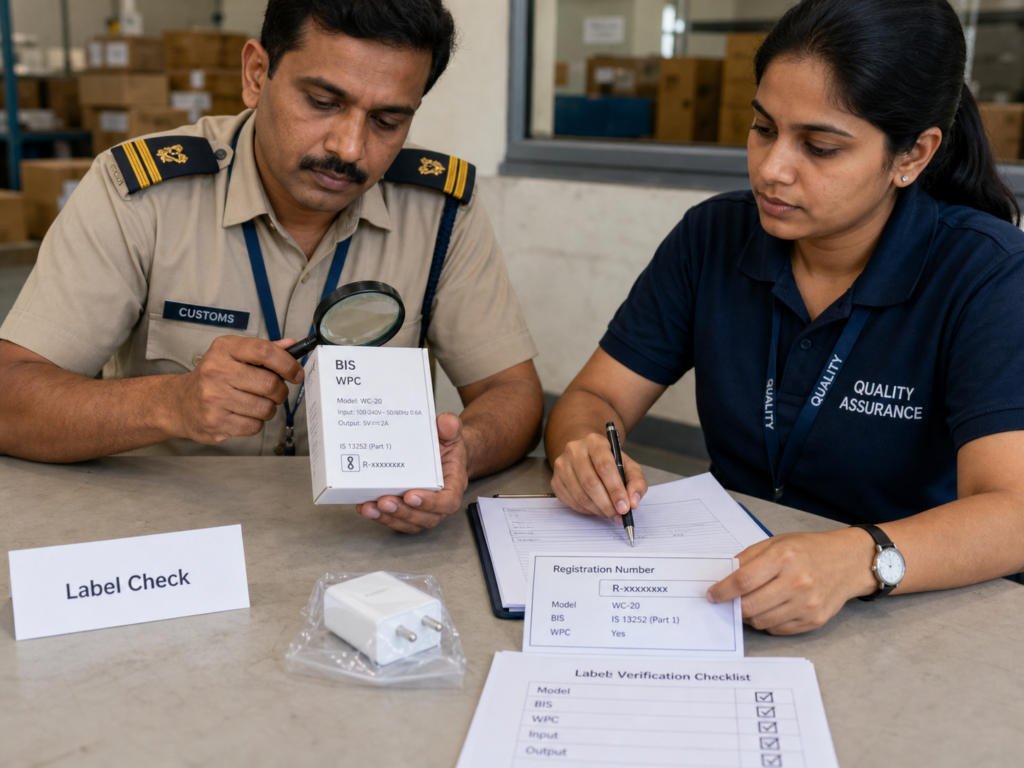
Finally, prepare the documents: both electronic and paper copies of certification or approval documents shall be prepared, as well as product specifications, authorization documents (if applicable), and other materials that may be required by customs.
Customs Clearance: Documents and Inspection
At the customs clearance stage, the core is that the documents are complete and the declaration information is accurate. The documents required by Indian Customs will vary according to the mode of transport, goods, customs declaration mode, tax and regulatory requirements. Usually, commercial invoices, packing lists, bills of lading or waybills, IEC, and applicable tax and certification documents shall be prepared according to specific cases.

If the product is regulated by BIS or WPC, corresponding BIS CRS registration documents, WPC ETA or other applicable approvals, exemptions, and declaration materials shall also be prepared. Certificate of origin, test reports, authorization documents, and explanatory documents required by customs shall be provided according to specific situations.
For goods regulated by BIS/WPC, the model, registration or approval information required by the regulatory authority shall be truthfully filled in the customs declaration and commercial invoice. The specific fields to be filled in shall be subject to the requirements of Indian Customs, the customs declaration system, and relevant regulatory departments. A certain certification number cannot be regarded as a unified statutory mandatory item for commercial invoices of all goods.
During customs inspection, common verification contents include: whether product labeling meets requirements, whether registration or approval documents are applicable, and whether the cargo model and technical parameters are consistent with the declaration information. Common reasons for customs clearance delays or failures include inapplicable status of certificates or approval documents, model mismatch, non-compliant labeling, missing documents, and failure to declare samples or non-sales purpose goods in accordance with applicable procedures.
Post-Clearance and Exception Handling
Goods being cleared through customs does not mean all compliance obligations are over. When products are put on the market for sale, the required rated parameters, manufacturer or importer information, warnings, and instructions for use shall be provided on the product, packaging, manual, or label in accordance with the corresponding IS standards, BIS labeling requirements, Legal Metrology, and other applicable product regulations. The specific content and location shall be confirmed according to the product category and applicable rules, and the statement that “all information must be written in the manual” cannot be simply applied.
At the same time, certification or approval documents, test reports, import records, product specification materials, and supply chain documents shall be retained as required, which may be needed for subsequent market spot checks or dispute handling.
If you really encounter customs detention or law enforcement inspection, don’t panic. You should first suspend release or sales as required by the competent authority, preserve the goods and all documentary evidence, and entrust a local Indian compliance agency, customs clearance professional, or lawyer to handle the connection as soon as possible. Do not arbitrarily modify the declaration or provide unverified explanations on your own.
In addition, if the product has a built-in battery, you must additionally verify India’s battery regulations and EPR (Extended Producer Responsibility) requirements. This part belongs to another regulatory scope, and should not be ignored just because BIS or WPC verification has been completed.
Compliance Verification and Risk Avoidance
When doing business in the Indian market, you cannot rely entirely on service providers. You must also learn to verify compliance information and identify risks, so that you are not easily cheated.
Official Verification Channels
All information is subject to official sources. Commonly used official verification channels are as follows:
• BIS-related: BIS’s CRS catalog and registration query system, QCO release page, IS standard query page;
• WPC-related: DoT/WPC official website, Saral Sanchar online application and declaration platform, frequency band policy and license-free frequency band release page;
• Import qualification-related: DGFT’s IEC query page, Indian Customs and ICEGATE’s import declaration and regulatory requirement pages.
Saral Sanchar is mainly used for online application and declaration of WPC/DoT, and cannot be generally understood as a public database open to the public that can freely retrieve all ETAs by certificate number or model. The public verification capability, queryable fields, and platform functions of WPC ETA may be subject to the official pages and documents at the time.
Before each bulk order, the latest rules shall be verified through official channels, as India’s regulations and implementation requirements may be updated. It is best to keep the web pages, documents, emails, or platform records of each verification for subsequent explanation of the judgment basis at that time.
Certificate Authenticity and Validity Verification
Whether using certificates provided by suppliers or documents applied for by yourself, you must verify their authenticity and applicability. Don’t be unaware that you have got a fake or inapplicable certificate.
When verifying BIS CRS registration, you can check the registration number, manufacturer name, factory, brand, model, and applicable standards through the BIS or CRS official system. For WPC, the certificate and declaration information shall be checked through the WPC/DoT official website, application records in the Saral Sanchar account, and ETA documents issued by WPC. If the public platform cannot retrieve, do not assume that verification can be completed online solely by certificate number or product model. You should obtain official documents and necessary written confirmation from WPC or the certificate-holding applicant.
BIS and WPC cannot be verified in exactly the same way:
• For BIS, the validity period, renewal status, certificate coverage, and change records of the registration shall be checked;
• For WPC, the approval status, applicable conditions, revocation or change status of ETA documents or other approval documents shall be checked;
• For both, it is necessary to check whether the manufacturer, factory, brand, model, key parameters are consistent with the imported goods;
• It is also necessary to confirm the commercial relationship between the importer and the manufacturer or brand owner and any applicable authorization requirements.
Others’ certificates cannot be used for uncovered manufacturers, factories, brands, or models, nor can technical or supply chain changes that have occurred to the product itself be ignored just because the documents are authentic.
High-Risk Scenarios and Corrective Actions
When doing business in the Indian market, there are several high-risk pitfalls that must be avoided in advance. We have compiled corresponding corrective actions:
• **Risk of counterfeit branded certificates**: Do not just look at the certificate number. Carefully check the product appearance, rated parameters, model, and factory information on the certificate to ensure they are consistent with the products you import;
• **Risk of unclear commercial relationship or authorization**: Confirm in advance the commercial relationship between the importer and the manufacturer, brand owner, or certificate holder, as well as applicable brand or distribution authorization requirements, to ensure consistent customs declaration information;
• **Risk of non-compliant labeling**: Before stocking and production, check the label samples according to the corresponding rules, and confirm there are no problems before mass production. Do not wait until production is completed to find that the format or content is not applicable;
• **Risk of inapplicable certificate status**: Before each order, check the validity period and renewal status of BIS registration, as well as the approval status, applicable conditions, and changes of WPC documents;
• **Risk of factory change**: Verify in advance whether the factory address on the certificate is consistent with the actual production factory. If you want to change the factory, evaluate the compliance impact in advance, and handle changes, supplementary testing, or new applications as required by BIS or relevant competent authorities;
• **Risk of module replacement**: Before replacing wireless modules, antennas, or adjusting radio frequency parameters, first evaluate WPC requirements, and confirm with WPC or the declaration platform whether changes, retesting, or re-obtaining ETA are required.
Compliance Judgment Logic for Complex Products
If you encounter relatively complex products and don’t know how to judge, you can follow these logics:
For all-in-one products, each function shall be checked separately to see if it triggers the corresponding access requirements. For example, for an all-in-one charging station with Bluetooth, check BIS for the charging function, check the applicable scope of WPC for the Bluetooth function, and then determine whether ETA is required based on specific parameters.
For set products, it cannot be simply assumed that the certificate of one product can cover all individual items. Each individual item must first be judged whether it falls within the effective QCO/CRS scope. Accessories provided with the complete machine or set may be treated as complete machine configuration only if explicitly permitted by applicable regulations or BIS, and are not imported or sold as separate regulated products. Otherwise, chargers, cables, or other accessories may need to meet their respective requirements respectively.
For customized or new products, do not judge based on experience. It is best to entrust a compliance service provider in advance or verify directly with the relevant competent authority. For bulk import of multiple models, check each model one by one to see if it is within the coverage of the registration or approval documents. Do not mix uncompliant models, otherwise the entire batch of goods may be required to provide supplementary explanations or have release suspended.
Common Consequences of Non-Compliance
Finally, let’s emphasize the consequences of non-compliance. Do not take chances. During the customs clearance stage, problems such as cargo detention, return, destruction, demurrage, and storage fees may occur; if the product has already entered the market and is found, it may also face fines, product removal, recall, or other law enforcement measures.
Multiple or serious violations may lead to stricter risk assessment, inspection, penalties, or subsequent customs clearance delays. However, whether Indian Customs adopts key inspection or other measures shall be determined by the risk management system and the competent authority according to law on a case-by-case basis. It cannot be simply assumed that every multiple violation subject will automatically enter a certain fixed list.
Pre-Import Self-Check List and Special Situation Handling
For your quick check before import, we have compiled a 5-step quick self-check list, which you can tick off one by one:
□ Complete product information, BIS mandatory list has been verified; if BIS is required, confirm the certificate is valid, model matches, and registration coverage is correct
□ The wireless transmission function of the product has been checked; if it falls within the applicable scope of WPC, confirm the approval status, conditions, and model match of ETA or other required documents
□ The certification labels on the product and packaging comply with official rules and are consistent with the information in the registration or approval documents
□ Routine documents, certification, and tax documents required for customs clearance have been fully prepared according to specific requirements
□ The importer’s IEC is valid, and whether GST registration is required has been confirmed according to Indian sales, taxable supplies, and GST rules, while other applicable registration requirements have been verified
Meeting these 5 items can only reduce risks related to BIS/WPC and basic customs clearance documents. You still need to verify customs classification, taxation, labeling, transportation, batteries, EPR, brand intellectual property rights, and other applicable regulations according to the product and transaction mode, and the actual review by Indian competent authorities shall prevail.
If you encounter some special situations, you can handle them according to the following ideas:
• **Sample import**: For imports of samples, R&D, testing, or exhibition purposes, the applicable procedures and exemption conditions shall be verified with Indian Customs, DGFT, and relevant competent authorities before shipment, corresponding purpose certificates, commitment documents, or other materials shall be prepared, and the goods shall be used for the approved purpose. Goods enjoying exemption for non-sales purposes shall not be resold in violation of the exemption conditions;
• **Separate import of accessories**: Only evaluate the compliance requirements of the accessories themselves, and do not automatically bind them to the complete machine. For example, if importing USB cables separately, check whether the cables themselves fall within the relevant mandatory list, and do not directly use the certificate of the charger or complete machine;
• **Set import**: Each individual item must first be judged for its own compliance requirements. Accessories provided with the complete machine may be treated as complete machine configuration only if explicitly permitted by applicable regulations or BIS; outer box and label information shall also be prepared according to specific rules to facilitate customs inspection;
• **First import**: If you are not familiar with the rules, it is best to entrust a local compliance service provider or customs broker to conduct a pre-assessment in advance to eliminate risks early;
• **Regulatory updates**: Do not use old rules as the basis. Before bulk import, be sure to verify the latest requirements through official channels again to ensure that the product, certificate, declaration, and label are consistent with each other.
Summary: Importer Compliance Decision Logic
Finally, we sort out the compliance decision logic for charging products in the Indian market into four clear steps, which you can follow:
Step 1: Collect complete product information, including basic attributes, electrical parameters, wireless attributes, and import attributes;
Step 2: Check against the latest BIS QCO/CRS mandatory list to verify whether the product requires BIS. If required, confirm that the registration coverage, model, manufacturer, factory, brand, and applicable standards are all consistent with the goods;
Step 3: Check the wireless transmission function of the product, confirm whether it falls within the applicable scope of WPC, and determine whether ETA or other approval or declaration is required based on frequency band, power, standard, purpose, and exemption policies;
Step 4: Confirm that the importer’s IEC is valid, confirm GST and other tax and customs registration requirements according to actual business, and finally prepare all customs clearance documents.
Here is a priority tip: prioritize using the manufacturer’s existing valid compliance documents, but check whether the certificate holder, manufacturing factory, brand, model, standards, and technical parameters are consistent with the goods, and confirm the commercial relationship and applicable authorization requirements. If there are no ready-made documents, be sure to start testing, registration, or declaration in advance, reserve sufficient review time, and do not rush at the last minute.
The final principle to remember is: all compliance determinations are subject to the latest rules in effect by Indian authorities at the time of product import. If you are unsure, be sure to consult a professional compliance service provider or verify with the relevant competent authority, and do not judge based on experience or take things for granted.
Of course, not everything requires a service provider. Tasks such as initial judgment of BIS/WPC requirements for charging products, verification of registration or approval documents, pre-import compliance self-check, and common risk identification can be completed by importers on their own first, and then professional help can be sought for complex or controversial parts.