
If you deal with consumer electronic accessories such as charging cables, USB-C cables, chargers, power adapters, car chargers, and wireless chargers and want to enter the Indian market, the first hurdle to cross is not product selection, but compliance. Many sellers ship goods with only CE and FCC certificates, only to have their goods inspected by customs, potentially facing detention, return shipment, or other handling, and their e-commerce stores may even be removed from shelves in accordance with platform rules.
India’s market access rules are complex in some ways: there are many regulatory bodies, many abbreviations, and regulations are updated quickly. But they are also simple in other ways: as long as you conduct step-by-step checks logically, figure out which requirements are mandatory, which are optional, and which pitfalls to avoid, you can enter the market steadily. This article focuses on charging products, and will thoroughly explain the essential certifications and compliance requirements for the Indian market, from entry-level basics to self-inspection.
I. Basics of Market Access for Charging Products in India (Must-Read for Beginners)
Scope of Application and Boundary Judgment
The charging cables, USB-C cables, chargers, power adapters, car chargers, wireless chargers, and interface connectors we commonly contact basically fall under the regulatory scope of consumer-grade electronic accessories. However, the boundary judgment is not only based on whether the product is powered (active/passive), but also combines **official regulatory catalogs + actual sales forms**: for example, an ordinary passive charging cable sold separately at retail may be in the regulatory catalog, but if it is exported as an accessory of industrial equipment along with the whole machine, it may not fall under the consumer-grade regulatory scope.
Non-consumer-grade accessories such as industrial-grade high-voltage power supplies and core telecommunications equipment are not within the scope of consumer electronics regulation discussed in this article, and are subject to other special rules. If your product has a built-in battery (such as a wireless charger with a battery), in addition to the certification of the product itself, you also need to comply with the EPR (Extended Producer Responsibility) requirements for batteries, which will be discussed in detail later.
Actual Consequences of Non-Compliance
Many novices have no concept of the severity of compliance issues. We will clarify them by stage:
• **Customs clearance stage**: If a product is subject to mandatory certification or other import requirements but fails to meet them, it may face customs inspection, detention, return shipment, confiscation, or punishment in accordance with the law, depending on the facts of the violation and the decision of the competent authority.
• **Sales stage**: E-commerce platforms may take measures such as removing products from shelves or restricting sales in accordance with their own rules. Whether points will be deducted, new product launches will be restricted, or sales will be banned depends on platform rules and specific violation circumstances.
• **Regulatory stage**: If an official case is filed, the enterprise may be required to suspend business for rectification and recall products across all channels, which will directly affect brand reputation and make it much more difficult to enter the Indian market in the future.
Division of Responsibilities of Core Regulatory Authorities
There are many regulatory authorities in India, but each is in charge of a specific area. You don’t need to memorize the full names, just know what each is responsible for:
• **BIS (Bureau of Indian Standards)**: Responsible for standards, certification, and registration of applicable products; BIS requirements constitute mandatory market access conditions only for products covered by the corresponding QCO, CRS list, or other mandatory catalogs.
• **WPC (Wireless Planning and Coordination Wing)**: Regulates products with wireless transmission functions to ensure that frequency bands do not interfere with India’s communication and broadcasting order.
• **CPCB/SPCB (Central/State Pollution Control Board)**: Responsible for environmental protection requirements, such as e-waste recycling, restriction of hazardous substances, and plastic packaging recycling.
• **BEE (Bureau of Energy Efficiency)**: Responsible for energy efficiency-related labeling, which falls under the category of on-demand assessment and is not mandatory for all products.
Difference Between Mandatory Compliance and Voluntary Value-Added Certification
This is the most confusing point for beginners. Let’s first confirm the conclusion:
• **Mandatory compliance**: Without it, you cannot clear customs or sell products. You must apply in accordance with the official regulatory catalog, with no room for negotiation.
• **Voluntary value-added certification**: It is only required when explicitly requested by channel cooperation, government procurement, or brand promotion. It is not necessary for market access and does not need to be done in advance.
**Biggest beginner misconception**: No matter how many international certifications such as CE, FCC, and CCC you have, they cannot replace local Indian certifications. They can only be submitted as supporting materials at most. This is a red line that must never be crossed.
Core Abbreviation Comparison Table
Many abbreviations will be used later. We have compiled a comparison table first, and you can refer back to it if you forget:
| Abbreviation | Plain Explanation |
| QCO (Quality Control Order) | A mandatory compliance catalog issued by the Government of India, which clarifies which products must be certified |
| CRS (Compulsory Registration Scheme) | A mandatory safety registration system of BIS for consumer electronic products, which does not require factory inspection |
| ISI | Another certification mode under BIS, which usually requires on-site factory inspection. Applicable products are subject to the official catalog |
| AR (Authorized Representative) | A local Indian agent that overseas manufacturers must appoint to submit certification applications |
| WPC/ETA | Equipment type approval and related spectrum compliance procedures of WPC/DoT for applicable wireless equipment. Specific requirements depend on equipment functions, frequency bands, and latest rules |
| EPR (Extended Producer Responsibility) | A mandatory environmental protection requirement that requires producers, importers, or other responsible entities defined by rules to bear the recycling responsibility after products are discarded |
| PRO (Producer Responsibility Organization) | A third-party organization entrusted to carry out recycling. Enterprises may entrust a PRO to fulfill part of their EPR obligations on the premise of complying with rules |
| RoHS (Restriction of Hazardous Substances) | A mandatory requirement to limit the content of hazardous substances in electronic products. No third-party certification is required, but compliance certificates must be kept for inspection |
II. Official Regulation Verification and Update Mechanism
Why Must You Verify Regulations Yourself?
India’s regulations are updated very frequently, and mandatory catalogs, test standards, and effective dates are often adjusted. For example, the USB-C universal interface policy that everyone is concerned about has been discussed for several years, but the specific products covered and the effective date are subject to the latest official announcement. The guide you read last year may be incorrect this year. All compliance conclusions must be based on the latest official documents. You cannot rely on casual remarks from others, nor apply old experience to new situations.
Core Official Inquiry Channels
You don’t need to memorize complex URLs. You can find the official entry by searching the corresponding institution name + keywords directly:
• **BIS-related**: To check the CRS mandatory registration list, QCO announcements, IS standard database, and certificate authenticity, go to the BIS official website.
• **WPC-related**: To check the ETA license catalog, radio frequency exemption list, and certificate validity, go to the WPC official website.
• **Environmental-related**: To check EPR registration, waste management rules, and RoHS schedules, go to the CPCB EPR registration portal.
• **Label and customs clearance-related**: To check packaging rules, contact the Legal Metrology department; to check HS codes, use the Indian customs inquiry system.
Verification Traceability Requirements
Don’t just finish the check and leave it at that. Be sure to keep records: before each order or shipment, clearly record the current regulation version, the corresponding QCO number and effective date, and the applicable standard version. You should also keep official inquiry screenshots, verifier information, and assessment reports. On the one hand, they can be used directly for the next shipment; on the other hand, in case of regulatory spot checks, you can produce evidence to prove that you met the requirements at that time.
Scenarios Requiring Re-Verification
One verification is not a once-and-for-all solution. You must re-check in the following situations: new product launch, product modification (including chip replacement, shell modification, and parameter adjustment), and change in sales form (for example, from separate sales to set sales, or from retail to distribution with the whole machine). In addition, at the beginning of each year or when there are rumors of policy adjustments, you should also re-check the mandatory catalog to avoid being unaware of rule changes.
III. Preparations Before Certification
Before officially applying for certification, completing these three things first can save you a lot of detours.
Product BOM Disassembly Method
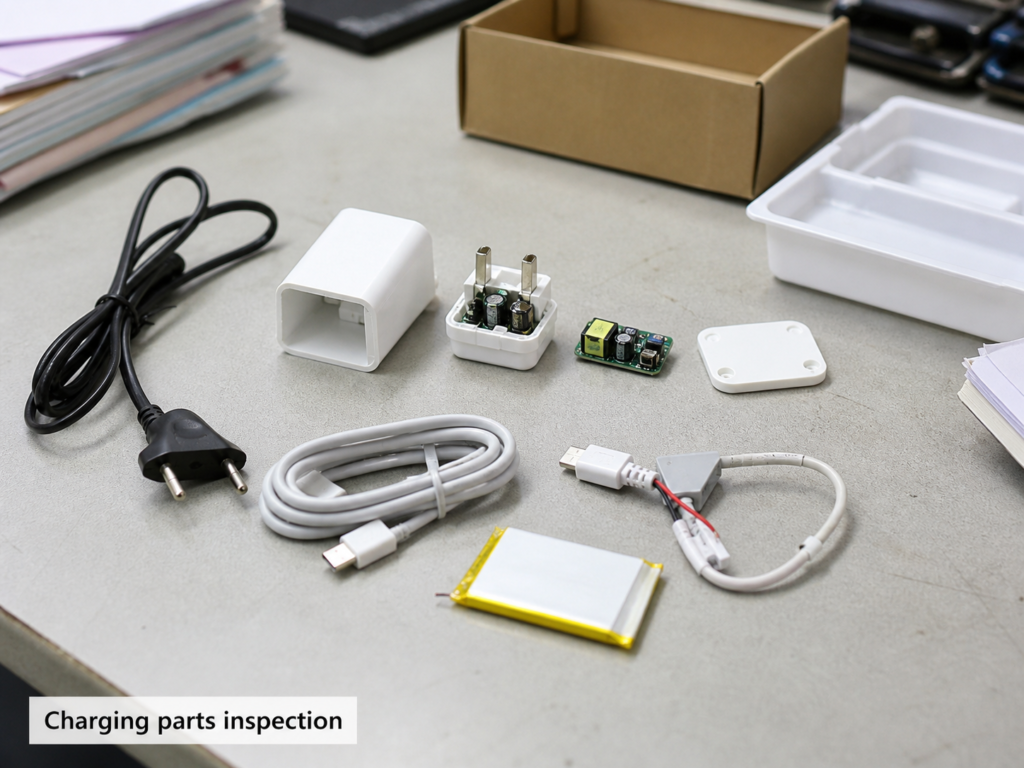
BOM stands for Bill of Materials. The disassembly logic is very simple: disassemble each independent functional component in the retail set, and judge the compliance requirements one by one. You cannot say “this is a set, so only the main unit needs to pass certification”.
Common disassembled components include: charger body, power cord, charging cable, plug, wireless module (if any), battery (if any), and packaging materials. Don’t miss the packaging, as plastic packaging also has compliance requirements. For example, a 65W GaN charger set should be disassembled into components such as the charger, cable, plug, plastic inner tray, and paper outer box, each of which requires separate requirement checks.
Definition of Responsible Entities
Many people are confused about who should be responsible for certification. Let’s clarify directly:
• **Indian importer**: Usually responsible for import declaration, as well as obligations such as labeling and EPR arising from its role as an importer. The specific EPR responsible entity shall be confirmed in accordance with the definitions of producer, importer, and brand owner in the corresponding rules and CPCB requirements.
• **Overseas brand owner**: Cannot directly apply for certifications such as BIS and WPC, and must appoint a local Indian AR (Authorized Representative) to submit the application.
• **Original Equipment Manufacturer (OEM)**: Certifications held by the OEM itself are not yours. For example, if the OEM has obtained CRS for the same type of charger for another brand, you cannot use it directly. You must confirm that the certificate covers your brand and model, otherwise it is a fraudulent use of a certificate.
• **PRO**: A third-party organization specializing in recycling. You may entrust it to fulfill part of your EPR recycling obligations on the premise of complying with rules, without having to establish all recycling channels on your own.
Technical Document and Sample Consistency Control
Documents that need to be prepared in advance generally include: product specifications, BOM list, list of key safety components (such as transformers and capacitors), wireless module model (if any), label draft, and user manual.
The most critical requirement is that **mass-produced products shall be consistent with the test samples in terms of model, rated parameters, key safety components, structure, and manufacturing location that affect compliance**. Any change shall be evaluated in advance in accordance with BIS change rules, and supplementary testing or certificate change shall be carried out if necessary. A common pitfall is using good parts for test samples, but switching to cheaper parts during mass production to save money. As a result, if caught in a BIS spot check, the certification will be directly revoked, which is not worth the loss.
IV. Core Mandatory Access: BIS CRS Safety Registration
Some chargers, adapters, and related electronic products are included in the BIS mandatory catalog; whether CRS is required must be confirmed item by item according to specific product categories, models, and the latest QCO/CRS list. Charging cables and passive cables cannot be judged solely by their names.
Basic Description of CRS Registration
CRS is a mandatory safety registration of BIS for electronic and IT products included in the QCO mandatory catalog. Its core is to verify basic safety performance such as electric shock prevention, overheating prevention, and insulation — for example, whether a charger will leak electricity or catch fire during use. After passing, a registration number starting with R will be issued, and the BIS standard mark and registration number must be marked on the product as required. Note: Only products in the mandatory catalog need to apply, not all charging products. Don’t waste money.
Four-Step Verification Method for CRS Applicability
To determine whether your product requires CRS, just follow these four steps:
1. First, list all retail products and each disassembled independent component, without missing any;
2. Search in the latest QCO and CRS mandatory lists to confirm whether the product is included;
3. If it is in the catalog, confirm the applicable IS standard (Indian national standard number), test requirements, and effective date;
4. Check that the brand, model, and factory address are consistent with the certificate coverage, so that you don’t buy someone else’s certificate that you can’t use.
Each step must be traced, and verification basis such as QCO number, catalog screenshot, and IS standard version must be properly saved.
Core Requirements for CRS Registration
There are several hard requirements to know in advance to avoid detours:
• **Test requirements**: Usually, the required tests must be completed in a BIS-recognized laboratory in accordance with the current CRS procedures; overseas reports generally cannot directly replace the tests required by CRS. Whether there is a special acceptance procedure shall be confirmed based on the latest BIS requirements.
• **Applicant entity**: Overseas manufacturers must appoint a local Indian AR to submit the application. Submitting the application directly by themselves usually cannot complete the required application process.
• **Document requirements**: Product specifications, list of key components, factory information, label drafts, etc. The more complete the better, to avoid delays caused by supplementary materials.
Validity Period, Renewal, and Change Control
The validity period and renewal window of CRS shall be subject to the current BIS rules (rules may be adjusted). Be sure to apply in advance before expiration, don’t wait until it expires to rush.
If there is a product change, you must never secretly modify it and sell it. You must first submit it to a BIS-recognized laboratory or AR for evaluation to see whether re-testing or certificate change is required. Wait for BIS’s reply before implementation, and keep the evaluation report, BIS reply, and changed certificate (if any). Common change items include: factory address, brand, model, key components, rated parameters, wireless module, and standard version update.
**Common misconception**: Products of the same brand from different factories cannot share the same registration number; OEM products cannot use certificates of other brands held by the OEM, and must apply for their own brand certificates separately.
Core Differences Between CRS and ISI Certification
Many people confuse CRS and ISI. We have compiled a comparison table:
| Comparison Item | BIS CRS | BIS ISI |
| Applicable products | Consumer electronics and IT products included in the mandatory catalog | Products in the official ISI catalog, mostly home appliances, industrial supplies, etc. |
| Audit method | Only sample testing is required, no on-site factory inspection | Usually requires on-site factory inspection + sample testing |
| Certificate form | Registration number starting with R, standard mark required | ISI mark certificate |
| Applicability to charging products | Some chargers, adapters, and related electronic products need to be checked against the CRS catalog; charging cables and passive cables cannot be judged solely by name | Rarely involved for ordinary charging accessories, subject to the official catalog |
Whether to take the CRS path still requires checking against the official catalog one by one — even accessories sold with the whole machine are not automatically exempt from compliance obligations.
Updates on USB-C Interface Policy
India is indeed promoting the standardization of universal charging interfaces for portable electronic devices, in a direction similar to the European Union, but it has not been fully implemented yet. To determine whether your product needs to be adjusted, check three points: whether the product category is covered, whether the effective date has arrived, and whether separately sold chargers/cables are covered.
**Common misconception**: Policy direction is not the same as effective mandatory obligations. Don’t rush to modify your product just because someone says “India must use USB-C now”. Everything is subject to the official formal announcement to avoid wasting money or missing opportunities.
V. On-Demand Mandatory Certification: WPC/ETA and Other Boundaries
This part is not required for all products, only for those that meet the conditions, and belongs to “on-demand mandatory” requirements.
WPC/ETA Wireless Compliance
The ETA of WPC/DoT is usually used for equipment type approval of applicable wireless equipment, focusing on verifying radio frequency parameters, operating frequency bands, and related spectrum rules. Whether ETA or other licenses are required shall be judged according to equipment functions and the latest WPC/DoT procedures. It is a relatively independent system from BIS. Passing BIS does not mean that the wireless compliance requirements under WPC/DoT have been completed.
Judgment Logic
• **Requires verification**: The product contains radio frequency modules such as Wi-Fi/Bluetooth/NFC/cellular, or uses regulated frequency bands.
• **No verification required**: Wired chargers, charging cables, and power adapters without wireless transmission functions.
• **Wireless charging products**: For Qi wireless chargers that only use inductive power supply and have no radio frequency module, you need to first check the WPC exemption/ETA catalog, and it may not be required.
The core judgment criterion is not whether the name contains “wireless”, but whether there is an actual radio frequency transmission module, as well as the frequency band used by the equipment and applicable procedures — this is the most common misconception.
Application Requirements
Existing FCC/CE radio frequency reports can be submitted as supporting materials, but the final review shall be conducted in accordance with the applicable WPC/DoT procedures, and cannot be directly converted into a certificate as a matter of course; overseas applicants need to appoint a local Indian agent to submit; the authorization type, validity period, and labeling requirements are subject to the approval document and current rules.
Boundaries of Other Easily Confused Mandatory Certifications
There are two other easily confused certifications. Let’s clarify their boundaries:
• **TEC Telecommunication Certification**: TEC/MTCTE only applies to telecommunication equipment covered by the TEC official mandatory product list; ordinary charging accessories that do not have the attributes of telecommunication equipment are usually not in this list, but should still be confirmed according to specific product models and the latest list.
• **Plug/Socket/Converter Certification**: Indian standard products sold separately need to be checked against the BIS mandatory catalog; those sold with the whole machine need to confirm whether they are compliant with the whole machine, and are not necessarily exempt.
These judgments must be based on the mandatory catalogs and official notices of the competent authorities, and should not be taken for granted.
VI. Environmental Compliance Applicability Verification
Many sellers think that passing safety certification means everything is fine. In fact, environmental compliance is also mandatory, and inspections are becoming increasingly strict.
E-Waste EPR Registration
This is a mandatory requirement of the E-Waste Management Rules 2022. Simply put, “whoever produces/imports is responsible for recycling” — the electronic products you sell that eventually become e-waste must be recycled by the producer, importer, brand owner, or other responsible entities defined by the rules, and cannot be simply attributed to a single entity.
Applicability Judgment
You need to check the categories of regulated electrical and electronic products in the schedule of the rules. Not all charging products/cables are applicable. For example, some passive cables may not be in the catalog, so you must check clearly. The responsible entity is determined according to the import mode and brand ownership, usually the Indian importer or brand owner. The specific definition is subject to the definitions of producer, importer, and brand owner in the corresponding rules and CPCB requirements. Whether passive cables and connectors in the set are included in the EPR scope should also be confirmed according to CPCB portal rules, and cannot be decided by yourself.
Core Obligations
CPCB registration shall be completed and EPR obligations such as targets, recycling, and reporting shall be fulfilled according to applicable product categories; enterprises may fulfill their obligations by establishing their own recycling mechanisms or entrusting qualified PROs in accordance with the law. The specific requirements are subject to CPCB rules and portal requirements.
**Common misconception**: Having a BIS certificate does not mean that EPR has been completed. The two are completely independent. BIS manages safety, and EPR manages environmental protection. Both are required.
Supplementary Requirements for Battery EPR
If the product contains built-in/included batteries (such as a wireless charger with a battery), the battery EPR must be verified separately in accordance with the Battery Waste Management Rules, and cannot be mixed with the product EPR. The responsible entity is usually borne by the battery producer/importer or the finished product brand owner, and is confirmed according to the specific cooperation mode.
India RoHS (Restriction of Hazardous Substances)
India RoHS is incorporated into the e-waste management rules. No third-party certification is required. You only need to ensure compliance by yourself and keep compliance certificates for inspection.
Restricted substances, limits, and exemptions are subject to the E-Waste Management Rules 2022 and its revised schedules. Documents to be kept include: hazardous substance test reports from recognized laboratories, and supplier material declarations. EU RoHS reports can be used as technical evidence, but an India applicability difference analysis must be completed, and they cannot be directly applied. RoHS labeling is voluntary, not mandatory.
Plastic Packaging EPR
Derived from the Plastic Waste Management Rules, it requires producers/importers of plastic packaging to bear corresponding recycling responsibilities.
Applicability Judgment
All packaging components must be disassembled to check whether they contain plastic components (including paper-plastic composites and plastic coatings); paper packaging that is completely free of plastic does not need to meet the requirements. The responsible entity is usually the Indian importer or brand owner, and the specific situation shall be confirmed in accordance with applicable rules and CPCB requirements.
For regulated plastic packaging, the required labeling, marking, and EPR obligations shall be completed in accordance with the PWM Rules, revised documents, and current CPCB guidelines; the specific content and method of labeling shall be checked item by item according to packaging categories.
VII. Implementation Compliance: Labeling, Packaging, and Import Customs Clearance
Even if all certifications are completed, a mistake in the details of labeling, packaging, or customs clearance during implementation may also lead to customs detention or product removal.
Tiered Labeling Compliance Requirements
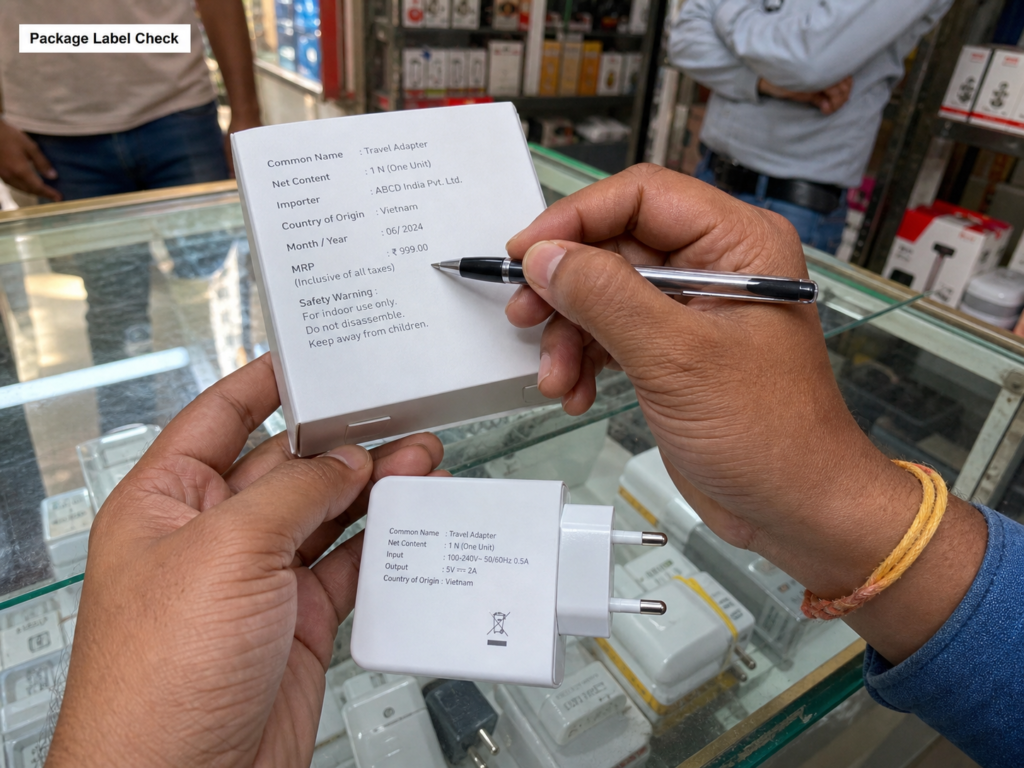
Labeling requirements for different positions are different. Don’t confuse them:
• **Product body (when applicable)**: Corresponding information shall be marked in accordance with applicable BIS product standards, CRS labeling requirements, WPC approval conditions, and other special regulations. Pre-packaged declarations such as country of origin, importer, and MRP shall be placed on the specified retail packaging or allowed label carriers in accordance with Legal Metrology rules.
• **Retail packaging (pre-packaged imported goods)**: In accordance with Legal Metrology rules, the following must be printed: common name, net content/specification, name, address and contact information of the Indian importer, country of origin, month and year of production/import, consumer complaint channel, MRP (maximum retail price including tax), recycling mark, and safety warning (if any). The specific declaration content, display method, and applicable conditions shall be confirmed item by item according to the product and packaging form.
• **Outer carton**: Carton specifications, gross weight/net weight, consignor and consignee information, and country of origin are subject to customs requirements.
• **E-commerce product detail page**: Parameters, certification information, and MRP must be completely consistent with the retail packaging, and false labeling is prohibited.
Applicable pre-packaged goods shall declare the tax-inclusive MRP on the specified display surface or in allowed labeling methods in accordance with Legal Metrology rules, and ensure that it is clear, readable, and consistent with the actual sales price rules.
Common Labeling and Packaging Errors
We have compiled several of the most common pitfalls, which you can check against:
1. Certification marks are only attached with easily worn stickers, which do not meet the wear resistance requirements;
2. The certified model is inconsistent with the actually sold model, or the registration number does not match;
3. Only international certification marks are labeled, and the importer information required by India is not labeled;
4. Missing MRP, net content, complaint channel, etc. required by Legal Metrology;
5. Information on the online sales page is inconsistent with the packaging/certificate.
Import Customs Clearance Requirements
First, make it clear: the IEC import code and GSTIN tax number are qualifications required by Indian importers, not by overseas manufacturers.
Common compliance documents for customs clearance include: BIS certificate (if applicable), WPC approval document (if applicable), EPR authorization copy, etc. Common reasons for customs detention include: inconsistency between goods and certificate models, test laboratories not recognized by BIS, lack of compliance documents, and incorrect HS code declaration.
VIII. Compliance Pitfall Avoidance: Anti-Fraud and Efficiency Optimization
Anti-Fraud Verification of Certificates and Service Providers
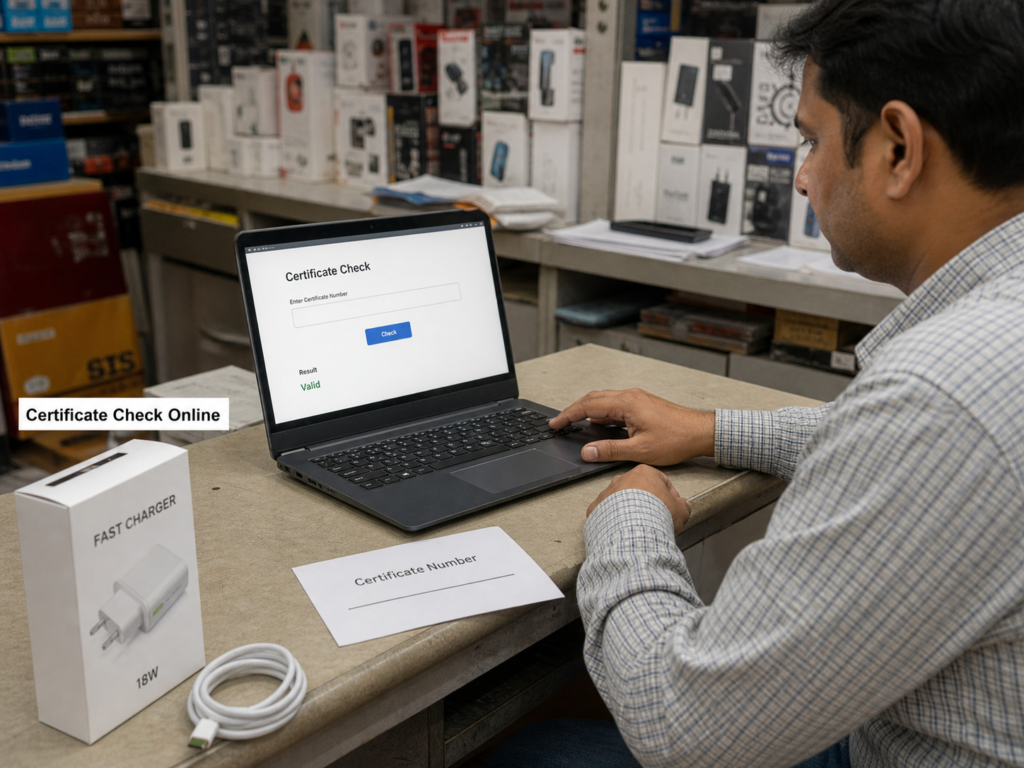
Nowadays, service providers for Indian certification are mixed, and there are many fake certificates and fraudulent certificate uses. You must learn to verify by yourself:
1. **Check certificate authenticity**: Log in to the official website of the competent authority to check the validity of the registration number/certificate number;
2. **Check matching degree**: Even if the certificate is real, you must check whether the brand, model, factory address, and applicable standards are consistent with the actual product. Otherwise, it is a fraudulent use of a certificate and cannot be used;
3. **Check service provider qualifications**: Require the service provider to provide the official recognition qualifications of the cooperative laboratory, and do not use unqualified laboratories.
**Common scam identification**:
• Promising to obtain a certificate in an extremely short period: The normal cycle is affected by scheduling and review. Those who say it can be obtained in a few days are basically untrustworthy. Subject to written quotations and official acceptance notices;
• Claiming that foreign reports can be directly converted into certificates: Both BIS and WPC require testing and review in accordance with local rules and cannot be directly converted;
• Fake/fraudulently used certificates: Cannot be queried on the official website, or the certificate information does not match the product/brand/factory;
• Low price with guaranteed pass: Most of them only provide test reports, use other people’s certificates, or have no formal registration, which will be exposed as soon as customs checks.
Verification of Channel/Tender Value-Added Requirements
Some large channels and government tenders require voluntary certifications (such as energy efficiency labels, quality labels, and environmental labels). These are not mandatory for market access, and should only be evaluated when explicitly required by channel contracts, tender documents, or brand promotion.
When verifying, you need to clarify: project name, competent authority, applicable standards, mandatory/voluntary status, application path, official inquiry link, and the original text of the requirements. Don’t do it just because the channel says so casually; it may not be needed at all.
Compliance Efficiency and Cost Optimization
• **Series product coverage assessment**: Products of the same brand, same factory, and highly similar parameters/key components (such as 20W/30W/45W chargers of the same series) can apply for series testing/registration, which can save a lot of money. The final result is subject to review.
• **Time optimization**: Prepare complete product information in advance to avoid delays caused by supplementary materials; choose an agent with direct local Indian qualifications to avoid multi-layer subcontracting, which is both cost-effective and fast.
• **Risk avoidance**: Conduct change assessment before product modification to avoid unqualified spot checks; check the validity of certificates and product consistency before each shipment, and don’t ship after the certificate expires.
IX. Quick Self-Inspection: Preliminary Product Compliance Check Matrix
For your convenience in conducting preliminary checks, we have compiled a check matrix, but first we need to clarify: **This is only a preliminary check reference and cannot replace the verification of the latest official regulations**. All conclusions must be supported by official inquiry records, standard versions, assessment reports, and other basis.
Core Matrix Columns
The matrix is divided into three parts, which you can fill in accordingly:
1. **Basic information**: Product type/component, sales method (separate retail/set/with whole machine), whether it contains a radio frequency module, whether it contains a battery;
2. **Compliance judgment**: Applicable QCO/IS standards, BIS path (CRS/ISI/not required), WPC path (required/not required/to be verified), environmental compliance requirements (e-waste EPR/battery EPR/RoHS/plastic packaging EPR), labeling requirements;
3. **Traceability items**: Responsible entity, verification basis (QCO number/official website screenshot, etc.), matters to be confirmed.
Covers Common Charging Product Types
This matrix basically covers common categories: wired chargers/power adapters, USB-C charging/data cables, ordinary passive charging cables (no electronic components), wireless chargers with/without communication modules, Indian standard plugs/adapters, and charger + cable sets.
Special Judgment Rules for Set Sales
Each independent component in the set needs to be judged for compliance requirements separately. You cannot default to accessory compliance just because the main unit is certified. For accessories sold with terminal equipment, you need to confirm whether they are compliant with the whole machine; if sold separately, they still need to be evaluated separately.
Reference Example: 65W USB-C GaN Charger Set
We use a common set to demonstrate the check logic (note: this is only for demonstration, not the final conclusion. The final result is subject to official verification):
• **Disassembled components**: GaN charger body, E-marker USB-C cable, Indian three-pin plug, plastic inner tray, paper outer box;
• **Preliminary check logic**: Check BIS CRS/e-waste EPR/RoHS for the charger; check the BIS mandatory catalog for the cable; the plastic inner tray is plastic packaging, so check plastic packaging EPR according to the applicable category; if the paper outer box has no plastic coating, no plastic EPR is required;
• **Matters to be confirmed**: Whether each component is in the latest mandatory catalog, applicable IS standard version, and division of responsible entities.
Final Remarks
By now, the certification and compliance requirements for charging products in the Indian market have been fully explained. After learning this, you should be able to complete the following tasks independently:
• Able to disassemble the product BOM and define the compliance responsibilities of different entities, no longer struggling with who should do the certification;
• Able to query the latest regulations through official channels and independently judge whether the product requires mandatory certifications such as BIS and WPC;
• Able to distinguish the applicable scenarios of BIS CRS, ISI, WPC/ETA, EPR, and RoHS, and no longer confuse them;
• Able to identify common certification scams and independently verify the authenticity of certificates and their matching with products;
• Able to prepare labels, packaging, and customs clearance documents as required to avoid common customs detention risks;
• Able to complete preliminary product compliance checks and keep verification basis.
Compliance in the Indian market seems cumbersome, but as long as you follow the logic step by step, take the latest official documents as the standard, and keep good traceability records, there will be no major problems. Don’t trust “shortcuts” easily, and don’t be intimidated by complex abbreviations. Once you figure out the core rules, you can enter the Indian market steadily.