
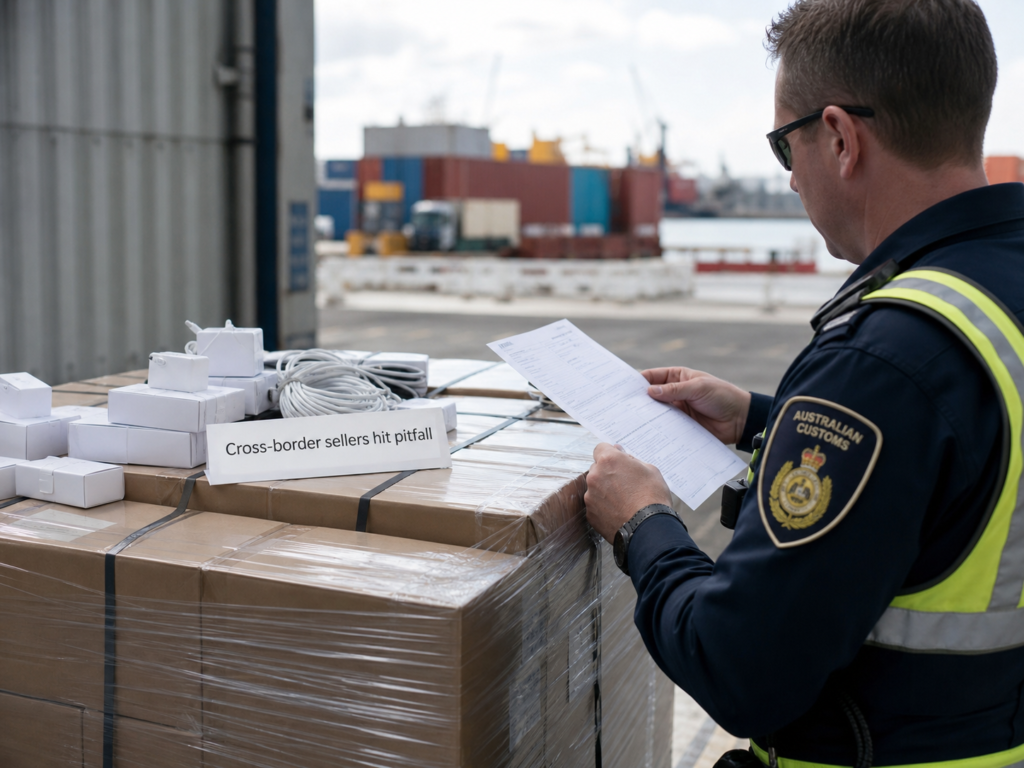
Many cross-border sellers of charging accessories fall into the same pitfall when first expanding into the Australian market: they ship goods with CE or FCC certifications, only to have their cargo detained by customs as soon as it arrives at the port, facing either return or destruction, and possibly incurring fines. In fact, Australia has an independent electronic product market access system that is not mutually recognized with the rules of the European Union or the United States. Even ordinary charging cables that seem unremarkable may be subject to product safety, EMC, electrical safety or consumer law requirements.
This article will clarify the compliance requirements for the Australian market, focusing on common charging products such as chargers, charging cables, and wireless chargers. It should be noted first that there is no “unified certification checklist” applicable to all electronic products in Australia. Specific requirements shall be assessed on a case-by-case basis according to product structure, intended use, whether it is connected to mains electricity, whether it is a regulated device, and whether it falls under the GEMS catalogue.
First Things First: Core Logic of Australian Regulation
Many newcomers are confused by a pile of acronyms when first exposed to Australian certifications. In fact, they can be understood as three regulatory systems with different responsibilities, but they are not interchangeable “sets of certificates”.
The first is the **Electrical Safety Regulation and EESS System**, whose core purpose is to prevent electric shock, overheating and fire. For products connected to Australian mains electricity, it is usually necessary to verify the electrical safety requirements of the relevant state or territory, and whether EESS applies. Whether EESS registration is required shall be judged based on whether the product is prescribed equipment and its regulatory level, and cannot be simply understood as all mains products automatically fall into the same EESS certification process.
The second is the **ACMA Electromagnetic Compatibility and Radio Regulatory System**, whose core is to reduce interference between electronic devices and ensure that products with radio functions comply with applicable spectrum and radio rules. For example, some electronic products may affect radios or other devices when operating, which involves electromagnetic compatibility (EMC for short). If the product has Bluetooth, Wi-Fi or other radio transmission modules, further verification of radio equipment requirements is needed. For wireless charging products, applicable EMC and spectrum rules shall be verified based on operating frequency and radiation characteristics, and not all wireless charging products can be directly equated with Bluetooth or Wi-Fi devices.
The third is the **GEMS Energy Efficiency Scheme**, whose purpose is to reduce energy consumption and related emissions of regulated products. It only applies to categories covered by the official product catalogue and specific product Determinations, and not all charging products require GEMS processing.
Which Charging Products Need Compliance? Boundaries Must Be Clarified First
Common chargers, power adapters, charging cables, data cables, charging adapters, connectors and plug-in wireless charging accessories may all be subject to product safety, EMC, radio or consumer law requirements.
However, whether EESS registration, ACMA compliance, supplier registration or RCM mark is required cannot be judged solely by the product name. It must be assessed item by item in combination with the product’s internal structure, rated input and output, whether it is connected to mains electricity, whether it contains active circuitry, whether it has radio transmission functions, and applicable standards.
Today, we will not discuss toys, large home appliances, complete consumer electronics with built-in batteries (such as mobile phones and laptops themselves), or specialized medical or industrial electronic equipment. These products usually have their own regulatory rules, and the assessment methods for charging accessories cannot be directly applied to them.
Special attention should be paid to a boundary that is easy to misstep: if the adapter has built-in voltage transformation, rectification or control circuitry, for example, it directly outputs USB 5V/20V after being plugged into mains electricity, then even if it looks like an ordinary adapter, its electrical safety, EMC and possible energy efficiency requirements shall be assessed according to its actual functions, and it cannot be simply treated as a purely physical adapter.
5 Essential Basic Terms to Stop Confusing
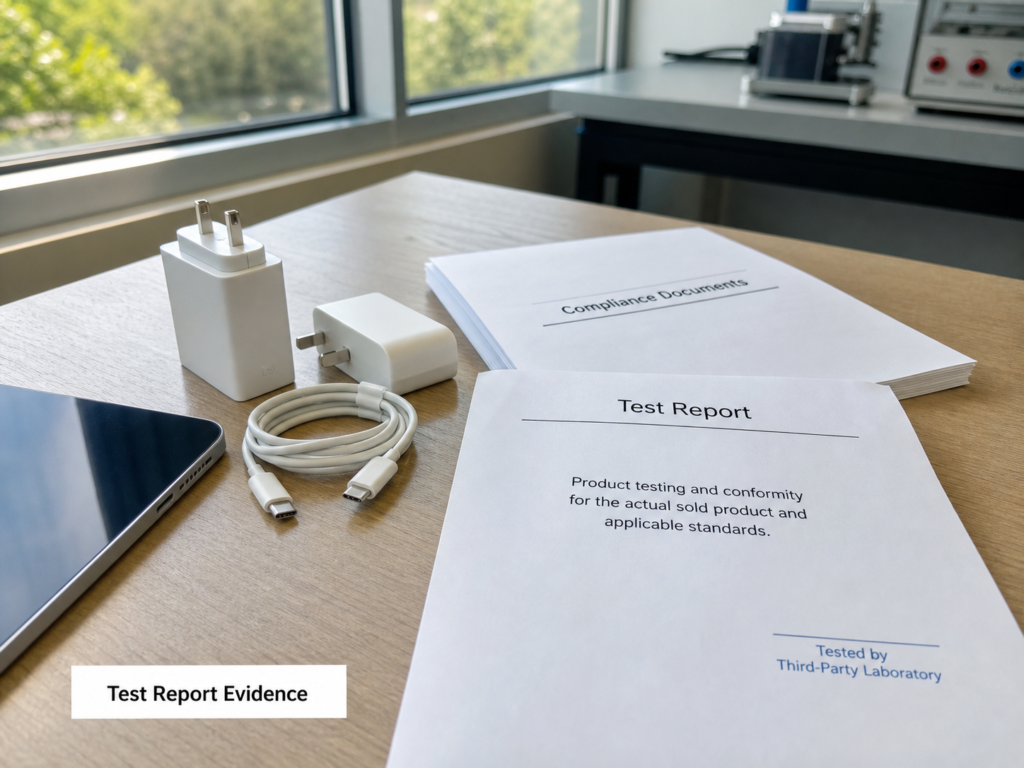
Before talking about specific requirements, let’s clarify a few most easily confused terms, otherwise it’s easy to get more confused as you read on:
• **Test Report**: A technical document issued by a third-party laboratory or conformity assessment body after completing testing. It is important evidence proving that the product meets relevant requirements, but the report must cover the actually sold product and applicable standards.
• **Declaration of Conformity**: A written commitment signed by the responsible supplier, stating that the product complies with applicable laws, regulations and standards. It is not a standalone proof independent of technical documentation, and usually requires testing, design documentation and product records as support.
• **Official Registration**: Some schemes require responsible suppliers or regulated products to be registered in the regulatory system. For example, some EESS prescribed equipment requires EESS registration, and products falling under GEMS product categories may also require GEMS registration. The registration objects and rules of different schemes are not the same.
• **RCM Mark**: The RCM is a compliance mark used by responsible suppliers to indicate that a product meets applicable Australian safety and electromagnetic compatibility requirements. It is not a certificate that can be purchased separately, nor is it a unified product registration certificate. The RCM itself is not equivalent to a product number.
• **Responsible Supplier**: An Australian or New Zealand responsible supplier that meets the definitions of the corresponding schemes. Its subject qualification, registration method and scope of responsibility shall be confirmed in accordance with EESS and ACMA rules respectively. It cannot be generally asserted that it must be a local Australian company or that individuals are entirely ineligible.
How Big Is the Cost of Non-Compliance? Don’t Take Chances
Many newcomers think “I’ll sell first, and deal with it if I get caught”, but Australian product compliance obligations do not automatically disappear just because the product is small in size or low in price.
First, in the import and supply chain, goods may be detained, banned from supply, required to be rectified, returned or destroyed, and freight and goods damage may also be borne by the supplier.
If the product has entered the market, regulatory authorities may take measures such as banning supply, rectification, and recall, and may involve administrative or criminal penalties and civil liability. The specific amount of fines depends on applicable federal or state/territory laws and regulations, the violating entity and the facts of the case. There is no unified upper limit of “several times the value of the goods” that is generally applicable to all electronic product non-compliance cases.
For sellers on e-commerce platforms, once the platform finds problems with product documentation, labels or certifications, the products may be delisted, and in severe cases, store permissions may be restricted.
Previous non-compliance records, consumer complaints or risk assessments may also lead to stricter regulatory scrutiny in the future. However, whether to be listed as a key inspection target shall be determined by relevant authorities based on legal authorization and specific risks, and not all suppliers with previous non-compliance records will automatically receive the same treatment.
4 Common Cognitive Misconceptions for Newcomers
Almost everyone who is new to Australian certifications has fallen into the following pitfalls. Avoiding them in advance can save a lot of detours:
First, don’t treat overseas certifications as a master key. Compliance documents from the EU, US, and UK such as CE, FCC, and UKCA cannot directly replace Australian compliance requirements; they can only serve as technical references at most. Assessment must still be conducted in accordance with locally applicable Australian laws, regulations, standards and labelling rules.
Second, the RCM is not a universal certificate that can be bought directly. The RCM is a mark used by responsible suppliers after completing applicable safety, EMC or radio compliance assessments and fulfilling corresponding declaration, registration and record-keeping obligations. It is not an “official product registration” obtained by combining EESS and ACMA, nor does ACMA issue a unified RCM certification number for each product.
Third, passive charging cables cannot be completely ignored just because they have no chips. Whether cables and connectors are EESS or ACMA regulated devices depends on their specific structure, rated use and applicable requirements; even if RCM or ACMA declarations are not required, they may still be subject to product safety, cable quality, plug requirements and consumer law.
Fourth, products of the same series cannot be assumed to share certifications. Even if two products look identical, as long as their internal circuitry, core components, interfaces, plugs, wireless modules or rated parameters are different, it is necessary to confirm whether the original technical documentation and registration still cover the actually sold products.
Step 1: First Determine Which Schemes Apply to the Product
Australian electronic products cannot be uniformly classified into three tiers of “high risk, medium risk, low risk”, nor can the certification method be determined solely based on whether they are connected to mains electricity, whether they have chips, or whether they have wireless functions.
A more accurate assessment method is to answer the following questions separately:
1. Is the product EESS prescribed equipment? If yes, further confirm whether it is EESS Level 1, Level 2 or Level 3 equipment, and complete safety assessment, registration or evidence retention in accordance with corresponding requirements.
2. Is the product an ACMA regulated device? Applicable EMC standards, radio rules, supplier registration, declaration of conformity and labelling obligations need to be confirmed.
3. Does the product contain Bluetooth, Wi-Fi or other radio transmission modules? If yes, additional verification of ACMA radio equipment requirements is needed.
4. Does the product fall under a product category in the GEMS catalogue? If yes, confirm energy efficiency indicators, registration, exemptions and registration periods in accordance with the specific product Determination.
5. Is the actual sales configuration of the product consistent with the technical documentation? Including input voltage, plug, output power, number of interfaces, chip, housing, antenna and accessories.
Assessment Direction for Common Products
| Product Type | Key Items to Verify |
| Mains-connected chargers or power adapters | Whether they are EESS prescribed equipment and their Level classification; applicable safety standards; ACMA EMC requirements; whether they fall under the GEMS external power supply category |
| Active adapters with voltage transformation, rectification or control circuitry | Cannot be treated as purely physical adapters; EESS, ACMA and possible GEMS requirements shall be assessed based on actual circuitry and input/output functions |
| Plug-in wireless charging bases | Electrical safety and EMC requirements; operating frequency and radiation characteristics; whether they involve ACMA radio or spectrum rules |
| Charging cables with E-Marker or PD chips | Whether they are EESS prescribed equipment, whether they are ACMA regulated devices, and the impact of chips and operating modes on technical evidence |
| Passive charging cables, data cables and purely physical adapters | First confirm whether they are EESS or ACMA regulated devices; simultaneously verify cable, connector, insulation, mechanical strength and consumer law requirements |
3 Boundary Cases Prone to Misjudgment
Some products have special circumstances and cannot be directly assessed using fixed tables:
The first is chargers with travel adapters. The adapter only provides physical conversion and cannot replace the compliance requirements of the charger itself. The charger, adapter, and the combined actual sales configuration must all be assessed based on actual structure and intended use.
The second is chargers included as free gifts with devices. Don’t think that just because they are free, they don’t need to comply. Even if the charger is not sold separately for a fee, its electrical safety and EMC requirements still need to be verified; whether GEMS is involved shall be judged based on the specific product category, supply method and applicable Determination, and cannot be automatically assumed to be exempt.
The third is accessories with wireless charging. Wireless charging is not necessarily equivalent to Bluetooth or Wi-Fi radio devices, but products still need to verify applicable EMC and spectrum rules based on operating frequency and radiation characteristics. If they also have Bluetooth, Wi-Fi or other radio transmission modules, they must also meet corresponding ACMA radio requirements.
Detailed Explanation of Core Compliance Requirements
EESS Electrical Safety: The First Line of Defense Against Electric Shock and Fire
EESS mainly targets electrical equipment included in its equipment classification and registration requirements. For products connected to Australian mains electricity, it is usually necessary to simultaneously verify state or territory electrical safety regulations, EESS equipment classification and relevant product standards. Non-registered equipment does not mean there are no safety obligations at all; the responsible supplier still needs to prepare appropriate compliance evidence.
For products such as chargers, active adapters, and plug-in wireless chargers, the following items should be focused on confirming:
First, confirm whether the product is EESS prescribed equipment and its corresponding Level 1, Level 2 or Level 3 classification. Registration, assessment and evidence requirements vary by level, and cannot be summarized simply as “high risk” or “low risk”.
Second, testing or conformity assessment shall be completed by laboratories or conformity assessment bodies that meet the requirements of applicable schemes, standards and accreditation scopes. It is not possible to simply limit all reports to two forms: “NATA or IECEE CB”, nor to assume that having IECEE CB qualification means all reports will be automatically accepted by Australia.
Third, if the product requires EESS registration, the responsible supplier that meets the definition shall complete the corresponding registration and continuously fulfill maintenance and compliance obligations.
Fourth, testing and technical documentation must cover the input range, rated conditions, plugs, output configurations and applicable Australia-New Zealand national differences of the product when sold in Australia. When only covering inapplicable US-standard plugs or voltage conditions, they cannot be directly used as complete Australian compliance evidence. For products with a 100–240V input range, some tests will not be completely invalidated due to the use of a certain input voltage, but Australian plugs, rated conditions and national differences still need to be covered.
Key Test Items for Charging Products
Many newcomers don’t know what exactly is tested. In fact, for charging products, the core test items all revolve around “safety”:
First are insulation, withstand voltage, and temperature rise tests. Simply put, these test whether the product will leak electricity, whether voltage fluctuations will cause breakdown, and whether the temperature will be too high after long-term use.
Then are safety tests under abnormal operation, short circuit, and overcurrent conditions, used to assess whether electric shock or fire may occur in case of user misoperation or product failure.
It is also necessary to check the structure and reliability of plugs, connectors and housings to ensure the product is suitable for the actual use environment in Australia.
Special mention should be made of multi-port chargers: testing should cover operating modes that may occur during actual sales, including simultaneous operation of multiple ports, different output combinations and corresponding load conditions. You cannot only test single-port low load and then directly extend the results to all usage scenarios.
Judging the Validity of Test Reports
Don’t think everything is fine once you get the test report. First verify these points:
First, verify the product model, hardware version and actual sales configuration, including input range, output power, number of interfaces, plugs and key components.
Second, confirm that the issuing body or conformity assessment body has applicable accreditation qualifications within the relevant test scope. The name of the accreditation qualification is not the only criterion; the key is whether the accreditation scope covers this product and relevant standards.
Third, verify whether the test scope covers plugs, input conditions, rated parameters and national differences for sales in Australia. For example, if you sell a 65W multi-port charger, the report cannot only cover a 20W single-port configuration.
If you have an IECEE CB report, whether it can be used for Australia depends on the specific equipment, standards, report type and national differences. In some cases, supplementary Australia-New Zealand difference tests are required, and it cannot be generally assumed that a CB report can directly replace all Australian compliance documentation.
Safety Requirements for Low Regulatory Level or Non-Registered Equipment
For products such as passive charging cables and purely physical adapters, first confirm whether they are EESS prescribed equipment. If not, EESS registration is usually not required, but they still need to meet applicable product safety, cable, connector, plug and consumer law requirements.
It is recommended to retain technical documentation or third-party test reports consistent with the actual product, which can be used to explain the basis for product design and quality control in case of customs, platform or market spot checks.
Key inspection items include whether the insulation layer is sufficient, whether the connectors are firm, whether the conductor cross-sectional area matches the rated use, and whether the product can still work safely after long-term bending, tension and plugging/unplugging.
ACMA Electromagnetic Compatibility: Don’t Let Your Device Interfere with Others
Many people confuse electromagnetic compatibility with electrical safety, but in fact the two are independent: safety focuses on whether people will be injured, get an electric shock, or whether there will be a fire; EMC focuses on whether the product will cause undue interference to other devices and whether it can work normally in common electromagnetic environments. Neither can replace the other.
The responsible supplier needs to prove that the product meets applicable EMC standards in accordance with ACMA requirements and retain sufficient technical evidence. Whether an EMC report must be issued by a third-party laboratory shall be judged based on the product category, applicable standards and specific ACMA requirements, and cannot be generalized solely based on the fact that the product is “active”.
For passive cables and purely mechanical connectors, it also cannot be assumed in advance that they are definitely subject to ACMA EMC regulation. First confirm whether the product is a regulated device; if not, separate ACMA EMC self-declaration or RCM is usually not required, but applicable product safety and consumer law requirements must still be met.
If the product contains Bluetooth, Wi-Fi or other radio transmission modules, additional verification of ACMA radio requirements is needed. For wireless charging products, applicable EMC and spectrum rules shall be confirmed based on operating frequency, radiation method and specific technical category.
Judging the Validity of EMC Reports
For the validity of EMC reports, in addition to verifying laboratory qualifications and product models, special attention should be paid to the following points:
First, technical evidence should cover all actual operating modes. For example, multi-port chargers need to consider different interface combinations and load conditions, and fast charging products need to consider different power levels actually supported. You cannot test only one mode and then cover all configurations.
Second, if the chip, circuitry, housing or antenna is replaced, the original report may no longer be sufficient, as these changes may affect electromagnetic compatibility performance and require reassessment.
Third, even if the wireless module used has completed overseas certification, it cannot automatically replace the Australian EMC or radio compliance of the whole device. After the module is installed in the whole device, it may be affected by the housing, power supply circuit and other components, and the responsible supplier still needs to confirm that the whole device meets the requirements.
RCM Mark: Not a Certificate, But a Compliance Label
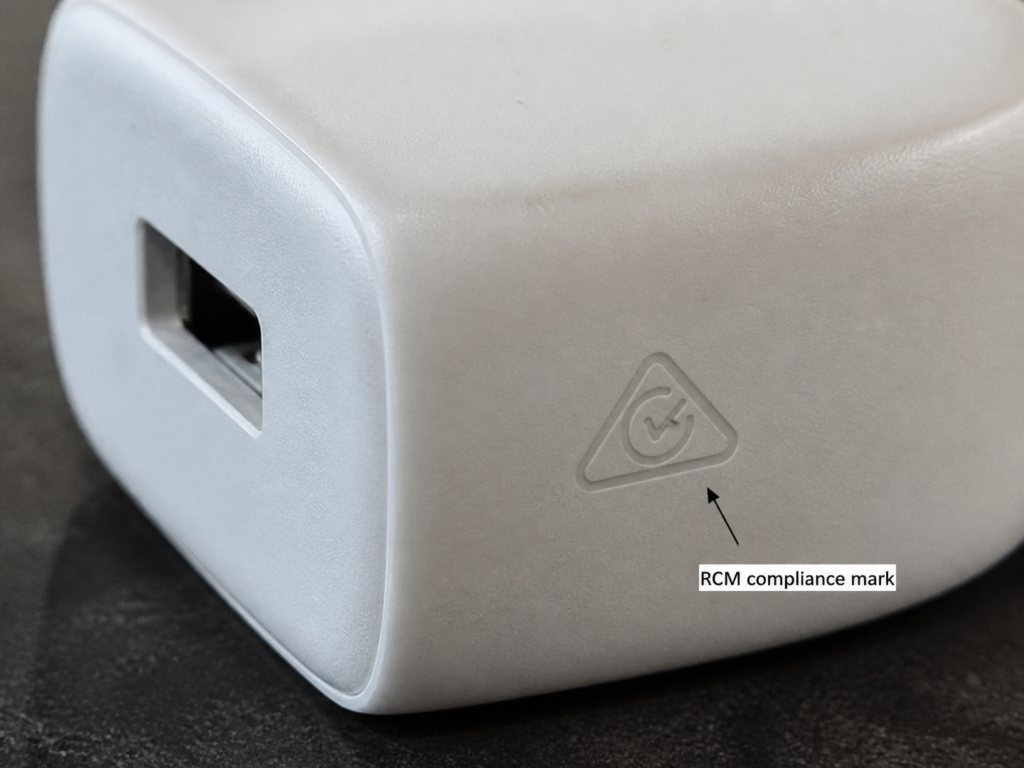
The RCM is a common compliance label in the Australian market, but it is not a separate certification program, nor is it a product certificate that can be purchased directly with money.
The responsible supplier shall use the RCM in accordance with regulations after completing applicable electrical safety, EMC or radio compliance assessments and preparing the corresponding declaration of conformity and technical evidence. The RCM itself is not equivalent to EESS registration, nor is it an official certification number issued by ACMA for each product.
Whether product model, serial number and rated information must be marked shall be confirmed in accordance with applicable laws, regulations and product standards. The identification information of the responsible supplier shall be provided in accordance with ACMA labelling rules and relevant scheme requirements.
Affixing Specifications
The RCM mark shall be clear, durable and placed in accordance with applicable labelling rules. Usually, it should be marked on the product body first; if the product is too small or product standards allow, it may also be required or permitted to be marked on the packaging, instruction manual or accompanying materials. The specific position and size shall be subject to applicable ACMA labelling requirements.
The mark must not be deformed, blurred, or obscured, nor can the mark or responsible supplier information of other products be used. The RCM should not be used in advance before applicable compliance assessments and declarations are completed.
Required Information on Labels and Manuals
Label and manual information cannot cover all electronic products with a fixed template. Generally, attention should be paid to the following types of content:
• Mark the RCM and responsible supplier identification information in accordance with applicable ACMA labelling rules;
• Mark the model, rated input/output voltage, current and power in accordance with corresponding product safety standards;
• Provide applicable English safety warnings, instructions for use and compatibility ranges;
• Ensure that label parameters are consistent with the actual product, test documentation and sales page.
Whether a specific piece of information needs to be marked shall be subject to the corresponding product standards, ACMA rules and other applicable laws and regulations. Do not present the “Australian supplier registration number” as a unified mandatory labelling item for all electronic products.
GEMS Energy Efficiency: Only Products in the Catalogue Require It
Many newcomers, upon hearing about Australian certifications, think that all products need energy efficiency certification, but that’s not the case. GEMS is a mandatory scheme, but it only targets products falling under official product categories and specific Determination scopes, and is independent of EESS and ACMA requirements.
For charging products, GEMS cannot be judged simply by “whether it is sold independently”. Whether external power supplies are sold separately or provided with equipment, they shall be verified item by item based on the product definition, power conditions, scope of application and exceptions in the GEMS External Power Supply Determination. Having a USB port, low power, or being provided as an accessory also cannot be automatically regarded as exempt.
Passive charging cables and purely physical adapters usually do not belong to external power supply products, but this shall still be subject to the GEMS product catalogue and specific product rules.
Core Compliance Requirements
If the product falls under a GEMS regulated category, the core requirements usually include:
First, meet the corresponding energy efficiency indicators, such as no-load power consumption, average efficiency, etc.
Then, the responsible supplier must complete the corresponding GEMS registration before supply or sale, and continuously meet the requirements of that product category. Products that do not fall under GEMS regulated categories do not require GEMS registration.
If the product is redesigned, or the power supply solution, key power IC, etc. are replaced, it shall be reassessed whether the original test documentation and registration still cover the actual sales configuration, and retesting or updating registration information shall be done if necessary.
Full Certification Process: From Preparation to Compliant Sales
After clarifying the requirements, many newcomers will ask: how exactly do I go about it? The actual process shall be arranged according to the combination of schemes applicable to the product, and all products cannot be forced into the same “testing – EESS – GEMS – RCM” process.
Preparations Before Processing
Before starting the process, preparing these things first can save a lot of time:
First is product information: organize product model, input/output parameters, interfaces, functions, photos, specifications, internal structure and key component information.
Second is the responsible entity: determine a responsible supplier that meets EESS or ACMA rules, and confirm its registration and document retention obligations. Different schemes may have different definitions of responsible suppliers, and you cannot only look at whether there is an Australian company.
Third is laboratory selection: choose a laboratory or conformity assessment body with applicable accreditation qualifications within the relevant test scope. Don’t just look at the words “NATA” or “CB” in promotions; also confirm whether its accreditation scope covers your product and standards.
Standard Processing Steps
The common processing approach is as follows:
1. Clarify the product structure, intended use, rated parameters and actual sales configuration.
2. Determine whether the product is EESS prescribed equipment, and confirm the applicable Level classification and safety assessment method.
3. Determine whether the product is an ACMA regulated device, complete applicable EMC or radio compliance assessments, and prepare the declaration of conformity and technical documentation.
4. If the product is equipment requiring EESS registration, the eligible responsible supplier shall complete EESS registration.
5. If the product falls under a GEMS regulated category, complete the corresponding GEMS registration before supply or sale and meet the energy efficiency indicators.
6. Use the RCM or other applicable labels in accordance with ACMA and relevant product standard requirements, and ensure that the responsible supplier identification information is correct.
7. Organize and retain test reports, technical documents, declarations of conformity, registration materials, product photos and change records.
Choosing a Processing Method
There are two main ways to handle compliance, you can choose according to your own situation:
One is to handle it yourself, which is suitable for large sellers with a dedicated compliance team. The cost is relatively low, but the process is more cumbersome: you need to confirm applicable laws and regulations yourself, liaise with laboratories, prepare declarations and maintain registration information.
The other is to entrust a formal agent to handle it, which is suitable for new sellers and more worry-free. The agent can assist in liaising with laboratories, preparing documentation and completing registration, but you need to verify their actual qualifications, scope of responsibility and whether they can provide verifiable official registration information.
Here’s a tip to avoid pitfalls: don’t just accept “certificate screenshots” sent by the agent. You should verify applicable registration information, responsible supplier materials and document content through EESS/ERAC, the GEMS product registration system and ACMA official channels respectively. The registration objects, numbers and public query methods of the three schemes are not the same, and you cannot require a so-called “RCM number” to handle all verifications.
Reference for Timeline and Cost
Many people care about how long it takes and how much it costs. In fact, there is no fixed number applicable to all products.
The timeline depends on the product category, test items, whether samples need rectification, laboratory scheduling, and the processing time of EESS or GEMS registration. It shall be subject to the time given by the specific laboratory and regulatory registration authority, and 2–4 weeks cannot be regarded as a unified commitment.
The cost is mainly affected by product complexity, number of models, test items, number of rectifications, whether EESS or GEMS registration is required, and the subsequent document maintenance method. The difference can be large, and it is recommended to obtain a formal quotation based on the actual configuration.
Pitfall Avoidance and Long-Term Compliance: Don’t Wait Until You’re Fined to Pay Attention
Many sellers think that once certification is done, it’s done once and for all, but that’s not the case. Product redesigns, standard changes, changes in responsible suppliers or changes in sales configurations may all trigger reassessment.
4 Most Common Pitfalls in Practice
Let’s first talk about a few of the most common pitfalls in practice. Avoiding them in advance can save a lot of detours:
First, compliance documentation cannot be applied permanently. If applicable Australian standards are updated, or your product is redesigned, you need to reassess whether the original reports, declarations and registration are still valid.
Second, multi-port chargers cannot only be tested for single-port low load. Many sellers, to save money, only ask the laboratory to test single-port conditions, resulting in safety or EMC problems when multiple ports are actually used, which instead requires re-rectification and testing.
Third, the same plug shape does not mean it meets Australian standards. Some plugs look like figure-8 pins, but their internal structure, dimensions, rated parameters or applicable standards do not meet requirements, and they may still be judged unqualified. You can’t just look at the appearance.
Fourth, free bundled chargers also need to comply. Don’t think that no one cares because they are free; chargers may still be subject to electrical safety, EMC and GEMS rules, and need to be judged in combination with the actual product category.
How to Judge Whether Compliance Documentation is Authentic and Valid
There are many fake certificates on the market now. How to judge whether the documentation you get is authentic and valid? Remember these points:
First, verify registration information separately. The registration objects, numbers and public query methods of EESS, GEMS and ACMA are not the same. You should verify applicable registration and responsible supplier materials through EESS/ERAC, the GEMS product registration system and ACMA official channels, and do not believe the claim that “all three schemes have a unified product certification number”.
Second, check the qualifications of the laboratory or conformity assessment body. Confirm whether its accreditation scope covers relevant products and test standards; you can’t just look at the institution name or the logo on the report.
Third, verify the content of the report. The product model, parameters, plug type, key components and actual sales configuration in the report must be consistent; if there is a hardware change, confirm whether supplementary testing or updated documentation is required.
Fourth, check the standard version. The testing basis shall be consistent with current applicable Australian requirements. If it is a report based on an old standard, confirm whether it is still within the applicable period or transition period, and cannot be directly used indefinitely.
Key Focus of Customs and Market Spot Checks
Many people worry about spot checks. In fact, spot checks often focus on products with higher risks, more complaints or higher historical non-conformity rates.
Common non-conformity items include: non-compliant use of labels or RCM, substandard insulation, non-compliant EMC, non-compliant plugs or rated parameters with Australian requirements, and falling under a GEMS regulated category but not completing registration.
Spot checks may come from customs risk management, consumer complaints, peer reports or e-commerce platform inspections. Previous records and risk assessments may affect the level of regulatory attention, but specific handling is still determined by relevant authorities based on risk and legal authority.
Compliance Maintenance and Update Rules
After certification and registration are completed, attention should also be paid to continuous maintenance:
• **EESS Safety Registration**: Usually maintained or renewed annually. The specific validity period and renewal requirements are subject to the EESS registration system and applicable jurisdiction rules. Reassessment is also required when standards are updated or products are redesigned.
• **GEMS Energy Efficiency Registration**: The registration period is determined by the specific product category and Determination. A common period is 5 years, but this cannot be generalized to all products, and renewal is required upon expiration in accordance with regulations.
• **ACMA Responsible Supplier Obligations**: Maintain supplier registration, declarations of conformity and technical records in accordance with ACMA requirements. The RCM itself is not a license issued based on product risk level and renewed annually.
• **Product Redesign**: After replacing circuitry, core components, interfaces, plugs, housings or wireless modules, as long as it may affect safety, EMC or radio performance, reassessment shall be conducted and relevant documentation updated.
• **Document Retention**: Test reports, registration materials, declaration documents and change records shall be retained in accordance with applicable schemes and legal requirements. For the specific retention period, a single number cannot replace all schemes, and enterprises shall follow the corresponding rules.
Applicable Boundaries and Exceptions
Of course, not all products need to go through the same set of compliance procedures, but exceptions must have a clear legal basis:
First are test samples. Whether test samples can be exempted must be confirmed with relevant state or territory regulatory authorities, ACMA, GEMS and customs respectively for applicable written exemptions or import conditions. You cannot automatically assume that exemption has been granted just because the quantity is small, they are for testing, or they are not intended for sale; even if exemption is obtained, they cannot be sold as ordinary goods.
Second are personal use items. The obligations for personal use items and commercially sold products may be different, but if the product enters the commercial supply chain, it can no longer be treated as a personal use item.
Third are industrial supporting products. Industrial use or B2B sales do not automatically exempt from EESS, ACMA, GEMS or product safety requirements. Only when they meet the equipment definition, intended use and explicit exemption clauses in specific laws and regulations, and can provide proof, may some requirements be exempted.
Quick Pre-Listing Self-Checklist, Just Tick Off Items
Finally, we have compiled a pre-listing self-checklist for you. Before the product is ready for sale, confirm the applicable schemes and documentation item by item, don’t just look at whether there is a so-called “RCM certificate”.
3 Steps to Determine Certification Requirements
If you are still not sure which certifications you need, follow these three steps first:
Step 1: Determine whether the product is EESS prescribed equipment. Don’t just judge by “active” or “passive”; instead, confirm the safety assessment, registration or evidence retention requirements in combination with the product structure, input/output, rated use and EESS Level 1, Level 2, Level 3 classifications.
Step 2: Determine whether the product is an ACMA regulated device. Confirm whether EMC assessment, radio compliance, supplier registration, declaration of conformity and RCM or other labels are required. Products with Bluetooth, Wi-Fi or other radio transmission modules also need to separately verify radio requirements; wireless charging products shall be judged based on operating frequency and radiation characteristics.
Step 3: Confirm whether it falls under a GEMS product category. Whether external power supplies are sold separately or provided with equipment, they shall be verified based on the definition, power conditions and exceptions of the corresponding GEMS Determination, and cannot be judged solely by “sold separately” or “has a USB port”.
Final Pre-Listing Check
There are 5 items in total. List only after all are confirmed:
First, product parameters: voltage, plug, power and interface configurations meet Australian sales requirements, and are consistent with the test report, technical documents and actual product.
Second, compliant labelling: RCM or other applicable labels are clear and durable, responsible supplier identification information is correct, and there is no false promotion or misappropriation of other product documentation.
Third, complete documentation: test reports, technical documents, declarations of conformity, EESS or GEMS registration materials, and necessary change records have all been organized and retained as required.
Fourth, clear responsibility: a responsible supplier that meets the definitions of the corresponding schemes has been determined, and can handle consumer complaints, regulatory communication and necessary recall matters.
Fifth, additional requirements: radio, EMC, energy efficiency, plug, cable and other special requirements have all completed applicable assessments or registrations.
Overall, Australian electronic product compliance may seem to have many acronyms and detailed requirements, but the key is not to buy a so-called “Australian certification certificate”, but to first confirm which schemes apply to the product respectively, and then prepare matching test evidence, declarations, registrations and labels.
If you encounter uncertain situations, you should directly check the official rules of EESS/ERAC, ACMA and GEMS, or verify with a formal agent that can explain the scope of responsibility and legal basis. Only by clearly confirming the product classification, responsible entity and actual sales configuration can you reduce the risks of cargo detention, delisting, rectification and recall, and enter the Australian market with peace of mind.