
Cross-border sellers of charging products or small importers targeting the Australian market have most likely encountered these frustrating issues: an entire batch of chargers is required to provide compliance proof as soon as it arrives at the port; supplementary RCM-related information is required when listing on Amazon Australia or eBay Australia; even a best-selling fast charger that has been sold for more than half a year is suddenly subject to regulatory spot checks requiring rectification or recall, resulting in lost payment for goods and affecting store operations. The core of these problems is a failure to fully understand the compliance requirements for launching electronic products in Australia — RCM is just one important mark and compliance framework among them.
Many people think RCM is a “certificate you can buy with money”, but it is far from that simple. It involves product safety, electromagnetic compatibility, radio requirements, responsible suppliers, compliance evidence and marking specifications, etc. A misstep in any aspect may lead to losses. This guide explains the key knowledge points that need attention when charging products enter the Australian market, from entry-level judgment to advanced pitfall avoidance.
First, Understand What RCM Is: An Important Compliance Mark for Australian Electronic Products
The Essence of RCM: Not a Single Certificate, but a Compliance Mark
Many new sellers’ first reaction is “I need to get an RCM certificate”, which is the most common misunderstanding. RCM usually refers to **Regulatory Compliance Mark**, a unified mark indicating that a product has met applicable Australian regulatory requirements, not a single certificate.
RCM itself is not an independent certification issued by a certain institution. Depending on the product type, the responsible supplier needs to prove that the product meets applicable ACMA requirements, EESS electrical safety requirements, or both and other relevant requirements, and then use the RCM mark in accordance with regulations.
Put simply, the responsible supplier needs to make a declaration of product compliance, but this commitment is not just empty talk. The product should be supported by corresponding test reports, technical documentation, compliance evidence and records. If a product has problems, the responsible supplier needs to bear corresponding obligations in accordance with the applicable regulatory system.
It should also be noted that RCM was introduced in 2013 to replace C-Tick and A-Tick. Old marks may only be used within the transitional arrangements stipulated by regulations; the relevant transition period ended on March 1, 2016, and currently applicable products should generally use RCM. You cannot generally judge that old marks can continue to be used solely based on the production time of the product or remaining inventory.
Why Must RCM Be Taken Seriously?
Many sellers think “I’ll sell first and deal with it if I get inspected”, but compliance risks in Australia may involve multiple links including customs clearance, market sales, and product safety:
• **Customs clearance link**: Products may be required to provide compliance documentation, and may face delays, detention, return shipment or other handling if documents are missing;
• **Market supervision**: The ACCC, ACMA, and electrical safety regulatory agencies of each state and territory may carry out market supervision in accordance with their respective functions and powers. Consequences of non-compliance may include rectification, sales suspension, recall, fines or other law enforcement measures, depending on the violation and the competent authority;
• **Platform requirements**: Some platforms or specific product categories may require sellers to provide RCM, EESS or ACMA-related compliance materials, which shall be subject to the platform’s current policies and case-by-case review requirements;
• **Accident liability**: If a product causes a safety accident, the responsible supplier may need to cooperate with investigation, rectification or recall, and bear corresponding legal and compensation liabilities.
Don’t Confuse Them: Core Differences Between RCM and Common Certifications
Many sellers will ask with their existing CE, FCC, and SAA materials “can these be used directly as RCM”, which cannot be understood simply as such:
• **Differences from CE and FCC**: CE and FCC marks cannot directly replace RCM. Whether relevant test reports can be used as Australian compliance evidence requires item-by-item verification of applicable standards, versions, test scope, sample configuration and accreditation requirements, and supplementary testing is required when necessary;
• **Differences from SAA**: SAA generally falls under safety compliance evidence, and cannot automatically cover EMC, radio or other applicable requirements involved in RCM. Whether it is sufficient still depends on the specific regulatory system applicable to the product;
• **Differences from old C-Tick and A-Tick**: C-Tick and A-Tick have been replaced by the RCM system. Old marks cannot continue to be used solely based on production date or inventory status, and shall be judged according to the ended transitional arrangements; currently applicable products should generally use RCM.
3 Most Common Pitfalls for Newcomers
Sellers who are new to RCM almost always encounter these misunderstandings:
1. **Having CE/FCC means you can directly mark RCM**: Wrong. CE/FCC marks themselves cannot replace Australian compliance. It is necessary to verify whether overseas reports cover Australian applicable standards and actual product configuration, and supplement missing items;
2. **Overseas companies absolutely cannot be the responsible entity**: This statement is too simplistic. The qualification of the responsible entity shall be verified against the enterprise’s Australian registration, operation and supplier status in accordance with ACMA and EESS rules respectively. If the corresponding qualification is not available, a qualified Australian responsible entity shall be designated;
3. **All electronic products require the same RCM process**: Wrong. It shall be judged separately whether the product is an EESS in-scope device, whether it is an electrical/electronic or radio device regulated by ACMA, and whether there is a clear regulatory exemption. Conclusions cannot be drawn solely based on the name “electronic product”.
Does Your Charging Product Need RCM? First Judge by 3 Questions
Now that you understand what RCM is, the next core question is: do the charging cables and chargers I sell need RCM at all?
You cannot directly judge simply by “whether it plugs into the wall”, “whether it is USB-C” or “whether it has a chip”. A more reliable approach is to answer three questions separately:
1. Is the product an EESS in-scope device, and what risk level does it belong to?
2. Is the product an electrical/electronic device or radio device regulated by ACMA?
3. Does the product meet a clear regulatory exemption condition?
Common Charging Products That Require Key Evaluation
The following products generally require key evaluation of EESS, ACMA or other applicable requirements:
• Wall-plug chargers, laptop power adapters, multi-port chargers, power strips with charging function, desktop power supplies, etc. that are connected to Australian low-voltage mains;
• Charging devices with switching power supplies, conversion circuits, control circuits or other electronic functions;
• Charging products with intentional radio transmission functions such as Bluetooth and Wi-Fi;
• Devices with wireless charging function require separate evaluation of EMC, radio and safety requirements based on their operating frequency, transmission characteristics and specific product category;
• USB or USB-C cables and accessories with active electronic modules shall also be judged based on actual circuit functions and whether they are regulated devices.
Australian power supply is generally nominally **230V, 50Hz** system. Chargers and external power supplies connected to Australian low-voltage mains generally require evaluation of EESS and other applicable requirements, but whether they are EESS in-scope devices, what level they belong to, and whether there are exemptions still need to be confirmed according to specific product categories, rated parameters and applicable rules.
These Situations Cannot Be Directly Regarded as Universal Exemptions
Some products or usage scenarios may be subject to specific exemptions, or bear obligations different from ordinary retail products, but you cannot conclude that “no compliance is required at all” solely based on the product’s purpose:
• **Pure passive cables**: Whether they are subject to a certain requirement shall be judged based on whether they are devices under relevant regulations and their specific functions, not solely based on the name of the USB or USB-C interface, nor can it be generally asserted that EMC evaluation is mandatory;
• **Internal supporting parts for industrial equipment**: Accessories used internally in industry and not sold separately to consumers may be subject to different requirements, but the actual supply, use and sales conditions must be verified;
• **Temporarily imported products**: Products that are re-exported after exhibition or testing may have specific exemptions, but need to meet relevant import, use and re-export conditions;
• **Personal use products**: Small parcels for personal use may not bear all the obligations of commercial suppliers, but not all personal parcels can be generalized as automatically exempt from RCM or other product requirements.
Products That Are Easy to Misjudge, Follow These Rules
• **USB/USB-C cables**: Don’t just look at the interface name. It depends on whether the cable has actual electrical or electronic functions, whether it is an ACMA regulated device, and whether it falls within the scope of EESS in-scope devices. The existence of E-Marker or PD chips itself is not the only condition that automatically triggers RCM;
• **Combination sets**: For example, a set of “fast charger + PD cable” requires separate judgment of applicable requirements for each component. As long as one of the components is subject to mandatory requirements, the overall sales materials and labels cannot conceal the compliance obligations of that component;
• **Car chargers**: 12V in-vehicle devices cannot be automatically deemed as EESS devices just because they have conversion circuits. They shall be judged in combination with rated voltage, actual functions, EMC characteristics and specific product categories;
• **Charging products with Bluetooth or Wi-Fi**: Such functions that intentionally emit radio waves generally require additional evaluation of Australian radio spectrum requirements. Inductive wireless charging shall be judged separately based on operating frequency, transmission characteristics and device classification, and cannot be deemed to apply the same radio rules solely based on the three words “wireless charging”.
For quick reference, the judgment directions for common charging products are sorted out:
| Product Type | Conclusions That Cannot Be Drawn Directly | Core Evaluation Directions |
| Wall-plug PD fast charger | Level cannot be judged solely by name | EESS device scope and level, EMC and other applicable requirements |
| Laptop power adapter | Different models may have different classifications | EESS device classification, safety, EMC |
| USB-C cable with E-Marker chip | RCM marking is not automatically mandatory just because there is a chip | Actual circuit function, ACMA device scope, EESS scope and exemptions |
| Pure passive ordinary charging cable | EMC obligations are not automatically generated by interface name | Whether it is a regulated device and specific functions |
| In-vehicle devices with wireless charging function | The same set of radio requirements does not automatically apply just because of “wireless charging” | Operating frequency, transmission characteristics, rated voltage, EMC and safety requirements |
| Supporting power supply for industrial equipment | Not automatically exempt just because it is not sold retail | Actual supply, usage scenarios and regulatory exemption conditions |
3-Step Quick Self-Inspection Method
If your product is not in the table above, you can check in these 3 steps:
**Step 1: Determine whether it is an EESS in-scope device.**
If the product is connected to Australian low-voltage mains, you should focus on verifying the device definition, rated parameters, product category, risk level and applicable exemptions, rather than simply believing that “any mains-connected product must belong to the same level”.
**Step 2: Determine whether it is within the scope of ACMA regulation.**
Check whether the product has electrical or electronic functions, whether it will generate electromagnetic interference, and whether it has intentional radio transmission functions such as Bluetooth and Wi-Fi. ACMA requirements corresponding to different functions may be different.
**Step 3: Verify whether there is a clear exemption.**
Scenarios such as internal industrial use, temporary import for re-export, and personal use may only be eligible for exemption if they meet specific regulatory conditions. If you cannot confirm, you should further verify according to the actual supply and use of the product, rather than assuming that all compliance obligations are exempted on your own.
What Requirements Must RCM Meet? Disassembly of Two Core Systems
Many people think RCM is just doing a test, but that’s not the case. A product may involve two independent regulatory systems at the same time: one mainly manages electrical safety, and the other mainly manages electromagnetic compatibility and radio. The two sets of requirements cannot replace each other.
The First System: EESS Electrical Safety System — Prevent Electric Shock and Fire
EESS is Australia’s electrical equipment safety system, which mainly focuses on whether products will cause electric shock, fire or other electrical safety risks.
Common inspection directions include:
• Whether insulation and protection of live parts are sufficient;
• Whether plugs and connection structures meet applicable requirements;
• Whether there is reasonable overheating, overcurrent and short circuit protection;
• Whether the enclosure and mechanical structure can maintain safety protection;
• Whether the product’s rated parameters are consistent with actual performance.
EESS arranges different compliance paths according to device classification and risk:
• **Level 1** generally does not require device registration, but compliance evidence still needs to be retained;
• **Level 2 and Level 3** generally involve responsible supplier registration and corresponding compliance evidence. Among them, Level 3 generally requires a Certificate of Conformity, and Level 2 applies the corresponding Evidence of Conformity;
• The level of chargers and power adapters must be confirmed according to specific device classification, and cannot be generally deemed as Level 2 or Level 3 just because they “have mains input”.
The Second System: ACMA Regulatory System — Reduce Interference and Meet Radio Requirements
ACMA is the Australian Communications and Media Authority, which is mainly involved in the supervision of electromagnetic compatibility and radio equipment.
• **EMC requirements**: Products should not generate interference exceeding limits during operation, and should also have reasonable anti-interference ability;
• **Radio requirements**: For radio transmission functions such as Bluetooth and Wi-Fi, applicable Australian frequency bands, power, spectrum masks and other technical parameters shall be verified;
• **Wireless charging devices**: Shall be evaluated based on specific operating frequency, transmission characteristics and device classification, and should not be simply equated with intentional radio communication functions such as Bluetooth and Wi-Fi.
For charging products, switching power supplies, fast charging circuits and long unshielded cables may all affect EMC results. But whether a certain test is actually required still needs to be judged based on product functions and applicable regulations.
Core Rules of the Two Systems, Don’t Get Them Wrong
1. Electrical safety and EMC/radio requirements cannot replace each other. Even if a product passes safety evaluation, if other applicable requirements are not met, the product may still not be able to be launched compliantly;
2. Overseas test reports of wireless modules do not necessarily mean that the whole device is compliant in Australia. Changes in antenna, enclosure, firmware, power supply method and installation position may all affect the whole device’s results;
3. Both Australia and New Zealand use RCM, but the two countries have different electrical safety, radio/EMC rules, responsible entities and registration systems. When selling in both countries, the requirements of the two countries must be verified separately.
Importers’ Legal Responsibilities and Required Compliance Documents
One of the cores of RCM is the responsible supplier. Many sellers casually find a freight forwarder or customs broker to “put their name on it”, and only find out after problems arise that the other party does not bear product compliance responsibilities.
Requirements for Australian Responsible Entities
The qualification of **responsible supplier** under ACMA and EESS shall be confirmed separately. Generally, a registered or operating entity that meets the requirements in Australia is required; overseas sellers who do not have the corresponding qualifications shall designate a qualified Australian responsible entity.
It should be noted that:
• Overseas direct shipping does not of course exempt suppliers from compliance obligations;
• Whether an overseas enterprise can assume the role of responsible entity shall be judged based on its registration status, operation mode and specific regulatory system in Australia;
• Freight forwarders and customs brokers are generally only responsible for logistics and customs declaration, and cannot automatically become the responsible entity for product compliance just because they participate in customs clearance.
Core Compliance Documents That Must Be Retained
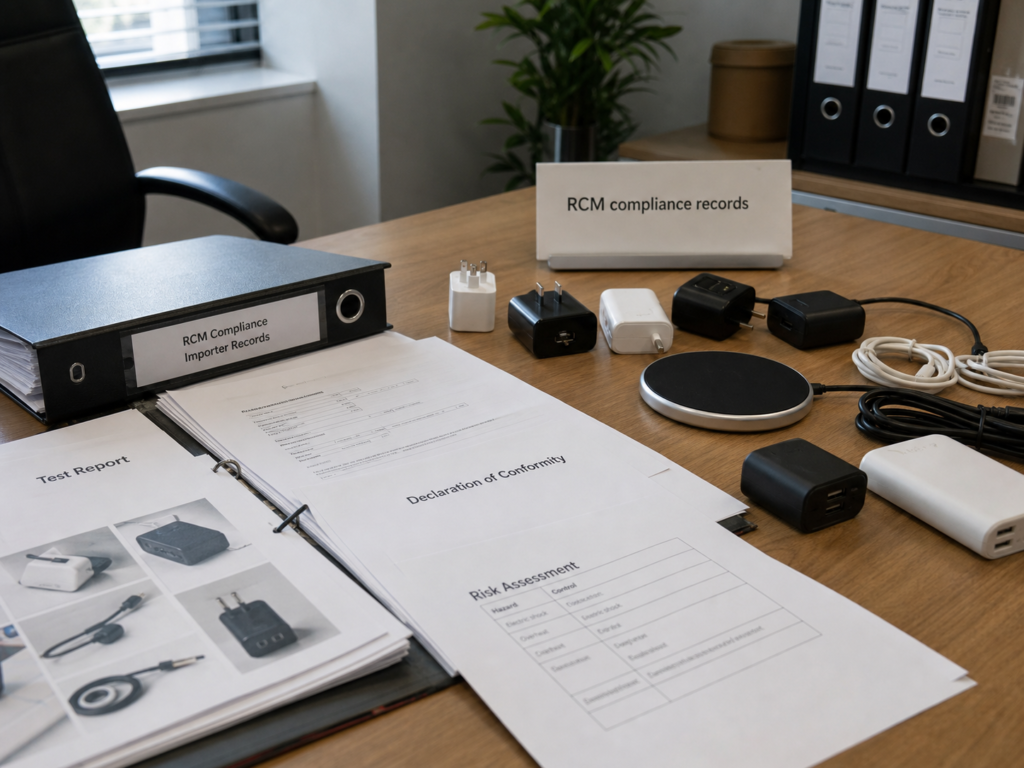
As an importer, you don’t need to stick all documents on the product, but you should retain materials that can prove product compliance according to the applicable regulatory system, generally including:
1. **Basic product information**: Model, rated parameters, interfaces, key components and circuit materials, which must be consistent with the actually sold products;
2. **Regulatory judgment records**: Explain why the product is or is not subject to a certain requirement, and which standards or compliance paths are adopted;
3. **Test reports and other compliance evidence**: Cover safety, EMC, radio or other applicable items according to product type;
4. **Compliance declaration or supplier declaration**: Signed by a qualified responsible supplier;
5. **Product labels, packaging, manuals and web page materials**;
6. **Records of complaints, rectifications, accidents and recalls**.
Document Retention and Verification Requirements
Technical documents and compliance evidence shall be kept in accordance with ACMA, EESS and other applicable regulations, generally for at least the period stipulated by regulations. When required by regulatory authorities, they shall be provided within the specified period, and “48 hours” should not be regarded as the unified legal period for all products and documents.
After receiving the documents, verify at least the following contents:
• Whether the model, parameters, and plug structure on the test report are consistent with the actual product;
• Whether the test sample represents the actual sales configuration;
• Whether the test scope covers all applicable requirements;
• Whether the responsible supplier information, signing information, product identification information and applicable regulations or standards in the declaration document are complete;
• Whether re-evaluation and document update are required when products or regulations change.
DoC does not have a universally applicable fixed validity period. It shall always be consistent with the current product configuration, applicable regulations and standards; when the product undergoes changes that affect compliance, or relevant changes occur in regulations or standards, it shall be re-evaluated and updated.
Full RCM Processing Process: Newcomers Can Follow This
RCM processing is not a fixed “test – get certificate – mark” process, but first identifies the regulatory system applicable to the product, then selects the corresponding compliance path.
3 Preparations Before Processing
Before starting the processing, do these 3 things first:
1. **Organize product information**: Including model, input and output parameters, interfaces, wireless functions, key components and circuit structure;
2. **Confirm the identity of the responsible supplier**: Confirm whether you have the supplier qualifications required by ACMA and EESS, and if not, find a qualified Australian responsible entity;
3. **Screen testing institutions and evaluation service providers**: Confirm that they are familiar with Australian applicable standards, test scope and regulatory document requirements, don’t just look at whether they can issue CE or FCC reports.
Standard Processing Steps (From Importer’s Perspective)
You can proceed in the following order:
Step 1, **Complete product classification and regulation identification**. Determine whether the product is an EESS in-scope device, which level it applies to, whether it is an EMC or radio device regulated by ACMA, and whether there is a clear exemption.
Step 2, **Prepare compliance evidence**. Arrange safety, EMC, radio or other necessary evaluations according to product classification and applicable requirements. If you already have overseas reports, you should also verify their standard versions, test scope, sample configuration and accreditation conditions.
Step 3, **Fulfill supplier registration and declaration obligations**. According to the regulatory system applicable to the product, the responsible supplier shall complete ACMA supplier registration (if applicable) and EESS registration (if applicable), and prepare and sign the corresponding DoC or other declaration documents.
Step 4, **Confirm marks and materials**. Use the mark in accordance with official RCM pattern, size, visibility and alternative position rules, and check product labels, packaging, manuals and web page materials at the same time.
Step 5, **Continuous maintenance after launch**. Retain compliance records, and re-evaluate when the product is remodeled, components are replaced, power changes, wireless functions change, or regulations are updated.
Reference for Processing Cycle and Cost
There is no unified official standard for the cycle and cost that everyone is most concerned about, which actually depends on the product category and compliance path:
• **Cycle**: Conventional products may take several weeks, but classification confirmation, material supplementation, rectification and supplementary testing will all extend the time;
• **Cost**: Mainly affected by factors such as the number of models, test items, product structure, whether rectification is required, whether registration is required, and whether existing reports can be used;
• **Quotation**: Different institutions have different service scopes, which shall be subject to the official quotation and specific test plan of the third-party institution.
4 Things You Must Check After Getting the Documents
1. The product model, parameters, and structure on the test report are consistent with the actually sold style;
2. The declaration document has complete information and signing records of the responsible supplier;
3. The test or evaluation scope covers all applicable requirements, and there are no missing items due to the product having wireless functions or structural changes;
4. The style, size, position and use conditions of the RCM mark meet official requirements.
RCM Mark and Product Materials: These Detail Errors Also Count as Violations
After passing the test, if the mark usage method or product materials do not meet the requirements, it may still cause platform or regulatory problems.
Correct Usage Specifications for RCM Mark
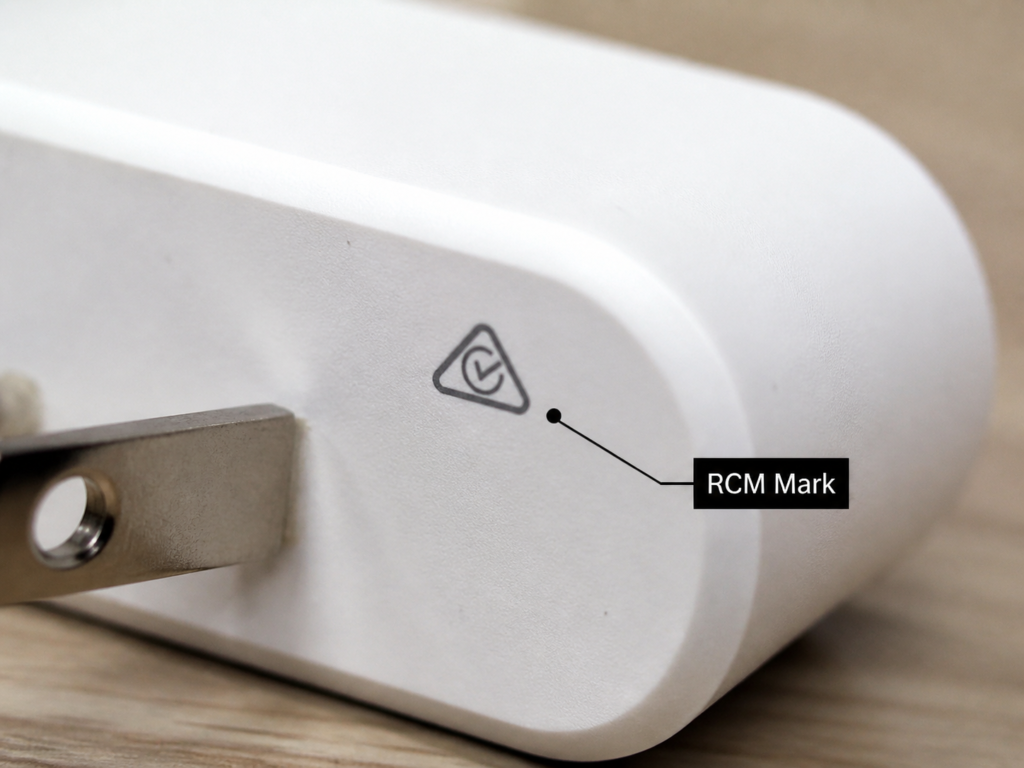
The RCM pattern and size requirements specified by ACMA shall be strictly used. In principle, the mark shall be marked on the product body; it can only be marked on the packaging, manual or accompanying materials in accordance with regulations under conditions such as official rules permitting and technical infeasibility on the product body.
Therefore, it cannot be simply understood as “as long as the product is small, the mark can be placed on the packaging or manual”, nor can a unified 3mm minimum size conclusion be applied on your own. It shall be subject to official mark specifications and requirements of the specific regulatory system.
The RCM mark should not be used in advance before completing applicable compliance procedures, declaration and registration obligations.
What Contents Should Product Labels Include?
Label contents are not exactly the same for all products with RCM, and shall be determined according to applicable ACMA and EESS marking rules, product safety standards and specific product categories. Generally, key verification is required for:
• Product model or other product identification information;
• Responsible supplier identification information;
• Rated parameters such as input and output voltage, current, and power;
• RCM mark and its specified usage method;
• Other warnings, instructions or marks required by product safety standards.
Multi-port USB-C products shall also ensure that the power distribution information in packaging, web pages, manuals and physical products is true and consistent. For example, single-port power, total power and limitations when multiple ports are used simultaneously cannot be exaggerated. However, whether all power distribution rules must be printed on the product body label shall be confirmed according to specific standards, and cannot be generalized as a mandatory item for unified RCM labels of all products.
Compliance Key Points for Packaging, Manuals and Publicity
In addition to product labels, the contents of packaging, manuals and e-commerce detail pages shall also be accurate:
• Provide applicable English safety instructions for Australian consumers;
• Do not use expressions that are easy to mislead consumers such as “globally universal certification” and “Australian official certification”;
• Parameters on packaging and e-commerce web pages shall be consistent with physical labels, test materials and actual performance;
• You cannot only display the RCM mark on the publicity page or detail page, while the physical product or packaging is not marked in accordance with regulations at all.
Advanced Pitfall Avoidance and Compliance Decision-Making Skills
Common Non-Conformity Reasons for Charging Products
• **Electrical safety category**: Insufficient insulation, plugs or connection structures not meeting applicable requirements, false parameter labeling, insufficient overheating or short circuit protection;
• **EMC category**: Radiated or conducted interference exceeding limits, large interference from fast charging circuits, cable and enclosure design affecting test results;
• **Marking category**: RCM pattern, size or position not meeting requirements, missing responsible supplier information, incorrect parameter labeling;
• **Radio category**: Frequency band, power, spectrum parameters or other radio technical conditions not meeting requirements, or the whole device configuration is different from the original test configuration of the wireless module.
How to Judge Whether a Third-Party Testing Institution Is Reliable?
When selecting an institution, you can focus on verifying the following contents:
1. Whether the laboratory is accredited to ISO/IEC 17025 by NATA or other ILAC MRA signatory bodies;
2. Whether the accreditation scope covers the specific standards and test items you need;
3. Whether the report can explain the test sample, standard version, test scope and results, rather than just providing a general “compliance certificate”;
4. Don’t easily believe promises such as “guaranteed pass” and “ultra-low price certificate issued in 3 days”;
5. “Can do CE/FCC” cannot be used as the only standard to judge its Australian compliance capability.
A laboratory being accredited does not mean that all reports it issues will automatically meet EESS or ACMA requirements. Ultimately, it depends on whether the report content, accreditation scope, applicable standards and specific regulatory system match.
How to Save Compliance Costs for Multi-Model Products?
Products of the same series can sometimes share or partially share test evidence, but this cannot be understood as a “series certification” issued by a regulatory authority.
If the circuits, key components, structures, input and output parameters, and worst-case configurations of multiple models are close enough, the laboratory may allow combined testing or cover some models according to applicable standards and variant evaluation conditions. Conversely, changes in power, interfaces, power boards, main control chips, plug structures or wireless configurations may also affect the test scope.
Whether they can be combined must be confirmed by the laboratory and the responsible supplier based on specific differences. RCM itself is not a uniformly issued series certificate, and cannot be judged on your own solely based on similar appearance or “the same solution”.
The Product Has Been Remodeled, Do You Need to Re-Evaluate?
After product remodeling, at least the compliance impact shall be rechecked:
• **Changes that generally require re-evaluation**: Replacing core circuits, power boards, main control chips or plugs, increasing power, changing key components, adding wireless functions, changing antennas, enclosures or structures that affect heat dissipation and insulation;
• **Changes with relatively small impact**: Only replacing enclosure color, packaging or appearance parts that do not affect circuit and safety performance;
• Regardless of whether re-testing is required, product identification, technical documents, declarations and label materials shall be updated after remodeling, and old model documents cannot be used without verification.
How to Deal with Customs Clearance and E-Commerce Spot Checks?
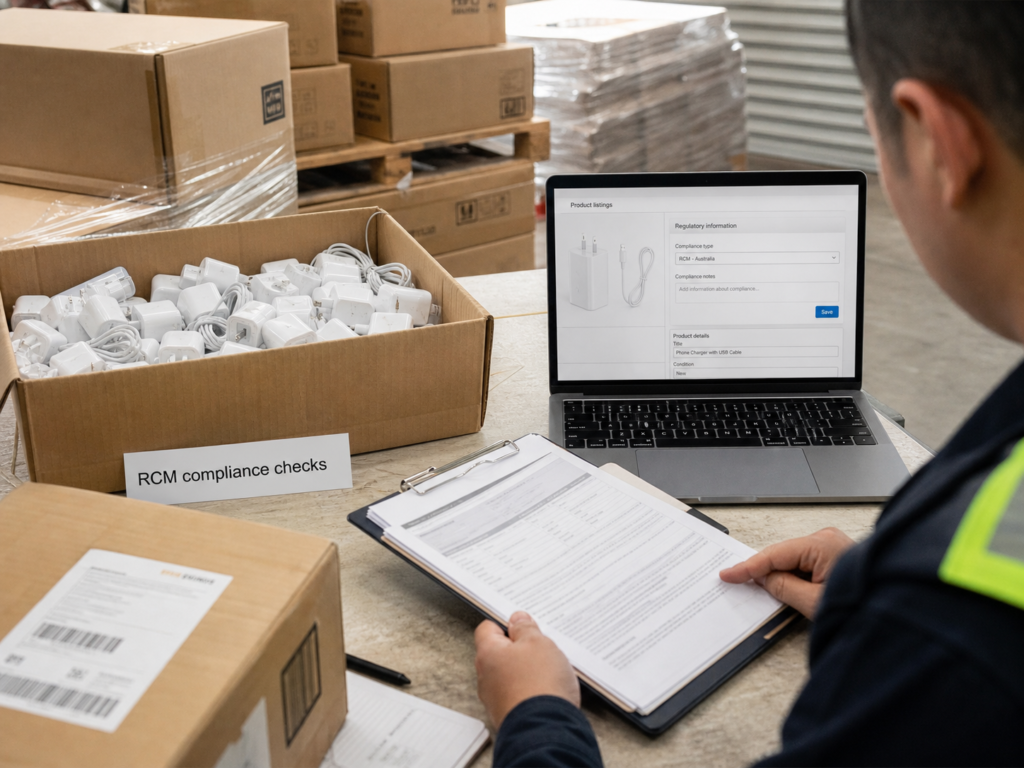
• During customs clearance, you can prepare test reports, compliance declarations, responsible supplier information and product technical materials, but which documents need to be submitted shall be subject to the specific requirements of customs, regulatory authorities or logistics links;
• During e-commerce platform spot checks, compliance documents for corresponding models shall be submitted as required. The platform may require RCM, EESS or ACMA-related materials, but there may not be a unified “RCM certificate”;
• If problems are found by regulatory authorities or the platform, measures such as sales suspension, isolation, rectification or recall shall be taken immediately in accordance with the notice, and rectification evidence, test reports and other materials shall be submitted in accordance with the requirements of the competent authority or platform;
• Resumption of sales shall be subject to the official confirmation of the competent authority or the platform’s review result, and there is no unified “resume sales after supplementary testing” process applicable to all situations;
• Passing platform review does not equal regulatory exemption, and complete compliance documents shall still be retained to accept possible market supervision.
Answers to Several Common Advanced Questions
• **Can overseas CE/FCC reports be used?**
CE or FCC marks cannot directly replace RCM. Whether the report can be used as Australian compliance evidence requires verification of standards, versions, test scope, sample configuration and accreditation requirements, and missing items need to be supplemented.
• **Do low-voltage USB cables all need no attention?**
No. Whether relevant evaluation is required depends on the actual electrical or electronic functions of the cable, whether it is an ACMA regulated device, whether it is an EESS in-scope device, and whether there are exemptions. Conclusions cannot be drawn solely based on low voltage, USB-C, or whether it has a PD/E-Marker chip.
• **Does customs clearance release equal compliance?**
No. Customs clearance is only the entry link, and market supervision may still inspect the physical product, labels, responsible supplier identity, technical documents and recall obligations. Customs clearance release cannot replace post-launch compliance responsibilities.
Pre-Launch Self-Inspection Checklist and Capability Summary
RCM Pre-Launch Self-Inspection Checklist for Charging Products
Before the product is launched, check one by one against this checklist:
• [ ] Have separately judged whether the product is an EESS in-scope device, an ACMA regulated device, and whether there are regulatory exemptions
• [ ] Have completed all applicable safety, EMC, radio or other evaluations, and materials correspond to the actual sales model
• [ ] Have confirmed the qualification of the responsible supplier under ACMA and EESS
• [ ] Have completed ACMA supplier registration and EESS registration (if applicable) in accordance with applicable requirements
• [ ] Have corresponding declaration documents signed by the responsible supplier
• [ ] The RCM mark, label content and position on the product and packaging meet official rules
• [ ] Parameters on packaging and e-commerce web pages are completely consistent with physical products and test materials
• [ ] All compliance documents have been archived and can be provided within the period specified by the regulatory authority
• [ ] Have established records of product remodeling, complaints, rectifications and recalls
After Learning This Guide, You Can Independently Do These 3 Things
1. Based on the EESS device scope, ACMA regulatory scope and specific exemption conditions, initially judge which Australian requirements charging products need to meet;
2. Prepare compliance evidence, registration and declaration documents according to the correct process, avoiding label errors, unqualified responsible entities and false “guaranteed pass” services;
3. When facing customs clearance, e-commerce review or market supervision, know what materials to prepare and how to handle problems according to the requirements of the competent authority or platform.
The core of Australian RCM compliance can be summarized as “correct classification, clear responsibility, sufficient evidence, and accurate marking”. Complete compliance evaluation and document retention help reduce the risks of customs clearance, platform review and market supervision, but cannot guarantee inevitable release or exemption from spot checks; after actual sales, you should still cooperate with handling according to the requirements of the competent authority, and continuously pay attention to product changes, regulation updates and recall obligations.