
Friends who do cross-border e-commerce selling chargers to Australia have most likely heard the term “compliance”, but many either think “once it clears customs it’s fine”, or get confused by various claims like “full certification package” or “get certificate in one week”. In fact, Australia’s charger import compliance has a clear inspection logic; as long as you check step by step according to the checklist, you can identify and avoid many risks of fines, delisting, or even recalls.
Before we officially start, let’s firmly clarify one core misunderstanding that is most easy to fall into: **Customs release only means the goods are allowed to enter the country, and it does not at all mean they can be legally sold in the Australian market**. Australian compliance requires separate verification of customs import, market supply/sales, applicable electrical installation and use rules, and the platform’s own listing policies; platform review is not equivalent to government approval. The requirements and responsible entities for different links are different, and they must never be confused.
Step 2: How to Handle Electrical Safety Compliance (EESS System)
If your product may fall within the scope of electrical safety control, you must first determine whether EESS applies based on the current EESS product classification list, then confirm the responsible supplier, equipment class, test evidence, and registration obligations. You cannot directly assume that a product must be the same type of EESS-regulated product just because it is connected to mains electricity or has “charger” in its name.
Simply put, EESS is an electrical product safety framework that governs whether products may cause electric shock, fire, or safety accidents, and is implemented by regulatory authorities in various Australian states and territories. Whether it applies and which equipment class a product belongs to must be determined by combining factors such as product category, structure, function, intended use, whether it is a component of other equipment, and by checking the current applicable list of AS/NZS 4417.2.
Who is Responsible? A Qualified Responsible Supplier is Required
The core rule of EESS is: **Usually, there must be a responsible supplier established in Australia or New Zealand that can assume responsibility and complete registration**. Specific qualifications are subject to the current EESS registration rules.
The responsible supplier can be a qualified Australian or New Zealand manufacturer, importer, or other responsible entity. If overseas sellers do not have a qualified Australian or New Zealand entity, they usually cannot directly complete the responsible supplier registration, which is also a key issue that many overseas sellers need to resolve in advance.
What Standards Must Be Met? It Is Not Determined by the USB Port
Many people think that “USB chargers use a certain fixed standard”, but that is actually wrong. The applicable safety standards need to be confirmed by a qualified laboratory or compliance agency based on the product’s function, structure, intended use, and applicable classification, and are not determined by single factors such as USB port or power.
Common safety standards for chargers include the AS/NZS 62368.1 and AS/NZS 61558 series, but which one specifically applies shall be based on the actual situation of the product and applicable rules. The standard version on which the test report is based, the applicable transition period, and product changes should be verified. Old version reports may require supplementary difference assessment or retesting; they cannot be simply regarded as automatically invalid, nor can they be assumed to be permanently valid by default.
What to Pay Attention to for Registration? Information Must Be Accurately Matched
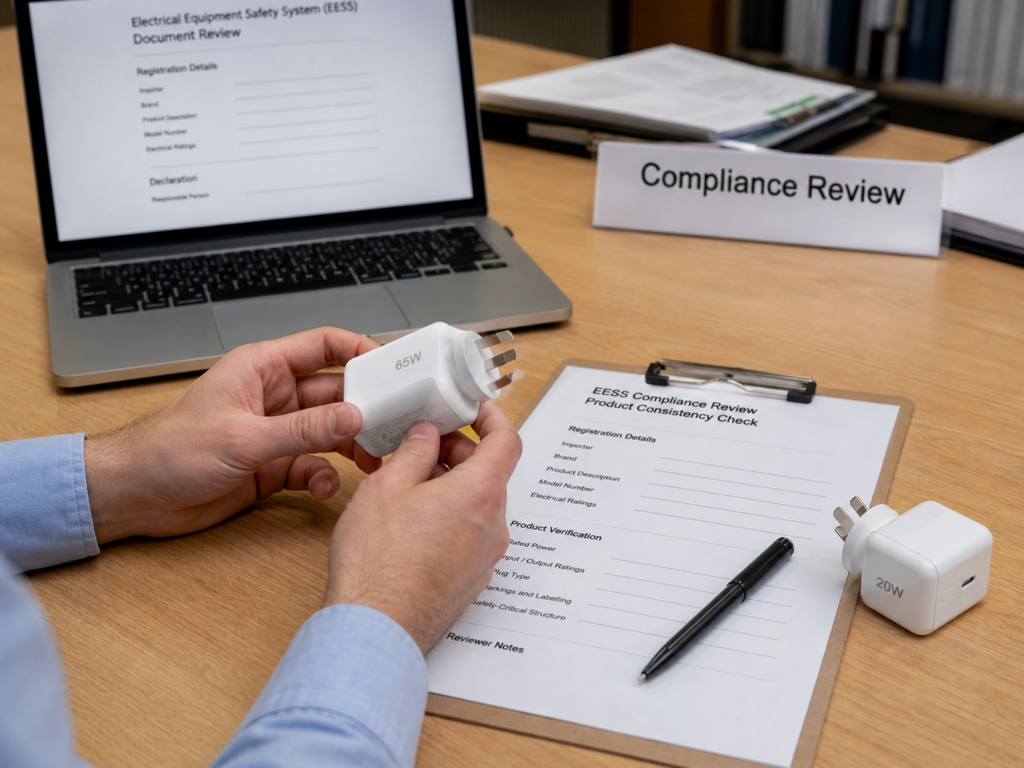
The core requirement of EESS registration is “information accurately covers the actually supplied products”:
• The registered brand, model, manufacturer, and key parameters must be consistent with the actually sold products.
• Whether models with different power, ports, or structures need to be registered separately shall be confirmed item by item according to the EESS system and current rules.
• You cannot without authorization allow different models to share the same registration record just because the products belong to the same series; nor can you arbitrarily conclude that separate registration is required solely based on changes in power or ports.
For example, for 20W and 65W chargers of the same series, the declaration method should be confirmed based on registration fields, product differences, and safety-critical structures. You cannot directly share registration for convenience, nor can you make an absolute judgment solely based on changes in rated power.
What Evidence Should Be Kept? You Must Be Able to Explain the Compliance Basis During Spot Checks
Compliance is not done once registration is completed; you must also retain corresponding conformity evidence according to the EESS equipment class and applicable standards. When required, documents may include:
• Laboratory test reports;
• Key component documentation;
• Product structure descriptions;
• Declaration of Conformity (DoC);
• Batch traceability records.
The conformity evidence and test requirements corresponding to different equipment classes are not exactly the same, and a unified document list cannot replace class judgment. Which materials actually need to be retained shall be subject to the current EESS rules, applicable standards, and state/territory regulatory requirements.
Step 4: GEMS Energy Efficiency Compliance, Not Just “Saving Power Is Enough”
In addition to safety and EMC, some chargers or external power supplies may also need to meet Australia’s mandatory energy efficiency requirements, namely the GEMS system. Simply put, GEMS mainly focuses on product performance such as conversion efficiency, standby power consumption, and no-load power consumption.
Which Chargers Need GEMS? Check Official Product Determinations Model by Model
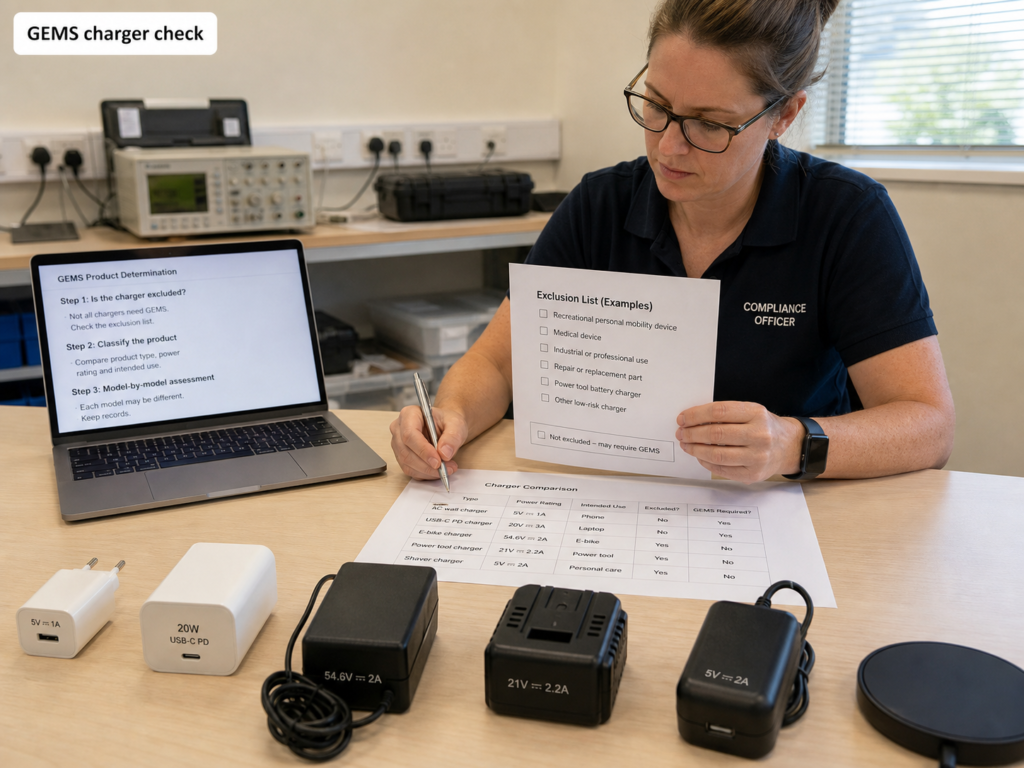
Not all chargers need GEMS; you need to check the official GEMS “Product Determination” model by model. The judgment basis includes product type, power, intended use, and official exclusions, and cannot be guessed solely based on product name or experience.
• Chargers with vehicle-mounted low-voltage input usually do not apply to relevant GEMS requirements, but the specific product classification should still be verified.
• Power supplies for special industrial and medical purposes cannot be assumed to be exempt by default; they must be confirmed by checking the official list.
• GEMS rules and lists are updated. Before proceeding, be sure to check the latest official information, and cannot use experience from several years ago as a basis.
What to Do for Regulated Products? Implement According to Product Determinations
If it is confirmed model by model that the product falls under a certain GEMS product determination, you must complete the applicable registration, testing, record-keeping, and labeling obligations in accordance with that determination. Whether registration is required, what form the registration information takes, and whether specific labeling is required must all be confirmed based on the latest official product determinations and GEMS system requirements.
Products must also meet the minimum conversion efficiency, standby power consumption, or no-load power consumption limits specified for the corresponding power segment or product category.
Special reminder: **Safety compliance and energy efficiency compliance are two independent requirements and cannot replace each other** — completing EESS-related requirements does not mean that GEMS requirements are automatically completed; the reverse is also true.
Energy Efficiency Labeling Cannot Be Affixed Randomly: Judge According to Applicable Product Determinations
Energy efficiency requirements are not just about testing; promotion and labeling must also be compliant:
• Energy efficiency parameters on products and packaging must be consistent with applicable product determinations, test results, and registration information.
• Energy efficiency star ratings or other energy efficiency labels shall only be used when explicitly required by the corresponding GEMS product determination.
• All energy efficiency promotions and labeling must be consistent with actual test results and applicable registration materials.
• Claims such as “fast charging” and “high conversion efficiency” in promotions must not exceed test results and the actual performance of the product.
Step 6: Import Link: Sort Out Customs Clearance, Roles, and Taxes and Fees
After the product itself completes the applicable compliance verification, the import link must also be sorted out clearly, otherwise there may be declaration errors, delays, or subsequent regulatory risks.
What Documents Should Be Prepared for Customs Declaration?
Usually, commercial invoices, as well as transportation and cargo documents required by customs, carriers, or customs brokers, should be prepared. Depending on the mode of transport, customs declaration mode, and specific requirements, documents such as packing lists, bills of lading, or air waybills may be involved.
If applying for preferential treatment such as the China-Australia Free Trade Agreement, or if specific regulatory requirements apply, corresponding certificates of origin, declarations of origin, or other origin evidence should also be prepared. A certificate of origin is not generally mandatory for the customs clearance of every ordinary import shipment.
It must be emphasized again: customs clearance only means that the goods are allowed to enter the country, and does not mean they can be legally sold. Don’t think that everything is fine once you pass customs.
What Documents Should Be Kept for Spot Checks and Platform Reviews?

In addition to customs trade documents, you must also retain product compliance-related materials to respond to subsequent market regulatory spot checks and platform reviews, such as:
• EESS registration information or proof, when applicable;
• GEMS registration information or registration number, when applicable;
• Test and conformity materials matching the product model;
• Declaration of Conformity and supply chain and batch records.
Platform review documents are not unified statutory mandatory documents. The requirements of each platform are different; for example, the requirements of Amazon and eBay may be different, and shall be subject to the latest backend policies of the platform.
Import-Related Roles: Responsibilities Must Be Clarified in Advance
Australian import compliance is not a “five mutually independent roles” uniformly stipulated by law. In actual operation, the following responsibilities should be identified separately:
1. **Customs import declaration entity**: responsible for customs clearance, tax declaration, and compliance with Australian customs requirements.
2. **EESS responsible supplier**: when the product is subject to EESS, responsible for electrical safety-related responsibilities and completing applicable registration.
3. **GEMS registration or responsible entity**: when the product falls under a GEMS product determination, responsible for applicable energy efficiency registration, testing, and record-keeping obligations.
4. **Supplier responsibilities under ACMA regulations**: responsible for EMC, radio, or other applicable communication regulatory requirements.
5. **Platform seller**: also needs to comply with the platform’s contractual policies on listing, promotion, after-sales service, and document submission.
These roles can be assumed by the same entity or by different entities. The responsibilities of all parties should be clarified in writing in advance, and the applicable supplier and responsible entity information requirements in the product, packaging, or accompanying materials should be verified.
Taxes, Fees, and HS Codes: Don’t Make Them Up Yourself
Taxes and fees are a concern for many sellers, but there is no fixed answer, and shall be subject to official verification:
• **HS code**: 8504.40 is a candidate code for charger products, but the specific code shall be determined according to the product’s structure, power, and function, and ultimately subject to the Australian Customs Tariff and professional classification opinions. Don’t make up codes randomly.
• **Tariff**: There is no fixed tax rate; it is confirmed based on HS classification, origin, trade agreements, and customs rulings. Products that meet the origin rules of the China-Australia Free Trade Agreement may enjoy preferential tax rates.
• **GST**: The current tax rate is 10%. The taxable import value of imported goods is usually calculated based on customs value, tariffs, and statutory includable items such as freight and insurance premiums. The specific amount shall be subject to the calculation of the Australian Border Force or customs broker.
• There are also other fees, such as customs clearance handling fees, storage fees, various registration and review fees, etc., which are calculated according to the actual situation.
Problems with Customs Clearance? First Distinguish Between Customs Risks and Market Compliance Risks
Customs clearance risks mainly include:
1. The declared information is inconsistent with the model, quantity, value, or parameters of the actual goods;
2. There are problems with HS classification or cargo value;
3. Applicable licenses and border regulatory requirements are not met;
4. Missing customs clearance or transportation documents;
5. Violating other provisions of border regulation.
Issues with EESS, GEMS, ACMA, and product labels mainly belong to market supply, product safety, or market regulatory compliance issues. They may lead to subsequent detention, delisting, recall, or prohibition of supply, but they are not necessarily a common precondition for Australian Customs to clear every ordinary charger shipment. Whether they are inspected at the entry link depends on specific border regulatory measures.
Step 7: Sales Link: Platforms, Spot Checks, and Consumer Law
Once the product has entered the country and been listed, it is not time to sit back and relax; there are still many compliance requirements in the sales link.
E-commerce Platform Listing Requirements: Not Statutorily Mandatory, But You Can’t Sell Without Passing Them
The listing requirements of mainstream e-commerce platforms belong to platform rules and are not statutorily mandatory, but you must comply if you want to sell on the platform. Common requirements include:
• May require uploading EESS registration certificates, GEMS registration numbers, or other compliance materials for review;
• The parameters, power, and fast charging descriptions on the detail page must be consistent with the actual performance of the product and relevant compliance materials;
• The platform may require Australian local contact information, return and exchange addresses, or after-sales mechanisms. Whether they must be provided shall be subject to the current policies of the specific platform;
• If sold as a set, all electrical products inside must be separately verified for applicable compliance requirements.
At the statutory level, consumer guarantees and remedy obligations under the Australian Consumer Law (ACL) must be fulfilled. Platform policies will be adjusted according to category, time, and seller type, and must be subject to the latest backend rules.
Who to Contact for Regulatory Spot Checks? Different Agencies Are in Charge of Different Areas
Australian market regulation is handled by different departments, so don’t go to the wrong place:
• **State/territory electrical safety regulatory authorities**: responsible for electrical safety regulation of EESS-applicable products, may focus on plug safety, RCM use, responsible supplier information, and registration validity;
• **ACMA**: responsible for EMC, radio spectrum, and related communication regulation compliance;
• **GEMS regulatory authority**: responsible for energy efficiency registration, performance, and labeling spot checks of applicable products;
• **ACCC**: responsible for consumer law compliance, investigation and punishment of false publicity, and overall coordination of product recalls.
If non-compliant, the consequences may include product delisting, mandatory recall, fines, and prohibition of supply in the Australian market, which is no trivial matter.
Australian Consumer Law (ACL): Don’t Think Everything Is Fine Just Because Compliance Is Completed
Many sellers think that completing safety, energy efficiency, and EMC compliance is the end, but in fact, they must also meet the requirements of the Australian Consumer Law (ACL for short), which is often overlooked:
• **Consumer guarantees**: The law provides mandatory consumer guarantees for product quality, conformity with description, fitness for purpose, etc. The merchant’s own warranty period cannot replace statutory guarantees. For example, if you say the warranty is 1 year, the statutory consumer guarantee may last longer depending on the product situation, and you cannot simply say that you will not be responsible after 1 year.
• **Prohibition of false publicity**: You cannot falsely mark power, compatibility range, energy efficiency, or fast charging performance. For example, promoting 65W fast charging but the actual performance cannot reach it may trigger consumer law risks.
• **Traceability and recall**: Records sufficient to support product identification, supply chain tracing, and necessary recalls should be retained. Whether there are specific mandatory traceability, incident reporting, or recall obligations shall be confirmed according to product categories and relevant ACL provisions.
• **After-sales rules**: Must comply with the requirements of statutory remedies such as refunds, replacements, and repairs, and cannot arbitrarily reject reasonable demands from consumers.
Step 8: Upgraded Pitfall Avoidance: Verification Methods and Compliance Decisions
After understanding all the requirements, you also need to learn how to verify the authenticity of materials, how to judge the compliance direction of different products, and how to avoid common pitfalls.
How to Check Registration and Compliance Materials? Use Official and Original Material Channels
Don’t just trust a certificate given by the supplier and be done with it; you must verify it yourself:
• **EESS safety registration**: Use the official EESS database to check the responsible supplier and applicable equipment registration information, then verify the original report and model matching with the report-issuing laboratory, certification body, and supplier.
• **GEMS energy efficiency registration**: If the product is subject to GEMS, use the official GEMS registration system to check relevant registration information and confirm that it is consistent with the product determination and actual model.
• **EMC/RCM and radio frequency compliance**: Verify applicable standards, supplier declarations, and labeling rules through official ACMA channels. ACMA usually does not provide a database for model-by-model approval or unified certificate query for all products, and RCM is not an official certification that can be verified model by model online.
Common fraud pitfalls include: shared certificates for different models of the same series, Photoshopped fake certificates, reports using expired standards, and mismatched registration information and products. All of these must be carefully checked in combination with model, structure, manufacturer, key components, and the report-issuing body.
Compliance Decision Logic for 4 Types of Common Chargers
Different types of chargers have different compliance requirements. Here is a quick judgment logic for you, but remember to verify model by model:
1. **Wall-plug AC input USB/USB-C charger**: First verify whether it is an EESS-applicable product and its equipment class, then check safety evidence, EMC compliance, and whether it falls under a certain GEMS product determination.
2. **Vehicle-mounted DC input (12V/24V) charger**: Verify whether it falls within the control scope of EESS, EMC, or GEMS. Many products may not be within certain mandatory scopes, but you cannot assume all are exempt just because they are vehicle-mounted or have low-voltage input.
3. **Multi-port PD fast charger**: Verify whether testing and evaluation cover total power, simultaneous operation of all ports, and various output modes, then confirm EESS classification and GEMS applicability.
4. **Smart charger with wireless function**: First distinguish whether it is wireless power transmission such as Qi, or active radio frequency transmission functions such as Bluetooth and Wi-Fi, then separately verify applicable EMC, radio spectrum, and electromagnetic field exposure requirements.
How Long and How Much Does Compliance Cost? Don’t Believe “Full Package Guaranteed Pass”
Many people ask “how long and how much does compliance take”, but there is actually no official fixed answer. Here are two practical judgment logics:
• **In terms of cycle**: Influencing factors include test scheduling, number of sample rectifications, standard updates, and data completeness. The cycles stated by service providers are all empirical references, and there is no official fixed time limit. Promises like “get certificate in one week” with full confidence need to be watched out for.
• **In terms of cost**: Billing is based on product model, power, test items, and registration type, all of which have actual costs. If you encounter “full package” or “guaranteed pass” that is far below the market price, you must be wary of fake certificates; formal testing and registration all require costs.
In short, do not easily believe promises that do not conform to the actual process, such as “no sample testing required” and “100% guaranteed pass”.
Do You Need to Redo Compliance If the Product Is Changed? First Do a Change Impact Assessment
Many sellers directly use old certificates and registrations after modifying the product, which is a big risk. However, whether retesting or re-registration is required cannot be automatically determined according to a fixed list.
Any change should first undergo a change impact assessment, and then the handling method shall be determined based on the following factors:
• Whether it affects safety-critical components;
• Whether it changes the product structure, insulation, protection, or rated values;
• Whether it affects EMC performance;
• Whether it changes wireless parameters, antennas, or firmware;
• Whether it affects energy efficiency performance;
• Whether the production location or production control conditions are changed;
• Whether EESS, GEMS, or ACMA registration fields are changed.
According to the assessment results, supplementary testing, updating conformity evidence, modifying registration materials, or re-registration may be required. Changing factories, changing brands, changing responsible suppliers, modifying packaging, changing protocols, replacing components, adding ports, or increasing power cannot directly apply the absolute conclusion that “all must be retested” or “only updating the label is enough”.
The core principle is: **First assess the impact of the change, then decide how to handle testing, documents, and registration**, and cannot directly use old certificates or registration records.
5 Most Common Compliance Misunderstandings
Finally, let’s sort out 5 high-frequency cognitive misunderstandings, don’t fall for them again:
1. **Having a CB report/CE certification means you can sell directly in Australia**: Wrong. You still need to check Australian national differences, EESS applicability, ACMA declarations, and other local requirements.
2. **Listing on an e-commerce platform equals approval by regulatory authorities**: Wrong. The platform only reviews based on its own policies, and supplier responsibility may still be pursued during market regulation.
3. **Only test the charger body, no need to check the plug/power cord**: Wrong. Plugs, power cords, and combined products all need to be checked for applicable Australian standard requirements.
4. **Industrial/medical use products are automatically exempt from all requirements**: Wrong. You need to check the official exclusion list item by item, and cannot assume exemption by default.
5. **RCM is an official certification mark**: Wrong. It is a self-declaration mark used by the responsible supplier after completing applicable compliance, and does not mean that the official has approved it model by model.
Quick Compliance Self-Checklist
You can check item by item against the list below to ensure nothing is missed:
• [ ] Scope confirmation: Verify model by model whether it is under EESS/EMC/GEMS control, or meets official exemption conditions
• [ ] Electrical safety: Complete corresponding EESS registration obligations (if required), test and conformity materials match registration information and products
• [ ] EMC and wireless: Complete applicable EMC compliance declarations, products with wireless functions have supplementary corresponding spectrum, EMC, or electromagnetic field exposure assessments
• [ ] Energy efficiency: Verify whether it falls under GEMS product determinations; those requiring registration or other obligations have been completed in accordance with the latest rules, and parameters are consistent with labeling
• [ ] Product body: RCM use is compliant, Australian standard plugs/power cords meet applicable requirements, label and manual information is accurate and consistent
• [ ] Import preparation: Customs declaration documents are complete, relevant responsibilities are clear, tax and fee calculations comply with customs rules
• [ ] Sales preparation: Detail page promotion is compliant, there is an after-sales mechanism that meets ACL requirements, and records sufficient to support product identification and necessary recalls are retained
Where to Check Official Information? Remember to Verify the Latest Version
All compliance requirements are subject to the latest official information. Core official channels include:
• EESS official registration and product classification information;
• ACMA supplier, EMC, radio, and RCM rule pages;
• GEMS product determination and registration system;
• Australian Border Force import declaration, classification, tax and fee, and origin rules;
• ACCC and Product Safety Australia information on consumer law, product safety, incident reporting, and recalls;
• Relevant state/territory electrical safety regulatory authority websites.
Australian regulations, standards, and regulatory requirements may be adjusted. Before launching products, be sure to check the latest official information and record the verification date to avoid continuing to use outdated rules.
Having read this far, you have gone through the compliance logic of Australian charger imports from start to finish. You don’t have to memorize all clauses by rote. As long as you remember the core logic of “first judge the scope, then implement item by item, and keep good evidence for inspection”, and know to verify through official channels when encountering problems, you won’t be fooled by various absolute statements.
Now you can first complete these basic tasks: determine which Australian compliance directions apply to a charger, verify the responsible supplier and registration information through official channels, check whether test materials match the actual model, identify common risks in customs clearance and sales links in advance, assess whether a compliance re-evaluation is needed after product changes, and distinguish the responsibilities and query channels of different regulatory agencies. This can help beginner sellers identify some common risks, but it cannot replace verification for specific models, standard versions, state/territory requirements, and regulatory agency rules.